
PREFACE
This book is about the physical and biological basis of visual consciousness. Starting with relatively simple physics, it explains how photons get organized into an image in the eye. It then shows how neural information processing overcomes inherent optical and physiological limits to produce an image that accurately represents the physical world. Pictures and less technical language are used for general reading.
Its purpose is to explain how consciousness results from biological activity in our brain – as far as currently (2025) possible. As we learn evermore about how the brain works, neuroscience reveals a growing complexity that requires many areas of specialized knowledge to be understood. When matters extend beyond our understanding, it may be easier to take them for granted or attribute them to magic. However, that can leave us vulnerable to disinformation serving other agendas.
Consciousness is our existence. As we interact with others and the world around us, we come to realize that we exist within a physical world and a history that extends far beyond our senses and memory. The brain activity that produces our identity, place in society, hopes and responsibilities, loves and hates differs for each person. Those aspects of consciousness may only be explainable on much broader bases such as genetics, development, environment, and past choices.
Yet it is possible to experimentally study one aspect of consciousness that directly responds to the physics and physiology of how the world works. It is the most salient aspect of consciousness: the picture-in-our-head. Solving how that is produced may open the way for better understanding the other aspects. We are not there – yet. The following seeks to explain how far we have gotten.
We take for granted that what we sense around us is what is actually there. It is difficult to grasp that what we sense is not the same as the physical world. It is a representation of the world created by our brain – an illusion so welldone that we do not experience it as activity in our brain but rather as activity “out there”. Honed by survival of millions of our ancestors, that projection is so accurate that it usually matches perfectly with everyday experiences: how far we must reach or move to touch what we see or to recognize a voice as coming from a familiar face over there.
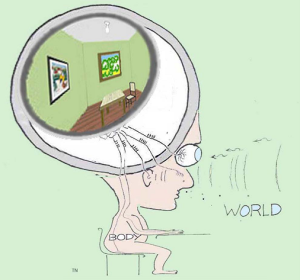 How can we be aware of something away from us? If it vibrates, awareness comes by pressure waves in air, which tickle hair cells in our ears, leading to experiencing sound. Molecules escaping from some substance drift through the air until captured by cells in our nose and are revealed as an odor. When a distant surface reflects photons, some reach light sensitive cells in our eyes and give rise to brightness.
No matter what stimulated those variously specialized receptors, what is sent to the brain is the same:
identical 40 millivolt impulses each lasting about a millisecond.
The only difference is where they arrive in the brain. Each location creates its own effects from those impulses to make you aware of what is around you.
Close your eyes for a moment. Open briefly, then close them again. A glance is enough for a picture in your head, an image of the world around you. How we are conscious of that image has greater significance in daily life and the foreseeable future than questions of quantal physics and cosmology. Our consciousness is the basis of nearly everything we know, do, and plan. Therefore, we ought to realize that it is not just a hallucination, a “ghost in the machine” of our body, or part of some universal “spirit” over which we have no control.
Consider some details of your glance above: Conveniently, the image was “out there”! It was huge! It had intense detail wherever you happened to look! Clap your hands. You see their two shapes move together exactly as you decide. As you see them meet, you simultaneously feel them touch and hear the clap. Now wave one hand up and down and follow it with your eyes. You see the hand move even though its image in your eye does not move. While the image of the room must have moved down and up, the room did not. This demonstrates there can be differences between the optical image in your eye and the visual image in your brain. 1 Place the cursor on this number, and double LCLICK – to see this endnote on page 215. It further demonstrates the difference between the optical image in your eye and the visual image in your brain. To return to the text here, place the cursor on the endnote number and double LCLICK again.
This book’s focus is on vision because the “picture-in-our-head” is the most salient aspect of consciousness. More is known about vision than any other aspect of consciousness. It is the area of inquiry most likely to lead to a break-through in discovering how consciousness works. We can trace the source of that image from its origin in photons reflected by various surfaces to an optical image in our eyes. Thence we can follow that information through various neural processes used to produce a representation of those surfaces.
We take that representation for granted. The moon is bright; the grass is green; the road goes over a hill. Examine your view of this page, your hands in front of the page, the room on each side. Everything you see is an “illusion” – a representation of the physical world beyond your eyes. The selective survival of millions of your ancestors has honed those subjective brightness, color, and shape effects to provide the most useful information possible using pictures.