
APPENDIX G – How Muscles Work
(N.B. Muscles work only by contracting. Therefore, they must be used in opponent pairs to obtain movement in both directions.)
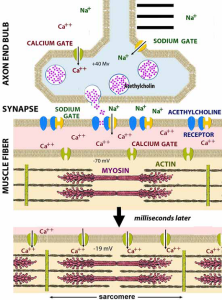
Muscles contract when nerve impulses arrive at a neuro-muscular synapse between an axon and a muscle fiber. These operate similarly to the synapses that enable neurons transmit information to other neurons. (Once nature finds a reliable solution to a problem, it gets repeated in many variations.)
As with neural-dendrite synapses, arriving impulses open sodium gates that raise the axon end bulb voltage to 40 mV. This opens calcium gates. The inflow of Ca ions releases a transmitter, acetylcholine, to muscle cell receptors across a synaptic gap.
These receptors also open sodium gates. The inflowing Na raise the muscle’s internal voltage. This voltage rise opens another set of calcium gates into an inner part of the muscle fiber, the sarcomere. There is where the actual movement occurs:
Connected to each end of a sarcomere are paired layers of tough actin filaments. Between those layers are double-ended myosin structures with molecular “fingers” at each end oriented in opposite directions. Inflowing calcium ions change the fingers’ bonding angle with the actin filaments, thereby pulling the actin filament. Burning of Adenosine triphosphate (ATP) into a diphosphate (ADP) provides the energy to release the fingers. By repetition, these actions ratchet together the actin filament pairs from each end of the sarcomere, thereby contracting the sarcomere.
Voluntary movements are produced by signals from the motor cortex to the appropriate muscles – in some cases directly along a single axon. That signal is copied to the basal ganglia and the cerebellum. As the muscles contract, feedback from stretch receptors in the muscle and pressure receptors in limb joints informs the basal ganglia and cerebellum how much movement has occurred. When that feedback matches the signal from the motor cortex, the contraction signal stops.
There you have it: the basis of every movement we (and virtually every living animal) make, from directing our eyes as we read, to speaking, breathing, throwing, running, etc.
(How our brain can move our body is only half of the “Mind-Body Problem”. The other half is how our body influences our mind. This subtler aspect is based on many mechanisms.
From our muscles there is additional sensory feedback about strain and fatigue. From the largest organ, our skin, various touch receptors convey pain and other emotional signals in addition to information about temperature, and the location and qualities of surfaces we contact. From our digestive system, numerous hormones and neurotransmitters carried by the vascular system to the brain – particularly to the hypothalamus – influence thoughts and motivations in subtler ways, many of which remain to be understood.)