
IV. STEPS TOWARDS CONSCIOUSNESS
31. THE BINDING PROBLEM:
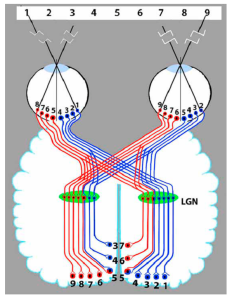
The melee of photons before our eyes holds the potential of telling us what is out there. Obtaining this information begins with a lens that sorts the photons to different locations on the retina according to the direction whence they came. This optical image is a map of our surroundings.
Differences in density and wavelength of those photons provide the details in that map. Absorption of these photon differences results in different pulse rates being mapped into the optic nerve. At the cortex, this pulse rate map is subdivided to process particular aspects of those details such as line orientation, spatial frequency, and color, while carefully preserving the direction from which they arrived in multiple maps. [1]
After that, matters get complicated.
For example, does seeing a line focused at 7, 6, 5 in the left eye and at 5, 4, 3 in the right eye as one thing require that the cortical neuronsreceiving this information be connected bysome intrinsic network in the visual cortex? Or is overlap of the ionic fields from these cortical maps sufficient? Or does it suffice that the responses in these separate cortical maps occur at the same time?
Matters would be simpler if the visual system mapped the optical image to a single network of neurons in the cortex. However, added processing extracts more information than the densities, wavelengths, and directions from which the photons arrived.
Added processing corrects for defects in the optical image, works around limits to sensitivity and acuity, corrects for transforms the information for efficient transmission and subsequent processing, other information to estimate distance, uses various principles to organize the image, and employs cognition to resolve uncertainty. This enables rapid inferences about the source of the retinal image with remarkable accuracy.
Producing visual effects, such as brightness, color, shape, and distance, involves different methods that are processed separately. Many maps seem to keep all this processing in order. How many maps? Possibly six or seven. [2] Yet, how are these maps combined to form the single continuous picture-in-our-head?
One possibility is Pribram’s Holographic Theory. It proposes that Fourier Synthesis reassembles the visual information in many spatial frequency receptive fields to produce shapes. [3] Yet the neurophysiology for this synthesis is not evident. And that is only the beginning. How are the visual effects for brightness, color, distance, size, etc., added to obtain a complete picture?
This is the Binding Problem. [4]
Neural Connections
Initial steps to solving that problem go back to the late 1800’s when Santiago Ramon y Cajal began using a neuron selective stain discovered by his contemporary, Camillo Golgi. This stain enabled tracing neural connections amongst the densely intertwined dendrites and axons because it only made some neurons visible. In the past decade, advances in these techniques have made tracing all neurons within a cortical segment possible. The enormous complexity of the revealed neural connections may have the potential to connect multiple maps anatomically. [5]
Various experiments indicate that a visual image is complete in less than 200 ms – see Ch 30 for examples. Since it takes about 80 milliseconds (ms) for visual responses to reach the cortex, that leaves scarcely 100 milliseconds to form an image. It is unclear whether that is enough time to complete connecting what probably requires a million neural interactions. [6] Two alternatives come to mind:
Electromagnetic Fields
Fields spread almost instantly, and their disregard for Pauli’s Exclusion Principle means that any number of them can be superimposed at once. [7] Interacting fields can produce complex patterns. Yet there is no evidence that the electromagnetic field emitted from a neuron reflects its unique sensitivity to a specific feature, such as spatial frequency or color – other than the location of the field’s origin.
Temporal Binding
The need to “physically” connect the activity of neurons at different locations in the cortex may reflect a cognitive limit in our thinking. [8] If distributed processing such as population coding sufficed, a picture-in-our-head could occur collectively by simultaneous processing in the various cortical maps. There is strong evidence that synchronization of neural activity in different parts of the brain is critical for consciousness perception. [9]
Whatever way the Binding Problem is solved, a more enigmatic problem remains:
How can neural activity or its electromagnetic radiations produce the shapes and qualities of a conscious picture to represent the world around you? [10]
- Note how information from the left goes to the right visual cortex in an orderly manner, and vice versa - in both eyes. This is also the case in the auditory and touch systems, but not smell and taste. This cross-over compliments the movement control system, where the left side of the brain more directly controls muscles on the right side of the body. These cross-overs have survival value. If an animal is attacked and damaged on one side it can still access information from that side and operate muscles on that side for protection. Consistent with the retinal image being upside-down, the cortical map is also upside-down. Thus, locations in the upper visual field are located below the horizontal midplane of the cortex in this figure. ↵
- Swindale NV (2000) How many maps are there in the visual cortex? Cerebral Cortex, 10, 633–643. ↵
- Pribram KH (1990) Brain and Perception. Hillsdale, N.J.: Lawrence Erlbaum Associates. Blakemore & Campbell’s discovery implies that spatial frequency analysis ought to be followed by synthesis, leading to the visual image of the world before our eyes. ↵
- Revonsuo A (1999) Binding and the phenomenal unity of consciousness. Consciousness and Cognition, 8, 173-185. ↵
- Ng B, et al (2024) Integration across biophysical scales identifies molecular and cellular correlates of person-to-person variability in human brain connectivity. Nature Neuroscience, 27, 2243-2255 {doi.org/10.1038/s42593-024-01788-z}. ↵
- Levy IN, Hasson U & Malach R (2004) One picture is worth at least a million neurons. Current Biology, 14, 996-1001 {doi 10.1016/jcub.2004.05.045}. ↵
- Miller EK, Brincat SL & Roy JE (2024) Cognition is an emergent property. Current Opinion in Behavioral Sciences, 57: 101388. ↵
- Nilsson TH (1975) Limits to understanding? Science, 189, 503-504. ↵
- Fries P (2015) Rhythms for cognition: Communication through coherence. Neuron, 88, 220-235 {1-s2.0-S0896627315008235-main.pdf}. ↵
- Chalmers DJ (1995) Facing up to the problem of consciousness. Journal of Consciousness Studies, 2(3): 200-19. ↵