
I. FROM PHOTONS TO RETINAL IMAGE
5. PHOTONS ARE REFLECTED
Our world has relatively few natural sources of visible light: e.g., sun, moon, wildfires, fireflies. We would live in darkness if most surfaces around us did not reflect photons from those sources and lamps.
Reflection is characterized by how photons leave again after encountering either of two ideal surfaces:
SPECULAR REFLECTION 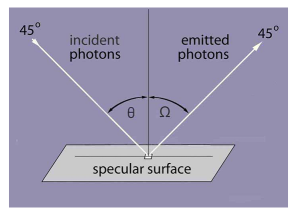
Some smooth surfaces are shiny or even mirror-like (specular). Photons leave these surfaces at an angle that equals their incident angle. They’re obeying Snell’s Law:
EMITTED ANGLE Ω
=
INCIDENT ANGLE θ
*NB – A reflected photon does not “bounce” off a surface. If it is not absorbed (Chapter 11), its field is repelled by the fields of the electrons in that surface. Equality of the incident and emitted angles arises from the conservation of momentum when the photon’s direction is reversed. [1]
When some surfaces reflect rays of photons, photons vibrating parallel to that surface tend to be reflected while the rest tend to get dragged in and absorbed or internally transmitted. Because the reflected photons all vibrate in the same orientation, these rays are said to be polarized.
This effect is most evident when the surface is specular: 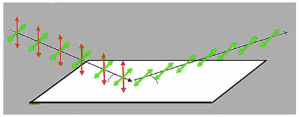
Some materials have molecular arrangements that only transmit photons vibrating at a particular orientation. Such polarized filters can provide a source of polarized light from ordinary light. Placed in polarized light, they can vary the amount of light they pass depending on their orientation.
For example:
Wearing vertically polarized sunglasses  can reduce the glare from horizontally polarized photons reflected from specular surfaces such as wet roads:
LAMBERTIAN REFLECTION
Lambertian surfaces appear uniformly dull or flat. A microscope reveals that such surfaces consist of irregular facets. Therefore, photons reflect off these surfaces in various directions, though each photon obeys Snell’s Law for specular reflection.
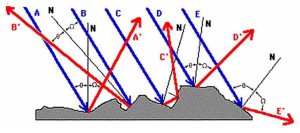
EMITTED ANGLE Ω
=
INCIDENT ANGLE θ
Though the individual photons obey Snell’s Law, the result is totally different due to the combined effects of all the facet angles:
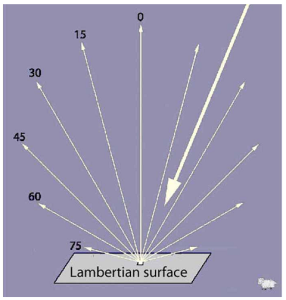
An ideal dull surface reflects photons similarly to how light sources like candles radiate them – recall Chapter 4. Regardless of their incident angle, more photons are reflected perpendicularly from the surface than at other angles. As a group they obey Lambert’s Law, regardless of the angle at which they strike the surface.
Here, the length of these reflected rays at various angles illustrate that their intensity is proportional to the cosine of the angle that they leave the surface.
Such ideal surfaces are said to be Lambertian whether radiating or reflecting light.
Most surfaces tend to be more Lambertian than specular (dull than mirror-like). This makes their retinal images more independent of where the light comes from.
As a result: Differences in the appearance of the surfaces around us are less due to the lighting and more attributable to differences in the surfaces themselves.
Which is what we usually need to know.
Here is an example of how Lambertian reflections work in our favor from a different perspective:
Despite the reduction in light reflected at various angles, dull (matte) surfaces tend to appear equally bright regardless of the angle at which you view them!
At first counterintuitive, it is logical when one considers the size of the “per unit area” doing the reflection. Viewed head-on (at 0o) that unit area appears the biggest. It decreases at larger angles to the same extent as the amount reflected decreases. Therefore, the amount of light received per apparent unit area stays the same.
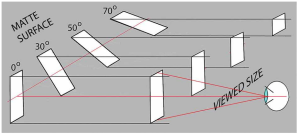 Again, this results in a similarity of the surfaces’ apparent brightness of the viewing angle. Another fortunate outcome that helps us recognize things at wherever angle we see them.
- Photons do have an equivalent mass, which is the amount of mass that their energy would produce based on: E = mc2. That mass would be their energy (E) in joules divided by the speed of light (c) squared. In specific conditions, this gives photons the property of having momentum. ↵