
II. FROM OPTICAL TO VISUAL EFFECTS
17. BRIGHTNESS IS SUBJECTIVE
Despite the above everyday examples of adaptation and contrast, it is difficult to grasp the truly subjective nature of our experience of “brightness”. There is nothing intrinsically bright about the streams of photons arriving at the eye from a particular direction.
 Photons do not “shine”. They are transparent packets of energy. In the eye, their absorption by a few to many light-sensitive molecules results in a few to many neural impulses. These transmit to the brain information that a certain photon density of light has reached a specific location in the eye.
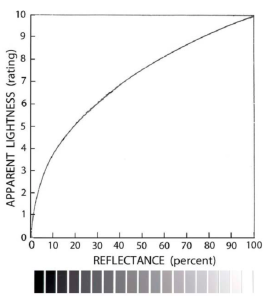
To make us aware of this information, the visual system selects an appropriate effect from an innate lightness repertoire. Since neurons can transmit only a 1 to 25 times range of impulse frequencies, it is not surprising that this repertoire has a limited range of lightness levels for us to experience. This range can be measured by matching the subjective effect to printed shades of grey from white to black: [1]
Note how lightness changes more rapidly at lower reflectance. It is more important to see subtle differences where there is less light.
The dark area that looks black still reflects as much as 5% of the light compared to what is reflected by the lightest sample. Similarly, an area with 99% reflectance looks no lighter than an area reflecting 95%. The visual system shifts this limited range of lightness effects up to operate in full sunshine or down to operate in twilight:
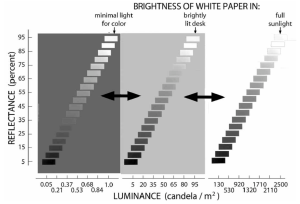 This figure illustrates that the visual system localizes the “sliding grey scale” to improve the perception of differences in light intensity as well as moving it over a wide range of light intensities:
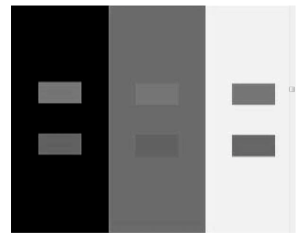 The three upper rectangles are identical and slightly lighter than the three identical lower rectangles. This difference is not evident in high contrast surrounds – the crispening effect. Covering the surrounding areas can make that more evident.
Similar effects occur in discriminating small differences in color and auditory loudness. They reveal how these systems can move a limited range of subjective effects to portray a wide range of real world physical effects.
- Figure is based on LeGrand Y (1968) Light, Colour and Vision, London, Chapman & Hall, Fig. 62. ↵