
I. FROM PHOTONS TO RETINAL IMAGE
4. PHOTONS RADIATE
Other than laser, most light sources emit photons in all directions – namely, they radiate. They tend to emit more photons straight out from their surface and fewer photons off to any side.
This radiating characteristic is true for any point in a candle flame, on a glowing wire in a light bulb, and on the surface of a light emitting diode.
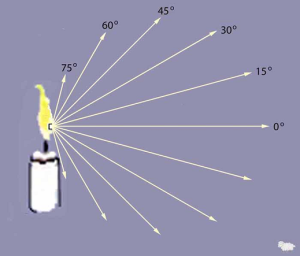 The number of photons emitted in various directions from any point on an ideal source looks like this: the line lengths here are proportional to the number of photons in the ray (its intensity) in that direction.
e.g., The 60 degree ray has half the intensity of the direct ray.
In 1760, Johann Lambert discovered that the intensity of photons emitted at any angle was proportional to the angle’s cosine. This is Lambert’s Law.
(The cosine of 60o is 0.50.)
Surfaces that emit light in this manner are therefore called “Lambertian”.
This radiation of photons from a source has severe consequences for lighting: The further the source, the weaker the radiation’s strength per unit area (illuminance):
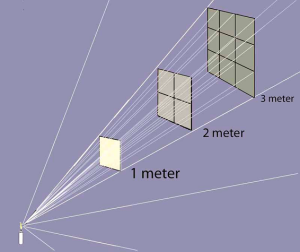 The same photons that reach a square at 1 meter, are spread over 4 squares at 2 meters, over 9 squares at 3 meters, and so forth:
Simple geometry determines that the number of photons per unit area decreases with distance squared.
At 3 times the distance, a light meter finds the illumination to be 1/9th of what it measured at 1 meter from a source.
Thus, we have the Inverse Square Law of Radiation:
The strength of any radiation decreases with distance squared.
Nothing remarkable about that. It’s just a logical result of light radiating.
Then why doesn’t a candle get dimmer as you walk away?
This question applies not only to candles or light bulbs, but also to everything else we see.
The explanation (Chapter 9) comes from physics not perception. However, that requires understanding some optics.
First, let’s consider why it applies to (almost) everything we see: