
I. FROM PHOTONS TO RETINAL IMAGE
8. PHOTONS GET REFRACTED
Refractory means “resistance” and this is what light encounters on entering a denser medium. (Recall Chapter 1?)
What happens when a photon enters a denser medium at an angle is particularly relevant to how images are formed. For the briefest moment, “drag” slows down the first portion of its wave while the remainder continues at the same speed. Partial slowing changes the photon’s direction of travel inside the new medium. [1]
Refraction is a particular term that refers to the bending of any wave that changes speed when entering a new medium at an angle other than 90o.
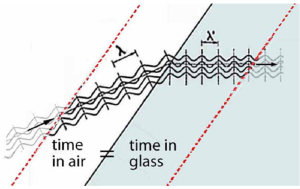
Our eye uses refraction to sort photons into an image at the back of the eye. The next few pages explain how that works:
(Or skip to Chapter 9)
Count the number of cycles during the same time in air and glass:
(Frequency remains the same because that’s determined by the photon’s energy. In glass, the distance traveled is shorter over the same time. Therefore, its wavelength, λ, is shorter.)
The following is just to show that the bending can be precisely calculated in terms of the angle at which photons arrive and refractive index. (Thus begins the technology that may lead to our civilization from an electronic to an optical era fueled by laser driven fusion.)
The bending depends on the ratio of their speeds in the two media – in this example air and glass. Yet, it is not necessary to calculate those speeds to determine the bending. The ratio of their refractive indexes (see page 9) will do. The refractive index for various materials is listed in tables from many sources, including the CRC Handbook of Chemistry and Physics.
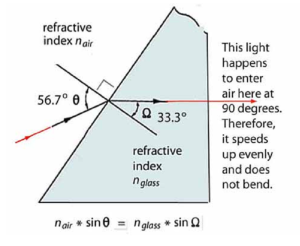
Plain trigonometry is sufficient for these calculations.
e.g. For air n = 1; for crown glass n = 1.52. In this example, if the medium on the left is air, the denser medium is crown glass, and the angle of incidence on the glass, Θ, equals 56.7 degrees:
sine of the refracted angle Ω =
(nair / nglass) x sine incident angle Θ
sine Ω = ( 1 / 1.52) x sine 56.7o
= 0.66 x 0.87 = 0.57
So the refracted angle Ω = 33.3o
These calculations are the same when photons leave a denser material. If both surfaces are parallel, the photons leave in the same direction they entered.
Recall that high-frequency photons slow more in denser media than low-frequency photons – see Ch 1 (For most substances, the refractive index, n, increases with frequency.) Consequently, when entering a higher refractive index medium, “blue” photons change direction more than “red” photons.
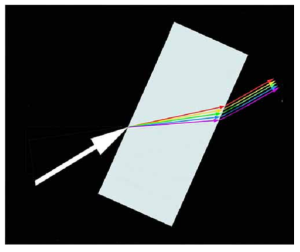 Refraction sorts photons into lightly different directions depending on their frequency:
This is why water droplets larger than 100 nm spread white light into a rainbow. And that is relevant to how we began finding out that the picture is in our head.
In the late 1700s, differential refraction of white light by a prism led Isaac Newton to realize that colors resulted from differences in light rather than from some inherent property of things. It was a significant step in recognizing the physical basis of a subjective quality.
This differential effect creates problems when refraction is used to sort light into an image. The high frequency photons get directed to slightly different positions than the low ones. Such separation of wavelengths in optical images is called chromatic aberration. The visual system corrects this in our visual image.
(N.B. Diffraction has the opposite effect on light – low frequency photons bend more than high frequency ones. In contrast, the angle at which a surface reflects photons is the same for all wavelengths and does not depend on its refractive index. This is one reason why mirror telescopes are preferred over lens telescopes.)
- In class, I demonstrate this by rolling a toy car from a hard floor onto a mat at various angles. ↵