APPENDIX C – Neurotransmitters (& Receptors)
In addition to neurotransmitter molecules, both axons and dendrites release a variety of other molecules called transmitter modulators that interact with synaptic transmission in several ways. Some modulators may bind to specific receptors without activating them and thereby block transmission. Some break down transmitters. Some aid in recycling the transmitter or its decay components. Some may make a receptor more receptive to a transmitter. Some deactivate other modulators. However, these details go beyond the role of a primer.
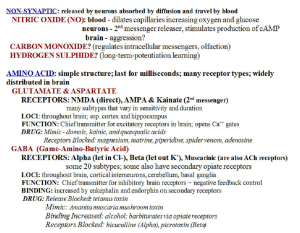
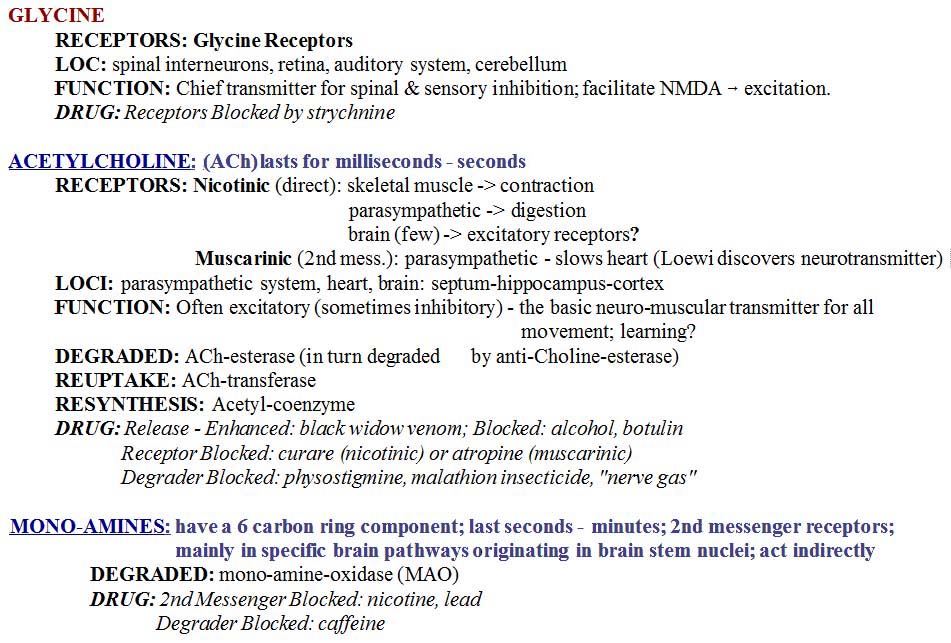
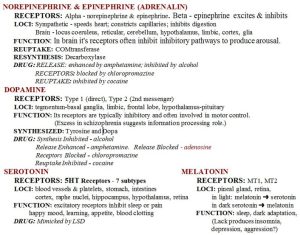
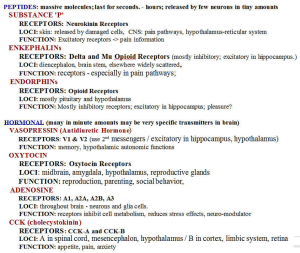
The following summarizes the various neurotransmitters and some modulators currently known. Doubtlessly more remain to be discovered. Some of these transmitters come in several varieties, but only the most common are listed. For each transmitter the table provides its principle functions, and depending on appropriateness and state of knowledge their receptors, locations, modulators, and examples of drugs that interact with the transmitter. They are listed in increasing order of chemical complexity. More complex molecules have longer half-lives in their natural decay.
However, bear in mind:
The effect of any neurotransmitter is determined by specific transmembrane protein structures, the receptors that receive it.
There are four main types of receptors: (excitatory and inhibitory) X (direct and indirect) – in all combinations.
Excitatory receptors lead to the opening of sodium (Na ) or calcium (Ca ) ion gates. The inflow of these positive ions depolarizes the -70 mV level of the dendrite, thereby causing an action potential.
Inhibitory receptors open potassium (K ) or chlorine (Cl–) ion gates. The outflow of K or inflow of Cl– ions makes the dendrite more negatively polarized, hindering it from producing an action potential.
X
Direct-acting receptors have an ion gate as part of their structure. This enables them to produce an effect quickly.
Indirect receptors release a chemical, a 2nd messenger, inside the dendrite that, through stages, can open any of the four types of ion gates. This takes longer but can continue affecting the gates after the transmitter decays.
While certain categories of receptors may predominate for a specific transmitter, always bear in mind that it is the receptor that determines the effect of a transmitter. Therefore, a particular transmitter may quickly produce inhibition in one part of the brain and also slowly produce excitation in another part. This adds considerable complexity to finding out what a transmitter does. The table identifies only major types of receptors. In many cases, there are several subtypes that differ in sensitivity or involve compound transmitter activation. There are more types of receptors than transmitters, and probably more receptors than transmitters are still to be found.