
I. FROM PHOTONS TO RETINAL IMAGE
9. HOW PHOTONS GET IMAGED
Because steeper angles of a transparent surface bend light rays more, a stack of appropriately shaped glass prisms can stop photons from continuing to radiate:
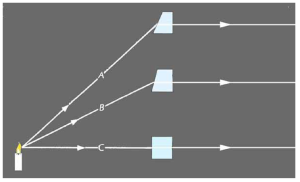
One could add more prisms with in-between angles to catch more rays radiating from the candle. However, there is a simpler solution. A continuously curved surface can do the same thing:
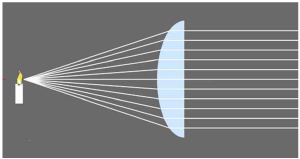 Lenses like this enable projecting rays of photons radiating from a source to a distant location without losing intensity with distance squared. Producing parallel rays of photons so they form a beam is called collimation.
A given lens curvature bends rays a certain amount. Therefore, the above lens only produces parallel rays when the candle is at a specific distance.
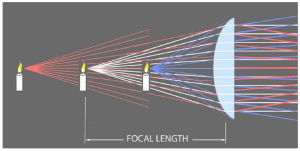
Rays from a close candle enter the lens at angles too steep to be bent parallel. They still spread out, though less.
Rays from a distant candle enter the lens at shallow angles. The same bending causes them to converge.
The lens’ focal length is the source distance at which a lens produces parallel rays.
 Now consider the reverse of the previous figure. Rays from a candle far to the left are parallel when they arrive at this lens.
For most optical applications, a distance of 3 meters from a light source is far enough for its rays to be considered parallel.
Because the rays speed up as they leave the denser medium (the glass), they get bent as much in the reverse case. Therefore, the rays from that far candle will converge to a point at a focal length behind the lens.
At that point, there is an image of the candle:
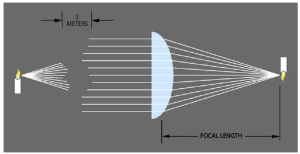
But the image is upside down, though the real candle is right side up?
To see why the image is inverted, follow the rays on the next page.
By bending the rays even more, it is possible to bring them all back together for an image of a source closer than infinity (3 meters). This can be done by curving both sides of the lens.
Three geometric rules govern where a simple lens produces an image:
1. Rays passing through the lens’ focal point emerge perpendicular to the lens.
2. Rays passing through the lens’ center continue in the same direction.
3. Rays perpendicular to the lens pass through its focal point after emerging.
All you need to know is the lens’ focal length and distance of the source.
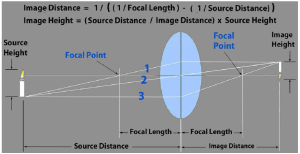 Don’t let the math interfere with understanding how images are formed.
Now For That Ch 4 Question About Brightness And Distance:
Since light intensity decreases with the square of the distance from a source, why don’t lamps get dimmer as you back away from them?
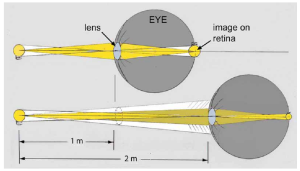 Only 1/4 as many photons reach the eye at 2 meters. However, the image extends over only 1/4 as much area. Therefore, the image is just as bright.
The same occurs at any distance for the image of any surface that radiates or reflects photons. Therefore, things appear similar and easier to recognize regardless of their distance.
Lenses are how our eyes sort the confusion of where rays come from by focusing them to produce an image where each location represents a different direction.
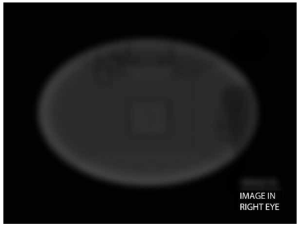 However, that image would look like this to us: were it not for another characteristic of photons.