
I. FROM PHOTONS TO RETINAL IMAGE
3. PHOTONS DIFFRACT
Till now, it has been claimed that photons vibrate. That they “diffract” (swerve) when encountering an edge is the principal evidence of their vibration. That vibration is critical for vision because it determines how they interact with matter as well as pass through it.
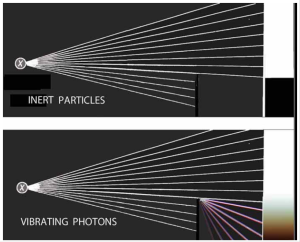
Streams of inert particles don’t swerve when they meet a barrier. They either pass or not:
Because photons vibrate, those passing too close to an edge encounter a slight e-m field drag on that side, causing them to swerve behind it. [1]
How much they swerve depends on their wave- length and phase as they encounter the edge. Look closely. Note the slight color fringe in the bent rays.
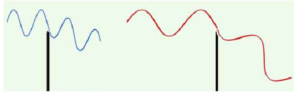 Long wavelengths (red) are more in contact with an edge than shorter (blue) ones. The greater drag on the long wavelengths causes them to bend further.
Such “bending” around an edge is characteristic of waves in general. For example, long wavelength (low frequency) sound waves bend around walls and rocks. However, sound waves bend due to spreading air or water pressure behind an edge. Photon diffraction is not produced by the medium it travels through.
Although light is bent for a different reason than the bending of sound waves, the same wave equations apply. That similar bending of light around an edge was an early clue to its wave-like nature, albeit for the wrong reason. (The trouble with equations is they only describe – they do not explain.)
In chapter 20, we begin explaining how the visual system converts differences in photon wavelength into various colors.
More compelling evidence of the wave properties of photons appears when photons of a single wavelength are directed at two adjacent slits:
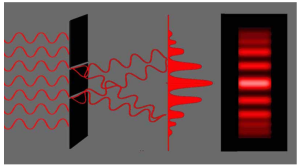
With two edges, each slit diffracts photons in both directions. At various locations, beyond the slits, photons from each slit cross paths.
Where these photons are in opposite phase, their energies cancel producing darkness. Where they are in phase, their energies sum producing extra intensity.
If photons were only tiny particles that did not vibrate, most would blast directly through the vast empty spaces between the atoms that form matter.
Unless you are dealing with a lot of edge compared to the size of a beam of photons, the diffraction effect is negligible. That is why treating streams of photons like linear rays is great for visualizing how images are formed and how photons are distributed in most lighting applications.
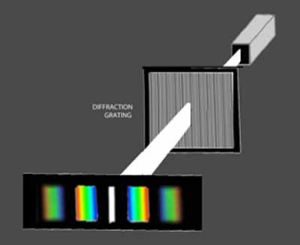
- This drag is analogous to what happens as waves approach a shore. When the depth decreases to half their wavelength, the bottom of the wave slows while the top keeps going. Thereupon, the top of the wave changes direction as it tips over. Diffraction is often explained by analogy to how water and sound waves spread after passing an edge. That spreading is due to the pressure spreading the transmitting medium in all directions after passing and edge. While wave equations describe both types, the cause is very different. It is the photons that spread at an edge, not the medium they are passing through. Light is diffracted in a vacuum as well as in air. Those color fringes are scarcely noticeable with a single edge, but the effect from hundreds of edges close together (a diffraction grating) adds up, producing vivid spectra as the longer wavelengths are bent more than the shorter ones. Similar spectral effects also appear in reflections from the fine grooves on compact audio disks, fish scales, and insect wings.
 ↵