
II. FROM OPTICAL TO VISUAL EFFECTS
15. LIGHT
Correcting photon energy in terms of brightness provides an objective means of dealing with electromagnetic radiation in terms of its visual effectiveness.
Photons of various vibration frequencies (or wavelengths) are emitted by all matter that has a temperature above absolute zero degrees Kelvin. Our visual system is sensitive only to a narrow portion of an immensely wide range of electromagnetic radiation. “Light” is that portion.
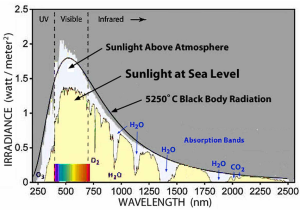 Here is the distribution of photon wavelengths in sunlight:
It approximates 5250o C black- body radiation.(This means our sun is nearly a “black body”-see preface.)
At sea level, water molecules in the air absorb radiation below 400 nm (ultraviolet) and above 750 nm (infrared). [1]
Most of the electromagnetic radiation available on Earth are photons from the sun. Several other factors listed below contribute to making 400 to 700 nm radiation the “Goldilocks” range we call light.
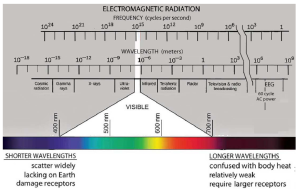 Given the abundance and usefulness of radiation in the 400 to 700 nm range, it’s only natural that receptors evolved specifically to detect radiation in this range. [2]
- Figure modified from Van Roozendael M (2016) Remote sensing of atmospheric composition. European Space Agency, https://eo4society.esa.int/wp-content/uploads/2021/05/2016_EOSS_MR1.pdf. The white envelope and yellow area represent sunlight above and below the atmosphere. In a clear sky, sunlight is slightly yellow due to more scattering of its shorter wavelengths than the longer ones. (It may also be yellowed by color contrast with blue sky - see Ch 20.) Clouds are white because the 1/100th millimeter size of their water droplets reflects all wave-lengths equally. This overrides the scattering away of the short wavelength sunlight that passes directly through the cloud cover. Therefore, the sun’s stark white appearance in a light overcast sky reveals its true color above the atmosphere. The white envelope and yellow area represent sunlight above and below the atmosphere. In a clear sky, sunlight is slightly yellow due to more scattering of its shorter wavelengths than the longer ones. (It may also be yellowed by color contrast with blue sky - see p. The white envelope and yellow area represent sunlight above and below the atmosphere. ↵
- Figure modified from: Abramov I & Gordon J (1974) Chapter 16 - Vision, in EC Carterette & MP Friedman, eds, Handbook of Perception & Performance, Vol. 3, Biology of Perceptual Systems, Fig. 1, p. 328. ↵