
I. FROM PHOTONS TO RETINAL IMAGE
10. PHOTONS ARE DISOBEDIENT
Unlike good little electrons, protons, and neutrons; photons do not obey the Pauli Exclusion Principle.
It’s a principle everyone understands: You can not put any two things in the same place at the same time.
Any two things except photons, that is. Photons are not “things”. Therefore, any number of photons can pile up on top of each other at the same time in the same place.
This is very fortunate!
In daylight, surfaces reflect thousands of photons every second in every direction. However, if only one photon at a time could enter the eye from each direction, the image would be a uniform dim grey. We would see no shapes.
Shapes are defined by differences in intensity from point to point.
Differences in the intensity of light rays are due to differences in the number of superimposed photons coming from the same direction.
The eye’s lens directs rays from different directions to different locations at the back of the eye – a region called the retina. Differences in photon density of the rays from different directions produce the differences in that retinal image:
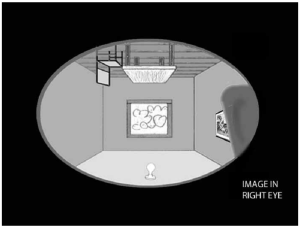
As we saw earlier, when a lens focuses light to form an image, that image is upside down.
The discovery that the image in our eye is upside-down and reversed mystified philosophers in the Middle Ages. [1]
The answer to that “little” inconsistency between the optical image in the eye and our visual image turns out to be more profound than any mystery in physics.
(It is not solved by rotating the neural connections from the eye to the brain. Here’s why: After a few days of confusion from wearing “glasses” that turn the image right side up in the eye, people find the world appears normal.)
Ahead, there is more evidence that our visual image is not constrained by neuroanatomy.
Yet before that, another property of photons is essential for us to respond to the optical image in our eye:
- To read more about this, see Crombie AC (1964) Early concepts of the senses and the mind. Scientific American, May, reprint 184. p. 37 To read more about this, see Crombie AC (1964) Early concepts of the senses and the mind. Scientific American, May, reprint 184. ↵