
APPENDIX D – Measuring Light (Photometry)
As photons are focused in our eye, differences in their density are the primary basis of the information they bring. Their density can be physically measured in terms of their total energy, joules, but that would not relate to the brightness of a steady visual image. Measuring the rate at which they arrive, joules/second or watts, is an improvement. Yet, for a focused image, the direction from which the photons arrive makes all the difference. The directional measurement of light, watts/steradian, involves a unit of measurement not widely understood.
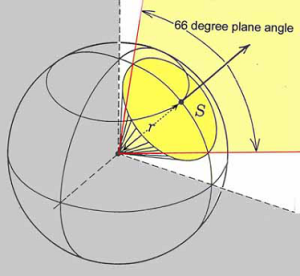
We tend to think of direction as a line, but this has no reality to contain any energy. A steradian is the physical measurement of direction – a solid angle. This unit is a cone-like volume extending in a specific direction from a point and having an open end plane, whose surface area, S, at a distance, r, from the origin equals r2: the number of steradians = S / r2
For a circular cone, 1 steradian has a plane angle of 66 degrees.
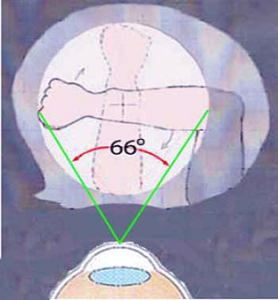
Compared to the unit for measuring angles on a plane in degrees, the steradian is large and difficult to visualize.
This may help: > Extend your arm straight out from one eye.
>Bend the forearm 90 degrees and make a fist.
>Focus on the forearm center.
> Swing the forearm in a circle as much as possible perpendicular to your line of sight. That eye’s view of the circle described by your knuckle and the inside of the elbow is about one steradian.
Photosensor responses are proportional to light energy. Therefore, their output is not representative of the visual brightness. The three types of cone receptors absorb light depending on both photon density and the resonance of a photon’s wavelength with their photopigments. (Only photons that are absorbed trigger a response.) Despite their high energy, photons whose wavelength is shorter than 400 nm are not absorbed. Some absorption begins with 400 nm photons and increases as wavelength increases to a maximum around 550 nm. With further increases in wavelength, absorption declines. See Ch 12.
To better represent our visual response, the energy sensitivity of photosensors is tailored by filters and sensing material to match our photoreceptors’ overall sensitivity as a function of wavelength. Consequently, there are two systems of light measurements:
RADIOMETRIC units that describe the energy of light are based on the joule, the standard unit of physical energy.
PHOTOMETRIC units transform radiometric energy units in terms of their effectiveness for vision based on human sensitivity to various wavelengths in daylight conditions. (Also, there are parallel measurement units based on scotopic sensitivity. They are used to measure the visual effectiveness of lighted surfaces in nighttime conditions.)
To describe how light is typically measured, we’ll focus on the units based on photopic sensitivity. In this system, the modified energy unit that corresponds to joules of energy is the lumen-second. Since brightness depends on the rate at which the light energy arrives, the units are named with respect to this rate, the lumen.
To measure the visual effectiveness of various wavelengths, the observers had to look at something. Accordingly, the standard unit of photometric measurements is the rate at which photons arrive from a specific direction, lumen/steradian or the candela. This name relates to early standards of brightness, which were a point of light in the flame of a specific type of candle. [1]
The following table illustrates how these units work:
PHOTOMETRIC UNITS
Only two photometric measurements are widely used:
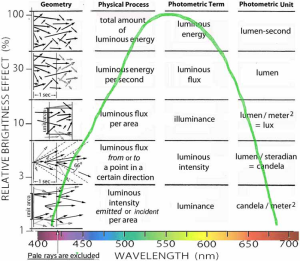
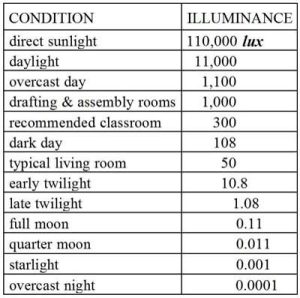
Illuminance describes lighting conditions. It is measured in lux – the rate at which luminous flux leaves (or arrives) per unit area of a surface. In applications, such as lighting design, it refers to the amount of light present. The available light determines the possible brightness of surfaces depending on their reflectance. See endnote [2] for some examples.
Luminance describes light sources. It is measured in candela / square meter – the rate at which luminous flux is emitted in a unit direction or received from a unit direction per unit area of the light source or receiving surface. Because it describes light when focused into an image, it is the physical measurement closest to describing the brightness of lamps and surfaces. Ch 16 shows the luminance of some familiar sources.
However, bear in mind that photometry is a physical measurement corrected by a standardized average of visual sensitivity to the wavelengths. Luminance can provide an objective basis for estimating brightness, but it does not measure brightness.
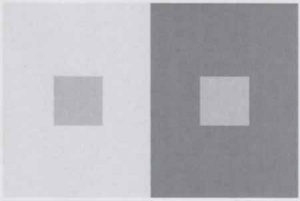
This figure is a compelling demonstration of the degree to which our visual image includes holistic processing of information that goes well beyond projecting receptor-by-receptor responses.
A photometer would tell you that the two central squares are the same luminance. It would not “lie”. On the other hand, your visual system uses Natural Intelligence (NI) to discriminate them – an advantage when matters are more ambiguous.
For more information, the International Commission on Illumination (CIE) has numerous publications on international standards for specific lighting applications, for example:
CIE S 017/E:2020 ILV: International Lighting Vocabulary, 2nd Edition
CIE S 027:2024 Photometry of road illumination devices, light-signaling devices, etc.
IEC 62471:2006/CIE S 009:2002 Photobiological safety of lamps and lamp systems
ISO/CIE 20086:2019(E) Light and Lighting — Energy Performance of Lighting in Buildings
Nilsson TH (2009) Photometric specification of images. Journal of Modern Optics 56, 1523-1535.
Zalewski EF (2010) Radiometry and Photometry. in the Optical Society of America’s Handbook of Optics, Vol. 2, 34.3-34.47.
- The oldest measurement system still in use is the stellar magnitude scale created by Hipparchus in 127 BC to describe the brightness of stars. It is still accurate because its standard, the brightness of specific stars, has not changed for over two thousand years. Working with stars became awkward as the need arose to measure light for research and forapplications in industry and lighting. In the 1700s, candles were used as brightness standards. To measure an unknown source, its brightness was compared to a standard candle. The source and the standard were matched by changing their distances from a screen and/or adding darkening filters. The resulting ratio indicated the relative brightness of the source in terms of the standard. Over the years, the content of standard candle was more specifically defined. The flames of other sources were also considered. In 1948, the candle unit was replaced by a unit of nearly the same brightness, the candela. It was the luminous flux in one steradian emitted by a tiny black body at 2042°C. In 1979, this point source was replaced by a standard radiometer. When light is filtered across wavelength to match the CIE photopic sensitivity function, 1.5*10-3 watts indicates 1 candela of luminous intensity. ↵
- Here are examples of typical and recommended illuminances present in various outdoor and indoor conditions:
 ↵