
APPENDIX B – A Little Atomic Physics
How photons affect matter depends mainly on how the atom’s outer electrons orbit its nucleus. The negative charge of electrons strongly attracts them to the positive electric field of the protons in nuclei. They would collapse into the nucleus if they did not vibrate. All particles vibrate at wavelengths proportional to their mass and speed – DeBroglie waves. Electrons form standing waves around nuclei only at distances where their orbital circumference equals a multiple of their wavelength.
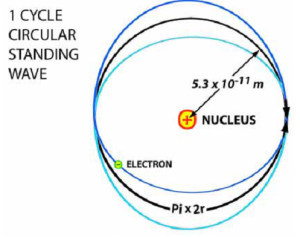
The closest an electron can come to a nucleus is a distance where the orbital circumference equals its wavelength:
An electron’s DeBroglie wavelength
= Planck’s constant / mass x velocity
= 6.6 x 10⁻³⁴ / (9.1×10-31 x 2.1×106)
= 3.3 x 10⁻¹⁰ meters
At a distance of 5.3 x 10⁻¹¹ m, the electrostatic attraction equals the centrifugal acceleration of the electron. It is not a mere coincidence that the circumference (2 Pi x 5.3 x 10–11 ) of an orbit at this distance equals an electron’s DeBroglie wavelength.
 A circular standing wave unrolled:
The circular wave model works fine for the hydrogen atom with its single electron and proton. It describes why only photons of specific wavelengths are absorbed, causing molecular changes. Many orbits are possible as long as their circumferences equal a whole number of electron wavelengths. These become stable as standing waves.
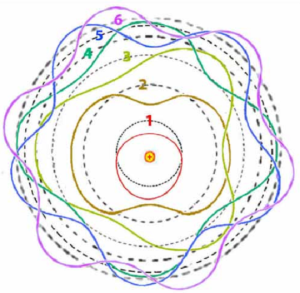
This depicts the 1- to 6-cycle standing wave orbits for a hydrogen atom:
Two-dimensional standing waves were discovered by Chladni in 1789 as vibrations in metal plates (Chladni patterns). In the Caribbean, Chladni patterns are hammered into steel drum heads to make them resonate at various sound frequencies.
In 3-dimensional space, valence electron “orbits” are waves in spherical shells. As they become increasingly complex, the orbits must meet the standing wave rule of complete cycles to be stable. Standing waves can be described with similar mathematical functions, whether they are orbits of electrons, vibrations of plates, or oscillations of molecules in solid materials, liquids, or gases.
If a photon has enough energy, its absorption may add enough waves that the electron’s orbit is so large that it extends beyond the nucleus’ attraction. The freed electron leaves the atom with a net positive charge, making it ionized. Ionization alters how the atom is attached to a molecule, which changes the molecule’s shape. The consequences for protein molecules are generally damaging. Photons with frequencies above 1016 Hz (strong ultraviolet, gamma, and X rays) are called ionizing radiation. (See the figure in Ch 13.) Focused in the eye, such radiation in sunlight quickly destroys delicate receptors and neurons.