
II. FROM OPTICAL TO VISUAL EFFECTS
19. DISTINGUISHING THEIR WAVELENGTH
(The Picture Gets Complicated)
Images are not just about differences in the brightness of surfaces surrounding you. Being able also distinguish the wavelength of those reflected photons can provide lots of “added value”. Recall that which wavelengths get absorbed or emitted by a substance depends on its molecular structure (p. 44). Distinguishing those wavelengths can reveal what a surface is made of, whether it be stuff in a test tube, fruit hanging from the next tree, or a distant star – spectroscopy.
For this reason, even primitive visual systems evolved receptors with photo-pigments sensitive to specific wave-lengths. Furthermore, distinguishing surfaces by their reflected wavelengths also helps determine their shape.
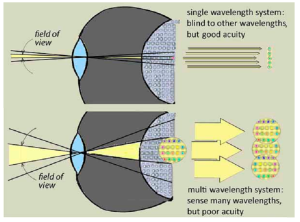
UPPER: Single pigment systems sensitive to the wavelength reflected by an animal’s food would be efficient, but would need to evolve new pigments to find new foods if conditions change.
LOWER: Systems with many receptors, each with a different wavelength pigment, could detect various foods when conditions change. However, responding to any of these wave-lengths from a particular direction would require the receptors to operate as a cluster for that direction. Within these clusters, differences in direction would be indistinguishable. They would have poor acuity.
An alternative approach uses photoreceptors thatrespond to a wide range of wavelengths. These systems use information processing to distinguish wavelengths.
Receptors with molecules that react to a wide range of wavelengths can take advantage of more available light at any point in an image. Reacting optimally to a specific wavelength and less to others provides a limited ability to distinguish wavelengths. But not much. Here’s why:
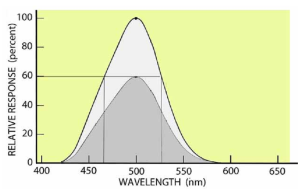
In lots of light, this receptor’s response is strongest to its optimal 500 nm wavelength and weaker to longer and shorter wavelengths (e.g., a 60% response to 465 and 535 nm). However, 465 and 535 nm would be indistinguishable.
Furthermore, the response to these wavelengths would be the same as the response to less light (60%) at 500 nm -gray distribution.
A system with one type of wide range receptor could not distinguish differences in light intensity from differences in wavelength
Adding a second wide-range receptor maximally sensitive to different yet overlapping range of wavelengths makes it possible to distinguish individual wavelengths to which they both respond: This called population encoding.
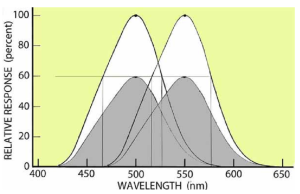
The ratio of their responses indicates wavelength regardless of the amount of light. The more precise those calculations, the finer the distinction, and the more brain needed.
For even better wavelength discrimination over a wide range, many vertebrates (from fish to birds) and invertebrates have three or more such receptors.
However, most mammals have only two receptors for daytime conditions. Why is another story. [1]
For example, dogs have one receptor whose spectral sensitivity is close to the one on the right in the above model. The other receptor peaks at about 430 nm. The middle picture at the beginning of Ch 21 shows what dogs see.
Us, old-world primates, and squirrels are unique among mammals in having three types of broad-spectrum daylight receptors. (There was increased survival value in recognizing food in distant trees as savannahs developed in eastern Africa. Thereby, our ancestors could avoid unprofitable ground forays where they were vulnerable.)
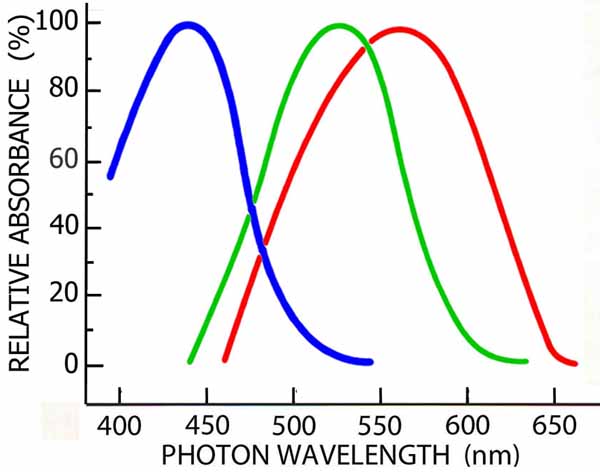
Based on the range of wavelengths they absorb, these receptors are called SHORT, MIDDLE, and LONG wavelength cones. (Yes, they are cone-shaped cells – see Ch 12.)
This graph shows how the absorption of photons varies as a function of wavelength for the three types of cones: [2]
- Based on Jerison HJ (1991) Brain Size and the Evolution of Mind. American Museum of Natural History, New York: As the story goes, mammals developed warm bodies (homeothermic) to compete against cold-bodied reptiles when the Earth’s temperature declined about 250 million years ago. However, shortly thereafter, the climate warmed again. This left mammals with unnecessarily complex bodies that were slower to adapt than reptiles. As dinosaurs evolved, mammals continued to lose in competing for territory. Finally, mammals survived by dwelling in burrows. Underground, vision was useless for finding food and mates. Therefore, they expanded information processing for smell, sound, touch, and memory by adding networks in the neocortex. (See the brain diagram in Appendix A.) With the demise of dinosaurs, mammals returned to the surface. Vision became valuable again, but ithad to be redeveloped after disuse for 150 million years. Because it was added last, vision is at the back of the cortex, furthest from the eyes. Yet, emerging from this bottleneck, mammals were confronted with a problem that otherwise would never have occurred. Vision added to enhanced smell, hearing, and touch resulted in information overflow. To cope with the confusion, mammals developed a new stage of super=efficient information processing - consciousness.More recently, this approach is reflected in the Integrated Information Theory of consciousness: Tononi G. (2008) Consciousness as integrated information: A provisional manifesto. The Biological Bulletin, 215, 216-242. For the story behind how we acquired trichromatic vision see: Bowmaker JK (1998) Evolution of colour vision in vertebrates. Eye, 12, 541-547. ↵
- The Short, Middle, and Long wavelength absorption functions are based on Brown PK &Wald G (1964) Visual pigments in single rods and cones of the human retina, Science, 144, 45-52. For nearly 100 years, various experiments had sought to determine how many types of receptors were the basis of color vision. This was difficult because cones are tiny with broad and overlapping wavelength sensitivities. Finally, Brown & Wald succeeded in focusing a photometer on single cone receptors and measuring how much light they absorbed as wavelength changed. The results were similar to what had been estimated from perception experiments. ↵