
II. FROM OPTICAL TO VISUAL EFFECTS
18. PHOTONS DON’T LAST:
But Brightness Does
Have you ever whirled a campfire stick or flashlight in a circle at night? The arc of light from the glowing end persists even when the light has moved on. This effect opens the door to three fundamental properties of the picture-in-our-head and consciousness:
1. What we see, hear, and feel seems to happen immediately. No wonder sensation was believed to be instantaneous. However, in 1850, Herman Helmholtz measured the time it took for nerves to conduct stimuli like touch, sound, and light. The speed was surprisingly slow, only 2 to 80 meters per second – much slower than the 330 m/s speed of sound, which had been known for over a hundred years. Effects that take time to happen aren’t magic. This indicated that perception is a physical process. Therefore, it ought to be possible to study how it works as well as how it is built.
2. Moreover, this also means that what we experience as now happened at least 1/5th of a second ago. This indicates that our experiences are distinct from world events.
3. The axon fibers of the optic nerve vary in size and thus in conduction speed. This means that the responses to a 1-millisecond flash get spread over some 120 ms by the time they arrive at the cortex. As a result, a 1-ms flash seems to last about 60 ms. This temporal spreading limits how rapidly we can see change. It also suggests there is a duration to what we call “now”. [1]
While brightness varies with the density of photons in the retinal image, it also depends on how long those photons keep arriving. Picture walking into a dark room. If you could turn on the light for just 1 millisecond, the room would hardly brighten before it gets dark again. Turn it on for 10 ms, and for a moment, the room looks 3 times as bright. Turn it on for 100 ms, and briefly it’s brighter still. Yet left on, the room does not continue getting brighter. Whether lit by a 15 or 100 watt bulb, the room almost immediately becomes either dim or bright.
How does the visual system know the bulb’s wattage?
Measurements of brightness over time reveal more about the visual processing that creates a visual image.
Matching a steady light to the brightness of a flash, reveals that the flash gets steadily brighter as its duration increases. Still at some critical duration that stops, and further increases do not increase its brightness.
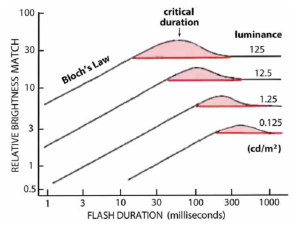
That critical duration is shorter for higher luminance (brightness) light. Furthermore, at the critical duration, there is an over-shoot in its brightness. Yes, the flashlooks brighter than when it is left on.
That overshot is a clue to answering how the visual system “knows” when to stop. The effect is characteristic of systems that use negative feedback to control their operation. Overshoot occurs when there is a delay between a system’s response and the signal monitoring the strength of its response. The monitoring signal (feedback) tells the system when to stop increasing its output (that’s the “negative” part) to obtain a specific effect.
Your body uses negative feedback to precisely regulate everything from temperature to blood sugar.
In this case, the brightness effect to be reached is determined by the rate at which the brightness increases. Brighter lights increase more rapidly in brightness. (Note brightness and time are scaled logarithmically). This rate controls the duration over which the system summates the nerve impulses to set brightness. [2]
- Evolution has a knack for making assets out of potential liabilities - in this case, the inability to produce millions of axons that conduct at the same rate for precise timing of information flow. The spreading of sensory information over time can be adaptive by helping to synchronize information (binding) from different senses and brain areas by providing overlap when these sources have different response times and transmission delays. While “God invented time so everything would not happen at once”, He then had to invent consciousness so things that happened at once could be seen together. ↵
- The figure is based on Mansfield RJW (1973) Brightness function: Effect of area and duration. Journal of the Optical Society of America, 63, 913-920. For the first 100 milliseconds, the brightness of a flash is proportional to the product of its duration and luminance, i.e., the total number of photons of the same wavelength - Bloch’s Law. Thus a dim flash lasting 100 ms has the same brightness as ten 10 ms flashes at 10 times that luminance or as a single 1 ms flash at 100 times that luminance. In all three cases, those photons are absorbed by the same number of pigment molecules in the retinal photoreceptors. After that matters get interesting. Negative feedback regulates a system by comparing its output with the level that is needed. The comparison is done by adding a negative value of its current output to the value needed. If that sum is positive, the system increases its output. If the sum is negative, the system decreases its output. Together, the result is a dynamic balance at exactly the level needed. Such systems do not require precise mechanisms. Brightness information in the retinal image is sensed by ganglion cells connected to many photoreceptors, which makes them extra sensitive, though poor in acuity. This requires them to be extra large, and accordingly, they have extra large axons. These axons conduct impulses more rapidly than the small axons of small ganglion cells connected to only a few receptors. This enables controlling brightness summation before much of the detailed image information arrives at the cortex. Clever! Critical durations over which the visual system summates light, together with the implications of temporal spreading for what we perceive as “now” have led to suggestions that the picture-in-our-head might consist of a series of “moments” (possibly overlapping) similar to how a rapid series of optical images produces movies. For a review see: White PA (2018) Is conscious perception a series of discrete temporal frames? Consciousness and Cognition, 60, 98-126 {https://doi.org/10.1016/j.concog.2018.02.012} ↵