
I. FROM PHOTONS TO RETINAL IMAGE
11. PHOTONS CATALYZE
More important than enabling the formation of optical images is the ability of photons to initiate chemical reactions. Otherwise, there would be no visual response to images in our eyes, nor life on earth. A photon interacts with matter when it is absorbed by an outer valence electron of an atom. (See Appendix B – A Little Atomic Physics.) Whether that happens depends on the photon’s wavelength.
Electrons vibrate as they orbit their nucleus. An electron can absorb a photon’s energy by increasing the number of standing waves in its orbit. The larger orbit forces the electron further from the nucleus, which increases its potential energy – energy provided by the photon.
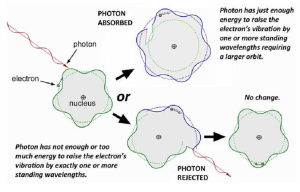 However, the photon’s energy must be the right amount (as determined by its frequency) to increase the electron’s energy so that the new orbit’s circumference adds precisely one or more whole cycles of its de Broglie wavelength.
If the photon does not have enough energy or a bit too much energy, the new orbit is either not large enough or is too large for a standing wave. The electron then rejects that photon and drops back to its stable orbit.
A valence electron’s orbit change tends to alter that atom’s position in a molecule. Such restructuring can trigger a chain of chemical reactions. This happens when a photon is absorbed by photo-pigment molecules in the photoreceptor cells of the eye.
In larger atoms with more electrons, the Pauli Exclusion Principle limits how many electrons can share an orbit as orbit size increases. Repulsion between several electrons in different orbits further complicates matters, extending the resonance patterns into 3-dimensional cloud-like orbits. The math gets complicated, but the basic principles still describe which photon wavelengths are absorbed.
Atomic absorption of photons has various consequences, ranging from slightly heating the substance to catalyzing changes in molecular structure. Depending on wavelength and substance, such changes include:
* photosynthesis – photons trigger this chain reaction, which oxygenates the earth’s atmosphere while simultaneously producing the ultimate food source (carbohydrates) for most life forms.
* odorant release – thereby influencing behavior
* germicidal sterilization – including potential for non-chemical destruction of airborne viruses. [1]
* chromosome mutation – Though most mutations are harmful, light plays a significant role in evolution.
* photoisomerization – You are currently experiencing the consequences of this effect:
Photons within a narrow range of the electromagnetic spectrum can be absorbed by specific molecules (photopigments) in the retina’s receptor cells.
The change in molecular shape triggers a chain reaction that disrupts the receptor’s release of glutamate – a neurotransmitter. In turn, the glutamate changes the rate at which adjacent neurons emit nerve impulses.
- Listen to David Brenner’s TED Talk: 11 August 2020, Can light stop the corona virus? Then read Buonanno M, Welch D, Shuryak I & Brenner DJ (2020) Far-UVC light (222 nm) efficiently and safely inactivates airborne human viruses. Nature,10:10285 {doi.org/10.1038/d41598-020-67211-2}. ↵