
I. FROM PHOTONS TO RETINAL IMAGE
6. PHOTONS GET SCATTERED
If photons encounter particles whose size is similar or smaller than their 400 – 700 nm wavelengths, they can get reflected off to either side depending on their vibration phase at the encounter. If the particles are less than 10 nanometers, the photons scatter randomly (Rayleigh scattering) – some photons may even barrel on through. The chance of such encounters increases with photon vibration frequency because more vibrations are more likely to sweep them into such particles. In contrast, lower-frequency photons are more likely to slip past. That is why more short-wavelength (high frequency, blue) photons get scattered than longer (low frequency, red) ones.
Were it not for this scatter, the sky would look black everywhere on a clear day except when you looked directly at the sun. (DON’T EVER.) Clusters of water molecules from 0.3 to 10 nm suspended in the atmosphere are the right size to scatter photons. Therefore, rays of sunlight that originally were headed elsewhere have some of their photons scattered in your direction. Since more short-wavelength photons are scattered, they predominate. Their blue sensory effect is attributed to the sky in the direction from which they arrived.
For the same reason, the sun looks yellowish because some of its rays headed toward you, especially the shorter wavelength ones, get scattered in other directions. [1]
The water droplets that make up clouds are several orders of magnitude larger. Therefore, clouds are Lambertian. They reflect all wavelengths equally, and appear white. A continuous range of particle sizes, from single atoms of water to raindrops, provide a range of color effects depending on weather conditions.
Scattered photons can result in collateral color distortion, which gives them away. For example, take those distant mountains’ purple majesty. Of course, up close, they don’t look purple at all.
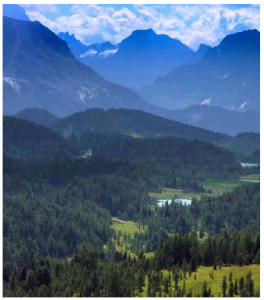 What happens is this:
Traveling from afar, those mountain photons are joined by other photons scattered by water molecules in the air. Because more short wavelengths (blue) get scattered, more short wavelength photons than long ones get added along the way to those coming from the mountain. Given enough distance, these added “hitchhikers” predominate.
Note also the reduced contrast from all those extra photons that did not originate from those distant locations.
The haze is a combination of these two effects.
Such scattering also occurs in our eyes as photons pass through the eye’s structures and fluids. Later we’ll look at how visual processing reduces these optical defects (Chapter 24).
- Sunlight appears even more yellowish when dust from combustion or sand storms adds more particles that scatter more short wavelength photons. ↵