
I. FROM PHOTONS TO RETINAL IMAGE
2. THE SPEED OF LIGHT ISN’T CONSTANT
But everybody (including Einstein) says the speed of light is constant?
(It is constant, whether you are traveling towards or away from the light source during the measurement.) [1]
However, the speed of light does depend on what it travels through.
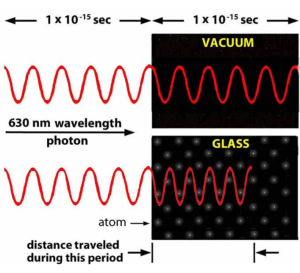 That is very fortunate. Otherwise, there would be no image of the world in our eyes. Later you’ll see why.
When photons pass an atom, the photons’ electromagnetic (e-m) fields are attracted and repelled by the e-m fields of the atom’s electrons and protons. This slows down the photons.
I’ll call this effect “drag”. Photons encounter more drag as they enter denser media due to the greater overlap of its atoms’ e-m fields.
(Even though the densest matter is mostly empty space, light wavelengths are a thousand times greater than the size of a single atom.)
A photon’s vibration frequency does not change as it passes through media that differ in density. Energy determines a photon’s vibration frequency. Though photons slow down on entering denser media, energy is conserved. (Note that the equal number of vibrations during the same time period in the previous upper and lower figures.) Nor do photons gain energy when they speed up as they enter less dense media.
Energy is conserved wherever photons travel.
A photon’s wavelength, however, does change with speed – decreasing as it slows down and increasing as it speeds up.
These changes in the speed of light are the basis of how we can control it. Simple arithmetic is sufficient to calculate their change in speed:
The amount of drag on the photons can be described in terms of the ratio of their speed in vacuum to their speed in any medium. This characteristic ratio is called the medium’s refractive index (n):
n = c (the speed of light in a vacuum – 3 X 10⁸ m/s) / its speed in a specific medium
For example: Photons in glass (n = 1.5) slow down to:
speed = (3 X 10⁸ m/s) / 1.5 = 2 x 10⁸ m/s
The previous figure shows that a photon travels only 2/3 of the distance in glass compared to the distance it travels through a vacuum over the same time.
In a vacuum, all photons, regardless of frequency or wavelength, travel at the same speed.
However, when not traveling through a vacuum, a photon’s speed also depends on its vibration frequency.
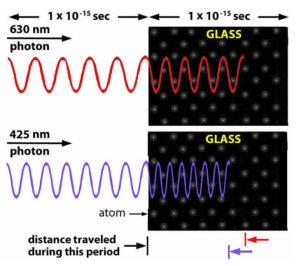 Photons that vibrate faster pass close to more atoms per second. Therefore, there is more drag on short-wavelength photons, and they do not get as far in a given length of time:
That is why a medium’s refractive index increases with photon vibration frequency.
Note again that the number of vibrations is the same over the 1 x 10-15 seconds in both figures. It is wave-length and distance traveled that changes.
- This is contrary to logic when one thinks about the speed of things. For example, the measured speed of a ball thrown at you, is different if the pitcher is standing or running towards you. Waves are different. If the pitcher was also blowing a whistle, you would measure the speed of its sound as the same. (Though the whistle’s pitch would be slightly higher when the pitcher runs toward you.) Constancy of the speed of light is proven by measuring its speed from a distant star. The Earth’s orbital speed is 3 X 10⁴ meters/second. Whether we are approaching or receding from the star in our orbital position, the measured speed of its light is the same. Its wavelength, however, will shorten or lengthen. That’s the basis of the “red-shift” which indicates the speed at which distant galaxies are receding from us. ↵