
I. FROM PHOTONS TO RETINAL IMAGE
1. WHAT PHOTONS ARE
Let’s start with light. Everybody ”knows” what light is. After all, we can see it – or think we can. Actually, we don’t see light. We only see the surfaces that reflect or emit light. Whatever. Light is a stream of photons, but only those photons within a narrow, visible part of a nearly infinite range of electromagnetic radiation.
Physicists count photons, measure their energy, but don’t agree on what photons are! Don’t let that discourage you. Here is how I’ll deal with photons as they relate to vision:
As many readers know, photons have a dual personality.[1] On one hand, photons are massless particles that speed along in straight lines called rays.[2] From this perspective, basic geometry is enough to see how rays can form images. On the other hand, photons are waves of energy describable by Maxwell’s equations. Don’t worry, calculus is not needed here, but their waviness can’t be ignored. Waves explain how light interacts with matter – interactions that make images possible and enable those images to be seen.
For teaching, I use a graphic compromise between the particle and wave perspectives. Photons are treated as quantal packets of energy that vibrate transversely to their direction of travel. Taking the average of their vibrations as location enables treating them as rays, while their vibration determines the probability of where they go when interacting with matter.
To explain how they interact with matter, I use the outdated (?) Rutherford-Bohr planetary model of the atom. This may cause apoplexy amongst some physicists. Yet, as physicist Paul Dirac points out, “All the same the mathematics is only a tool, and one should learn to hold physical ideas in mind without reference to the mathematical form.” [3] Until someone finds a better pictorial analogy, photons as: traveling packets of vibrating energy will have to do.
Electromagnetic radiation is emitted by all matter above absolute zero (0o Kelvin or -273o Celsius). It is streams of energy bundles – photons.
A photon’s energy depends on its frequency of vibration:
Energy = frequency x Planck’s constant
Planck’s constant is 6.626 x 10⁻³⁴ joule-second. It is the smallest amount of power possible. Therefore, photons only come in discrete (quantal) steps.
Multiplying their frequency in vibrations per second (Hz) by Planck’s joule-seconds, cancels the seconds, leaving Energy as joules – the unit of measurement for pure energy.
This equation shows that:
HIGHER FREQUENCY PHOTONS HAVE MORE ENERGY
The few equations in this are included to show how things are related or to show how it is possible to calculate certain effects.
(Appendix I – A Little Statistics was added to explain how we can find specific visual responses amongst the extremely complex patterns of brain activity. It just uses counting and arithmetic.)
Ever watch iron turning dark red and then become yellow as a smith heats it over a furnace? As matter heats up, it radiates more photons.
It takes more energy for matter to release 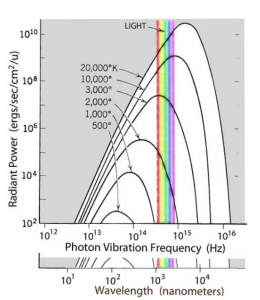 the higher-frequency photons.
These degrees Kelvin plots show that more high frequency photons are emitted at higher temperatures: To picture the relationship between energy, frequency, and wavelength, consider this: It takes more effort to shake a rope, a carpet runner or bed sheet faster, thereby increasing the number waves along its length. For ideal matter, the relationship between temperature and energy of the emitted photons is called the Blackbody Radiation Law.
Real matter deviates from this ideal, but it’s a good place to start.
For example, at room temperature, a square meter of ordinary things (stairs, spoons, etc.) emits about one photon of visible light every 42 seconds (Wikipedia). We need about 30 photons/sec to see something. [4]
That’s why we need lamps at night to see things – even if we turn up the thermostat.
A photon’s energy consists of electric and magnetic fields that rhythmically increase and decrease in strength along planes perpendicular to the photon’s direction of travel. The electric field and magnetic field planes are perpendicular to each other. The strength of these fields varies with distance from the photon’s path, resulting in sinusoidal envelopes or waves as the photon travels.
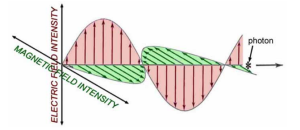 The varying electric field induces a corresponding varying magnetic field. Likewise, the varying magnetic field induces a varying electric field. (It’s a “mutual admiration society” that keeps the universe balanced and makes much modern technology possible.)
Because these energy vibrations are so fast, at most time scales, photons can be regarded in terms of their average position as traveling in straight lines – rays.
Attending to the electric field wave is sufficient for most lighting, chemistry, and vision work. To simplify matters, the magnetic component will not be discussed further. Phew!
In a ray of photons emitted by most sources, such as the sun or the heated wire in a light bulb, any particular photon’s electrical field vibrates in a randomly oriented plane perpendicular to its direction of travel.
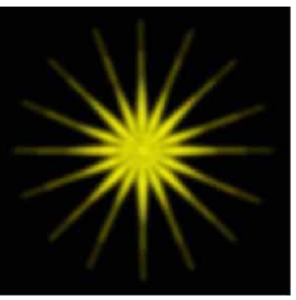
A head-on view of the vibrations of many photons in a ray looks like this, plus more at the in-between angles:
Ideally, their vibration fields extend indefinitely, but become vanishingly weak beyond a few microns. [5]
Certain materials and surfaces tend to transmit or reflect only those photons vibrating in a plane parallel to their surface. The resulting rays are called polarized. (More later in Ch 5.)
Photons travel 300,000,000 meters per second in a vacuum (or air for most purposes).
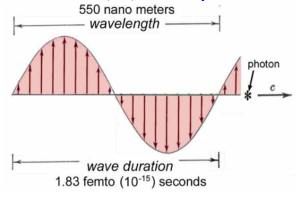 This speed is called “c”.
The distance a photon has traveled during one complete vibration cycle is called its “wavelength”. Therefore, a photon’s wavelength depends on its speed:
WAVELENGTH =SPEED / FREQUENCY
In the visible range of electro-magnetic radiation, photons vibrate at 750 to 430 trillion cycles per second or terahertz (THz = 1012 Hz). This results in wave- lengths from 400 to 700 nanometers (nm = 10-9 meters) in a vacuum or air.
Of these two metrics, wavelength seems easier to comprehend than frequency. Therefore, most vision-related applications refer to photon wavelength. To simplify matters, so shall this book – for the most part.
- For further discussion, see Li J-K, Sun K, Wang Y, et al (2023) Experimental demonstration of separating the wave-particle duality of a single photon with the quantum Cheshire cat. Light: Science & Applications, 12 {https://doi.org/10.1038/s41377-022-01063-5} ↵
- Photons do have an equivalent mass, which is the amount of mass that their energy would produce based on: E = mc2. That mass would be their energy (E) in joules divided by the speed of light (c) squared. In specific conditions, this gives photons the property of having momentum. ↵
- Dirac P (1930) The Principles of Quantum Mechanics, Oxford, UK: Clarendon Press, Preface. ↵
- Holmes R (2016) Seeing single photons. Physics World, 29, (12) 28-31 {https://research.physics.illinois.edu/QI/Photonics/pdf/PWDec16Holmes.pdf}. ↵
- For the precise shape of a single photon: Yuen B & Demetriadou A (2024) Exact quantum electro-dynamics of radiative photonic environments. Physics Review Letters, 133, {http://arxiv.org/abs/2406.10164}. Their figure can be seen at: {https://scitechdaily.com/quantum-leap-scientists-reveal-the-shape-of-a-single-photon-for-the-first-time}. ↵