
Main Body
Chapter 3: Unlocking Your Inquiry Superpowers
Tessa Rooseboom; Stacey MacKinnon; and Patience Smith
Time Management
Beginning a new program can be challenging, and knowing how to use your time efficiently is a common struggle for many. Because of the busy lifestyle that comes with being a student, we must learn to have a good school-life balance. During the transition to university, it can be easy to pour all our energy into one specific aspect of our lives, whether that be studying, working, or partying. While all of these are significant aspects of university life, we also need to know how to manage our time effectively and efficiently so each gets the attention it deserves. Focusing on one aspect of our life so drastically over another can cause both diminished academic achievement and burnout, thereby making the balancing act of time management all the more important.
While I’m sure rudimentary to some, there are several strategies I have used over my time as an undergraduate student to ensure I am making the most of the time I have. Beyond completing assignments, this also includes ensuring I take the time to enjoy all the other experiences university provides.
- Planner/To-Do List. Something I am certain you have been told to use a million times is a planner or to-do list. Although a very simple tool, that can mean it often is neglected for its value. I have had a physical planner the entirety of my degree, and it has been a lifesaver for remembering all I need to get done in a day, especially later in the semester when life gets crazy with exams. Your planner can be digital, physical, or something as simple as a note on your phone. Basically anything where you are able to write down what needs to be done for the day so you can easily remember your priorities. However you choose to organize this is up to you. You can have strict times for each activity. A list ordered by priority or most enjoyable task. Whatever works best for you is what you should do, even if that means a simple mental note that something needs to get done (although I wouldn’t recommend that, even if you have perfect memory!). A planner or to-do list is more about ensuring you know what is necessary for your day than the product you create.
- Assignment tracker. This is the type of tool that may take more time initially but could save you hours in the long run. Creating a list of all my assignments for each class at the beginning of a semester has been one of the best tools I have used over my degree. When you start classes, the amount of work can feel overwhelming, and having it all spread across five different 7-page documents likely isn’t helping. That is why, instead of having to sort through your syllabus pile every time you need to know a due date or relying on your professor to remind you (they often don’t), having everything in one place can minimize the amount of effort to figure out what needs to be done. I like to use a spreadsheet to sort all my due dates in chronological order, but you could also use calendar apps like Notion, your planner, or even a notebook. It is important to remember that a tool is only useful if you use it, meaning whatever format you are most likely to stick with is the best choice.
- Digital calendar. A digital (or physical) calendar is a helpful way to ensure you are able to keep track of all the important dates and events of the semester. This is especially helpful for future events like reading week and days off. Where you are able to see your whole month at the same time, making it easier to plan around unmovable deadlines and determine when you are most busy.
- Scheduled breaks and sleep. University is a lot of work, especially when you consider added responsibilities like work and volunteering. It can be easy to get overwhelmed by all that is going on, and as your semester gets busier, your free time and sleep can feel like they are shrinking. It is important to take advantage of all the experiences university has to offer, like research, clubs, meeting new people, and most especially your academics. However, in doing this, it is also valuable to prioritize taking time to reset and recover, so you don’t get burnt out. This is when scheduling breaks and ensuring time for a proper night of sleep (8 hours!!) can come in handy to make sure you are prioritizing your rest and wellbeing.
- Focus apps. If you get distracted easily, then these are lifesavers. I only started using focus apps in my final year, but having something that blocks the apps that most often distract me has been helpful for studying. This is especially the case when just starting a long study session or after getting home from a long lecture. If I catch myself scrolling too long, then I can turn on a timer to block out the distractions, which allows me to start focusing on work again. There are lots of different apps like Opal or Focus Friend that are helpful, or you can use the do-not-disturb setting on your phone if you have the willpower.
- READ YOUR SYLLABUS!!! Do this for every class at the beginning of the semester. If you are not familiar with the syllabus of a course then these time management tools will be entirely ineffective.
While there are probably a million other strategies to ensure you are correctly prioritizing your time as a university student, these are just a few that I have found particularly useful over the past four years. However, it is important to remember that what works for others may not work for you. We are all different and need different tools to help us stay on track. It is most important that you find what helps you the most and stick with that. Sometimes this discovery takes time, and that’s okay. You simply need to be open to curiosity about yourself and learn to inquire about what tools and skills exist and which benefit you the most.
Shallow vs Deep Work
In his bestselling book “Deep Work: Rules for Focused Success in a Distracted World” (2016), Cal Newport introduces us to the concept of deep work and shallow work. He identifies deep work as tasks that require a substantial portion of our cognitive capacity, meaning they need distraction-free concentration. These tasks are said to help maximize the use of your skills and create new learning. Whereas shallow work is simple tasks that are easy to repeat and do, which do not require a substantial amount of your attention. It is not that each of these different types of work are inherently good or bad; it is more that you must know how to effectively utilize your time to ensure you are able to complete your tasks.
The idea behind deep work and shallow work is for you to find a time of day to prioritize your deep work while also implementing periods to complete more shallow tasks. Your goal should be to balance the amount of deep and shallow work you are completing in a day to avoid overloading yourself. Finding the times of day where you have the greatest amount of cognitive energy and are best able to concentrate is crucial for being able to productively complete deep work. By scheduling your high cognitive demand tasks during these times and building your shallow work around this, you can take advantage of the time you are best able to focus and complete tasks that truly need this level of concentration. Knowing the difference between deep and shallow work is invaluable when we are talking about time management and making the most of your time in a day, so try to keep these ideas in mind as you continue to read!
When it comes to time management, it is important to remember that, as students, managing our time is not only impacted by the decisions we make day to day or week to week, but also by the choices we make before we even begin our semester. I know it can feel like a lot of pressure to enroll in 5 courses each semester to ensure you finish your degree in 4 years. Except I am going to let you in on a little secret… that is not a requirement! In fact, many students do not finish their degrees in 4 years, but take closer to 5 or 6, especially if you are considering something like an honours or co-op program. Even if you want to (or need to) finish in 4 years, then you can still do this without 5 courses a semester! UPEI offers a variety of both in-person and online courses during the summer. Don’t be discouraged if you cannot find a course to take at UPEI. Depending on the amount of transfer credits you have, you may be able to get permission to take a course from another institution. All you need is an approved letter of permission (found on your myUPEI), but make sure you remain within the limit of transfer credits per course hours (typically 12hrs per last 60 credits).
If you cannot change the amount of courses you take per semester, do not stress, as there are still other ways to reduce your course load without actually dropping courses. Ensuring you are varying the types of courses you are taking each semester can help to ease the amount of work you are completing overall and provide a level of variety in what you are learning. Contrary to popular belief, there is no law saying you must complete all your required 1000-level courses in your first year. If you are able, trying to take a variety of required courses, while mixing in electives, can help to even out your degree schedule to avoid overloading yourself. This is not only a valuable strategy for when you have to take 5 courses, but also when you don’t.
Making a good schedule is not only about timing and the amount of courses you take, but is also important to consider what course subjects you are taking, especially when it comes to electives. While you do not have a lot (any) say in your required courses for your degree, you do for your electives. I strongly encourage you to take advantage of this flexibility. There are limited rules, if any, surrounding the electives you take, so use them as a way of expanding your knowledge and developing new skills. I know it can be easy to take a course that sounds like it is the easiest, but it is the courses you are truly interested in that can provide you with the most experience. Is something sounds interesting, like history of rock n roll did to me in my first year, then take it if you can, even if it has seemingly nothing to do with your degree or future career.
Similar to the types of courses you take in a semester, you also do not want to overload your daily schedule of courses either. Scheduling all your courses on the same few days can be incredibly exhausting. Take it from my 12-hour Wednesdays and me, but hey, at least I had a 3-day weekend… right? Having days this long often takes time to recover from, in turn making it difficult to be productive afterwards. This means that 3-day weekend you thought you could use to get ahead of your studying will most likely be used for recovery and rest. When you spread your courses out across the week, not only are you avoiding overloading yourself and potentially burning out, but you are also giving yourself the opportunity to take advantage of the breaks in your schedule. I found the days when I had the most breaks between classes, I was the most productive. These breaks not only allowed me to reset, but also to take advantage of the extra time to get work done.
The ability to manage time well is not only important outside of class, but also for the work you do during lectures. Unlike high school, university lectures expect you to arrive in class prepared to learn. To truly focus on being a learner, it is important that you focus in class and not multitask. If you are using your class time to catch up on other courses or make up some missed leisure time, then you are not fully focused on being a learner. Ensuring you use your free time productively means that you will be better able to use your class time properly.
In high school, most of your daily schedule and courses are decided for you. When you get to university, this all changes, and you can use that to your advantage. Use this freedom to create a schedule that works for you and manage your time with tools that work best for you. If you know you are not a morning person, do not schedule an 8:30 lecture if there are any other options (trust me, you won’t go). If you have trouble focusing, find an app that keeps you off your phone. You have the freedom to create a learning experience that aligns with what works for you; take advantage of that to the best of your abilities!
Apps and Tools Used by CIRCL Member
- Notion: customizable online planner. I use it to track all my due dates and readings by class. This helps to keep them all in the same place and easy to find. (Tessa)
- Google Calendar or any calendar: used to keep track of all that needs to be done in a day. I find this really helpful for events far into the future. (Tessa and Alissa)
- Focus Friend: Great app that blocks you from other apps on your phone so you don’t get distracted. I really like this one in particular because it rewards you with a little bean avatar that knits and lets you decorate. (Tessa)
- Pomodoro Time: The Pomodoro method was developed in the late 1980’s, and is a great way to improve concentration when studying! The timer app (or website) is intended for you to work with no distractions until the timer rings; then you take a small break and repeat. It’s helped me stay focused on the task at hand more times than I can count. (Patience)
- Timer: I use a timer to make starting a session easier. I set a task (for example, do some reading) and a time limit (let’s say 25 minutes), and then I turn on the timer. Then after the timer ends, I take a rest. (Katie)
- Spreadsheet: For weekly goals, everyday to-do lists, and everyday schedules. I allocate time for certain activities through the schedule. My schedule changes on a day-to-day basis, but it is helpful for reducing the effort required for decision-making. (Katie)
- Prioritization: I am developing this habit and skill. What I would do is list all the things I need to do in both the long and short term. Then I pick two or three concrete tasks to focus on in the next two or three days. If anything changes, I would redo the prioritization process in response. (Katie)
- 番茄todo: This is a Chinese time management app. It doesn’t have an English version, but I find the idea of recording the tasks I did in one day with the duration of each task helpful. (Katie)
- TickTick App: a to do list and time management app that contains tools like a pomodoro timer, calendar and to do lists.
Taking Advantage of University Services
To truly be able to harness your inquiry superpowers, it is important that you know all the different opportunities and services available to help you do this. Most universities, with UPEI being no exception, are equipped with a variety of services and resources to help you succeed in your post-secondary journey. Student services often offer a variety of resources, from academic counselling to accessibility supports to tuition assistance. The library is also a great service to help support you with things like academic writing and research. Even your professors can be great people to turn to with questions, especially if you take advantage of their office hours. The important thing to remember is that, to help make the most of your time in university, it is so important to take advantage of all the supports and opportunities provided to you.
UPEI Student Supports
- UPEISU: “The University of Prince Edward island Student Union is a not-for-profit organization dedicated to improving the lives of students on campus and enriching the UPEI experience”
- First year advising: help with course planning for first-year students.
- Academic advising and coaching: help students navigate academic calandar, forms, and program opportunities, and upper-year students with course planning. Academic coaching is avaible through the Gateway program.
- Accessibility services: “Students with documented visible, invisible, and/or temporary disabilities can register with Accessibility Services and may be eligible to receive classroom and/or exam accommodations.”
- Writing centre: “The UPEI Writing Centre provides writing support for all students, faculty, and staff at any stage of the writing process and in all disciplines.”
- Career services: provides students with supports and activities surrounding career development and job acquisition.
- Counselling: “Counselling Services offers confidential, short term help to students dealing with personal, relational or mental health concerns.”
- Health centre: team of healthcare providers available to UPEI students to help support your health and wellbeing.
- Peer support: students available to lend a listening ear, providing group and one-on-one support sessions.
- Campus life: “Our mission is to help you build lasting friendships, create cherished memories, and thoroughly enjoy university life.”
- Mawi’omi Indigenous Students Centre: “Here, students can access support services, find a quiet space to study, connect with peers, participate in cultural programming, or simply take a break in a warm and inclusive environment.”
- Chaplaincy centre: “The Chaplaincy Centre provides a location to meet, eat, socialize, pray, and hold religious services.”
- Sexual violence prevention and response services: “UPEI’s Sexual Violence Prevention and Response Office (SV-PRO) is a safe and confidential space for students, staff, and faculty who have experienced sexual violence to obtain support.”
Not only are there many supports provided to you by the university, but there are also a variety of ways you can get out there and create opportunities for yourself. There are very simple ways to do this, like joining a society or a research lab. Many departments have societies for their majors, as well as many other groups found based around specific hobbies and interests. If for some reason you cannot find a group you think fits you, then do not fret because you can also create your own club! Clubs and societies are great ways to build friendships and expand the communities you are a part of. Similarly, joining a research lab is a great way to get involved in your department, and is especially important if you are considering a career in research or graduate school. If you are taking a class with a professor you really enjoy, do not be afraid to ask them about their current research; most are more than happy to share with you. If you find a faculty member who is doing research you love, go ask them to volunteer; the worst they can say is no! I took part in both research labs and societies during most of my degree and learned so much from the opportunities; I strongly encourage you to seek similar opportunities for yourself. Try to absorb all you can and truly value any chances you have to learn and grow.
Your Learning Differences Can Be Learning Strengths
Another piece of the transition from student to learner means recognizing that there is no single “right” way to think, process information, or make sense of the world. For those of us who enter higher education carrying labels such as ADD/ADHD, autism spectrum disorder, dyslexia, social anxiety, or other learning differences, these labels are often framed primarily in terms of our limitations, but that perspective tells only part of our story. The same differences that may create challenges in traditional learning environments can also provide unique strengths in inquiry—what we describe as learning superpowers.
For example, people with ADD/ADHD may experience challenges with sustained attention, organization, or managing competing demands. However, we also often have strengths in areas requiring creativity, divergent thinking, and the ability to generate multiple possible solutions to a problem (White & Shah, 2004). Learners on the autism spectrum may experience challenges related to communication, sensory processing, or navigating social expectations, but also demonstrate strengths in areas such as attention to detail, pattern recognition, logical reasoning, and deep engagement with topics of interest (Baron-Cohen et al., 2001).
Dyslexia provides another important example. While dyslexia can make reading, spelling, and processing written information more challenging, many people with dyslexia are great with visual-spatial reasoning, creativity, problem-solving, and seeing connections across different ideas. In fact, some learners with dyslexia show enhanced abilities in the combination of visuospatial processing and holistic reasoning, which can be valuable in fields requiring innovation and big-picture thinking (von Károlyi et al., 2003).
Similarly, those of us who experience social anxiety often find group discussions, presentations, networking, or asking questions in class challenging because we experience heightened attention to social cues and increased self-monitoring (Clark & Wells, 1995). The good news is that when these tendencies are understood and managed effectively, they can contribute to us having valuable strengths such as engaging in careful preparation, thoughtful reflection, active listening, and being sensitive to others (Hofmann, 2007; Tibi-Elhanany & Shamay-Tsoory, 2011).
Our goal here is not to pretend that learning disabilities are always an advantage or that these challenges aren’t real. Rather, it is to recognize that EVERY learner has a unique profile of strengths and areas requiring support AND that these abilities can be powerful assets in academic inquiry, research, innovation, and problem-solving.
University isn’t just a place where you demonstrate what you already know or stay within your comfort zone. Whether you have a label/diagnosis or not, It is a place where you are can stretch, experiment, and discover what you are actually capable of. Part of becoming a learner is understanding your challenges while also being willing to push your own boundaries. This may mean raising your hand even when you feel uncomfortable, trying a new study strategy, attending office hours, working with classmates, presenting your ideas, or tackling subjects that initially feel intimidating. Growth rarely happens when we only choose what feels easy.
EVERYONE can benefit from the learning resources offered by their institution: MathLab, Writing Centre, workshops on time management, inquiry skills, and yes, even this book and its accompanying website! If you don’t see what you need offered, approach your student affairs office and ask for it. They are always wanting to better understand the needs of students and are there to help provide those services and opportunities. We understand that time is a precious commodity in every student’s life, but investing an hour here and there strengthening and expanding your learning skills is time well spent.
If you do have a label/diagnosis, one of the most important steps you can take initially is to explore the accessibility supports available at your institution. Accommodations like these are not shortcuts or unfair advantages; they are tools designed to reduce barriers so that you can demonstrate your superpower abilities. These may include extended time on assessments, assistive technologies, note-taking support, alternative formats for course materials, quiet testing environments, or flexible approaches to demonstrating learning. Successful learners recognize that seeking support is not a sign of weakness—it is a skill of self-awareness and self-advocacy.
At the same time, accommodations are only one part of the equation. Becoming an effective learner means discovering strategies that work with your brain rather than constantly fighting against it. This may involve using visual organizers, breaking complex tasks into smaller steps, scheduling focused work periods, creating routines that support organization, using technology strategically, or finding ways to connect unfamiliar material to your existing interests.
Your learning difference is not something you need to overcome before you can become a successful learner. It is part of how you experience the world. The challenge—and the opportunity—is learning how to use your strengths, access the supports available to you, and continue expanding what you believe you are capable of achieving.
Now that you have a better sense of what’s possible, let’s explore some surprisingly easy and effective ways to grow your learning superpowers. In particular, we’re going to introduce you to the Question Formulation Technique (Rothstein & Santana, 1999), Reading/Watching with Purpose (MacKinnon, 2026), and the RISE Model of Feedback (Wray, 2011).
Thinking Beyond the Answer: Why Critical and Creative Thinking Matter Even If We Are Sick of Hearing About It
I don’t know about you, but I am so sick of hearing the term critical thinking. Everyone says it is important, but rarely do they make a strong case for what it is or how to actually engage in it in real life. The term creative thinking is less commonly used, but when you put the two together, these concepts start to make sense!
Making the shift from student to learner means changing how you approach knowledge. Being a successful student often involves learning information, remembering important concepts, and demonstrating what you know on assignments and exams. These skills matter, even for a learner. However, becoming a true learner requires something more: the ability to question, evaluate, connect ideas, and use what you know in new situations. This is where critical thinking and creative thinking become essential—not just for university, but for life.
Critical thinking means learning how to carefully examine information before accepting it as true. In a world where we are constantly surrounded by information—and misinformation—through social media, news, websites, and online conversations, this skill has never been more important. Critical thinking involves asking questions, looking for evidence, recognizing assumptions, considering different perspectives, and making thoughtful decisions (Wineburg & McGrew, 2017; Abrami et al., 2015). It means pausing before sharing information and asking: Who created this information? What evidence supports it? Is this source reliable? Are there other explanations or perspectives I should consider? Critical thinkers understand that not everything they encounter online is accurate, and they develop the skills needed to separate strong evidence from opinions, assumptions, and misleading claims. The reality is that critical thinking is a skill we need to develop because most students struggle to evaluate online information effectively (Breakstone et al, 2021).
Creative thinking, on the other hand, means being able to generate new ideas, make connections between seemingly unrelated things, and imagine different possibilities. It is the ability to look at a situation from a different angle and ask, “Is there another way to approach this?” Creative thinking is not something that only belongs to artists, inventors, or people who describe themselves as “creative.” A scientist developing a new treatment, an engineer designing a more efficient technology, an entrepreneur creating a new service, a teacher finding a better way to explain a difficult concept, or a student discovering a more effective way to study are all examples of creative thinking in action. And the good news is that creative thinking is a skill that everyone can develop through practice. Working with university students, Ritter et al. (2020) have shown that creative thinking can be strengthened through intentional activities that encourage idea generation, exploration, and problem-solving.
At its core, creativity involves making connections. Many innovative ideas come from combining existing knowledge in new ways. For example, the development of the smartphone brought together ideas from computers, telecommunications, cameras, and design. A chef might combine ingredients from different cultures to create a new dish. A community leader might adapt an idea from another city to solve a local problem. Creative thinkers recognize that ideas do not exist in isolation; they are constantly being reshaped and recombined.
Creative thinking also requires the willingness to explore possibilities before immediately deciding whether an idea will work. This does not mean that every idea will be successful. In fact, creativity often involves trial and error, experimentation, and learning from failure (remember we talked about this earlier in this book!). The ability to generate multiple possibilities before selecting the best option is known as divergent thinking and is considered an important part of creativity (Guilford, 1950).
For university students and adulthood more generally, creative thinking is especially important because many of the problems you encounter will not have a single correct answer; they are indeed “wicked problems” (remember how we talked about that earlier!). You may be asked to design a research project, propose a solution to a social issue, develop a business idea, interpret a complex text, or find a new way to explain a concept. In these situations, success depends not only on knowing information but also on your ability to use that information in new and meaningful ways.
Best of Both Worlds
While critical thinking and creative thinking are often described separately, they are most powerful when they work together. Creative thinking helps you imagine possibilities, ask “what if?” questions, and generate new ideas. Critical thinking helps you evaluate those ideas, examine evidence, recognize limitations, and decide which possibilities are worth pursuing. In other words, creative thinking helps you expand your thinking; critical thinking helps you refine it. One without the other can create problems. Creativity without critical thinking can lead to ideas that are interesting but unrealistic, while critical thinking without creativity can result in analyzing existing solutions without imagining better ones.
Consider the topic of climate change. A student might memorize facts about rising global temperatures and human impacts on the environment. A learner engaged in critical thinking asks: Where does this information come from? How strong is the evidence? What factors contribute to this problem? Who is affected, and in what ways? A learner engaged in creative thinking then asks: What new solutions could we imagine? How might technology, policy, communities, or individual actions contribute to addressing this challenge? Together, critical and creative thinking allow you not only to understand a complex problem but also to imagine and evaluate possible ways forward.
These skills are equally important when studying ideas from the past. Imagine reading a classic novel such as Frankenstein by Mary Shelley. A student focused only on remembering information might memorize the characters, plot, and historical context. A learner using critical thinking asks: What questions about science, responsibility, ambition, and society was Shelley exploring? What assumptions about human progress are being challenged? Creative thinking then allows the reader to make new connections: How do these themes relate to artificial intelligence, modern technology, or ethical decisions we face today? The combination of critical and creative thinking transforms reading from an exercise in remembering a story into an opportunity to explore enduring questions about humanity.
Creative thinking is especially important because many of the problems we face do not have a single correct answer. Scientists, engineers, healthcare professionals, entrepreneurs, educators, and community leaders all need to develop new approaches to complex challenges. Creativity is not simply about artistic ability or having unusual ideas; it is about using divergent thinking and finding possibilities where others may see limitations.
Critical and creative thinking are also valuable in everyday life. Imagine you are deciding whether to buy a used car. Critical thinking helps you evaluate information: comparing prices, researching reliability, questioning claims from sellers, and considering long-term costs. Creative thinking helps you explore possibilities: perhaps choosing a different vehicle, considering alternative transportation, sharing a car with others, or finding a solution you had not initially considered. Together, these skills help you make thoughtful decisions rather than simply accepting the first option presented to you.
These skills matter because the world you enter after university will continue to change. The careers, technologies, and challenges you encounter may look very different from those that exist today. Success will depend not only on what you know but also on your ability to learn new information, adapt to change, solve unfamiliar problems, and imagine new possibilities. The Organization for Economic Co-operation and Development (OECD) identifies creativity, critical thinking, and problem-solving as important competencies that help individuals navigate complex personal, professional, and social environments (OECD, 2019).
The good news is that critical and creative thinking are skills you can practice and strengthen. When you read something online, do not immediately accept it as true—ask who created the information, what evidence supports it, and what perspectives may be missing. When facing a problem, challenge yourself to generate several possible solutions before deciding which one is best. When you encounter an idea different from your own, approach it with curiosity: What can I learn from this perspective? What questions does it raise?
Becoming a learner means moving beyond asking, “What is the answer?” and beginning to ask, “How do we know?” and “What else is possible?” Critical thinking helps you understand the world more clearly. Creative thinking helps you imagine how the world could be different. Together, they provide the foundation for becoming an independent thinker, a better problem solver, and a lifelong learner.
Reflection and Metacognition
By now, you’ve likely come to realize that learning in higher education is much more complicated than memorizing information for your next science test. It is not uncommon in high school for success to come from following detailed instructions, completing assignments, and recalling facts without much thought on what it all really means. University, however, operates differently. In order to be successful, higher education requires you to not only follow instructions and complete tasks on time (very important, see previous section on time management), but also ask questions and think critically and creatively, both independently and in groups. Making this shift is at the heart of becoming a great learner, and one of the most important skills that supports it is metacognition.
At its simplest, metacognition means “thinking about your thinking” (Martinez, 2006). It means taking a step back and becoming aware of how you learn, solve problems, and make decisions. Rather than simply asking “Did I get the right answer?”, someone who employs metacognition might ask “How did I arrive at this answer?” or “What did I do well this time, and what could I do differently next time?” If you already take the time to ask questions like these and evaluate your answers, you’re already employing metacognition! If not, while they may seem simple, this way of thinking can completely change the way you approach learning and help you succeed in academic environments and beyond. When you begin to ask questions like these, you go beyond simply completing assignments. Rather, you’re becoming an active participant in your own learning process and development.
In academia, we think of metacognition as comprising three broad categories: metamemory and metacomprehension, problem solving, and critical thinking (Martinez, 2006).
First, we start with metamemory, which is essentially the awareness of our memory processes (Martinez, 2006). Have you ever run into someone that you know you know their name, but it just won’t come to you? Or failed to recall that one term in biology class, even though you just got it right on the last test? That tip-of-the-tongue feeling is actually metamemory! Metacomprehension is a related concept focused on your internal awareness of how well you understand what you’re learning (Martinez, 2006). Both metamemory and metacomprehension are not only important for our everyday lives, but are especially vital to learning effectively. Take, for example, a student reading a chapter of their textbook and not understanding it. Now imagine they don’t even realize they don’t understand it! It’s common for students to not understand something they are reading, but the problem lies in not taking the time to even realize what they do or do not know. Simply taking notes or reading mechanically without thought is a major mistake university students make and is a reason so many struggle in these environments. By utilizing both metamemory and metacognition, we are able to recognize what we are reading, how much we know, and what needs our attention most.
The second category in metacognition is problem solving. A term I’m sure you’ve heard a million times, problem solving is how our brain does just that: identify and work through the issues it is faced with. Importantly, “it’s what you do when you don’t know what you’re doing” (Martinez, 2006). This concept is critical for success in educational environments, especially in university settings where learning is mostly self-directed. Whether you realize it or not, we engage in problem-solving almost every day; from creating study schedules amidst daily life to completing crossword puzzles, we problem-solve. You may even be better at it than you realize.
The third component, critical thinking, is the last piece of the metacognition puzzle (Martinez, 2006). It involves questioning assumptions, processing information, considering different perspectives, and making informed decisions. It is something that you will be expected to employ throughout your education, and for good reason. Instead of accepting given information at face value, a critical thinker might ask: “What evidence supports this view?” or “How did I arrive at this conclusion?” Being able to think critically about your ideas and information will help carry you far not only in school, but in daily life as well. By combining the ideas of metamemory and metacomprehension, problem solving, and critical thinking, you become better at using metacognition and taking control of your own learning. Instead of waiting for someone else to tell you exactly what to do, metacognition allows you to start making your own decisions about how you learn best. It can even lead you to become more independent and more confident in tackling unfamiliar academic challenges.
Reflection is one of the most important parts of metacognition, and all three categories we’ve just discussed are only made possible because of it. It means carefully and intentionally looking back on an experience to understand what happened and what we can learn from it. The next time you don’t do as well on a test as you had hoped (it happens to everyone), rather than calling yourself names, blaming the prof or immediately throwing in the towel, ask yourself:
- Why was this difficult?
- Why didn’t I do as well as I wanted?
- Did I really understand the instructions?
- How did I work through the things I didn’t understand?
- What did I do well?
- What can I change for next time?
Taking the time to evaluate the answers to these questions, and others, provides the opportunity to turn every experience (even the hard ones) into opportunities for improvement. By utilizing metacognition to question how you approach problems and find out what works for you, you’re doing so much more than preparing for the next assignment in the syllabus. You’re developing the skills of a successful learner that will carry you far beyond your current environments.
The Question Formulation Technique (Plus)
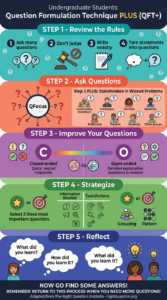
The Question Formulation Technique, also known as the QFT, is a way of generating questions developed by the Right Question Institute (Rothstein & Santanam, 1999; The Right Question Institute). It was created to help people work on asking questions to their doctors, and for parents to ask questions to their children’s teacher at parent-teacher conferences. As students, we can use this technique to help us brainstorm topics for projects, examine assigned readings more closely, and even come up with insightful questions to bring to group discussions.
The QFT follows a very simple set of rules designed to help us efficiently think up questions related to a broader topic. This technique can be used individually or in a group and follows the same rules and steps in either setting. The following steps are what we call QFT Plus, which are the basic steps of the QFT with some minor additions to help you develop even more questions and a more varied understanding of your work. This is how it works:
Step one: Know AND FOLLOW the rules. There are only four (4) rules for asking questions that must be followed:
1) ask as many questions as you can,
2) do not stop to overthink, discuss, judge or answer the questions,
3) write down every question exactly as you think of it,
4) change any statement into a question.
Now, keeping the rules of question asking in mind, use the following steps to complete the QFT yourself.
Step two: Determine your QFocus. The Question Focus (QFocus) or prompt for your inquiry may be given to you by your professor or something you choose yourself that represents the assignment you may be working on. This focus should be a general idea surrounding the topic of discussion. The QFocus could be something like a picture of a city or a forest, or a prompt like ‘cow in Ireland learns to talk’ or ‘most world maps are wrong’. There is only one rule for the QFocus; it cannot be a question.
Example:
QFocus: sinking cities
Step three: Now look at your QFocus and think about what questions you have about it and write them all down. Write down all questions that come to mind (even if you think they are “stupid”). During this process, don’t forget to reference the QFT rules and make sure you number your questions along the way.
Example:
- What is a sinking city?
- What causes cities to sink?
- Can we stop cities from sinking?
- How many sinking cities are there?
- Are certain parts of the world more likely to have sinking cities?
- Etc….
Step four: Once you’ve listed as many questions as you can, it’s time to improve your questions. Go down the list and label each question as open-ended or closed-ended. After labelling all questions, change some of your closed-ended questions to open and some of your open-ended questions to closed. This could be as little as one of each or as many as all of the questions you have. How much you complete of this step will depend on how much time you have and what is being asked of you. Changing your questions helps you to look at them from a different angle and determine if there is a better way to ask them.
Example:
- What is a sinking city? – O (Closed: Is a sinking city a city being covered by water?)
- What causes cities to sink? – O (Closed: Is being close to the ocean what causes cities to sink?)
- Can we stop cities from sinking? – C (Open: How can we stop cities from sinking?)
- How many sinking cities are there? – C (Open: Who decides what counts as a sinking city?)
- Are certain parts of the world more likely to have sinking cities? – C (Open: What could make parts of the world more likely to have sinking cities?)
- Etc….
Step five (the PLUS): identify stakeholders. This is an optional but strongly encouraged step, as it can help you to expand the perspectives of your question asking. Begin by identifying anyone who may have stakes in your QFocus, whether it be community members, politicians, healthcare workers, etc. Once stakeholders are established, repeat steps one and two from the perspective of your stakeholders; ask questions and improve your questions from their point of view.
Example:
Stakeholder: Engineers
- How much is the ground lowering each year?
- Is there mining nearby impacting the land?
- Should we build sea walls?
- Etc.
Stakeholder: Community members
- Am I safe to stay in my home?
- How can I ensure the city is acting to help prevent this?
- Where would I move to if I had to leave?
- Etc.
Step six: Identify the purpose of your questions. Find common themes and ideas that tie your questions into your greater purpose. This helps you narrow down the long list of questions to something more manageable for your goals.
Example:
Purpose: to do a presentation about sinking cities
Step seven: Strategize. Pick 5 questions that relate best to your purpose and decide how you will use them, be that as inspiration for an assignment or to learn more about something being discussed in your courses.
Example:
- What is a sinking city?
- What causes cities to sink?
- How many sinking cities are there?
- What could make parts of the world more likely to have sinking cities?
- How much is the ground lowering each year?
Step eight: reflect on the process and what you were able to learn from it!
When you first begin, the QFT may be difficult to adjust to. I know it was for me. However, with time it will get easier, and as long as you remember the rules, this technique can be used for almost anything, providing value far beyond academic contexts. Next time you have a paper or a research project you just can’t seem to crack, pull out your QFT knowledge and come up with questions to get started. You never realize how much it will help until you try it!
Question Formulation Technique Plus
Step 1: Rules for asking questions
- Ask as many questions as you can
- Do not stop to discuss, judge or answer the questions
- Write down every question exactly as you think of it
- Change any statement into a question
Step 2: Identify your QFocus.
- This is what your question asking will focus on. It can be assigned to you or created to represent an assignment you were assigned.
- The only rule is this cannot be a question.
Step 3: Ask questions.
- You will have a prompt known as the Question Focus. Look at this and think about what questions you have.
- Don’t forget to follow the rules and number your questions.
Step 4: Improve your questions.
- Go down you list of questions and label each with “C” for closed-ended or “O” for open-ended.
- After, change every open-ended questions possible to closed and every closed-ended questions possible to open.
Step 5: Identify stakeholders. Think of anyone who could have some sort of investment in your QFocus.
- This could be community member, first responders, politicians, etc. Repeat the question asking process (steps 1-3) as if you were some of these stake holders. (OPTIONAL, depends on the QFocus)
Step 6: Identify the purpose of your questions.
- Find common themes and ideas that tie all your questions into your greater purpose.
Step 7: Strategize. Pick your questions that relate best to your purpose and decide how you will use them.
- Look at your list and choose your most important questions and put a star next to them• Determine what you need to know and what you need to do to answer your questions
Step 8: Reflect on the process and what you were able to learn from it!
Reading & Watching With Purpose
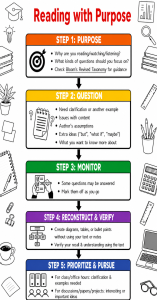
Reading With Purpose (RWP) and Watching With Purpose (WWP) are inquiry-based reading and watching techniques developed by Dr. Stacey MacKinnon (our mentor and one of the authors of this handbook!). After realizing how little she was gaining from reading without actually thinking about what she was reading, RWP and WWP were born! These techniques are loosely based on the QFT, which I know you are now an expert in. The techniques of RWP/WWP were designed to ensure learners are reading and watching material with an emphasis on deeper understanding, figuring out what they don’t know, and coming up with both critical and creative questions to address in office hours, face-to-face discussions, and projects. Like the QFT, utilizing these techniques might prove challenging at the start, but it’s important to keep working on them to improve. Once you’ve adjusted to this way of learning, they are much quicker to utilize and can provide endless positive benefits in the classroom.
The steps of RWP and WWP are as follows.
Step one: read or watch through the material and write down questions it raises for you as you go along. If watching videos, keep in mind that the pause button is your friend and it should be used.
- These questions can include things that need clarification, things that need another example, issues you have with the material, assumptions you feel are made in the material, and extra ideas not explained.
- This helps to focus more on the material and make connections that can be valuable in helping to grow memory from material earlier on in the learning process.
Step two: as your questions are answered by your continued reading, check them off.
- This is to help keep track of the questions that are being answered.
- The number of questions that get answered can widely range from a very limited number to potentially them all, but it really all depends on the materials you are engaging with and the kinds of questions that you are asking. But always remember, there is no right or wrong amount of questions to be answered, as it is more about the process than the result.
Step three: at the end of the material, summarize what you have learned. Summaries are not only something you can check back to in the future, but are also a way to recognize what you have gained from your reading.
Step four: review the remaining unanswered questions and order them based on your needs.
- These can be used for clarification during class or office hours, participating in class discussions, completing assignments, etc.
Even if you already have established techniques for engaging with academic materials, I encourage you to give RWP and WWP a chance like I did. It may take more time and effort in the beginning than what you’re used to, but as you become more familiar with how it works, the process becomes much quicker to complete, and you may even get more out of it than your previous ways of learning.
The RISE Model of Giving and Receiving Feedback
Many of us struggle with both giving and receiving feedback. As students, we are not often the providers of feedback, which can make taking on this role all the more difficult, but that does not mean it is impossible or unimportant. Even when we do give feedback, it tends to be one of two forms: cheerleader type, where one only focuses on the positives without actually providing constructive comments to improve writing (think “that’s SO good”, “I love it!”); or feedback solely focused on grammar and spelling. And while both compliments and grammar/spelling checks are important aspects of giving feedback as students, they are only pieces of the much larger puzzle. If you are only providing surface-level edits (or no edits at all), both you and your peers lose out on the many benefits of providing feedback in academic environments. Now, if you have little experience engaging in these processes, you may be wondering what the goal of peer feedback even is? The truth is, while seemingly simple, allowing students to receive feedback on their learning creates several benefits! It helps to increase engagement in your learning, deepens understanding of the content you’re reviewing, and even improves communication skills between peers. These are only a few of the many benefits you gain from engaging in this practice, and while it may seem intimidating to begin, the more you do it, the more you get out of it.
With inquiry-based learning, the feedback you need to give and receive is often not quite like what you are used to in the classroom. It is important to note that there are many variations and ways of giving feedback. Below is a variety of feedback types you may or may not be familiar with.
- Formative vs. Summative Feedback. Formative feedback is developmental; it is given over the course of a project’s completion, allowing us to determine strengths and weaknesses throughout the process and make improvements as we go along. Summative feedback is more final, given once the work is completed and is often accompanied by a grade of some kind; this is likely the most familiar form of feedback for us as students.
- Formal vs. Informal Feedback. Formal feedback is a structured method of giving feedback, often done in specific settings and evaluating specific aspects of work. Informal feedback is more in the moment, given when an opportunity or idea strikes.
- Process vs. Product-Oriented Feedback. Process-oriented feedback is similar to the idea of formative feedback, where it happens over the course of a project and evaluates the progress made before a final product. Product-oriented feedback is more similar to summative feedback, where the focus is on the final results over what was done to achieve these results.
- Immediate vs. Delayed Feedback. Immediate feedback can be valuable for making adjustments and quick insights into our work, as feedback is given the best chance of effectiveness when provided as soon as possible. Delayed feedback is important for reflection and providing the opportunity to think more critically about the work presented.
No one type of feedback is better than the other. They all serve their own purpose and carry their own value. To be able to accurately give and receive feedback, it is important to remember there are various ways of doing this and which is best will change based on the environment and what is asked of us.
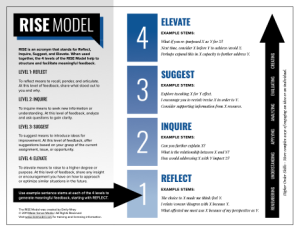
I struggled a lot with giving and receiving peer feedback the first time I did it for an inquiry-based learning project, but with the help of a valuable feedback tool called the RISE model, it became a lot easier. The RISE model was developed by Emily Wray to make giving and receiving feedback a more positive and productive process. There are four levels in the RISE model process, each represented by a letter in its title.
- Reflect (Level 1). Think about and share what parts of someone’s work made an impact on you and why.
- Inquire (Level 2). Ask questions to develop greater understanding of someone’s work, to ask questions and gain clarity (RWP may come in handy here!).
- Suggest (Level 3). Provide our suggestions of ways to add to the work and/or make improvements based on our current understanding of their work.
- Elevate (Level 4). Suggest future directions and ways you think the learner could take their work to the next level.
The RISE model of feedback provides us with an opportunity to give and receive feedback positively. This can create a safer feedback environment where we all feel comfortable sharing our insights and receiving them from others.
Check out this quick video on how you can use the RISE model of feedback as a student: https://www.youtube.com/watch?v=-OfGt8pxVag
Newport, C. (2016). Deep Work: Rules for Focused Success in a Distracted World. Grand Central Publishing.
White, H. A., & Shah, P. (2006). Uninhibited imagination: Creativity in adults with attention-deficit/hyperactivity disorder. Personality and Individual Differences, 40(6), 1121–1131. https://doi.org/10.1016/j.paid.2005.11.007
Baron-Cohen, S., Wheelwright, S., Stone, V. E., & Rutherford, M. (2001). A mathematician, a physicist and a computer scientist with Asperger syndrome: Performance on folk psychology and folk physics tasks. Neurocase, 7(6), 489–500. https://doi.org/10.1076/neur.7.6.489.29370
von Károlyi, C., Winner, E., Gray, W., & Sherman, G. F. (2003). Dyslexia linked to talent: Global visual-spatial ability. Brain and Language, 85(3), 427–431. https://doi.org/10.1016/S0093-934X(03)00052-X
Clark, D. M., & Wells, A. (1995). A cognitive model of social phobia. In R. G. Heimberg, M. Liebowitz, D. Hope, & F. Scheier (Eds.), Social phobia: Diagnosis, assessment, and treatment (pp. 69–93). Guilford Press.
Hofmann, S. G. (2007). Cognitive factors that maintain social anxiety disorder: A comprehensive model and its treatment implications. Cognitive Behaviour Therapy, 36(4), 193–209. https://doi.org/10.1080/16506070701421313
Tibi-Elhanany, Y., & Shamay-Tsoory, S. G. (2011). Social cognition in social anxiety: The role of empathy. Journal of Anxiety Disorders, 25(5), 644–651. https://doi.org/10.1016/j.janxdis.2011.02.008
Rothstein, D., & Santana, L. (2011). Make just one change: Teach students to ask their own questions. Harvard Education Press.
The RISE Model for Self-Evaluation / Peer Feedback. Make Sense Media. https://www.risemodel.com/
Wineburg, S., & McGrew, S. (2017). Lateral reading and the nature of expertise: Reading less and learning more when evaluating digital information. Teachers College Record, 121(11), 1–40.
Abrami, P. C., Bernard, R. M., Borokhovski, E., Waddington, D. I., Wade, C. A., & Persson, T. (2015). Strategies for teaching students to think critically: A meta-analysis. Review of Educational Research, 85(2), 275–314. https://doi.org/10.3102/0034654314551063
Breakstone, J., Smith, M., Wineburg, S., Rapaport, A., Carle, J., Garland, M., & Saavedra, A. (2021). Students’ civic online reasoning: A national portrait. Educational Researcher, 50(8), 505–515. https://doi.org/10.3102/0013189X211017495
Ritter, S. M., Gu, X., Crijns, M., & Biekens, P. (2020). Fostering students’ creative thinking skills by means of a one-year creativity training program. PLOS ONE, 15(3), e0229773. https://doi.org/10.1371/journal.pone.0229773
Guilford, J. P. (1950). Creativity. American Psychologist, 5(9), 444–454. https://doi.org/10.1037/h0063487
Martinez, M. E. (2006). What is Metacognition? Phi Delta Kappan, 87(9), 696-699.
question that cannot be answered with a simple one-word response but requires more details
questions that have a limited preset group of answers