
Main Body
Chapter 2: So Many Cool Types of Questions
Tessa Rooseboom
Hopefully, by now we’ve convinced you to take a serious look at your mindsets and make choices that will bring you closer to shifting from student to learner. This chapter is all about asking really good questions and guiding your own learning. Let’s start with something we are all familiar with – the 5Ws (and one H).
Who, What, When, Where, Why, How
Most of us have been told at some point in our lives that we need to focus on the main types of questions:
- who,
- what,
- when,
- where,
- why,
- and how (somebody has to come up with a “W” word for this one!)
While we agree that the five W’s and H are important types of questions, there is so much more to inquiry than these simple concepts. Wicked questions are not addressed with only the five Ws and H. We must go beyond these simple concepts to address these major questions of life. To be proper inquirers, we need to understand questioning beyond baseline concepts.
Wicked Questions
Horst Rittel and Melvin Webber created the term “wicked problem” in 1973 to grapple with issues outside of the bounds of traditional problem-solving. Wicked problems are incomplete, contradictory, change in their requirements, and prompt solutions that are hard to identify as right or wrong. Wicked questions are not like normal questions; they are meant to stimulate dialogue and bring forth paradoxes. There are a few key features that identify wicked questions including their paradoxical nature (meaning that wicked problems have traits that butt heads or do not seem to go together, they are opposites and their disagreement should not be resolved too early), open-endedness (there is no right answer, they require exploring), provocative framing (they challenge existing models and assumptions), and collaborative engagement (they are easiest to work on in a group setting with diverse perspectives). When discussing collaboration, it is important to remember to collaborate not only with people who share your perspective (e.g., other people in your major) but also to work with and learn from people with other backgrounds and perspectives. The question should then become not who is “right” but how we can incorporate this broader knowledge to better understand the issue and make the work better. Additionally, it is important to note that solving one piece of a wicked problem often changes or creates a different issue that will need to be addressed. Wicked problems include things like poverty, climate change, etc.; they are problems that are incredibly complex and often intertwined with one another that do not have one simple solution.
Systems thinking is a great example of wicked problems. Thinking that addresses how different parts of a system interact naturally focuses more on interconnectedness and less on individualism, and highlights the impact of understanding patterns, feedback loops, and emergent behaviour. This kind of thinking creates a perfect environment for wicked questions that are intended to explore the chaos of real-world systems. Wicked questions are important for ending oversimplification, giving opportunities to properly engage in the system, and inviting exploration of unique solutions. Engagement with wicked problems requires strong inquiry skills that allow you to ask thoughtful, open-ended questions, listen actively, reflect critically, and synthesize diverse perspectives. These skills help you to:
- create space for traits that disagree with each other without rushing to solutions;
- challenge assumptions;
- facilitate collective sense-making;
- promote psychological safety.
Wicked questions mostly come from difficult or ambiguous situations, but that does not make them only negative. They can still be quite positive and generative. Wicked problems are intended to generate questions that give us opportunities for thinking, collaboration, and innovation. Their value is not in solutions but in the opportunities they provide. Due to the nature of wicked problems, they are catalysts for innovation; they foster resilience and adaptability, strengthen relationships and dialogue, and empower leadership and engagement. Wicked questions are often used in organizational development to foster transformational change; they frame issues as paradox instead of conflict, and create a “safe container” for dialogue around this complicated issue. They can also be positive in the sense of “I have two concerts to go to, in two different provinces, on the same weekend. How can I make this happen?”
Regardless, wicked questions are a valuable way of engaging in complicated problems using systems thinking and organizational development. While wicked problems seem negative, they come with positives as well, as they are used to generate opportunities for thinking, collaboration, and innovation. These are the types of questions where their value lies in the process over the solution to the problem. Wicked problems are complicated and complex, and take diverse perspectives to properly work on. However, they are also some of the most interesting and frustrating problems to grapple with. Wicked problems are so incredibly intertwined with our everyday lives and make up most of the issues we deal with. They are inescapable and vast in nature, but working towards solutions to them can be some of the most rewarding experiences you have.
Types of Inquiry
Spronken-Smith and Walker (2010) claim there are three types of Inquiry-Based Learning: structured, guided, and open. Each type can be used for different activities and in different ways. While as learners we may not have control of the types of inquiry being asked of us in the classroom, it is still important for us to understand the different ways of inquiring so we can learn more effectively in these situations and maybe even try to create these types of learning for ourselves and our classmates (*cough cough* interactive presentation). The three most common approaches are structured, guided, and open inquiry. Let’s start with the type of inquiry we tend to have the most experience with, structured inquiry.
Structured Inquiry
You can think of structured inquiry like an experiment, where there is a step-by-step guideline of how things are to be done. Structured inquiry explores a question presented by the professor, with a set of explicit guidelines to follow for each step, leading to a specific, known outcome. It’s kind of like baking, where we are following a recipe to make sure our food comes out the way we intended it to. We know what the outcome is supposed to be from the beginning, and we follow specific steps to achieve this outcome.
Structured inquiry has the most guidance and support from instructors out of all three types. It is important to understand the expectations and timeline ahead of beginning the work. Ensuring we are clear on what our instructor expects and requires of us is a crucial aspect of this method of inquiry.
One example of structured inquiry that you could choose to use for a group project is known as Structured Controversy (SC). In SC, there are two different groups, each of which is given a theme, one opposing the other (e.g. ‘they should raise minimum wage to $23/hr’ or ‘university should be free for all students to attend’). Each group will create a main question related to their theme, research the potential answers to their question, and share what they gathered in the research process. Understanding the other position is a crucial aspect of this activity, meaning it requires active listening as the other group presents. Afterwards, you will debrief the event as a whole group and reflect on the experience. While similar, it is important to note that SC is not a debate. SC is intended to be a collaborative learning experience among a group of people used to form an agreement and group understanding of all sides of an issue (great for a group project!). Whereas a debate is competitive and requires groups to take opposing positions in an attempt to win an argument (less great for a group project, unless that project is a debate of course!).
Guided Inquiry
Guided inquiry, also known as scaffolded inquiry, falls between structured and open inquiry, requiring some amount of guidance or structure, but also offering more flexibility in the work than structured. It is a type of inquiry that can help us to develop valuable information literacy skills. This type of inquiry can be used to develop research questions, which requires first the development of a theme. Guided inquiry most often involves being given an idea or question to explore, while also having the freedom to explore this in a way that we would like to. In guided inquiry, you are given what you are expected to explore as well as the freedom to explore the topic as you wish to while your professor assists in giving insights and guiding discovery over providing direct assistance.
Guided inquiry is best used to encourage exploration of our own interests and to teach us to value our own learning. Strategies that will be discussed in Chapter 3, such as the Question Formulation Technique and Reading/Watching With Purpose, are useful examples of what guided inquiry can look like. Like structured inquiry, guided inquiry can be used in a variety of settings for a variety of purposes, like being given questions to explore while reading or being asked how light affects plant growth and getting to choose where to put a plant to test this.
Open Inquiry
Open inquiry is the type of inquiry that provides the most independence for learners. Unlike structured and guided inquiry, you are provided minimal, if any, support from your professor and much more flexibility and responsibility throughout the learning process. Being unfamiliar with this style of learning, I found it can be intimidating at first, but as with most things, as I adjusted and became more familiar with the process, it did get easier. In the open inquiry process, instructors are there as consultants, and we, the learners, take on the primary role of choosing our questions and exploring the themes independently. Open inquiry does not provide you with opportunities for direct feedback like many other types of learning you are familiar with. In open inquiry, you need to seek feedback and be comfortable with feedback in the form of suggestions and insights, not solutions.
As is the case with the other two types of inquiry, open inquiry can be used in many different situations and settings. If you ever participated in a science fair in your earlier education experiences, then you have already been provided an opportunity to practice your open inquiry skills. Science fairs give you true freedom to explore a topic you like in a way you wish to learn about it. Another great example of open inquiry is the curiosity project (MacKinnon, 2017). Chapter 1 addresses the curiosity project in more detail; however, it is essentially a project in which you are allowed to explore any subject you would like in any format you wish. There are no rules for formatting or what you must learn about. You simply learn about something important to you, like fixing your truck, baking a cake or how to improve your sleep.
Revised Bloom’s Taxonomy
Bloom's Taxonomy is a model you may or may not be already familiar with; it was created by Bloom and Krathwohl in 1956. Originally known as the Taxonomy of Educational Objectives, it is a model for educational objectives that follows three domains: cognitive, affective and psychomotor. The priority domain in higher education tends to be the cognitive domain, which focuses on our ability to recall information, evaluate concepts and ideas, and apply knowledge in new ways. There are a group of skills for us to develop arranged in order of lowest complexity to highest: remembering, understanding, applying, analyzing, evaluating, and creating.
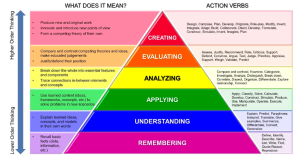
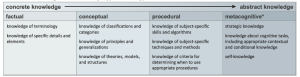
Since its creation, Bloom’s Taxonomy, specifically the cognitive domain, has been revised by Anderson and Krathwohl (2001). They have recreated the cognitive domain as the convergence of the Cognitive Process Dimension and the Knowledge Dimension. While these dimensions are still represented as a hierarchy, they are not simply black and white; there is more fluidity to them than that. The Knowledge Dimension is made up of four sections, each with its own subtypes, ranging from concrete knowledge types to abstract knowledge types. The four types of knowledge are as follows: factual, conceptual, procedural, and metacognitive (in this model, “metacognitive knowledge is knowledge of [one’s own] cognition and about oneself in relation to various subject matters” (Anderson & Krathwohl, 2001)). Below is a visual of the knowledge dimension, with all themes and subthemes.
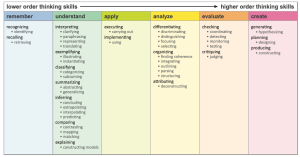
The Cognitive Process Dimension follows more closely with the original structure of Bloom’s Taxonomy. This new table still orders skills from least complex to most complex; they simply enhanced the categories to include further sections of clarification for each category.
Researchers have combined find these two tables into a more complex model, which you can find here: https://www.teachthought.com/critical-thinking-posts/blooms-taxonomy-model-3d/
Bloom’s Taxonomy was created with the purpose of outlining learning objectives, which typically contain a verb and an object. The verbs are the cognitive processes, and the object is the knowledge we gain or create. Bloom’s is commonly used by professors for lesson planning and assessment, as that is part of the intention behind its creation. However, we have found it to not be completely useful for student questioning. This is what led Stacey and me to propose further revision to Bloom’s Revised Taxonomy, which we are (currently) calling Bloom’s Revised Taxonomy: Student Edition. This revision includes the basic principles of Bloom’s original work with modifications to better suit the needs of students, like myself. It is important to note that this model is in the very early stages of its creation.
Two key differences between our Student Edition and Bloom’s Revised model are the removal of the remember stage and the incorporation of the metacognitive stage. We have deliberately removed the remember stage of Bloom’s Revised Taxonomy in our edition, as when asking questions of inquiry, you do not do so as a form of remembering. For example, if I were working on a project about social media misinformation, there would not be questions of remembrance for me to ask, as I am working with the goal of exploration and inquiry. With the removal of remember, the order of our edition remains the same: understand/clarify, apply, analyze, evaluate, create. Where the true difference lies is in the knowledge dimension. We reject the current state of the knowledge dimension and propose that metacognition is to be used in every step of the taxonomy and is not something to be evaluated. Below is a visual of this model with examples of questions and uses for each category. We encourage you to use this next time you are asking questions to evaluate the level of learning you may be accomplishing.
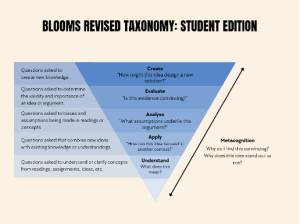
Throughout this book, you will find a variety of tools that get you to both think about the idea of asking questions and put your question-asking skills to work. Try to keep the assessment levels of Bloom’s in mind as you continue on and see what levels of question-asking you may be achieving.
Rittel, H. W., & Webber, M. M. (1973). Dilemmas in a general theory of planning. Policy sciences, 4(2), 155-169.
MacKinnon, S. L. (2017). ‘The curiosity project’: Re-igniting the desire to inquire through intrinsically-motivated learning and mentorship. Journal of Transformative Learning, (4)1, 4-21.
Bloom BS. (1956). Taxonomy of educational objectives: the classification of educational goals. New YorkNY: Longmans, Green.
Anderson LW & Krathwohl DR. (2001). A taxonomy for learning, teaching, and assessing: a revision of Bloom’s taxonomy of educational objectives. New YorkNY: Longmans.