Introduction
Pjilitaq / Welcome everyone
Like all languages, the Mi’kmaw language continues to evolve. This text uses the Francis/Smith orthography which was developed in the 1970s by Dr. Bernie Francis, a respected Mi’kmaw Elder and distinguished linguist from Nova Scotia and his collaborator Doug Smith. They were tasked with creating “an optimal writing system for contemporary Mi’kmaq, especially the young, to facilitate everyday reading and writing and the development of teaching materials for reserves and schools”.[1] The Francis/Smith orthography is used in Nova Scotia, Prince Edward Island, Newfoundland, and parts of New Brunswick. It has also been adopted as the official orthography of the Mi’kmaq Sante’ Mawio’mi (Grand Council).
Responding to the Truth and Reconciliation Commission’s Calls to Action
The Truth and Reconciliation Commission’s Calls to Action 13–17 call on governments and institutions to protect and strengthen Indigenous languages. These Calls recognize that Indigenous language rights are part of Indigenous rights and that language is central to identity, culture, and community. The calls include:
-
- We call upon the federal government to acknowledge that Aboriginal rights include Aboriginal language rights.
- We call upon the federal government to enact an Aboriginal Languages Act that incorporates the following principles:
i) Aboriginal languages are a fundamental and valued element of Canadian culture and society, and there is an urgency to preserve them.
ii) Aboriginal language rights are reinforced by the Treaties.
iii) The federal government has a responsibility to provide sufficient funds for Aboriginal-language revitalization and preservation.
iv) The preservation, revitalization, and strengthening of Aboriginal languages and cultures are best managed by Aboriginal people and communities.
v) Funding for Aboriginal language initiatives must reflect the diversity of Aboriginal languages. - We call upon the federal government to appoint, in consultation with Aboriginal groups, an Aboriginal Languages Commissioner. The commissioner should help promote Aboriginal languages and report on the adequacy of federal funding of Aboriginal-languages initiatives.
- We call upon post-secondary institutions to create university and college degree and diploma programs in Aboriginal languages.
- We call upon all levels of government to enable residential school Survivors and their families to reclaim names changed by the residential school system by waiving administrative costs for a period of five years for the name-change process and the revision of official identity documents, such as birth certificates, passports, driver’s licenses, health cards, status cards, and social insurance numbers.
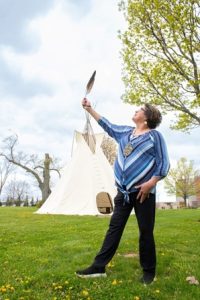 Strong Indigenous languages are essential to reconciliation, cultural survival, and community well-being.
The University of Prince Edward Island (UPEI) has sought to address the Calls to Action in a number of ways including the establishment of the Faculty of Indigenous Knowledge, Education, Research, and Applied Studies, along with a Minor and Major in Indigenous Studies. A component of both the Minor and Major are courses in the Mi’kmaw language. This text with serve both UPEI students, Indigenous communities on PEI and in the region and will be freely accessible.
This work is a “living” text in that it can be updated, corrected, and expanded over time. I was very fortunate to work with my UPEI campus students in 2025 as they took part in creating short Mi’kmaw language videos that have been integrated in the book. This work was completed as part of the Mi’kmaw Language Introduction course (IKE-2010-01).
Recognizing the importance of the Mi’kmaw Language to the First Nations, UPEI and the Indigenous Knowledge, Education, Research and Applied Studies (IKERAS) are honoured to offer the Mi’kmaw Language Introduction course (IKE 2010-01) to First Nations Peoples. The First Nations people also actively participated in the TRC’s Calls to Action, demonstrating their willingness to learn the Mi’kmaw language and to rekindle the spirit of the language. We extend our gratitude to all who have engaged in these meaningful experiences—learning the Mi’kmaw language and culture and reconnecting with our Indigenous language rights.
Starting in 2023, UPEI’s Faculty of Indigenous Knowledge, Education, Research, and Applied Studies members delivered the Level One Mi’kmaw Language IKE-2010-01 course on Lennox Island and Scotchfort First Nations. We are pleased to present certificates of completion to particpants who successfully completed the course from 2023-2026. (Please note that participants who completed the Mi’kmaw Language Course on the UPEI campus will also receive a certification for Level One completion).
| **Top Row – Left to Right (August 26th Event at UPEI in the IKERAS Faculty):** Mary Jane Bernard, Patricia Bourque, Mary Sark, Randy Thomas, Joseph Knockwook, Thirley Levi |
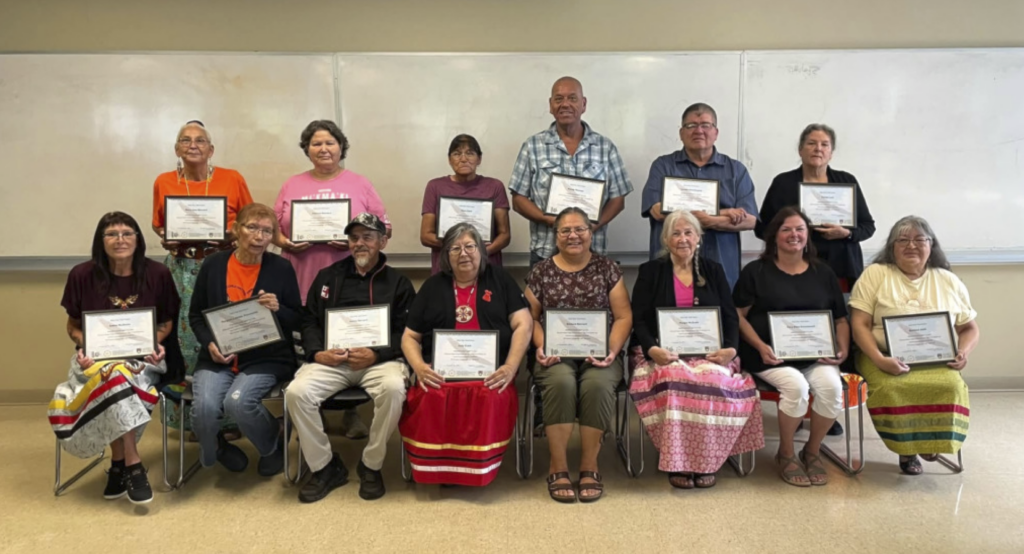 |
| IKE-2010-01 Class Participants – 2026 |
**Bottom Row – Left to Right:**
Adele McGuire, Margaret Labobe-Provencher, Jimmy Bernard, Dr. Judy Clark, Brenda Bernard, Margie McGrath, Mary Ellen Knockwood, Barbara Jadis
Sharing the QR code that is written on the IKE-2010-01 Certificate where Doris Googoo speaks the text in the Mi’kmaw Language .
 |
Kelu’lkw Tela’teken Mekite’lmulek sapa’tu’nek Ekinau’taqn Kaqi-kisa’toq tan teli-l’nui’simk aq nestmn klusuaqnl Mi’kmaw Language IKE-2010-01 |
- Smith, D. (2012). Publication: The Language of this Land, Mi’kma’ki. What's Happening in Toronto Linguistics (WHITL). https://utlinguistics.blogspot.com/2012/06/publication-language-of-this-land.html ↵
An orthography is the representation of the sounds of a language by written or printed symbols, according to a standard usage. The Mi'kmaq language has several different orthographies.