Acknowledgements

Wela’lioq / Thank You
Doris Googoo
The creation of this text has been supported by a grant from the UPEI OER Development Program.
Inspiration and much of the content for this book has been derived from the No’kmaq Village Mi’kmaw Language Project Supplementary Guide (Creative Commons Attribution-NonCommercial-ShareAlike (CC BY-NC-SA) license), No’kmaq Village (Flat Bay Band, Inc.). Some of the audio linked in the text is provided by the Mi’gmaq/Mi’kmaq Online Talking Dictionary which is is licensed under the Creative Commons Attribution-NonCommercial 4.0 International license.
Individuals who have supported the book through advice and/or shared resources they created.
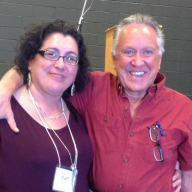
Bernie Francis |
Dr. Bernie Francis is a member of the Maupeltu (Membertou) First Nation community in Cape Breton, Nova Scotia. From 1970 to 1974, Dr. Francis commenced his training in linguistics under the guidance of linguist Doug Smith from the University of Toronto. He completed this training in 1980, during which he developed a new orthography for the Mi’kmaw language in collaboration with Professor Smith. The Smith/Francis orthography is now formally recognized by the Mi’kmaw chiefs in Nova Scotia, as well as by the Canada–Nova Scotia–Mi’kmaq Tripartite Forum. Dr. Francis was awarded an honorary doctorate from Dalhousie University in October 1999. He continues to work on numerous projects, including the Pjila’si Mi’kma’ki: Mi’kmaw Place Names Digital Atlas and Website Project. An accomplished musician, storyteller, and translator, Mr. Francis has performed throughout the Maritime provinces and in Mexico, where he considers his second home. Wela’lin for all you do for the Mi’kmaw Language and sharing your teachings to everyone. |
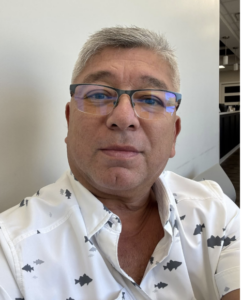 Curtis Michael |
We thank Curtis Michael for his permission to use flashcards he develop as learning activities in this book. Curtis is a widely respected Mi’kmaw language instructor and cultural educator from the Sipekne’katik First Nation in Nova Scotia. He has dedicated much of his life and career to the preservation, revitalization, and teaching of the Mi’kmaw language. Through highly impactful initiatives like the Mi’kmaw Made Easy learning tools and the Mi’kmaw Motherese project (on Facebook), he has successfully made the language more accessible to both community members and new learners. His work as an instructor in Indigenous Studies at Dalhousie University further underscores his deep commitment to ensuring the language thrives for generations to come. It was a true honour to work with Curtis, even if only for a short time. I am incredibly grateful for your dedication to shaping and preserving the Mi’kmaw language. Wela’lin for sharing your knowledge and teachings with me. |
| I want to acknowledge Arlene Stevens & Barbara Sylliboy for their expertise, wisdom, patience, & understanding in the development of the Verb Conjugation Resource book. They have tirelessly assisted me with the conjugations in the present, past, and future indicatives. Each conjugation has been tested over and over again to ensure accuracy, fluency, flow, and correct spelling in the Francis /Smith Orthography with Unama’ki dialect. Wela’lioq Arlene aqq Barbara! | |
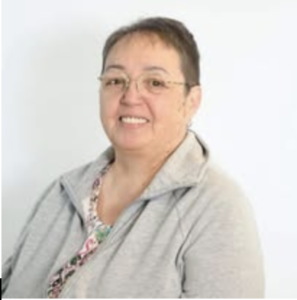 Arlene Stevens |
Arlene Stevens is married to Spencer and mother of three adult children, with ten grandchildren. She speaks, reads, and writes Mi’kmaq. She worked as a teacher at Eskasoni School and Sherwood Park Education Center and also worked as an administrator at the Eskasoni School. She also taught adult education at TEC and courses for McGill University. She has done numerous translation contracts for both federal and provincial governments and other organizations. She has also been involved in transcribing old Mi’kmaq language and song into the modern writing system. She has been involved in the church choir, prayer ministries, and in translation of Bible soties (both written and oral) into Mi’kmaq and the Lectionary. She has a Bachelor of Education and certificate in Mi’kmaw Immersion. Currently is employed with the Eskasoni School Board developing Mi’kmaq language curriculum materials for the Immersion Program. |
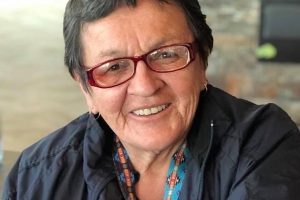 Barbara Sylliboy |
Barbara Sylliboy resides in the community of Eskasoni. She fostered two daughters who are now both young adults. She has a Bachelor of Arts and a Bachelor of Education, Diploma of Education (Counselling), Diploma in Education (Curriculum Development) and has been involved in teaching most of her life. She has taught in the Mi’kmaw Language Program at the school in Eskasoni, worked as a guidance counsellor, Vice-Principal, and as a Social Counsellor for University students. Currently, she works to develop Mi’kmaq Language curriculum materials for the Mi’kmaw Immersion program at Eskasoni school, and has done numerous translation contracts for both federal and provincial governments, Woodland Publishers, Mi’kmaw Kina’matnewey, UINR, and a variety of business organizations and individuals. She is also involved in the translation of oral and written Bible stories in Mi’kmaq and translation of the Lectionary. |
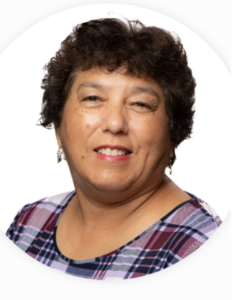 Beverly Jeddore |
Beverly Jeddore is known as the Mi’kmaq Language Technician at MK since 2016. In this role, she provides language instruction to the communities of Acadia, Bear River, Annapolis Valley, and Glooscap through virtual platforms such as Zoom and Polycom. She develops educational materials for MK schools, provincial schools, parents, and community members who seek to revitalize, preserve, and learn the Mi’kmaw language. Previously, Beverly was a teacher at Eskasoni School, where she was responsible for developing curriculum for students from Primary through Grade 3 within the Immersion School in Eskasoni. The curriculum team created instructional materials across subjects including Mathematics, Science, Social Studies, Health, and Language Arts. During her 28 years at Eskasoni, Beverly held multiple roles, with her true passion being the Mi’kmaw language. She developed a curriculum for Core Mi’kmaw and subsequently obtained a position as the Resource Teacher for the Immersion Program.
You can watch Beverly read Kalolin Kesatk Nitap Day, her recently released book, in both Mi’kmaw and English. Kalolin Kesatk Nitap Day (in Mi’kmaw) |
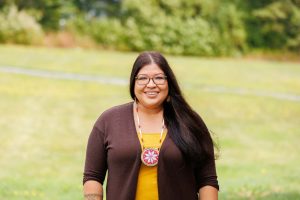
Melissa Peter-Paul |
Melissa Peter-Paul is a Mi’kmaw woman from the Abegweit First Nation, located on Epekwitk (Prince Edward Island). Throughout her upbringing, she was immersed in cultural teachings and was surrounded by a family of skilled basket makers. Her exposure to various Mi’kmaq art forms led her to explore quillwork, a traditional craft in which the ancestors of her maternal grandfather were renowned. She derives significant inspiration from 20th-century Mi’kmaw quillwork and benefits from her family’s support in her harvesting endeavors. Melissa takes pride in preserving and passing on this art form to her two sons and the broader community. Wela’liek for the beautiful image of quillwork that Melissa created and we have used for the cover on our book. See more of Melissa’s work at Melissapeterpaul.com |
Organizations
I appreciate the organizations that collaborate with Indigenous communities and diligently work to incorporate the Mi’kmaw language and culture within their operations. I commend these organizations and their dedicated staff for their efforts to enhance the quality of life for our Indigenous peoples through education and by fostering a reconnection with the Spirit of the Mi’kmaw language and culture.
| Mi’kmaw Kina’matnewey from Unama’ki /Cape Breton Island
|
The Mi’kmaw Kina’matnewey organization is dedicated to serving and supporting communities in any manner possible—promoting Mi’kmaq education, developing unique and valuable resources for our schools and communities, and hosting events that foster the development and growth of our people. We are also grateful for the permissions to use and integrate language material developed by Mi’kmaw Kina’matnewey (MK). MK has been great in sharing the Mi’kmaw resources with University of PEI (UPEI), Indigenous Knowledge, Education, Research, and Applied Studies Faculty (IKERAS), John J. Sark Elementary School, Hernwood intermediate school and Scotchfort First Nation Daycare. Wela’liek – Thank you from all of us. |
| L’NUEY from Epekwitk/ Prince Edward Island | L’NUEY believes Education and awareness regarding Mi’kmaw rights and culture are fundamental to supporting the advancement of Mi’kmaw rights and promoting overall reconciliation. When individuals understand the historical context, legal frameworks, and lived experiences of Mi’kmaw communities, it becomes more difficult to dismiss, distort, or deny these rights. L’nuey places a strong emphasis on clear and accessible communication, recognizing that informed individuals are instrumental in fostering meaningful change. Wela’liek – Thank you from all of us for sharing Knowledge with everyone. We appreciate it. |
| The Mi’kmaw Confederacy of Prince Edward Island
|
The Mi’kmaw Confederacy’s Education Program is implemented to assist Epekwitnewaq Mi’kmaq students in achieving their highest potential at every phase of their educational development. This is accomplished through the promotion of academic, cultural, and social growth from early childhood through Grade 12. Our Education Program staff work in close collaboration with administrators, educators, and staff at John J. Sark Memorial School, Westisle Family of Schools, Bluefield Family of Schools, and Morell Family of Schools to effectively address the unique needs of First Nations students. They also work closely with Indigenous Elders with programs. Wela’liek /Thank you for providing me with the opportunity to teach the Mi’kmaw language off reserve and to work with elders in their homes through your programs several years ago. |
| The Native Council of Prince Edward Island
|
The Native Council of Prince Edward Island offers programs aimed at promoting and strengthening the resilience of Indigenous individuals and their families on Prince Edward Island. These initiatives provide support to off-reserve Indigenous residents across all age groups and life stages. Furthermore, the Native Council conducts Mi’kmaw evening classes every Wednesday for anyone interested in learning the Mi’kmaw language. Wela’liek / Thank you from everyone for your efforts in teaching the Mi’kmaw language and culture within your programs.
|
Lennox Island Tourism Center in Epekwitk 
|
Lennox Island Tourism is dedicated to the preservation of the Mi’kmaw language and culture within the Lennox Island First Nation community. I am honored to have had the opportunity to teach and reaffirm the Mi’kmaw language in collaboration with several elders from Lennox Island from 2012 to 2021. It was a privilege to work closely with the Lennox Island elders on a weekly basis during evening classes. Wela’liek / Thank you for your commitment to the Mi’kmaw language and culture for msɨt No’kmaq/ all our relations. |
Wela’lioq / Thank you all for your commitment.
Doris Googoo