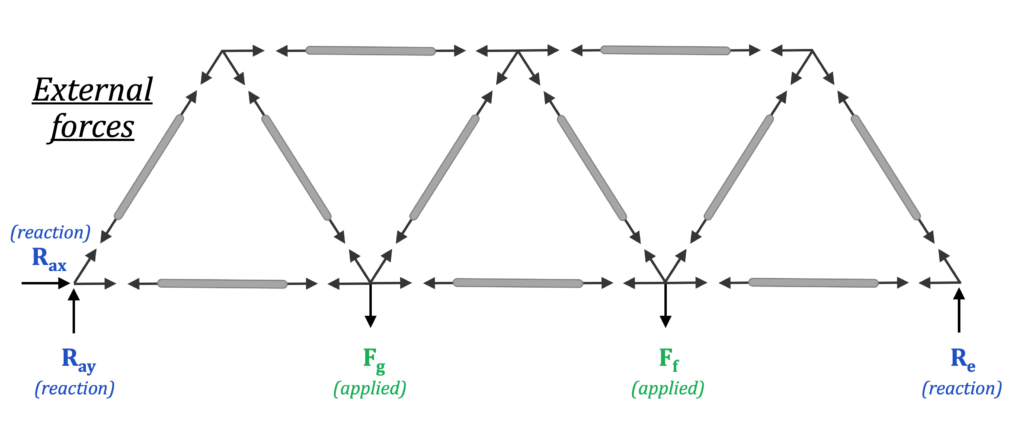
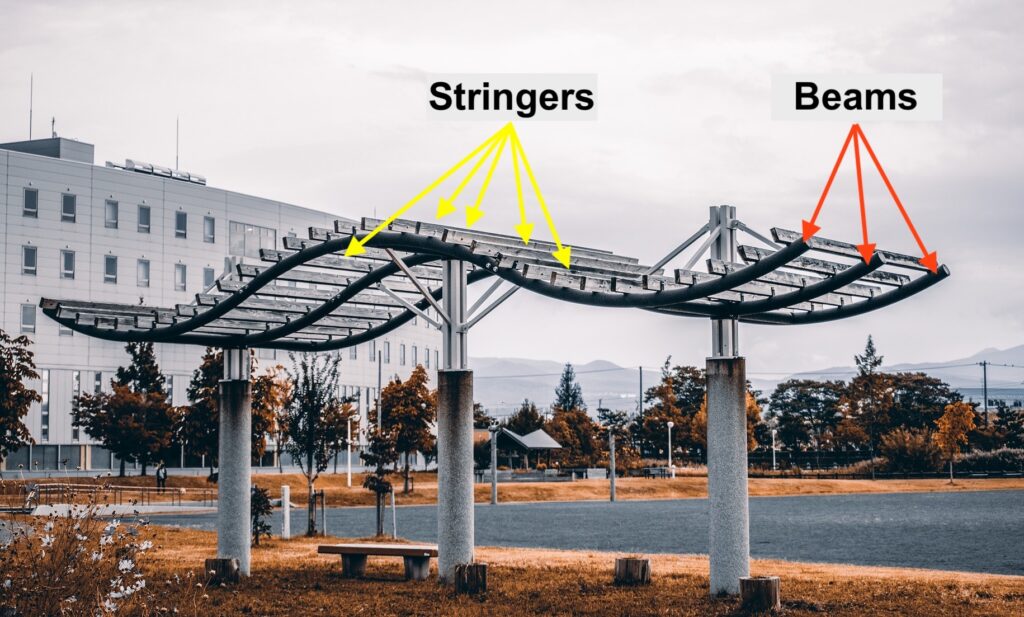
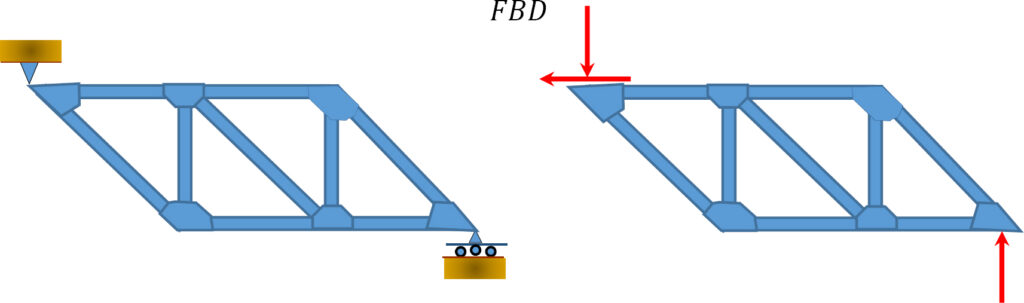
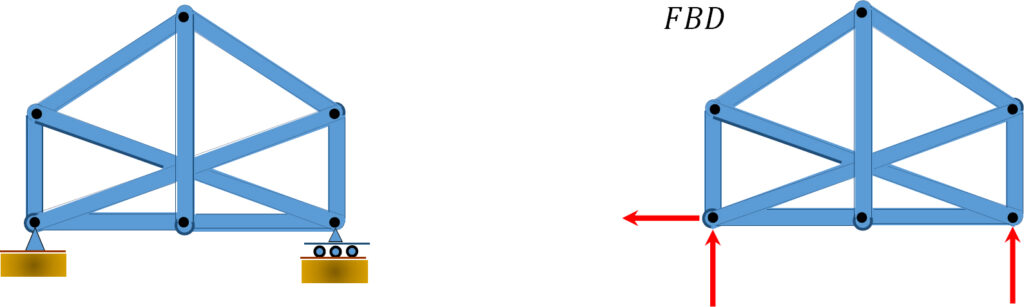
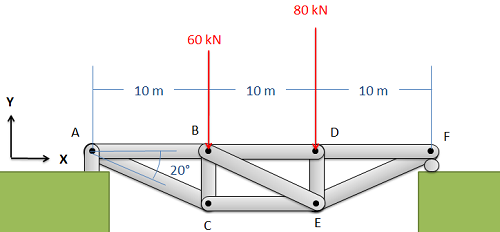
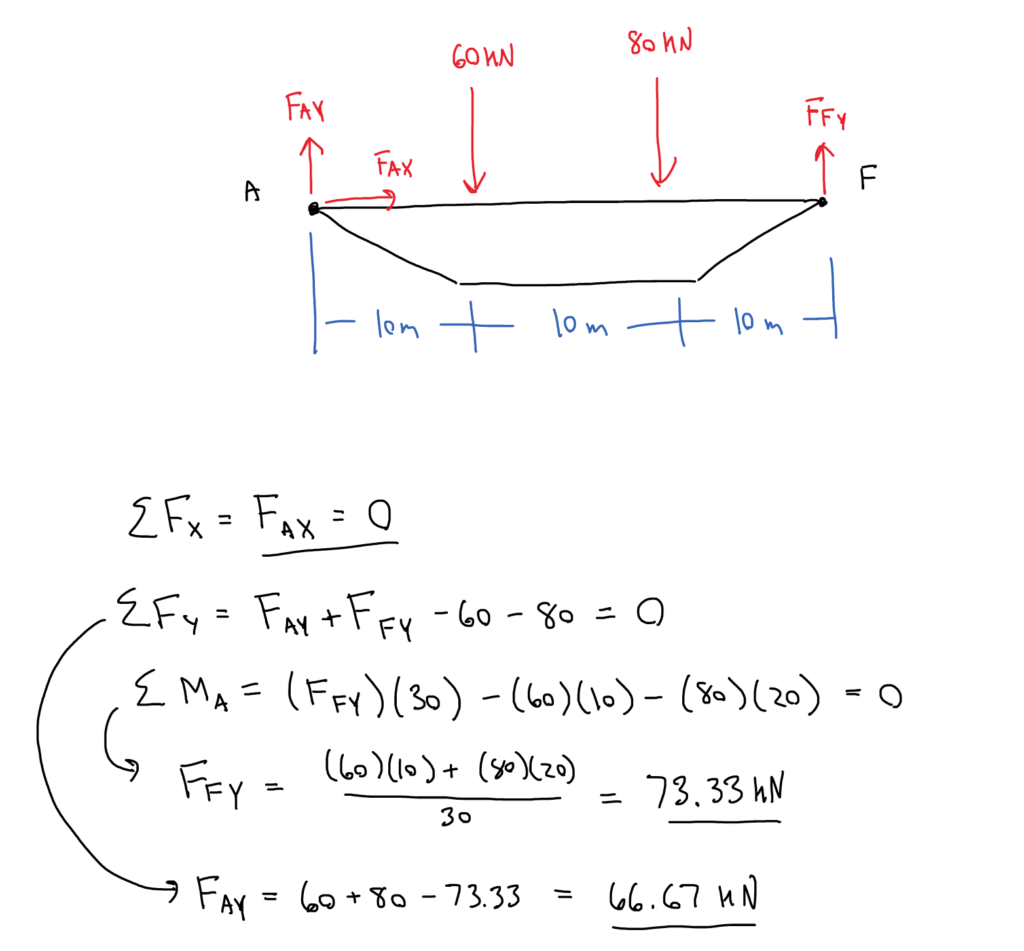
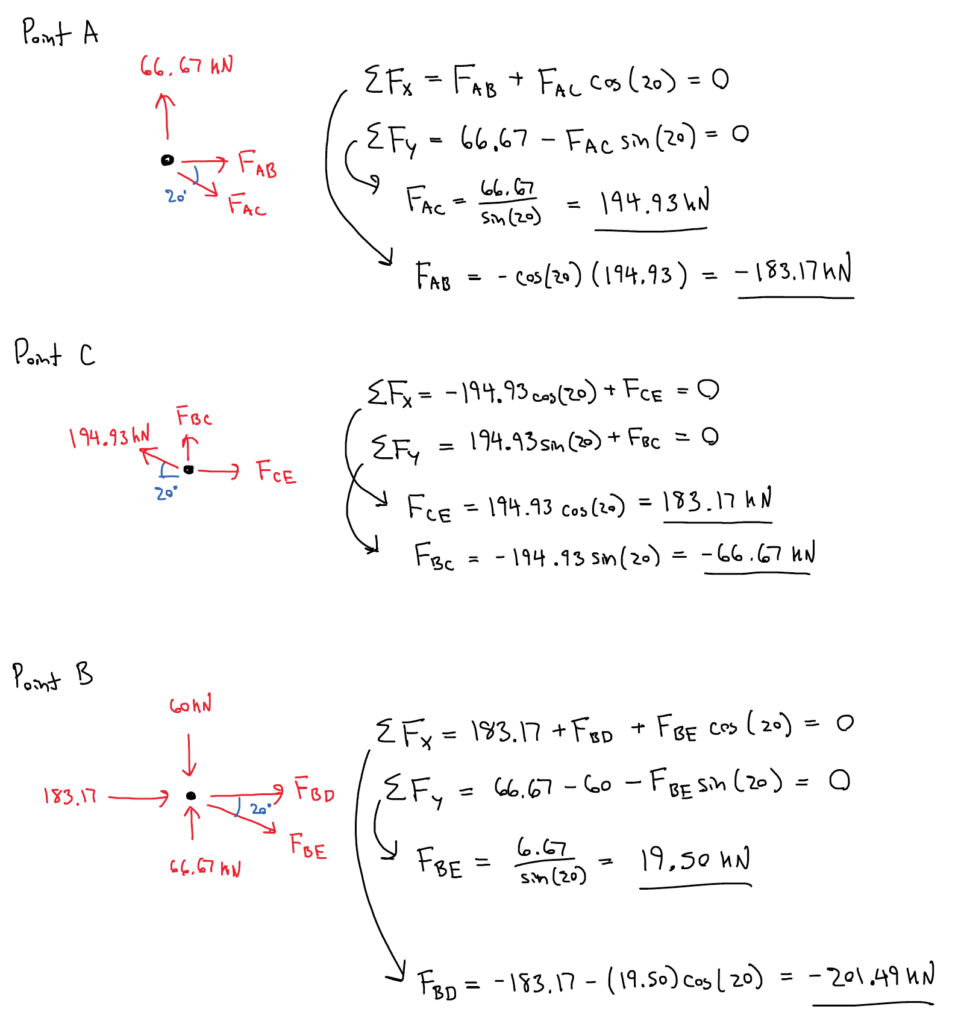
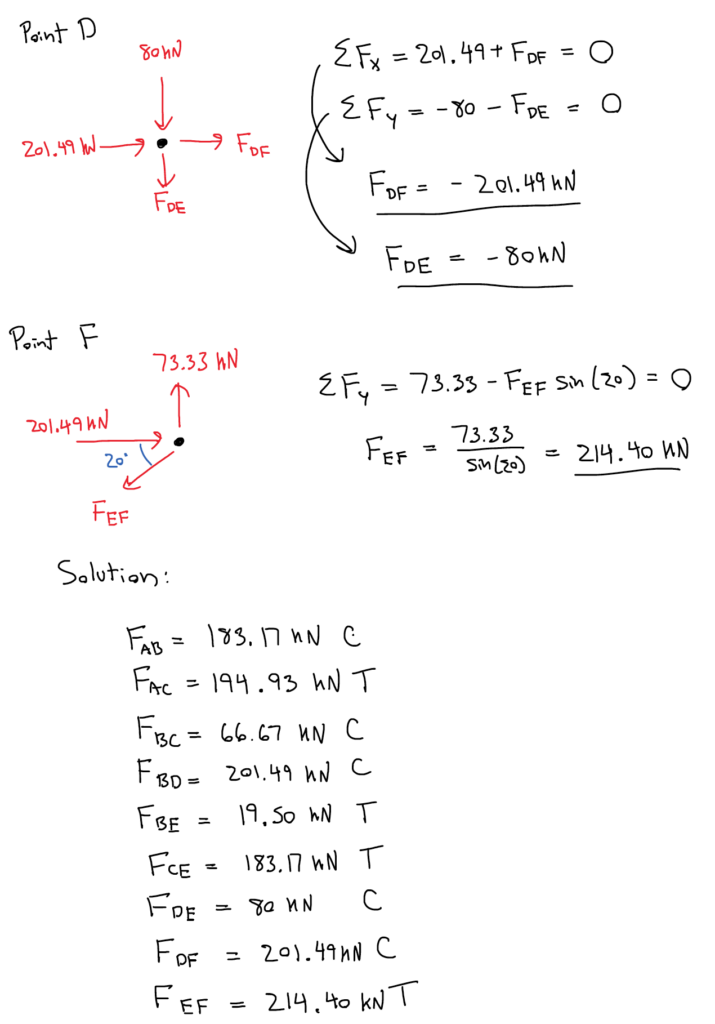
<?xml version="1.0" encoding="UTF-8"?>
<!DOCTYPE html PUBLIC "-//W3C//DTD XHTML 1.1//EN" "http://www.w3.org/TR/xhtml11/DTD/xhtml11.dtd">
<html xmlns="http://www.w3.org/1999/xhtml" xml:lang="en">
<head>
<meta content="text/html; charset=UTF-8" http-equiv="content-type" />
<meta http-equiv="Content-Language" content="en" />
<meta name="generator" content="Pressbooks 6.22.2" />
<meta name="pb-authors" content="Libby (Elizabeth) Osgood" />
<meta name="pb-authors" content="Gayla Cameron" />
<meta name="pb-authors" content="Emma Christensen" />
<meta name="pb-authors" content="Analiya Benny" />
<meta name="pb-authors" content="Matthew Hutchison" />
<meta name="pb-authors" content="Deborah Areoye" />
<meta name="pb-title" content="Engineering Mechanics: Statics" />
<meta name="pb-language" content="en-ca" />
<meta name="pb-cover-image" content="https://pressbooks.library.upei.ca/statics/wp-content/uploads/sites/56/2021/04/cairn-5598199_1920.jpg" />
<meta name="pb-primary-subject" content="PHDT" />
<meta name="pb-book-license" content="cc-by-nc-sa" />
<meta name="pb-about-140" content="Mechanical concepts when acceleration is 0" />
<meta name="pb-about-50" content="Introduction to engineering mechanics: statics, for those who love to learn. Concepts include: particles and rigid body equilibrium equations, distributed loads, shear and moment diagrams, trusses, method of joints and sections, &amp; inertia." />
<meta name="pb-about-unlimited" content="Introduction to engineering mechanics: statics, when acceleration is 0. Concepts include: particles and rigid body equilibrium equations, distributed loads, shear and moment diagrams, trusses, method of joints and sections, &amp; inertia. This book is intended for those who love to learn." />
<meta name="pb-short-title" content="Statics" />
<meta name="pb-book-doi" content="10.32393/EngnMech" />
<meta name="pb-additional-subjects" content="TBC, TGB" />
<title>Engineering Mechanics: Statics</title>
</head>
<body lang='en' >
<div id="half-title-page"><h1 class="title">Engineering Mechanics: Statics</h1></div>
<div id="title-page">
			<h1 class="title">Engineering Mechanics: Statics</h1>
		<h2 class="subtitle"></h2>
					<p class="author">Libby (Elizabeth) Osgood; Gayla Cameron; Emma Christensen; Analiya Benny; Matthew Hutchison; and Deborah Areoye</p>
								<p class="publisher"></p>
		<p class="publisher-city"></p>
	</div>
<div id="copyright-page">
	<div class="ugc">
					
<div class="license-attribution"><p><img src="https://pressbooks.library.upei.ca/statics/wp-content/themes/pressbooks-book/packages/buckram/assets/images/cc-by-nc-sa.svg" alt="Icon for the Creative Commons Attribution-NonCommercial-ShareAlike 4.0 International License" /></p><p>Engineering Mechanics: Statics Copyright © by <span>Libby (Elizabeth) Osgood; Gayla Cameron; Emma Christensen; Analiya Benny; Matthew Hutchison; and Deborah Areoye</span> is licensed under a <a rel="license" href="https://creativecommons.org/licenses/by-nc-sa/4.0/">Creative Commons Attribution-NonCommercial-ShareAlike 4.0 International License</a>, except where otherwise noted.</p></div>

									</div>
</div>
<div id="toc">
	<h1>Contents</h1>
	<ul>
					<li class="front-matter introduction">
	<a href="#front-matter-introduction">
		<span class="toc-chapter-title">Introduction</span>
							</a>
	</li>

					<li class="part">
	<a href="#part-main-body">
					Chapter 1: Fundamental Concepts
			</a>
</li>

					<li class="chapter standard">
	<a href="#chapter-review">
		<span class="toc-chapter-title">1.1 Preparatory Concepts</span>
							</a>
			<ul class="sections">
							<li class="section">
	<a href="#chapter-141-section-1">
		<span class="toc-subsection-title">1.1.1 Scalar vs. Vector</span>
	</a>
</li>
							<li class="section">
	<a href="#chapter-141-section-2">
		<span class="toc-subsection-title">1.1.2 Newton’s Laws</span>
	</a>
</li>
							<li class="section">
	<a href="#chapter-141-section-3">
		<span class="toc-subsection-title">1.1.3 Units</span>
	</a>
</li>
							<li class="section">
	<a href="#chapter-141-section-4">
		<span class="toc-subsection-title">1.1.4 Measurement Conversions</span>
	</a>
</li>
							<li class="section">
	<a href="#chapter-141-section-5">
		<span class="toc-subsection-title">1.1.5 Weight vs. Mass</span>
	</a>
</li>
							<li class="section">
	<a href="#chapter-141-section-6">
		<span class="toc-subsection-title">1.1.6 Pythagorean Theorem</span>
	</a>
</li>
							<li class="section">
	<a href="#chapter-141-section-7">
		<span class="toc-subsection-title">1.1.7 Sine/Cosine Laws</span>
	</a>
</li>
					</ul>
	</li>

					<li class="chapter standard">
	<a href="#chapter-xyz-coordinate-frame-review">
		<span class="toc-chapter-title">1.2 XYZ Coordinate Frame</span>
							</a>
			<ul class="sections">
							<li class="section">
	<a href="#chapter-158-section-1">
		<span class="toc-subsection-title">1.2.1 Cartesian Coordinate Frame in 2D</span>
	</a>
</li>
							<li class="section">
	<a href="#chapter-158-section-2">
		<span class="toc-subsection-title">1.2.2. Cartesian Coordinate Frame in 3D</span>
	</a>
</li>
					</ul>
	</li>

					<li class="chapter standard">
	<a href="#chapter-vector-form-notation">
		<span class="toc-chapter-title">1.3 Vectors</span>
							</a>
			<ul class="sections">
							<li class="section">
	<a href="#chapter-156-section-1">
		<span class="toc-subsection-title">1.3.1 Vector Components</span>
	</a>
</li>
							<li class="section">
	<a href="#chapter-156-section-2">
		<span class="toc-subsection-title">1.3.2 Componentizing a Vector</span>
	</a>
</li>
							<li class="section">
	<a href="#chapter-156-section-3">
		<span class="toc-subsection-title">1.3.3 Position Vector</span>
	</a>
</li>
							<li class="section">
	<a href="#chapter-156-section-4">
		<span class="toc-subsection-title">1.3.4 Vector Math</span>
	</a>
</li>
					</ul>
	</li>

					<li class="chapter standard">
	<a href="#chapter-dot-and-cross-product">
		<span class="toc-chapter-title">1.4 Dot Product</span>
							</a>
	</li>

					<li class="chapter standard">
	<a href="#chapter-cross-products">
		<span class="toc-chapter-title">1.5 Cross Products</span>
							</a>
	</li>

					<li class="chapter standard">
	<a href="#chapter-torque-moment">
		<span class="toc-chapter-title">1.6 Torque/Moment</span>
							</a>
			<ul class="sections">
							<li class="section">
	<a href="#chapter-168-section-1">
		<span class="toc-subsection-title">1.6.1 Moments</span>
	</a>
</li>
							<li class="section">
	<a href="#chapter-168-section-2">
		<span class="toc-subsection-title">1.6.2 Scalar Method in 2 Dimensions</span>
	</a>
</li>
							<li class="section">
	<a href="#chapter-168-section-3">
		<span class="toc-subsection-title">1.6.3 Vector Method in 3 Dimensions</span>
	</a>
</li>
					</ul>
	</li>

					<li class="chapter standard">
	<a href="#chapter-smart-method-6-step">
		<span class="toc-chapter-title">1.7 Problem Solving Process</span>
							</a>
	</li>

					<li class="chapter standard">
	<a href="#chapter-slug-1-8-examples">
		<span class="toc-chapter-title">1.8 Examples</span>
							</a>
			<ul class="sections">
							<li class="section">
	<a href="#chapter-566-section-1">
		<span class="toc-subsection-title">Example 1.8.1: Vectors, Submitted by Tyson Ashton-Losee</span>
	</a>
</li>
							<li class="section">
	<a href="#chapter-566-section-2">
		<span class="toc-subsection-title">Example 1.8.2: Vectors, Submitted by Brian MacDonald</span>
	</a>
</li>
							<li class="section">
	<a href="#chapter-566-section-3">
		<span class="toc-subsection-title">Example 1.8.3: Dot product and cross product, submitted by Anonymous ENGN 1230 Student</span>
	</a>
</li>
							<li class="section">
	<a href="#chapter-566-section-4">
		<span class="toc-subsection-title">Example 1.8.4: Torque, Submitted by Luke McCarvill</span>
	</a>
</li>
							<li class="section">
	<a href="#chapter-566-section-5">
		<span class="toc-subsection-title">Example 1.8.5: Torque, submitted by Hamza Ben Driouech</span>
	</a>
</li>
							<li class="section">
	<a href="#chapter-566-section-6">
		<span class="toc-subsection-title">Example 1.8.6: Bonus Vector Material, Submitted by Liam Murdock</span>
	</a>
</li>
							<li class="section">
	<a href="#chapter-566-section-7">
		<span class="toc-subsection-title">Example 1.8.7: Cross Product, Submitted By Victoria Keefe</span>
	</a>
</li>
					</ul>
	</li>

					<li class="part">
	<a href="#part-chapter-2-vectors">
					Chapter 2: Particles
			</a>
</li>

					<li class="chapter standard">
	<a href="#chapter-slug-1-5-particle-rigid-body">
		<span class="toc-chapter-title">2.1 Particle & Rigid Body</span>
							</a>
	</li>

					<li class="chapter standard">
	<a href="#chapter-free-body-diagrams">
		<span class="toc-chapter-title">2.2 Free Body Diagrams for Particles</span>
							</a>
	</li>

					<li class="chapter standard">
	<a href="#chapter-particle-equilibrium">
		<span class="toc-chapter-title">2.3 Equilibrium Equations for Particles</span>
							</a>
	</li>

					<li class="chapter standard">
	<a href="#chapter-slug-2-4-examples">
		<span class="toc-chapter-title">2.4. Examples</span>
							</a>
			<ul class="sections">
							<li class="section">
	<a href="#chapter-568-section-1">
		<span class="toc-subsection-title">Example 2.4.1: Equilibrium Equation and Components of Vectors, Submitted by Analiya Benny</span>
	</a>
</li>
							<li class="section">
	<a href="#chapter-568-section-2">
		<span class="toc-subsection-title">Example 2.4.2: Equilibrium Equation, Submitted by Kylian Duplan</span>
	</a>
</li>
							<li class="section">
	<a href="#chapter-568-section-3">
		<span class="toc-subsection-title">Example 2.4.3: Equilibrium Equation, Submitted Anonymously</span>
	</a>
</li>
							<li class="section">
	<a href="#chapter-568-section-4">
		<span class="toc-subsection-title">Example 2.4.4: Equilibrium Equation, Submitted by Analiya Benny</span>
	</a>
</li>
					</ul>
	</li>

					<li class="part">
	<a href="#part-chapter-3-particles">
					Chapter 3: Rigid Body Basics
			</a>
</li>

					<li class="chapter standard">
	<a href="#chapter-right-hand-rule">
		<span class="toc-chapter-title">3.1 Right Hand Rule</span>
							</a>
			<ul class="sections">
							<li class="section">
	<a href="#chapter-162-section-1">
		<span class="toc-subsection-title">3.1.1 The Whole-Hand Method</span>
	</a>
</li>
							<li class="section">
	<a href="#chapter-162-section-2">
		<span class="toc-subsection-title">3.1.2 Right Hand Rule and Torque</span>
	</a>
</li>
							<li class="section">
	<a href="#chapter-162-section-3">
		<span class="toc-subsection-title">3.1.3 Three-Finger Configuration</span>
	</a>
</li>
					</ul>
	</li>

					<li class="chapter standard">
	<a href="#chapter-couples">
		<span class="toc-chapter-title">3.2 Couples</span>
							</a>
	</li>

					<li class="chapter standard">
	<a href="#chapter-distributed-loads">
		<span class="toc-chapter-title">3.3 Distributed Loads</span>
							</a>
			<ul class="sections">
							<li class="section">
	<a href="#chapter-182-section-1">
		<span class="toc-subsection-title">3.3.1 Intensity</span>
	</a>
</li>
							<li class="section">
	<a href="#chapter-182-section-2">
		<span class="toc-subsection-title">3.3.2 Equivalent Point Load & Location</span>
	</a>
</li>
							<li class="section">
	<a href="#chapter-182-section-3">
		<span class="toc-subsection-title">3.3.3 Composite Distributed Loads</span>
	</a>
</li>
					</ul>
	</li>

					<li class="chapter standard">
	<a href="#chapter-reaction-forces">
		<span class="toc-chapter-title">3.4 Reactions & Supports</span>
							</a>
	</li>

					<li class="chapter standard">
	<a href="#chapter-restraints-and-their-forces">
		<span class="toc-chapter-title">3.5 Indeterminate Loads</span>
							</a>
			<ul class="sections">
							<li class="section">
	<a href="#chapter-178-section-1">
		<span class="toc-subsection-title">Determinate Loads</span>
	</a>
</li>
							<li class="section">
	<a href="#chapter-178-section-2">
		<span class="toc-subsection-title">Indeterminate Loads</span>
	</a>
</li>
					</ul>
	</li>

					<li class="chapter standard">
	<a href="#chapter-slug-3-6-examples">
		<span class="toc-chapter-title">3.6 Examples</span>
							</a>
			<ul class="sections">
							<li class="section">
	<a href="#chapter-569-section-1">
		<span class="toc-subsection-title">Example 3.6.1: Reaction Forces, Submitted by Andrew Williamson</span>
	</a>
</li>
							<li class="section">
	<a href="#chapter-569-section-2">
		<span class="toc-subsection-title">Example 3.6.2: Couples, Submitted by Kirsty MacLellan</span>
	</a>
</li>
							<li class="section">
	<a href="#chapter-569-section-3">
		<span class="toc-subsection-title">Example 3.6.3: Distributed Load, Submitted by Luciana Davila</span>
	</a>
</li>
							<li class="section">
	<a href="#chapter-569-section-4">
		<span class="toc-subsection-title">Example 3.6.4: Couple, Submitted by Hamza Ben Driouech</span>
	</a>
</li>
							<li class="section">
	<a href="#chapter-569-section-5">
		<span class="toc-subsection-title">Example 3.6.5: Couple, Submitted by Andrew Williamson.</span>
	</a>
</li>
							<li class="section">
	<a href="#chapter-569-section-6">
		<span class="toc-subsection-title">Example 3.6.6: Couple, Submitted by Elliot Fraser</span>
	</a>
</li>
							<li class="section">
	<a href="#chapter-569-section-7">
		<span class="toc-subsection-title">Example 3.6.7: Lever Arms, Submitted by Dhruvil Kanani</span>
	</a>
</li>
							<li class="section">
	<a href="#chapter-569-section-8">
		<span class="toc-subsection-title">Example 3.6.8: Distributed loads, Submitted by Will Craine</span>
	</a>
</li>
							<li class="section">
	<a href="#chapter-569-section-9">
		<span class="toc-subsection-title">Example 3.6.9: Couple, Submitted by Anonymous</span>
	</a>
</li>
					</ul>
	</li>

					<li class="part">
	<a href="#part-chapter-4-rigid-bodies">
					Chapter 4: Rigid Bodies
			</a>
</li>

					<li class="chapter standard">
	<a href="#chapter-external-forces">
		<span class="toc-chapter-title">4.1 External Forces</span>
							</a>
	</li>

					<li class="chapter standard">
	<a href="#chapter-free-body-diagrams-2">
		<span class="toc-chapter-title">4.2 Rigid Body Free Body Diagrams</span>
							</a>
			<ul class="sections">
							<li class="section">
	<a href="#chapter-172-section-1">
		<span class="toc-subsection-title">4.2.1 Part FBD</span>
	</a>
</li>
							<li class="section">
	<a href="#chapter-172-section-2">
		<span class="toc-subsection-title">4.2.2 System FBD</span>
	</a>
</li>
							<li class="section">
	<a href="#chapter-172-section-3">
		<span class="toc-subsection-title">4.2.3 Examples</span>
	</a>
</li>
					</ul>
	</li>

					<li class="chapter standard">
	<a href="#chapter-rigid-body-equilibrium">
		<span class="toc-chapter-title">4.3 Rigid Body Equilibrium Equations</span>
							</a>
	</li>

					<li class="chapter standard">
	<a href="#chapter-friction-and-impending-motion">
		<span class="toc-chapter-title">4.4 Friction and Impending Motion</span>
							</a>
	</li>

					<li class="chapter standard">
	<a href="#chapter-slug-4-5-examples">
		<span class="toc-chapter-title">4.5 Examples</span>
							</a>
			<ul class="sections">
							<li class="section">
	<a href="#chapter-571-section-1">
		<span class="toc-subsection-title">Example 4.5.1: External Forces, Submitted by Elliott Fraser</span>
	</a>
</li>
							<li class="section">
	<a href="#chapter-571-section-2">
		<span class="toc-subsection-title">Example 4.5.2: Free-Body Diagrams, Submitted by Victoria Keefe</span>
	</a>
</li>
							<li class="section">
	<a href="#chapter-571-section-3">
		<span class="toc-subsection-title">Example 4.5.3: Friction, Submitted by Deanna Malone</span>
	</a>
</li>
							<li class="section">
	<a href="#chapter-571-section-4">
		<span class="toc-subsection-title">Example 4.5.4: Friction, Submitted by Dhruvil Kanani</span>
	</a>
</li>
							<li class="section">
	<a href="#chapter-571-section-5">
		<span class="toc-subsection-title">Example 4.5.5: Friction, Submitted by Emma Christensen</span>
	</a>
</li>
							<li class="section">
	<a href="#chapter-571-section-6">
		<span class="toc-subsection-title">Example 4.5.6: Friction, Submitted by Riley Fitzpatrick</span>
	</a>
</li>
							<li class="section">
	<a href="#chapter-571-section-7">
		<span class="toc-subsection-title">Example 4.5.7: Slip or Tip, Submitted by Luke McCarvill</span>
	</a>
</li>
							<li class="section">
	<a href="#chapter-571-section-8">
		<span class="toc-subsection-title">Example 4.5.8: Friction, Submitted by Michael Oppong-Ampomah</span>
	</a>
</li>
							<li class="section">
	<a href="#chapter-571-section-9">
		<span class="toc-subsection-title">Example 4.5.9: Finding the coefficient of friction, Submitted by Liam Murdock</span>
	</a>
</li>
					</ul>
	</li>

					<li class="part">
	<a href="#part-chapter-5-trusses">
					Chapter 5: Trusses
			</a>
</li>

					<li class="chapter standard">
	<a href="#chapter-trusses-introduction">
		<span class="toc-chapter-title">5.1 Trusses Introduction</span>
							</a>
			<ul class="sections">
							<li class="section">
	<a href="#chapter-184-section-1">
		<span class="toc-subsection-title">5.1.1 Two Force Members</span>
	</a>
</li>
							<li class="section">
	<a href="#chapter-184-section-2">
		<span class="toc-subsection-title">5.1.2 Trusses</span>
	</a>
</li>
							<li class="section">
	<a href="#chapter-184-section-3">
		<span class="toc-subsection-title">5.1.3 Parts of a Truss</span>
	</a>
</li>
							<li class="section">
	<a href="#chapter-184-section-4">
		<span class="toc-subsection-title">5.1.4 Tension & Compression</span>
	</a>
</li>
					</ul>
	</li>

					<li class="chapter standard">
	<a href="#chapter-method-of-joints">
		<span class="toc-chapter-title">5.2 Method of Joints</span>
							</a>
	</li>

					<li class="chapter standard">
	<a href="#chapter-method-of-sections">
		<span class="toc-chapter-title">5.3 Method of Sections</span>
							</a>
	</li>

					<li class="chapter standard">
	<a href="#chapter-slug-5-4-zero-force-members">
		<span class="toc-chapter-title">5.4 Zero-Force Members</span>
							</a>
	</li>

					<li class="chapter standard">
	<a href="#chapter-slug-5-5-examples">
		<span class="toc-chapter-title">5.5 Examples</span>
							</a>
			<ul class="sections">
							<li class="section">
	<a href="#chapter-574-section-1">
		<span class="toc-subsection-title">Example 5.5.1: Method of Sections, Submitted by Riley Fitzpatrick</span>
	</a>
</li>
							<li class="section">
	<a href="#chapter-574-section-2">
		<span class="toc-subsection-title">Example 5.5.2: Zero-Force Members, Submitted by Michael Oppong-Ampomah</span>
	</a>
</li>
							<li class="section">
	<a href="#chapter-574-section-3">
		<span class="toc-subsection-title">Example 5.5.3: Method of Joints, Submitted by Deanna Malone</span>
	</a>
</li>
							<li class="section">
	<a href="#chapter-574-section-4">
		<span class="toc-subsection-title">Example 5.5.4  Method of Joints, Submitted by Luke McCarvill</span>
	</a>
</li>
							<li class="section">
	<a href="#chapter-574-section-5">
		<span class="toc-subsection-title">Example 5.5.5: Method of Sections, Submitted by Liam Murdock</span>
	</a>
</li>
					</ul>
	</li>

					<li class="part">
	<a href="#part-chapter-6-internal-forces">
					Chapter 6: Internal Forces
			</a>
</li>

					<li class="chapter standard">
	<a href="#chapter-slug-3-types-of-internal-forces">
		<span class="toc-chapter-title">6.1 Types of Internal Forces</span>
							</a>
			<ul class="sections">
							<li class="section">
	<a href="#chapter-190-section-1">
		<span class="toc-subsection-title">6.1.1 Types of Internal Forces</span>
	</a>
</li>
							<li class="section">
	<a href="#chapter-190-section-2">
		<span class="toc-subsection-title">6.1.2 Sign Convention</span>
	</a>
</li>
							<li class="section">
	<a href="#chapter-190-section-3">
		<span class="toc-subsection-title">6.1.3 Calculating the Internal Forces</span>
	</a>
</li>
					</ul>
	</li>

					<li class="chapter standard">
	<a href="#chapter-shear-moment-diagrams">
		<span class="toc-chapter-title">6.2 Shear/Moment Diagrams</span>
							</a>
			<ul class="sections">
							<li class="section">
	<a href="#chapter-192-section-1">
		<span class="toc-subsection-title">6.2.1 What are Shear/Moment Diagrams?</span>
	</a>
</li>
							<li class="section">
	<a href="#chapter-192-section-2">
		<span class="toc-subsection-title">6.2.2 Distributed Loads & Shear/Moment Diagrams</span>
	</a>
</li>
							<li class="section">
	<a href="#chapter-192-section-3">
		<span class="toc-subsection-title">6.2.3 Producing a Shear/Moment Diagram</span>
	</a>
</li>
							<li class="section">
	<a href="#chapter-192-section-4">
		<span class="toc-subsection-title">6.2.4 Tips & Plot Shapes</span>
	</a>
</li>
					</ul>
	</li>

					<li class="chapter standard">
	<a href="#chapter-slug-6-3-examples">
		<span class="toc-chapter-title">6.3 Examples</span>
							</a>
			<ul class="sections">
							<li class="section">
	<a href="#chapter-575-section-1">
		<span class="toc-subsection-title">Example 6.3.1: Internal Forces, Submitted by Emma Christensen</span>
	</a>
</li>
							<li class="section">
	<a href="#chapter-575-section-2">
		<span class="toc-subsection-title">Example 6.3.2: Shear/Moment Diagrams, Submitted by Deanna Malone</span>
	</a>
</li>
							<li class="section">
	<a href="#chapter-575-section-3">
		<span class="toc-subsection-title">Example 6.3.3: V/M Diagrams, Submitted by Luciana Davila</span>
	</a>
</li>
							<li class="section">
	<a href="#chapter-575-section-4">
		<span class="toc-subsection-title">Example 6.3.4: V/M Diagrams, Submitted by Michael Oppong-Ampomah</span>
	</a>
</li>
							<li class="section">
	<a href="#chapter-575-section-5">
		<span class="toc-subsection-title">Example 6.3.5: V/M Diagrams, Submitted by William Craine</span>
	</a>
</li>
							<li class="section">
	<a href="#chapter-575-section-6">
		<span class="toc-subsection-title">Example 6.3.6: Internal Forces, Submitted by Riley Fitzpatrick</span>
	</a>
</li>
							<li class="section">
	<a href="#chapter-575-section-7">
		<span class="toc-subsection-title">Example 6.3.7: Internal Forces and Shear/Moment Diagrams, Submitted by Odegua Obehi-Arhebun</span>
	</a>
</li>
							<li class="section">
	<a href="#chapter-575-section-8">
		<span class="toc-subsection-title">Example 6.3.8: Internal Forces, Submitted by Celina Areoye</span>
	</a>
</li>
							<li class="section">
	<a href="#chapter-575-section-9">
		<span class="toc-subsection-title">Example 6.3.9: Internal Forces, Submitted by Okino Itopa Farooq</span>
	</a>
</li>
					</ul>
	</li>

					<li class="part">
	<a href="#part-chapter-8-inertia">
					Chapter 7: Inertia
			</a>
</li>

					<li class="chapter standard">
	<a href="#chapter-centre-of-gravity-single-objects">
		<span class="toc-chapter-title">7.1 Center of Mass: Single Objects</span>
							</a>
			<ul class="sections">
							<li class="section">
	<a href="#chapter-66-section-1">
		<span class="toc-subsection-title">7.1.1 Center of Mass of Two Particles</span>
	</a>
</li>
							<li class="section">
	<a href="#chapter-66-section-2">
		<span class="toc-subsection-title">7.1.2 Center of Mass in 2D & 3D</span>
	</a>
</li>
							<li class="section">
	<a href="#chapter-66-section-3">
		<span class="toc-subsection-title">7.1.3 The Center of Mass of a Thin Uniform Rod (Calculus Method)
</span>
	</a>
</li>
							<li class="section">
	<a href="#chapter-66-section-4">
		<span class="toc-subsection-title">7.1.4 The Center of Mass of a Non-Uniform Rod</span>
	</a>
</li>
					</ul>
	</li>

					<li class="chapter standard">
	<a href="#chapter-centre-of-mass-composite-shapes">
		<span class="toc-chapter-title">7.2 Center of Mass: Composite Shapes</span>
							</a>
			<ul class="sections">
							<li class="section">
	<a href="#chapter-68-section-1">
		<span class="toc-subsection-title">7.2.1 Centroid Tables</span>
	</a>
</li>
							<li class="section">
	<a href="#chapter-68-section-2">
		<span class="toc-subsection-title">7.2.2 Composite Shapes</span>
	</a>
</li>
					</ul>
	</li>

					<li class="chapter standard">
	<a href="#chapter-inertia-intro-different-kinds-of-inertia">
		<span class="toc-chapter-title">7.3 Types of Inertia</span>
							</a>
	</li>

					<li class="chapter standard">
	<a href="#chapter-mass-moment-of-inertia">
		<span class="toc-chapter-title">7.4 Mass Moment of Inertia</span>
							</a>
			<ul class="sections">
							<li class="section">
	<a href="#chapter-74-section-1">
		<span class="toc-subsection-title">7.4.1 Intro to Mass Moment of Inertia</span>
	</a>
</li>
							<li class="section">
	<a href="#chapter-74-section-2">
		<span class="toc-subsection-title">7.4.2 Inertia Table of Common Shapes</span>
	</a>
</li>
							<li class="section">
	<a href="#chapter-74-section-3">
		<span class="toc-subsection-title">7.4.3 Radius of Gyration</span>
	</a>
</li>
					</ul>
	</li>

					<li class="chapter standard">
	<a href="#chapter-inertia-intro-parallel-axis-theorem">
		<span class="toc-chapter-title">7.5 Inertia Intro: Parallel Axis Theorem</span>
							</a>
	</li>

					<li class="chapter standard">
	<a href="#chapter-slug-7-7-examples">
		<span class="toc-chapter-title">7.6 Examples</span>
							</a>
			<ul class="sections">
							<li class="section">
	<a href="#chapter-577-section-1">
		<span class="toc-subsection-title">Example 7.6.1: All of Ch 7, Submitted by William Craine</span>
	</a>
</li>
							<li class="section">
	<a href="#chapter-577-section-2">
		<span class="toc-subsection-title">Example 7.6.2 Inertia, Submitted by Luke McCarvill</span>
	</a>
</li>
							<li class="section">
	<a href="#chapter-577-section-3">
		<span class="toc-subsection-title">Example 7.6.3: All of Ch 7, Submitted by Victoria Keefe</span>
	</a>
</li>
							<li class="section">
	<a href="#chapter-577-section-4">
		<span class="toc-subsection-title">Example 7.6.4: All of Ch 7, Submitted by Deanna Malone</span>
	</a>
</li>
							<li class="section">
	<a href="#chapter-577-section-5">
		<span class="toc-subsection-title">Example 7.6.5: All of Ch 7, Submitted by Liam Murdock</span>
	</a>
</li>
							<li class="section">
	<a href="#chapter-577-section-6">
		<span class="toc-subsection-title">Example 7.6.6: Center of Mass, Submitted by Dhruvil Kanani</span>
	</a>
</li>
							<li class="section">
	<a href="#chapter-577-section-7">
		<span class="toc-subsection-title">Example 7.6.7: Mass moment of inertia, Submitted by Michael Oppong-Ampomah</span>
	</a>
</li>
					</ul>
	</li>

					<li class="back-matter miscellaneous">
	<a href="#back-matter-index">
		<span class="toc-chapter-title">Index</span>
							</a>
	</li>

					<li class="back-matter appendix">
	<a href="#back-matter-appendix">
		<span class="toc-chapter-title">Appendix A: Included Open Textbooks</span>
							</a>
	</li>

			</ul>
</div>
<div class="front-matter introduction " id="front-matter-introduction" title="Introduction">
	<div class="front-matter-title-wrap">
		<p class="front-matter-number">1</p>
		<h1 class="front-matter-title"><span class="display-none">Introduction</span></h1>
								</div>
	<div class="ugc front-matter-ugc">
				 <p>Welcome! This book is an introduction to engineering mechanics: statics, when acceleration is 0. Hopefully, this course will help you to see statics <em>everywhere </em>in the world – because it truly is <em>everywhere! </em>Concepts include:</p> <ul><li>particles and rigid body equilibrium equations,</li> <li>free-body diagrams,</li> <li>distributed loads,</li> <li>shear and moment diagrams,</li> <li>trusses, method of joints and sections, &amp;</li> <li>inertia.</li> </ul> <p>This is the first of two courses to describe how objects move and the forces that cause motion. This combines math and physics fundamentals with real-world application. A structured problem-solving process is included, and by the end of the book, you should be able to recognize and describe motion all around you in your everyday life.</p> <p><a href="http://pressbooks.library.upei.ca/statics/part/main-body/" data-url="http://pressbooks.library.upei.ca/statics/part/main-body/">Chapter 1</a> contains the fundamental math and physics concepts including vectors, Pythagorean theorem, sine and cosine laws, dot product, Newton’s laws, weight and mass, unit conversions, and the problem solving process.</p> <p><a href="http://pressbooks.library.upei.ca/statics/part/chapter-2-vectors/" data-url="http://pressbooks.library.upei.ca/statics/part/chapter-2-vectors/">Chapter 2</a> explains the difference between particles and rigid bodies and introduces free-body diagrams and equilibrium equations for particles.</p> <p><a href="http://pressbooks.library.upei.ca/statics/part/chapter-3-particles/" data-url="http://pressbooks.library.upei.ca/statics/part/chapter-3-particles/">Chapter 3</a> contains introductory rigid body concepts, including cross products, the right hand rule, torques/moments and couples, distributed loads and reaction/support forces.</p> <p><a href="http://pressbooks.library.upei.ca/statics/part/chapter-4-rigid-bodies/" data-url="http://pressbooks.library.upei.ca/statics/part/chapter-4-rigid-bodies/">Chapter 4</a> introduces free-body diagrams and equilibrium equations for rigid bodies, as well as external forces, frictional and impending motion.</p> <p><a href="http://pressbooks.library.upei.ca/statics/part/chapter-5-trusses/" data-url="http://pressbooks.library.upei.ca/statics/part/chapter-5-trusses/">Chapter 5</a> introduces trusses and two methods to solve truss systems: method of joints and method of sections.</p> <p><a href="http://pressbooks.library.upei.ca/statics/part/chapter-6-internal-forces/" data-url="http://pressbooks.library.upei.ca/statics/part/chapter-6-internal-forces/">Chapter 6</a> explains internal forces and breaks down shear/moment diagrams.</p> <p><a href="http://pressbooks.library.upei.ca/statics/part/chapter-8-inertia/" data-url="http://pressbooks.library.upei.ca/statics/part/chapter-8-inertia/">Chapter 7</a> introduces center of mass, mass moment of inertia, area moment of inertia, and the parallel axis theorem.</p> <p><a href="http://pressbooks.library.upei.ca/statics/back-matter/appendix/" data-url="http://pressbooks.library.upei.ca/statics/back-matter/appendix/">Appendix A</a> has a reference list of open textbooks.</p> <div class="textbox">This book is a combination of many other open educational resources (OER) under similar creative commons licenses. This information is denoted inside a box like this. The links to the original source are very clearly included so you can go to those books to see what they say on other topics and try out their sample problems.</div> <div class="textbox textbox--key-takeaways"><div class="textbox__header"><p class="textbox__title">Key Takeaways</p> </div> <div class="textbox__content">Most sections have a ‘key takeaway’ that includes text from me (Libby), containing the most important part of the section (<em>Basically), </em>where it occurs in the real world <em>(Application), </em>and what part of this course it connects to – the why are we learning this <em>(Looking ahead).</em></div> </div> <p>The last section of each chapter includes examples that were submitted by former ENGN 1230 statics students to help you learn. Statics and most engineering courses are ‘team sports’. I recommend finding a few study partners to struggle through the homework and study for the tests together.</p> <p>This book is a good start to helping you learn, but ultimately it’s up to you. Complete <span style="text-decoration: underline"><strong>every</strong></span> homework and go to <span style="text-decoration: underline"><strong>every</strong></span> class. But that’s not enough. Look at the solutions that are posted and practice.&nbsp; You’ll get out of it what you put in, and statics can be fun. It’s how engineers apply physics concepts to the real world. I hope you learn to love learning engineering as much as I enjoy teaching it. Hopefully, you’ll get a sense of the wonder of engineering through this book.</p> <p>&nbsp;</p> <p>Book cover image by <a href="https://pixabay.com/users/malinoh-7232933/?utm_source=link-attribution&amp;utm_medium=referral&amp;utm_campaign=image&amp;utm_content=5598199" data-url="https://pixabay.com/users/malinoh-7232933/?utm_source=link-attribution&amp;utm_medium=referral&amp;utm_campaign=image&amp;utm_content=5598199">malinoh</a> from <a href="https://pixabay.com/?utm_source=link-attribution&amp;utm_medium=referral&amp;utm_campaign=image&amp;utm_content=5598199" data-url="https://pixabay.com/?utm_source=link-attribution&amp;utm_medium=referral&amp;utm_campaign=image&amp;utm_content=5598199">Pixabay</a></p> 
	</div>


	</div>
<div class="part-wrapper" id="part-main-body-wrapper">
    <div class="part  " id="part-main-body">
	<div class="part-title-wrap">
		<p class="part-number">I</p>
		<h1 class="part-title">Chapter 1: Fundamental Concepts</h1>
	</div>
	<div class="ugc part-ugc">
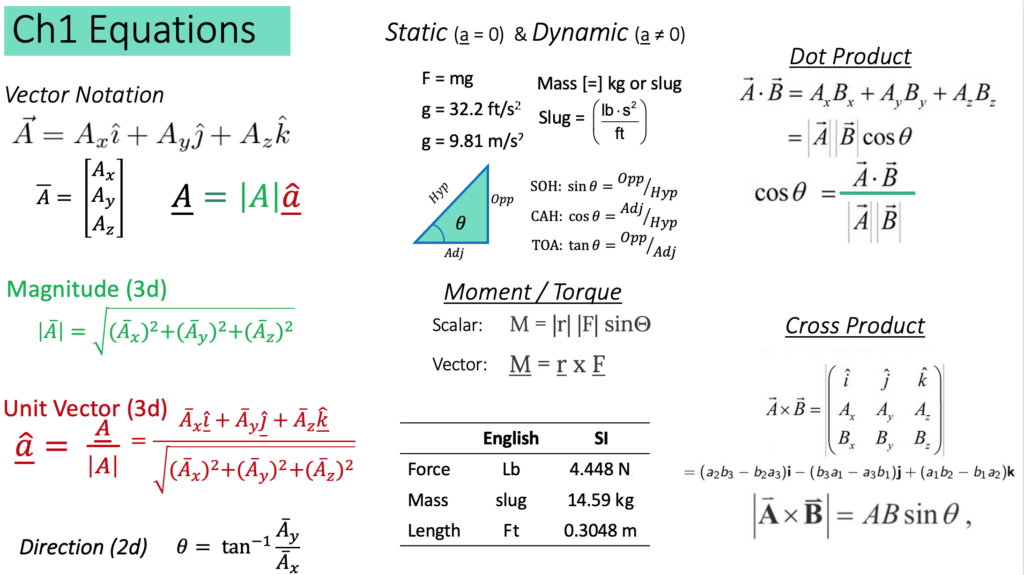
		<p><strong>Static vs Dynamic Motion</strong></p> <p>Before we start, what is the difference between <strong>static</strong> and <strong>dynamic</strong>? Static problems are all problems where there is no acceleration. As you’re driving down the road and you’re cruising along at a constant velocity, that is a static problem. As soon as you start to slow down for a stop light or speed up, you are in dynamic motion, and that’s much more complicated. For this course, we will only consider problems where there is <strong><span style="text-decoration: underline">no motion</span></strong> (such as the ‘static’ is used in the English language), or <strong><span style="text-decoration: underline">constant velocity</span></strong>. Be prepared to give many examples of static versus dynamic, because before you can solve a problem, you have to know what type of problem it is!</p> <p><strong>Introduction to Chapter 1: Fundamental Concepts</strong></p> <p>This chapter has a lot of concepts from math and physics that are necessary for you to understand before we can apply them in engineering contexts. It’s kind of like: before you can write an essay to express your opinion, you need to know how to write the a, b, c’s and what each word means. Here, you need to know how to compute a cross product before you can calculate how much Torque is created from a force.</p> <p>Some of this might be new. Some of this might be familiar, but we might be applying it in a different way. (Such as calculating torque – this is not what you learned in high school physics!) Some of it might feel new, so practice practice practice!</p> <p><span>Here are the sections in this Chapter:</span></p> <ul><li><span><a href="#chapter-review" data-url="https://pressbooks.library.upei.ca/statics/chapter/review/">1.1 Math &amp; Physics Important Concepts&nbsp; </a>(Mass, Weight, Slugs, Trig, Units, Conversions, Scalar, Vector, Newton’s Laws)</span></li> <li class="toc__title"><a href="#chapter-xyz-coordinate-frame-review" data-url="https://pressbooks.library.upei.ca/statics/chapter/xyz-coordinate-frame-review/">1.2 XYZ Coordinate Frame</a></li> <li class="toc__title"><a href="#chapter-vector-form-notation" data-url="https://pressbooks.library.upei.ca/statics/chapter/vector-form-notation/">1.3 Vectors</a></li> <li class="toc__title"><a href="#chapter-dot-and-cross-product" data-url="https://pressbooks.library.upei.ca/statics/chapter/dot-and-cross-product/">1.4 Dot Product</a></li> <li class="toc__title"><a href="#chapter-cross-products" data-url="https://pressbooks.library.upei.ca/statics/chapter/cross-products/">1.5 Cross Products</a></li> <li class="toc__title"><a href="#chapter-torque-moment" data-url="https://pressbooks.library.upei.ca/statics/chapter/torque-moment/">1.6 Torque/Moment</a></li> <li><a href="#chapter-smart-method-6-step" data-url="https://pressbooks.library.upei.ca/statics/chapter/smart-method-6-step/">1.7 Problem Solving Process</a></li> <li><a href="http://pressbooks.library.upei.ca/statics/chapter/1-8-examples/" data-url="http://pressbooks.library.upei.ca/statics/chapter/1-8-examples/">1.8 Student examples</a></li> </ul> <p>Here are the key equations and concepts you will learn in this chapter</p> <p><img src="http://pressbooks.library.upei.ca/statics/wp-content/uploads/sites/56/2020/05/Screen-Shot-2021-07-28-at-11.18.51-PM-1024x575.png" alt="List Equations for Chapter 1. These include: Vector Notation, Static vs Dynamic, Dot Product, 3d Magnitude, Moment vs Torque, Cross Product, 3d Unit Vector." class="aligncenter wp-image-984 size-large" width="1024" height="575" srcset="https://pressbooks.library.upei.ca/statics/wp-content/uploads/sites/56/2020/05/Screen-Shot-2021-07-28-at-11.18.51-PM-1024x575.png 1024w, https://pressbooks.library.upei.ca/statics/wp-content/uploads/sites/56/2020/05/Screen-Shot-2021-07-28-at-11.18.51-PM-300x169.png 300w, https://pressbooks.library.upei.ca/statics/wp-content/uploads/sites/56/2020/05/Screen-Shot-2021-07-28-at-11.18.51-PM-768x431.png 768w, https://pressbooks.library.upei.ca/statics/wp-content/uploads/sites/56/2020/05/Screen-Shot-2021-07-28-at-11.18.51-PM-1536x863.png 1536w, https://pressbooks.library.upei.ca/statics/wp-content/uploads/sites/56/2020/05/Screen-Shot-2021-07-28-at-11.18.51-PM-2048x1150.png 2048w, https://pressbooks.library.upei.ca/statics/wp-content/uploads/sites/56/2020/05/Screen-Shot-2021-07-28-at-11.18.51-PM-65x37.png 65w, https://pressbooks.library.upei.ca/statics/wp-content/uploads/sites/56/2020/05/Screen-Shot-2021-07-28-at-11.18.51-PM-225x126.png 225w, https://pressbooks.library.upei.ca/statics/wp-content/uploads/sites/56/2020/05/Screen-Shot-2021-07-28-at-11.18.51-PM-350x197.png 350w" sizes="auto, (max-width: 1024px) 100vw, 1024px" title="" /></p>
	</div>
			
				
	</div>
<div class="chapter standard with-subsections" id="chapter-review" title="1.1 Preparatory Concepts">
	<div class="chapter-title-wrap">
		<p class="chapter-number">1</p>
		<h1 class="chapter-title">1.1 Preparatory Concepts</h1>
								</div>
	<div class="ugc chapter-ugc">
				
 <h1 id="chapter-141-section-1" class="section-header">1.1.1 Scalar vs. Vector</h1> <div class="textbox"><p id="fs-id1167132379492">Many familiar physical quantities can be specified completely by giving a single number and the appropriate unit. For example, “a class period lasts 50 min” or “the gas tank in my car holds 65 L” or “the distance between two posts is 100 m.” A physical quantity that can be specified completely in this manner is called a<span>&nbsp;</span><strong>scalar quantity</strong>. Scalar is a synonym of “number.” Time, mass, distance, length, volume, temperature, and energy are examples of<span>&nbsp;</span><strong>scalar</strong><span>&nbsp;</span>quantities.</p> <p id="fs-id1167133331747">Scalar quantities that have the same physical units can be added or subtracted according to the usual rules of algebra for numbers. For example, a class ending 10 min earlier than 50 min lasts <span>(50 min – 10 min) = 40 min</span>. Similarly, a 60-cal serving of corn followed by a 200-cal serving of donuts gives <span>(60 cal + 200 cal) = 260 cal</span><span>&nbsp;</span>of energy. When we multiply a scalar quantity by a number, we obtain the same scalar quantity but with a larger (or smaller) value. For example, if yesterday’s breakfast had 200 cal of energy and today’s breakfast has four times as much energy as it had yesterday, then today’s breakfast has <span>4(200 cal) = 800 cal</span><span>&nbsp;</span>of energy. Two scalar quantities can also be multiplied or divided by each other to form a derived scalar quantity. For example, if a train covers a distance of 100 km in 1.0 h, its speed is 100.0 km/1.0 h = 27.8 m/s, where the speed is a derived scalar quantity obtained by dividing distance by time.</p> <p id="fs-id1167132683784">Many physical quantities, however, cannot be described completely by just a single number of physical units. For example, when the U.S. Coast Guard dispatches a ship or a helicopter for a rescue mission, the rescue team must know not only the distance to the distress signal, but also the direction from which the signal is coming so they can get to its origin as quickly as possible. Physical quantities specified completely by giving a number of units (magnitude) and a direction are called<span>&nbsp;</span><strong>vector quantities</strong>. Examples of vector quantities include displacement, velocity, position, force, and torque. In the language of mathematics, physical vector quantities are represented by mathematical objects called<strong><span>&nbsp;</span>vectors</strong>. We can add or subtract two vectors, and we can multiply a vector by a scalar or by another vector, but we cannot divide by a vector. The operation of division by a vector is not defined.</p> <p><img src="https://s3-us-west-2.amazonaws.com/courses-images/wp-content/uploads/sites/2952/2018/01/31183930/CNX_UPhysics_02_01_dog.jpg" alt="A photo of a dog. Below the photo is a horizontal arrow which starts below the dog’s tail and ends below the dog’s nose. The arrow is labeled Vector D, and its length is labeled as magnitude D. The start (tail) of the arrow is labeled “From tail of a vector origin” and its end (head) is labeled “To head of a vector end.”" class="aligncenter" width="409" height="243" title=""></p> <p>Source: University Physics Volume 1, OpenStax CNX <a href="https://courses.lumenlearning.com/suny-osuniversityphysics/chapter/2-1-scalars-and-vectors/" data-url="https://courses.lumenlearning.com/suny-osuniversityphysics/chapter/2-1-scalars-and-vectors/">https://courses.lumenlearning.com/suny-osuniversityphysics/chapter/2-1-scalars-and-vectors</a></p> </div> <div class="textbox textbox--key-takeaways"><div class="textbox__header"><p class="textbox__title">Key Takeaways</p> </div> <div class="textbox__content"><p><em>Basically</em>: a scalar has only magnitude, whereas a vector has magnitude <span style="text-decoration: underline">and</span> direction.</p> <p><em>Application:</em> I might have gone for a 4 km walk (scalar), but whether I walked in a straight line, took turns, or went 2 km out and turned around to walk 2 km back would tell me a lot more information (vector).</p> <p><em>Looking ahead: </em>We will talk about this again in sections 1.3 on vectors and in sections 1.4 and 1.5 on dot products and cross products.</p> </div> </div> <h1 id="chapter-141-section-2" class="section-header">1.1.2 Newton’s Laws</h1> <div class="textbox"><p><strong>1st Law:</strong></p> <p>Newton’s first law states that:<span>&nbsp;</span><strong>“A body at rest will remain at rest unless acted on by an unbalanced force. A body in motion continues in motion with the same speed and in the same direction unless acted upon by an unbalanced force.”</strong></p> <p>This law, also sometimes called the “law of inertia”, means that bodies maintain their current velocity unless a force is applied to change that velocity. If an object is at rest with zero velocity, it will remain at rest until some force begins to change that velocity, and if an object is moving at a set speed and in a set direction, it will remain at that same velocity until some force begins to change that velocity.</p> <p><strong>Net Forces:&nbsp;</strong><span>It is important to note that the&nbsp;</span><strong>net force</strong> <span>is what will cause a change in velocity. The net force is the sum of all forces acting on the body. For example, we can imagine gently pushing on the rock in the figure below and observing that the rock does not move. This is because we will have a friction force equal in magnitude and opposite in direction opposing our gentle pushing force. The sum of these two forces will be equal to zero; therefore, the net force is zero, and the change in velocity is zero.</span></p> <p style="direction: ltr"><strong>Rotational Motion:&nbsp;</strong><span>Newton’s first law also applies to moments and rotational velocities. A body will maintain its current rotational velocity until a net moment is exerted to change that rotational velocity. This can be seen in things like toy tops, flywheels, stationary bikes, and other objects that will continue spinning once started until brakes or friction stop them.</span></p> <div class="wp-caption aligncenter" id="attachment_2653" aria-describedby="caption-attachment-2653" style="width: 300px"><img src="http://pressbooks.library.upei.ca/statics/wp-content/uploads/sites/56/2021/02/Screenshot-2025-07-15-124853-300x239.png" alt="An illustration of a spacecraft with two large circular solar panels orbiting close to the Moon, with Earth visible in the background." width="300" height="239" class="wp-image-2653 size-medium" srcset="https://pressbooks.library.upei.ca/statics/wp-content/uploads/sites/56/2021/02/Screenshot-2025-07-15-124853-300x239.png 300w, https://pressbooks.library.upei.ca/statics/wp-content/uploads/sites/56/2021/02/Screenshot-2025-07-15-124853-65x52.png 65w, https://pressbooks.library.upei.ca/statics/wp-content/uploads/sites/56/2021/02/Screenshot-2025-07-15-124853-225x179.png 225w, https://pressbooks.library.upei.ca/statics/wp-content/uploads/sites/56/2021/02/Screenshot-2025-07-15-124853-350x278.png 350w, https://pressbooks.library.upei.ca/statics/wp-content/uploads/sites/56/2021/02/Screenshot-2025-07-15-124853.png 566w" sizes="auto, (max-width: 300px) 100vw, 300px" title=""><div class="wp-caption-text" id="caption-attachment-2653">In the absence of friction in space, this space capsule will maintain its current velocity until some outside force causes that velocity to change. Public Domain image by NASA.</div></div> <p>&nbsp;</p> <div class="wp-caption aligncenter" id="attachment_2654" aria-describedby="caption-attachment-2654" style="width: 300px"><img src="http://pressbooks.library.upei.ca/statics/wp-content/uploads/sites/56/2021/02/Screenshot-2025-07-15-124906-300x227.png" alt="A large rock rests in a grassy field, illustrating the concept of static equilibrium and net forces acting on it" width="300" height="227" class="wp-image-2654 size-medium" srcset="https://pressbooks.library.upei.ca/statics/wp-content/uploads/sites/56/2021/02/Screenshot-2025-07-15-124906-300x227.png 300w, https://pressbooks.library.upei.ca/statics/wp-content/uploads/sites/56/2021/02/Screenshot-2025-07-15-124906-65x49.png 65w, https://pressbooks.library.upei.ca/statics/wp-content/uploads/sites/56/2021/02/Screenshot-2025-07-15-124906-225x170.png 225w, https://pressbooks.library.upei.ca/statics/wp-content/uploads/sites/56/2021/02/Screenshot-2025-07-15-124906-350x265.png 350w, https://pressbooks.library.upei.ca/statics/wp-content/uploads/sites/56/2021/02/Screenshot-2025-07-15-124906.png 565w" sizes="auto, (max-width: 300px) 100vw, 300px" title=""><div class="wp-caption-text" id="caption-attachment-2654">This rock is at rest with zero velocity and will remain at rest until a net force causes the rock to move. The net force on the rock is the sum of any force pushing the rock and the friction force of the ground on the rock opposing that force. Image by Liz Gray CC-BY-SA 2.0.</div></div> <p>&nbsp;</p> <div class="wp-caption aligncenter" id="attachment_2655" aria-describedby="caption-attachment-2655" style="width: 300px"><img src="http://pressbooks.library.upei.ca/statics/wp-content/uploads/sites/56/2021/02/Screenshot-2025-07-15-124921-300x221.png" alt="A colourful spinning top on the ground, demonstrating how friction gradually slows its rotation" width="300" height="221" class="wp-image-2655 size-medium" srcset="https://pressbooks.library.upei.ca/statics/wp-content/uploads/sites/56/2021/02/Screenshot-2025-07-15-124921-300x221.png 300w, https://pressbooks.library.upei.ca/statics/wp-content/uploads/sites/56/2021/02/Screenshot-2025-07-15-124921-65x48.png 65w, https://pressbooks.library.upei.ca/statics/wp-content/uploads/sites/56/2021/02/Screenshot-2025-07-15-124921-225x166.png 225w, https://pressbooks.library.upei.ca/statics/wp-content/uploads/sites/56/2021/02/Screenshot-2025-07-15-124921-350x258.png 350w, https://pressbooks.library.upei.ca/statics/wp-content/uploads/sites/56/2021/02/Screenshot-2025-07-15-124921.png 706w" sizes="auto, (max-width: 300px) 100vw, 300px" title=""><div class="wp-caption-text" id="caption-attachment-2655">In the absence of friction, this spinning top would continue to spin forever, but the small frictional moment exerted at the point of contact between the top and the ground will slow the tops spinning over time. Image by Carrotmadman6 CC-BY-2.0</div></div> <p>&nbsp;</p> <p>Source: Engineering Mechanics, Jacob Moore et al., <a href="https://mechanicsmap.psu.edu/websites/1_mechanics_basics/1-7_newtons_first_law/firstlaw.html" data-url="https://mechanicsmap.psu.edu/websites/1_mechanics_basics/1-7_newtons_first_law/firstlaw.html">Mechanics Map – Newton’s First Law</a></p> <p>&nbsp;</p> <p><strong>2nd Law:</strong></p> <p><span>Newton’s second law states that:&nbsp;</span><strong>“When a net force acts on any body with mass, it produces an acceleration of that body. The net force will be equal to the mass of the body times the acceleration of the body.”</strong></p> <p>&nbsp;</p> <p><img src="http://localhost:3000/mathml?mathml=%3Cmath%20display%3D%22block%22%20xmlns%3D%22http%3A%2F%2Fwww.w3.org%2F1998%2FMath%2FMathML%22%3E%3Cmrow%20class%3D%22MJX-TeXAtom-ORD%22%3E%3Cmover%3E%3Cmi%3EF%3C%2Fmi%3E%3Cmo%20stretchy%3D%22false%22%3E%E2%86%92%3C%21--%20%E2%86%92%20--%3E%3C%2Fmo%3E%3C%2Fmover%3E%3C%2Fmrow%3E%3Cmo%3E%3D%3C%2Fmo%3E%3Cmi%3Em%3C%2Fmi%3E%3Cmrow%20class%3D%22MJX-TeXAtom-ORD%22%3E%3Cmover%3E%3Cmi%3Ea%3C%2Fmi%3E%3Cmo%20stretchy%3D%22false%22%3E%E2%86%92%3C%21--%20%E2%86%92%20--%3E%3C%2Fmo%3E%3C%2Fmover%3E%3C%2Fmrow%3E%3C%2Fmath%3E&amp;fg=000000&amp;font=TeX&amp;svg=1" alt="F→=ma→" title="F→=ma→" class="mathml mathjax">&nbsp;</p> <p>You will notice that the force and the acceleration in the equation above have an arrow above them. This means that they are vector quantities, having both a magnitude and a direction. Mass, on the other hand, is a scalar quantity having only a magnitude. Based on the above equation, you can infer that the magnitude of the net force acting on the body will be equal to the mass of the body times the magnitude of the acceleration, and that the direction of the net force on the body will be equal to the direction of the acceleration of the body.</p> <p><strong>Rotational Motion:&nbsp;</strong><span>Newton’s second law also applies to moments and rotational velocities. The revised version of the second law equation states that the net moment acting on the object will be equal to the mass moment of inertia of the body about the axis of rotation (I) times the angular acceleration of the body.</span></p> <p>&nbsp;</p> <p><img src="http://localhost:3000/mathml?mathml=%3Cmath%20display%3D%22block%22%20xmlns%3D%22http%3A%2F%2Fwww.w3.org%2F1998%2FMath%2FMathML%22%3E%3Cmrow%20class%3D%22MJX-TeXAtom-ORD%22%3E%3Cmover%3E%3Cmi%3EM%3C%2Fmi%3E%3Cmo%20stretchy%3D%22false%22%3E%E2%86%92%3C%21--%20%E2%86%92%20--%3E%3C%2Fmo%3E%3C%2Fmover%3E%3C%2Fmrow%3E%3Cmo%3E%3D%3C%2Fmo%3E%3Cmi%3EI%3C%2Fmi%3E%3Cmo%3E%E2%88%97%3C%21--%20%E2%88%97%20--%3E%3C%2Fmo%3E%3Cmrow%20class%3D%22MJX-TeXAtom-ORD%22%3E%3Cmover%3E%3Cmi%3E%CE%B1%3C%21--%20%CE%B1%20--%3E%3C%2Fmi%3E%3Cmo%20stretchy%3D%22false%22%3E%E2%86%92%3C%21--%20%E2%86%92%20--%3E%3C%2Fmo%3E%3C%2Fmover%3E%3C%2Fmrow%3E%3C%2Fmath%3E&amp;fg=000000&amp;font=TeX&amp;svg=1" alt="M→=I∗α→" title="M→=I∗α→" class="mathml mathjax">&nbsp;</p> <p><span>You should again notice that the moment and the angular acceleration of the body have arrows above them, indicating that they are vector quantities with both a magnitude and direction. The mass moment of inertia, on the other hand, is a scalar quantity having only a magnitude. The magnitude of the net moment will be equal to the mass moment of inertia times the magnitude of the angular acceleration, and the direction of the net moment will be equal to the direction of the angular acceleration.</span></p> <p>Source: Engineering Mechanics, Jacob Moore et al., <a href="https://mechanicsmap.psu.edu/websites/1_mechanics_basics/1-8_newtons_second_law/secondlaw.html" data-url="https://mechanicsmap.psu.edu/websites/1_mechanics_basics/1-8_newtons_second_law/secondlaw.html">Mechanics Map – Newton’s Second Law</a></p> <p>&nbsp;</p> <p><strong>3rd Law:</strong></p> <p><span>Newton’s Third Law states, </span><strong>“For any action, there is an equal and opposite reaction.”</strong> <span>By “action,” Newton meant a force, so for every force one body exerts on another body, that second body exerts a force of equal magnitude but opposite direction back on the first body. Since all forces are exerted by bodies (either directly or indirectly), all forces come in pairs, one acting on each of the bodies interacting.</span></p> <p><span>Though there may be two equal and opposite forces acting on a single body, it is important to remember that for each of the forces, a Third Law pair acts on a separate body. This can sometimes be confusing when there are multiple Third Law pairs at work. Below are some examples of situations where multiple Third Law pairs occur.</span></p> <div class="wp-caption aligncenter" id="attachment_2656" aria-describedby="caption-attachment-2656" style="width: 260px"><img src="http://pressbooks.library.upei.ca/statics/wp-content/uploads/sites/56/2021/02/Screenshot-2025-07-15-130846-260x300.png" alt="A volleyball on a surface illustrating gravitational and normal forces acting on the ball and ground in equilibrium." width="260" height="300" class="wp-image-2656 size-medium" srcset="https://pressbooks.library.upei.ca/statics/wp-content/uploads/sites/56/2021/02/Screenshot-2025-07-15-130846-260x300.png 260w, https://pressbooks.library.upei.ca/statics/wp-content/uploads/sites/56/2021/02/Screenshot-2025-07-15-130846-65x75.png 65w, https://pressbooks.library.upei.ca/statics/wp-content/uploads/sites/56/2021/02/Screenshot-2025-07-15-130846-225x259.png 225w, https://pressbooks.library.upei.ca/statics/wp-content/uploads/sites/56/2021/02/Screenshot-2025-07-15-130846.png 290w" sizes="auto, (max-width: 260px) 100vw, 260px" title=""><div class="wp-caption-text" id="caption-attachment-2656">This volleyball resting on a surface has two pairs of Third Law forces. The first consists of the gravitational forces (one force on the ball and one force on the ground). The second consists of the normal forces at the point of contact (one force on the ball and one force on the ground). Image adapted from Public Domain image, no author listed.</div></div> <p>&nbsp;</p> <div class="wp-caption aligncenter" id="attachment_2657" aria-describedby="caption-attachment-2657" style="width: 269px"><img src="http://pressbooks.library.upei.ca/statics/wp-content/uploads/sites/56/2021/02/Screenshot-2025-07-15-130858-269x300.png" alt="A metal clamp holding a wooden block, illustrating normal forces at both contact points, adapted from a public domain image." width="269" height="300" class="wp-image-2657 size-medium" srcset="https://pressbooks.library.upei.ca/statics/wp-content/uploads/sites/56/2021/02/Screenshot-2025-07-15-130858-269x300.png 269w, https://pressbooks.library.upei.ca/statics/wp-content/uploads/sites/56/2021/02/Screenshot-2025-07-15-130858-65x73.png 65w, https://pressbooks.library.upei.ca/statics/wp-content/uploads/sites/56/2021/02/Screenshot-2025-07-15-130858-225x251.png 225w, https://pressbooks.library.upei.ca/statics/wp-content/uploads/sites/56/2021/02/Screenshot-2025-07-15-130858.png 293w" sizes="auto, (max-width: 269px) 100vw, 269px" title=""><div class="wp-caption-text" id="caption-attachment-2657">If we ignore the weight of the two objects, this clamp will also have two pairs of Third Law forces. The first will be a set of normal forces at the top point of contact (one force on the wood and one force on the clamp) and the second will be another set of normal forces at the bottom point of contact (one force on the wood and one force on the clamp) Image adapted from Public Domain image, no author listed.</div></div> <p>&nbsp;</p> <p>Source: Engineering Mechanics, Jacob Moore et al., <a href="https://mechanicsmap.psu.edu/websites/1_mechanics_basics/1-9_newtons_third_law/thirdlaw.html" data-url="https://mechanicsmap.psu.edu/websites/1_mechanics_basics/1-9_newtons_third_law/thirdlaw.html">Mechanics Map – Newton’s Third Law</a></p> </div> <div class="textbox textbox--key-takeaways"><div class="textbox__header"><p class="textbox__title">Key Takeaways</p> </div> <div class="textbox__content"><p><em>Basically</em>: These 3 laws form the foundation of statics and dynamics. It makes our problems interesting! In statics, we don’t do a lot with rotation.</p> <ul><li><span style="text-decoration: underline">1st law:</span> the motion of an object won’t change unless there is a force to cause the change.</li> <li><span style="text-decoration: underline">2nd law</span>: Combination of all forces = mass * acceleration</li> <li><span style="text-decoration: underline">3rd law</span>: A system of interacting objects can be split up into parts, where forces are used to model the other part. Forces are equal (same size) and opposite (their directions cancel out – one up, one down</li> </ul> <p><em>Application:</em> <span style="text-decoration: underline">1st law:</span> a rock rolling down the hill will keep going unless it hits a tree. <span style="text-decoration: underline">2nd law</span>: the amount of forces on the rock and how massive (heavy) it is will determine how much it is accelerating (or decelerating). <span style="text-decoration: underline">3rd law</span>: the rock is pushing on the ground with the same amount of force as the ground is pushing on the rock, but in the opposite direction.</p> <p><em>Looking ahead: </em>You’ll see these concepts again in Ch 7 on Inertia (<span style="text-decoration: underline">1st law</span>), Section 2.3 and 4.3 on equillibrium equations <span style="text-decoration: underline">(2nd law), </span>Section 4.2 on system free-body diagrams (<span style="text-decoration: underline">3rd law</span>).<em><br> </em></p> </div> </div> <h1 id="chapter-141-section-3" class="section-header"><strong>1.1.3 Units</strong></h1> <div class="textbox"><p id="fs-id1168329295259">Giving numerical values for physical quantities and equations for physical principles allows us to understand nature much more deeply than qualitative descriptions alone. To comprehend these vast ranges, we must also have accepted units in which to express them. We shall find that even in the potentially mundane discussion of meters, kilograms, and seconds, a profound simplicity of nature appears: all physical quantities can be expressed as combinations of only seven base physical quantities.</p> <p id="fs-id1168329075122">We define a<span>&nbsp;</span><strong>physical quantity</strong><span>&nbsp;</span>either by specifying how it is measured or by stating how it is calculated from other measurements. For example, we might define distance and time by specifying methods for measuring them, such as using a meter stick and a stopwatch. Then, we could define<span>&nbsp;</span><em>average speed</em><span>&nbsp;</span>by stating that it is calculated as the total distance traveled divided by time of travel.</p> <p><span>Measurements of physical quantities are expressed in terms of&nbsp;</span><strong>units</strong><span>, which are standardized values. For example, the length of a race, which is a physical quantity, can be expressed in units of meters (for sprinters) or kilometers (for distance runners). Without standardized units, it would be extremely difficult for scientists to express and compare measured values in a meaningful way.</span></p> <p><span>Two major systems of units are used in the world:&nbsp;</span><strong>SI units</strong><span>&nbsp;(for the French&nbsp;</span><em>Système International d’Unités</em><span>), also known as the&nbsp;</span><em>metric system</em><span>, and&nbsp;</span><strong>English units</strong><span>&nbsp;(also known as the&nbsp;</span><em>customary</em><span>&nbsp;or&nbsp;</span><em>imperial system</em><span>). English units were historically used in nations once ruled by the British Empire and are still widely used in the United States. English units may also be referred to as the&nbsp;</span><em>foot–pound–second</em><span>&nbsp;(fps) system, as opposed to the&nbsp;</span><em>centimeter–gram–second</em><span>&nbsp;(cgs) system.&nbsp;</span></p> <p><strong>SI Units: Base and Derived Units</strong></p> <p id="fs-id1168326756913">In any system of units, the units for some physical quantities must be defined through a measurement process. These are called the base quantities for that system and their units are the system’s<strong><span>&nbsp;</span>base units</strong>. All other physical quantities can then be expressed as algebraic combinations of the base quantities. Each of these physical quantities is then known as a<strong><span>&nbsp;</span>derived quantity</strong><span>&nbsp;</span>and each unit is called a<span>&nbsp;</span><strong>derived unit</strong>. The choice of base quantities is somewhat arbitrary, as long as they are independent of each other and all other quantities can be derived from them. Typically, the goal is to choose physical quantities that can be measured accurately to a high precision as the base quantities. The reason for this is simple. Since the<span>&nbsp;</span><strong><span class="no-emphasis">derived units</span><span>&nbsp;</span></strong>can be expressed as algebraic combinations of the base units, they can only be as accurate and precise as the base units from which they are derived.</p> <p id="fs-id1168329477724">Based on such considerations, the International Standards Organization recommends using seven base quantities, which form the International System of Quantities (ISQ). These are the base quantities used to define the SI base units. <span>The following table </span>lists these seven ISQ base quantities and the corresponding SI base units.</p> <table class="grid aligncenter" style="border-collapse: collapse;width: 46.2366%;height: 120px"><tbody><tr style="height: 15px"><td class="shaded" style="width: 50%;height: 15px"><span style="color: #000000"><strong>ISQ Base Quantity</strong></span></td> <td class="shaded" style="width: 50%;height: 15px"><span style="color: #000000"><strong>SI Base Unit</strong></span></td> </tr> <tr style="height: 15px"><td class="border" style="width: 50%;height: 15px">Length</td> <td class="border" style="width: 50%;height: 15px">Meter (m)</td> </tr> <tr style="height: 15px"><td class="border" style="width: 50%;height: 15px">Mass</td> <td class="border" style="width: 50%;height: 15px">Kilogram (kg)</td> </tr> <tr style="height: 15px"><td class="border" style="width: 50%;height: 15px">Time</td> <td class="border" style="width: 50%;height: 15px">Second (s)</td> </tr> <tr style="height: 15px"><td class="border" style="width: 50%;height: 15px">Electrical current</td> <td class="border" style="width: 50%;height: 15px">Ampere (A)</td> </tr> <tr style="height: 15px"><td class="border" style="width: 50%;height: 15px">Thermodynamic temp.</td> <td class="border" style="width: 50%;height: 15px">Kelvin (K)</td> </tr> <tr style="height: 15px"><td class="border" style="width: 50%;height: 15px">Amount of substance</td> <td class="border" style="width: 50%;height: 15px">Mole (mol)</td> </tr> <tr style="height: 15px"><td class="border" style="width: 50%;height: 15px">Luminous intensity</td> <td class="border" style="width: 50%;height: 15px">Candela (cd)</td> </tr> </tbody> </table> <p>You are probably already familiar with some derived quantities that can be formed from the base quantities. For example, the geometric concept of area is always calculated as the product of two lengths. Thus, area is a derived quantity that can be expressed in terms of SI base units using square meters (m x m = m<sup>2</sup>).</p> <p>Similarly, volume is a derived quantity that can be expressed in cubic meters (m<sup>3</sup>). Speed is length per time; so in terms of SI base units, we could measure it in meters per <span>second (m/s). Volume mass density (or just density) is mass per volume, which is expressed in terms of SI base units such as kilograms per cubic meter (kg/m</span><sup>3</sup><span>). Angles can also be thought of as derived quantities because they can be defined as the ratio of the arc length subtended by two radii of a circle to the radius of the circle. This is how the radian is defined. Depending on your background and interests, you may be able to come up with other derived quantities, such as the mass flow rate (kg/s) or volume flow rate (m</span><sup>3</sup><span>/s) of a fluid, electric charge (A·s),</span> <span>mass flux density kg/(m<sup>2</sup>·s), and so on. We will see many more examples throughout this text. For now, the point is that every physical quantity can be derived from the seven base quantities</span><span>, and the units of every physical quantity can be derived from the seven SI base units.</span></p> <p>Source: University Physics Volume 1, OpenStax CNX, <a href="https://courses.lumenlearning.com/suny-osuniversityphysics/chapter/1-2-units-and-standards/" data-url="https://courses.lumenlearning.com/suny-osuniversityphysics/chapter/1-2-units-and-standards/">https://courses.lumenlearning.com/suny-osuniversityphysics/chapter/1-2-units-and-standards/</a></p> </div> <p>While most Canadian companies use SI, much manufacturing still uses English units, so it’s important for you to be familiar with them. What is a big number in feet? What is small? It’s important to know. The most important advice is to <em><strong>stay in one unit system.</strong> </em>So, if you are doing a homework problem that has a mixture, convert to one system to be consistent. Challenge yourself to try the one you aren’t comfortable with. Here is a table of the most common quantities that we’ll use in this class:</p> <table class="grid aligncenter" style="border-collapse: collapse;width: 80.4061%;height: 91px"><tbody><tr style="height: 15px"><td class="shaded" style="width: 14.5566%;height: 15px"><span style="text-decoration: underline"><span style="color: #000000;text-decoration: underline"><strong>Quantity</strong></span></span></td> <td class="shaded" style="width: 39.0188%;height: 15px"><span style="text-decoration: underline"><span style="color: #000000"><strong>SI Unit</strong></span></span></td> <td class="shaded" style="width: 34.0995%;height: 15px"><span style="text-decoration: underline"><span style="color: #000000"><strong>English</strong></span></span></td> </tr> <tr style="height: 15px"><td style="width: 14.5566%;height: 15px">Length</td> <td class="border" style="width: 39.0188%;height: 15px">m (meter), km (kilometer), mm (milimeter)</td> <td style="width: 34.0995%;height: 15px">ft (foot), mi (mile), in (inch)</td> </tr> <tr style="height: 15px"><td style="width: 14.5566%;height: 15px">Mass</td> <td class="border" style="width: 39.0188%;height: 15px">kg (kilogram)</td> <td style="width: 34.0995%;height: 15px">slug</td> </tr> <tr style="height: 15px"><td style="width: 14.5566%;height: 15px">Force</td> <td class="border" style="width: 39.0188%;height: 15px">N (Newton)</td> <td style="width: 34.0995%;height: 15px">lb (pound)</td> </tr> <tr style="height: 31px"><td style="width: 14.5566%;height: 31px">Pressure</td> <td style="width: 39.0188%;height: 31px">Pa (Pascal) = N/m<sup>2</sup></td> <td style="width: 34.0995%;height: 31px">psi (pound per square inch) = lb/in<sup>2</sup></td> </tr> </tbody> </table> <p>Very helpful additional information about units is at this webpage:</p> <p style="text-align: center"><a href="https://www.physics.nist.gov/cuu/Units/index.html" data-url="https://www.physics.nist.gov/cuu/Units/index.html">https://www.physics.nist.gov/cuu/Units/index.html</a></p> <p>&nbsp;</p> <div class="textbox textbox--key-takeaways"><div class="textbox__header"><p class="textbox__title">Key Takeaways</p> </div> <div class="textbox__content"><p><em>Basically:&nbsp;</em>Units give us a standard so we can use the same language to describe a concept.</p> <p><em>Application:</em> In 1999, after taking 286 days for NASA Mars Orbiter satellite to get to Mars, a conversion error between N and lb caused the $125 million satellite to be lost, forever. Click <a href="https://spacemath.gsfc.nasa.gov/Grade67/6Page53.pdf" data-url="https://spacemath.gsfc.nasa.gov/Grade67/6Page53.pdf">here</a> for more fun conversion error stories. If you want to design ANYTHING, you need to be sure everyone involved is using the same unit system.</p> <p><em>Looking Ahead:</em> The next section (1.1.4) will look at converting the units back and forth between the two systems.</p> </div> </div> <h1 id="chapter-141-section-4" class="section-header">1.1.4 Measurement Conversions</h1> <div class="textbox"><p id="fs-id1168327934938">It is often necessary to convert from one unit to another. For example, if you are reading a European cookbook, some quantities may be expressed in units of liters and you need to convert them to cups. Or perhaps you are reading walking directions from one location to another and you are interested in how many miles you will be walking. In this case, you may need to convert units of feet or meters to miles.</p> <p id="fs-id1168328205340">Let’s consider a simple example of how to convert units. Suppose we want to convert 80 m to kilometers. The first thing to do is to list the units you have and the units to which you want to convert. In this case, we have units in<span>&nbsp;</span><em>meters</em><span>&nbsp;</span>and we want to convert to<span>&nbsp;</span><em>kilometers</em>. Next, we need to determine a conversion factor relating meters to kilometers. A<strong><span>&nbsp;</span>conversion factor</strong><span>&nbsp;</span>is a ratio that expresses how many of one unit are equal to another unit. For example, there are 12 in. in 1 ft, 1609 m in 1 mi, 100 cm in 1 m, 60 s in 1 min, and so on.&nbsp;In this case, we know that there are 1000 m in 1 km. Now we can set up our unit conversion. We write the units we have and then multiply them by the conversion factor so the units cancel out, as shown:</p> <p style="text-align: center"><img src="http://localhost:3000/latex?latex=80m%5Ctimes%5Cfrac%7B1km%7D%7B1000m%7D%3D0.080km&amp;fg=000000&amp;font=TeX&amp;svg=1" alt="80m\times\frac{1km}{1000m}=0.080km" title="80m\times\frac{1km}{1000m}=0.080km" class="latex mathjax"></p> <p><span>Note that the unwanted meter unit cancels, leaving only the desired kilometer unit. You can use this method to convert between any type of unit. Now, the conversion of 80 m to kilometers is simply the use of a metric prefix, as we saw in the preceding section, so we can get the same answer just as easily by noting that</span></p> <p><img src="http://pressbooks.library.upei.ca/statics/wp-content/uploads/sites/56/2021/02/Screenshot-2025-07-12-142850-300x32.png" alt="The image shows the conversion of 80 meters to scientific notation and kilometers: 80 m = 8.0 × 10¹ m = 8.0 × 10⁻² km = 0.080 km" width="347" height="37" class="aligncenter wp-image-2627" srcset="https://pressbooks.library.upei.ca/statics/wp-content/uploads/sites/56/2021/02/Screenshot-2025-07-12-142850-300x32.png 300w, https://pressbooks.library.upei.ca/statics/wp-content/uploads/sites/56/2021/02/Screenshot-2025-07-12-142850-65x7.png 65w, https://pressbooks.library.upei.ca/statics/wp-content/uploads/sites/56/2021/02/Screenshot-2025-07-12-142850-225x24.png 225w, https://pressbooks.library.upei.ca/statics/wp-content/uploads/sites/56/2021/02/Screenshot-2025-07-12-142850-350x38.png 350w, https://pressbooks.library.upei.ca/statics/wp-content/uploads/sites/56/2021/02/Screenshot-2025-07-12-142850.png 417w" sizes="auto, (max-width: 347px) 100vw, 347px" title=""></p> <p style="text-align: left">Since “kilo-” means 10<sup>3</sup>, however, using conversion factors is handy when converting between units that are not metric or when converting between derived units, as the following examples illustrate.</p> <p>Source: University Physics Volume 1, OpenStax CNX, <a href="https://courses.lumenlearning.com/suny-osuniversityphysics/chapter/1-3-unit-conversion/" data-url="https://courses.lumenlearning.com/suny-osuniversityphysics/chapter/1-3-unit-conversion/">https://courses.lumenlearning.com/suny-osuniversityphysics/chapter/1-3-unit-conversion/</a></p> </div> <p>Going back and forth between SI and English will become a very useful skill. If you can memorize km to mi, ft to m, and inches to ft, you’ll be able to communicate better with coworkers. Here are common conversions you’ll need for this course:</p> <table class="grid aligncenter" style="width: 516px"><tbody><tr><td class="shaded" style="width: 77.4167px"><span><strong>Quantity</strong></span></td> <td class="shaded" style="width: 124.717px"><span><strong>SI<br> </strong></span></td> <td class="shaded" style="width: 115.017px"><span><strong>English</strong></span></td> <td class="shaded" style="width: 141.983px"><span><strong>Convert</strong></span></td> </tr> <tr><td style="width: 77.4167px">Length</td> <td class="border" style="width: 124.717px">1 km = 1000 m <p>1 m = 1000 mm</p></td> <td style="width: 115.017px">1 mi = 5,280 ft <p>1 ft = 12 in</p></td> <td style="width: 141.983px">1 m = 3.28 ft <p>2.2 km = 1 mi</p></td> </tr> <tr><td style="width: 77.4167px">Mass</td> <td class="border" style="width: 124.717px">kg</td> <td style="width: 115.017px">slug</td> <td style="width: 141.983px">1 slug = 14.6 kg</td> </tr> <tr><td style="width: 77.4167px">Force</td> <td class="border" style="width: 124.717px">N</td> <td style="width: 115.017px">lb</td> <td style="width: 141.983px">1 lb = 4.448 N</td> </tr> <tr><td style="width: 77.4167px">Pressure</td> <td style="width: 124.717px">Pa</td> <td style="width: 115.017px">psi</td> <td style="width: 141.983px"><div class="page" title="Page 1"><div class="section"><div class="layoutArea"><div class="column"><p><span>1psi = 6895 Pa </span></p> </div> </div> </div> </div> </td> </tr> </tbody> </table> <p>All of the other units that we will encounter will be a mix of these units (intensity <span style="text-decoration: underline">w</span> = N/m or lb/ft). One additional conversion that is common is 1 lb = 2.2 kg, though this only works on Earth because it is mixing kg and lb (see next section). For a full table, MechanicsMap has a pdf available: <a href="http://mechanicsmap.psu.edu/websites/UnitConversion.pdf" data-url="http://mechanicsmap.psu.edu/websites/UnitConversion.pdf">http://mechanicsmap.psu.edu/websites/UnitConversion.pdf</a></p> <p>&nbsp;</p> <table cellpadding="3" style="width: 100%; border-spacing: 0px;"><tbody><tr><td colspan="3"><div class="textbox"><table class="no-lines" cellpadding="3" style="width: 100%; border-spacing: 0px;"><tbody><tr><td colspan="3"><b><span style="color: #006633;font-family: Myriad Roman,Syntax,Arial,Helvetica;font-size: large">Units outside the SI that are accepted for use with the SI</span></b> <hr> </td> </tr> <tr><td><b>Name</b></td> <td><b>Symbol&nbsp;</b></td> <td><b>Value in SI units</b></td> </tr> <tr style="background-color: #D0F0C8;"><td>minute (time)</td> <td>min</td> <td>1 min = 60 s</td> </tr> <tr><td>hour</td> <td>h</td> <td>1 h = 60 min = 3600 s</td> </tr> <tr style="background-color: #D0F0C8;"><td>day</td> <td>d</td> <td>1 d = 24 h = 86 400 s</td> </tr> <tr><td>degree (angle)</td> <td>°</td> <td>1° = ( <img src="https://www.physics.nist.gov/cuu/Images/pi.gif" alt="pi" title="" style="text-align: absbottom;">/180) rad</td> </tr> <tr style="background-color: #D0F0C8;"><td>minute (angle)</td> <td><img src="https://www.physics.nist.gov/cuu/Images/prime.gif" alt="&amp;#039;" width="4" height="17" title="" style="text-align: absbottom;"></td> <td>1<img src="https://www.physics.nist.gov/cuu/Images/prime.gif" alt="&amp;#039;" width="4" height="17" title="" style="text-align: absbottom;"> = (1/60)° = (<img src="https://www.physics.nist.gov/cuu/Images/pi.gif" alt="pi" title="" style="text-align: absbottom;">/10 800) rad</td> </tr> <tr><td>second (angle)</td> <td><img src="https://www.physics.nist.gov/cuu/Images/prime.gif" alt="&amp;#039;" width="4" height="17" title="" style="text-align: absbottom;"><img src="https://www.physics.nist.gov/cuu/Images/prime.gif" alt="&amp;#039;" width="4" height="17" title="" style="text-align: absbottom;"></td> <td>1<img src="https://www.physics.nist.gov/cuu/Images/prime.gif" alt="&amp;#039;" width="4" height="17" title="" style="text-align: absbottom;"><img src="https://www.physics.nist.gov/cuu/Images/prime.gif" alt="&amp;#039;" width="4" height="17" title="" style="text-align: absbottom;"> = (1/60)<img src="https://www.physics.nist.gov/cuu/Images/prime.gif" alt="&amp;#039;" width="4" height="17" title="" style="text-align: absbottom;"> = (<img src="https://www.physics.nist.gov/cuu/Images/pi.gif" alt="pi" title="" style="text-align: absbottom;">/648 000) rad</td> </tr> <tr style="background-color: #D0F0C8;"><td>liter</td> <td>L</td> <td>1 L = 1 dm<sup>3 </sup>= 10<sup>-3</sup> m<sup>3 </sup></td> </tr> <tr><td>metric ton <sup>(a)</sup></td> <td>t</td> <td>1 t = 10<sup>3</sup> kg</td> </tr> <tr style="background-color: #D0F0C8;"><td>neper</td> <td>Np</td> <td>1 Np = 1</td> </tr> <tr><td>bel <sup>(b)</sup></td> <td>B</td> <td>1 B = (1/2) ln 10 Np <sup>(c)</sup></td> </tr> <tr style="background-color: #D0F0C8;"><td>electronvolt <sup>(d)</sup></td> <td>eV</td> <td>1 eV = 1.602 18 x 10<sup>-19</sup> J, approximately</td> </tr> <tr><td>unified atomic mass unit <sup>(e)</sup></td> <td>u</td> <td>1 u = 1.660 54 x 10<sup>-27</sup> kg, approximately</td> </tr> <tr style="background-color: #D0F0C8;"><td>astronomical unit <sup>(f)</sup></td> <td><span style="font-family: Myriad Roman,Syntax,Arial,Helvetica">au</span></td> <td>1 <span style="font-family: Myriad Roman,Syntax,Arial,Helvetica">au</span> = <span style="font-family: Myriad Roman,Syntax,Arial,Helvetica">149 597 870 700 m, exactly</span></td> </tr> <tr><td colspan="3"><sup><span style="font-size: small">(a) </span></sup><span style="font-size: small">In many countries, this unit is called “tonne.”<br> <sup>(b) </sup>The bel is most commonly used with the SI prefix deci: 1 dB = 0.1 B.<br> <sup>(c) </sup>Although the neper is coherent with SI units and is accepted by the CIPM, it has not been adopted by the General Conference on Weights and Measures (CGPM, <i>Conférence Générale des Poids et Mesures</i>) and is thus not an SI unit.<br> <sup>(d) </sup>The electronvolt is the kinetic energy acquired by an electron passing through a potential difference of 1 V in vacuum. The value must be obtained by experiment, and is therefore not known exactly.<br> <sup>(e) </sup>The unified atomic mass unit is equal to 1/12 of the mass of an unbound atom of the nuclide <sup>12</sup>C, at rest and in its ground state. The value must be obtained by experiment, and is therefore not known exactly.<sup><br> (f) </sup>The astronomical unit <span style="font-family: Myriad Roman,Syntax,Arial,Helvetica">of length was redefined by the XXVIII General Assembly of the International Astronomical Union (Resolution B2, 2012).</span></span></td> </tr> </tbody> </table> <p>Source: <a href="https://www.physics.nist.gov/cuu/Units/outside.html" data-url="https://www.physics.nist.gov/cuu/Units/outside.html">https://www.physics.nist.gov/cuu/Units/outside.html</a></p> </div> <p>&nbsp;</p></td> </tr> <tr><td></td> <td></td> <td></td> </tr> <tr style="background-color: #D0F0C8;"><td></td> <td></td> <td></td> </tr> <tr><td></td> <td></td> <td></td> </tr> <tr style="background-color: #D0F0C8;"><td></td> <td></td> <td></td> </tr> <tr><td></td> <td></td> <td></td> </tr> <tr style="background-color: #D0F0C8;"><td></td> <td></td> <td></td> </tr> <tr><td></td> <td></td> <td></td> </tr> <tr style="background-color: #D0F0C8;"><td></td> <td></td> <td></td> </tr> <tr><td></td> <td></td> <td></td> </tr> <tr style="background-color: #D0F0C8;"><td></td> <td></td> <td></td> </tr> <tr><td></td> <td></td> <td></td> </tr> <tr style="background-color: #D0F0C8;"><td></td> <td></td> <td></td> </tr> <tr><td></td> <td></td> <td></td> </tr> <tr style="background-color: #D0F0C8;"><td></td> <td></td> <td></td> </tr> <tr><td colspan="3"></td> </tr> </tbody> </table> <p>&nbsp;</p> <p>&nbsp;</p> <p>&nbsp;</p> <div class="textbox textbox--key-takeaways"><div class="textbox__header"><p class="textbox__title">Key Takeaways</p> </div> <div class="textbox__content"><p><em>Basically:</em> Different industries use different standards. English is common in the US. SI is standard many other places, however not generally in aerospace.</p> <p><em>Application:</em> In 1999, after taking 286 days for NASA Mars Orbiter satellite to get to Mars, a conversion error between N and lb caused the $125 million satellite to be lost, forever. Click <a href="https://spacemath.gsfc.nasa.gov/Grade67/6Page53.pdf" data-url="https://spacemath.gsfc.nasa.gov/Grade67/6Page53.pdf">here</a> for more fun conversion error stories. If you want to design ANYTHING, you need to be sure everyone involved is using the same unit system.</p> <p><em>Looking Ahead:</em> Always always always check what unit you’re using. So many students lose points on homework and the test because they aren’t paying attention to units.</p> </div> </div> <h1 id="chapter-141-section-5" class="section-header">1.1.5 Weight vs. Mass</h1> <div class="textbox"><div class="page" title="Page 122"><div class="layoutArea"><div class="column"><p><span>Weight is the force exerted by gravity. While all objects with mass exert an attractive force </span><span>of gravity on all other objects with mass, that force is usually negligible unless the mass of </span><span>one of the objects is very large. For an object near the surface of the Earth, we can, to a </span><span>very good degree of approximation, assume that the only force of gravity on the object is </span><span></span><span>from the Earth. We usually label the force of gravity on an object as </span><span>F</span><sub><span>g</span></sub><span>. All objects near </span><span>the surface of the Earth will experience a weight, as long as they have a mass. If an object has a mass, </span><span>m</span><span>, and is located near the surface of the Earth, it will experience a force (its weight) that is given by: </span></p> <p style="text-align: center"><img src="http://pressbooks.library.upei.ca/statics/wp-content/uploads/sites/56/2021/02/Screenshot-2025-07-12-153525.png" alt="Newton’s second law for weight: The gravitational force vector equals mass times gravitational acceleration vector." width="135" height="57" class="alignnone wp-image-2629" srcset="https://pressbooks.library.upei.ca/statics/wp-content/uploads/sites/56/2021/02/Screenshot-2025-07-12-153525.png 111w, https://pressbooks.library.upei.ca/statics/wp-content/uploads/sites/56/2021/02/Screenshot-2025-07-12-153525-65x28.png 65w" sizes="auto, (max-width: 135px) 100vw, 135px" title=""></p> <p><span></span><span>where </span><span>g </span><span>is the Earth’s “gravitational field” vector and </span><span>points towards the centre of the Earth</span><span>. Near the surface of the Earth, the magnitude of the gravitational field is approximately </span><span>g </span><span>= 9</span><span>.</span><span>81 m/s<sup>2</sup></span><span>. The gravitational field is a measure of the strength of the force of gravity from the Earth (it is the gravitational force per unit mass). The magnitude of the gravitational field is weaker as you move further from the centre of the Earth (e.g. at the top of a mountain, or in Earth’s orbit). The gravitational field is also different on different planets; for example, at the surface of the moon, it is approximately </span><span>g</span><sub><span>m </span></sub><span>= 1</span><span>.</span><span>62&nbsp;</span><span>m/s<sup>2</sup> (six times less) – thus the weight of an object is six times less at the surface of the moon (but its mass is still the same). As we will see, the magnitude of the gravitational field from any spherical body of mass </span><span>M </span><span>(e.g a planet) is given by:</span></p> <p style="text-align: center"><img src="http://pressbooks.library.upei.ca/statics/wp-content/uploads/sites/56/2021/02/Screenshot-2025-07-12-153709.png" alt="Equation showing gravitational field strength: g(r) equals G times M divided by r squared, where G is the gravitational constant, M is mass, and r is the distance from the mass" width="190" height="71" class="alignnone wp-image-2630 size-full" srcset="https://pressbooks.library.upei.ca/statics/wp-content/uploads/sites/56/2021/02/Screenshot-2025-07-12-153709.png 190w, https://pressbooks.library.upei.ca/statics/wp-content/uploads/sites/56/2021/02/Screenshot-2025-07-12-153709-65x24.png 65w" sizes="auto, (max-width: 190px) 100vw, 190px" title=""></p> <p><span>where </span><span>G </span><span>= 6</span><span>.</span><span>67 </span><span>× </span><span>10</span><span>−</span><span>11 </span><span>is Newton’s constant of gravity, and </span><span>r </span><span>is the distance from the centre of the object. </span><span></span></p> <p><span>Although we have not yet introduced the concept of mass, it is worth emphasizing that m</span>ass and weight are different (they have different dimensions). Mass is an intrinsic property of an object, whereas weight is a force of gravity that is exerted on that object because it has mass and is located next to another object with mass (e.g. the Earth). On Earth, when we measure our weight, we usually do so by standing on a spring scale, which is designed to measure a force by compressing a spring. We are thus measuring mg, which can easily be related to our mass since, on Earth, weight and mass are related by a factor of g = 9.81 <span>m/s<sup>2</sup></span><span></span>; this is usually what leads to the confusion between mass and weight.</p> </div> </div> </div> <p>Source: Introductory Physics, Ryan Martin et al., <a href="https://openlibrary.ecampusontario.ca/catalogue/item/?id=4c3c2c75-0029-4c9e-967f-41f178bebbbb" data-url="https://openlibrary.ecampusontario.ca/catalogue/item/?id=4c3c2c75-0029-4c9e-967f-41f178bebbbb">https://openlibrary.ecampusontario.ca/catalogue/item/?id=4c3c2c75-0029-4c9e-967f-41f178bebbbb</a> page 106</p> </div> <p>&nbsp;</p> <p>In the English language, the words ‘mass’ and ‘weight’ are used interchangeably. A person might say, “I weigh 50 kg”, but in statics language, <span>that’s wrong!</span> Or more accurately, that language isn’t precise enough for statics.</p> <p><img src="http://pressbooks.library.upei.ca/statics/wp-content/uploads/sites/56/2021/02/Class-1-Slugs.png" alt="A comic with slugs and cartoon weights discussing mass and weight: An English-labeled slug says its mass is 0.0002 slugs; another, SI-labeled slug says its mass is 0.003 kg. Two blue weights compare 2 lb and 8.9 N. Another weight explains mass is constant but weight changes in space." class="alignleft wp-image-613" width="347" height="421" srcset="https://pressbooks.library.upei.ca/statics/wp-content/uploads/sites/56/2021/02/Class-1-Slugs.png 620w, https://pressbooks.library.upei.ca/statics/wp-content/uploads/sites/56/2021/02/Class-1-Slugs-247x300.png 247w, https://pressbooks.library.upei.ca/statics/wp-content/uploads/sites/56/2021/02/Class-1-Slugs-65x79.png 65w, https://pressbooks.library.upei.ca/statics/wp-content/uploads/sites/56/2021/02/Class-1-Slugs-225x273.png 225w, https://pressbooks.library.upei.ca/statics/wp-content/uploads/sites/56/2021/02/Class-1-Slugs-350x425.png 350w" sizes="auto, (max-width: 347px) 100vw, 347px" title=""></p> <p>An object’s mass is the same whether they are on the moon, Mars, or Earth. However, their weight changes because the constant of gravity with which that planet is pulling changes (see above description comparing the moon and Earth).</p> <p><span>g = 9.81 m/s<sup>2</sup></span> (SI) and <span>g = 32.2 ft/s<sup>2</sup> </span>(English)</p> <p><span></span><span><img src="http://localhost:3000/latex?latex=%5Cvec%20%3Cmrow%20class%3D%22MJX-TeXAtom-ORD%22%20style%3D%22text-align%3A%20initial%3Bbackground-color%3A%20initial%3Bfont-size%3A%201em%22%3E%3Cmover%3E%3Cmi%3EF%3C%2Fmi%3E%3Cmo%20stretchy%3D%22false%22%3E_g%3C%2Fmo%3E%3C%2Fmover%3E%3C%2Fmrow%3E%3Cmo%20style%3D%22text-align%3A%20initial%3Bbackground-color%3A%20initial%3Bfont-size%3A%201em%22%3E%3Dm%5Cvec%20g&amp;fg=000000&amp;font=TeX&amp;svg=1" alt="\vec &amp;lt;mrow class=&amp;quot;MJX-TeXAtom-ORD&amp;quot; style=&amp;quot;text-align: initial;background-color: initial;font-size: 1em&amp;quot;&amp;gt;&amp;lt;mover&amp;gt;&amp;lt;mi&amp;gt;F&amp;lt;/mi&amp;gt;&amp;lt;mo stretchy=&amp;quot;false&amp;quot;&amp;gt;_g&amp;lt;/mo&amp;gt;&amp;lt;/mover&amp;gt;&amp;lt;/mrow&amp;gt;&amp;lt;mo style=&amp;quot;text-align: initial;background-color: initial;font-size: 1em&amp;quot;&amp;gt;=m\vec g" title="\vec &amp;lt;mrow class=&amp;quot;MJX-TeXAtom-ORD&amp;quot; style=&amp;quot;text-align: initial;background-color: initial;font-size: 1em&amp;quot;&amp;gt;&amp;lt;mover&amp;gt;&amp;lt;mi&amp;gt;F&amp;lt;/mi&amp;gt;&amp;lt;mo stretchy=&amp;quot;false&amp;quot;&amp;gt;_g&amp;lt;/mo&amp;gt;&amp;lt;/mover&amp;gt;&amp;lt;/mrow&amp;gt;&amp;lt;mo style=&amp;quot;text-align: initial;background-color: initial;font-size: 1em&amp;quot;&amp;gt;=m\vec g" class="latex mathjax"></span></p> <p>Weight = mass * gravitational constant<span></span></p> <p>Units of mass are kg (SI) or slugs (English), whereas units of weight/force are N (SI) or lb (English). Because ‘slugs’ is such an odd, unfamiliar unit, the graphic on the left uses real slugs to help you remember to say “my mass is 50 kg (or 3.43 slugs)” or “I weigh 490 N (or 110 lb)”.</p> <p>While most Canadian companies use SI units, it’s important to be familiar with English, so you should learn <span>slugs</span>. You don’t want to be excluded from a conversation at your future job.</p> <p>Note lb<sub>m&nbsp; </sub>(pound-mass) is not used in this book, though some textbooks use it as a mass value. When lb is used, it is assumed to be lb<sub>f</sub> (pound-force).</p> <div class="textbox textbox--key-takeaways"><div class="textbox__header"><p class="textbox__title">Key Takeaways</p> </div> <div class="textbox__content"><p><em>Basically: M</em>ass and force are two different quantities. Mass is in kg (SI) or slug (English), and weight is in N (SI) and lb (English).</p> <p><em>Application: </em>Mass stays the same, but weight changes from the Earth to the moon.</p> <p><em>Looking ahead: T</em>his will become very important when we look at forces in Section 4.1.</p> </div> </div> <h1 id="chapter-141-section-6" class="section-header">1.1.6 Pythagorean Theorem</h1> <div class="textbox"><p><strong>Right triangle:</strong> a triangle containing a 90° angle.<br> <strong>Pythagorean theorem</strong>: a relation among the three sides of a right triangle which states that the square of the hypotenuse is equal to the sum of the squares of the other two sides (legs).</p> <p><img src="http://pressbooks.library.upei.ca/statics/wp-content/uploads/sites/56/2021/02/IMG-0645.jpg" alt="A right triangle labeled with leg, leg, and hypotenuse, alongside the Pythagorean theorem formulas: hypotenuse² = leg₁² + leg₂², hypotenuse = √(leg₁² + leg₂²), and leg = √(hypotenuse² - leg₂²)." class="alignnone wp-image-503" width="598" height="110" srcset="https://pressbooks.library.upei.ca/statics/wp-content/uploads/sites/56/2021/02/IMG-0645.jpg 1409w, https://pressbooks.library.upei.ca/statics/wp-content/uploads/sites/56/2021/02/IMG-0645-300x55.jpg 300w, https://pressbooks.library.upei.ca/statics/wp-content/uploads/sites/56/2021/02/IMG-0645-1024x188.jpg 1024w, https://pressbooks.library.upei.ca/statics/wp-content/uploads/sites/56/2021/02/IMG-0645-768x141.jpg 768w, https://pressbooks.library.upei.ca/statics/wp-content/uploads/sites/56/2021/02/IMG-0645-65x12.jpg 65w, https://pressbooks.library.upei.ca/statics/wp-content/uploads/sites/56/2021/02/IMG-0645-225x41.jpg 225w, https://pressbooks.library.upei.ca/statics/wp-content/uploads/sites/56/2021/02/IMG-0645-350x64.jpg 350w" sizes="auto, (max-width: 598px) 100vw, 598px" title=""></p> <p>Using the Pythagorean theorem can find the length of the missing side in a right triangle.</p> <p><img src="http://pressbooks.library.upei.ca/statics/wp-content/uploads/sites/56/2021/02/IMG-0646.jpg" alt="A right triangle with sides labeled a, b, and hypotenuse c, next to formulas: c = √(a² + b²), b = √(c² - a²), and a = √(c² - b²)." class="alignnone wp-image-504" width="624" height="104" srcset="https://pressbooks.library.upei.ca/statics/wp-content/uploads/sites/56/2021/02/IMG-0646.jpg 1352w, https://pressbooks.library.upei.ca/statics/wp-content/uploads/sites/56/2021/02/IMG-0646-300x50.jpg 300w, https://pressbooks.library.upei.ca/statics/wp-content/uploads/sites/56/2021/02/IMG-0646-1024x170.jpg 1024w, https://pressbooks.library.upei.ca/statics/wp-content/uploads/sites/56/2021/02/IMG-0646-768x128.jpg 768w, https://pressbooks.library.upei.ca/statics/wp-content/uploads/sites/56/2021/02/IMG-0646-65x11.jpg 65w, https://pressbooks.library.upei.ca/statics/wp-content/uploads/sites/56/2021/02/IMG-0646-225x37.jpg 225w, https://pressbooks.library.upei.ca/statics/wp-content/uploads/sites/56/2021/02/IMG-0646-350x58.jpg 350w" sizes="auto, (max-width: 624px) 100vw, 624px" title=""></p> <p>▪ c is the longest side of the triangle (hypotenuse).<br> ▪ Other two sides (legs) of the triangle a and b can be exchanged.</p> <p>Source: <span>Key Concepts of Intermediate Level&nbsp; Math,</span> <span>Meizhong Wang and the College of New Caledonia, </span><span></span><a href="https://openlibrary.ecampusontario.ca/catalogue/item/?id=d8bdc88b-5439-4652-b4bb-2948f0d5c625" data-url="https://openlibrary.ecampusontario.ca/catalogue/item/?id=d8bdc88b-5439-4652-b4bb-2948f0d5c625">https://openlibrary.ecampusontario.ca/catalogue/item/?id=d8bdc88b-5439-4652-b4bb-2948f0d5c625</a>, page 136.</p> </div> <p>&nbsp;</p> <p>A special case of the right triangle is called a 3-4-5 triangle, or a Pythagorean triple. The two short sides are 3 and 4, and the hypotenuse is 5! Many of your homework problems will use this coincidence, so you can save on the math by remembering 3-4-5 triangles: 3<sup>2</sup> + 4<sup>2</sup> = 5<sup>2</sup>,&nbsp;&nbsp;&nbsp;&nbsp;&nbsp; 9 + 16 = 25. Wow!</p> <p>&nbsp;</p> <div class="textbox textbox--key-takeaways"><div class="textbox__header"><p class="textbox__title">Key Takeaways</p> </div> <div class="textbox__content"><p><em>Basically:</em> The Pythagorean theorem will help you find a lot of information throughout this course. The longest side c<sup>2</sup> = a<sup>2</sup> + b<sup>2</sup></p> <p><em>Application:</em> If I have a 6 ft ladder leaned up against a wall whose base is 2 ft from the wall, the Pythagorean theorem helps you to calculate the vertical height of the ladder (b<sup>2</sup> = 6<sup>2</sup> – 2<sup>2</sup> ).</p> <p><em>Looking Ahead:</em> You’ll use this to help find geometrical aspects of the problems, especially when we get into trusses in Ch 5.</p> </div> </div> <h1 id="chapter-141-section-7" class="section-header">1.1.7 Sine/Cosine Laws</h1> <div class="textbox"><p data-type="title"><strong>The Six Basic Trigonometric Functions</strong></p> <p id="fs-id1170572175201">Trigonometric functions allow us to use angle measures, in radians or degrees, to find the coordinates of a point on any circle—not only on a unit circle—or to find an angle given a point on a circle. They also define the relationship among the sides and angles of a triangle.</p> <p id="fs-id1170572094630">To define the trigonometric functions, first consider the unit circle centred at the origin and a point P = (x,y) on the unit circle. Let <span>θ</span> be an angle with an initial side that lies along the positive <span>x</span>-axis and with a terminal side that is the line segment <span>OP. W</span>e can then define the values of the six trigonometric functions for <span>θ&nbsp;</span> in terms of the coordinates <span>x </span> and <span>y.</span><br> <img src="http://pressbooks.library.upei.ca/statics/wp-content/uploads/sites/56/2021/02/IMG-0647.jpg" alt="A unit circle centered at the origin with a point P = (x, y) on the circumference. A radius forms an angle θ with the x-axis, and a vertical dashed line is drawn from P to the x-axis." class="aligncenter wp-image-505" width="247" height="252" srcset="https://pressbooks.library.upei.ca/statics/wp-content/uploads/sites/56/2021/02/IMG-0647.jpg 906w, https://pressbooks.library.upei.ca/statics/wp-content/uploads/sites/56/2021/02/IMG-0647-294x300.jpg 294w, https://pressbooks.library.upei.ca/statics/wp-content/uploads/sites/56/2021/02/IMG-0647-768x785.jpg 768w, https://pressbooks.library.upei.ca/statics/wp-content/uploads/sites/56/2021/02/IMG-0647-65x66.jpg 65w, https://pressbooks.library.upei.ca/statics/wp-content/uploads/sites/56/2021/02/IMG-0647-225x230.jpg 225w, https://pressbooks.library.upei.ca/statics/wp-content/uploads/sites/56/2021/02/IMG-0647-350x358.jpg 350w" sizes="auto, (max-width: 247px) 100vw, 247px" title=""></p> <p><span>Let P=(x,y)</span><span class="os-math-in-para"><span class="MathJax_Preview"></span></span><span>&nbsp;be a point on the unit circle centered at the origin O.</span> <span>Let&nbsp;</span>θ be an angle with an initial side along the positive x<span class="os-math-in-para"><span class="MathJax_Preview"></span></span><span>-axis and a terminal side given by the line segment OP.</span><span class="os-math-in-para"><span class="MathJax_Preview"></span></span><span>&nbsp;The&nbsp;</span><span data-type="term" id="term45">trigonometric functions</span><span>&nbsp;are then defined as</span></p> <p><img src="http://pressbooks.library.upei.ca/statics/wp-content/uploads/sites/56/2021/02/IMG-0648.jpg" alt="Trigonometric functions and their reciprocals: sinθ = y, cosθ = x, tanθ = y/x, cscθ = 1/y, secθ = 1/x, cotθ = x/y, all written in two columns." class="aligncenter wp-image-506" width="241" height="118" srcset="https://pressbooks.library.upei.ca/statics/wp-content/uploads/sites/56/2021/02/IMG-0648.jpg 910w, https://pressbooks.library.upei.ca/statics/wp-content/uploads/sites/56/2021/02/IMG-0648-300x147.jpg 300w, https://pressbooks.library.upei.ca/statics/wp-content/uploads/sites/56/2021/02/IMG-0648-768x376.jpg 768w, https://pressbooks.library.upei.ca/statics/wp-content/uploads/sites/56/2021/02/IMG-0648-65x32.jpg 65w, https://pressbooks.library.upei.ca/statics/wp-content/uploads/sites/56/2021/02/IMG-0648-225x110.jpg 225w, https://pressbooks.library.upei.ca/statics/wp-content/uploads/sites/56/2021/02/IMG-0648-350x171.jpg 350w" sizes="auto, (max-width: 241px) 100vw, 241px" title=""></p> <p><span>If x=0</span>, secθ and tanθ are undefined. If y=0, then cotθ and cscθ are undefined.</p> <p id="fs-id1170572151609">We can see that for a point <span>P=(x,y) </span><span class="os-math-in-para"><span class="MathJax_Preview"></span></span>on a circle of radius <span>r</span><span class="os-math-in-para"><span class="MathJax_Preview"></span></span><span>&nbsp;</span>with a corresponding angle θ,the coordinates <span>x and y satisfy:</span></p> <p style="text-align: center"><img src="http://pressbooks.library.upei.ca/statics/wp-content/uploads/sites/56/2021/02/Screenshot-2025-07-12-165828-300x130.png" alt="Mathematical equations showing cosθ = x/r implies x = r cosθ, and sinθ = y/r implies y = r sinθ, relating Cartesian and polar coordinates." width="300" height="130" class="alignnone wp-image-2637 size-medium" srcset="https://pressbooks.library.upei.ca/statics/wp-content/uploads/sites/56/2021/02/Screenshot-2025-07-12-165828-300x130.png 300w, https://pressbooks.library.upei.ca/statics/wp-content/uploads/sites/56/2021/02/Screenshot-2025-07-12-165828-65x28.png 65w, https://pressbooks.library.upei.ca/statics/wp-content/uploads/sites/56/2021/02/Screenshot-2025-07-12-165828-225x97.png 225w, https://pressbooks.library.upei.ca/statics/wp-content/uploads/sites/56/2021/02/Screenshot-2025-07-12-165828.png 317w" sizes="auto, (max-width: 300px) 100vw, 300px" title=""></p> <p><span>The values of the other trigonometric functions can be expressed in terms of x, y, and r:</span><span class="os-math-in-para"><span class="MathJax_Preview"></span></span><span></span></p> <p><img src="http://pressbooks.library.upei.ca/statics/wp-content/uploads/sites/56/2021/02/IMG-0650.jpg" alt="A diagram of a circle centered at the origin, showing a point P on the circle with coordinates (r cosθ, r sinθ). The radius r and angle θ are marked, with right triangles illustrating x and y components." class="aligncenter wp-image-508" width="444" height="281" srcset="https://pressbooks.library.upei.ca/statics/wp-content/uploads/sites/56/2021/02/IMG-0650.jpg 1210w, https://pressbooks.library.upei.ca/statics/wp-content/uploads/sites/56/2021/02/IMG-0650-300x190.jpg 300w, https://pressbooks.library.upei.ca/statics/wp-content/uploads/sites/56/2021/02/IMG-0650-1024x648.jpg 1024w, https://pressbooks.library.upei.ca/statics/wp-content/uploads/sites/56/2021/02/IMG-0650-768x486.jpg 768w, https://pressbooks.library.upei.ca/statics/wp-content/uploads/sites/56/2021/02/IMG-0650-65x41.jpg 65w, https://pressbooks.library.upei.ca/statics/wp-content/uploads/sites/56/2021/02/IMG-0650-225x142.jpg 225w, https://pressbooks.library.upei.ca/statics/wp-content/uploads/sites/56/2021/02/IMG-0650-350x222.jpg 350w" sizes="auto, (max-width: 444px) 100vw, 444px" title=""></p> <p><span>The table below shows the values of sine and cosine at the major angles in the first quadrant. From this table, we can determine the values of sine and cosine at the corresponding angles in the other quadrants. The values of the other trigonometric functions are calculated easily from the values of sinθ and cosθ:</span></p> <p><img src="http://pressbooks.library.upei.ca/statics/wp-content/uploads/sites/56/2021/02/IMG-0651.jpg" alt="A trigonometric table with columns for θ, sinθ, and cosθ, showing key values for θ: 0, π/6, π/4, π/3, and π/2, along with their corresponding sine and cosine values." class="aligncenter wp-image-509" width="692" height="206" srcset="https://pressbooks.library.upei.ca/statics/wp-content/uploads/sites/56/2021/02/IMG-0651.jpg 1662w, https://pressbooks.library.upei.ca/statics/wp-content/uploads/sites/56/2021/02/IMG-0651-300x89.jpg 300w, https://pressbooks.library.upei.ca/statics/wp-content/uploads/sites/56/2021/02/IMG-0651-1024x305.jpg 1024w, https://pressbooks.library.upei.ca/statics/wp-content/uploads/sites/56/2021/02/IMG-0651-768x229.jpg 768w, https://pressbooks.library.upei.ca/statics/wp-content/uploads/sites/56/2021/02/IMG-0651-1536x457.jpg 1536w, https://pressbooks.library.upei.ca/statics/wp-content/uploads/sites/56/2021/02/IMG-0651-65x19.jpg 65w, https://pressbooks.library.upei.ca/statics/wp-content/uploads/sites/56/2021/02/IMG-0651-225x67.jpg 225w, https://pressbooks.library.upei.ca/statics/wp-content/uploads/sites/56/2021/02/IMG-0651-350x104.jpg 350w" sizes="auto, (max-width: 692px) 100vw, 692px" title=""></p> <p data-type="title"><strong>Trigonometric Identities</strong></p> <p id="fs-id1170572229415">A<span>&nbsp;</span><span data-type="term" id="term46">trigonometric identity</span><span>&nbsp;</span>is an equation involving trigonometric functions that is true for all angles <span>θ</span> for which the functions are defined. We can use the identities to help us solve or simplify equations. The main trigonometric identities are listed next.</p> <p>&nbsp;</p> <div><img src="http://pressbooks.library.upei.ca/statics/wp-content/uploads/sites/56/2021/02/IMG-0652-e1619710857284.jpg" alt="A list of trigonometric identities, including reciprocal, Pythagorean, addition and subtraction, and double-angle formulas, with various equations involving sine, cosine, tangent, cotangent, secant, and cosecant." class="aligncenter wp-image-510" width="676" height="528" srcset="https://pressbooks.library.upei.ca/statics/wp-content/uploads/sites/56/2021/02/IMG-0652-e1619710857284.jpg 1257w, https://pressbooks.library.upei.ca/statics/wp-content/uploads/sites/56/2021/02/IMG-0652-e1619710857284-300x234.jpg 300w, https://pressbooks.library.upei.ca/statics/wp-content/uploads/sites/56/2021/02/IMG-0652-e1619710857284-1024x800.jpg 1024w, https://pressbooks.library.upei.ca/statics/wp-content/uploads/sites/56/2021/02/IMG-0652-e1619710857284-768x600.jpg 768w, https://pressbooks.library.upei.ca/statics/wp-content/uploads/sites/56/2021/02/IMG-0652-e1619710857284-65x51.jpg 65w, https://pressbooks.library.upei.ca/statics/wp-content/uploads/sites/56/2021/02/IMG-0652-e1619710857284-225x176.jpg 225w, https://pressbooks.library.upei.ca/statics/wp-content/uploads/sites/56/2021/02/IMG-0652-e1619710857284-350x273.jpg 350w" sizes="auto, (max-width: 676px) 100vw, 676px" title=""></div> <div></div> <div>Source: Calculus Volume 1, Gilbert Strang &amp; Edwin “Jed” Herman, <a href="https://openstax.org/books/calculus-volume-1/pages/1-3-trigonometric-functions" data-url="https://openstax.org/books/calculus-volume-1/pages/1-3-trigonometric-functions">https://openstax.org/books/calculus-volume-1/pages/1-3-trigonometric-functions</a></div> </div> <p>We often refer to this as SOH-CAH-TOA:</p> <ul><li>Sine = Opposite / Hypotenuse&nbsp; &gt;&gt;&nbsp; S = O/H &nbsp;&nbsp; &gt;&gt;&nbsp; SOH</li> <li>Cosine = Adjacent / Hypotenuse &gt;&gt; C = A / H &gt;&gt; CAH</li> <li>Tangent = Opposite / Adjacent &gt;&gt; T = O / A&nbsp;&nbsp; &gt;&gt; TOA</li> </ul> <p><img src="http://pressbooks.library.upei.ca/statics/wp-content/uploads/sites/56/2021/02/Screen-Shot-2021-07-28-at-11.18.35-PM.png" alt="A right triangle labeled with angle θ, hypotenuse (Hyp), opposite (Opp), and adjacent (Adj) sides. Next to it, SOH: sin θ = Opp/Hyp, CAH: cos θ = Adj/Hyp, TOA: tan θ = Opp/Adj." class="aligncenter wp-image-982" width="538" height="224" srcset="https://pressbooks.library.upei.ca/statics/wp-content/uploads/sites/56/2021/02/Screen-Shot-2021-07-28-at-11.18.35-PM.png 882w, https://pressbooks.library.upei.ca/statics/wp-content/uploads/sites/56/2021/02/Screen-Shot-2021-07-28-at-11.18.35-PM-300x125.png 300w, https://pressbooks.library.upei.ca/statics/wp-content/uploads/sites/56/2021/02/Screen-Shot-2021-07-28-at-11.18.35-PM-768x320.png 768w, https://pressbooks.library.upei.ca/statics/wp-content/uploads/sites/56/2021/02/Screen-Shot-2021-07-28-at-11.18.35-PM-65x27.png 65w, https://pressbooks.library.upei.ca/statics/wp-content/uploads/sites/56/2021/02/Screen-Shot-2021-07-28-at-11.18.35-PM-225x94.png 225w, https://pressbooks.library.upei.ca/statics/wp-content/uploads/sites/56/2021/02/Screen-Shot-2021-07-28-at-11.18.35-PM-350x146.png 350w" sizes="auto, (max-width: 538px) 100vw, 538px" title=""></p> <p>I remember that <em>cos</em> is <em>close –&nbsp;</em>the side that’s close to the angle is cosine. (It kind of rhymes and ‘close’ is a more familiar word than ‘adjacent’).</p> <p>&nbsp;</p> <div><div class="textbox textbox--key-takeaways"><div class="textbox__header"><p class="textbox__title">Key Takeaways</p> </div> <div class="textbox__content"><p><em>Basically:</em> Trigonometric functions will help you to solve problems. You’ll use SOH-CAH-TOA in many statics problems, whether to componentize a vector or resolve a force.</p> <p><em>Application:</em> A 6ft ladder leaning up against a house is at a 60-degree angle. We can find the vertical height where the ladder reaches the house by using height = 6 ft * sin 60 degrees. (sin = opp / hyp)</p> <p><em>Looking Ahead:</em> Chapter 4 (forces) and Chapter 5 (trusses) will use the calculation of angles a lot.</p> </div> </div> </div> 
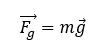
	</div>


	</div>
<div class="chapter standard with-subsections" id="chapter-xyz-coordinate-frame-review" title="1.2 XYZ Coordinate Frame">
	<div class="chapter-title-wrap">
		<p class="chapter-number">2</p>
		<h1 class="chapter-title">1.2 XYZ Coordinate Frame</h1>
								</div>
	<div class="ugc chapter-ugc">
				
 <p>We need a standard to be able to share a common language. The <em>Cartesian coordinate frame </em>lets us express the location of a point so that others can understand what we’re talking about.In this section, we’ll look at 2d and 3d coordinate frames.</p> <div class="textbox"><h1 id="chapter-158-section-1" class="section-header">1.2.1 Cartesian Coordinate Frame in 2D</h1> <p id="fs-id1167133446629">Vectors are usually described in terms of their components in a<span>&nbsp;</span><strong><span class="no-emphasis">coordinate system</span></strong>. Even in everyday life we naturally invoke the concept of orthogonal projections in a rectangular coordinate system. For example, if you ask someone for directions to a particular location, you will more likely be told to go 40 km east and 30 km north than 50 km in the direction <span>37°</span><span>&nbsp;</span>north of east.</p> <p id="fs-id1167133855194">In a rectangular (Cartesian)<span>&nbsp;</span><em>x-y </em>coordinate system in a plane, a point in a plane is described by a pair of coordinates (<em>x</em>,<span>&nbsp;</span><em>y</em>). In a similar fashion, a vector<span>&nbsp;<img src="http://localhost:3000/latex?latex=%5Cvec%20A&amp;fg=000000&amp;font=TeX&amp;svg=1" alt="\vec A" title="\vec A" class="latex mathjax"> </span>in a plane is described by a pair of its<span>&nbsp;</span><em>vector</em><span>&nbsp;</span>coordinates. The<span>&nbsp;</span><em>x</em>-coordinate of vector A is called its x-component, and the y-coordinate of vector A is called its<span>&nbsp;</span><em>y</em>-component. The vector<span>&nbsp;</span><em>x</em>-component is a vector denoted by <span>A<sub>x</sub></span>. The vector<span>&nbsp;</span><em>y</em>-component is a vector denoted by <span>A<sub>Y</sub></span>. In the Cartesian system, the<span>&nbsp;</span><em>x</em><span>&nbsp;</span>and<span>&nbsp;</span><em>y</em><span>&nbsp;</span><strong>vector components</strong><span>&nbsp;</span>of a vector are the orthogonal projections of this vector onto the<span>&nbsp;</span><em>x</em>– and<span>&nbsp;</span><em>y</em>-axes, respectively. In this way, following the parallelogram rule for vector addition, each vector on a Cartesian plane can be expressed as the vector sum of its vector components:</p> <p style="text-align: center"><img src="http://pressbooks.library.upei.ca/statics/wp-content/uploads/sites/56/2021/03/Screenshot-2025-07-13-155955.png" alt="Equation showing a vector: vector A equals vector Ax plus vector Ay, with all terms written in bold and with arrow notation." width="196" height="103" class="alignnone wp-image-2634 size-full" srcset="https://pressbooks.library.upei.ca/statics/wp-content/uploads/sites/56/2021/03/Screenshot-2025-07-13-155955.png 196w, https://pressbooks.library.upei.ca/statics/wp-content/uploads/sites/56/2021/03/Screenshot-2025-07-13-155955-65x34.png 65w" sizes="auto, (max-width: 196px) 100vw, 196px" title=""></p> <p><span>As illustrated in the figure below</span><span>, vector <img src="http://localhost:3000/latex?latex=%5Cvec%20A&amp;fg=000000&amp;font=TeX&amp;svg=1" alt="\vec A" title="\vec A" class="latex mathjax"> </span><span>is the diagonal of the rectangle where the&nbsp;</span><em>x</em><span>-component <img src="http://localhost:3000/latex?latex=%5Cvec%20A_x&amp;fg=000000&amp;font=TeX&amp;svg=1" alt="\vec A_x" title="\vec A_x" class="latex mathjax"> </span><span>is the side parallel to the&nbsp;</span><em>x</em><span>-axis and the&nbsp;</span><em>y</em><span>-component&nbsp;</span><span><img src="http://localhost:3000/latex?latex=%5Cvec%20A_y&amp;fg=000000&amp;font=TeX&amp;svg=1" alt="\vec A_y" title="\vec A_y" class="latex mathjax"> is the side parallel to the </span><em>y</em><span>-axis. Vector component <img src="http://localhost:3000/latex?latex=%5Cvec%20A_x&amp;fg=000000&amp;font=TeX&amp;svg=1" alt="\vec A_x" title="\vec A_x" class="latex mathjax"></span> <span>is orthogonal to vector component <img src="http://localhost:3000/latex?latex=%5Cvec%20A_y&amp;fg=000000&amp;font=TeX&amp;svg=1" alt="\vec A_y" title="\vec A_y" class="latex mathjax"></span><span>.</span></p> <div class="wp-caption aligncenter" id="attachment_2660" aria-describedby="caption-attachment-2660" style="width: 477px"><img src="http://pressbooks.library.upei.ca/statics/wp-content/uploads/sites/56/2021/03/Screenshot-2025-07-15-141808-300x219.png" alt="A vector diagram showing vector A from point b to e, decomposed into horizontal (Ax) and vertical (Ay) components along the x and y axes, with labeled coordinates and unit vectors." class="wp-image-2660" width="477" height="348" srcset="https://pressbooks.library.upei.ca/statics/wp-content/uploads/sites/56/2021/03/Screenshot-2025-07-15-141808-300x219.png 300w, https://pressbooks.library.upei.ca/statics/wp-content/uploads/sites/56/2021/03/Screenshot-2025-07-15-141808-1024x749.png 1024w, https://pressbooks.library.upei.ca/statics/wp-content/uploads/sites/56/2021/03/Screenshot-2025-07-15-141808-768x562.png 768w, https://pressbooks.library.upei.ca/statics/wp-content/uploads/sites/56/2021/03/Screenshot-2025-07-15-141808-65x48.png 65w, https://pressbooks.library.upei.ca/statics/wp-content/uploads/sites/56/2021/03/Screenshot-2025-07-15-141808-225x165.png 225w, https://pressbooks.library.upei.ca/statics/wp-content/uploads/sites/56/2021/03/Screenshot-2025-07-15-141808-350x256.png 350w, https://pressbooks.library.upei.ca/statics/wp-content/uploads/sites/56/2021/03/Screenshot-2025-07-15-141808.png 1295w" sizes="auto, (max-width: 477px) 100vw, 477px" title=""><div class="wp-caption-text" id="caption-attachment-2660">The figure shows the vector A in a plane in the Cartesian coordinate system, represented as the vector sum of its x- and y-components. The x-component vector, A<sub>x</sub>, is the orthogonal projection of Vector A onto the x-axis, and the y-component vector, A<sub>y</sub>, is the orthogonal projection onto the y-axis. The numbers A<sub>x</sub> and A<sub>x</sub> that multiply the unit vectors are the scalar components of the vector.</div></div> <p><span>It is customary to denote the positive direction on the&nbsp;</span><em>x</em><span>-axis by the unit vector i </span><span>and the positive direction on the&nbsp;</span><em>y</em><span>-axis by the unit vector j</span><span>.&nbsp;</span><strong>Unit vectors of the axes</strong><span>, i</span> <span>and j</span><span>, define two orthogonal directions in the plane. As shown in the figure above</span><span>, the&nbsp;</span><em>x</em><span>– and&nbsp;</span><em>y</em><span>–components of a vector can now be written in terms of the unit vectors of the axes:</span></p> <p style="text-align: center"><img src="http://localhost:3000/latex?latex=%5Cvec%20A_x%20%3D%20A_x%5Cunderline%7B%5Chat%7Bi%7D%7D&amp;fg=000000&amp;font=TeX&amp;svg=1" alt="\vec A_x = A_x\underline{\hat{i}}" title="\vec A_x = A_x\underline{\hat{i}}" class="latex mathjax"></p> <p style="text-align: center"><img src="http://localhost:3000/latex?latex=%5Cvec%20A_y%20%3D%20A_y%5Cunderline%7B%5Chat%7Bj%7D%7D&amp;fg=000000&amp;font=TeX&amp;svg=1" alt="\vec A_y = A_y\underline{\hat{j}}" title="\vec A_y = A_y\underline{\hat{j}}" class="latex mathjax"></p> <p id="fs-id1167133345023" style="text-align: center">The vectors <span>A<sub>x </sub></span>and <span>A<sub>y</sub> </span>defined by <span>the figure above</span><span>&nbsp;</span>are the<span>&nbsp;</span><em>vector components</em><span>&nbsp;</span>of vector <img src="http://localhost:3000/latex?latex=%5Cvec%20A&amp;fg=000000&amp;font=TeX&amp;svg=1" alt="\vec A" title="\vec A" class="latex mathjax">. The numbers <span>A<sub>x</sub></span> and <span>A<sub>y</sub></span> that define the vector components above are the scalar components of vector <img src="http://localhost:3000/latex?latex=%5Cvec%20A&amp;fg=000000&amp;font=TeX&amp;svg=1" alt="\vec A" title="\vec A" class="latex mathjax">. Combining <span>the diagram above </span>with <span>the equations above</span>, we obtain<span>&nbsp;</span><strong>the component form of a vector:</strong></p> <p style="text-align: center"><img src="http://localhost:3000/latex?latex=%5Cvec%20A%3DA_x%5Cunderline%7B%5Chat%20%7Bi%7D%7D%20%2B%20A_y%5Cunderline%7B%5Chat%20%7Bj%7D%7D&amp;fg=000000&amp;font=TeX&amp;svg=1" alt="\vec A=A_x\underline{\hat {i}} + A_y\underline{\hat {j}}" title="\vec A=A_x\underline{\hat {i}} + A_y\underline{\hat {j}}" class="latex mathjax"></p> <p><span>If we know the coordinates b(x<sub>b</sub>, y<sub>b</sub>)</span><span>&nbsp;of the origin point of a vector (where&nbsp;</span><em>b</em><span>&nbsp;stands for “beginning”) and the coordinates e(x<sub>e</sub>, y<sub>e</sub>)</span><span>&nbsp;of the end point of a vector (where&nbsp;</span><em>e</em><span>&nbsp;stands for “end”), we can obtain the scalar components of a vector simply by subtracting the origin point coordinates from the end point coordinates:</span></p> <p style="text-align: center"><img src="http://localhost:3000/latex?latex=A_x%20%3D%20x_e%20-%20x_b&amp;fg=000000&amp;font=TeX&amp;svg=1" alt="A_x = x_e - x_b" title="A_x = x_e - x_b" class="latex mathjax"></p> <p style="text-align: center"><img src="http://localhost:3000/latex?latex=A_y%20%3D%20y_e%20-%20y_b&amp;fg=000000&amp;font=TeX&amp;svg=1" alt="A_y = y_e - y_b" title="A_y = y_e - y_b" class="latex mathjax"></p> <h1 id="chapter-158-section-2" class="section-header">1.2.2. Cartesian Coordinate Frame in 3D</h1> <p id="fs-id1167132741874">To specify the location of a point in space, we need three coordinates (<em>x</em>,<span>&nbsp;</span><em>y</em>,<span>&nbsp;</span><em>z</em>), where coordinates<span>&nbsp;</span><em>x</em><span>&nbsp;</span>and<span>&nbsp;</span><em>y</em><span>&nbsp;</span>specify locations in a plane, and coordinate<span>&nbsp;</span><em>z</em><span>&nbsp;</span>gives a vertical position above or below the plane. Three-dimensional space has three orthogonal directions, so we need not two but<span>&nbsp;</span><em>three</em><span>&nbsp;</span>unit vectors to define a three-dimensional coordinate system. In the Cartesian coordinate system, the first two unit vectors are the unit vector of the<span>&nbsp;</span><em>x</em>-axis <span>i</span><span>&nbsp;</span>and the unit vector of the<span>&nbsp;</span><em>y</em>-axis <span>j</span>. The third unit vector <span>k</span><span>&nbsp;</span>is the direction of the<span>&nbsp;</span><em>z</em>-axis, as can be seen below. The order in which the axes are labeled, which is the order in which the three unit vectors appear, is important because it defines the orientation of the coordinate system. The order<span>&nbsp;</span><em>x</em>–<em>y</em>–<em>z</em>, which is equivalent to the order i-j-k, defines the standard right-handed coordinate system (positive orientation).</p> <p><img src="http://pressbooks.library.upei.ca/statics/wp-content/uploads/sites/56/2021/03/IMG-0654.jpg" alt="3D diagram showing the x, y, and z axes labeled with unit vectors î, ĵ, and k̂, respectively, inside a transparent cube with dashed edges." class="aligncenter wp-image-537" width="474" height="483" srcset="https://pressbooks.library.upei.ca/statics/wp-content/uploads/sites/56/2021/03/IMG-0654.jpg 1017w, https://pressbooks.library.upei.ca/statics/wp-content/uploads/sites/56/2021/03/IMG-0654-294x300.jpg 294w, https://pressbooks.library.upei.ca/statics/wp-content/uploads/sites/56/2021/03/IMG-0654-1005x1024.jpg 1005w, https://pressbooks.library.upei.ca/statics/wp-content/uploads/sites/56/2021/03/IMG-0654-768x782.jpg 768w, https://pressbooks.library.upei.ca/statics/wp-content/uploads/sites/56/2021/03/IMG-0654-65x66.jpg 65w, https://pressbooks.library.upei.ca/statics/wp-content/uploads/sites/56/2021/03/IMG-0654-225x229.jpg 225w, https://pressbooks.library.upei.ca/statics/wp-content/uploads/sites/56/2021/03/IMG-0654-350x357.jpg 350w" sizes="auto, (max-width: 474px) 100vw, 474px" title=""></p> <p id="fs-id1167132688199">In three-dimensional space, vector <img src="http://localhost:3000/latex?latex=%5Cvec%20A&amp;fg=000000&amp;font=TeX&amp;svg=1" alt="\vec A" title="\vec A" class="latex mathjax"><span>&nbsp;</span>has three vector components: the<span>&nbsp;</span><em>x</em>-component <img src="http://localhost:3000/latex?latex=%5Cvec%20A_x%20%3D%20A_x%5Cunderline%7B%5Chat%7Bi%7D%7D&amp;fg=000000&amp;font=TeX&amp;svg=1" alt="\vec A_x = A_x\underline{\hat{i}}" title="\vec A_x = A_x\underline{\hat{i}}" class="latex mathjax">, which is the part of vector<img src="http://localhost:3000/latex?latex=%5Cvec%20A&amp;fg=000000&amp;font=TeX&amp;svg=1" alt="\vec A" title="\vec A" class="latex mathjax">&nbsp;along the<span>&nbsp;</span><em>x</em>-axis; the<span>&nbsp;</span><em>y</em>-component <img src="http://localhost:3000/latex?latex=%5Cvec%20A_y%20%3D%20A_y%5Cunderline%7B%5Chat%7Bj%7D%7D&amp;fg=000000&amp;font=TeX&amp;svg=1" alt="\vec A_y = A_y\underline{\hat{j}}" title="\vec A_y = A_y\underline{\hat{j}}" class="latex mathjax">, which is the part of <img src="http://localhost:3000/latex?latex=%5Cvec%20A&amp;fg=000000&amp;font=TeX&amp;svg=1" alt="\vec A" title="\vec A" class="latex mathjax"><span>&nbsp;</span>along the<span>&nbsp;</span><em>y</em>-axis; and the<span>&nbsp;</span><em>z</em>-component <span><img src="http://localhost:3000/latex?latex=%5Cvec%20A_z%20%3D%20A_z%20%5Cunderline%7B%5Chat%7Bk%7D%7D&amp;fg=000000&amp;font=TeX&amp;svg=1" alt="\vec A_z = A_z \underline{\hat{k}}" title="\vec A_z = A_z \underline{\hat{k}}" class="latex mathjax"></span>, which is the part of the vector along the<span>&nbsp;</span><em>z</em>-axis. A vector in three-dimensional space is the vector sum of its three vector components:</p> <p style="text-align: center"><img src="http://localhost:3000/latex?latex=%5Cvec%20A%3D%20A_x%5Cunderline%7B%5Chat%7Bi%7D%7D%2BA_y%5Cunderline%7B%5Chat%7Bj%7D%7D%2BA_z%5Cunderline%7B%5Chat%7Bk%7D%7D&amp;fg=000000&amp;font=TeX&amp;svg=1" alt="\vec A= A_x\underline{\hat{i}}+A_y\underline{\hat{j}}+A_z\underline{\hat{k}}" title="\vec A= A_x\underline{\hat{i}}+A_y\underline{\hat{j}}+A_z\underline{\hat{k}}" class="latex mathjax"></p> <p id="fs-id1167132736522">If we know the coordinates of its origin <span>b(x<sub>b</sub>, y<sub>b</sub>, z<sub>b</sub>)</span><span>&nbsp;</span>and of its end <span>e(x<sub>e</sub>, y<sub>e</sub></span>, z<sub>e</sub>) its scalar components are obtained by taking their differences, and the<span>&nbsp;</span><em>z</em>-component is given by:</p> <p style="text-align: center"><img src="http://localhost:3000/latex?latex=A_z%3Dz_e-z_b&amp;fg=000000&amp;font=TeX&amp;svg=1" alt="A_z=z_e-z_b" title="A_z=z_e-z_b" class="latex mathjax"></p> <p id="fs-id1167132436510">Magnitude<span>&nbsp;</span><em>A</em><span>&nbsp;</span>is obtained by the following equation:</p> <p style="text-align: center"><img src="http://localhost:3000/latex?latex=A%3D%5Csqrt%20%7BA_%7Bx%7D%5E%7B2%7D%2BA_%7By%7D%5E%7B2%7D%2BA_%7Bz%7D%5E%7B2%7D%7D&amp;fg=000000&amp;font=TeX&amp;svg=1" alt="A=\sqrt {A_{x}^{2}+A_{y}^{2}+A_{z}^{2}}" title="A=\sqrt {A_{x}^{2}+A_{y}^{2}+A_{z}^{2}}" class="latex mathjax"></p> <p id="fs-id1167132716914">This expression for the vector magnitude comes from applying the Pythagorean theorem twice. As seen in <span>the figure below</span>, the diagonal in the<span>&nbsp;</span><em>x-y </em>plane has length <span><img src="http://localhost:3000/latex?latex=%5Csqrt%7BA_%7Bx%7D%5E%7B2%7D%2BA_%7By%7D%5E%7B2%7D%7D&amp;fg=000000&amp;font=TeX&amp;svg=1" alt="\sqrt{A_{x}^{2}+A_{y}^{2}}" title="\sqrt{A_{x}^{2}+A_{y}^{2}}" class="latex mathjax"> </span><span>&nbsp;</span>and its square adds to the square <span>A<sub>z</sub><sup>2</sup></span> <span></span>to give A<sup>2</sup> . Note that when the<span>&nbsp;</span><em>z</em>-component is zero, the vector lies entirely in the<span>&nbsp;</span><em>x-y </em>plane and its description is reduced to two dimensions.</p> <p><img src="http://pressbooks.library.upei.ca/statics/wp-content/uploads/sites/56/2021/03/IMG-0661.jpg" alt="A 3D coordinate system diagram showing vector A in red, decomposed into components along x, y, and z axes (blue). Dashed lines illustrating vector projections and their sums." class="aligncenter wp-image-544" width="572" height="506" srcset="https://pressbooks.library.upei.ca/statics/wp-content/uploads/sites/56/2021/03/IMG-0661.jpg 1170w, https://pressbooks.library.upei.ca/statics/wp-content/uploads/sites/56/2021/03/IMG-0661-300x265.jpg 300w, https://pressbooks.library.upei.ca/statics/wp-content/uploads/sites/56/2021/03/IMG-0661-1024x905.jpg 1024w, https://pressbooks.library.upei.ca/statics/wp-content/uploads/sites/56/2021/03/IMG-0661-768x679.jpg 768w, https://pressbooks.library.upei.ca/statics/wp-content/uploads/sites/56/2021/03/IMG-0661-65x57.jpg 65w, https://pressbooks.library.upei.ca/statics/wp-content/uploads/sites/56/2021/03/IMG-0661-225x199.jpg 225w, https://pressbooks.library.upei.ca/statics/wp-content/uploads/sites/56/2021/03/IMG-0661-350x309.jpg 350w" sizes="auto, (max-width: 572px) 100vw, 572px" title=""></p> <p>Source: University Physics Volume 1, OpenStax CNX, <a href="https://courses.lumenlearning.com/suny-osuniversityphysics/chapter/2-2-coordinate-systems-and-components-of-a-vector/" data-url="https://courses.lumenlearning.com/suny-osuniversityphysics/chapter/2-2-coordinate-systems-and-components-of-a-vector/">https://courses.lumenlearning.com/suny-osuniversityphysics/chapter/2-2-coordinate-systems-and-components-of-a-vector/</a></p> </div> <p>The Cartesian coordinate frame is a right-orthogonal system. This will matter when we start looking at the right-hand rule in section 3.1. What it means is that when you draw two of the directions (say x and y), then z must go either up or down. We’ll get into that more later.</p> <p>&nbsp;</p> <div class="textbox textbox--key-takeaways"><div class="textbox__header"><p class="textbox__title">Key Takeaways</p> </div> <div class="textbox__content"><p><em>Basically</em>: The Cartesian coordinate frame gives us a way to communicate the location of a point in space. In 2-d we use [x, y] and in 3-d we also include z: [x, y, z].</p> <p><em>Application:</em> If I am trying to walk across the room, I can walk in a straight line for 5 steps, or I can take 3 steps to the right and 4 steps ahead. If I wanted to describe the position of where I went in the Cartesian coordinate frame, it would be [3, 4], assuming x is to the right and y is straight ahead.</p> <p><em>Looking ahead</em>: This will connect with everything we do in this class, especially with cross-products (1.5), torque (1.6), and equilibrium equations (everywhere).</p> </div> </div> 

	</div>


	</div>
<div class="chapter standard with-subsections" id="chapter-vector-form-notation" title="1.3 Vectors">
	<div class="chapter-title-wrap">
		<p class="chapter-number">3</p>
		<h1 class="chapter-title">1.3 Vectors</h1>
								</div>
	<div class="ugc chapter-ugc">
				
 <h1 id="chapter-156-section-1" class="section-header">1.3.1 Vector Components</h1> <p>Some fun facts about vectors:</p> <ul><li>The vector is denoted with a line on top or bottom: <img src="http://localhost:3000/latex?latex=%5Cvec%20A&amp;fg=000000&amp;font=TeX&amp;svg=1" alt="\vec A" title="\vec A" class="latex mathjax"> or <strong><span style="text-decoration: underline">A</span></strong>.</li> <li>There are two parts of a vector (<img src="http://localhost:3000/latex?latex=%5Cvec%20A&amp;fg=000000&amp;font=TeX&amp;svg=1" alt="\vec A" title="\vec A" class="latex mathjax">): magnitude (A or |<span style="text-decoration: underline">A</span>|) and direction (<img src="http://localhost:3000/latex?latex=%5Cunderline%7B%5Chat%7Ba%7D%7D&amp;fg=000000&amp;font=TeX&amp;svg=1" alt="\underline{\hat{a}}" title="\underline{\hat{a}}" class="latex mathjax">): <img src="http://localhost:3000/latex?latex=%5Cvec%20A%20%3D%20%7C%5Cunderline%7BA%7D%7C%2A%5Cunderline%7B%5Chat%7Ba%7D%7D&amp;fg=000000&amp;font=TeX&amp;svg=1" alt="\vec A = |\underline{A}|*\underline{\hat{a}}" title="\vec A = |\underline{A}|*\underline{\hat{a}}" class="latex mathjax"></li> <li>In 2-dimensions, there are two <em>components: </em>x and y. In 3D, there are three components: x, y, and z.</li> <li>Vectors can be denoted using Cartesian form or brackets: <img src="http://localhost:3000/latex?latex=%5Cvec%20A%3DA_x%5Cunderline%7B%5Chat%7Bi%7D%7D%2BA_y%5Cunderline%7B%5Chat%7Bj%7D%7D%2BA_z%5Cunderline%7B%5Chat%7Bk%7D%7D&amp;fg=000000&amp;font=TeX&amp;svg=1" alt="\vec A=A_x\underline{\hat{i}}+A_y\underline{\hat{j}}+A_z\underline{\hat{k}}" title="\vec A=A_x\underline{\hat{i}}+A_y\underline{\hat{j}}+A_z\underline{\hat{k}}" class="latex mathjax"> or using the bracket form horizontally: <img src="http://localhost:3000/latex?latex=%5Cvec%20A%3D%5B%20A_x%2C%20A_y%2C%20A_z&amp;fg=000000&amp;font=TeX&amp;svg=1" alt="\vec A=[ A_x, A_y, A_z" title="\vec A=[ A_x, A_y, A_z" class="latex mathjax"> ] or vertically:&nbsp; <img src="http://localhost:3000/latex?latex=%5Cvec%20A%3D%5Cbegin%7Bbmatrix%7DA_x%5C%5CA_y%2C%5C%5CA_z%20%5Cend%7Bbmatrix%7D&amp;fg=000000&amp;font=TeX&amp;svg=1" alt="\vec A=\begin{bmatrix}A_x\\A_y,\\A_z \end{bmatrix}" title="\vec A=\begin{bmatrix}A_x\\A_y,\\A_z \end{bmatrix}" class="latex mathjax"></li> <li>The magnitude (A or |<span style="text-decoration: underline">A</span>|) is calculated using the Pythagorean theorem for each component in 2d: <img src="http://localhost:3000/latex?latex=A%20%3D%20%5Csqrt%7B%7BA%7D_%7Bx%7D%5E%7B2%7D%2B%7BA%7D_%7By%7D%5E%7B2%7D%7D&amp;fg=000000&amp;font=TeX&amp;svg=1" alt="A = \sqrt{{A}_{x}^{2}+{A}_{y}^{2}}" title="A = \sqrt{{A}_{x}^{2}+{A}_{y}^{2}}" class="latex mathjax"> and 3d: <img src="http://localhost:3000/latex?latex=A%20%3D%20%5Csqrt%7B%7BA%7D_%7Bx%7D%5E%7B2%7D%2B%7BA%7D_%7By%7D%5E%7B2%7D%2B%7BA%7D_%7Bz%7D%5E%7B2%7D%7D&amp;fg=000000&amp;font=TeX&amp;svg=1" alt="A = \sqrt{{A}_{x}^{2}+{A}_{y}^{2}+{A}_{z}^{2}}" title="A = \sqrt{{A}_{x}^{2}+{A}_{y}^{2}+{A}_{z}^{2}}" class="latex mathjax"></li> <li>The unit vector (<img src="http://localhost:3000/latex?latex=%5Cunderline%7B%5Chat%7Bu%7D%7D&amp;fg=000000&amp;font=TeX&amp;svg=1" alt="\underline{\hat{u}}" title="\underline{\hat{u}}" class="latex mathjax">) represents the direction in cartesian form <img src="http://localhost:3000/latex?latex=%5Cunderline%7B%5Chat%7Bu%7D%7D%3D%5Cunderline%7B%5Chat%7Bi%7D%7D%2B%5Cunderline%7B%5Chat%7Bj%7D%7D%2B%5Cunderline%7B%5Chat%7Bk%7D%7D&amp;fg=000000&amp;font=TeX&amp;svg=1" alt="\underline{\hat{u}}=\underline{\hat{i}}+\underline{\hat{j}}+\underline{\hat{k}}" title="\underline{\hat{u}}=\underline{\hat{i}}+\underline{\hat{j}}+\underline{\hat{k}}" class="latex mathjax"> or using bracket form: [ <img src="http://localhost:3000/latex?latex=%5Cunderline%7B%5Chat%7Bi%7D%7D%2C%20%5Cunderline%7B%5Chat%7Bj%7D%7D%2C%20%5Cunderline%7B%5Chat%7Bk%7D%7D&amp;fg=000000&amp;font=TeX&amp;svg=1" alt="\underline{\hat{i}}, \underline{\hat{j}}, \underline{\hat{k}}" title="\underline{\hat{i}}, \underline{\hat{j}}, \underline{\hat{k}}" class="latex mathjax"> ].</li> <li>The magnitude of the unit vector is 1 (denoted by the ‘hat’ on top) and it is unit-less: <img src="http://localhost:3000/latex?latex=%7C%5Cunderline%7B%5Chat%7Bu%7D%7D%20%7C%3D%20%5Csqrt%7B%7B%5Cunderline%7B%5Chat%7Bi%7D%7D%7D%5E%7B2%7D%2B%7B%5Cunderline%7B%5Chat%7Bj%7D%7D%7D%5E%7B2%7D%2B%7B%5Cunderline%7B%5Chat%7Bk%7D%7D%7D%5E%7B2%7D%7D%20%3D%201&amp;fg=000000&amp;font=TeX&amp;svg=1" alt="|\underline{\hat{u}} |= \sqrt{{\underline{\hat{i}}}^{2}+{\underline{\hat{j}}}^{2}+{\underline{\hat{k}}}^{2}} = 1" title="|\underline{\hat{u}} |= \sqrt{{\underline{\hat{i}}}^{2}+{\underline{\hat{j}}}^{2}+{\underline{\hat{k}}}^{2}} = 1" class="latex mathjax"></li> <li>The unit vector can be calculated from the magnitude and vector: <img src="http://localhost:3000/latex?latex=%5Cunderline%7B%5Chat%7Ba%7D%7D%20%3D%5Cvec%20A%2F%7CA%7C&amp;fg=000000&amp;font=TeX&amp;svg=1" alt="\underline{\hat{a}} =\vec A/|A|" title="\underline{\hat{a}} =\vec A/|A|" class="latex mathjax"></li> </ul> <p>&nbsp;</p> <div class="textbox"><p>In 2d &amp; 3d:</p> <p>&nbsp;</p> <p><img src="https://s3-us-west-2.amazonaws.com/courses-images/wp-content/uploads/sites/2952/2018/01/31183906/CNX_UPhysics_02_02_comp03.jpg" alt="Vector A has horizontal x component A sub x equal to magnitude A sub x I hat and vertical y component A sub y equal to magnitude A sub y j hat. Vector A and the components form a right triangle with sides length magnitude A sub x and magnitude A sub y and hypotenuse magnitude A equal to the square root of A sub x squared plus A sub y squared. The angle between the horizontal side A sub x and the hypotenuse A is theta sub A." class="alignleft" width="322" height="232" title=""><img src="https://s3-us-west-2.amazonaws.com/courses-images/wp-content/uploads/sites/2952/2018/01/31183920/CNX_UPhysics_02_02_vector3D.jpg" alt="Vector A in the x y z coordinate system extends from the origin. Vector A equals the sum of vectors A sub x, A sub y and A sub z. Vector A sub x is the x component along the x axis and has length A sub x I hat. Vector A sub y is the y component along the y axis and has length A sub y j hat. Vector A sub z is the z component along the z axis and has length A sub x k hat. The components form the sides of a rectangular box with sides length A sub x, A sub y, and A sub z." class="aligncenter" width="289" height="266" style="padding-left: 0px;text-align: justify" title=""></p> <p>Source: University Physics Volume 1, OpenStax CNX, <a href="https://courses.lumenlearning.com/suny-osuniversityphysics/chapter/2-2-coordinate-systems-and-components-of-a-vector/" data-url="https://courses.lumenlearning.com/suny-osuniversityphysics/chapter/2-2-coordinate-systems-and-components-of-a-vector/">https://courses.lumenlearning.com/suny-osuniversityphysics/chapter/2-2-coordinate-systems-and-components-of-a-vector/</a></p> </div> <h1 id="chapter-156-section-2" class="section-header">1.3.2 Componentizing a Vector</h1> <div class="wp-caption alignright" id="attachment_714" aria-describedby="caption-attachment-714" style="width: 200px"><img src="http://pressbooks.library.upei.ca/statics/wp-content/uploads/sites/56/2021/03/Screen-Shot-2021-07-27-at-12.27.17-AM-300x293.png" alt="A 2D coordinate plane with x and y axes. A point P is marked, connected to the origin by a line labeled r, forming an angle θ with the x-axis. The angle θ is shown with a dashed arc." class="wp-image-714" width="200" height="195" srcset="https://pressbooks.library.upei.ca/statics/wp-content/uploads/sites/56/2021/03/Screen-Shot-2021-07-27-at-12.27.17-AM-300x293.png 300w, https://pressbooks.library.upei.ca/statics/wp-content/uploads/sites/56/2021/03/Screen-Shot-2021-07-27-at-12.27.17-AM-65x63.png 65w, https://pressbooks.library.upei.ca/statics/wp-content/uploads/sites/56/2021/03/Screen-Shot-2021-07-27-at-12.27.17-AM-225x220.png 225w, https://pressbooks.library.upei.ca/statics/wp-content/uploads/sites/56/2021/03/Screen-Shot-2021-07-27-at-12.27.17-AM-350x342.png 350w, https://pressbooks.library.upei.ca/statics/wp-content/uploads/sites/56/2021/03/Screen-Shot-2021-07-27-at-12.27.17-AM.png 580w" sizes="auto, (max-width: 200px) 100vw, 200px" title=""><div class="wp-caption-text" id="caption-attachment-714">Source: Introductory Physics, Ryan Martin et al., <a href="https://openlibrary.ecampusontario.ca/catalogue/item/?id=4c3c2c75-0029-4c9e-967f-41f178bebbbb" data-url="https://openlibrary.ecampusontario.ca/catalogue/item/?id=4c3c2c75-0029-4c9e-967f-41f178bebbbb">https://openlibrary.ecampusontario.ca/catalogue/item/?id=4c3c2c75-0029-4c9e-967f-41f178bebbbb</a> p814</div></div> <p>In 2d:</p> <p>To find the components of a vector (<span style="text-decoration: underline">A</span>) in 2 dimensions (the x and y portions A<sub>x</sub> and A<sub>y</sub>), use SOH CAH TOA:</p> <p>&nbsp;</p> <div class="page" title="Page 830"><div class="layoutArea"><div class="column"><p><span style="text-decoration: underline"></span><img src="http://localhost:3000/latex?latex=%5Cvec%20A%3DA_x%5Cunderline%7B%5Chat%7Bi%7D%7D%2BA_y%5Cunderline%7B%5Chat%7Bj%7D%7D&amp;fg=000000&amp;font=TeX&amp;svg=1" alt="\vec A=A_x\underline{\hat{i}}+A_y\underline{\hat{j}}" title="\vec A=A_x\underline{\hat{i}}+A_y\underline{\hat{j}}" class="latex mathjax"></p> <p><span>A<sub>x </sub></span><span>= |<span style="text-decoration: underline">A</span>|</span> <span></span><span>cos(Θ</span><span></span><span>)</span></p> <p><span>A<sub>y</sub> = |<span style="text-decoration: underline">A</span>|</span> <span></span><span>sin(Θ</span><span></span><span>) </span></p> <p><span style="text-decoration: underline">|A|</span><sup>2</sup> = A<sub>x</sub><sup>2</sup> + A<sub>y</sub><sup>2&nbsp; </sup>(magnitude)</p> <p>tan(<span>Θ</span>) = A<sub>y</sub> / A<sub>x</sub>&nbsp; &nbsp; (direction)</p> <p><span style="text-decoration: underline"></span><span><br> </span></p> <p>In 3d:</p> <p><img src="http://localhost:3000/latex?latex=%5Cvec%20A%3DA_x%5Cunderline%7B%5Chat%7Bi%7D%7D%2BA_y%5Cunderline%7B%5Chat%7Bj%7D%7D%2BA_z%5Cunderline%7B%5Chat%7Bk%7D%7D&amp;fg=000000&amp;font=TeX&amp;svg=1" alt="\vec A=A_x\underline{\hat{i}}+A_y\underline{\hat{j}}+A_z\underline{\hat{k}}" title="\vec A=A_x\underline{\hat{i}}+A_y\underline{\hat{j}}+A_z\underline{\hat{k}}" class="latex mathjax"></p> <p><span>|<span style="text-decoration: underline">A</span>|</span><sup>2</sup> = A<sub>x</sub><sup>2</sup> + A<sub>y</sub><sup>2</sup>+ A<sub>z</sub><sup>2 </sup>&nbsp; (magnitude)</p> <p><img src="http://localhost:3000/latex?latex=%5Cbegin%7Baligned%7D%20%20%26%5Chat%7Ba%7D%3D%5Cfrac%7B%5Cvec%20A%7D%7B%7C%5Cvec%20A%7C%7D%20%20%5Cend%7Baligned%7D%3D%5Cfrac%7B%7BA%7D_%7Bx%7D%20%5Cunderline%7B%5Chat%7B%5Cimath%7D%7D%2BA_%7By%7D%20%5Cunderline%7B%5Chat%7B%5Cjmath%7D%7D%2B%7BA%7D_%7Bz%7D%20%5Cunderline%7B%5Chat%7Bk%7D%7D%7D%7B%5Csqrt%7B%5Cleft%28%7BA%7D_%7Bx%7D%5Cright%29%5E%7B2%7D%2B%5Cleft%28%7BA%7D_%7By%7D%5Cright%29%5E%7B2%7D%2B%5Cleft%28%7BA%7D_%7Bz%7D%5Cright%29%5E%7B2%7D%7D%7D&amp;fg=000000&amp;font=TeX&amp;svg=1" alt="\begin{aligned} &amp;amp;\hat{a}=\frac{\vec A}{|\vec A|} \end{aligned}=\frac{{A}_{x} \underline{\hat{\imath}}+A_{y} \underline{\hat{\jmath}}+{A}_{z} \underline{\hat{k}}}{\sqrt{\left({A}_{x}\right)^{2}+\left({A}_{y}\right)^{2}+\left({A}_{z}\right)^{2}}}" title="\begin{aligned} &amp;amp;\hat{a}=\frac{\vec A}{|\vec A|} \end{aligned}=\frac{{A}_{x} \underline{\hat{\imath}}+A_{y} \underline{\hat{\jmath}}+{A}_{z} \underline{\hat{k}}}{\sqrt{\left({A}_{x}\right)^{2}+\left({A}_{y}\right)^{2}+\left({A}_{z}\right)^{2}}}" class="latex mathjax"></p> </div> </div> </div> <h1 id="chapter-156-section-3" class="section-header">1.3.3 Position Vector</h1> <p>The position vector describes the position of an object or person from a predefined origin (a starting point, absolute 0, or some other point), for example the point where <span style="text-decoration: underline">A</span> in the above image is point at. <span style="text-decoration: underline">A</span> is the position vector. You can add individual position vectors to find the total position traveled (<span style="text-decoration: underline">c</span> = <span style="text-decoration: underline">a</span> + <span style="text-decoration: underline">b</span>), for example if someone walks from one point on campus to another, they would rarely walk in one straight line like c. In the image below, imagine that there is a building in the square near where <span style="text-decoration: underline">a</span> and <span style="text-decoration: underline">b</span> meet, so the person couldn’t take <span style="text-decoration: underline">c</span> but had to walk around. The total distance traveled is |<span style="text-decoration: underline">a|</span> + <span style="text-decoration: underline">|b|</span>, not |<span style="text-decoration: underline">c</span>| (because |<span style="text-decoration: underline">c</span>| ≠ |<span><span style="text-decoration: underline">a</span>|</span> + <span>|<span style="text-decoration: underline">b</span>|)</span>.</p> <div class="textbox"><div class="page" title="Page 837"><div class="wp-caption aligncenter" id="attachment_2664" aria-describedby="caption-attachment-2664" style="width: 300px"><img src="http://pressbooks.library.upei.ca/statics/wp-content/uploads/sites/56/2021/03/Screenshot-2025-07-15-151515-1-300x186.png" alt="A diagram showing vector addition in 2D: vectors a and b form a parallelogram, resulting in vector c. Equations for vector components are shown: cₓ = aₓ + bₓ and cᵧ = aᵧ + bᵧ." width="300" height="186" class="wp-image-2664 size-medium" srcset="https://pressbooks.library.upei.ca/statics/wp-content/uploads/sites/56/2021/03/Screenshot-2025-07-15-151515-1-300x186.png 300w, https://pressbooks.library.upei.ca/statics/wp-content/uploads/sites/56/2021/03/Screenshot-2025-07-15-151515-1-65x40.png 65w, https://pressbooks.library.upei.ca/statics/wp-content/uploads/sites/56/2021/03/Screenshot-2025-07-15-151515-1-225x139.png 225w, https://pressbooks.library.upei.ca/statics/wp-content/uploads/sites/56/2021/03/Screenshot-2025-07-15-151515-1-350x217.png 350w, https://pressbooks.library.upei.ca/statics/wp-content/uploads/sites/56/2021/03/Screenshot-2025-07-15-151515-1.png 525w" sizes="auto, (max-width: 300px) 100vw, 300px" title=""><div class="wp-caption-text" id="caption-attachment-2664">Source: Introductory Physics, Ryan Martin et al., <a href="https://openlibrary.ecampusontario.ca/catalogue/item/?id=4c3c2c75-0029-4c9e-967f-41f178bebbbb" data-url="https://openlibrary.ecampusontario.ca/catalogue/item/?id=4c3c2c75-0029-4c9e-967f-41f178bebbbb">https://openlibrary.ecampusontario.ca/catalogue/item/?id=4c3c2c75-0029-4c9e-967f-41f178bebbbb</a> page 821</div></div> <p>Geometric addition of the vectors a and b by placing them “head to tail.”</p> </div> <div title="Page 837"><div class="page" title="Page 837"><div class="page" title="Page 837"></div> </div> </div> </div> <div title="Page 837"><div class="page" title="Page 837"><div class="page" title="Page 837"><p>Subtraction works the same way, but instead of going from tail to head of the arrow, the reverse direction is taken, from head to tail. For example, <span style="text-decoration: underline">a</span> = c-b<span style="text-decoration: underline">,</span> follow c from tail to head, then go in the reverse direction of b from head to tail, and you end up at <span style="text-decoration: underline">a.</span></p> </div> </div> </div> <h1 id="chapter-156-section-4" class="section-header">1.3.4 Vector Math</h1> <p>Here’s more official language to describe vectors:</p> <div class="textbox"><p>Vectors can be added together and multiplied by scalars. Vector addition is associative and commutative, and vector multiplication by a sum of scalars is distributive. Also, scalar multiplication by a sum of vectors is distributive:</p> <p style="text-align: center"><img src="http://localhost:3000/latex?latex=%5Calpha%28%5Cvec%20A%2B%5Cvec%20B%29%3D%5Calpha%5Cvec%20A%20%2B%5Calpha%5Cvec%20B&amp;fg=000000&amp;font=TeX&amp;svg=1" alt="\alpha(\vec A+\vec B)=\alpha\vec A +\alpha\vec B" title="\alpha(\vec A+\vec B)=\alpha\vec A +\alpha\vec B" class="latex mathjax"></p> <p>In this equation, α is any number (a scalar). For example, a vector antiparallel to vector <img src="http://localhost:3000/latex?latex=%5Cvec%20A%3DA_x%5Chat%7Bi%7D%2BA_y%5Chat%7Bj%7D%2BA_z%5Chat%7Bk%7D&amp;fg=000000&amp;font=TeX&amp;svg=1" alt="\vec A=A_x\hat{i}+A_y\hat{j}+A_z\hat{k}" title="\vec A=A_x\hat{i}+A_y\hat{j}+A_z\hat{k}" class="latex mathjax"> can be expressed simply by multiplying <img src="http://localhost:3000/latex?latex=%5Cvec%20A&amp;fg=000000&amp;font=TeX&amp;svg=1" alt="\vec A" title="\vec A" class="latex mathjax"> by the scalar α=-1:</p> <p style="text-align: center"><img src="http://localhost:3000/latex?latex=-%5Cvec%20A%3D-A_x%5Chat%7Bi%7D-A_y%5Chat%7Bj%7D-A_z%5Chat%7Bk%7D&amp;fg=000000&amp;font=TeX&amp;svg=1" alt="-\vec A=-A_x\hat{i}-A_y\hat{j}-A_z\hat{k}" title="-\vec A=-A_x\hat{i}-A_y\hat{j}-A_z\hat{k}" class="latex mathjax"></p> <p id="fs-id1167132504881">The generalization of the number zero to vector algebra is called the&nbsp;null vector, denoted by <img src="http://localhost:3000/latex?latex=%5Cvec%200&amp;fg=000000&amp;font=TeX&amp;svg=1" alt="\vec 0" title="\vec 0" class="latex mathjax">. All components of the null vector are zero <img src="http://localhost:3000/latex?latex=%5Cvec%200%20%3D%200%20%5Chat%7Bi%7D%20%2B%200%20%5Chat%7Bj%7D%20%2B%200%20%5Chat%7Bk%7D&amp;fg=000000&amp;font=TeX&amp;svg=1" alt="\vec 0 = 0 \hat{i} + 0 \hat{j} + 0 \hat{k}" title="\vec 0 = 0 \hat{i} + 0 \hat{j} + 0 \hat{k}" class="latex mathjax"> , so the null vector has no length and no direction.</p> <p id="fs-id1167133485200">Two vectors <img src="http://localhost:3000/latex?latex=%5Cvec%20A&amp;fg=000000&amp;font=TeX&amp;svg=1" alt="\vec A" title="\vec A" class="latex mathjax">&nbsp;and <img src="http://localhost:3000/latex?latex=%5Cvec%20B&amp;fg=000000&amp;font=TeX&amp;svg=1" alt="\vec B" title="\vec B" class="latex mathjax">&nbsp;are&nbsp;equal vectors&nbsp;if and only if their difference is the null vector:</p> <p><img src="http://localhost:3000/latex?latex=%5Cvec%7B0%7D%20%3D%20%5Cvec%7BA%7D%20-%20%5Cvec%7BB%7D%20%3D%20%28A_x%5Chat%7Bi%7D%20%2B%20A_y%5Chat%7Bj%7D%20%2B%20A_z%5Chat%7Bk%7D%29%20-%20%28B_x%5Chat%7Bi%7D%20%2B%20B_y%5Chat%7Bj%7D%20%2B%20B_z%5Chat%7Bk%7D%29%20%5C%5C%20%3D%20%28A_x%20-%20B_x%29%5Chat%7Bi%7D%20%2B%20%28A_y%20-%20B_y%29%5Chat%7Bj%7D%20%2B%20%28A_z%20-%20B_z%29%5Chat%7Bk%7D&amp;fg=000000&amp;font=TeX&amp;svg=1" alt="\vec{0} = \vec{A} - \vec{B} = (A_x\hat{i} + A_y\hat{j} + A_z\hat{k}) - (B_x\hat{i} + B_y\hat{j} + B_z\hat{k}) \\ = (A_x - B_x)\hat{i} + (A_y - B_y)\hat{j} + (A_z - B_z)\hat{k}" title="\vec{0} = \vec{A} - \vec{B} = (A_x\hat{i} + A_y\hat{j} + A_z\hat{k}) - (B_x\hat{i} + B_y\hat{j} + B_z\hat{k}) \\ = (A_x - B_x)\hat{i} + (A_y - B_y)\hat{j} + (A_z - B_z)\hat{k}" class="latex mathjax"></p> <p style="text-align: center"><span><img src="http://localhost:3000/latex?latex=%5Cspace%3D%28A_x%20-%20B_x%29%5Cunderline%7B%5Chat%7Bi%7D%7D%20%2B%20%28A_y%20-%20B_y%29%5Cunderline%7B%5Chat%7Bj%7D%7D%20%2B%20%28A_z%20-%20B_z%29%5Cunderline%7B%5Chat%7Bk%7D%7D&amp;fg=000000&amp;font=TeX&amp;svg=1" alt="\space=(A_x - B_x)\underline{\hat{i}} + (A_y - B_y)\underline{\hat{j}} + (A_z - B_z)\underline{\hat{k}}" title="\space=(A_x - B_x)\underline{\hat{i}} + (A_y - B_y)\underline{\hat{j}} + (A_z - B_z)\underline{\hat{k}}" class="latex mathjax">&nbsp;</span></p> <p><span>This vector equation means we must have simultaneously <img src="http://localhost:3000/latex?latex=A_x-B_x%3D0&amp;fg=000000&amp;font=TeX&amp;svg=1" alt="A_x-B_x=0" title="A_x-B_x=0" class="latex mathjax">, <img src="http://localhost:3000/latex?latex=A_y-B_y%3D0&amp;fg=000000&amp;font=TeX&amp;svg=1" alt="A_y-B_y=0" title="A_y-B_y=0" class="latex mathjax">, and <img src="http://localhost:3000/latex?latex=A_z-B_z%3D0&amp;fg=000000&amp;font=TeX&amp;svg=1" alt="A_z-B_z=0" title="A_z-B_z=0" class="latex mathjax"></span><span>. Hence, we can write <img src="http://localhost:3000/latex?latex=%5Cvec%20A%3D%5Cvec%20B&amp;fg=000000&amp;font=TeX&amp;svg=1" alt="\vec A=\vec B" title="\vec A=\vec B" class="latex mathjax"> </span><span>if and only if the corresponding components of vectors&nbsp;<img src="http://localhost:3000/latex?latex=%5Cvec%20A&amp;fg=000000&amp;font=TeX&amp;svg=1" alt="\vec A" title="\vec A" class="latex mathjax"></span> <span>and <img src="http://localhost:3000/latex?latex=%5Cvec%20B&amp;fg=000000&amp;font=TeX&amp;svg=1" alt="\vec B" title="\vec B" class="latex mathjax"></span> <span>are equal:</span></p> <p style="text-align: center"><img src="http://localhost:3000/latex?latex=%5Cvec%20A%20%3D%5Cvec%20B&amp;fg=000000&amp;font=TeX&amp;svg=1" alt="\vec A =\vec B" title="\vec A =\vec B" class="latex mathjax">&nbsp;&nbsp; if &nbsp; <img src="http://localhost:3000/latex?latex=%5Cbegin%7Bbmatrix%7DA_x%3DB_x%5C%5CA_y%3DB_y%5C%5CA_z%3DB_z%5Cend%7Bbmatrix%7D&amp;fg=000000&amp;font=TeX&amp;svg=1" alt="\begin{bmatrix}A_x=B_x\\A_y=B_y\\A_z=B_z\end{bmatrix}" title="\begin{bmatrix}A_x=B_x\\A_y=B_y\\A_z=B_z\end{bmatrix}" class="latex mathjax"></p> <p id="fs-id1167133466190">Two vectors are equal when their corresponding scalar components are equal.</p> <p id="fs-id1167133321055">Resolving vectors into their scalar components (i.e., finding their scalar components) and expressing them analytically in vector component form allows us to use vector algebra to find sums or differences of many vectors <em>analytically </em>(i.e., using graphical methods). For example, to find the resultant of two vectors <img src="http://localhost:3000/latex?latex=%5Coverset%7B%5Cto%20%7D%7BA%7D&amp;fg=000000&amp;font=TeX&amp;svg=1" alt="\overset{\to }{A}" title="\overset{\to }{A}" class="latex mathjax"><span>&nbsp;</span>and <span><img src="http://localhost:3000/latex?latex=%5Cvec%20B&amp;fg=000000&amp;font=TeX&amp;svg=1" alt="\vec B" title="\vec B" class="latex mathjax"></span>, we simply add them component by component, as follows:</p> <p><img src="http://localhost:3000/latex?latex=%5Cvec%20R%3D%5Cvec%20A%20%2B%20%5Cvec%20B%3D%28A_x%5Cunderline%7B%5Chat%7Bi%7D%7D%2BA_y%5Cunderline%7B%5Chat%7Bj%7D%7D%2BA_z%5Cunderline%7B%5Chat%7Bk%7D%7D%29%2B%28B_x%5Cunderline%7B%5Chat%7Bi%7D%7D%2BB_y%5Cunderline%7B%5Chat%7Bj%7D%7D%2BB_z%5Cunderline%7B%5Chat%7Bk%7D%7D%29%3D%28A_x%2BB_x%29%5Cunderline%7B%5Chat%7Bi%7D%7D%2B%28A_y%2BB_y%29%5Cunderline%7B%5Chat%7Bj%7D%7D%2B%28A_z%2BB_z%29%5Cunderline%7B%5Chat%7Bk%7D%7D&amp;fg=000000&amp;font=TeX&amp;svg=1" alt="\vec R=\vec A + \vec B=(A_x\underline{\hat{i}}+A_y\underline{\hat{j}}+A_z\underline{\hat{k}})+(B_x\underline{\hat{i}}+B_y\underline{\hat{j}}+B_z\underline{\hat{k}})=(A_x+B_x)\underline{\hat{i}}+(A_y+B_y)\underline{\hat{j}}+(A_z+B_z)\underline{\hat{k}}" title="\vec R=\vec A + \vec B=(A_x\underline{\hat{i}}+A_y\underline{\hat{j}}+A_z\underline{\hat{k}})+(B_x\underline{\hat{i}}+B_y\underline{\hat{j}}+B_z\underline{\hat{k}})=(A_x+B_x)\underline{\hat{i}}+(A_y+B_y)\underline{\hat{j}}+(A_z+B_z)\underline{\hat{k}}" class="latex mathjax"></p> <p style="text-align: left"><span>In this way,</span> <span>scalar components of the resultant vector: <img src="http://localhost:3000/latex?latex=%5Cvec%20R%3D%28R_x%5Cunderline%7B%5Chat%7Bi%7D%7D%2BR_y%5Cunderline%7B%5Chat%7Bj%7D%7D%2BR_z%5Cunderline%7B%5Chat%7Bk%7D%7D%29&amp;fg=000000&amp;font=TeX&amp;svg=1" alt="\vec R=(R_x\underline{\hat{i}}+R_y\underline{\hat{j}}+R_z\underline{\hat{k}})" title="\vec R=(R_x\underline{\hat{i}}+R_y\underline{\hat{j}}+R_z\underline{\hat{k}})" class="latex mathjax">.</span></p> <p style="text-align: center"><img src="http://localhost:3000/latex?latex=%5Cbegin%7Bmatrix%7DR_x%20%3D%20A_x%2BB_x%5C%5CR_y%20%3D%20A_y%2BB_y%5C%5CR_z%20%3D%20A_z%2BB_z%5Cend%7Bmatrix%7D&amp;fg=000000&amp;font=TeX&amp;svg=1" alt="\begin{matrix}R_x = A_x+B_x\\R_y = A_y+B_y\\R_z = A_z+B_z\end{matrix}" title="\begin{matrix}R_x = A_x+B_x\\R_y = A_y+B_y\\R_z = A_z+B_z\end{matrix}" class="latex mathjax"></p> <div></div> <div id="fs-id1167132536774" class="unnumbered">Source: University Physics Volume 1, OpenStax CNX, <a href="https://courses.lumenlearning.com/suny-osuniversityphysics/chapter/2-3-algebra-of-vectors/" data-url="https://courses.lumenlearning.com/suny-osuniversityphysics/chapter/2-3-algebra-of-vectors/">https://courses.lumenlearning.com/suny-osuniversityphysics/chapter/2-3-algebra-of-vectors/</a></div> </div> <div><img src="http://pressbooks.library.upei.ca/statics/wp-content/uploads/sites/56/2021/03/Screen-Shot-2021-07-27-at-10.52.59-PM-1024x585.png" alt="A campus map with labeled buildings and a yellow path from the FSDE building to the Library, showing vectors R₁ to R₇, each marked with red points and arrows. X and Y axes are shown near a soccer field." class="aligncenter wp-image-862 size-large" width="1024" height="585" srcset="https://pressbooks.library.upei.ca/statics/wp-content/uploads/sites/56/2021/03/Screen-Shot-2021-07-27-at-10.52.59-PM-1024x585.png 1024w, https://pressbooks.library.upei.ca/statics/wp-content/uploads/sites/56/2021/03/Screen-Shot-2021-07-27-at-10.52.59-PM-300x171.png 300w, https://pressbooks.library.upei.ca/statics/wp-content/uploads/sites/56/2021/03/Screen-Shot-2021-07-27-at-10.52.59-PM-768x439.png 768w, https://pressbooks.library.upei.ca/statics/wp-content/uploads/sites/56/2021/03/Screen-Shot-2021-07-27-at-10.52.59-PM-1536x878.png 1536w, https://pressbooks.library.upei.ca/statics/wp-content/uploads/sites/56/2021/03/Screen-Shot-2021-07-27-at-10.52.59-PM-2048x1170.png 2048w, https://pressbooks.library.upei.ca/statics/wp-content/uploads/sites/56/2021/03/Screen-Shot-2021-07-27-at-10.52.59-PM-65x37.png 65w, https://pressbooks.library.upei.ca/statics/wp-content/uploads/sites/56/2021/03/Screen-Shot-2021-07-27-at-10.52.59-PM-225x129.png 225w, https://pressbooks.library.upei.ca/statics/wp-content/uploads/sites/56/2021/03/Screen-Shot-2021-07-27-at-10.52.59-PM-350x200.png 350w" sizes="auto, (max-width: 1024px) 100vw, 1024px" title=""></div> <div class="textbox textbox--key-takeaways"><div class="textbox__header"><p class="textbox__title">Key Takeaways</p> </div> <div class="textbox__content"><p><em>Basically: </em>Vectors help describe position, forces, and quantities. Vectors use components, magnitude, and direction (unit vector) to do so.</p> <p><em>Application: </em>A hammock hangs at an angle from the wall. When a person is in the hammock, they are pulling on the wall with a force at an angle. This force vector could be componentized into x and y, using the angle and the weight of the person to calculate it.</p> <p><em>Looking ahead: </em>The next place vectors will appear is in Moments in 1.6.</p> </div> </div> 

	</div>


	</div>
<div class="chapter standard with-subsections" id="chapter-dot-and-cross-product" title="1.4 Dot Product">
	<div class="chapter-title-wrap">
		<p class="chapter-number">4</p>
		<h1 class="chapter-title">1.4 Dot Product</h1>
								</div>
	<div class="ugc chapter-ugc">
				 <p>A dot product produces a single number to describe the product of two vectors. If you haven’t taken linear algebra yet, this may be a new concept. This is a form of multiplication that is used to calculate work, unit vectors, and to find the angle between two vectors.</p> <p style="text-align: center"><img src="http://localhost:3000/latex?latex=%5Cvec%20A%5Ccdot%20%5Cvec%20B%3D%7C%5Cvec%20A%7C%7C%5Cvec%20B%7C%5Ccos%5Ctheta&amp;fg=000000&amp;font=TeX&amp;svg=1" alt="\vec A\cdot \vec B=|\vec A||\vec B|\cos\theta" title="\vec A\cdot \vec B=|\vec A||\vec B|\cos\theta" class="latex mathjax" /></p> <p>&nbsp;</p> <div class="textbox"><p><span>A vector can be multiplied by another vector, but it may not be divided by another vector. There are two kinds of products of vectors used broadly in physics and engineering. One kind of multiplication is a </span><em>scalar multiplication of two vectors</em><span>. Taking a scalar product of two vectors results in a number (a scalar), as its name indicates. Scalar products are used to define work and energy relations. For example, the work that a force (a vector) performs on an object while causing its displacement (a vector) is defined as a scalar product of the force vector with the displacement vector. A quite different kind of multiplication is a&nbsp;</span><em>vector multiplication of vectors</em><span>. Taking a vector product of two vectors returns as a result a vector, as its name suggests. Vector products are used to define other derived vector quantities. For example, in describing rotations, a vector quantity called&nbsp;</span><em>torque</em><span>&nbsp;is defined as a vector product of an applied force (a vector) and its distance from pivot to force (a vector). It is important to distinguish between these two kinds of vector multiplications because the scalar product is a scalar quantity and a vector product is a vector quantity.</span></p> <p><span>Scalar multiplication of two vectors yields a scalar product.</span></p> <div class="textbox shaded"><p id="fs-id1167131499095" style="text-align: center"><em><strong>Dot Product</strong></em></p> <p>The<span>&nbsp;</span><strong>scalar product</strong> <span><img src="http://localhost:3000/latex?latex=%5Cvec%20A%5Ccdot%20%5Cvec%20B&amp;fg=000000&amp;font=TeX&amp;svg=1" alt="\vec A\cdot \vec B" title="\vec A\cdot \vec B" class="latex mathjax" /> </span>of two vectors <img src="http://localhost:3000/latex?latex=%5Cvec%20A%20%5Ctext%7B%20and%20%7D%20%5Cvec%20B&amp;fg=000000&amp;font=TeX&amp;svg=1" alt="\vec A \text{ and } \vec B" title="\vec A \text{ and } \vec B" class="latex mathjax" /><span></span> <span></span>is a number defined by the equation:</p> <div id="fs-id1167129962128" style="text-align: center"><span><img src="http://localhost:3000/latex?latex=%5Cvec%20A%5Ccdot%20%5Cvec%20B%3D%7C%5Cvec%20A%7C%7C%5Cvec%20B%7C%20%5Ccos%20%5Cphi&amp;fg=000000&amp;font=TeX&amp;svg=1" alt="\vec A\cdot \vec B=|\vec A||\vec B| \cos \phi" title="\vec A\cdot \vec B=|\vec A||\vec B| \cos \phi" class="latex mathjax" /></span></div> <p>where ϕ is the angle between the vectors. The scalar product is also called the <strong>dot product</strong> because of the dot notation that indicates it.</p> </div> <p>When the vectors are given in their vector component forms:</p> <p style="text-align: center">$$\vec A=A_x\underline{\hat{i}}+A_y\underline{\hat{j}}+A_z\underline{\hat{k}}\text{&nbsp; and&nbsp; }\vec B=B_x\underline{\hat{i}}+B_y\underline{\hat{j}}+B_z\underline{\hat{k}}$$</p> <p><span>we can compute their scalar product as follows:</span></p> <p>$$\vec A\cdot\vec B=(A_x\underline{\hat{i}}+A_y\underline{\hat{j}}+A_z\underline{\hat{k}})\cdot(B_x\underline{\hat{i}}+B_y\underline{\hat{j}}+B_z\underline{\hat{k}})\\=A_xB_x\underline{\hat{i}}\cdot\underline{\hat{i}}+A_xB_y\underline{\hat{i}}\cdot\underline{\hat{j}}+A_xB_z\underline{\hat{i}}\cdot\underline{\hat{k}}\\+A_yB_x\underline{\hat{j}}\cdot\underline{\hat{i}}+A_yB_y\underline{\hat{j}}\cdot\underline{\hat{j}}+A_yB_z\underline{\hat{j}}\cdot\underline{\hat{k}}\\+A_zB_x\underline{\hat{k}}\cdot\underline{\hat{i}}+A_zB_y\underline{\hat{k}}\cdot\underline{\hat{j}}+A_zB_z\underline{\hat{k}}\cdot\underline{\hat{k}}$$</p> <p><span>Since scalar products of two different unit vectors of axes give zero, and scalar products of unit vectors with themselves give one</span><span>, there are only three nonzero terms in this expression. Thus, the scalar product simplifies to:</span></p> <p style="text-align: center"><img src="http://localhost:3000/latex?latex=%5Cvec%20A%5Ccdot%5Cvec%20B%3DA_xB_x%2BA_yB_y%2BA_zB_z&amp;fg=000000&amp;font=TeX&amp;svg=1" alt="\vec A\cdot\vec B=A_xB_x+A_yB_y+A_zB_z" title="\vec A\cdot\vec B=A_xB_x+A_yB_y+A_zB_z" class="latex mathjax" /></p> <p><span>We can use the equation below to find the angle between two vectors. When we divide <img src="http://localhost:3000/latex?latex=%5Cvec%20A%5Ccdot%5Cvec%20B%3D%7C%5Cvec%20A%7C%7C%5Cvec%20B%7C%20%5Ccos%5Cphi&amp;fg=000000&amp;font=TeX&amp;svg=1" alt="\vec A\cdot\vec B=|\vec A||\vec B| \cos\phi" title="\vec A\cdot\vec B=|\vec A||\vec B| \cos\phi" class="latex mathjax" /> by <img src="http://localhost:3000/latex?latex=%7C%5Cvec%20A%20%7C%7C%20%5Cvec%20B%7C&amp;fg=000000&amp;font=TeX&amp;svg=1" alt="|\vec A || \vec B|" title="|\vec A || \vec B|" class="latex mathjax" /> , we obtain the equation for cos(ϕ), into which we substitute the equation from above:</span></p> <p><span>$$\text{cos}\,\phi =\frac{\overset{\to }{A}·\overset{\to }{B}}{AB}=\frac{{A}_{x}{B}_{x}+{A}_{y}{B}_{y}+{A}_{z}{B}_{z}}{AB}$$</span></p> <p><span>The angle ϕ, </span><span>between vectors <img src="http://localhost:3000/latex?latex=%5Cvec%20A%20%5Ctext%7B%20and%20%7D%5Cvec%20B&amp;fg=000000&amp;font=TeX&amp;svg=1" alt="\vec A \text{ and }\vec B" title="\vec A \text{ and }\vec B" class="latex mathjax" /> </span> <span></span><span>is obtained by taking the inverse cosine of the expression above</span><span>.&nbsp;</span></p> <p>&nbsp;</p> <p>Source: University Physics Volume 1, OpenStax CNX, <a href="https://courses.lumenlearning.com/suny-osuniversityphysics/chapter/2-4-products-of-vectors" data-url="https://courses.lumenlearning.com/suny-osuniversityphysics/chapter/2-4-products-of-vectors">https://courses.lumenlearning.com/suny-osuniversityphysics/chapter/2-4-products-of-vectors</a> (many examples at this page).</p> </div> <p>&nbsp;</p> <p><strong>But what <em>IS </em>it?</strong></p> <p><img src="http://pressbooks.library.upei.ca/statics/wp-content/uploads/sites/56/2021/03/220px-Dot_Product.svg_.png" alt="A diagram shows two vectors, A and B, forming an angle θ. The projection of A onto B is labeled as |A| cosθ with a dashed line perpendicular to B, and a right angle is indicated." class="alignright wp-image-546" title="https://en.wikipedia.org/wiki/Dot_product#/media/File:Dot_Product.svg" width="208" height="166" srcset="https://pressbooks.library.upei.ca/statics/wp-content/uploads/sites/56/2021/03/220px-Dot_Product.svg_.png 220w, https://pressbooks.library.upei.ca/statics/wp-content/uploads/sites/56/2021/03/220px-Dot_Product.svg_-65x52.png 65w" sizes="auto, (max-width: 208px) 100vw, 208px" />The dot product is the component of vector A along B ( |A| cos Θ ) times the magnitude (size of B). OR, it’s the component of B on A times the magnitude of A. <span>Visually, this can be seen in the figure.<span class="footnote"><span class="footnote-indirect" data-fnref="160-1"></span></span><br /> </span></p> <p>There is a nice mathematical proof on page 169 of <a href="https://openlibrary.ecampusontario.ca/catalogue/item/?id=ce74a181-ccde-491c-848d-05489ed182e7" data-url="https://openlibrary.ecampusontario.ca/catalogue/item/?id=ce74a181-ccde-491c-848d-05489ed182e7">Calculus-Based Physics.&nbsp;</a></p> <p>One neat thing about the dot product is that <span style="text-decoration: underline">A</span> • <span style="text-decoration: underline">B</span> = <span style="text-decoration: underline">B</span> • <span style="text-decoration: underline">A</span></p> <p>An example of a dot product is in a solar panel. To maximize efficiency, the rays coming from the sun should be perpendicular to the panels, that is, straight on. You could use the dot product between a vector of the sun’s rays (yellow in the image below) and the unit vector perpendicular to the surface (green in the image) to calculate what portion of a ray that comes in at an angle produces energy.</p> <p>&nbsp;</p> <div class="wp-caption aligncenter" id="attachment_868" aria-describedby="caption-attachment-868" style="width: 1024px"><img src="http://pressbooks.library.upei.ca/statics/wp-content/uploads/sites/56/2021/03/Solar-Panel-1024x683.png" alt="A solar panel array in a grassy field with yellow arrows pointing down at the panels from above and green arrows pointing upward from below, under a clear blue sky." class="wp-image-868 size-large" width="1024" height="683" srcset="https://pressbooks.library.upei.ca/statics/wp-content/uploads/sites/56/2021/03/Solar-Panel-1024x683.png 1024w, https://pressbooks.library.upei.ca/statics/wp-content/uploads/sites/56/2021/03/Solar-Panel-300x200.png 300w, https://pressbooks.library.upei.ca/statics/wp-content/uploads/sites/56/2021/03/Solar-Panel-768x512.png 768w, https://pressbooks.library.upei.ca/statics/wp-content/uploads/sites/56/2021/03/Solar-Panel-1536x1024.png 1536w, https://pressbooks.library.upei.ca/statics/wp-content/uploads/sites/56/2021/03/Solar-Panel-65x43.png 65w, https://pressbooks.library.upei.ca/statics/wp-content/uploads/sites/56/2021/03/Solar-Panel-225x150.png 225w, https://pressbooks.library.upei.ca/statics/wp-content/uploads/sites/56/2021/03/Solar-Panel-350x233.png 350w, https://pressbooks.library.upei.ca/statics/wp-content/uploads/sites/56/2021/03/Solar-Panel.png 1687w" sizes="auto, (max-width: 1024px) 100vw, 1024px" title="" /><div class="wp-caption-text" id="caption-attachment-868">Arrows added to photo from Source: <a href="https://www.pxfuel.com/en/free-photo-ouswv" data-url="https://www.pxfuel.com/en/free-photo-ouswv">https://www.pxfuel.com/en/free-photo-ouswv</a></div></div> <div class="textbox__header"><p class="textbox__title"></p></div> <div class="textbox__content"><div class="textbox textbox--key-takeaways"><div class="textbox__header"><p class="textbox__title">Key Takeaways</p> </div> <div class="textbox__content"><p><em>Basically: </em>Dot product is a method to find a number that is a product of two vectors.</p> <p><em>Application: </em>Two ropes attached to a sign are being pulled in different directions. To find the angle between them, use the dot product of the two vectors.</p> <p><em>Looking ahead: </em>We will use the dot product in Section 2.3 on particle equilibrium equations (and more in dynamics next semester).</p> </div> </div> <p>&nbsp;</p> </div> 
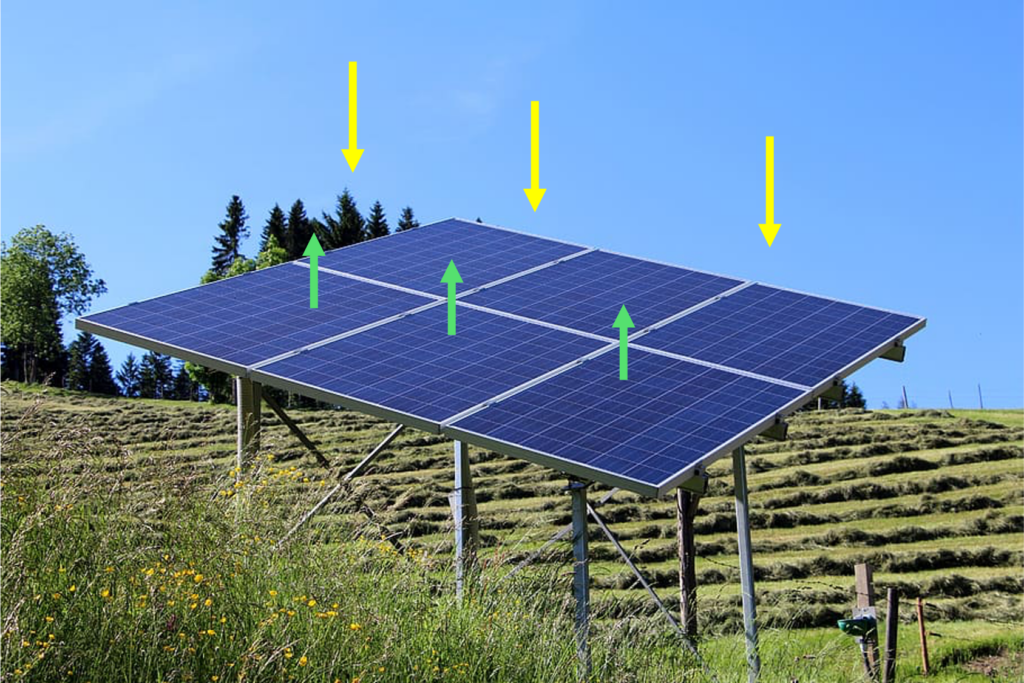
	</div>
			
				
				<div class="footnotes"><div id='160-1'><p>Source: https://en.wikipedia.org/wiki/Dot_product#/media/File:Dot_Product.svg</p>
</div></div>
	</div>
<div class="chapter standard with-subsections" id="chapter-cross-products" title="1.5 Cross Products">
	<div class="chapter-title-wrap">
		<p class="chapter-number">5</p>
		<h1 class="chapter-title">1.5 Cross Products</h1>
								</div>
	<div class="ugc chapter-ugc">
				 <p>This is a second way to calculate the product of two vectors. It creates a third vector that is perpendicular to the plane made from the two vectors as shown in the figure <span class="footnote"><span class="footnote-indirect" data-fnref="281-1"></span></span>.</p> <p><img src="https://upload.wikimedia.org/wikipedia/commons/5/5f/Cross-product-with-area.svg" alt="File:Cross-product-with-area.svg - Wikimedia Commons" class="n3VNCb alignright" data-noaft="1" width="289" height="251" title="" />The black arrow is perpendicular to the grey plane made from blue and red vectors). This is how you will find the amount of torque created from a force, which we will do many times. Also, unlike the dot product, <span>a</span> x <span>b</span>&nbsp; is a different direction than <span>b</span> x <span>a</span>.</p> <p>$$ \vec A\times\vec B=\begin{bmatrix}<br /> \underline{\hat{i}} &amp; \underline{\hat{j}} &amp; \underline{\hat{k}} \\<br /> A_x &amp; A_y &amp; A_z \\<br /> B_x &amp; B_y &amp; B_z<br /> \end{bmatrix} $$</p> <p>&nbsp;</p> <p><img src="http://localhost:3000/latex?latex=%5Cvec%20%7B%5Ctextbf%7BA%7D%7D%5Ctimes%5Cvec%7B%5Ctextbf%7BB%7D%7D%3D%28A_yB_z-A_zB_y%29%5Cunderline%7B%5Chat%7B%5Ctextbf%7Bi%7D%7D%7D%2B%28A_zB_x-A_xB_z%29%5Cunderline%7B%5Chat%7B%5Ctextbf%7Bj%7D%7D%7D%2B%28A_xB_y-A_yB_x%29%5Cunderline%7B%5Chat%7B%5Ctextbf%7Bk%7D%7D%7D&amp;fg=000000&amp;font=TeX&amp;svg=1" alt="\vec {\textbf{A}}\times\vec{\textbf{B}}=(A_yB_z-A_zB_y)\underline{\hat{\textbf{i}}}+(A_zB_x-A_xB_z)\underline{\hat{\textbf{j}}}+(A_xB_y-A_yB_x)\underline{\hat{\textbf{k}}}" title="\vec {\textbf{A}}\times\vec{\textbf{B}}=(A_yB_z-A_zB_y)\underline{\hat{\textbf{i}}}+(A_zB_x-A_xB_z)\underline{\hat{\textbf{j}}}+(A_xB_y-A_yB_x)\underline{\hat{\textbf{k}}}" class="latex mathjax" /></p> <p style="text-align: center"><img src="http://localhost:3000/latex?latex=%7C%5Cvec%20%7B%5Ctextbf%7BA%7D%7D%5Ctimes%5Cvec%20%7B%5Ctextbf%7BB%7D%7D%7C%3D%7C%5Cvec%20A%7C%7C%5Cvec%20B%7C%5Csin%5Ctheta&amp;fg=000000&amp;font=TeX&amp;svg=1" alt="|\vec {\textbf{A}}\times\vec {\textbf{B}}|=|\vec A||\vec B|\sin\theta" title="|\vec {\textbf{A}}\times\vec {\textbf{B}}|=|\vec A||\vec B|\sin\theta" class="latex mathjax" /></p> <div class="textbox"><p><span>The </span><strong>vector product</strong> <span>of two vectors <img src="http://localhost:3000/latex?latex=%5Cvec%20A%20%5Ctext%7B%C2%A0%20and%C2%A0%20%7D%5Cvec%20B&amp;fg=000000&amp;font=TeX&amp;svg=1" alt="\vec A \text{&nbsp; and&nbsp; }\vec B" title="\vec A \text{&nbsp; and&nbsp; }\vec B" class="latex mathjax" /></span><span>&nbsp;</span><span>is denoted by <img src="http://localhost:3000/latex?latex=%5Cvec%20A%20%5Ctext%7B%20x%20%7D%5Cvec%20B&amp;fg=000000&amp;font=TeX&amp;svg=1" alt="\vec A \text{ x }\vec B" title="\vec A \text{ x }\vec B" class="latex mathjax" /></span><span>&nbsp;and is often referred to as a&nbsp;</span><strong>cross product</strong><span>. The vector product is a vector that has its direction perpendicular to both vectors <img src="http://localhost:3000/latex?latex=%5Cvec%20A%20%5Ctext%7B%C2%A0%20and%C2%A0%20%7D%5Cvec%20B&amp;fg=000000&amp;font=TeX&amp;svg=1" alt="\vec A \text{&nbsp; and&nbsp; }\vec B" title="\vec A \text{&nbsp; and&nbsp; }\vec B" class="latex mathjax" /></span><span>. In other words, vector <img src="http://localhost:3000/latex?latex=%5Cvec%20A%20%5Ctext%7B%20x%20%7D%5Cvec%20B&amp;fg=000000&amp;font=TeX&amp;svg=1" alt="\vec A \text{ x }\vec B" title="\vec A \text{ x }\vec B" class="latex mathjax" /></span> <span>is perpendicular to the plane that contains vectors <img src="http://localhost:3000/latex?latex=%5Cvec%20A%20%5Ctext%7B%C2%A0%20and%C2%A0%20%7D%5Cvec%20B&amp;fg=000000&amp;font=TeX&amp;svg=1" alt="\vec A \text{&nbsp; and&nbsp; }\vec B" title="\vec A \text{&nbsp; and&nbsp; }\vec B" class="latex mathjax" /></span><span>.</span><span></span></p> <p>Source: University Physics Volume 1, OpenStax CNX, <a href="https://courses.lumenlearning.com/suny-osuniversityphysics/chapter/2-4-products-of-vectors/" data-url="https://courses.lumenlearning.com/suny-osuniversityphysics/chapter/2-4-products-of-vectors/">https://courses.lumenlearning.com/suny-osuniversityphysics/chapter/2-4-products-of-vectors/</a></p> </div> <div class="textbox"><p>Unit vectors allow for a straightforward calculation of the cross product of two vectors under even the most general circumstances, e.g. circumstances in which each of the vectors is pointing in an arbitrary direction in a three-dimensional space. To take advantage of the method, we need to know the cross product of the Cartesian coordinate axis unit vectors i, j, and k with each other. First off, we should note that any vector crossed into itself gives zero. This is evident from the&nbsp; equation:</p> <p style="text-align: center"><img src="http://localhost:3000/latex?latex=%7C%5Cvec%20A%5Ctimes%5Cvec%20B%7C%3D%7C%5Cvec%20A%7C%7C%5Cvec%20B%7C%5Csin%5Ctheta&amp;fg=000000&amp;font=TeX&amp;svg=1" alt="|\vec A\times\vec B|=|\vec A||\vec B|\sin\theta" title="|\vec A\times\vec B|=|\vec A||\vec B|\sin\theta" class="latex mathjax" />.</p> <p>because if A and B are in the same direction, then θ = 0°, and since sin 0° = 0, we have <img src="http://localhost:3000/latex?latex=%7C%5Cvec%20A%5Ctimes%5Cvec%20B%7C%3D0&amp;fg=000000&amp;font=TeX&amp;svg=1" alt="|\vec A\times\vec B|=0" title="|\vec A\times\vec B|=0" class="latex mathjax" />.&nbsp;Regarding the unit vectors, this means that:</p> <p style="text-align: center">$$\underline{\hat{i}}\times\underline{\hat{i}}=0\\\underline{\hat{j}}\times\underline{\hat{j}}=0\\\underline{\hat{k}}\times\underline{\hat{k}}=0$$</p> <p>&nbsp;</p> <p>Next we note that the magnitude of the cross product of two vectors that are perpendicular to each other is just the ordinary product of the magnitudes of the vectors. This is also evident from the equation:</p> <p style="text-align: center">$$|\vec {A}\times\vec{B}|=|\vec A||\vec B|\sin\theta$$</p> <p>because if <img src="http://localhost:3000/latex?latex=%5Cvec%20A&amp;fg=000000&amp;font=TeX&amp;svg=1" alt="\vec A" title="\vec A" class="latex mathjax" /> is perpendicular to <img src="http://localhost:3000/latex?latex=%5Cvec%20B&amp;fg=000000&amp;font=TeX&amp;svg=1" alt="\vec B" title="\vec B" class="latex mathjax" />&nbsp;then θ = 90° and sin90° = 1 so:</p> <p style="text-align: center">$$|\vec A\times\vec B|=|\vec A||\vec B|$$</p> <p>Now if A and B are unit vectors, then their magnitudes are both 1, so, the product of their magnitudes is also 1. Furthermore, the unit vectors i, j, and k are all perpendicular to each other so the magnitude of the cross product of any one of them with any other one of them is the product of the two magnitudes, that is, 1.</p> <p>Now how about the direction? Let’s use the right-hand rule to get the direction of i×j:</p> <p><img src="http://pressbooks.library.upei.ca/statics/wp-content/uploads/sites/56/2021/04/IMG-0584.jpg" alt="A 3D coordinate system showing the x, y, and z axes with unit vectors labeled î (x-axis), ĵ (y-axis), and k̂ (z-axis) pointing in their respective positive directions." class="aligncenter wp-image-410" width="327" height="320" srcset="https://pressbooks.library.upei.ca/statics/wp-content/uploads/sites/56/2021/04/IMG-0584.jpg 1040w, https://pressbooks.library.upei.ca/statics/wp-content/uploads/sites/56/2021/04/IMG-0584-300x294.jpg 300w, https://pressbooks.library.upei.ca/statics/wp-content/uploads/sites/56/2021/04/IMG-0584-1024x1003.jpg 1024w, https://pressbooks.library.upei.ca/statics/wp-content/uploads/sites/56/2021/04/IMG-0584-768x752.jpg 768w, https://pressbooks.library.upei.ca/statics/wp-content/uploads/sites/56/2021/04/IMG-0584-65x64.jpg 65w, https://pressbooks.library.upei.ca/statics/wp-content/uploads/sites/56/2021/04/IMG-0584-225x220.jpg 225w, https://pressbooks.library.upei.ca/statics/wp-content/uploads/sites/56/2021/04/IMG-0584-350x343.jpg 350w" sizes="auto, (max-width: 327px) 100vw, 327px" title="" /></p> <p><em>[To find the direction, we use the right-hand rule which we will cover more in section 3.1. Here is an overview]</em>. With the fingers of the right hand pointing directly away from the right elbow, and in the same direction as i, (the first vector in “<img src="http://localhost:3000/latex?latex=%5Cunderline%7B%5Chat%7Bi%7D%7D%5Ctimes%5Cunderline%7B%5Chat%7Bj%7D%7D&amp;fg=000000&amp;font=TeX&amp;svg=1" alt="\underline{\hat{i}}\times\underline{\hat{j}}" title="\underline{\hat{i}}\times\underline{\hat{j}}" class="latex mathjax" />”) to make it so that if one were to close the fingers, they would point in the same direction as <img src="http://localhost:3000/latex?latex=%5Cunderline%7B%5Chat%7Bj%7D%7D&amp;fg=000000&amp;font=TeX&amp;svg=1" alt="\underline{\hat{j}}" title="\underline{\hat{j}}" class="latex mathjax" />, the palm must be facing in the +y direction. That being the case, the extended thumb must be pointing in the +z direction. Putting the magnitude (the magnitude of each unit vector is 1) and direction (+z) information together we see that:</p> <ul><li><img src="http://localhost:3000/latex?latex=%5Cunderline%7B%5Chat%7Bi%7D%7D%5Ctimes%5Cunderline%7B%5Chat%7Bj%7D%7D%3D%5Cunderline%7B%5Chat%7Bk%7D%7D&amp;fg=000000&amp;font=TeX&amp;svg=1" alt="\underline{\hat{i}}\times\underline{\hat{j}}=\underline{\hat{k}}" title="\underline{\hat{i}}\times\underline{\hat{j}}=\underline{\hat{k}}" class="latex mathjax" /></li> <li><img src="http://localhost:3000/latex?latex=%5Cunderline%7B%5Chat%7Bj%7D%7D%5Ctimes%5Cunderline%7B%5Chat%7Bk%7D%7D%3D%5Cunderline%7B%5Chat%7Bi%7D%7D&amp;fg=000000&amp;font=TeX&amp;svg=1" alt="\underline{\hat{j}}\times\underline{\hat{k}}=\underline{\hat{i}}" title="\underline{\hat{j}}\times\underline{\hat{k}}=\underline{\hat{i}}" class="latex mathjax" /></li> <li><img src="http://localhost:3000/latex?latex=%5Cunderline%7B%5Chat%7Bk%7D%7D%5Ctimes%5Cunderline%7B%5Chat%7Bi%7D%7D%3D%5Cunderline%7B%5Chat%7Bj%7D%7D&amp;fg=000000&amp;font=TeX&amp;svg=1" alt="\underline{\hat{k}}\times\underline{\hat{i}}=\underline{\hat{j}}" title="\underline{\hat{k}}\times\underline{\hat{i}}=\underline{\hat{j}}" class="latex mathjax" /></li> <li><img src="http://localhost:3000/latex?latex=%5Cunderline%7B%5Chat%7Bj%7D%7D%5Ctimes%5Cunderline%7B%5Chat%7Bi%7D%7D%3D-%5Cunderline%7B%5Chat%7Bk%7D%7D&amp;fg=000000&amp;font=TeX&amp;svg=1" alt="\underline{\hat{j}}\times\underline{\hat{i}}=-\underline{\hat{k}}" title="\underline{\hat{j}}\times\underline{\hat{i}}=-\underline{\hat{k}}" class="latex mathjax" /></li> <li><img src="http://localhost:3000/latex?latex=%5Cunderline%7B%5Chat%7Bk%7D%7D%5Ctimes%5Cunderline%7B%5Chat%7Bj%7D%7D%3D-%5Cunderline%7B%5Chat%7Bi%7D%7D&amp;fg=000000&amp;font=TeX&amp;svg=1" alt="\underline{\hat{k}}\times\underline{\hat{j}}=-\underline{\hat{i}}" title="\underline{\hat{k}}\times\underline{\hat{j}}=-\underline{\hat{i}}" class="latex mathjax" /></li> <li><img src="http://localhost:3000/latex?latex=%5Cunderline%7B%5Chat%7Bi%7D%7D%5Ctimes%5Cunderline%7B%5Chat%7Bk%7D%7D%3D-%5Cunderline%7B%5Chat%7Bj%7D%7D&amp;fg=000000&amp;font=TeX&amp;svg=1" alt="\underline{\hat{i}}\times\underline{\hat{k}}=-\underline{\hat{j}}" title="\underline{\hat{i}}\times\underline{\hat{k}}=-\underline{\hat{j}}" class="latex mathjax" /></li> </ul> <p>One way of remembering this is to write <img src="http://localhost:3000/latex?latex=%5Cunderline%7B%5Chat%7Bi%7D%7D%2C%5Cunderline%7B%5Chat%7Bj%7D%7D%2C%5Cunderline%7B%5Chat%7Bk%7D%7D&amp;fg=000000&amp;font=TeX&amp;svg=1" alt="\underline{\hat{i}},\underline{\hat{j}},\underline{\hat{k}}" title="\underline{\hat{i}},\underline{\hat{j}},\underline{\hat{k}}" class="latex mathjax" /> twice in succession:</p> <p style="text-align: center"><img src="http://localhost:3000/latex?latex=%5Cunderline%7B%5Chat%7B%5Ctextbf%7Bi%7D%7D%7D%2C%5Cunderline%7B%5Chat%7B%5Ctextbf%7Bj%7D%7D%7D%2C%5Cunderline%7B%5Chat%7B%5Ctextbf%7Bk%7D%7D%7D%2C%5Cunderline%7B%5Chat%7B%5Ctextbf%7Bi%7D%7D%7D%2C%5Cunderline%7B%5Chat%7B%5Ctextbf%7Bj%7D%7D%7D%2C%5Cunderline%7B%5Chat%7B%5Ctextbf%7Bk%7D%7D%7D&amp;fg=000000&amp;font=TeX&amp;svg=1" alt="\underline{\hat{\textbf{i}}},\underline{\hat{\textbf{j}}},\underline{\hat{\textbf{k}}},\underline{\hat{\textbf{i}}},\underline{\hat{\textbf{j}}},\underline{\hat{\textbf{k}}}" title="\underline{\hat{\textbf{i}}},\underline{\hat{\textbf{j}}},\underline{\hat{\textbf{k}}},\underline{\hat{\textbf{i}}},\underline{\hat{\textbf{j}}},\underline{\hat{\textbf{k}}}" class="latex mathjax" /></p> <p>Then, crossing any one of the first three vectors into the vector immediately to its right yields the next vector to the right. But crossing any one of the last three vectors into the vector immediately to its left yields the negative of the next vector to the left (left-to-right “+“, but right-to-left “−“).</p> <p>Now we’re ready to look at the general case. Any vector&nbsp; <img src="http://localhost:3000/latex?latex=%5Cvec%20A&amp;fg=000000&amp;font=TeX&amp;svg=1" alt="\vec A" title="\vec A" class="latex mathjax" /> &nbsp;can be expressed in terms of unit vectors:</p> <p>$$\vec{\textbf{A}}=A_x\hat{\underline{i}}+A_y\hat{\underline{j}}+A_z\hat{\underline{k}}$$</p> <p>Doing the same for a vector&nbsp; <img src="http://localhost:3000/latex?latex=%5Cvec%20B&amp;fg=000000&amp;font=TeX&amp;svg=1" alt="\vec B" title="\vec B" class="latex mathjax" />&nbsp; <span></span> then allows us to write the cross product as:</p> <p>$$\vec{\textbf{A}}\times\vec{\textbf{B}}=(A_x\hat{\underline{i}}+A_y\hat{\underline{j}}+A_z\hat{\underline{k}})\times(B_x\hat{\underline{i}}+B_y\hat{\underline{j}}+B_z\hat{\underline{k}})$$</p> <p>Using the distributive rule for multiplication we can write this as:</p> <p>$$\begin{aligned}\vec{\textbf{A}}\times\vec{\textbf{B}}=&amp;A_x\hat{\underline{i}}\times(B_x\hat{\underline{i}}+B_y\hat{\underline{j}}+B_z\hat{\underline{k}})+\\&amp;A_y\hat{\underline{j}}\times(B_x\hat{\underline{i}}+B_y\hat{\underline{j}}+B_z\hat{\underline{k}})+\\&amp;A_z\hat{\underline{k}}\times(B_x\hat{\underline{i}}+B_y\hat{\underline{j}}+B_z\hat{\underline{k}})\end{aligned}$$</p> <p>$$\begin{aligned}\vec{\textbf{A}}\times\vec{\textbf{B}}=&amp;A_x\hat{\underline{i}}\times B_x\hat{\underline{i}}+A_x\hat{\underline{i}}\times B_y\hat{\underline{j}}+A_x\hat{\underline{i}}\times&nbsp; B_z\hat{\underline{k}}+\\&amp;A_y\hat{\underline{j}}\times B_x\hat{\underline{i}}+A_y\hat{\underline{j}}\times B_y\hat{\underline{j}}+A_y\hat{\underline{j}}\times B_z\hat{\underline{k}}+\\&amp;A_z\hat{\underline{k}}\times B_x\hat{\underline{i}}+A_z\hat{\underline{k}}\times B_y\hat{\underline{j}}+A_z\hat{\underline{k}}\times B_z\hat{\underline{k}}\end{aligned}$$</p> <p>Using, in each term, the commutative rule and the associative rule for multiplication we can write this as:</p> <p>$$\begin{aligned}\vec{\textbf{A}}\times\vec{\textbf{B}}=&amp;A_xB_x(\hat{\underline{i}}\times\hat{\underline{i}})+A_xB_y(\hat{\underline{i}}\times\hat{\underline{j}})+A_xB_z(\hat{\underline{i}}\times\hat{\underline{k}})+\\&amp;A_yB_x(\hat{\underline{j}}\times\hat{\underline{i}})+A_yB_y(\hat{\underline{j}}\times\hat{\underline{j}})+A_yB_z(\hat{\underline{j}}\times\hat{\underline{k}})+\\&amp;A_zB_x(\hat{\underline{k}}\times\hat{\underline{i}})+A_zB_y(\hat{\underline{k}}\times\hat{\underline{j}})+A_zB_z(\hat{\underline{k}}\times\hat{\underline{k}})\end{aligned}$$</p> <p>Now we evaluate the cross product that appears in each term:</p> <p>$$\begin{aligned}\vec A\times\vec B=&amp;A_xB_x(0)+A_xB_y(\underline{\hat{k}})+A_xB_z(-\underline{\hat{j}})+\\&amp;A_yB_x(-\underline{\hat{k}})+A_yB_y(0)+A_yB_z(\underline{\hat{i}})+\\&amp;A_zB_x(\underline{\hat{j}})+A_zB_y(-\underline{\hat{i}})+A_zB_z(0)\end{aligned}$$</p> <p>Eliminating the zero terms and grouping the terms with i together, the terms with j together, and the terms with k together yields:</p> <p>$$\begin{aligned}\vec A\times\vec B=&amp;A_yB_z(\underline{\hat{i}})+A_zB_y(-\underline{\hat{i}})+\\&amp;A_zB_x(\underline{\hat{j}})+A_xB_z(-\underline{\hat{j}})+\\&amp;A_xB_y(\underline{\hat{k}})+A_yB_x(-\underline{\hat{k}})\end{aligned}$$</p> <p>Factoring out the unit vectors yields:</p> <p>$$\begin{aligned}\vec A\times\vec B=&amp;(A_yB_z-A_zB_y)\underline{\hat{i}}+\\&amp;(A_zB_x-A_xB_z)\underline{\hat{j}}+\\&amp;(A_xB_y-A_yB_x)\underline{\hat{k}}\end{aligned}$$</p> <p>which can be written on one line as:</p> <p>$$\vec A\times\vec B=(A_yB_z-A_zB_y)\underline{\hat{i}}+(A_zB_x-A_xB_z)\underline{\hat{j}}+(A_xB_y-A_yB_x)\underline{\hat{k}}$$</p> <p>This is our end result. We can arrive at this result much more quickly if we borrow a tool from that branch of mathematics known as linear algebra (the mathematics of matrices).</p> <p>We form the 3×3 matrix:</p> <p style="text-align: center">$$ \begin{bmatrix}<br /> \underline{\hat{i}} &amp; \underline{\hat{j}} &amp; \underline{\hat{k}} \\<br /> A_x &amp; A_y &amp; A_z \\<br /> B_x &amp; B_y &amp; B_z<br /> \end{bmatrix} $$</p> <p>by writing i, j, k as the first row, then the components of the first vector that appears in the cross product as the second row, and finally the components of the second vector that appears in the cross product as the last row. It turns out that the cross product is equal to the determinant of that matrix. We use absolute value signs on the entire matrix to signify “the determinant of the matrix.” So we have:</p> <p style="text-align: center">$$ \vec A\times\vec B=\begin{bmatrix}<br /> \underline{\hat{i}} &amp; \underline{\hat{j}} &amp; \underline{\hat{k}} \\<br /> A_x &amp; A_y &amp; A_z \\<br /> B_x &amp; B_y &amp; B_z<br /> \end{bmatrix} $$</p> <p>&nbsp;</p> <p>To take the determinant of a 3×3 matrix you work your way across the top row. For each element in that row you take the product of the elements along the diagonal that extends down and to the right, minus the product of the elements down and to the left; and you add the three results (one result for each element in the top row) together. If there are no elements down and to the appropriate side, you move over to the other side of the matrix (see below) to complete the diagonal.</p> <p style="text-align: center">For the first element of the first row, the i, take the product down and to the right,</p> <p style="text-align: center"><img src="http://pressbooks.library.upei.ca/statics/wp-content/uploads/sites/56/2021/04/IMG-0597.jpg" alt="Diagram showing vectors i, j, k above columns labeled Ax, Ay, Az, and Bx, By, Bz, with two red arrows pointing from Ax to Ay and from Ay to Bz." class="aligncenter wp-image-422" width="139" height="132" srcset="https://pressbooks.library.upei.ca/statics/wp-content/uploads/sites/56/2021/04/IMG-0597.jpg 942w, https://pressbooks.library.upei.ca/statics/wp-content/uploads/sites/56/2021/04/IMG-0597-300x285.jpg 300w, https://pressbooks.library.upei.ca/statics/wp-content/uploads/sites/56/2021/04/IMG-0597-768x730.jpg 768w, https://pressbooks.library.upei.ca/statics/wp-content/uploads/sites/56/2021/04/IMG-0597-65x62.jpg 65w, https://pressbooks.library.upei.ca/statics/wp-content/uploads/sites/56/2021/04/IMG-0597-225x214.jpg 225w, https://pressbooks.library.upei.ca/statics/wp-content/uploads/sites/56/2021/04/IMG-0597-350x333.jpg 350w" sizes="auto, (max-width: 139px) 100vw, 139px" title="" /></p> <p style="text-align: center">( this yields iA<sub>y</sub>B<sub>z</sub>) minus the product down and to the left</p> <p style="text-align: center"><img src="http://pressbooks.library.upei.ca/statics/wp-content/uploads/sites/56/2021/04/IMG-0598.jpg" alt="Three columns with unit vectors î, ĵ, and k̂ on top. Below each vector, arrows point to Ax, By, and Az in the first, second, and third columns, respectively. Bx, By, and Bz are below them." class="aligncenter wp-image-423" width="163" height="135" srcset="https://pressbooks.library.upei.ca/statics/wp-content/uploads/sites/56/2021/04/IMG-0598.jpg 1013w, https://pressbooks.library.upei.ca/statics/wp-content/uploads/sites/56/2021/04/IMG-0598-300x249.jpg 300w, https://pressbooks.library.upei.ca/statics/wp-content/uploads/sites/56/2021/04/IMG-0598-768x638.jpg 768w, https://pressbooks.library.upei.ca/statics/wp-content/uploads/sites/56/2021/04/IMG-0598-65x54.jpg 65w, https://pressbooks.library.upei.ca/statics/wp-content/uploads/sites/56/2021/04/IMG-0598-225x187.jpg 225w, https://pressbooks.library.upei.ca/statics/wp-content/uploads/sites/56/2021/04/IMG-0598-350x291.jpg 350w" sizes="auto, (max-width: 163px) 100vw, 163px" title="" /></p> <p style="text-align: center">( the product down-and-to-the-left is iA<sub>z</sub>B<sub>y</sub>).</p> <p>For the first element in the first row, we thus have: <img src="http://localhost:3000/latex?latex=%5Cunderline%7B%5Chat%7Bi%7D%7D&amp;fg=000000&amp;font=TeX&amp;svg=1" alt="\underline{\hat{i}}" title="\underline{\hat{i}}" class="latex mathjax" />A<sub>y</sub>B<sub>z</sub> − <img src="http://localhost:3000/latex?latex=%5Cunderline%7B%5Chat%7Bi%7D%7D&amp;fg=000000&amp;font=TeX&amp;svg=1" alt="\underline{\hat{i}}" title="\underline{\hat{i}}" class="latex mathjax" />A<sub>z</sub>B<sub>y</sub> which can be written as: (A<sub>y</sub>B<sub>z</sub> − A<sub>z</sub>B<sub>y</sub>)<img src="http://localhost:3000/latex?latex=%5Cunderline%7B%5Chat%7Bi%7D%7D&amp;fg=000000&amp;font=TeX&amp;svg=1" alt="\underline{\hat{i}}" title="\underline{\hat{i}}" class="latex mathjax" />. Repeating the process for the second and third elements in the first row (the j and the k) we get (A<sub>z</sub>B<sub>x</sub> − A<sub>x</sub>B<sub>z</sub>)<img src="http://localhost:3000/latex?latex=%5Cunderline%7B%5Chat%7Bj%7D%7D&amp;fg=000000&amp;font=TeX&amp;svg=1" alt="\underline{\hat{j}}" title="\underline{\hat{j}}" class="latex mathjax" /> and (A<sub>x</sub>B<sub>y</sub> − A<code>y</code>B<sub>x</sub>)<img src="http://localhost:3000/latex?latex=%5Cunderline%7B%5Chat%7Bk%7D%7D&amp;fg=000000&amp;font=TeX&amp;svg=1" alt="\underline{\hat{k}}" title="\underline{\hat{k}}" class="latex mathjax" /> respectively. Adding the three results, to form the determinant of the matrix results in:</p> <p style="text-align: center">$$\vec A\times\vec B=(A_yB_z-A_zB_y)\underline{\hat{i}}+(A_zB_x-A_xB_z)\underline{\hat{j}}+(A_xB_y-A_yB_x)\underline{\hat{k}}$$</p> <p>as we found before, “the hard way.” Below the diagram shows the direction of each part of the cross product:</p> <p><img src="http://pressbooks.library.upei.ca/statics/wp-content/uploads/sites/56/2021/04/CNX_UPhysics_02_04_uniprod.jpg" alt="Four diagrams of coordinate axes in 3D boxes illustrate the right-hand rule for cross products, labeling directions for x (î), y (ĵ), and z (k̂) with curved arrows and vector equations." class="aligncenter wp-image-550" width="471" height="447" srcset="https://pressbooks.library.upei.ca/statics/wp-content/uploads/sites/56/2021/04/CNX_UPhysics_02_04_uniprod.jpg 596w, https://pressbooks.library.upei.ca/statics/wp-content/uploads/sites/56/2021/04/CNX_UPhysics_02_04_uniprod-300x285.jpg 300w, https://pressbooks.library.upei.ca/statics/wp-content/uploads/sites/56/2021/04/CNX_UPhysics_02_04_uniprod-65x62.jpg 65w, https://pressbooks.library.upei.ca/statics/wp-content/uploads/sites/56/2021/04/CNX_UPhysics_02_04_uniprod-225x214.jpg 225w, https://pressbooks.library.upei.ca/statics/wp-content/uploads/sites/56/2021/04/CNX_UPhysics_02_04_uniprod-350x332.jpg 350w" sizes="auto, (max-width: 471px) 100vw, 471px" title="" /></p> <p>Source: Calculus Based Physics, <span>Jeffrey W. Schnick,</span> <a href="https://openlibrary.ecampusontario.ca/catalogue/item/?id=ce74a181-ccde-491c-848d-05489ed182e7" data-url="https://openlibrary.ecampusontario.ca/catalogue/item/?id=ce74a181-ccde-491c-848d-05489ed182e7">https://openlibrary.ecampusontario.ca/catalogue/item/?id=ce74a181-ccde-491c-848d-05489ed182e7</a> page 136–141</p> </div> <div class="textbox textbox--key-takeaways"><div class="textbox__header"><p class="textbox__title">Key Takeaways</p> </div> <div class="textbox__content"><div class="textbox__content"><p><em>Basically: </em>Cross product is a method to find a vector that is a product of two vectors, perpendicular to the plane created from the two vectors.</p> <p><i>Application: While bicycling, the force of my foot pushing on the pedal produces the most rotation when the force is 90 degrees (perpendicular) from the surface of the pedal.</i> The pedals themselves rotate, so I can change the angle I am pushing with, otherwise, when the pedal is at the bottom, it would be very difficult to produce forward motion.</p> <p><em>Looking ahead: </em>In the next section, 1.6 on Torque, we will use the cross product to find the moment produced by forces.</p> </div> </div> </div> 
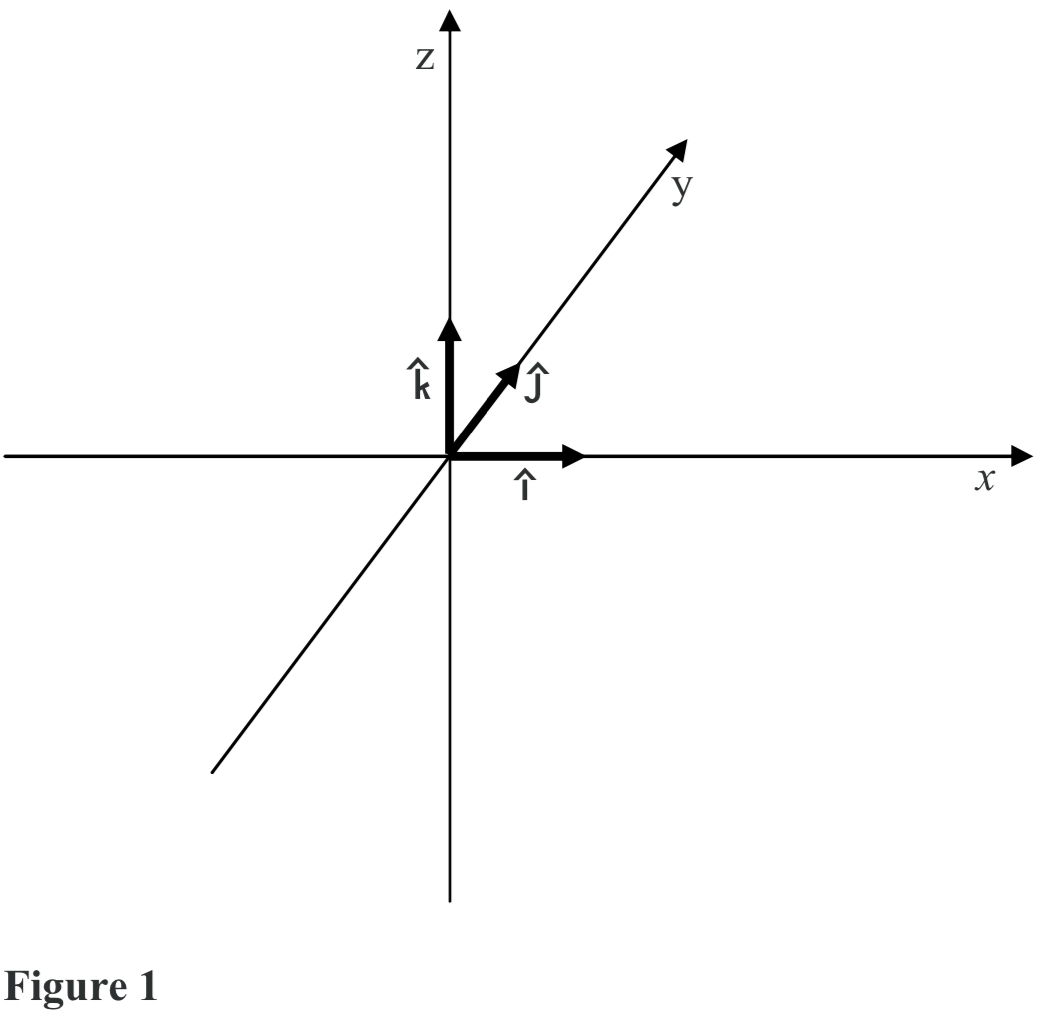
	</div>
			
				
				<div class="footnotes"><div id='281-1'>
<p><a href="https://commons.wikimedia.org/wiki/File:Cross-product-with-area.svg" data-url="https://commons.wikimedia.org/wiki/File:Cross-product-with-area.svg">https://commons.wikimedia.org/wiki/File:Cross-product-with-area.svg</a></p>

</div></div>
	</div>
<div class="chapter standard with-subsections" id="chapter-torque-moment" title="1.6 Torque/Moment">
	<div class="chapter-title-wrap">
		<p class="chapter-number">6</p>
		<h1 class="chapter-title">1.6 Torque/Moment</h1>
								</div>
	<div class="ugc chapter-ugc">
				
 <h1 id="chapter-168-section-1" class="section-header">1.6.1 Moments</h1> <p>Moments are created by a force acting at a distance from the center of rotation. There are three ways to calculate moments: scalar, vector, and using the right-hand rule. The first two methods will be presented in this section, and the third method will be discussed in section 3.1.3 on the right-hand rule.</p> <p>&nbsp;</p> <div class="textbox"><p><span>A&nbsp;</span><strong>moment</strong> <span>(sometimes called a torque) is defined as the “tendency of a force to rotate a body”. Where forces cause linear accelerations, moments cause </span><strong>angular accelerations</strong><span>. In this way, moments can be thought of as twisting forces.</span></p> <div class="wp-caption aligncenter" id="attachment_2671" aria-describedby="caption-attachment-2671" style="width: 531px"><img src="http://pressbooks.library.upei.ca/statics/wp-content/uploads/sites/56/2021/03/Screenshot-2025-07-15-155223-300x136.png" alt="Two rectangles labeled A and B each have a red upward arrow beneath them and a blue upward arrow above. B also has a blue curved arrow indicating rotation above it." class="wp-image-2671" width="531" height="241" srcset="https://pressbooks.library.upei.ca/statics/wp-content/uploads/sites/56/2021/03/Screenshot-2025-07-15-155223-300x136.png 300w, https://pressbooks.library.upei.ca/statics/wp-content/uploads/sites/56/2021/03/Screenshot-2025-07-15-155223-768x349.png 768w, https://pressbooks.library.upei.ca/statics/wp-content/uploads/sites/56/2021/03/Screenshot-2025-07-15-155223-65x30.png 65w, https://pressbooks.library.upei.ca/statics/wp-content/uploads/sites/56/2021/03/Screenshot-2025-07-15-155223-225x102.png 225w, https://pressbooks.library.upei.ca/statics/wp-content/uploads/sites/56/2021/03/Screenshot-2025-07-15-155223-350x159.png 350w, https://pressbooks.library.upei.ca/statics/wp-content/uploads/sites/56/2021/03/Screenshot-2025-07-15-155223.png 900w" sizes="auto, (max-width: 531px) 100vw, 531px" title=""><div class="wp-caption-text" id="caption-attachment-2671">Imagine two boxes on an icy surface. The force on box A would simply cause the box to begin accelerating, but the force on box B would cause the box to both accelerate and to begin to rotate. The force on box B is exerting a moment, whereas the force on box A is not.</div></div> <p><strong>The Vector Representation of a Moment:</strong></p> <p>Moments, like forces, can be represented as vectors and have a magnitude, a direction, and a “point of application”. For moments, however, a better name for the point of application is the axis of rotation. This will be the point or axis where we will determine all the moments.</p> <p>&nbsp;</p> <p><strong>Magnitude:</strong></p> <p>The magnitude of a moment is the degree to which the moment will cause angular acceleration in the body it is acting on. It is represented by a scalar (a single number). The magnitude of the moment can be thought of as the strength of the twisting force exerted on the body. When a moment is represented as a vector, the magnitude of the moment is usually explicitly labelled. Though the length of the moment vector also often corresponds to the relative magnitude of the moment.</p> <p>The magnitude of the moment is measured in units of force times distance. The standard metric units for the magnitude of moments are newton meters, and the standard English units for a moment are foot pounds.</p> <p style="text-align: center"><img src="http://localhost:3000/latex?latex=M%3D%20F%5Cast%20d%5C%5CMetric%3A%20N%5Cast%20m%5C%5CEnglish%3A%20lb%20%5Cast%20ft&amp;fg=000000&amp;font=TeX&amp;svg=1" alt="M= F\ast d\\Metric: N\ast m\\English: lb \ast ft" title="M= F\ast d\\Metric: N\ast m\\English: lb \ast ft" class="latex mathjax"> .</p> <p>&nbsp;</p> <p><strong>Direction:</strong></p> <p>In a two-dimensional problem, the direction can be thought of as a scalar quantity corresponding to the direction of rotation the moment would cause. A moment that would cause a counter-clockwise rotation is a positive moment, and a moment that would cause a clockwise rotation is a negative moment.</p> <p>In a three-dimensional problem, however, a body can rotate about an axis in any direction. If this is the case, we need a vector to represent the direction of the moment. The direction of the moment vector will line up with the axis of rotation that moment would cause, but to determine which of the two directions we can use along that axis we have available, we use the right-hand rule. To use the right-hand rule, align your right hand as shown so that your thumb lines up with the axis of rotation for the moment and your curled fingers point in the direction of rotation for your moment. If you do this, your thumb will be pointing in the direction of the moment vector.</p> <p><img src="http://pressbooks.library.upei.ca/statics/wp-content/uploads/sites/56/2021/03/unnamed-2-e1619446957586.jpg" alt="A diagram of a right hand gripping a rod; fingers curl in the direction of rotation and the thumb points along the axis of rotation. Labels indicate Direction of Rotation and Axis of Rotation." class="aligncenter wp-image-356" width="260" height="208" srcset="https://pressbooks.library.upei.ca/statics/wp-content/uploads/sites/56/2021/03/unnamed-2-e1619446957586.jpg 912w, https://pressbooks.library.upei.ca/statics/wp-content/uploads/sites/56/2021/03/unnamed-2-e1619446957586-300x240.jpg 300w, https://pressbooks.library.upei.ca/statics/wp-content/uploads/sites/56/2021/03/unnamed-2-e1619446957586-768x614.jpg 768w, https://pressbooks.library.upei.ca/statics/wp-content/uploads/sites/56/2021/03/unnamed-2-e1619446957586-65x52.jpg 65w, https://pressbooks.library.upei.ca/statics/wp-content/uploads/sites/56/2021/03/unnamed-2-e1619446957586-225x180.jpg 225w, https://pressbooks.library.upei.ca/statics/wp-content/uploads/sites/56/2021/03/unnamed-2-e1619446957586-350x280.jpg 350w" sizes="auto, (max-width: 260px) 100vw, 260px" title=""></p> <p>If we look back at two-dimensional problems, all rotations occur about an axis pointing directly into or out of the page (the z-axis). Using the right-hand rule, counter-clockwise rotations are represented by a vector in the positive z direction and clockwise rotations are represented by a vector in the negative z direction.</p> <p>&nbsp;</p> <p><strong>Axis of Rotation:</strong></p> <p>In engineering statics problems, we can choose any point/axis as the axis of rotation. The choice of this point will affect the magnitude and direction of the resulting moment, however, and the moment is only valid about that point.</p> <div class="wp-caption aligncenter" id="attachment_2672" aria-describedby="caption-attachment-2672" style="width: 451px"><img src="http://pressbooks.library.upei.ca/statics/wp-content/uploads/sites/56/2021/03/Screenshot-2025-07-15-160057-300x125.png" alt="A horizontal beam labeled A on the left and B on the right rests on two supports. A red upward arrow is shown at the center, indicating an applied force or load." class="wp-image-2672" width="451" height="188" srcset="https://pressbooks.library.upei.ca/statics/wp-content/uploads/sites/56/2021/03/Screenshot-2025-07-15-160057-300x125.png 300w, https://pressbooks.library.upei.ca/statics/wp-content/uploads/sites/56/2021/03/Screenshot-2025-07-15-160057-1024x426.png 1024w, https://pressbooks.library.upei.ca/statics/wp-content/uploads/sites/56/2021/03/Screenshot-2025-07-15-160057-768x320.png 768w, https://pressbooks.library.upei.ca/statics/wp-content/uploads/sites/56/2021/03/Screenshot-2025-07-15-160057-65x27.png 65w, https://pressbooks.library.upei.ca/statics/wp-content/uploads/sites/56/2021/03/Screenshot-2025-07-15-160057-225x94.png 225w, https://pressbooks.library.upei.ca/statics/wp-content/uploads/sites/56/2021/03/Screenshot-2025-07-15-160057-350x146.png 350w, https://pressbooks.library.upei.ca/statics/wp-content/uploads/sites/56/2021/03/Screenshot-2025-07-15-160057.png 1475w" sizes="auto, (max-width: 451px) 100vw, 451px" title=""><div class="wp-caption-text" id="caption-attachment-2672">The magnitude and direction of a moment depend upon the chosen axis of rotation. For example, the single force above would cause different moments about Point A and Point B, because it would cause different rotations depending on the point we fix in place.</div></div> <p>Though we can take the moment about any point in a statics problem, if we are<span>&nbsp;</span><strong>adding</strong><span>&nbsp;</span>together the moments from multiple forces, all the moments must be taken about a<span>&nbsp;</span><strong>common axis of rotation</strong>. Moments taken about different points cannot be added together to find a ‘net moment’</p> <p>Additionally, if we move into the subject of dynamics, where bodies are moving, we will want to relate moments to angular accelerations. For this to work, we will need to take the moments either about a single point that does not move (such as the hinge on a door) or we will need to take the moments about the center of mass of the body. Summing moments about other axes of rotation will not result in valid calculations.</p> <p>&nbsp;</p> <p><strong>Calculating Moments:</strong></p> <p><span>We will have two main options to calculate the moment that a force exerts on a body: </span><strong>scalar methods</strong><span>&nbsp;and&nbsp;</span><strong>vector methods</strong><span>. Scalar methods are generally faster for two-dimensional problems where a body can only rotate clockwise or counterclockwise, while vector methods are generally faster for three-dimensional problems where the axis of rotation is more complex.</span></p> <p><span>Given any point on an extended body, if there is a force acting on that body that does not travel through that point, then that force will cause a moment about that point. As discussed on the moments page, a moment is a force’s tendency to cause rotation.</span></p> <p>Source: Engineering Mechanics, Jacob Moore et al., <a href="http://mechanicsmap.psu.edu/websites/1_mechanics_basics/1-5_moments/moments.html" data-url="http://mechanicsmap.psu.edu/websites/1_mechanics_basics/1-5_moments/moments.html">http://mechanicsmap.psu.edu/websites/1_mechanics_basics/1-5_moments/moments.html</a></p> </div> <p>&nbsp;</p> <h1 id="chapter-168-section-2" class="section-header">1.6.2 Scalar Method in 2 Dimensions</h1> <div class="textbox"><p>In discussing how to calculate the moment of a force about a point via scalar quantities, we will begin with the example of a force on a simple lever as shown below. In this simple lever there is a force on the end of the lever, distance d away from the center of rotation for the lever (point A) where the force has a magnitude F.</p> <p><img src="http://pressbooks.library.upei.ca/statics/wp-content/uploads/sites/56/2021/03/lever1.png" alt="A diagram showing a rod fixed to a wall at point A. Point B is at the rods free end, distance d from A. An upward force F is applied at point B." class="aligncenter wp-image-1267 size-full" width="500" height="231" srcset="https://pressbooks.library.upei.ca/statics/wp-content/uploads/sites/56/2021/03/lever1.png 500w, https://pressbooks.library.upei.ca/statics/wp-content/uploads/sites/56/2021/03/lever1-300x139.png 300w, https://pressbooks.library.upei.ca/statics/wp-content/uploads/sites/56/2021/03/lever1-65x30.png 65w, https://pressbooks.library.upei.ca/statics/wp-content/uploads/sites/56/2021/03/lever1-225x104.png 225w, https://pressbooks.library.upei.ca/statics/wp-content/uploads/sites/56/2021/03/lever1-350x162.png 350w" sizes="auto, (max-width: 500px) 100vw, 500px" title=""></p> <p>When using scalar quantities, the magnitude of the moment will be equal to the perpendicular distance between the line of action of the force and the point we are taking the moment about.</p> <h2 style="text-align: center"><strong>$$M=F\ast d$$</strong></h2> <p>To determine the sign of the moment, we determine what type of rotation the force would cause. In this case we can see that the force would cause the lever to rotate counterclockwise about point A. Counterclockwise rotations are caused by positive moments while clockwise rotations are caused by negative moments.</p> <p>Another important factor to remember is that the value d is the perpendicular distance from the force to the point we are taking the moment about. We could measure the distance from point A to the head of the force vector, or the tail of the force vector, or really any point along the line of action of force F. The distance we need to use for the scalar moment calculation however is the shortest distance between the point and the line of action of the force. This will always be a line perpendicular to the line of action of the force, going to the point we are taking the moment about.</p> <p><img src="http://pressbooks.library.upei.ca/statics/wp-content/uploads/sites/56/2021/03/lever2.png" alt="Diagram of a rod attached to a wall at point A, extending to a blue circle at point B. A red vertical arrow labeled F points upward from B. A horizontal line labeled d connects A and the vertical line through B." class="aligncenter wp-image-1268 size-full" width="400" height="413" srcset="https://pressbooks.library.upei.ca/statics/wp-content/uploads/sites/56/2021/03/lever2.png 400w, https://pressbooks.library.upei.ca/statics/wp-content/uploads/sites/56/2021/03/lever2-291x300.png 291w, https://pressbooks.library.upei.ca/statics/wp-content/uploads/sites/56/2021/03/lever2-65x67.png 65w, https://pressbooks.library.upei.ca/statics/wp-content/uploads/sites/56/2021/03/lever2-225x232.png 225w, https://pressbooks.library.upei.ca/statics/wp-content/uploads/sites/56/2021/03/lever2-350x361.png 350w" sizes="auto, (max-width: 400px) 100vw, 400px" title=""></p> <p>Source: Engineering Mechanics, Jacob Moore et al., <a href="http://mechanicsmap.psu.edu/websites/3_equilibrium_rigid_body/3-1_moment_scalar/moment_scalar.html" data-url="http://mechanicsmap.psu.edu/websites/3_equilibrium_rigid_body/3-1_moment_scalar/moment_scalar.html">http://mechanicsmap.psu.edu/websites/3_equilibrium_rigid_body/3-1_moment_scalar/moment_scalar.html</a></p> </div> <p>If the position vector and force aren’t exactly 90 degrees, the equation <span><strong>T</strong></span> = |<span><strong>r</strong></span>| |<span><strong>F</strong></span>| sin Θ can be helpful and still produce a scalar number for moment or torque. This would be good if we had simple systems, such as opening a door or spinning a top. What happens when you have a rotating door and a few people try to go through it? Or a force that isn’t exactly along two axes? We’ll use vectors as shown in the next section to solve that.</p> <h1 id="chapter-168-section-3" class="section-header">1.6.3 Vector Method in 3 Dimensions</h1> <div class="textbox"><p>An alternative to calculating the moment via scalar quantities is using the vector or cross product methods. For simple two-dimensional problems, using scalar quantities is usually easier, but for more complex problems, using the cross product method is usually easier. The cross product method for calculating moments says that the moment vector of a force about a point will be equal to the cross product of a vector<span>&nbsp;</span><strong>r</strong><span>&nbsp;</span>from the point to anywhere on the line of action of the force and the force vector itself.</p> <p style="text-align: center">$$\vec M=\vec r\times\vec F$$</p> <p><span>A big advantage of this method is that r does not have to be the shortest distance between the point and the line of action; it goes from the point to any part of the line of action. For any problem, there are many possible </span><strong>r</strong> <span>vectors, though, because of the way the cross product works, they should all result in the same moment vector in the end.</span></p> <div class="wp-caption aligncenter" id="attachment_2673" aria-describedby="caption-attachment-2673" style="width: 300px"><img src="http://pressbooks.library.upei.ca/statics/wp-content/uploads/sites/56/2021/03/Screenshot-2025-07-15-161113-300x294.png" alt="Diagram showing a rod pivoted at point A on a wall, with the other end at point B. A force F acts upward at B, and the distance from A to B is labeled r with a blue arrow." class="wp-image-2673 size-medium" width="300" height="294" srcset="https://pressbooks.library.upei.ca/statics/wp-content/uploads/sites/56/2021/03/Screenshot-2025-07-15-161113-300x294.png 300w, https://pressbooks.library.upei.ca/statics/wp-content/uploads/sites/56/2021/03/Screenshot-2025-07-15-161113-65x64.png 65w, https://pressbooks.library.upei.ca/statics/wp-content/uploads/sites/56/2021/03/Screenshot-2025-07-15-161113-225x220.png 225w, https://pressbooks.library.upei.ca/statics/wp-content/uploads/sites/56/2021/03/Screenshot-2025-07-15-161113-350x343.png 350w, https://pressbooks.library.upei.ca/statics/wp-content/uploads/sites/56/2021/03/Screenshot-2025-07-15-161113.png 593w" sizes="auto, (max-width: 300px) 100vw, 300px" title=""><div class="wp-caption-text" id="caption-attachment-2673">The moment vector of the force F about point A will be equal to the cross product of the r vector and the force vector. The r vector is a vector from point A to any point along the line of action of the force.</div></div> <p>It is important to note here that all quantities (<strong>r</strong>,<span>&nbsp;</span><strong>F</strong><span>&nbsp;</span>and<span>&nbsp;</span><strong>M</strong>) are vectors. Before you can solve for the cross product, you will need to write out<span>&nbsp;</span><strong>r</strong><span>&nbsp;</span>and<span>&nbsp;</span><strong>F</strong><span>&nbsp;</span>in vector component form. Also, even for two-dimensional problems, you will need to write out all three components of the<span>&nbsp;</span><strong>r</strong><span>&nbsp;</span>and<span>&nbsp;</span><strong>F<span>&nbsp;</span></strong>vectors. For two-dimensional problems, the z components of the r and F vectors will simply be zero, but those values are necessary for the calculations.</p> <p>The moment vector you get will line up with the axis of rotation for the moment, where you can use the right-hand rule to determine if the moment is going clockwise or counterclockwise about that axis.</p> <div class="wp-caption aligncenter" id="attachment_2674" aria-describedby="caption-attachment-2674" style="width: 297px"><img src="http://pressbooks.library.upei.ca/statics/wp-content/uploads/sites/56/2021/03/Screenshot-2025-07-15-161432-266x300.png" alt="A 3D diagram shows a rod with end B rotating about a fixed axis through point A on a shaded plane. The rotation direction is marked with a purple arrow. A red dashed line indicates the axis. An xyz coordinate system is shown." class="wp-image-2674" width="297" height="335" srcset="https://pressbooks.library.upei.ca/statics/wp-content/uploads/sites/56/2021/03/Screenshot-2025-07-15-161432-266x300.png 266w, https://pressbooks.library.upei.ca/statics/wp-content/uploads/sites/56/2021/03/Screenshot-2025-07-15-161432-65x73.png 65w, https://pressbooks.library.upei.ca/statics/wp-content/uploads/sites/56/2021/03/Screenshot-2025-07-15-161432-225x253.png 225w, https://pressbooks.library.upei.ca/statics/wp-content/uploads/sites/56/2021/03/Screenshot-2025-07-15-161432-350x394.png 350w, https://pressbooks.library.upei.ca/statics/wp-content/uploads/sites/56/2021/03/Screenshot-2025-07-15-161432.png 761w" sizes="auto, (max-width: 297px) 100vw, 297px" title=""><div class="wp-caption-text" id="caption-attachment-2674">The result of r cross F will give us the moment vector. For this two-dimensional problem, the moment vector is pointing in the positive z direction. We can use the right-hand rule to determine the direction of rotation from the moment (line our right thumb up with the moment vector, and our curled fingers will point in the direction of rotation from the moment).</div></div> <p><span>Finally, it is also important to note that the cross product, unlike multiplication, is not commutative. This means that the order of the vectors matters, and </span><strong>r</strong><span>&nbsp;cross&nbsp;</span><strong>F</strong><span>&nbsp;will not be the same as&nbsp;</span><strong>F</strong><span>&nbsp;cross&nbsp;</span><strong>r</strong><span>. It is important to always use&nbsp;</span><strong>r</strong><span>&nbsp;cross&nbsp;</span><strong>F</strong><span>&nbsp;when calculating moments.</span></p> <p>Source: Engineering Mechanics, Jacob Moore et al., <a href="http://mechanicsmap.psu.edu/websites/3_equilibrium_rigid_body/3-1_moment_scalar/moment_scalar.html" data-url="http://mechanicsmap.psu.edu/websites/3_equilibrium_rigid_body/3-1_moment_scalar/moment_scalar.html">http://mechanicsmap.psu.edu/websites/3_equilibrium_rigid_body/moment_vector/momentvector.html</a></p> </div> <p>&nbsp;</p> <p>Whether you use scalars: M = |r| |F| sinΘ or vectors: M = r x F, you can solve most moment/torque problems. The scalar method is faster for 2-D problems, especially if the vectors are at 90-degree angles from each other (sin 90º = 1). The vector method is more robust, especially if there are additional angles involved. There is the potential to make errors, so it’s recommended to use the Step 6 Review step to try multiple methods to ensure your answer is correct.</p> <p>See the examples in section 1.8, as many of them concern moments.</p> <div class="textbox textbox--key-takeaways"><div class="textbox__header"><p class="textbox__title">Key Takeaways</p> </div> <div class="textbox__content"><p><em>Basically: </em>There are three methods to calculate moments, two of which were discussed here. Moments or Torque is created by a force acting some distance from an axis of rotation.</p> <p><em>Application: </em>When you are opening a heavy door, you push on the door. If you push closer to the axis of rotation, you’ll need a bigger force to make it move. If you push further away from the axis (so <span style="text-decoration: underline">r</span> is bigger), the force can be smaller to make the same motion occur.</p> <p><em>Looking ahead: </em>Moments apply when rigid bodies are involved, so we’ll pick up moments again in Chapter 3.1.3, when you’ll learn the third way to calculate moments (torque).</p> </div> </div> 
	</div>


	</div>
<div class="chapter standard with-subsections" id="chapter-smart-method-6-step" title="1.7 Problem Solving Process">
	<div class="chapter-title-wrap">
		<p class="chapter-number">7</p>
		<h1 class="chapter-title">1.7 Problem Solving Process</h1>
								</div>
	<div class="ugc chapter-ugc">
				 <p>Learning how to use a structured problem-solving process will help you to be more organized and support your future courses. Also, it will train your brain how to approach problems. Just like basketball players practice jump shots over and over to train their body how to act in high-pressure scenarios, if you are comfortable and familiar with a structured problem-solving process, when you’re in a high-pressure situation like a test, you can just jump into the problem like muscle memory.</p> <h2>6-Step Problem-Solving Method:</h2> <ol><li>Problem <ul><li>Write out the answer with all the necessary information that is given to you. It feels like it takes forever, but it’s important to have the problem and solution next to each other.</li> </ul> </li> <li>Draw <ul><li>Draw the problem; this is usually a free-body diagram (don’t forget a coordinate frame). Eventually, as you get further into the course, you might need a few drawings. One would be a quick sketch of the problem in the real world, then modelling it into a simplified engineering drawing, and finally, the free-body diagram.</li> </ul> </li> <li>Known and Unknowns <ul><li>Write out a list of the known/given values with the <em>variable</em> and <em>unit, </em>i.e <span style="text-decoration: underline">m = 14 kg</span>&nbsp; (variable = number unit)<em><br /> </em></li> <li>Write out a list of the unknown values that you will have to solve for in order to solve the problem.</li> <li>You can also add any assumptions you made here that change the problem.</li> <li>Also state any constants, i.e. g = 32.2 ft/m<sup>2</sup>&nbsp; or g = 9.81 m/s<sup>2</sup></li> <li>This step helps you have all the information in one place when you solve the problem. It’s also important because each number should include units, so you can see if the units match or if you need to convert some numbers so they are all in English or SI. This also gives you the variables side by side to ensure they are unique (so you don’t accidentally have 2 ‘d’ variables and can rename one with a subscript).</li> </ul> </li> <li>Approach <ul><li>Write a simple sentence or phrase explaining what method/approach you will use to solve the problem.</li> <li>For example: ‘use method of joints’, or equilibrium equations for a rigid body, MMOI for a certain shape, etc.</li> <li>This is going to be more important when you get to the later chapters, and especially next semester in Dynamics, where you can solve the same problem many ways. Might as well practice now!</li> </ul> </li> <li>Analysis <ul><li>This is the actual solving step. This is where you show all the work you have done to solve the problem.</li> <li>When you get an answer, restate the variable you are solving for, include the unit, and put a box around the answer.</li> </ul> </li> <li>Review <ul><li>Write a simple sentence explaining why (or why not) your answer makes sense. Use logic and common sense for this step.</li> <li>When possible, use a second quick numerical analysis to verify your answer. This is the “gut check” to do a quick calculation to ensure your answer is reasonable.</li> <li>This is the most confusing step as students often don’t know what to put here and up just writing ‘The number looks reasonable’. This step is vitally important to help you learn how to think about your answer. What does that number mean? What is it close to? For example, if you find that x = 4000 m, that’s a very large distance! In the review, I would say, ‘the object is 4 km long which is reasonable for a long bridge’. See how this is compared to something similar? Or you could do a second calculation to verify the number is correct, such as adding up multiple parts of the problem to confirm the total length is accurate, i.e. ‘x + y + z = total, yes it works!’</li> </ul> </li> </ol> <p>Additional notes for this course:</p> <ul><li>It’s important to include the <strong>number</strong> and <strong>label</strong> the steps so it’s clear what you’re doing, as shown in the example below.</li> <li>It’s okay if you make mistakes, just put a line through it and keep going.</li> <li>Remember, your header should include your name, the page number, the total number of pages, the course number, and the assignment number. If a problem spans a number of pages, you should include it in the header too.</li> </ul> <p><img src="http://pressbooks.library.upei.ca/statics/wp-content/uploads/sites/56/2021/02/6-step-1-792x1024.png" alt="A picture of a detailed example following the problem solving process" class="alignnone wp-image-593 size-large" width="792" height="1024" srcset="https://pressbooks.library.upei.ca/statics/wp-content/uploads/sites/56/2021/02/6-step-1-792x1024.png 792w, https://pressbooks.library.upei.ca/statics/wp-content/uploads/sites/56/2021/02/6-step-1-232x300.png 232w, https://pressbooks.library.upei.ca/statics/wp-content/uploads/sites/56/2021/02/6-step-1-768x993.png 768w, https://pressbooks.library.upei.ca/statics/wp-content/uploads/sites/56/2021/02/6-step-1-65x84.png 65w, https://pressbooks.library.upei.ca/statics/wp-content/uploads/sites/56/2021/02/6-step-1-225x291.png 225w, https://pressbooks.library.upei.ca/statics/wp-content/uploads/sites/56/2021/02/6-step-1-350x452.png 350w, https://pressbooks.library.upei.ca/statics/wp-content/uploads/sites/56/2021/02/6-step-1.png 1091w" sizes="auto, (max-width: 792px) 100vw, 792px" title="" /></p> <div class="textbox textbox--key-takeaways"><div class="textbox__header"><p class="textbox__title">Key Takeaways</p> </div> <p>&nbsp;</p> <p style="padding-left: 40px"><em>Basically:</em> Use a 6-step structured problem solving process: 1. Problem, 2. Draw, 3. Known &amp; Unknown, 4. Approach, 5. Analysis (Solve), 6. Review</p> <p style="padding-left: 40px"><em>Application:</em> In your future job there is likely a structure for analysis reports that will be used. Each company has a different approach, but most have a standard that should be followed. This is good practice.</p> <p style="padding-left: 40px"><em>Looking ahead:</em> This will be part of every homework assignment.</p> <p>&nbsp;</p> </div> <p>&nbsp;</p> <p>Written by Gayla &amp; Libby</p> 
	</div>


	</div>
<div class="chapter standard with-subsections" id="chapter-slug-1-8-examples" title="1.8 Examples">
	<div class="chapter-title-wrap">
		<p class="chapter-number">8</p>
		<h1 class="chapter-title">1.8 Examples</h1>
								</div>
	<div class="ugc chapter-ugc">
				
 <p style="text-align: justify">Here are examples from Chapter 1 to help you understand these concepts better. These were taken from the real world and supplied by FSDE students in Summer 2021. If you’d like to submit your own examples, please send them to:<br> <a href="mailto:eosgood@upei.ca" data-url="mailto:eosgood@upei.ca">eosgood@upei.ca</a></p> <h1 id="chapter-566-section-1" class="section-header">Example 1.8.1: Vectors, Submitted by Tyson Ashton-Losee</h1> <div class="textbox"><p><strong>1. Problem</strong></p> <div class="textbox shaded"><p>After a long day of studying, a student sitting at their computer moves the cursor from the bottom left of the screen to the top right in order to close a web browser. The computer mouse was displaced 6 cm along the x-axis and 3.5 cm along the y-axis. Draw the resultant vector and calculate the distance traveled.</p> <p><img src="http://pressbooks.library.upei.ca/statics/wp-content/uploads/sites/56/2021/07/Tyson-1-Problem-2-259x300.jpg" alt="A digital drawing of a computer mouse is shown from above with an arrow labeled r pointing diagonally outward from its center. X and Y axes are displayed in the lower left corner." class="alignright wp-image-745" width="200" height="232" srcset="https://pressbooks.library.upei.ca/statics/wp-content/uploads/sites/56/2021/07/Tyson-1-Problem-2-259x300.jpg 259w, https://pressbooks.library.upei.ca/statics/wp-content/uploads/sites/56/2021/07/Tyson-1-Problem-2-65x75.jpg 65w, https://pressbooks.library.upei.ca/statics/wp-content/uploads/sites/56/2021/07/Tyson-1-Problem-2-225x261.jpg 225w, https://pressbooks.library.upei.ca/statics/wp-content/uploads/sites/56/2021/07/Tyson-1-Problem-2.jpg 307w" sizes="auto, (max-width: 200px) 100vw, 200px" title=""></p> <p>&nbsp;</p> <div class="wp-caption alignnone" id="attachment_743" aria-describedby="caption-attachment-743" style="width: 270px"><a href="https://www.flickr.com/photos/dejankrsmanovic/33218207918" data-url="https://www.flickr.com/photos/dejankrsmanovic/33218207918"><img src="http://pressbooks.library.upei.ca/statics/wp-content/uploads/sites/56/2021/07/Tyson-1-Problem-300x200.jpg" alt="A black wired computer mouse is placed on a white surface, viewed from above." class="wp-image-743" width="270" height="180" srcset="https://pressbooks.library.upei.ca/statics/wp-content/uploads/sites/56/2021/07/Tyson-1-Problem-300x200.jpg 300w, https://pressbooks.library.upei.ca/statics/wp-content/uploads/sites/56/2021/07/Tyson-1-Problem-768x512.jpg 768w, https://pressbooks.library.upei.ca/statics/wp-content/uploads/sites/56/2021/07/Tyson-1-Problem-65x43.jpg 65w, https://pressbooks.library.upei.ca/statics/wp-content/uploads/sites/56/2021/07/Tyson-1-Problem-225x150.jpg 225w, https://pressbooks.library.upei.ca/statics/wp-content/uploads/sites/56/2021/07/Tyson-1-Problem-350x233.jpg 350w, https://pressbooks.library.upei.ca/statics/wp-content/uploads/sites/56/2021/07/Tyson-1-Problem.jpg 1024w" sizes="auto, (max-width: 270px) 100vw, 270px" title=""></a><div class="wp-caption-text" id="caption-attachment-743">Source: <a href="https://www.flickr.com/photos/155403590@N07/33218207918" data-url="https://www.flickr.com/photos/155403590@N07/33218207918">Black Computer Mouse on Table | Old dusty black computer mou… | Flickr</a></div></div> </div> <hr> <p><strong>2. Draw</strong></p> <p><img src="http://pressbooks.library.upei.ca/statics/wp-content/uploads/sites/56/2021/07/Tyson-1-draw-1.jpg" alt="A right triangle on an XY plane with base 6 cm on the X-axis, height 3.5 cm on the Y-axis, hypotenuse labeled r, and an angle theta (θ) at the origin." class="alignnone wp-image-746 size-full" width="249" height="137" srcset="https://pressbooks.library.upei.ca/statics/wp-content/uploads/sites/56/2021/07/Tyson-1-draw-1.jpg 249w, https://pressbooks.library.upei.ca/statics/wp-content/uploads/sites/56/2021/07/Tyson-1-draw-1-65x36.jpg 65w, https://pressbooks.library.upei.ca/statics/wp-content/uploads/sites/56/2021/07/Tyson-1-draw-1-225x124.jpg 225w" sizes="auto, (max-width: 249px) 100vw, 249px" title=""></p> <p><strong>3. Knowns and Unknowns</strong></p> <p>Known:</p> <ul><li>x = 6 cm</li> <li>y = 3.5 cm</li> </ul> <p>Unknown:</p> <ul><li>r</li> <li>θ</li> </ul> <p><strong>4. Approach</strong></p> <p>Use SOH CAH TOA, first find θ, then r</p> <p><strong>5. Analysis</strong></p> <p>\begin{aligned}<br> &amp;\tan \theta=\frac{y}{x} \\<br> &amp;\tan \theta=\frac{3.5 \mathrm{~cm}}{6 \mathrm{~cm}} \\<br> &amp;\theta=\tan ^{-1}\left(\frac{3.5}{6}\right) \\<br> &amp;\theta=30.256^{\circ} \\<br> &amp;\sin \theta=\frac{y}{r} \\<br> &amp;r=\frac{y}{\sin \theta} \\<br> &amp;r=\frac{3.5 \mathrm{~cm}}{\sin \left(30.256^{\circ}\right)} \\<br> &amp;r=6.946 \mathrm{~cm} \\<br> &amp;r=6.9 \mathrm{~cm}<br> \end{aligned}</p> <p>&nbsp;</p> <p><strong>6. Review</strong></p> <p>It makes sense that the angle is less that 45, because y is smaller than x. Also, if you use Pythagorean theorem to find r, you get the same answer.</p> </div> <p>&nbsp;</p> <h1 id="chapter-566-section-2" class="section-header">Example 1.8.2: Vectors, Submitted by Brian MacDonald</h1> <div class="textbox"><p><strong>1. Problem</strong></p> <div class="textbox shaded"><p>Mark is fishing in the ocean with his favourite fishing rod. The distance between the tip of the rod and the reel is 8 ft and the length of the reel handle is 0.25 ft. The angle between the fishing rod and fishing line is 45 degrees. If Mark catches a fish when 25 ft of the fishing line is released while the fish is diving down with a force of 180 N, how much force does Mark need to apply (push down) to the reel handle to bring in the fish? Draw the position vector of the fish relative to the reel.</p> <p class="no-indent">Assumptions:</p> <ul><li>Mark can reel in the fish when he generates more torque with the handle than the amount of torque that the fish is applying to the reel while pulling on the line.</li> <li>The fishing line comes out of the reel in a straight line at a 90-degree angle.</li> </ul> <div class="wp-caption aligncenter" id="attachment_1394" aria-describedby="caption-attachment-1394" style="width: 1024px"><img src="http://pressbooks.library.upei.ca/statics/wp-content/uploads/sites/56/2021/07/Deepsea-1024x768.jpg" alt="A person wearing a cap and life vest is fishing from a boat, holding a bent fishing rod over the sea." class="wp-image-1394 size-large" width="1024" height="768" srcset="https://pressbooks.library.upei.ca/statics/wp-content/uploads/sites/56/2021/07/Deepsea-1024x768.jpg 1024w, https://pressbooks.library.upei.ca/statics/wp-content/uploads/sites/56/2021/07/Deepsea-300x225.jpg 300w, https://pressbooks.library.upei.ca/statics/wp-content/uploads/sites/56/2021/07/Deepsea-768x576.jpg 768w, https://pressbooks.library.upei.ca/statics/wp-content/uploads/sites/56/2021/07/Deepsea-1536x1152.jpg 1536w, https://pressbooks.library.upei.ca/statics/wp-content/uploads/sites/56/2021/07/Deepsea-65x49.jpg 65w, https://pressbooks.library.upei.ca/statics/wp-content/uploads/sites/56/2021/07/Deepsea-225x169.jpg 225w, https://pressbooks.library.upei.ca/statics/wp-content/uploads/sites/56/2021/07/Deepsea-350x263.jpg 350w, https://pressbooks.library.upei.ca/statics/wp-content/uploads/sites/56/2021/07/Deepsea.jpg 1600w" sizes="auto, (max-width: 1024px) 100vw, 1024px" title=""><div class="wp-caption-text" id="caption-attachment-1394">Source: <a href="https://commons.wikimedia.org/wiki/File:Deepsea.JPG" data-url="https://commons.wikimedia.org/wiki/File:Deepsea.JPG">File:Deepsea.JPG – Wikimedia Commons</a></div></div> <p><img src="http://pressbooks.library.upei.ca/statics/wp-content/uploads/sites/56/2021/07/Brian-1v2-300x185.jpg" alt="A digital drawing of a fishing rod angled at 45 degrees is 8 ft tall with a 25 ft fishing line. A 180 N fish is hooked at the end. An inset shows a reel with a handle 0.25 ft from its center." class="aligncenter wp-image-582" width="373" height="230" srcset="https://pressbooks.library.upei.ca/statics/wp-content/uploads/sites/56/2021/07/Brian-1v2-300x185.jpg 300w, https://pressbooks.library.upei.ca/statics/wp-content/uploads/sites/56/2021/07/Brian-1v2-65x40.jpg 65w, https://pressbooks.library.upei.ca/statics/wp-content/uploads/sites/56/2021/07/Brian-1v2-225x139.jpg 225w, https://pressbooks.library.upei.ca/statics/wp-content/uploads/sites/56/2021/07/Brian-1v2-350x216.jpg 350w, https://pressbooks.library.upei.ca/statics/wp-content/uploads/sites/56/2021/07/Brian-1v2.jpg 526w" sizes="auto, (max-width: 373px) 100vw, 373px" title=""></p> </div> <hr> <p><strong>2. Draw</strong></p> <p>Sketch:</p> <p><img src="http://pressbooks.library.upei.ca/statics/wp-content/uploads/sites/56/2021/07/Brian-Draw-1-300x220.jpg" alt="Diagram of a right triangle on grid paper: vertical side AC is 8 ft, horizontal side AB is 0.25 ft, angle at C is 45°, and the hypotenuse CD measures 25 ft. Points A, B, C, and D are labeled." class="alignnone wp-image-590" width="345" height="253" srcset="https://pressbooks.library.upei.ca/statics/wp-content/uploads/sites/56/2021/07/Brian-Draw-1-300x220.jpg 300w, https://pressbooks.library.upei.ca/statics/wp-content/uploads/sites/56/2021/07/Brian-Draw-1-1024x750.jpg 1024w, https://pressbooks.library.upei.ca/statics/wp-content/uploads/sites/56/2021/07/Brian-Draw-1-768x563.jpg 768w, https://pressbooks.library.upei.ca/statics/wp-content/uploads/sites/56/2021/07/Brian-Draw-1-65x48.jpg 65w, https://pressbooks.library.upei.ca/statics/wp-content/uploads/sites/56/2021/07/Brian-Draw-1-225x165.jpg 225w, https://pressbooks.library.upei.ca/statics/wp-content/uploads/sites/56/2021/07/Brian-Draw-1-350x257.jpg 350w, https://pressbooks.library.upei.ca/statics/wp-content/uploads/sites/56/2021/07/Brian-Draw-1.jpg 1374w" sizes="auto, (max-width: 345px) 100vw, 345px" title=""></p> <p>Free-body diagram:</p> <p><img src="http://pressbooks.library.upei.ca/statics/wp-content/uploads/sites/56/2021/07/Brian-Draw-2-300x233.jpg" alt="A right triangle with a green vertical side, angle θ, and two red downward arrows labeled FA and FD. The x and y axes are shown pointing right and up, respectively." class="alignnone wp-image-589" width="328" height="255" srcset="https://pressbooks.library.upei.ca/statics/wp-content/uploads/sites/56/2021/07/Brian-Draw-2-300x233.jpg 300w, https://pressbooks.library.upei.ca/statics/wp-content/uploads/sites/56/2021/07/Brian-Draw-2-1024x796.jpg 1024w, https://pressbooks.library.upei.ca/statics/wp-content/uploads/sites/56/2021/07/Brian-Draw-2-768x597.jpg 768w, https://pressbooks.library.upei.ca/statics/wp-content/uploads/sites/56/2021/07/Brian-Draw-2-65x51.jpg 65w, https://pressbooks.library.upei.ca/statics/wp-content/uploads/sites/56/2021/07/Brian-Draw-2-225x175.jpg 225w, https://pressbooks.library.upei.ca/statics/wp-content/uploads/sites/56/2021/07/Brian-Draw-2-350x272.jpg 350w, https://pressbooks.library.upei.ca/statics/wp-content/uploads/sites/56/2021/07/Brian-Draw-2.jpg 1377w" sizes="auto, (max-width: 328px) 100vw, 328px" title=""></p> <p><strong>3. Knowns and Unknowns</strong></p> <p>Known:</p> <ul><li>r<sub>AB</sub> = 0.25 ft</li> <li>r<sub>BC</sub> = 8 ft</li> <li>r<sub>CD</sub> = 25 ft</li> <li>F<sub>D</sub> = 180 N</li> <li>θ = 45°</li> </ul> <p>Unknown:</p> <ul><li>F<sub>A</sub></li> <li>vector <span style="text-decoration: underline">r</span><sub>AD</sub></li> </ul> <p><strong>4. Approach</strong></p> <p class="indent">Convert inches to meters, then use the equation below.</p> <p><img src="http://localhost:3000/latex?latex=T%3D%7Cr%7C%20%2A%7CF%7C%20%2A%20%5Csin%20%5Ctheta%5C%5C&amp;fg=000000&amp;font=TeX&amp;svg=1" alt="T=|r| *|F| * \sin \theta\\" title="T=|r| *|F| * \sin \theta\\" class="latex mathjax"></p> <p><strong>5. Analysis</strong></p> <p class="indent">Step 1: Convert inches to meters</p> <p><img src="http://localhost:3000/latex?latex=%5Cbegin%7Balign%7D%20%20%2625%20%5Cmathrm%7Bft%7D%20%2A%20%5Cfrac%7B12%20%5Cmathrm%7Bin%7D%7D%7B1%20%5Cmathrm%7Bft%7D%7D%20%2A%20%5Cfrac%7B2.54%20%5Cmathrm%7Bcm%7D%7D%7B%5Coperatorname%7B1in%7D%20%7D%20%2A%20%5Cfrac%7B%5Coperatorname%7B1m%7D%7D%7B100%20%5Cmathrm%7Bcm%7D%7D%3D7.62%20%5Cmathrm%7Bm%7D%5C%5C%5C%5C%20%20%20%20%26%5Cquad%5Cmathrm%7Band%7D%5C%5C%5C%5C%20%20%20%20%260.25%20%5Cmathrm%7Bft%7D%20%2A%20%5Cfrac%7B12%C2%A0%20%5Cmathrm%7Bin%7D%7D%7B1%5Cmathrm%7Bft%7D%7D%20%2A%20%5Cfrac%7B2.54%20%5Cmathrm%7Bcm%7D%7D%7B%5Coperatorname%7B1in%7D%20%7D%20%2A%20%5Cfrac%7B%5Cmathrm%7B1m%7D%7D%7B100%20%5Cmathrm%7Bcm%7D%7D%3D0.0762%20%5Cmathrm%7Bm%7D%5C%5C%20%20%20%20%5Cend%7Balign%7D&amp;fg=000000&amp;font=TeX&amp;svg=1" alt="\begin{align} &amp;amp;25 \mathrm{ft} * \frac{12 \mathrm{in}}{1 \mathrm{ft}} * \frac{2.54 \mathrm{cm}}{\operatorname{1in} } * \frac{\operatorname{1m}}{100 \mathrm{cm}}=7.62 \mathrm{m}\\\\ &amp;amp;\quad\mathrm{and}\\\\ &amp;amp;0.25 \mathrm{ft} * \frac{12&nbsp; \mathrm{in}}{1\mathrm{ft}} * \frac{2.54 \mathrm{cm}}{\operatorname{1in} } * \frac{\mathrm{1m}}{100 \mathrm{cm}}=0.0762 \mathrm{m}\\ \end{align}" title="\begin{align} &amp;amp;25 \mathrm{ft} * \frac{12 \mathrm{in}}{1 \mathrm{ft}} * \frac{2.54 \mathrm{cm}}{\operatorname{1in} } * \frac{\operatorname{1m}}{100 \mathrm{cm}}=7.62 \mathrm{m}\\\\ &amp;amp;\quad\mathrm{and}\\\\ &amp;amp;0.25 \mathrm{ft} * \frac{12&nbsp; \mathrm{in}}{1\mathrm{ft}} * \frac{2.54 \mathrm{cm}}{\operatorname{1in} } * \frac{\mathrm{1m}}{100 \mathrm{cm}}=0.0762 \mathrm{m}\\ \end{align}" class="latex mathjax"></p> <p>&nbsp;</p> <p class="indent">Step 2: Solve for T<sub>D</sub></p> <p><img src="http://localhost:3000/latex?latex=%5Cbegin%7Baligned%7D%26T_%7BD%7D%3D%5Cleft%7Cr_%7BC%20D%7D%5Cright%7C%20%2A%20%5Cleft%7CF_%7BD%7D%5Cright%7C%20%2A%20%5Csin%20%5Ctheta%5C%5C%20%20%20%20%26T_%7BD%7D%3D%287.62%20m%29%28180%20N%29%20%5Csin%20%5Cleft%2845%5E%7B%5Ccirc%7D%5Cright%29%5C%5C%20%20%26T_%7BD%7D%3D969.86766%20%5Cmathrm%7BNm%7D%20%20%20%20%5Cend%7Baligned%7D&amp;fg=000000&amp;font=TeX&amp;svg=1" alt="\begin{aligned}&amp;amp;T_{D}=\left|r_{C D}\right| * \left|F_{D}\right| * \sin \theta\\ &amp;amp;T_{D}=(7.62 m)(180 N) \sin \left(45^{\circ}\right)\\ &amp;amp;T_{D}=969.86766 \mathrm{Nm} \end{aligned}" title="\begin{aligned}&amp;amp;T_{D}=\left|r_{C D}\right| * \left|F_{D}\right| * \sin \theta\\ &amp;amp;T_{D}=(7.62 m)(180 N) \sin \left(45^{\circ}\right)\\ &amp;amp;T_{D}=969.86766 \mathrm{Nm} \end{aligned}" class="latex mathjax"></p> <p>&nbsp;</p> <p class="indent">Step 3: Solve for F<sub>A</sub></p> <p><img src="http://localhost:3000/latex?latex=%5Cbegin%7Baligned%7D%26T_%7BA%7D%3D%5Cleft%7Cr_%7BAB%7D%5Cright%7C%20%2A%20%5Cleft%7CF_%7BA%7D%5Cright%7C%20%2A%20%5Csin%20%5Ctheta%5C%5C%20%20%20%20%26%5Ctext%20%7B%20Assume%20%7D%20T_%7BA%7D%3DT_%7BD%7D%5C%5C%20%20%20%20%26F_%7BA%7D%3D%5Cfrac%7BT_%7BD%7D%7D%7B%5Cleft%7Cr_%7BAB%7D%5Cright%7C%20%2A%20%5Csin%20%5Ctheta%7D%20%5C%5C%20%20%26F_%7BA%7D%3D%5Cfrac%7B969.86766%20%5Cmathrm%7B%20Nm%7D%7D%7B0.0762%20%5Cmathrm%7B~m%7D%20%2A%20%5Csin%20%5Cleft%2890%5E%7B%5Ccirc%7D%5Cright%29%7D%20%5C%5C%20%20%26F_%7BA%7D%3D12%20727.9%20%5Cmathrm%7BN%7D%20%5C%5C%20%20%26F_%7BA%7D%3D13%20000%20%5Cmathrm%7BN%7D%20%20%5Cend%7Baligned%7D&amp;fg=000000&amp;font=TeX&amp;svg=1" alt="\begin{aligned}&amp;amp;T_{A}=\left|r_{AB}\right| * \left|F_{A}\right| * \sin \theta\\ &amp;amp;\text { Assume } T_{A}=T_{D}\\ &amp;amp;F_{A}=\frac{T_{D}}{\left|r_{AB}\right| * \sin \theta} \\ &amp;amp;F_{A}=\frac{969.86766 \mathrm{ Nm}}{0.0762 \mathrm{~m} * \sin \left(90^{\circ}\right)} \\ &amp;amp;F_{A}=12 727.9 \mathrm{N} \\ &amp;amp;F_{A}=13 000 \mathrm{N} \end{aligned}" title="\begin{aligned}&amp;amp;T_{A}=\left|r_{AB}\right| * \left|F_{A}\right| * \sin \theta\\ &amp;amp;\text { Assume } T_{A}=T_{D}\\ &amp;amp;F_{A}=\frac{T_{D}}{\left|r_{AB}\right| * \sin \theta} \\ &amp;amp;F_{A}=\frac{969.86766 \mathrm{ Nm}}{0.0762 \mathrm{~m} * \sin \left(90^{\circ}\right)} \\ &amp;amp;F_{A}=12 727.9 \mathrm{N} \\ &amp;amp;F_{A}=13 000 \mathrm{N} \end{aligned}" class="latex mathjax"></p> <p>&nbsp;</p> <p class="indent">Vector <span style="text-decoration: underline">r</span><sub>AD</sub>:</p> <p><img src="http://pressbooks.library.upei.ca/statics/wp-content/uploads/sites/56/2021/07/Solve-Brain-1-v4-300x221.jpg" alt="A vector diagram on a grid showing points A, B, C, and D. Vectors are drawn from A to B, B to C (black), and A to D (orange), with labeled distances and axes for x and y shown at the bottom left." class="alignnone wp-image-628 size-medium" width="300" height="221" srcset="https://pressbooks.library.upei.ca/statics/wp-content/uploads/sites/56/2021/07/Solve-Brain-1-v4-300x221.jpg 300w, https://pressbooks.library.upei.ca/statics/wp-content/uploads/sites/56/2021/07/Solve-Brain-1-v4-1024x756.jpg 1024w, https://pressbooks.library.upei.ca/statics/wp-content/uploads/sites/56/2021/07/Solve-Brain-1-v4-768x567.jpg 768w, https://pressbooks.library.upei.ca/statics/wp-content/uploads/sites/56/2021/07/Solve-Brain-1-v4-65x48.jpg 65w, https://pressbooks.library.upei.ca/statics/wp-content/uploads/sites/56/2021/07/Solve-Brain-1-v4-225x166.jpg 225w, https://pressbooks.library.upei.ca/statics/wp-content/uploads/sites/56/2021/07/Solve-Brain-1-v4-350x258.jpg 350w, https://pressbooks.library.upei.ca/statics/wp-content/uploads/sites/56/2021/07/Solve-Brain-1-v4.jpg 1251w" sizes="auto, (max-width: 300px) 100vw, 300px" title=""></p> <p><img src="http://localhost:3000/latex?latex=%5Cbegin%7Baligned%7D%20%20%26%5Cvec%20r_%7BA%20D%7D%3D%5Cvec%20r_%7BA%20B%7D%2B%5Cvec%20r_%7BB%20C%7D%2B%5Cvec%20r_%7BC%20D%7D%20%5C%5C%20%20%26%5Cvec%20%7Br%7D_%7BA%20D%7D%3D%5Cleft%5B%5Cbegin%7Barray%7D%7Bc%7D%20%200.25%20%5C%5C%20%200%20%20%5Cend%7Barray%7D%5Cright%5D%20f%20t%2B%5Cleft%5B%5Cbegin%7Barray%7D%7Bl%7D%20%200%20%5C%5C%20%208%20%20%5Cend%7Barray%7D%5Cright%5D%20f%20t%2B%5Cleft%5B%5Cbegin%7Barray%7D%7Bc%7D%20%2025%20%5Csin%2045%5E%7B%5Ccirc%7D%20%5C%5C%20%20-25%20%5Ccos%2045%5E%7B%5Ccirc%7D%20%20%5Cend%7Barray%7D%5Cright%5D%20f%20t%20%5C%5C%20%20%26%5Cvec%20r_%7BA%20D%7D%3D%5Cleft%5B%5Cbegin%7Barray%7D%7Bcc%7D%20%2017.93%20%5C%5C%20%20-9.68%20%20%5Cend%7Barray%7D%5Cright%5D%20ft%20%20%5Cend%7Baligned%7D&amp;fg=000000&amp;font=TeX&amp;svg=1" alt="\begin{aligned} &amp;amp;\vec r_{A D}=\vec r_{A B}+\vec r_{B C}+\vec r_{C D} \\ &amp;amp;\vec {r}_{A D}=\left[\begin{array}{c} 0.25 \\ 0 \end{array}\right] f t+\left[\begin{array}{l} 0 \\ 8 \end{array}\right] f t+\left[\begin{array}{c} 25 \sin 45^{\circ} \\ -25 \cos 45^{\circ} \end{array}\right] f t \\ &amp;amp;\vec r_{A D}=\left[\begin{array}{cc} 17.93 \\ -9.68 \end{array}\right] ft \end{aligned}" title="\begin{aligned} &amp;amp;\vec r_{A D}=\vec r_{A B}+\vec r_{B C}+\vec r_{C D} \\ &amp;amp;\vec {r}_{A D}=\left[\begin{array}{c} 0.25 \\ 0 \end{array}\right] f t+\left[\begin{array}{l} 0 \\ 8 \end{array}\right] f t+\left[\begin{array}{c} 25 \sin 45^{\circ} \\ -25 \cos 45^{\circ} \end{array}\right] f t \\ &amp;amp;\vec r_{A D}=\left[\begin{array}{cc} 17.93 \\ -9.68 \end{array}\right] ft \end{aligned}" class="latex mathjax"></p> <p>&nbsp;</p> <p><strong>6. Review</strong></p> <p>Though yielding a very large number, the answer appears correct from the information given. 13,000 N of force is the amount of force Mark would need to apply to the reel handle to generate the same amount of force that the fish creates. 13,000 N in reality is too much for one to generate, but also in a real scenario, one would not have to generate the same amount of force to reel in the fish, to reel gearing, the amount of torque generated by the fishing rod itself, etc. In other words 13 000 N of force is too high in a real scenario, but with the assumptions given in the problem, the number seems reasonable. The answer also has the correct unit, N.</p> </div> <h1 id="chapter-566-section-3" class="section-header">Example 1.8.3: Dot product and cross product, submitted by Anonymous ENGN 1230 Student</h1> <div class="textbox"><p><strong>1. Problem</strong></p> <div class="textbox shaded"><p>$$\underline{a}=[6\;\;\;5\;\;\;3]\;\;\;\underline{b}=[8\;\;\;1\;\;\;3]$$</p> <p>a) Find 6a</p> <p>b) Find <img src="http://localhost:3000/latex?latex=a%5Ccdot%20b&amp;fg=000000&amp;font=TeX&amp;svg=1" alt="a\cdot b" title="a\cdot b" class="latex mathjax"></p> <p>c) Find <img src="http://localhost:3000/latex?latex=a%5Ctimes%20b&amp;fg=000000&amp;font=TeX&amp;svg=1" alt="a\times b" title="a\times b" class="latex mathjax"></p> <p>d) Find <img src="http://localhost:3000/latex?latex=2a%5Ctimes%20b&amp;fg=000000&amp;font=TeX&amp;svg=1" alt="2a\times b" title="2a\times b" class="latex mathjax"></p> </div> <hr> <p><strong>2. Draw</strong></p> <p style="text-align: center">N/A</p> <p><strong>3. Knowns and Unknowns</strong></p> <p>Known:</p> <ul><li><span style="text-decoration: underline">a</span></li> <li><span style="text-decoration: underline">b</span></li> </ul> <p>Unknowns:</p> <ul><li>6a,</li> <li><img src="http://localhost:3000/latex?latex=a%5Ccdot%20b&amp;fg=000000&amp;font=TeX&amp;svg=1" alt="a\cdot b" title="a\cdot b" class="latex mathjax"></li> <li><img src="http://localhost:3000/latex?latex=a%5Ctimes%20b&amp;fg=000000&amp;font=TeX&amp;svg=1" alt="a\times b" title="a\times b" class="latex mathjax"></li> <li><img src="http://localhost:3000/latex?latex=2a%5Ctimes%20b&amp;fg=000000&amp;font=TeX&amp;svg=1" alt="2a\times b" title="2a\times b" class="latex mathjax"></li> </ul> <p><strong>4. Approach</strong></p> <p>Use dot product and cross product equations</p> <p><strong>5. Analysis</strong></p> <p>Part a:</p> <p>$$6\underline{a}=6*[6\;\;\;5\;\;\;3]\\6\underline{a}=[36\;\;\;30\;\;\;18]$$</p> <p>Part b:</p> <p>$$\underline{a}\cdot\underline{b}=[6\;\;\;5\;\;\;3]\cdot[8\;\;\;1\;\;\;3]\\=6\cdot 8+5\cdot 1+3\cdot3\\=48+5+9\\\underline{a}\cdot\underline{b}=62$$</p> <p>Part c:</p> <p>$$\underline{a}\times\underline{b}=\begin{bmatrix}<br> \underline{\hat{i}} &amp;\underline{\hat{j}} &amp; \underline{\hat{k}} \\<br> 6 &amp; 5 &amp; 3 \\<br> 8 &amp; 1 &amp; 3<br> \end{bmatrix}\\(5\cdot 3-3\cdot 1)\underline{\hat{i}}-(6\cdot 3-3\cdot 8)\underline{\hat{j}}+(6\cdot 1-5\cdot 8)\underline{\hat{k}}\\\underline{a}\times\underline{b}=12\underline{\hat{i}}+6\underline{\hat{j}}-34\underline{\hat{k}}$$</p> <p>Part d:</p> <p>$$ 2\underline{a}=2*[6\;\;\;5\;\;\;3]=[12\;\;\;10\;\;\;6]\\\underline{b}=[8\;\;\;1\;\;\;3]\\2\underline{a}\times\underline{b} = \begin{bmatrix}<br> \underline{\hat{i}} &amp; \underline{\hat{j}} &amp; \underline{\hat{k}} \\<br> 12 &amp; 10 &amp; 6 \\<br> 8 &amp; 1 &amp; 3<br> \end{bmatrix} \\=(10\cdot 3-6\cdot 1)\underline{\hat{i}}-(12\cdot 3-6\cdot 8)\underline{\hat{j}}+(12\cdot 1-10\cdot 8)\underline{\hat{k}}\\2\underline{a}\times\underline{b}=24\underline{\hat{i}}+12\underline{\hat{j}}-68\underline{\hat{k}}$$</p> <p><strong>6. Review</strong></p> <p>The answer to part d is double the answer for part c, which makes sense. It also makes sense that the answers to a, c, and d have values in three directions, while b only has magnitude.</p> </div> <p>&nbsp;</p> <h1 id="chapter-566-section-4" class="section-header">Example 1.8.4: Torque, Submitted by Luke McCarvill</h1> <p><strong>1. Problem</strong></p> <div class="textbox"><div class="textbox shaded"><p>To start riding her bicycle, Jane must push down on one of her bike’s pedals which are on 16 centimeter long crank arms. Jane can push directly downwards with her legs with a force of 100N. Jane notices that the pedal’s starting position can sometimes make it more or less useful in generating torque.</p> <p>a) What is the ideal angle that Jane’s bike pedal should be at in order to generate the most torque? Prove this mathematically. (Assume we only care about the very start of her very first push, and choose a reference frame for the angle that makes most sense for you).</p> <p>b) What angle(s) should the bike pedal be at if Jane wants to generate exactly half of the maximum amount of torque?</p> <p>c) Is there any position(s) at which the pedal will create zero torque? Where are they and why?</p> <div class="wp-caption aligncenter" id="attachment_1393" aria-describedby="caption-attachment-1393" style="width: 1024px"><img src="http://pressbooks.library.upei.ca/statics/wp-content/uploads/sites/56/2021/07/Girl_on_a_Bike_Imagicity_116-1024x685.jpg" alt="Girl on a bike" class="wp-image-1393 size-large" width="1024" height="685" srcset="https://pressbooks.library.upei.ca/statics/wp-content/uploads/sites/56/2021/07/Girl_on_a_Bike_Imagicity_116-1024x685.jpg 1024w, https://pressbooks.library.upei.ca/statics/wp-content/uploads/sites/56/2021/07/Girl_on_a_Bike_Imagicity_116-300x201.jpg 300w, https://pressbooks.library.upei.ca/statics/wp-content/uploads/sites/56/2021/07/Girl_on_a_Bike_Imagicity_116-768x514.jpg 768w, https://pressbooks.library.upei.ca/statics/wp-content/uploads/sites/56/2021/07/Girl_on_a_Bike_Imagicity_116-1536x1028.jpg 1536w, https://pressbooks.library.upei.ca/statics/wp-content/uploads/sites/56/2021/07/Girl_on_a_Bike_Imagicity_116-65x44.jpg 65w, https://pressbooks.library.upei.ca/statics/wp-content/uploads/sites/56/2021/07/Girl_on_a_Bike_Imagicity_116-225x151.jpg 225w, https://pressbooks.library.upei.ca/statics/wp-content/uploads/sites/56/2021/07/Girl_on_a_Bike_Imagicity_116-350x234.jpg 350w, https://pressbooks.library.upei.ca/statics/wp-content/uploads/sites/56/2021/07/Girl_on_a_Bike_Imagicity_116.jpg 1600w" sizes="auto, (max-width: 1024px) 100vw, 1024px" title=""><div class="wp-caption-text" id="caption-attachment-1393">Source: https://commons.wikimedia.org/wiki/File:Girl_on_a_Bike_(Imagicity_116).jpg</div></div> <p>&nbsp;</p> <div class="wp-caption aligncenter" id="attachment_1395" aria-describedby="caption-attachment-1395" style="width: 1024px"><img src="http://pressbooks.library.upei.ca/statics/wp-content/uploads/sites/56/2021/07/bicycle-3168934_1280-1024x582.png" alt="A green bicycle" class="wp-image-1395 size-large" width="1024" height="582" srcset="https://pressbooks.library.upei.ca/statics/wp-content/uploads/sites/56/2021/07/bicycle-3168934_1280-1024x582.png 1024w, https://pressbooks.library.upei.ca/statics/wp-content/uploads/sites/56/2021/07/bicycle-3168934_1280-300x171.png 300w, https://pressbooks.library.upei.ca/statics/wp-content/uploads/sites/56/2021/07/bicycle-3168934_1280-768x437.png 768w, https://pressbooks.library.upei.ca/statics/wp-content/uploads/sites/56/2021/07/bicycle-3168934_1280-65x37.png 65w, https://pressbooks.library.upei.ca/statics/wp-content/uploads/sites/56/2021/07/bicycle-3168934_1280-225x128.png 225w, https://pressbooks.library.upei.ca/statics/wp-content/uploads/sites/56/2021/07/bicycle-3168934_1280-350x199.png 350w, https://pressbooks.library.upei.ca/statics/wp-content/uploads/sites/56/2021/07/bicycle-3168934_1280.png 1280w" sizes="auto, (max-width: 1024px) 100vw, 1024px" title=""><div class="wp-caption-text" id="caption-attachment-1395">Source: https://pixabay.com/illustrations/bicycle-cycle-two-wheeler-pedal-3168934/</div></div> </div> <hr> <p><strong>2. Draw</strong></p> <p><img src="http://pressbooks.library.upei.ca/statics/wp-content/uploads/sites/56/2021/07/Luke-1-Draw--300x231.jpg" alt="A16 cm horizontal bar, with a downward force labeled Fₐ acting at the right end of the bar. The y- and x-axes are shown in the top left corner." class="alignnone wp-image-644 size-medium" width="300" height="231" srcset="https://pressbooks.library.upei.ca/statics/wp-content/uploads/sites/56/2021/07/Luke-1-Draw--300x231.jpg 300w, https://pressbooks.library.upei.ca/statics/wp-content/uploads/sites/56/2021/07/Luke-1-Draw--1024x790.jpg 1024w, https://pressbooks.library.upei.ca/statics/wp-content/uploads/sites/56/2021/07/Luke-1-Draw--768x592.jpg 768w, https://pressbooks.library.upei.ca/statics/wp-content/uploads/sites/56/2021/07/Luke-1-Draw--1536x1185.jpg 1536w, https://pressbooks.library.upei.ca/statics/wp-content/uploads/sites/56/2021/07/Luke-1-Draw--65x50.jpg 65w, https://pressbooks.library.upei.ca/statics/wp-content/uploads/sites/56/2021/07/Luke-1-Draw--225x174.jpg 225w, https://pressbooks.library.upei.ca/statics/wp-content/uploads/sites/56/2021/07/Luke-1-Draw--350x270.jpg 350w, https://pressbooks.library.upei.ca/statics/wp-content/uploads/sites/56/2021/07/Luke-1-Draw-.jpg 1641w" sizes="auto, (max-width: 300px) 100vw, 300px" title=""></p> <p><strong>3. Knowns and Unknowns</strong></p> <p>Knowns:</p> <p><img src="http://localhost:3000/latex?latex=%5Cbegin%7Baligned%7D%20%20%26%5Cvec%20r%3D%5Cleft%5B%5Cbegin%7Barray%7D%7Bc%7D%20%200.16%20%5C%5C%20%200%20%5C%5C%20%200%20%20%5Cend%7Barray%7D%5Cright%5D%20m%20%5C%5C%20%20%26%5Cvec%20F_%7BA%7D%3D%5Cleft%5B%5Cbegin%7Barray%7D%7Bc%7D%20%200%20%5C%5C%20%20-100%20%5C%5C%20%200%20%20%5Cend%7Barray%7D%5Cright%5D%20N%20%20%20%20%5Cend%7Baligned%7D&amp;fg=000000&amp;font=TeX&amp;svg=1" alt="\begin{aligned} &amp;amp;\vec r=\left[\begin{array}{c} 0.16 \\ 0 \\ 0 \end{array}\right] m \\ &amp;amp;\vec F_{A}=\left[\begin{array}{c} 0 \\ -100 \\ 0 \end{array}\right] N \end{aligned}" title="\begin{aligned} &amp;amp;\vec r=\left[\begin{array}{c} 0.16 \\ 0 \\ 0 \end{array}\right] m \\ &amp;amp;\vec F_{A}=\left[\begin{array}{c} 0 \\ -100 \\ 0 \end{array}\right] N \end{aligned}" class="latex mathjax"></p> <p>Unknowns:</p> <ul><li>position of <span>r</span> for maximum torque</li> <li>position of <span>r</span> for half of maximum torque</li> <li>position of <span>r</span> for zero torque, and why</li> </ul> <p><strong>4. Approach</strong></p> <p>For part a), I will find a general equation for torque based on the given values in terms of θ, then analyze the function for its maxima</p> <p>For part b), I will find the magnitude of 50% of maximum torque and then reverse-engineer the equation to determine what angle(s) the pedal needs to be at to satisfy the equation.</p> <p>For part c), I will look back at my equation and find when the equation equals zero, then try to understand why given the example problem.</p> <p><strong>5. Analysis</strong></p> <p>Part a:</p> <p><img src="http://localhost:3000/latex?latex=%5Cbegin%7Baligned%7D%20%20%26T%3D%5Cleft%7C%5Cvec%20F_%7BA%7D%5Cright%7C%20%2A%20%5Cleft%7C%5Cvec%20r%5Cright%7C%20%2A%20%5Csin%20%5Ctheta%20%5C%5C%20%20%26T%3D%28100%20N%29%20%2A%280.16%20m%29%20%2A%20%5Csin%20%5Ctheta%20%5C%5C%20%20%26T%3D16%20%5Csin%20%5Ctheta%20%5Cmathrm%7BNm%7D%20%5C%5C%20%20%26%5Cquad%5Cleft%5C%7B90%5E%7B%5Ccirc%7D%2B360%5E%7B%5Ccirc%7D%20k%20%3B%20k%20%5Cin%20%5Cmathbb%7BZ%7D%5Cright%5C%7D%20%20%5Cend%7Baligned%7D&amp;fg=000000&amp;font=TeX&amp;svg=1" alt="\begin{aligned} &amp;amp;T=\left|\vec F_{A}\right| * \left|\vec r\right| * \sin \theta \\ &amp;amp;T=(100 N) *(0.16 m) * \sin \theta \\ &amp;amp;T=16 \sin \theta \mathrm{Nm} \\ &amp;amp;\quad\left\{90^{\circ}+360^{\circ} k ; k \in \mathbb{Z}\right\} \end{aligned}" title="\begin{aligned} &amp;amp;T=\left|\vec F_{A}\right| * \left|\vec r\right| * \sin \theta \\ &amp;amp;T=(100 N) *(0.16 m) * \sin \theta \\ &amp;amp;T=16 \sin \theta \mathrm{Nm} \\ &amp;amp;\quad\left\{90^{\circ}+360^{\circ} k ; k \in \mathbb{Z}\right\} \end{aligned}" class="latex mathjax"></p> <p>&nbsp;</p> <p>Thinking about the shape of the sine function in the first period, the maximum occurs at 90 degrees.</p> <p>You could say algebraically that the maximum is at 90, 450, 810 etc., but these angles all represent the same position on the wheel. Therefore, we will use 90.</p> <p>Part b:</p> <p><img src="http://localhost:3000/latex?latex=%5Cbegin%7Baligned%7D%20%20%26T_1%3D%5Cleft%7CF_%7BA%7D%5Cright%7C%20%2A%7Cr%7C%20%2A%20%5Csin%20%5Ctheta%20%5C%5C%20%20%26T_1%3D%28100%20N%29%2A%280.16%20m%29%2A%20%5Csin%2090%5E%7B%5Ccirc%7D%20%5C%5C%20%20%26T_1%3D16%20N%20m%20%5Cend%7Baligned%7D&amp;fg=000000&amp;font=TeX&amp;svg=1" alt="\begin{aligned} &amp;amp;T_1=\left|F_{A}\right| *|r| * \sin \theta \\ &amp;amp;T_1=(100 N)*(0.16 m)* \sin 90^{\circ} \\ &amp;amp;T_1=16 N m \end{aligned}" title="\begin{aligned} &amp;amp;T_1=\left|F_{A}\right| *|r| * \sin \theta \\ &amp;amp;T_1=(100 N)*(0.16 m)* \sin 90^{\circ} \\ &amp;amp;T_1=16 N m \end{aligned}" class="latex mathjax"></p> <p>Find 50% of the maximum torque:</p> <p><img src="http://localhost:3000/latex?latex=T_2%3D%5Cfrac%7BT_1%7D%7B2%7D&amp;fg=000000&amp;font=TeX&amp;svg=1" alt="T_2=\frac{T_1}{2}" title="T_2=\frac{T_1}{2}" class="latex mathjax"><br> <img src="http://localhost:3000/latex?latex=%5Cfrac%7B16%20Nm%7D%7B2%7D%3D8%20Nm&amp;fg=000000&amp;font=TeX&amp;svg=1" alt="\frac{16 Nm}{2}=8 Nm" title="\frac{16 Nm}{2}=8 Nm" class="latex mathjax"></p> <p>Rearrange T<sub>2</sub> equation: <img src="http://localhost:3000/latex?latex=T_%7B2%7D%3D%5Cleft%7CF_%7BA%7D%5Cright%7C%20%2A%7C%7Br%7D%7C%C2%A0%20%5Csin%20%5Ctheta&amp;fg=000000&amp;font=TeX&amp;svg=1" alt="T_{2}=\left|F_{A}\right| *|{r}|&nbsp; \sin \theta" title="T_{2}=\left|F_{A}\right| *|{r}|&nbsp; \sin \theta" class="latex mathjax"><br> <img src="http://localhost:3000/latex?latex=%5Cbegin%7Baligned%7D%26%5Csin%20%5Ctheta%3D%5Cfrac%7BT_%7B2%7D%7D%7B%5Cleft%7C%20F_%7BA%7D%5Cright%7C%20%2A%20%5Cleft%7C%20r%20%5Cright%7C%7D%20%5C%5C%20%20%20%20%26%5Csin%20%5Ctheta%3D%5Cfrac%7B8%20N%20m%7D%7B%28100%20N%29%2A%280.16%20m%29%7D%20%5C%5C%20%20%26%5Csin%20%5Ctheta%3D0.5%20%5C%5C%20%20%26%5Ctheta%3D30%5E%7B%5Ccirc%7D%2C%20150%5E%7B%5Ccirc%7D%2C%20etc%20%20%5Cend%7Baligned%7D&amp;fg=000000&amp;font=TeX&amp;svg=1" alt="\begin{aligned}&amp;amp;\sin \theta=\frac{T_{2}}{\left| F_{A}\right| * \left| r \right|} \\ &amp;amp;\sin \theta=\frac{8 N m}{(100 N)*(0.16 m)} \\ &amp;amp;\sin \theta=0.5 \\ &amp;amp;\theta=30^{\circ}, 150^{\circ}, etc \end{aligned}" title="\begin{aligned}&amp;amp;\sin \theta=\frac{T_{2}}{\left| F_{A}\right| * \left| r \right|} \\ &amp;amp;\sin \theta=\frac{8 N m}{(100 N)*(0.16 m)} \\ &amp;amp;\sin \theta=0.5 \\ &amp;amp;\theta=30^{\circ}, 150^{\circ}, etc \end{aligned}" class="latex mathjax"></p> <p>Therefore, Jane could push at 30 from vertical, or 150 from vertical to create half the torque.</p> <p>*Interesting to note is that half the angle does not yield half the torque; the angle is 30, not 45. This is because the sine function is non-linear.*</p> <p>Part c:</p> <p>T = 16 sinθ tells us that the angles of 0 and 180 will give us zero torque.</p> <p>This makes sense given that pushing straight down on a stable pendulum will not cause the pendulum to rotate!</p> <p>Likewise, if you just stand on your pedals, you’re providing lots of downward force, but creating zero torque since the crank arm and the direction of the force are parallel (or antiparallel)!</p> <p><strong>6. Review</strong></p> <p>These answers have the correct units (Nm and degrees) and are within a reasonable order of magnitude based on the given information. See logic/explanations above for more detail.</p> </div> <h1 id="chapter-566-section-5" class="section-header">Example 1.8.5: Torque, submitted by Hamza Ben Driouech</h1> <div class="textbox"><p><strong>1. Problem</strong></p> <div class="textbox shaded"><p>A person is pushing on a door with a force of 100 N. The door is at an angle α = 45° as shown in the sketch below.</p> <p>a) Calculate the moment when <span style="text-decoration: underline">r</span> is 45 cm and 75 cm.</p> <p>b) At what angle(s) is the moment zero? Explain why.</p> <p><img src="http://pressbooks.library.upei.ca/statics/wp-content/uploads/sites/56/2021/07/Hamza-draw-1-300x260.jpg" alt="A sketch of a hand pushing a door" class="aligncenter wp-image-1099" width="287" height="249" srcset="https://pressbooks.library.upei.ca/statics/wp-content/uploads/sites/56/2021/07/Hamza-draw-1-300x260.jpg 300w, https://pressbooks.library.upei.ca/statics/wp-content/uploads/sites/56/2021/07/Hamza-draw-1-1024x886.jpg 1024w, https://pressbooks.library.upei.ca/statics/wp-content/uploads/sites/56/2021/07/Hamza-draw-1-768x665.jpg 768w, https://pressbooks.library.upei.ca/statics/wp-content/uploads/sites/56/2021/07/Hamza-draw-1-65x56.jpg 65w, https://pressbooks.library.upei.ca/statics/wp-content/uploads/sites/56/2021/07/Hamza-draw-1-225x195.jpg 225w, https://pressbooks.library.upei.ca/statics/wp-content/uploads/sites/56/2021/07/Hamza-draw-1-350x303.jpg 350w, https://pressbooks.library.upei.ca/statics/wp-content/uploads/sites/56/2021/07/Hamza-draw-1.jpg 1355w" sizes="auto, (max-width: 287px) 100vw, 287px" title=""></p> <p>Assumptions: model the force as a single point load acting on the door.</p> </div> <hr> <p><strong>2. Draw</strong></p> <p>Sketch:</p> <p><img src="http://pressbooks.library.upei.ca/statics/wp-content/uploads/sites/56/2021/07/Hamza-draw-2-300x193.jpg" alt="A sketch of the forces acting on the door at certain points" class="alignnone wp-image-1100" width="356" height="229" srcset="https://pressbooks.library.upei.ca/statics/wp-content/uploads/sites/56/2021/07/Hamza-draw-2-300x193.jpg 300w, https://pressbooks.library.upei.ca/statics/wp-content/uploads/sites/56/2021/07/Hamza-draw-2-1024x659.jpg 1024w, https://pressbooks.library.upei.ca/statics/wp-content/uploads/sites/56/2021/07/Hamza-draw-2-768x494.jpg 768w, https://pressbooks.library.upei.ca/statics/wp-content/uploads/sites/56/2021/07/Hamza-draw-2-1536x989.jpg 1536w, https://pressbooks.library.upei.ca/statics/wp-content/uploads/sites/56/2021/07/Hamza-draw-2-65x42.jpg 65w, https://pressbooks.library.upei.ca/statics/wp-content/uploads/sites/56/2021/07/Hamza-draw-2-225x145.jpg 225w, https://pressbooks.library.upei.ca/statics/wp-content/uploads/sites/56/2021/07/Hamza-draw-2-350x225.jpg 350w, https://pressbooks.library.upei.ca/statics/wp-content/uploads/sites/56/2021/07/Hamza-draw-2.jpg 1807w" sizes="auto, (max-width: 356px) 100vw, 356px" title=""></p> <p>Free-body diagram:</p> <p><img src="http://pressbooks.library.upei.ca/statics/wp-content/uploads/sites/56/2021/07/Hamza-draw-3-300x144.jpg" alt="A free-body diagram of the forces acting on the door at certain points" class="alignnone wp-image-1101" width="433" height="208" srcset="https://pressbooks.library.upei.ca/statics/wp-content/uploads/sites/56/2021/07/Hamza-draw-3-300x144.jpg 300w, https://pressbooks.library.upei.ca/statics/wp-content/uploads/sites/56/2021/07/Hamza-draw-3-1024x493.jpg 1024w, https://pressbooks.library.upei.ca/statics/wp-content/uploads/sites/56/2021/07/Hamza-draw-3-768x370.jpg 768w, https://pressbooks.library.upei.ca/statics/wp-content/uploads/sites/56/2021/07/Hamza-draw-3-1536x739.jpg 1536w, https://pressbooks.library.upei.ca/statics/wp-content/uploads/sites/56/2021/07/Hamza-draw-3-2048x986.jpg 2048w, https://pressbooks.library.upei.ca/statics/wp-content/uploads/sites/56/2021/07/Hamza-draw-3-65x31.jpg 65w, https://pressbooks.library.upei.ca/statics/wp-content/uploads/sites/56/2021/07/Hamza-draw-3-225x108.jpg 225w, https://pressbooks.library.upei.ca/statics/wp-content/uploads/sites/56/2021/07/Hamza-draw-3-350x168.jpg 350w" sizes="auto, (max-width: 433px) 100vw, 433px" title=""></p> <p><strong>3. Knowns and Unknowns</strong></p> <p>Knowns:</p> <ul><li>F = 100N</li> <li>r<sub>1</sub> = 45cm</li> <li>r<sub>2</sub> = 75cm</li> <li>α = 45°</li> </ul> <p>Unknowns:</p> <ul><li>M<sub>1</sub></li> <li>M<sub>2</sub></li> <li>Angle when M is zero</li> </ul> <p><strong>4. Approach</strong></p> <p>Use equation below.</p> <p>$$ M=|r|\cdot|F|\cdot\sin\theta$$</p> <p><strong>5. Analysis</strong></p> <p>Part a)</p> <p>The angle we were given is not technically the one we should use in the moment equation. The angle should be between r and F. Therefore, we have to find the new angle.</p> <p><img src="http://pressbooks.library.upei.ca/statics/wp-content/uploads/sites/56/2021/07/Hamza-1-solve-1-1-228x300.jpg" alt="45 degree angle to the door" class="alignnone wp-image-1095" width="142" height="187" srcset="https://pressbooks.library.upei.ca/statics/wp-content/uploads/sites/56/2021/07/Hamza-1-solve-1-1-228x300.jpg 228w, https://pressbooks.library.upei.ca/statics/wp-content/uploads/sites/56/2021/07/Hamza-1-solve-1-1-65x86.jpg 65w, https://pressbooks.library.upei.ca/statics/wp-content/uploads/sites/56/2021/07/Hamza-1-solve-1-1-225x297.jpg 225w, https://pressbooks.library.upei.ca/statics/wp-content/uploads/sites/56/2021/07/Hamza-1-solve-1-1-350x461.jpg 350w, https://pressbooks.library.upei.ca/statics/wp-content/uploads/sites/56/2021/07/Hamza-1-solve-1-1.jpg 490w" sizes="auto, (max-width: 142px) 100vw, 142px" title=""></p> <p>As shown below, the angle we find is also 45°. Now we can continue and solve for M<sub>1</sub> and M<sub>2</sub>.</p> <p>$$\theta=90^{\circ}-45^{\circ}$$</p> <p>$$\theta=45^{\circ}$$</p> <p>$$ M_1=|r_1|\cdot|F|\cdot\sin\theta\\M_1=0.45m\cdot 100N\cdot\sin(45^{\circ})\\m_1=31.82Nm\\\\M_2=|r_2|\cdot |F|\cdot\sin\theta\\M_2=0.75m\cdot 100N\cdot\sin(45^{\circ})\\M_2=53.03Nm$$</p> <p>Part b)</p> <p>$$M=|r|\cdot|F|\cdot\sin\theta\\if \sin\theta=0, M=0\\\sin\theta=0\\\theta=\sin^{-1}(0)\\\theta=0^{\circ}, 180^{\circ}, 360^{\circ}$$</p> <p>Answer: the moment is zero when the angle between the force and the moment arm is 0° or 180° (360 would represent the same angle as 0°, as would 540°, etc.)</p> <p><strong>6. Review</strong></p> <p>It makes sense that the moment is zero when the door is either closed or wide open, because when we apply a force at those positions, no movement of the door is possible.</p> </div> <p>&nbsp;</p> <h1 id="chapter-566-section-6" class="section-header">Example 1.8.6: Bonus Vector Material, Submitted by Liam Murdock</h1> <div class="textbox"><p><strong>1. Problem</strong></p> <div class="textbox shaded"><p>George travelled a displacement of d<sub>g</sub> = [7 &nbsp; 0&nbsp; 8] m from his car. George’s dog, named Sparky, on the other hand, travelled a displacement of ds = [0 6 6] m from George’s car. George called Sparky’s name, and the dog ran to George’s position. It took Sparky four seconds to get there.</p> <p style="padding-left: 40px">a. What is the displacement from George to his dog?<br> b. What is Sparky’s velocity? (No need to draw.)<br> c. What is Sparky’s speed? (No need to draw.)</p> <p>&nbsp;</p> <div class="wp-caption aligncenter" id="attachment_1392" aria-describedby="caption-attachment-1392" style="width: 910px"><img src="http://pressbooks.library.upei.ca/statics/wp-content/uploads/sites/56/2021/07/united-kingdom-motherwell-colley-dog.jpg" alt="A dog running in the field" class="wp-image-1392 size-full" width="910" height="607" srcset="https://pressbooks.library.upei.ca/statics/wp-content/uploads/sites/56/2021/07/united-kingdom-motherwell-colley-dog.jpg 910w, https://pressbooks.library.upei.ca/statics/wp-content/uploads/sites/56/2021/07/united-kingdom-motherwell-colley-dog-300x200.jpg 300w, https://pressbooks.library.upei.ca/statics/wp-content/uploads/sites/56/2021/07/united-kingdom-motherwell-colley-dog-768x512.jpg 768w, https://pressbooks.library.upei.ca/statics/wp-content/uploads/sites/56/2021/07/united-kingdom-motherwell-colley-dog-65x43.jpg 65w, https://pressbooks.library.upei.ca/statics/wp-content/uploads/sites/56/2021/07/united-kingdom-motherwell-colley-dog-225x150.jpg 225w, https://pressbooks.library.upei.ca/statics/wp-content/uploads/sites/56/2021/07/united-kingdom-motherwell-colley-dog-350x233.jpg 350w" sizes="auto, (max-width: 910px) 100vw, 910px" title=""><div class="wp-caption-text" id="caption-attachment-1392">Source: https://www.piqsels.com/en/public-domain-photo-oekac</div></div> <p>&nbsp;</p> </div> <hr> <p><strong>2. Draw</strong></p> <p><img src="http://pressbooks.library.upei.ca/statics/wp-content/uploads/sites/56/2021/07/Liam-1-Draw-300x244.jpg" alt="A free-body diagram of the dog and George with dimensions shown" class="alignnone wp-image-633" width="341" height="277" srcset="https://pressbooks.library.upei.ca/statics/wp-content/uploads/sites/56/2021/07/Liam-1-Draw-300x244.jpg 300w, https://pressbooks.library.upei.ca/statics/wp-content/uploads/sites/56/2021/07/Liam-1-Draw-65x53.jpg 65w, https://pressbooks.library.upei.ca/statics/wp-content/uploads/sites/56/2021/07/Liam-1-Draw-225x183.jpg 225w, https://pressbooks.library.upei.ca/statics/wp-content/uploads/sites/56/2021/07/Liam-1-Draw-350x284.jpg 350w, https://pressbooks.library.upei.ca/statics/wp-content/uploads/sites/56/2021/07/Liam-1-Draw.jpg 543w" sizes="auto, (max-width: 341px) 100vw, 341px" title=""></p> <p><strong>3. Knowns and Unknowns</strong></p> <p>Knowns:</p> <ul><li>d<sub>g</sub> = [7 &nbsp; 0&nbsp; 8] m</li> <li>d<sub>s</sub> = [0&nbsp; 6&nbsp; 6] m</li> <li>t= 4 seconds</li> </ul> <p>Unknowns:</p> <ul><li>v<sub>sg</sub>= ?</li> <li>d<sub>sg</sub>= ?</li> </ul> <p><strong>4. Approach</strong></p> <p>We are going to use vector operations (both subtraction and division), the velocity-displacement relationship, the velocity-speed relationship, and Pythagoras’ theorem to solve this problem.</p> <p>&nbsp;</p> <p><strong>5. Analysis</strong></p> <p>Part a:</p> <p>$$ d_{sg}=d_{g}-d_{s}$$<br> $$ d_{sg}=[7\;\;\;0\;\;\;8]m-[0\;\;\;6\;\;\;6]m$$<br> $$ d_{sg}=[7-0\;\;\;0-6\;\;\;8-6]m$$<br> $$ d_{sg}=[7\;\;\;-6\;\;\;2]m$$</p> <p>Part b:</p> <p>$$ v_{sg}=d_{sg}/t$$<br> $$v_{sg}=[7\;\;\;-6\;\;\;2]m/4s$$<br> $$v_{sg}=[7/4\;\;\;-6/4\;\;\;2/4]m/s$$<br> $$v_{sg}=[1.75\;\;\;-1.5\;\;\;0.5]m/s$$</p> <p>Part c:</p> <p>$$V_{sg}=\sqrt{V_{sgx}^2+V_{sgy}^2+V_{sgz}^2}$$<br> $$V_{sg}=\sqrt{1.75^2+(-1.5)^2+0.5^2}$$<br> $$ V_{sg}=2.36m/s$$</p> <p>&nbsp;</p> <p><strong>6. Review</strong></p> <p>Part a:</p> <p>One way to review the question is to walk through the solution verbally. Our solution shows that for Sparky to get to George, he must walk 7 m in the positive x-direction (almost out of the page), 6 m in the negative y-direction (left), and finally 2 m in the positive z-direction (up).</p> <p>Firstly, since the dog initially did not go in the x-direction, it makes sense that Sparky would have to copy George’s exact x movement. Secondly, since George did not move in the y-direction, it would make sense that Sparky would just have to retrace his steps, and if he initially went 6 m right, he would have to go 6 m left. Thirdly, George and Sparky both went upwards, but George went 2 m higher with an altitude of 8 m compared to Sparky’s 6 m, correlating to Sparky having to go positive 2 m in the z-direction to meet George.</p> <p>Therefore, since all the movements make sense for Sparky to meet George (using logic), the answer is proven to be right.</p> <p>&nbsp;</p> <p>Parts b and c:</p> <p>Since B and C correlate to the same magnitude, they can be reviewed together. From a quick search, an average dog tops out at a speed of 19 miles per hour. We can convert this to SI units:</p> <p><img src="http://localhost:3000/latex?latex=%5Cfrac%7B19%20%5Ctext%20%7B%20miles%20%7D%7D%7B1%20h%20r%7D%5Cleft%28%5Cfrac%7B1%20%5Cmathrm%7B~km%7D%7D%7B0.621371%20%5Ctext%20%7B%20miles%20%7D%7D%5Cright%29%5Cleft%28%5Cfrac%7B1000%20%5Cmathrm%7B~m%7D%7D%7B1%20%5Cmathrm%7B~km%7D%7D%5Cright%29%5Cleft%28%5Cfrac%7B1%20%5Cmathrm%7Bhr%7D%7D%7B3600%7D%5Cright%29%3D8.49%20%5Cmathrm%7B~m%7D%20%2F%20%5Cmathrm%7Bs%7D&amp;fg=000000&amp;font=TeX&amp;svg=1" alt="\frac{19 \text { miles }}{1 h r}\left(\frac{1 \mathrm{~km}}{0.621371 \text { miles }}\right)\left(\frac{1000 \mathrm{~m}}{1 \mathrm{~km}}\right)\left(\frac{1 \mathrm{hr}}{3600}\right)=8.49 \mathrm{~m} / \mathrm{s}" title="\frac{19 \text { miles }}{1 h r}\left(\frac{1 \mathrm{~km}}{0.621371 \text { miles }}\right)\left(\frac{1000 \mathrm{~m}}{1 \mathrm{~km}}\right)\left(\frac{1 \mathrm{hr}}{3600}\right)=8.49 \mathrm{~m} / \mathrm{s}" class="latex mathjax"></p> <p>The top speed of an average dog is 8.49 m/s. So 2.36m/s is approximately a quarter of the top speed of an average dog. Sparky probably was not sprinting at full speed and he could be a slower dog breed, making&nbsp; 2.36m/s a reasonable answer.</p> <h1 id="chapter-566-section-7" class="section-header">Example 1.8.7: Cross Product, Submitted By Victoria Keefe</h1> <div class="textbox shaded"><strong>1. Problem:</strong><br> Using the cross product, find the torque on point A due to force F. Force F = (5 i – 2 j + k)N. The width of the platform is 1 meter, the height is 0.25 meters, and the length is 5 meters.</div> <p><strong>2: Sketch</strong></p> <p style="text-align: center">N/A</p> <p style="text-align: left"><strong><br> 3. Knowns and Unknowns</strong></p> <p>Knowns:</p> <ul><li>F = (5 i – 2 j + k)N</li> <li>l = 5m</li> <li>w = 1m</li> <li>h = 0.25m</li> </ul> <p>Unknown:</p> <ul><li>M</li> </ul> <p><strong>4: Approach</strong></p> <p>Use the equation: M = r x F</p> <p><strong>5. Analysis</strong></p> <p>$$ r = (-1 \hat{i} + 0.25 \hat{j} + 5 \hat{k})m \\ \bar{F} = (5 \hat{i} – 2 \hat{j} + \hat{k})N \\&nbsp; \bar{M} =[ [(0.25 \cdot 1) – (-2 \cdot 5)] \hat{i} – [(-1 \cdot 1) – (5 \cdot 5)] \hat{j} + [(-1 \cdot -2) – (5 \cdot 0.25)] \hat{k}]Nm \\ \bar{M} = (10.25 \hat{i} + 26 \hat{j} +0.75 \hat{k})Nm $$</p> <p><strong>6.0 Review</strong></p> <p>The resulting moment has reasonable values and can be verified with a cross product calculator.</p> </div> <p>&nbsp;</p> <p>&nbsp;</p> 
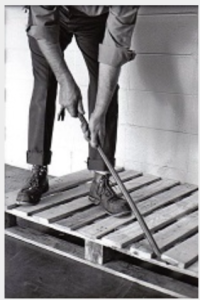
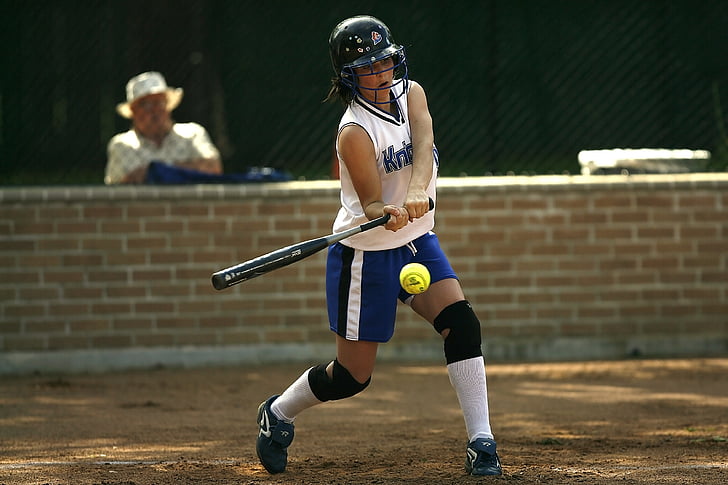
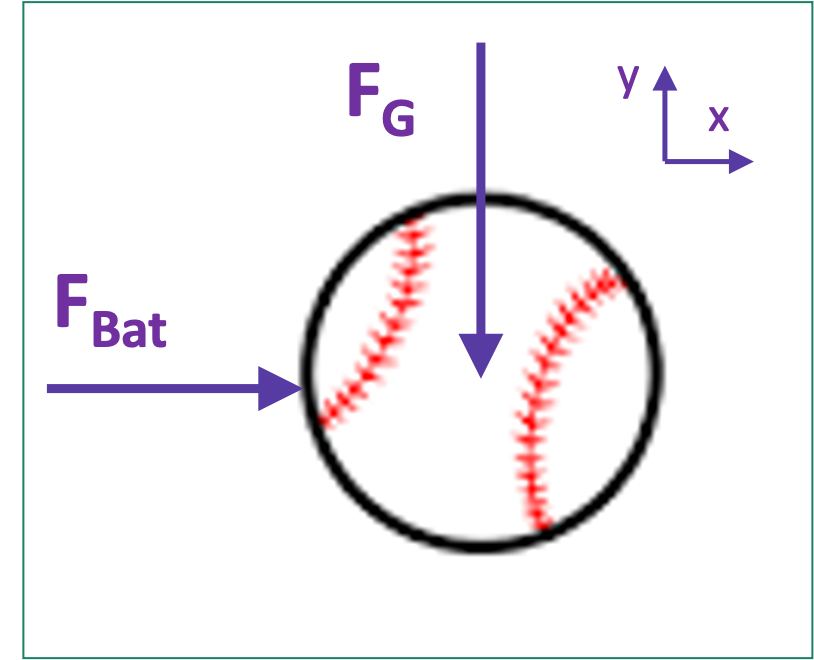
	</div>


	</div>

</div>
<div class="part-wrapper" id="part-chapter-2-vectors-wrapper">
    <div class="part  " id="part-chapter-2-vectors">
	<div class="part-title-wrap">
		<p class="part-number">II</p>
		<h1 class="part-title">Chapter 2: Particles</h1>
	</div>
	<div class="ugc part-ugc">
		<p>In this chapter, we analyze our first static bodies (motion where acceleration = 0), treating them as particles. The sections in this chapter include:</p> <ul><li class="toc__title"><a href="#chapter-1-5-particle-rigid-body" data-url="https://pressbooks.library.upei.ca/statics/chapter/1-5-particle-rigid-body/">2.1 Particle &amp; Rigid Body</a> – the difference between particles and rigid bodies</li> <li class="toc__title"><a href="#chapter-free-body-diagrams" data-url="https://pressbooks.library.upei.ca/statics/chapter/free-body-diagrams/">2.2 Free Body Diagrams for Particles</a> – learning how to model forces and motion</li> <li class="toc__title"><a href="#chapter-particle-equilibrium" data-url="https://pressbooks.library.upei.ca/statics/chapter/particle-equilibrium/">2.3 Equilibrium Equations for Particles</a> – analyzing static bodies</li> <li class="toc__title"><a href="#chapter-2-4-examples" data-url="https://pressbooks.library.upei.ca/statics/chapter/2-4-examples/">2.4. Examples&nbsp; </a>– problems submitted by other students.</li> </ul> <p>Very simply, here are the important equations for this section (the <a href="#part-main-body" data-url="https://pressbooks.library.upei.ca/statics/part/main-body/">Ch 1 equations</a> might be helpful too)</p> <p><img src="http://pressbooks.library.upei.ca/statics/wp-content/uploads/sites/56/2021/02/Ch-2-1024x247.png" alt="List Equations for Chapter 2. These include: Particle, rigid body." class="aligncenter wp-image-964 size-large" width="1024" height="247" srcset="https://pressbooks.library.upei.ca/statics/wp-content/uploads/sites/56/2021/02/Ch-2-1024x247.png 1024w, https://pressbooks.library.upei.ca/statics/wp-content/uploads/sites/56/2021/02/Ch-2-300x72.png 300w, https://pressbooks.library.upei.ca/statics/wp-content/uploads/sites/56/2021/02/Ch-2-768x185.png 768w, https://pressbooks.library.upei.ca/statics/wp-content/uploads/sites/56/2021/02/Ch-2-1536x370.png 1536w, https://pressbooks.library.upei.ca/statics/wp-content/uploads/sites/56/2021/02/Ch-2-65x16.png 65w, https://pressbooks.library.upei.ca/statics/wp-content/uploads/sites/56/2021/02/Ch-2-225x54.png 225w, https://pressbooks.library.upei.ca/statics/wp-content/uploads/sites/56/2021/02/Ch-2-350x84.png 350w, https://pressbooks.library.upei.ca/statics/wp-content/uploads/sites/56/2021/02/Ch-2.png 1570w" sizes="auto, (max-width: 1024px) 100vw, 1024px" title="" /></p>
	</div>
			
				
	</div>
<div class="chapter standard with-subsections" id="chapter-slug-1-5-particle-rigid-body" title="2.1 Particle &#038; Rigid Body">
	<div class="chapter-title-wrap">
		<p class="chapter-number">9</p>
		<h1 class="chapter-title">2.1 Particle & Rigid Body</h1>
								</div>
	<div class="ugc chapter-ugc">
				 <p>This may seem like a simple concept, but it is important to know the difference between particles and rigid bodies because it will change the type of analysis you perform.</p> <p>&nbsp;</p> <div class="textbox"><p><strong>Particles</strong><span>&nbsp;are bodies where all the mass is concentrated at a single point in space. Particle analysis will only have to take into account the forces acting on the body and translational motion because rotation is not considered for particles. </span></p> <p><span><b>Rigid bodies, on the other hand, have mass that is distributed throughout a finite volume.</b> Rigid</span> <span>body analysis is more complex and also has to take into account moments and rotational motions. In actuality, no bodies are truly particles, but some bodies can be approximated as particles to simplify analysis. Bodies are often assumed to be particles if the rotational motions are negligible when compared to the translational motions, or in systems where there is no moment exerted on the body, such as a concurrent force system.</span></p> <div class="wp-caption aligncenter" id="attachment_2681" aria-describedby="caption-attachment-2681" style="width: 300px"><img src="http://pressbooks.library.upei.ca/statics/wp-content/uploads/sites/56/2021/04/Screenshot-2025-07-16-143606-300x170.png" alt="A glowing comet traveling through space." class="wp-image-2681 size-medium" width="300" height="170" srcset="https://pressbooks.library.upei.ca/statics/wp-content/uploads/sites/56/2021/04/Screenshot-2025-07-16-143606-300x170.png 300w, https://pressbooks.library.upei.ca/statics/wp-content/uploads/sites/56/2021/04/Screenshot-2025-07-16-143606-65x37.png 65w, https://pressbooks.library.upei.ca/statics/wp-content/uploads/sites/56/2021/04/Screenshot-2025-07-16-143606-225x128.png 225w, https://pressbooks.library.upei.ca/statics/wp-content/uploads/sites/56/2021/04/Screenshot-2025-07-16-143606-350x198.png 350w, https://pressbooks.library.upei.ca/statics/wp-content/uploads/sites/56/2021/04/Screenshot-2025-07-16-143606.png 635w" sizes="auto, (max-width: 300px) 100vw, 300px" title="" /><div class="wp-caption-text" id="caption-attachment-2681">The rotation of this comet and the moments exerted on the comet are unimportant in modeling its trajectory through space, therefore we would treat it as a particle. Public Domain image by Buddy Nath.</div></div> <div class="wp-caption aligncenter" id="attachment_2682" aria-describedby="caption-attachment-2682" style="width: 300px"><img src="http://pressbooks.library.upei.ca/statics/wp-content/uploads/sites/56/2021/04/Screenshot-2025-07-16-144358-300x166.png" alt="A skycam suspended by cables" class="wp-image-2682 size-medium" width="300" height="166" srcset="https://pressbooks.library.upei.ca/statics/wp-content/uploads/sites/56/2021/04/Screenshot-2025-07-16-144358-300x166.png 300w, https://pressbooks.library.upei.ca/statics/wp-content/uploads/sites/56/2021/04/Screenshot-2025-07-16-144358-65x36.png 65w, https://pressbooks.library.upei.ca/statics/wp-content/uploads/sites/56/2021/04/Screenshot-2025-07-16-144358-225x125.png 225w, https://pressbooks.library.upei.ca/statics/wp-content/uploads/sites/56/2021/04/Screenshot-2025-07-16-144358-350x194.png 350w, https://pressbooks.library.upei.ca/statics/wp-content/uploads/sites/56/2021/04/Screenshot-2025-07-16-144358.png 468w" sizes="auto, (max-width: 300px) 100vw, 300px" title="" /><div class="wp-caption-text" id="caption-attachment-2682">The gravitational forces and the tension forces on the skycam all act through a single point, making this a concurrent force system that can be analyzed as a particle. Image by Despeaux CC-BY-SA 3.0.</div></div> <div class="wp-caption aligncenter" id="attachment_2683" aria-describedby="caption-attachment-2683" style="width: 200px"><img src="http://pressbooks.library.upei.ca/statics/wp-content/uploads/sites/56/2021/04/Screenshot-2025-07-16-144553-200x300.png" alt="A person using a crowbar to lift a wooden pallet" class="wp-image-2683 size-medium" width="200" height="300" srcset="https://pressbooks.library.upei.ca/statics/wp-content/uploads/sites/56/2021/04/Screenshot-2025-07-16-144553-200x300.png 200w, https://pressbooks.library.upei.ca/statics/wp-content/uploads/sites/56/2021/04/Screenshot-2025-07-16-144553-65x98.png 65w, https://pressbooks.library.upei.ca/statics/wp-content/uploads/sites/56/2021/04/Screenshot-2025-07-16-144553-225x338.png 225w, https://pressbooks.library.upei.ca/statics/wp-content/uploads/sites/56/2021/04/Screenshot-2025-07-16-144553.png 318w" sizes="auto, (max-width: 200px) 100vw, 200px" title="" /><div class="wp-caption-text" id="caption-attachment-2683">Rotation and moments will be key to the analysis of the crowbar in this system, therefore the crowbar needs to be analyzed as an extended body. Public Domain image by Pearson Scott Foresman.</div></div> <p>&nbsp;</p> <p>Source: Engineering Mechanics, Jacob Moore, et al. <a href="http://www.oercommons.org/courses/mechanics-map-open-mechanics-textbook/view" data-url="http://www.oercommons.org/courses/mechanics-map-open-mechanics-textbook/view">http://www.oercommons.org/courses/mechanics-map-open-mechanics-textbook/view</a></p> </div> <p>Particles are typically part of a larger scale, such as a sky diver falling through the sky, or a football flying through the air. <strong><em>Rigid body analyses are required when the length or size of the object must be considered</em></strong>, such as if you need to calculate the torque from turning a bolt with a wrench, or if there is rotation, such as the bolt that is being turned.</p> <p>One way to think of it is that <em>particles have mass</em>, whereas <em>rigid bodies have mass and shape</em>. We make an assumption that neither particles nor rigid bodies deform (change shape). Note: we say particles don’t deform even though we are already assuming that the shape of particles is negligible.</p> <p>In baseball, if you want to consider how far the ball travels, that would be a particle analysis because the speed is much greater than the size of the ball. A rigid body analysis would be how the bat swings to hit the ball, because the length of the bat would change how far the ball travels. A rigid body analysis could be to calculate the spin on the ball as it flies through the air (if you focus on how it is rotating).</p> <p>&nbsp;</p> <div class="wp-caption aligncenter" style="width: 636px"><img src="https://i0.hippopx.com/photos/613/24/1019/softball-batter-girl-game-preview.jpg" alt="Free photo: softball, batter, female, hitter, bat, helmet, stance | Hippopx" class="n3VNCb" data-noaft="1" width="636" height="424" title="" /><div class="wp-caption-text">Source: <a href="https://i0.hippopx.com/photos/613/24/1019/softball-batter-girl-game-preview.jpg" data-url="https://i0.hippopx.com/photos/613/24/1019/softball-batter-girl-game-preview.jpg">https://i0.hippopx.com/photos/613/24/1019/softball-batter-girl-game-preview.jpg</a></div></div> <p>You would have done particle analyses in your high school physics classes. Starting in chapter 3, we’ll expand on these concepts to include rigid bodies and bring shape and size into the problem.</p> <div class="textbox textbox--key-takeaways"><div class="textbox__header"><p class="textbox__title">Key Takeaways</p> </div> <div class="textbox__content"><p><em>Basically:</em> Particles have non-deforming mass &amp; rigid bodies have non-deforming mass with shape &amp; size. Rigid body analyses are required when length or size of the object much be considered, including rotation and torque. Particle analyses are for a grander scale where the object is small in comparison to the distance or speed.</p> <p><em>Application:</em> A particle analysis would be an airplane as it flies at a high speed through the air. A rigid body analysis would be if you analyze how the plane is rotating in order to turn, or to consider the size of the wheels as it is taxing on the runway or the size of the wings to keep it in the air.</p> <p><i>Looking ahead, Chapter 2 concerns particle analyses, and Chapters 3 – 7 focus on rigid body analyses.</i></p> </div> </div> <p>&nbsp;</p> 
	</div>


	</div>
<div class="chapter standard with-subsections" id="chapter-free-body-diagrams" title="2.2 Free Body Diagrams for Particles">
	<div class="chapter-title-wrap">
		<p class="chapter-number">10</p>
		<h1 class="chapter-title">2.2 Free Body Diagrams for Particles</h1>
								</div>
	<div class="ugc chapter-ugc">
				 <p>A free-body diagram (FBD) helps you to simplify a complicated problem. The first thing to remember is the object should always be <em>free</em> which means, floating in space. You represent the floor or other surfaces with forces. You might have done these particle free body diagrams in your high school physics class, where all the forces act at the centre of the object. (This will be different for rigid bodies). <em><br /> </em></p> <p>To draw a free-body diagram remember four points:</p> <ul><li><span style="text-decoration: underline">Add coordinate frame</span> <em>(which way is positive x and positive y?)</em></li> <li><span style="text-decoration: underline">Replace surfaces with forces </span><em>(floor, hand, and objects touching it become arrows)</em></li> <li><span style="text-decoration: underline">Point forces in the correct direction </span><em>(the head of the arrow points to where the force acts. F<sub>G</sub> acts down)<br /> </em></li> <li><span style="text-decoration: underline">Use unique (different) names </span><em>(be sure to name each force with a different name).<br /> </em></li> </ul> <p>For a baseball being hit by a bat (and neglecting air), the force of gravity acts at the center, the force of the bat acts on the outside. Notice in the figure<span class="footnote"><span class="footnote-indirect" data-fnref="164-1"></span></span> the names F<sub>Bat</sub> and F<sub>G</sub> are different in the figure below. Also – you can understand what they represent quickly. Also see the coordinate frame? You’ll be adding these in your sleep by the end of this class.</p> <p><img src="http://pressbooks.library.upei.ca/statics/wp-content/uploads/sites/56/2021/03/Baseball.png" alt="A baseball with force vectors labeled F_Bat and F_G acting on it." class="aligncenter wp-image-870" width="373" height="303" srcset="https://pressbooks.library.upei.ca/statics/wp-content/uploads/sites/56/2021/03/Baseball.png 814w, https://pressbooks.library.upei.ca/statics/wp-content/uploads/sites/56/2021/03/Baseball-300x243.png 300w, https://pressbooks.library.upei.ca/statics/wp-content/uploads/sites/56/2021/03/Baseball-768x623.png 768w, https://pressbooks.library.upei.ca/statics/wp-content/uploads/sites/56/2021/03/Baseball-65x53.png 65w, https://pressbooks.library.upei.ca/statics/wp-content/uploads/sites/56/2021/03/Baseball-225x182.png 225w, https://pressbooks.library.upei.ca/statics/wp-content/uploads/sites/56/2021/03/Baseball-350x284.png 350w" sizes="auto, (max-width: 373px) 100vw, 373px" title="" /></p> <div class="textbox"><p>As you draw a free body diagram, there are a couple of things you need to keep in mind:</p> <p style="padding-left: 40px">(1) Include only those forces acting ON the object whose free body diagram you are drawing. Any force exerted BY the object on some other object belongs on the free body diagram of the other object.<br /> (2) All forces are contact forces and every force has an agent. The agent is “that which is exerting the force.” In other words, the agent is the life form or thing that is doing the pushing or pulling on the object. No agent can exert a force on an object without being in contact with the object.</p> <p>We are going to introduce the various kinds of forces by means of examples. Here is the first<br /> example:</p> <div class="textbox textbox--examples"><div class="textbox__header"><p class="textbox__title">A rock is thrown up into the air by a person. Draw the free body diagram of the rock while it is up in the air. (Your free body diagram is applicable for any time after the rock leaves the thrower’s hand, until the last instant before the rock makes contact with whatever it is destined to hit.) Neglect any forces that might be exerted on the rock by the air.</p> </div> <div class="textbox__content"><p>If you see the rock flying through the air, it may very well look to you like there is nothing touching the rock. But the earth’s gravitational field is everywhere in the vicinity of the earth. It can’t be blocked. It can’t be shielded. It is in the air, in the water, even in the dirt. It is in direct contact with everything in the vicinity of the earth. It exerts a force on every object near the surface of the earth. We call that force the gravitational force. You have already studied the gravitational force. We give a brief synopsis of it here.</p> <p>&nbsp;</p> <p><strong>The Gravitational Force Exerted on Objects Near the Surface of the Earth.</strong></p> <p>Because it has mass, the earth has a gravitational field. The gravitational field is a force-per-mass field. It is invisible. It is not matter. It is an infinite set of force-per-mass vectors, one at every point in space in the vicinity of the surface of the earth. Each force per-mass vector is directed downward, toward the center of the earth and, near the surface of the earth, has a magnitude of 9.81 N/kg.&nbsp; The effect of the earth’s gravitational field is to exert a force on any object that is in the earth’s gravitational field. The force is called the gravitational force and is equal to the product of the mass of the object and the earth’s gravitational field vector: F<sub>g</sub>=mg. Where g=9.81 N/kg is the magnitude of the earth’s gravitational field vector. The direction of the near-earth’s-surface gravitational force is downward, toward the center of the earth.</p> <p>Here is the free body diagram and the corresponding table of forces:</p> <p><img src="http://pressbooks.library.upei.ca/statics/wp-content/uploads/sites/56/2021/03/IMG-0600.jpg" alt="A rock experiencing downward gravitational force, with a force table showing its symbol, name, agent, and victim" class="aligncenter wp-image-428" width="465" height="105" srcset="https://pressbooks.library.upei.ca/statics/wp-content/uploads/sites/56/2021/03/IMG-0600.jpg 1479w, https://pressbooks.library.upei.ca/statics/wp-content/uploads/sites/56/2021/03/IMG-0600-300x68.jpg 300w, https://pressbooks.library.upei.ca/statics/wp-content/uploads/sites/56/2021/03/IMG-0600-1024x231.jpg 1024w, https://pressbooks.library.upei.ca/statics/wp-content/uploads/sites/56/2021/03/IMG-0600-768x173.jpg 768w, https://pressbooks.library.upei.ca/statics/wp-content/uploads/sites/56/2021/03/IMG-0600-65x15.jpg 65w, https://pressbooks.library.upei.ca/statics/wp-content/uploads/sites/56/2021/03/IMG-0600-225x51.jpg 225w, https://pressbooks.library.upei.ca/statics/wp-content/uploads/sites/56/2021/03/IMG-0600-350x79.jpg 350w" sizes="auto, (max-width: 465px) 100vw, 465px" title="" /></p> <p>(1) The only thing touching the object while it is up in the air (neglecting the air itself) is the earth’s gravitational field. So there is only one force on the object, namely the gravitational force. The arrow representing the force vector is drawn so that the tail of the arrow is touching the object, and the arrow extends away from the object in the direction of the force.</p> <p>(2) Unless otherwise stipulated, label the diagram yourself however it makes most sense. Always draw a coordinate frame (Usually x is upwards, and y extends to the right).</p> <p>(3) There is no velocity information on a free body diagram</p> <p>(4) There is no force of the hand acting on the object because, at the instant in question, the hand is no longer touching the object. When you draw a free body diagram, only forces that are acting on the object at the instant depicted in the diagram are included. The acceleration of the object depends only on the currently-acting forces on the object. The force of the hand is of historical interest only.</p> <p>(5) Regarding the table of forces:<br /> a) Make sure that for any free body diagram you draw, you are capable of making a complete table of forces. You are not required to provide a table of forces with every free body diagram you draw, but you should expect to be called upon to create a table of forces more than once.<br /> b) In the table of forces, the agent is the life form or thing that is exerting the force and the victim is the object on which the force is being exerted. Make sure that, in every case,<br /> the victim is the object for which the free body diagram is being drawn.<br /> c) In the case at hand, there is only one force so there is only one entry in the table of forces.<br /> d) For any object near the surface of the earth, the agent of the gravitational force is the earth’s gravitational field. It is okay to abbreviate that to “Earth” because the gravitational field of the earth can be considered to be an invisible part of the earth, but it is NOT okay to call it “gravity.” Gravity is a subject heading corresponding to the kind of force the gravitational force is, gravity is not an agent</p> </div> </div> <div class="textbox textbox--examples"><div class="textbox__header"><p class="textbox__title">A ball of mass m hangs at rest, suspended by a string. Draw the free body diagram for the ball, and create the corresponding table of forces.</p> </div> <div class="textbox__content"><p>To do this problem, you need the following information about strings:</p> <p><strong>The Force Exerted by a Taut String on an Object to Which it is Affixed </strong>(This also applies to ropes, cables, chains, and the like.)</p> <p>The force exerted by a string, on an object to which it is attached, is always directed away from the object, along the length of the string. Note that the force in question is exerted by the string, not for instance, by some person pulling on the other end of the string. The force exerted by a string on an object is referred to as a “tension force” and its magnitude is conventionally represented by the symbol F<sub>T</sub>.</p> <p>Note: There is no formula to tell you what the tension force is. If it is not given, the only way to get it is to use Newton’s 2nd Law.</p> <p>Here is the free body diagram of the ball, and the corresponding table of forces:</p> <p><img src="http://pressbooks.library.upei.ca/statics/wp-content/uploads/sites/56/2021/03/IMG-0601.jpg" alt="A ball in equilibrium with upward tension and downward gravitational force, shown alongside a force table" class="aligncenter wp-image-429" width="474" height="112" srcset="https://pressbooks.library.upei.ca/statics/wp-content/uploads/sites/56/2021/03/IMG-0601.jpg 1567w, https://pressbooks.library.upei.ca/statics/wp-content/uploads/sites/56/2021/03/IMG-0601-300x71.jpg 300w, https://pressbooks.library.upei.ca/statics/wp-content/uploads/sites/56/2021/03/IMG-0601-1024x242.jpg 1024w, https://pressbooks.library.upei.ca/statics/wp-content/uploads/sites/56/2021/03/IMG-0601-768x182.jpg 768w, https://pressbooks.library.upei.ca/statics/wp-content/uploads/sites/56/2021/03/IMG-0601-1536x364.jpg 1536w, https://pressbooks.library.upei.ca/statics/wp-content/uploads/sites/56/2021/03/IMG-0601-65x15.jpg 65w, https://pressbooks.library.upei.ca/statics/wp-content/uploads/sites/56/2021/03/IMG-0601-225x53.jpg 225w, https://pressbooks.library.upei.ca/statics/wp-content/uploads/sites/56/2021/03/IMG-0601-350x83.jpg 350w" sizes="auto, (max-width: 474px) 100vw, 474px" title="" /></p> </div> </div> <p><em>There is no “force of motion” acting on an object. Once you have the force or forces</em><br /> <em>exerted on the object by everything that is touching the object, you have all the forces. Do not add a “force of motion” to your free body diagram. It is especially tempting to add this force when there are no actual forces in the direction in which an object is going. Keep in mind, however, that an object does not need a force on it to keep going in the direction in which it is going; moving along at a constant velocity is what an object does when there is no net force on it.</em></p> <p>Source: Calculus-Based Physics 1, Jeffery W. Schnick. <a href="https://openlibrary.ecampusontario.ca/catalogue/item/?id=ce74a181-ccde-491c-848d-05489ed182e7" data-url="https://openlibrary.ecampusontario.ca/catalogue/item/?id=ce74a181-ccde-491c-848d-05489ed182e7">https://openlibrary.ecampusontario.ca/catalogue/item/?id=ce74a181-ccde-491c-848d-05489ed182e7</a> page 86</p> </div> <p>&nbsp;</p> <div class="textbox textbox--key-takeaways"><div class="textbox__header"><p class="textbox__title">Key Takeaways</p> </div> <div class="textbox__content"><p><em>Basically:</em> Free-body diagrams (FBDs) give you a way to model complicated problems in a simple way. All exterior forces are modelled with an arrow.</p> <p><i>Application: A baseball can be modelled using a FBD to show how the bat and gravity affect the ball.</i></p> <p><em>Looking ahead</em>: You’ll use a FBD in every step 2 in nearly every homework problem. These are especially helpful with Equilibrium Equations in the next section.</p> </div> </div> 
	</div>
			
				
				<div class="footnotes"><div id='164-1'>
<p>Original image of baseball from: <a href="https://openclipart.org/detail/258473/baseball-refixed" data-url="https://openclipart.org/detail/258473/baseball-refixed">https://openclipart.org/detail/258473/baseball-refixed</a> Annotations added by the author</p>

</div></div>
	</div>
<div class="chapter standard with-subsections" id="chapter-particle-equilibrium" title="2.3 Equilibrium Equations for Particles">
	<div class="chapter-title-wrap">
		<p class="chapter-number">11</p>
		<h1 class="chapter-title">2.3 Equilibrium Equations for Particles</h1>
								</div>
	<div class="ugc chapter-ugc">
				 <p>For a particle in static equilibrium, Newton’s 2nd law can be adapted for <img src="http://localhost:3000/latex?latex=%5Cvec%20a%20%3D%200&amp;fg=000000&amp;font=TeX&amp;svg=1" alt="\vec a = 0" title="\vec a = 0" class="latex mathjax" /> and componentized in x y and z:</p> <p style="text-align: center">$$\sum\vec F=m*\vec a$$</p> <p style="text-align: center">$$\sum\vec F=0$$</p> <p style="text-align: center">$$\sum F_x=0\quad\quad\sum F_y=0\quad\quad\sum F_z=0$$</p> <p>Notice that the left size of the equation says ‘sum of the forces’ which means add up all the forces in that direction. In statics, they will all cancel out. If you aren’t sure if something is in static motion, sum the forces and see if they equal 0.</p> <h2>Static Equilibrium:</h2> <div class="textbox"><p><span>Objects in static equilibrium are objects that are not accelerating (either linear acceleration or angular acceleration). These objects may be stationary, or they may have a constant velocity.</span></p> <p>Newton’s Second Law states that the force exerted on an object is equal to the mass of the object times the acceleration it experiences. Therefore, if we know that the acceleration of an object is equal to zero, then we can assume that the sum of all forces acting on the object is zero. Individual forces acting on the object, represented by force vectors, may not have zero magnitude but the sum of all the force vectors will always be equal to zero for objects in equilibrium.</p> <p>The equations used when dealing with particles in equilibrium are:</p> <p style="text-align: center">$$\sum\vec F=0$$</p> <p>Which leads to:</p> <p style="text-align: center">$$\sum F_x=0\\\sum F_y=0\\\sum F_z=0$$</p> <p>Since it is a particle, there are no moments involved like there is when it comes to rigid bodies.</p> <p>Source: Engineering Mechanics, Jacob Moore, et al. <a href="http://mechanicsmap.psu.edu/websites/2_equilibrium_concurrent/2-1_static_equilibrium/staticequilibrium.html" data-url="http://mechanicsmap.psu.edu/websites/2_equilibrium_concurrent/2-1_static_equilibrium/staticequilibrium.html">http://mechanicsmap.psu.edu/websites/2_equilibrium_concurrent/2-1_static_equilibrium/staticequilibrium.html</a></p> </div> <h2>Finding the Equilibrium Equations:</h2> <div class="textbox"><p>The first step in finding the equilibrium equations is to <strong>draw a free body diagram</strong> of the body being analyzed. This diagram should show all the known and unknown force vectors acting on the body. In the free body diagram, provide values for any of the know magnitudes or directions for the force vectors and provide variable names for any unknowns (either magnitudes or directions).</p> <p><img src="http://pressbooks.library.upei.ca/statics/wp-content/uploads/sites/56/2021/03/freebodydiagram.png" alt="A 600 lb force acting on a ball resting in a V-shaped stand with force components shown at 45° and 30° angles." class="aligncenter wp-image-1271 size-full" width="600" height="272" srcset="https://pressbooks.library.upei.ca/statics/wp-content/uploads/sites/56/2021/03/freebodydiagram.png 600w, https://pressbooks.library.upei.ca/statics/wp-content/uploads/sites/56/2021/03/freebodydiagram-300x136.png 300w, https://pressbooks.library.upei.ca/statics/wp-content/uploads/sites/56/2021/03/freebodydiagram-65x29.png 65w, https://pressbooks.library.upei.ca/statics/wp-content/uploads/sites/56/2021/03/freebodydiagram-225x102.png 225w, https://pressbooks.library.upei.ca/statics/wp-content/uploads/sites/56/2021/03/freebodydiagram-350x159.png 350w" sizes="auto, (max-width: 600px) 100vw, 600px" title="" /></p> <div class="center"><div class="bc-figcaption figcaption">The first step in equilibrium analysis is drawing a free-body diagram. This is done by removing everything but the body and drawing in all forces acting on the body. Labelling all forces, key dimensions, and angles is also useful.</div></div> <p>Next, you will need to choose the x, y, and z axes. These axes do need to be perpendicular to one another, but they do not necessarily have to be horizontal or vertical. If you choose coordinate axes that line up with some of your force vectors you will simplify later analysis.</p> <p>Once you have chosen axes, you need to break down all of the force vectors into components along the x, y and z directions (see the vectors page in Appendix 1 if you need more guidance on this). Your first equation will be the sum of the magnitudes of the components in the x direction being equal to zero, the second equation will be the sum of the magnitudes of the components in the y direction being equal to zero, and the third (if you have a 3D problem) will be the sum of the magnitudes in the z direction being equal to zero. Collectively, these are known as the <strong>equilibrium equations</strong>.</p> <p>Once you have your equilibrium equations, you can solve them for unknowns using algebra. The number of unknowns that you will be able to solve for will be the number of equilibrium equations that you have. In instances where you have more unknowns than equations, the problem is known as a <strong>statically indeterminate problem,</strong> and you will need additional information to solve for the given unknowns.</p> <p>Example:</p> <p><strong>1. Problem</strong></p> <p><img src="http://pressbooks.library.upei.ca/statics/wp-content/uploads/sites/56/2021/03/Screen-Shot-2021-07-27-at-11.44.50-PM-1024x610.png" alt="A 6 kg traffic light hanging from two cables, with one cable angled at 15 degrees." style="border: 1px solid black" class="aligncenter wp-image-873" width="455" height="271" srcset="https://pressbooks.library.upei.ca/statics/wp-content/uploads/sites/56/2021/03/Screen-Shot-2021-07-27-at-11.44.50-PM-1024x610.png 1024w, https://pressbooks.library.upei.ca/statics/wp-content/uploads/sites/56/2021/03/Screen-Shot-2021-07-27-at-11.44.50-PM-300x179.png 300w, https://pressbooks.library.upei.ca/statics/wp-content/uploads/sites/56/2021/03/Screen-Shot-2021-07-27-at-11.44.50-PM-768x457.png 768w, https://pressbooks.library.upei.ca/statics/wp-content/uploads/sites/56/2021/03/Screen-Shot-2021-07-27-at-11.44.50-PM-65x39.png 65w, https://pressbooks.library.upei.ca/statics/wp-content/uploads/sites/56/2021/03/Screen-Shot-2021-07-27-at-11.44.50-PM-225x134.png 225w, https://pressbooks.library.upei.ca/statics/wp-content/uploads/sites/56/2021/03/Screen-Shot-2021-07-27-at-11.44.50-PM-350x208.png 350w, https://pressbooks.library.upei.ca/statics/wp-content/uploads/sites/56/2021/03/Screen-Shot-2021-07-27-at-11.44.50-PM.png 1088w" sizes="auto, (max-width: 455px) 100vw, 455px" title="" /></p> <hr /> <p><strong>2. Draw</strong></p> <p><img src="http://pressbooks.library.upei.ca/statics/wp-content/uploads/sites/56/2021/03/Screenshot-2025-04-29-112624-300x250.png" alt="A free-body diagram of the problem" width="300" height="250" style="border: 1px solid black" class="aligncenter wp-image-2267 size-medium" srcset="https://pressbooks.library.upei.ca/statics/wp-content/uploads/sites/56/2021/03/Screenshot-2025-04-29-112624-300x250.png 300w, https://pressbooks.library.upei.ca/statics/wp-content/uploads/sites/56/2021/03/Screenshot-2025-04-29-112624-65x54.png 65w, https://pressbooks.library.upei.ca/statics/wp-content/uploads/sites/56/2021/03/Screenshot-2025-04-29-112624-225x188.png 225w, https://pressbooks.library.upei.ca/statics/wp-content/uploads/sites/56/2021/03/Screenshot-2025-04-29-112624-350x292.png 350w, https://pressbooks.library.upei.ca/statics/wp-content/uploads/sites/56/2021/03/Screenshot-2025-04-29-112624.png 506w" sizes="auto, (max-width: 300px) 100vw, 300px" title="" /></p> <p><strong>3. Knowns and Unknowns</strong></p> <p>Known:</p> <ul><li>M<sub>g</sub> = 6kg</li> </ul> <p>Unknown:</p> <ul><li>T<sub>1</sub></li> <li>T<sub>2</sub></li> </ul> <p><strong>4. Approach</strong></p> <p>Derive equilibrium equations and solve simultaneously to find T<sub>2&nbsp;</sub>and T<sub>1</sub></p> <p><strong>5. Analysis</strong></p> <p>$$F_g=(9.8)(6)\\F_g=58.8N\\\sum F_x=-T_1+T_2\cos(15^{\circ})=0\\\sum F_y=T_2\sin(15^{\circ})-58.8=0\\T_2=\frac{58.8}{\sin(15^{\circ})}=227.2N\\-T_1+227.2\cos(15^{\circ})=0\\T_1=227.2\cos(15^{\circ})=219.4N\\T_1=219.4N\\T_2=227.2N$$</p> <p><strong>6. Review</strong></p> <p>It makes sense that the tension in T<sub>2</sub> is greater than T<sub>1</sub> since it is at an angle.</p> <p>Source: Engineering Mechanics, Jacob Moore, et al. <a href="https://mechanicsmap.psu.edu/websites/2_equilibrium_concurrent/2-5_equilibrium_analysis_concurrent/equilibriumconcurrent.html" data-url="https://mechanicsmap.psu.edu/websites/2_equilibrium_concurrent/2-5_equilibrium_analysis_concurrent/equilibriumconcurrent.html">Mechanics Map – Equilibrium Analysis for Concurrent Force Systems.</a> Many more examples are available at this site.</p> <p>See additional examples: <a href="https://mechanicsmap.psu.edu/websites/2_equilibrium_concurrent/2-5_equilibrium_analysis_concurrent/pdf/P3.pdf" data-url="https://mechanicsmap.psu.edu/websites/2_equilibrium_concurrent/2-5_equilibrium_analysis_concurrent/pdf/P3.pdf">P3.pdf</a>, <a href="https://mechanicsmap.psu.edu/websites/2_equilibrium_concurrent/2-5_equilibrium_analysis_concurrent/pdf/P5.pdf" data-url="https://mechanicsmap.psu.edu/websites/2_equilibrium_concurrent/2-5_equilibrium_analysis_concurrent/pdf/P5.pdf">P5.pdf</a>, <a href="https://mechanicsmap.psu.edu/websites/2_equilibrium_concurrent/2-5_equilibrium_analysis_concurrent/pdf/P8.pdf" data-url="https://mechanicsmap.psu.edu/websites/2_equilibrium_concurrent/2-5_equilibrium_analysis_concurrent/pdf/P8.pdf">P8.pdf</a></p> </div> <p>&nbsp;</p> <div class="textbox textbox--key-takeaways"><div class="textbox__header"><p class="textbox__title">Key Takeaways</p> </div> <div class="textbox__content"><p><em>Basically:</em> Equilibrium equations allow you to separate the forces and motion into each axis.</p> <p><em>Application</em>: A heavy object is lifted using a rope and pulley. Based on the forces, is it in static equilibrium? (Answer: if sum of the forces in each direction equal zero, then yes!)</p> <p><em>Looking ahead</em>: We will next apply equilibrium equations to rigid bodies, allowing use to solve more complex problems.</p> </div> </div> 
	</div>


	</div>
<div class="chapter standard with-subsections" id="chapter-slug-2-4-examples" title="2.4 Examples">
	<div class="chapter-title-wrap">
		<p class="chapter-number">12</p>
		<h1 class="chapter-title">2.4. Examples</h1>
								</div>
	<div class="ugc chapter-ugc">
				
 <p>Here are examples from Chapter 2 to help you understand these concepts better. These were taken from the real world and supplied by FSDE students in Summer 2021. If you’d like to submit your own examples, please send them to the author <a href="mailto:eosgood@upei.ca" data-url="mailto:eosgood@upei.ca">eosgood@upei.ca</a>.</p> <h1 id="chapter-568-section-1" class="section-header">Example 2.4.1: Equilibrium Equation and Components of Vectors, Submitted by Analiya Benny</h1> <div class="textbox shaded"><ol><li><strong>Problem</strong></li> </ol> <p>A 280 lb Pipe is being lifted by a crane as shown in the figure. Find the magnitude of the tension on the cables, given that the forces on the cables are equal.</p> <p><img src="http://pressbooks.library.upei.ca/statics/wp-content/uploads/sites/56/2021/11/image-chap-2-PB-pipe-e1667658386342.jpg" alt="A cylindrical steel pipe suspended by two cables and a crane hook." width="462" height="451" class="aligncenter wp-image-1962 size-full" srcset="https://pressbooks.library.upei.ca/statics/wp-content/uploads/sites/56/2021/11/image-chap-2-PB-pipe-e1667658386342.jpg 462w, https://pressbooks.library.upei.ca/statics/wp-content/uploads/sites/56/2021/11/image-chap-2-PB-pipe-e1667658386342-300x293.jpg 300w, https://pressbooks.library.upei.ca/statics/wp-content/uploads/sites/56/2021/11/image-chap-2-PB-pipe-e1667658386342-65x63.jpg 65w, https://pressbooks.library.upei.ca/statics/wp-content/uploads/sites/56/2021/11/image-chap-2-PB-pipe-e1667658386342-225x220.jpg 225w, https://pressbooks.library.upei.ca/statics/wp-content/uploads/sites/56/2021/11/image-chap-2-PB-pipe-e1667658386342-350x342.jpg 350w" sizes="auto, (max-width: 462px) 100vw, 462px" title=""></p> <p>https://publicdomainvectors.org/en/free-clipart/Crane-with-a-pipeai/86375.html</p> <p><img src="http://pressbooks.library.upei.ca/statics/wp-content/uploads/sites/56/2021/11/Screenshot-2025-05-02-125158-300x254.png" alt="A sketch of the problem" width="312" height="264" class="aligncenter wp-image-2281" srcset="https://pressbooks.library.upei.ca/statics/wp-content/uploads/sites/56/2021/11/Screenshot-2025-05-02-125158-300x254.png 300w, https://pressbooks.library.upei.ca/statics/wp-content/uploads/sites/56/2021/11/Screenshot-2025-05-02-125158-65x55.png 65w, https://pressbooks.library.upei.ca/statics/wp-content/uploads/sites/56/2021/11/Screenshot-2025-05-02-125158-225x191.png 225w, https://pressbooks.library.upei.ca/statics/wp-content/uploads/sites/56/2021/11/Screenshot-2025-05-02-125158-350x297.png 350w, https://pressbooks.library.upei.ca/statics/wp-content/uploads/sites/56/2021/11/Screenshot-2025-05-02-125158.png 551w" sizes="auto, (max-width: 312px) 100vw, 312px" title=""></p> </div> <p>&nbsp;</p> <p><strong>2. Draw</strong></p> <p><img src="http://pressbooks.library.upei.ca/statics/wp-content/uploads/sites/56/2021/11/Screenshot-6-e1667699434378.png" alt="A free-body diagram of the problem" width="492" height="480" class="alignnone wp-image-1967 size-full" srcset="https://pressbooks.library.upei.ca/statics/wp-content/uploads/sites/56/2021/11/Screenshot-6-e1667699434378.png 492w, https://pressbooks.library.upei.ca/statics/wp-content/uploads/sites/56/2021/11/Screenshot-6-e1667699434378-300x293.png 300w, https://pressbooks.library.upei.ca/statics/wp-content/uploads/sites/56/2021/11/Screenshot-6-e1667699434378-65x63.png 65w, https://pressbooks.library.upei.ca/statics/wp-content/uploads/sites/56/2021/11/Screenshot-6-e1667699434378-225x220.png 225w, https://pressbooks.library.upei.ca/statics/wp-content/uploads/sites/56/2021/11/Screenshot-6-e1667699434378-350x341.png 350w" sizes="auto, (max-width: 492px) 100vw, 492px" title=""></p> <p><strong>3. Knowns and Unknowns</strong></p> <p>Knowns:</p> <ul><li>F = 280 lb</li> <li>θ = 60<span>°&nbsp;</span></li> </ul> <p>Unknown:</p> <ul><li><img src="http://localhost:3000/latex?latex=%5Coverrightarrow%7BT_%7BB%7D%7D&amp;fg=000000&amp;font=TeX&amp;svg=1" alt="\overrightarrow{T_{B}}" title="\overrightarrow{T_{B}}" class="latex mathjax"></li> <li><img src="http://localhost:3000/latex?latex=%5Coverrightarrow%7BT_%7BA%7D%7D&amp;fg=000000&amp;font=TeX&amp;svg=1" alt="\overrightarrow{T_{A}}" title="\overrightarrow{T_{A}}" class="latex mathjax"></li> </ul> <p><strong>4. Approach</strong></p> <p>Applying the equilibrium equation and componentization of vectors to find <img src="http://localhost:3000/latex?latex=T_%7BB%7D&amp;fg=000000&amp;font=TeX&amp;svg=1" alt="T_{B}" title="T_{B}" class="latex mathjax"> and <img src="http://localhost:3000/latex?latex=T_%7BA%7D&amp;fg=000000&amp;font=TeX&amp;svg=1" alt="T_{A}" title="T_{A}" class="latex mathjax">.</p> <p><strong>Note:</strong> <img src="http://localhost:3000/latex?latex=T_%7BB%7D&amp;fg=000000&amp;font=TeX&amp;svg=1" alt="T_{B}" title="T_{B}" class="latex mathjax"> = <img src="http://localhost:3000/latex?latex=T_%7BA%7D&amp;fg=000000&amp;font=TeX&amp;svg=1" alt="T_{A}" title="T_{A}" class="latex mathjax"></p> <p><strong>5. Analysis</strong></p> <p><span style="text-decoration: underline">Components of <img src="http://localhost:3000/latex?latex=T_%7BB%7D&amp;fg=000000&amp;font=TeX&amp;svg=1" alt="T_{B}" title="T_{B}" class="latex mathjax"></span></p> <p><img src="http://localhost:3000/latex?latex=T_%7BBy%7D%20%3D%20T_%7BB%7D%20%5Csin%20%7B60%7D&amp;fg=000000&amp;font=TeX&amp;svg=1" alt="T_{By} = T_{B} \sin {60}" title="T_{By} = T_{B} \sin {60}" class="latex mathjax"></p> <p>and, <img src="http://localhost:3000/latex?latex=T_%7BBx%7D%20%3D%20T_%7BB%7D%5Ccos%20%7B60%7D&amp;fg=000000&amp;font=TeX&amp;svg=1" alt="T_{Bx} = T_{B}\cos {60}" title="T_{Bx} = T_{B}\cos {60}" class="latex mathjax"></p> <p><img src="http://pressbooks.library.upei.ca/statics/wp-content/uploads/sites/56/2021/11/2.4.1done-300x192.jpg" alt="A force vector T_B at a 60° angle resolved into horizontal T_Bx and vertical T_By components." width="300" height="192" class="alignnone wp-image-2089 size-medium" srcset="https://pressbooks.library.upei.ca/statics/wp-content/uploads/sites/56/2021/11/2.4.1done-300x192.jpg 300w, https://pressbooks.library.upei.ca/statics/wp-content/uploads/sites/56/2021/11/2.4.1done-65x42.jpg 65w, https://pressbooks.library.upei.ca/statics/wp-content/uploads/sites/56/2021/11/2.4.1done-225x144.jpg 225w, https://pressbooks.library.upei.ca/statics/wp-content/uploads/sites/56/2021/11/2.4.1done-350x224.jpg 350w, https://pressbooks.library.upei.ca/statics/wp-content/uploads/sites/56/2021/11/2.4.1done.jpg 361w" sizes="auto, (max-width: 300px) 100vw, 300px" title=""></p> <p><span style="text-decoration: underline">Equilibrium equation in the y direction</span></p> <p><img src="http://pressbooks.library.upei.ca/statics/wp-content/uploads/sites/56/2021/11/Screenshot-8-e1667700978863.png" alt="A 280 lb load suspended by two symmetric cables at 60° angles with equal tension forces T_B." width="544" height="408" class="alignnone wp-image-1970 size-full" srcset="https://pressbooks.library.upei.ca/statics/wp-content/uploads/sites/56/2021/11/Screenshot-8-e1667700978863.png 544w, https://pressbooks.library.upei.ca/statics/wp-content/uploads/sites/56/2021/11/Screenshot-8-e1667700978863-300x225.png 300w, https://pressbooks.library.upei.ca/statics/wp-content/uploads/sites/56/2021/11/Screenshot-8-e1667700978863-65x49.png 65w, https://pressbooks.library.upei.ca/statics/wp-content/uploads/sites/56/2021/11/Screenshot-8-e1667700978863-225x169.png 225w, https://pressbooks.library.upei.ca/statics/wp-content/uploads/sites/56/2021/11/Screenshot-8-e1667700978863-350x263.png 350w" sizes="auto, (max-width: 544px) 100vw, 544px" title=""></p> <p><img src="http://localhost:3000/latex?latex=%5Csum%20F_%7By%7D%3D%20-T_%7BBy%7D%20-T_%7BBy%7D-280%20lb%20%3D%200%20%5C%5C%20%20%20%20T_%7BBy%7D%20%3D%20%5Cdfrac%7B-280%20lb%7D%7B2%7D%20%3D%20-140%20lb&amp;fg=000000&amp;font=TeX&amp;svg=1" alt="\sum F_{y}= -T_{By} -T_{By}-280 lb = 0 \\ T_{By} = \dfrac{-280 lb}{2} = -140 lb" title="\sum F_{y}= -T_{By} -T_{By}-280 lb = 0 \\ T_{By} = \dfrac{-280 lb}{2} = -140 lb" class="latex mathjax"></p> <p>Note that the -ve sign here means that the direction of vector T<sub>B</sub> is opposite to that drawn in the FBD diagram. So now the FBD is as given below:</p> <p><img src="http://pressbooks.library.upei.ca/statics/wp-content/uploads/sites/56/2021/11/Screenshot-10-e1667702644190.png" alt="A 280 lb load suspended by two upward-angled cables at 60°, each exerting a tension force T_B." width="464" height="420" class="alignnone wp-image-1975 size-full" srcset="https://pressbooks.library.upei.ca/statics/wp-content/uploads/sites/56/2021/11/Screenshot-10-e1667702644190.png 464w, https://pressbooks.library.upei.ca/statics/wp-content/uploads/sites/56/2021/11/Screenshot-10-e1667702644190-300x272.png 300w, https://pressbooks.library.upei.ca/statics/wp-content/uploads/sites/56/2021/11/Screenshot-10-e1667702644190-65x59.png 65w, https://pressbooks.library.upei.ca/statics/wp-content/uploads/sites/56/2021/11/Screenshot-10-e1667702644190-225x204.png 225w, https://pressbooks.library.upei.ca/statics/wp-content/uploads/sites/56/2021/11/Screenshot-10-e1667702644190-350x317.png 350w" sizes="auto, (max-width: 464px) 100vw, 464px" title=""></p> <p>now,&nbsp; <img src="http://localhost:3000/latex?latex=T_%7BB%7D%20%5Csin%20%7B60%7D%20%3D%20140%20lb&amp;fg=000000&amp;font=TeX&amp;svg=1" alt="T_{B} \sin {60} = 140 lb" title="T_{B} \sin {60} = 140 lb" class="latex mathjax"></p> <p><img src="http://localhost:3000/latex?latex=T_%7BB%7D%20%3D%20%5Cdfrac%7B140%20lb%7D%7B%5Csin%7B60%7D%7D&amp;fg=000000&amp;font=TeX&amp;svg=1" alt="T_{B} = \dfrac{140 lb}{\sin{60}}" title="T_{B} = \dfrac{140 lb}{\sin{60}}" class="latex mathjax"></p> <p>Thus, <img src="http://localhost:3000/latex?latex=T_%7BB%7D%20%3D%20T_%7BA%7D%20%3D%20161.66%20lb&amp;fg=000000&amp;font=TeX&amp;svg=1" alt="T_{B} = T_{A} = 161.66 lb" title="T_{B} = T_{A} = 161.66 lb" class="latex mathjax"></p> <p>The magnitude of the tension carried by each of the cables is 161.66 lb.</p> <p><strong>6. Review</strong></p> <p>The results show that the x component does no essential contribution towards carrying the weight of the pipe because the sum of forces in the x direction just cancels out and equals 0lb.</p> <p><img src="http://localhost:3000/latex?latex=%5Csum%20F_%7Bx%7D%3D%20-T_%7BBx%7D%20%2BT_%7BBx%7D%3D%200&amp;fg=000000&amp;font=TeX&amp;svg=1" alt="\sum F_{x}= -T_{Bx} +T_{Bx}= 0" title="\sum F_{x}= -T_{Bx} +T_{Bx}= 0" class="latex mathjax"></p> <h1 id="chapter-568-section-2" class="section-header">Example 2.4.2: Equilibrium Equation, Submitted by Kylian Duplan</h1> <div class="textbox"><p><strong>1. Problem</strong></p> <div class="textbox shaded"><p>Desmond (80kg) is hanging for his life in a well, on a horizontal pole that is between two brick walls that displace 1200N of force each upwards along the pole. There is also a single brick positioned 2m away from the first wall. If Desmond is hanging 3m away from the second wall, and is to catch a backpack falling above him, what mass should the backpack be to break the pole, causing Desmond to fall into the well? What is the mass of the single brick? [g=9.81m/s^2]</p> <p><img src="http://pressbooks.library.upei.ca/statics/wp-content/uploads/sites/56/2021/07/Picture8-300x279.jpg" alt="An 80 kg person hanging from a horizontal bar stretched between two walls, with distances and directions labeled." width="442" height="411" class="alignnone wp-image-2572" srcset="https://pressbooks.library.upei.ca/statics/wp-content/uploads/sites/56/2021/07/Picture8-300x279.jpg 300w, https://pressbooks.library.upei.ca/statics/wp-content/uploads/sites/56/2021/07/Picture8-65x60.jpg 65w, https://pressbooks.library.upei.ca/statics/wp-content/uploads/sites/56/2021/07/Picture8-225x209.jpg 225w, https://pressbooks.library.upei.ca/statics/wp-content/uploads/sites/56/2021/07/Picture8-350x325.jpg 350w, https://pressbooks.library.upei.ca/statics/wp-content/uploads/sites/56/2021/07/Picture8.jpg 750w" sizes="auto, (max-width: 442px) 100vw, 442px" title=""></p> </div> <p>&nbsp;</p> <p><strong>2. Draw&nbsp;</strong></p> <p><img src="http://pressbooks.library.upei.ca/statics/wp-content/uploads/sites/56/2021/07/Screenshot-2025-07-09-171126-300x173.png" alt="A free-body diagram of the problem" width="447" height="258" class="alignnone wp-image-2574" srcset="https://pressbooks.library.upei.ca/statics/wp-content/uploads/sites/56/2021/07/Screenshot-2025-07-09-171126-300x173.png 300w, https://pressbooks.library.upei.ca/statics/wp-content/uploads/sites/56/2021/07/Screenshot-2025-07-09-171126-65x37.png 65w, https://pressbooks.library.upei.ca/statics/wp-content/uploads/sites/56/2021/07/Screenshot-2025-07-09-171126-225x130.png 225w, https://pressbooks.library.upei.ca/statics/wp-content/uploads/sites/56/2021/07/Screenshot-2025-07-09-171126-350x201.png 350w, https://pressbooks.library.upei.ca/statics/wp-content/uploads/sites/56/2021/07/Screenshot-2025-07-09-171126.png 674w" sizes="auto, (max-width: 447px) 100vw, 447px" title=""></p> <p><strong>3. Knowns and Unknowns</strong></p> <p>Knowns:</p> <ul><li>Desmond’s mass = 80kg</li> <li>Mass of bag caught = (y)kg</li> <li>Weight of Desmond + bag, W = 9.81(80 + y)</li> <li>Weight of the block = x</li> <li>Wall A = First wall</li> <li>Wall B = Second wall</li> <li>g = 9.81m/s<sup>2</sup></li> </ul> <p>Unknowns:</p> <ul><li>x</li> <li>y</li> </ul> <p><strong>4. Approach&nbsp;</strong></p> <p>Apply equilibrium equations and solve simultaneously to find x and y</p> <p><strong>5. Analysis&nbsp;</strong></p> <p>Taking moment about wall B,</p> <div><img src="http://localhost:3000/latex?latex=%5Csum%20M_B%20%3D%20W%283%5C%2C%5Cmathrm%7Bm%7D%29%20%2B%20x%2810%20-%202%29%5C%2C%5Cmathrm%7Bm%7D%20-%201200%2810%5C%2C%5Cmathrm%7Bm%7D%29%20%3D%200&amp;fg=000000&amp;font=TeX&amp;svg=1" alt="\sum M_B = W(3\,\mathrm{m}) + x(10 - 2)\,\mathrm{m} - 1200(10\,\mathrm{m}) = 0" title="\sum M_B = W(3\,\mathrm{m}) + x(10 - 2)\,\mathrm{m} - 1200(10\,\mathrm{m}) = 0" class="latex mathjax"></div> <div></div> <div><img src="http://localhost:3000/latex?latex=3%20%5Ctimes%209.81%2880%20%2B%20y%29%20%2B%208x%20-%2012000%20%3D%200&amp;fg=000000&amp;font=TeX&amp;svg=1" alt="3 \times 9.81(80 + y) + 8x - 12000 = 0" title="3 \times 9.81(80 + y) + 8x - 12000 = 0" class="latex mathjax"></div> <div></div> <div><img src="http://localhost:3000/latex?latex=29.43y%20%2B%208x%20%3D%209645.6%20%5Cquad%20%5Ctext%7B%281%29%7D&amp;fg=000000&amp;font=TeX&amp;svg=1" alt="29.43y + 8x = 9645.6 \quad \text{(1)}" title="29.43y + 8x = 9645.6 \quad \text{(1)}" class="latex mathjax"></div> <div><p>Summing up vertical forces</p> <div><img src="http://localhost:3000/latex?latex=%5Csum%20F_y%20%3D%201200%20%2B%201200%20-%20x%20-%20W%20%3D%200&amp;fg=000000&amp;font=TeX&amp;svg=1" alt="\sum F_y = 1200 + 1200 - x - W = 0" title="\sum F_y = 1200 + 1200 - x - W = 0" class="latex mathjax"></div> <div></div> <div><img src="http://localhost:3000/latex?latex=2400%20-%20x%20-%209.81%2880%20%2B%20y%29%20%3D%200&amp;fg=000000&amp;font=TeX&amp;svg=1" alt="2400 - x - 9.81(80 + y) = 0" title="2400 - x - 9.81(80 + y) = 0" class="latex mathjax"></div> <div></div> <div><img src="http://localhost:3000/latex?latex=2400%20-%20x%20-%20784.8%20-%209.81y%20%3D%200&amp;fg=000000&amp;font=TeX&amp;svg=1" alt="2400 - x - 784.8 - 9.81y = 0" title="2400 - x - 784.8 - 9.81y = 0" class="latex mathjax"></div> <div></div> <div><img src="http://localhost:3000/latex?latex=x%20%2B%209.81y%20%3D%201615.2%20%5Cquad%20%5Ctext%7B%282%29%7D&amp;fg=000000&amp;font=TeX&amp;svg=1" alt="x + 9.81y = 1615.2 \quad \text{(2)}" title="x + 9.81y = 1615.2 \quad \text{(2)}" class="latex mathjax"></div> <div></div> <div><div>Solving simultaneously;</div> <div><img src="http://localhost:3000/latex?latex=8x%20%2B%2029.43y%20%3D%209645.6%20%5Cquad%20%5Ctext%7B%281%29%7D&amp;fg=000000&amp;font=TeX&amp;svg=1" alt="8x + 29.43y = 9645.6 \quad \text{(1)}" title="8x + 29.43y = 9645.6 \quad \text{(1)}" class="latex mathjax"></div> <div></div> <div><img src="http://localhost:3000/latex?latex=x%20%2B%209.81y%20%3D%201615.2%20%5Cquad%20%5Ctext%7B%282%29%7D&amp;fg=000000&amp;font=TeX&amp;svg=1" alt="x + 9.81y = 1615.2 \quad \text{(2)}" title="x + 9.81y = 1615.2 \quad \text{(2)}" class="latex mathjax"></div> <div></div> <div><img src="http://localhost:3000/latex?latex=%5CRightarrow%20x%20%3D%20960%5C%2C%5Cmathrm%7BN%7D%2C%20%5Cquad%20y%20%3D%2066.79%5C%2C%5Cmathrm%7BN%7D&amp;fg=000000&amp;font=TeX&amp;svg=1" alt="\Rightarrow x = 960\,\mathrm{N}, \quad y = 66.79\,\mathrm{N}" title="\Rightarrow x = 960\,\mathrm{N}, \quad y = 66.79\,\mathrm{N}" class="latex mathjax"></div> <div><div><p>In kilograms; (Divide by 9.81m/s<sup>2</sup>)</p> </div> <div><img src="http://localhost:3000/latex?latex=x%20%3D%20%5Cfrac%7B960%7D%7B9.81%7D%20%3D%2097.86%5C%2C%5Cmathrm%7Bkg%7D%2C%20%5Cquad%20y%20%3D%20%5Cfrac%7B66.79%7D%7B9.81%7D%20%3D%206.81%5C%2C%5Cmathrm%7Bkg%7D&amp;fg=000000&amp;font=TeX&amp;svg=1" alt="x = \frac{960}{9.81} = 97.86\,\mathrm{kg}, \quad y = \frac{66.79}{9.81} = 6.81\,\mathrm{kg}" title="x = \frac{960}{9.81} = 97.86\,\mathrm{kg}, \quad y = \frac{66.79}{9.81} = 6.81\,\mathrm{kg}" class="latex mathjax"></div> <div></div> </div> </div> <p><strong style="text-align: initial;background-color: initial;font-size: 1em">6. Review&nbsp;</strong></p> <p>The block would need to weigh 97.86 kg at 2m from Wall A, and Desmond should catch the bag weighing 6.81kg while he hangs 7m from Wall A.</p> </div> </div> <h1 id="chapter-568-section-3" class="section-header">Example 2.4.3: Equilibrium Equation, Submitted Anonymously</h1> <div class="textbox"><p><strong>1. Problem</strong></p> <div class="textbox shaded"><p>A military M35 truck is lifted using a helicopter hover lift and cables whose upper strings are slightly shorter than the lower strings. The shorter-upper strings create an angle of 40 degrees to the top of the truck, and the longer-lower strings create an angle of 60 degrees to the top of the truck.&nbsp; If the truck has a mass of 5000 kg and is evenly distributed, determine:</p> <p>a. Draw Free Body Diagram at point A, B, and C.</p> <p>b. what are the tension on each string?</p> <p><img src="http://pressbooks.library.upei.ca/statics/wp-content/uploads/sites/56/2021/11/the-ch-53k-king-stallion-lifts-a-joint-light-tactical-4c867f-1024-300x200.jpg" alt="A helicopter flying in the sky while carrying a military vehicle suspended by cables." width="300" height="200" class="alignnone wp-image-2107 size-medium" srcset="https://pressbooks.library.upei.ca/statics/wp-content/uploads/sites/56/2021/11/the-ch-53k-king-stallion-lifts-a-joint-light-tactical-4c867f-1024-300x200.jpg 300w, https://pressbooks.library.upei.ca/statics/wp-content/uploads/sites/56/2021/11/the-ch-53k-king-stallion-lifts-a-joint-light-tactical-4c867f-1024-768x512.jpg 768w, https://pressbooks.library.upei.ca/statics/wp-content/uploads/sites/56/2021/11/the-ch-53k-king-stallion-lifts-a-joint-light-tactical-4c867f-1024-65x43.jpg 65w, https://pressbooks.library.upei.ca/statics/wp-content/uploads/sites/56/2021/11/the-ch-53k-king-stallion-lifts-a-joint-light-tactical-4c867f-1024-225x150.jpg 225w, https://pressbooks.library.upei.ca/statics/wp-content/uploads/sites/56/2021/11/the-ch-53k-king-stallion-lifts-a-joint-light-tactical-4c867f-1024-350x233.jpg 350w, https://pressbooks.library.upei.ca/statics/wp-content/uploads/sites/56/2021/11/the-ch-53k-king-stallion-lifts-a-joint-light-tactical-4c867f-1024.jpg 1024w" sizes="auto, (max-width: 300px) 100vw, 300px" title=""></p> <p>https://garystockbridge617.getarchive.net/media/the-ch-53k-king-stallion-lifts-a-joint-light-tactical-4c867f</p> </div> <p><strong>2. Draw</strong></p> <p><img src="http://pressbooks.library.upei.ca/statics/wp-content/uploads/sites/56/2021/11/helicopter-191x300.jpg" alt="A digital sketch of the problem" width="191" height="300" class="alignnone wp-image-2109 size-medium" srcset="https://pressbooks.library.upei.ca/statics/wp-content/uploads/sites/56/2021/11/helicopter-191x300.jpg 191w, https://pressbooks.library.upei.ca/statics/wp-content/uploads/sites/56/2021/11/helicopter-65x102.jpg 65w, https://pressbooks.library.upei.ca/statics/wp-content/uploads/sites/56/2021/11/helicopter.jpg 201w" sizes="auto, (max-width: 191px) 100vw, 191px" title=""></p> <p>Free Body Diagram:</p> <p><img src="http://pressbooks.library.upei.ca/statics/wp-content/uploads/sites/56/2021/11/helicopterFBD2.jpg" alt="A free-body diagram of the problem" width="201" height="251" class="alignnone wp-image-2112 size-full" srcset="https://pressbooks.library.upei.ca/statics/wp-content/uploads/sites/56/2021/11/helicopterFBD2.jpg 201w, https://pressbooks.library.upei.ca/statics/wp-content/uploads/sites/56/2021/11/helicopterFBD2-65x81.jpg 65w" sizes="auto, (max-width: 201px) 100vw, 201px" title=""></p> <p><strong>3. Knowns and Unknowns</strong></p> <p>Knowns:</p> <ul><li>m=5000 kg</li> <li><span>∠A = 40°</span></li> <li><span>∠B = 60°</span></li> </ul> <p>Unknowns:</p> <ul><li>F<sub>1</sub></li> <li>F<sub>2&nbsp;</sub></li> </ul> <p><strong>4. Approach</strong></p> <p>Considering the load is evenly distributed, the upper pair of string have equal lengths, and so does the lower pair, FBD can be drawn for each points. Use equilibrium equations for x and y direction to find tension on each string.</p> <p><strong>5. Analysis</strong></p> <p>Weight,<img src="http://localhost:3000/latex?latex=w%20%3Dm%5Ctimes%20g%3D%205000%20kg%5Ctimes%209.81%3D%2049050%20N&amp;fg=000000&amp;font=TeX&amp;svg=1" alt="w =m\times g= 5000 kg\times 9.81= 49050 N" title="w =m\times g= 5000 kg\times 9.81= 49050 N" class="latex mathjax"></p> <p><span style="text-decoration: underline">Point A</span></p> <p><img src="http://localhost:3000/latex?latex=%5Cbegin%7Bequation%7D%20%5Csum%7BF_%7By%7D%20%3D%20F_%7B1%7D%20%5Csin%7B40%7D%20-%5Cdfrac%7Bw%7D%7B4%7D%7D%20%5Cend%20%7Bequation%7D&amp;fg=000000&amp;font=TeX&amp;svg=1" alt="\begin{equation} \sum{F_{y} = F_{1} \sin{40} -\dfrac{w}{4}} \end {equation}" title="\begin{equation} \sum{F_{y} = F_{1} \sin{40} -\dfrac{w}{4}} \end {equation}" class="latex mathjax"></p> <p><img src="http://localhost:3000/latex?latex=%5Cbegin%7Bequation%7D%20F_%7B1%7D%20%3D%20%5Cdfrac%7Bw%7D%7B4%5Ctimes%20%5Csin%7B40%7D%7D%20%3D%20%5Cdfrac%7B49050%7D%7B4%5Ctimes%200.643%7D%20%5Cend%7Bequation%7D&amp;fg=000000&amp;font=TeX&amp;svg=1" alt="\begin{equation} F_{1} = \dfrac{w}{4\times \sin{40}} = \dfrac{49050}{4\times 0.643} \end{equation}" title="\begin{equation} F_{1} = \dfrac{w}{4\times \sin{40}} = \dfrac{49050}{4\times 0.643} \end{equation}" class="latex mathjax"></p> <p><img src="http://localhost:3000/latex?latex=F_%7B1%7D%20%3D%2019070.76%20N&amp;fg=000000&amp;font=TeX&amp;svg=1" alt="F_{1} = 19070.76 N" title="F_{1} = 19070.76 N" class="latex mathjax"></p> <p><span style="text-decoration: underline">Point B</span></p> <p><img src="http://localhost:3000/latex?latex=%5Cbegin%7Bequation%7D%20%5Csum%7BF_%7By%7D%20%3D%20F_%7B2%7D%20%5Csin%7B60%7D%20-%5Cdfrac%7Bw%7D%7B4%7D%7D%20%5Cend%20%7Bequation%7D&amp;fg=000000&amp;font=TeX&amp;svg=1" alt="\begin{equation} \sum{F_{y} = F_{2} \sin{60} -\dfrac{w}{4}} \end {equation}" title="\begin{equation} \sum{F_{y} = F_{2} \sin{60} -\dfrac{w}{4}} \end {equation}" class="latex mathjax"></p> <p><img src="http://localhost:3000/latex?latex=%5Cbegin%7Bequation%7D%20F_%7B2%7D%20%3D%20%5Cdfrac%7Bw%7D%7B4%5Ctimes%20%5Csin%7B60%7D%7D%20%5Cend%7Bequation%7D&amp;fg=000000&amp;font=TeX&amp;svg=1" alt="\begin{equation} F_{2} = \dfrac{w}{4\times \sin{60}} \end{equation}" title="\begin{equation} F_{2} = \dfrac{w}{4\times \sin{60}} \end{equation}" class="latex mathjax"></p> <p><img src="http://localhost:3000/latex?latex=F_%7B2%7D%20%3D%2014159.51%20N&amp;fg=000000&amp;font=TeX&amp;svg=1" alt="F_{2} = 14159.51 N" title="F_{2} = 14159.51 N" class="latex mathjax"></p> <p><span style="text-decoration: underline">Point C</span></p> <p><img src="http://localhost:3000/latex?latex=F_%7BT%7D%20%3DF_%7B1%7D%5Csin%7B40%7D%20%2BF_%7B2%7D%5Csin%7B60%7D&amp;fg=000000&amp;font=TeX&amp;svg=1" alt="F_{T} =F_{1}\sin{40} +F_{2}\sin{60}" title="F_{T} =F_{1}\sin{40} +F_{2}\sin{60}" class="latex mathjax"></p> <p><img src="http://localhost:3000/latex?latex=%5Cbegin%7Bequation%7D%20%5Cquad%5Cquad%C2%A0%20%3D%20%2819070.76%5Ctimes%200.643%29%20%2B%2814159.51%5Ctimes%200.866%29%5Cend%7Bequation%7D&amp;fg=000000&amp;font=TeX&amp;svg=1" alt="\begin{equation} \quad\quad&nbsp; = (19070.76\times 0.643) +(14159.51\times 0.866)\end{equation}" title="\begin{equation} \quad\quad&nbsp; = (19070.76\times 0.643) +(14159.51\times 0.866)\end{equation}" class="latex mathjax"></p> <p><img src="http://localhost:3000/latex?latex=F_%7BT%7D%20%3D%2024524.63%20N&amp;fg=000000&amp;font=TeX&amp;svg=1" alt="F_{T} = 24524.63 N" title="F_{T} = 24524.63 N" class="latex mathjax"></p> <p>Thus both the upper strings are at a tension of 19070.76 N and lower strings are at a tension of 14159.51 N.</p> <p><strong>6. Review</strong></p> <p>Note that in this problem the vehicle’s weight was evenly distributed which is convenient in symmetrical situations like this. The tension on the strings can be verified as follows.</p> <p><img src="http://localhost:3000/latex?latex=2F_%7BT%7D%20%3D%20m%5Ctimes%20g&amp;fg=000000&amp;font=TeX&amp;svg=1" alt="2F_{T} = m\times g" title="2F_{T} = m\times g" class="latex mathjax"></p> </div> <h1 id="chapter-568-section-4" class="section-header">Example 2.4.4: Equilibrium Equation, Submitted by Analiya Benny</h1> <div class="textbox"><p><strong>1. Problem</strong></p> <div class="textbox shaded"><p>A child with a mass of 20kg is sitting on a swing with both strings 4 m long.</p> <p>a. Draw the free-body diagram.</p> <p>b. Calculate the tension of the strings.</p> <p>c. What happens to the tension of the strings when string A is 3 m and string B is 4 m? Explain with a free-body diagram.</p> <p><img src="http://pressbooks.library.upei.ca/statics/wp-content/uploads/sites/56/2021/11/child-girl-doll-happy-preview.jpg" alt="Girl on a swing." width="499" height="749" class="alignnone wp-image-2059" srcset="https://pressbooks.library.upei.ca/statics/wp-content/uploads/sites/56/2021/11/child-girl-doll-happy-preview.jpg 728w, https://pressbooks.library.upei.ca/statics/wp-content/uploads/sites/56/2021/11/child-girl-doll-happy-preview-200x300.jpg 200w, https://pressbooks.library.upei.ca/statics/wp-content/uploads/sites/56/2021/11/child-girl-doll-happy-preview-683x1024.jpg 683w, https://pressbooks.library.upei.ca/statics/wp-content/uploads/sites/56/2021/11/child-girl-doll-happy-preview-65x98.jpg 65w, https://pressbooks.library.upei.ca/statics/wp-content/uploads/sites/56/2021/11/child-girl-doll-happy-preview-225x338.jpg 225w, https://pressbooks.library.upei.ca/statics/wp-content/uploads/sites/56/2021/11/child-girl-doll-happy-preview-350x525.jpg 350w" sizes="auto, (max-width: 499px) 100vw, 499px" title=""></p> <p>Image 1:&nbsp; A real-life demonstration of the situation in the question.</p> </div> <p>&nbsp;</p> <p><strong>2. Draw&nbsp;</strong></p> <p><img src="http://pressbooks.library.upei.ca/statics/wp-content/uploads/sites/56/2021/11/Screenshot-33-e1675991020826.png" alt="A free-body diagram of the problem" width="908" height="468" class="alignnone wp-image-2063 size-full" srcset="https://pressbooks.library.upei.ca/statics/wp-content/uploads/sites/56/2021/11/Screenshot-33-e1675991020826.png 908w, https://pressbooks.library.upei.ca/statics/wp-content/uploads/sites/56/2021/11/Screenshot-33-e1675991020826-300x155.png 300w, https://pressbooks.library.upei.ca/statics/wp-content/uploads/sites/56/2021/11/Screenshot-33-e1675991020826-768x396.png 768w, https://pressbooks.library.upei.ca/statics/wp-content/uploads/sites/56/2021/11/Screenshot-33-e1675991020826-65x34.png 65w, https://pressbooks.library.upei.ca/statics/wp-content/uploads/sites/56/2021/11/Screenshot-33-e1675991020826-225x116.png 225w, https://pressbooks.library.upei.ca/statics/wp-content/uploads/sites/56/2021/11/Screenshot-33-e1675991020826-350x180.png 350w" sizes="auto, (max-width: 908px) 100vw, 908px" title=""></p> <p><strong>3. Knowns and Unknowns</strong></p> <p>Knowns:</p> <ul><li><img src="http://localhost:3000/latex?latex=M%3D%2020kg&amp;fg=000000&amp;font=TeX&amp;svg=1" alt="M= 20kg" title="M= 20kg" class="latex mathjax"></li> <li><img src="http://localhost:3000/latex?latex=g%20%3D%209.81%20m%2Fs%5E2&amp;fg=000000&amp;font=TeX&amp;svg=1" alt="g = 9.81 m/s^2" title="g = 9.81 m/s^2" class="latex mathjax"></li> </ul> <p>Unknowns:</p> <ul><li>F<sub>A</sub></li> <li>F<sub>B</sub></li> </ul> <p><strong>4. Approach&nbsp;</strong></p> <p>Analyzing the dimensions of the situation and applying the equilibrium equation.</p> <p><strong>5. Analysis&nbsp;</strong></p> <p><img src="http://localhost:3000/latex?latex=w%20%3D%20m%20%5Ctimes%20g%20%3D%2020%20kg%20%5Ctimes%209.81%3D%20196.2%20N%C2%A0&amp;fg=000000&amp;font=TeX&amp;svg=1" alt="w = m \times g = 20 kg \times 9.81= 196.2 N&nbsp;" title="w = m \times g = 20 kg \times 9.81= 196.2 N&nbsp;" class="latex mathjax"></p> <p>b. When the length of the strings is equal, the weight on point A is equal to the weight on point B. F<sub>A</sub> = F<sub>B</sub></p> <p><img src="http://pressbooks.library.upei.ca/statics/wp-content/uploads/sites/56/2021/11/Screenshot-31-e1675989644427.png" alt="A suspended cable system with endpoints A and B, 4 meters apart vertically, showing forces F_A and F_B each supporting half the total weight w." width="708" height="420" class="alignnone wp-image-2061 size-full" srcset="https://pressbooks.library.upei.ca/statics/wp-content/uploads/sites/56/2021/11/Screenshot-31-e1675989644427.png 708w, https://pressbooks.library.upei.ca/statics/wp-content/uploads/sites/56/2021/11/Screenshot-31-e1675989644427-300x178.png 300w, https://pressbooks.library.upei.ca/statics/wp-content/uploads/sites/56/2021/11/Screenshot-31-e1675989644427-65x39.png 65w, https://pressbooks.library.upei.ca/statics/wp-content/uploads/sites/56/2021/11/Screenshot-31-e1675989644427-225x133.png 225w, https://pressbooks.library.upei.ca/statics/wp-content/uploads/sites/56/2021/11/Screenshot-31-e1675989644427-350x208.png 350w" sizes="auto, (max-width: 708px) 100vw, 708px" title=""></p> <p>No Force in the x-direction</p> <p><img src="http://localhost:3000/latex?latex=%5Csum%20F_y%20%3D%200%20%5C%5C%20%20F_A%20%2B%20F_B%20%3D%20196.2%20%5C%2C%20%5Ctext%7BN%7D%20%5C%5C%20%20F_B%20%2B%20F_B%20%3D%20196.2%20%5C%5C%20%202F_B%20%3D%20196.2%20%5C%5C%20%20F_B%20%3D%2098.1%20%5C%2C%20%5Ctext%7BN%7D%20%5C%5C%20%20%20%20%5Ctext%7BTension%20in%20each%20string%20is%20%7D%2098.1%20%5C%2C%20%5Ctext%7BN%7D&amp;fg=000000&amp;font=TeX&amp;svg=1" alt="\sum F_y = 0 \\ F_A + F_B = 196.2 \, \text{N} \\ F_B + F_B = 196.2 \\ 2F_B = 196.2 \\ F_B = 98.1 \, \text{N} \\ \text{Tension in each string is } 98.1 \, \text{N}" title="\sum F_y = 0 \\ F_A + F_B = 196.2 \, \text{N} \\ F_B + F_B = 196.2 \\ 2F_B = 196.2 \\ F_B = 98.1 \, \text{N} \\ \text{Tension in each string is } 98.1 \, \text{N}" class="latex mathjax"></p> <p>c. When one chain of the swing is longer, the tension on the chains varies such that <img src="http://localhost:3000/latex?latex=w_%7BB%7D%3Ew_%7BA%7D&amp;fg=000000&amp;font=TeX&amp;svg=1" alt="w_{B}&amp;gt;w_{A}" title="w_{B}&amp;gt;w_{A}" class="latex mathjax">; in turn, chain B will experience more tension than chain A. To solve for tension in the chains, we would require more information about the distribution of the weights on points A and B.</p> <p><img src="http://pressbooks.library.upei.ca/statics/wp-content/uploads/sites/56/2021/11/Screenshot-32-e1675990212710.png" alt="An asymmetric cable system with endpoints A and B at different heights, showing unequal weight distribution where w_B&amp;#039; &amp;gt; w_A." width="816" height="448" class="alignnone wp-image-2062 size-full" srcset="https://pressbooks.library.upei.ca/statics/wp-content/uploads/sites/56/2021/11/Screenshot-32-e1675990212710.png 816w, https://pressbooks.library.upei.ca/statics/wp-content/uploads/sites/56/2021/11/Screenshot-32-e1675990212710-300x165.png 300w, https://pressbooks.library.upei.ca/statics/wp-content/uploads/sites/56/2021/11/Screenshot-32-e1675990212710-768x422.png 768w, https://pressbooks.library.upei.ca/statics/wp-content/uploads/sites/56/2021/11/Screenshot-32-e1675990212710-65x36.png 65w, https://pressbooks.library.upei.ca/statics/wp-content/uploads/sites/56/2021/11/Screenshot-32-e1675990212710-225x124.png 225w, https://pressbooks.library.upei.ca/statics/wp-content/uploads/sites/56/2021/11/Screenshot-32-e1675990212710-350x192.png 350w" sizes="auto, (max-width: 816px) 100vw, 816px" title=""></p> <p><strong>6. Review&nbsp;</strong></p> <p>In questions involving free-body diagrams, it is convenient to have perfectly symmetrical situations. However, when faced with non-symmetrical or distributed loads, different techniques need to be applied, which will be explained in the following chapters.</p> </div> <p>&nbsp;</p> 

	</div>


	</div>

</div>
<div class="part-wrapper" id="part-chapter-3-particles-wrapper">
    <div class="part  " id="part-chapter-3-particles">
	<div class="part-title-wrap">
		<p class="part-number">III</p>
		<h1 class="part-title">Chapter 3: Rigid Body Basics</h1>
	</div>
	<div class="ugc part-ugc">
		<p>In this chapter, you will learn some fundamental tools for rigid bodies, what I call the <em>rigid body basics</em>. Recall, rigid bodies have mass <span style="text-decoration: underline">and </span>a particular shape or size. Here are the sections in this Chapter:</p> <ul><li class="toc__title"><a href="#chapter-right-hand-rule" data-url="https://pressbooks.library.upei.ca/statics/chapter/right-hand-rule/">3.1 Right Hand Rule</a> – a way to help you make accurate coordinate frames</li> <li class="toc__title"><a href="#chapter-couples" data-url="https://pressbooks.library.upei.ca/statics/chapter/couples/">3.2 Couples</a> – rotational motion created from two forces</li> <li class="toc__title"><span><a href="#chapter-distributed-loads" data-url="https://pressbooks.library.upei.ca/statics/chapter/distributed-loads/">3.3 Distributed Loads</a> – a way to express a force over a certain area<br /> </span></li> <li class="toc__title"><a href="#chapter-reaction-forces" data-url="https://pressbooks.library.upei.ca/statics/chapter/reaction-forces/">3.4 Reactions &amp; Supports</a> – how to model the constraints that keep an object in place</li> <li class="toc__title"><a href="#chapter-restraints-and-their-forces" data-url="https://pressbooks.library.upei.ca/statics/chapter/restraints-and-their-forces/">3.5 Indeterminate Loads</a> – how to determine if there are too many forces</li> <li class="toc__title"><a href="#chapter-3-6-examples" data-url="https://pressbooks.library.upei.ca/statics/chapter/3-6-examples/">3.6 Examples </a>– examples from your peers</li> </ul> <p>Here are the important equations for this chapter.</p> <p>&nbsp;</p> <p><img src="http://pressbooks.library.upei.ca/statics/wp-content/uploads/sites/56/2021/02/Screen-Shot-2021-07-31-at-1.53.22-AM-1024x772.png" alt="List of equations for Chapter 3. These include: Right hand rule, types of reaction forces, intensity, resultant force" class="aligncenter wp-image-1196 size-large" width="1024" height="772" srcset="https://pressbooks.library.upei.ca/statics/wp-content/uploads/sites/56/2021/02/Screen-Shot-2021-07-31-at-1.53.22-AM-1024x772.png 1024w, https://pressbooks.library.upei.ca/statics/wp-content/uploads/sites/56/2021/02/Screen-Shot-2021-07-31-at-1.53.22-AM-300x226.png 300w, https://pressbooks.library.upei.ca/statics/wp-content/uploads/sites/56/2021/02/Screen-Shot-2021-07-31-at-1.53.22-AM-768x579.png 768w, https://pressbooks.library.upei.ca/statics/wp-content/uploads/sites/56/2021/02/Screen-Shot-2021-07-31-at-1.53.22-AM-1536x1158.png 1536w, https://pressbooks.library.upei.ca/statics/wp-content/uploads/sites/56/2021/02/Screen-Shot-2021-07-31-at-1.53.22-AM-65x49.png 65w, https://pressbooks.library.upei.ca/statics/wp-content/uploads/sites/56/2021/02/Screen-Shot-2021-07-31-at-1.53.22-AM-225x170.png 225w, https://pressbooks.library.upei.ca/statics/wp-content/uploads/sites/56/2021/02/Screen-Shot-2021-07-31-at-1.53.22-AM-350x264.png 350w, https://pressbooks.library.upei.ca/statics/wp-content/uploads/sites/56/2021/02/Screen-Shot-2021-07-31-at-1.53.22-AM.png 1780w" sizes="auto, (max-width: 1024px) 100vw, 1024px" title="" /></p>
	</div>
			
				
	</div>
<div class="chapter standard with-subsections" id="chapter-right-hand-rule" title="3.1 Right Hand Rule">
	<div class="chapter-title-wrap">
		<p class="chapter-number">13</p>
		<h1 class="chapter-title">3.1 Right Hand Rule</h1>
								</div>
	<div class="ugc chapter-ugc">
				
 <p>Before we can analyze rigid bodies, we need to learn a little trick to help us with the cross product called the ‘right-hand rule’. We use the right-hand rule when we have two of the axes and need to find the direction of the third.</p> <div></div> <div>This is called a right-orthogonal system. The ‘<em>orthogonal’</em> part means that the three axes are all perpendicular to each other, and the’ <em>right’</em> part means that <img src="http://localhost:3000/latex?latex=%5Cunderline%7B%5Chat%7Bi%7D%7D%5Ctimes%5Cunderline%7B%5Chat%7Bj%7D%7D%3D%5Cunderline%7B%5Chat%7Bk%7D%7D&amp;fg=000000&amp;font=TeX&amp;svg=1" alt="\underline{\hat{i}}\times\underline{\hat{j}}=\underline{\hat{k}}" title="\underline{\hat{i}}\times\underline{\hat{j}}=\underline{\hat{k}}" class="latex mathjax">, hence the right hand rule. Remember these from section 1.5?</div> <div><ul><li style="list-style-type: none"><ul><li style="list-style-type: none"><ul><li><img src="http://localhost:3000/latex?latex=%5Cunderline%7B%5Chat%7Bi%7D%7D%5Ctimes%5Cunderline%7B%5Chat%7Bj%7D%7D%3D%5Cunderline%7B%5Chat%7Bk%7D%7D&amp;fg=000000&amp;font=TeX&amp;svg=1" alt="\underline{\hat{i}}\times\underline{\hat{j}}=\underline{\hat{k}}" title="\underline{\hat{i}}\times\underline{\hat{j}}=\underline{\hat{k}}" class="latex mathjax"></li> <li><img src="http://localhost:3000/latex?latex=%5Cunderline%7B%5Chat%7Bj%7D%7D%5Ctimes%5Cunderline%7B%5Chat%7Bk%7D%7D%3D%5Cunderline%7B%5Chat%7Bi%7D%7D&amp;fg=000000&amp;font=TeX&amp;svg=1" alt="\underline{\hat{j}}\times\underline{\hat{k}}=\underline{\hat{i}}" title="\underline{\hat{j}}\times\underline{\hat{k}}=\underline{\hat{i}}" class="latex mathjax"></li> <li><img src="http://localhost:3000/latex?latex=%5Cunderline%7B%5Chat%7Bk%7D%7D%5Ctimes%5Cunderline%7B%5Chat%7Bi%7D%7D%3D%5Cunderline%7B%5Chat%7Bj%7D%7D&amp;fg=000000&amp;font=TeX&amp;svg=1" alt="\underline{\hat{k}}\times\underline{\hat{i}}=\underline{\hat{j}}" title="\underline{\hat{k}}\times\underline{\hat{i}}=\underline{\hat{j}}" class="latex mathjax"></li> <li><img src="http://localhost:3000/latex?latex=%5Cunderline%7B%5Chat%7Bj%7D%7D%5Ctimes%5Cunderline%7B%5Chat%7Bi%7D%7D%3D-%5Cunderline%7B%5Chat%7Bk%7D%7D&amp;fg=000000&amp;font=TeX&amp;svg=1" alt="\underline{\hat{j}}\times\underline{\hat{i}}=-\underline{\hat{k}}" title="\underline{\hat{j}}\times\underline{\hat{i}}=-\underline{\hat{k}}" class="latex mathjax"></li> <li><img src="http://localhost:3000/latex?latex=%5Cunderline%7B%5Chat%7Bk%7D%7D%5Ctimes%5Cunderline%7B%5Chat%7Bj%7D%7D%3D-%5Cunderline%7B%5Chat%7Bi%7D%7D&amp;fg=000000&amp;font=TeX&amp;svg=1" alt="\underline{\hat{k}}\times\underline{\hat{j}}=-\underline{\hat{i}}" title="\underline{\hat{k}}\times\underline{\hat{j}}=-\underline{\hat{i}}" class="latex mathjax"></li> <li><img src="http://localhost:3000/latex?latex=%5Cunderline%7B%5Chat%7Bi%7D%7D%5Ctimes%5Cunderline%7B%5Chat%7Bk%7D%7D%3D-%5Cunderline%7B%5Chat%7Bj%7D%7D&amp;fg=000000&amp;font=TeX&amp;svg=1" alt="\underline{\hat{i}}\times\underline{\hat{k}}=-\underline{\hat{j}}" title="\underline{\hat{i}}\times\underline{\hat{k}}=-\underline{\hat{j}}" class="latex mathjax"></li> </ul> </li> </ul> </li> </ul> </div> <p>The opposite of the right-orthogonal system is the left-orthogonal system where <img src="http://localhost:3000/latex?latex=%5Cunderline%7B%5Chat%7Bi%7D%7D%5Ctimes%5Cunderline%7B%5Chat%7Bj%7D%7D%3D-%5Cunderline%7B%5Chat%7Bk%7D%7D&amp;fg=000000&amp;font=TeX&amp;svg=1" alt="\underline{\hat{i}}\times\underline{\hat{j}}=-\underline{\hat{k}}" title="\underline{\hat{i}}\times\underline{\hat{j}}=-\underline{\hat{k}}" class="latex mathjax">. We don’t use that one!</p> <p>There are two ways to do the right hand rule, and they take practice to conceptually understand, but this will make solving problems much quicker. You’re going to use your fingers and thumb to represent the x, y, and z axes.</p> <h1 id="chapter-162-section-1" class="section-header"><strong>3.1.1 The Whole-Hand Method</strong></h1> <div>In the following description, A x B = C, so for the coordinate frame, X x Y = Z (<img src="http://localhost:3000/latex?latex=%5Cunderline%7B%5Chat%7Bi%7D%7D%5Ctimes%5Cunderline%7B%5Chat%7Bj%7D%7D%3D%5Cunderline%7B%5Chat%7Bk%7D%7D&amp;fg=000000&amp;font=TeX&amp;svg=1" alt="\underline{\hat{i}}\times\underline{\hat{j}}=\underline{\hat{k}}" title="\underline{\hat{i}}\times\underline{\hat{j}}=\underline{\hat{k}}" class="latex mathjax">). Your fingers go in the direction of X, then you&nbsp; bend them 90 degrees to point towards Y, and your thumb is in the direction of Z.</div> <div></div> <div class="textbox"><p>The direction of the cross product vector A x B is given by the right-hand rule for the cross product of two vectors. To apply this right-hand rule, extend the fingers of your right hand so that they are pointing directly away from your right elbow. Extend your thumb so that it is at<br> right angles to your fingers.</p> <p><img src="http://pressbooks.library.upei.ca/statics/wp-content/uploads/sites/56/2021/03/IMG_0519.jpg" alt="A drawing of a right hand with the thumb extended upward and fingers pointing forward." class="aligncenter wp-image-257" width="253" height="208" srcset="https://pressbooks.library.upei.ca/statics/wp-content/uploads/sites/56/2021/03/IMG_0519.jpg 505w, https://pressbooks.library.upei.ca/statics/wp-content/uploads/sites/56/2021/03/IMG_0519-300x247.jpg 300w, https://pressbooks.library.upei.ca/statics/wp-content/uploads/sites/56/2021/03/IMG_0519-65x54.jpg 65w, https://pressbooks.library.upei.ca/statics/wp-content/uploads/sites/56/2021/03/IMG_0519-225x185.jpg 225w, https://pressbooks.library.upei.ca/statics/wp-content/uploads/sites/56/2021/03/IMG_0519-350x288.jpg 350w" sizes="auto, (max-width: 253px) 100vw, 253px" title=""></p> <p>Keeping your fingers aligned with your forearm, point your fingers in the direction of the first vector (the one that appears before the “×” in the mathematical expression for the cross product; e.g. the A in A x B ).</p> <p><img src="http://pressbooks.library.upei.ca/statics/wp-content/uploads/sites/56/2021/03/IMG_0520.jpg" alt="A right-hand diagram showing the thumb pointing up (B) and fingers pointing right (A)." class="aligncenter wp-image-258" width="293" height="254" srcset="https://pressbooks.library.upei.ca/statics/wp-content/uploads/sites/56/2021/03/IMG_0520.jpg 1115w, https://pressbooks.library.upei.ca/statics/wp-content/uploads/sites/56/2021/03/IMG_0520-300x259.jpg 300w, https://pressbooks.library.upei.ca/statics/wp-content/uploads/sites/56/2021/03/IMG_0520-1024x885.jpg 1024w, https://pressbooks.library.upei.ca/statics/wp-content/uploads/sites/56/2021/03/IMG_0520-768x664.jpg 768w, https://pressbooks.library.upei.ca/statics/wp-content/uploads/sites/56/2021/03/IMG_0520-65x56.jpg 65w, https://pressbooks.library.upei.ca/statics/wp-content/uploads/sites/56/2021/03/IMG_0520-225x195.jpg 225w, https://pressbooks.library.upei.ca/statics/wp-content/uploads/sites/56/2021/03/IMG_0520-350x303.jpg 350w" sizes="auto, (max-width: 293px) 100vw, 293px" title=""></p> <p>Now rotate your hand, as necessary, about an imaginary axis extending along your forearm and along your middle finger, until your hand is oriented such that, if you were to close your fingers, they would point in the&nbsp;direction of the second vector.</p> <p><img src="http://pressbooks.library.upei.ca/statics/wp-content/uploads/sites/56/2021/03/IMG_0521.jpg" alt="A right-hand diagram with the thumb pointing out of the page, fingers pointing right (A), and palm facing upward with vector B." class="aligncenter wp-image-259" width="326" height="190" srcset="https://pressbooks.library.upei.ca/statics/wp-content/uploads/sites/56/2021/03/IMG_0521.jpg 1477w, https://pressbooks.library.upei.ca/statics/wp-content/uploads/sites/56/2021/03/IMG_0521-300x176.jpg 300w, https://pressbooks.library.upei.ca/statics/wp-content/uploads/sites/56/2021/03/IMG_0521-1024x600.jpg 1024w, https://pressbooks.library.upei.ca/statics/wp-content/uploads/sites/56/2021/03/IMG_0521-768x450.jpg 768w, https://pressbooks.library.upei.ca/statics/wp-content/uploads/sites/56/2021/03/IMG_0521-65x38.jpg 65w, https://pressbooks.library.upei.ca/statics/wp-content/uploads/sites/56/2021/03/IMG_0521-225x132.jpg 225w, https://pressbooks.library.upei.ca/statics/wp-content/uploads/sites/56/2021/03/IMG_0521-350x205.jpg 350w" sizes="auto, (max-width: 326px) 100vw, 326px" title=""></p> <p>Your thumb is now pointing in the direction of the cross product vector. C = A x B. The cross product vector C is always perpendicular to both of the vectors that are in the cross product (the A and the B in the case at hand). Hence, if you draw them so that both of the vectors that are in the cross product are in the plane of the page, the cross product vector will always be perpendicular to the page, either straight into the page, or straight out of the page. In the case at hand, it is straight out of the page.</p> <p>When we use the cross product to calculate the torque due to a force F whose point of application has a position vector r, relative to the point about which we are calculating the torque, we get an axial torque vector τ. To determine the sense of rotation that such a torque vector would correspond to, about the axis defined by the torque vector itself, we use the Right Hand Rule for Something Curly Something Straight. Note that we are calculating the torque with respect to a point rather than an axis—the axis about which the torque acts comes out in the answer.</p> <p>&nbsp;</p> <p>Source: <span>Jeffrey W. Schnick </span><a href="https://openlibrary.ecampusontario.ca/catalogue/item/?id=ce74a181-ccde-491c-848d-05489ed182e7" data-url="https://openlibrary.ecampusontario.ca/catalogue/item/?id=ce74a181-ccde-491c-848d-05489ed182e7">https://openlibrary.ecampusontario.ca/catalogue/item/?id=ce74a181-ccde-491c-848d-05489ed182e7</a> pages 135–137</p> </div> <p>The hardest part of the right-hand rule is imagining the different axes and envisioning how they are perpendicular to each other. <img src="http://pressbooks.library.upei.ca/statics/wp-content/uploads/sites/56/2021/03/Screen-Shot-2021-07-30-at-12.00.21-PM-1024x218.png" alt="Diagrams showing the x, y, and z axes with right angle symbols to illustrate perpendicularity between each axis pair." class="aligncenter wp-image-1126 size-large" width="1024" height="218" srcset="https://pressbooks.library.upei.ca/statics/wp-content/uploads/sites/56/2021/03/Screen-Shot-2021-07-30-at-12.00.21-PM-1024x218.png 1024w, https://pressbooks.library.upei.ca/statics/wp-content/uploads/sites/56/2021/03/Screen-Shot-2021-07-30-at-12.00.21-PM-300x64.png 300w, https://pressbooks.library.upei.ca/statics/wp-content/uploads/sites/56/2021/03/Screen-Shot-2021-07-30-at-12.00.21-PM-768x163.png 768w, https://pressbooks.library.upei.ca/statics/wp-content/uploads/sites/56/2021/03/Screen-Shot-2021-07-30-at-12.00.21-PM-1536x326.png 1536w, https://pressbooks.library.upei.ca/statics/wp-content/uploads/sites/56/2021/03/Screen-Shot-2021-07-30-at-12.00.21-PM-65x14.png 65w, https://pressbooks.library.upei.ca/statics/wp-content/uploads/sites/56/2021/03/Screen-Shot-2021-07-30-at-12.00.21-PM-225x48.png 225w, https://pressbooks.library.upei.ca/statics/wp-content/uploads/sites/56/2021/03/Screen-Shot-2021-07-30-at-12.00.21-PM-350x74.png 350w, https://pressbooks.library.upei.ca/statics/wp-content/uploads/sites/56/2021/03/Screen-Shot-2021-07-30-at-12.00.21-PM.png 2014w" sizes="auto, (max-width: 1024px) 100vw, 1024px" title=""></p> <p>Try this one in 2d and 3d. Imagine (or draw) the right-angle symbols (Answer will be in a few steps)<img src="http://pressbooks.library.upei.ca/statics/wp-content/uploads/sites/56/2021/03/Screen-Shot-2021-07-30-at-12.03.47-PM.png" alt="Two diagrams showing right-handed coordinate systems with x, y, and z axes." class="aligncenter wp-image-1127" width="306" height="110" srcset="https://pressbooks.library.upei.ca/statics/wp-content/uploads/sites/56/2021/03/Screen-Shot-2021-07-30-at-12.03.47-PM.png 1012w, https://pressbooks.library.upei.ca/statics/wp-content/uploads/sites/56/2021/03/Screen-Shot-2021-07-30-at-12.03.47-PM-300x108.png 300w, https://pressbooks.library.upei.ca/statics/wp-content/uploads/sites/56/2021/03/Screen-Shot-2021-07-30-at-12.03.47-PM-768x276.png 768w, https://pressbooks.library.upei.ca/statics/wp-content/uploads/sites/56/2021/03/Screen-Shot-2021-07-30-at-12.03.47-PM-65x23.png 65w, https://pressbooks.library.upei.ca/statics/wp-content/uploads/sites/56/2021/03/Screen-Shot-2021-07-30-at-12.03.47-PM-225x81.png 225w, https://pressbooks.library.upei.ca/statics/wp-content/uploads/sites/56/2021/03/Screen-Shot-2021-07-30-at-12.03.47-PM-350x126.png 350w" sizes="auto, (max-width: 306px) 100vw, 306px" title=""></p> <h2><strong>Example 1:</strong></h2> <p>Using these x and y, let’s use the right-hand rule to find the direction of z.</p> <p><img src="http://pressbooks.library.upei.ca/statics/wp-content/uploads/sites/56/2021/03/Screen-Shot-2021-07-30-at-12.04.23-PM-1-1024x304.png" alt="Two 3D axis diagrams showing right-angle symbols between x, y, and z axes in different colors." class="aligncenter wp-image-1130" width="579" height="172" srcset="https://pressbooks.library.upei.ca/statics/wp-content/uploads/sites/56/2021/03/Screen-Shot-2021-07-30-at-12.04.23-PM-1-1024x304.png 1024w, https://pressbooks.library.upei.ca/statics/wp-content/uploads/sites/56/2021/03/Screen-Shot-2021-07-30-at-12.04.23-PM-1-300x89.png 300w, https://pressbooks.library.upei.ca/statics/wp-content/uploads/sites/56/2021/03/Screen-Shot-2021-07-30-at-12.04.23-PM-1-768x228.png 768w, https://pressbooks.library.upei.ca/statics/wp-content/uploads/sites/56/2021/03/Screen-Shot-2021-07-30-at-12.04.23-PM-1-65x19.png 65w, https://pressbooks.library.upei.ca/statics/wp-content/uploads/sites/56/2021/03/Screen-Shot-2021-07-30-at-12.04.23-PM-1-225x67.png 225w, https://pressbooks.library.upei.ca/statics/wp-content/uploads/sites/56/2021/03/Screen-Shot-2021-07-30-at-12.04.23-PM-1-350x104.png 350w, https://pressbooks.library.upei.ca/statics/wp-content/uploads/sites/56/2021/03/Screen-Shot-2021-07-30-at-12.04.23-PM-1.png 1158w" sizes="auto, (max-width: 579px) 100vw, 579px" title=""></p> <p>Here are the steps you can follow:</p> <p><img src="http://pressbooks.library.upei.ca/statics/wp-content/uploads/sites/56/2021/03/Screen-Shot-2021-07-30-at-12.59.54-PM-1024x748.png" alt="A 4-step visual guide demonstrating the right-hand rule for determining 3D coordinate directions using photos of a hand and labeled axes." class="aligncenter wp-image-1131 size-large" width="1024" height="748" srcset="https://pressbooks.library.upei.ca/statics/wp-content/uploads/sites/56/2021/03/Screen-Shot-2021-07-30-at-12.59.54-PM-1024x748.png 1024w, https://pressbooks.library.upei.ca/statics/wp-content/uploads/sites/56/2021/03/Screen-Shot-2021-07-30-at-12.59.54-PM-300x219.png 300w, https://pressbooks.library.upei.ca/statics/wp-content/uploads/sites/56/2021/03/Screen-Shot-2021-07-30-at-12.59.54-PM-768x561.png 768w, https://pressbooks.library.upei.ca/statics/wp-content/uploads/sites/56/2021/03/Screen-Shot-2021-07-30-at-12.59.54-PM-1536x1122.png 1536w, https://pressbooks.library.upei.ca/statics/wp-content/uploads/sites/56/2021/03/Screen-Shot-2021-07-30-at-12.59.54-PM-65x47.png 65w, https://pressbooks.library.upei.ca/statics/wp-content/uploads/sites/56/2021/03/Screen-Shot-2021-07-30-at-12.59.54-PM-225x164.png 225w, https://pressbooks.library.upei.ca/statics/wp-content/uploads/sites/56/2021/03/Screen-Shot-2021-07-30-at-12.59.54-PM-350x256.png 350w, https://pressbooks.library.upei.ca/statics/wp-content/uploads/sites/56/2021/03/Screen-Shot-2021-07-30-at-12.59.54-PM.png 1862w" sizes="auto, (max-width: 1024px) 100vw, 1024px" title=""></p> <p>&nbsp;</p> <h3>Example 2:</h3> <p>Sometimes you will need to flip your hand 180 degrees to find which way lets you point your fingers in the y direction, for example:</p> <p><img src="http://pressbooks.library.upei.ca/statics/wp-content/uploads/sites/56/2021/03/Screen-Shot-2021-07-30-at-2.16.55-PM-1024x1005.png" alt="A step-by-step guide using hand photos and 3D coordinate diagrams to explain the right-hand rule and identify the correct direction of the z-axis." class="aligncenter wp-image-1150 size-large" width="1024" height="1005" srcset="https://pressbooks.library.upei.ca/statics/wp-content/uploads/sites/56/2021/03/Screen-Shot-2021-07-30-at-2.16.55-PM-1024x1005.png 1024w, https://pressbooks.library.upei.ca/statics/wp-content/uploads/sites/56/2021/03/Screen-Shot-2021-07-30-at-2.16.55-PM-300x295.png 300w, https://pressbooks.library.upei.ca/statics/wp-content/uploads/sites/56/2021/03/Screen-Shot-2021-07-30-at-2.16.55-PM-768x754.png 768w, https://pressbooks.library.upei.ca/statics/wp-content/uploads/sites/56/2021/03/Screen-Shot-2021-07-30-at-2.16.55-PM-65x64.png 65w, https://pressbooks.library.upei.ca/statics/wp-content/uploads/sites/56/2021/03/Screen-Shot-2021-07-30-at-2.16.55-PM-225x221.png 225w, https://pressbooks.library.upei.ca/statics/wp-content/uploads/sites/56/2021/03/Screen-Shot-2021-07-30-at-2.16.55-PM-350x344.png 350w, https://pressbooks.library.upei.ca/statics/wp-content/uploads/sites/56/2021/03/Screen-Shot-2021-07-30-at-2.16.55-PM.png 1436w" sizes="auto, (max-width: 1024px) 100vw, 1024px" title=""></p> <p>&nbsp;</p> <h3>Example 3:</h3> <p>It’s important for you to be able to envision how the axes are perpendicular. Now practice using the right hand rule if you are trying to find x.</p> <p><img src="http://pressbooks.library.upei.ca/statics/wp-content/uploads/sites/56/2021/03/Screen-Shot-2021-07-30-at-2.21.07-PM-1024x263.png" alt="A visual explanation of using the right-hand rule to find the x-axis direction when z and y are known, showing hand positioning and a 3D coordinate system." class="aligncenter wp-image-1151 size-large" width="1024" height="263" srcset="https://pressbooks.library.upei.ca/statics/wp-content/uploads/sites/56/2021/03/Screen-Shot-2021-07-30-at-2.21.07-PM-1024x263.png 1024w, https://pressbooks.library.upei.ca/statics/wp-content/uploads/sites/56/2021/03/Screen-Shot-2021-07-30-at-2.21.07-PM-300x77.png 300w, https://pressbooks.library.upei.ca/statics/wp-content/uploads/sites/56/2021/03/Screen-Shot-2021-07-30-at-2.21.07-PM-768x197.png 768w, https://pressbooks.library.upei.ca/statics/wp-content/uploads/sites/56/2021/03/Screen-Shot-2021-07-30-at-2.21.07-PM-1536x395.png 1536w, https://pressbooks.library.upei.ca/statics/wp-content/uploads/sites/56/2021/03/Screen-Shot-2021-07-30-at-2.21.07-PM-65x17.png 65w, https://pressbooks.library.upei.ca/statics/wp-content/uploads/sites/56/2021/03/Screen-Shot-2021-07-30-at-2.21.07-PM-225x58.png 225w, https://pressbooks.library.upei.ca/statics/wp-content/uploads/sites/56/2021/03/Screen-Shot-2021-07-30-at-2.21.07-PM-350x90.png 350w, https://pressbooks.library.upei.ca/statics/wp-content/uploads/sites/56/2021/03/Screen-Shot-2021-07-30-at-2.21.07-PM.png 1610w" sizes="auto, (max-width: 1024px) 100vw, 1024px" title=""></p> <h3>Your Turn!</h3> <p>Keep going with these examples. The rules stay the same: thumb towards z, curled fingers towards y, extended fingers towards x. Find the missing axis:<img src="http://pressbooks.library.upei.ca/statics/wp-content/uploads/sites/56/2021/03/Screen-Shot-2021-07-30-at-2.25.56-PM-1024x207.png" alt="Five differently colored 3D coordinate axes showing various orientations of the x, y, and z directions." class="aligncenter wp-image-1152 size-large" width="1024" height="207" srcset="https://pressbooks.library.upei.ca/statics/wp-content/uploads/sites/56/2021/03/Screen-Shot-2021-07-30-at-2.25.56-PM-1024x207.png 1024w, https://pressbooks.library.upei.ca/statics/wp-content/uploads/sites/56/2021/03/Screen-Shot-2021-07-30-at-2.25.56-PM-300x61.png 300w, https://pressbooks.library.upei.ca/statics/wp-content/uploads/sites/56/2021/03/Screen-Shot-2021-07-30-at-2.25.56-PM-768x155.png 768w, https://pressbooks.library.upei.ca/statics/wp-content/uploads/sites/56/2021/03/Screen-Shot-2021-07-30-at-2.25.56-PM-1536x311.png 1536w, https://pressbooks.library.upei.ca/statics/wp-content/uploads/sites/56/2021/03/Screen-Shot-2021-07-30-at-2.25.56-PM-65x13.png 65w, https://pressbooks.library.upei.ca/statics/wp-content/uploads/sites/56/2021/03/Screen-Shot-2021-07-30-at-2.25.56-PM-225x46.png 225w, https://pressbooks.library.upei.ca/statics/wp-content/uploads/sites/56/2021/03/Screen-Shot-2021-07-30-at-2.25.56-PM-350x71.png 350w, https://pressbooks.library.upei.ca/statics/wp-content/uploads/sites/56/2021/03/Screen-Shot-2021-07-30-at-2.25.56-PM.png 1928w" sizes="auto, (max-width: 1024px) 100vw, 1024px" title=""></p> <p style="text-align: center">.</p> <p style="text-align: center">.</p> <p style="text-align: center">Did you do it?</p> <p style="text-align: center">.</p> <p style="text-align: center">.</p> <p style="text-align: center">.</p> <p style="text-align: center">Here are the answers:</p> <p style="text-align: center">.</p> <p style="text-align: center">.</p> <p><img src="http://pressbooks.library.upei.ca/statics/wp-content/uploads/sites/56/2021/03/Screen-Shot-2021-07-30-at-2.27.21-PM-1024x248.png" alt="Five colored 3D coordinate systems with green arrows indicating the correct direction of the third axis using the right-hand rule." class="aligncenter wp-image-1153 size-large" width="1024" height="248" srcset="https://pressbooks.library.upei.ca/statics/wp-content/uploads/sites/56/2021/03/Screen-Shot-2021-07-30-at-2.27.21-PM-1024x248.png 1024w, https://pressbooks.library.upei.ca/statics/wp-content/uploads/sites/56/2021/03/Screen-Shot-2021-07-30-at-2.27.21-PM-300x73.png 300w, https://pressbooks.library.upei.ca/statics/wp-content/uploads/sites/56/2021/03/Screen-Shot-2021-07-30-at-2.27.21-PM-768x186.png 768w, https://pressbooks.library.upei.ca/statics/wp-content/uploads/sites/56/2021/03/Screen-Shot-2021-07-30-at-2.27.21-PM-1536x372.png 1536w, https://pressbooks.library.upei.ca/statics/wp-content/uploads/sites/56/2021/03/Screen-Shot-2021-07-30-at-2.27.21-PM-65x16.png 65w, https://pressbooks.library.upei.ca/statics/wp-content/uploads/sites/56/2021/03/Screen-Shot-2021-07-30-at-2.27.21-PM-225x54.png 225w, https://pressbooks.library.upei.ca/statics/wp-content/uploads/sites/56/2021/03/Screen-Shot-2021-07-30-at-2.27.21-PM-350x85.png 350w, https://pressbooks.library.upei.ca/statics/wp-content/uploads/sites/56/2021/03/Screen-Shot-2021-07-30-at-2.27.21-PM.png 1974w" sizes="auto, (max-width: 1024px) 100vw, 1024px" title=""></p> <h1 id="chapter-162-section-2" class="section-header">3.1.2 Right Hand Rule and Torque</h1> <p>The third way to calculate torque, as was alluded to in Section 1.6, is to use the right-hand rule to identify the axis of rotation. The first way (the scalar method) uses | <span><span style="text-decoration: underline"><strong>M</strong></span> |</span> = |<span style="text-decoration: underline"><strong>r</strong></span>| |<span style="text-decoration: underline"><strong>F</strong></span>| sin Θ, and often the angle between the position vector and force is 90 degrees. The vector method is for more complicated situations and uses the cross product <span style="text-decoration: underline"><strong>r</strong></span> x <span style="text-decoration: underline"><strong>F</strong></span> <strong>= </strong><span style="text-decoration: underline"><strong>M</strong></span><strong>. </strong>The third method finds the scalar value separately, then uses the right-hand rule to find the direction (positive or negative along the third axis).</p> <ul><li>Point your fingers in the direction of <em><span style="text-decoration: underline">the perpendicular part</span></em> of the position vector <span style="text-decoration: underline"><strong>r<span></span></strong></span> (as you would for x)</li> <li>Curl them towards the direction of the Force vector <span style="text-decoration: underline"><strong>F</strong></span> (as you would for y)</li> <li>Your thumb is in the direction of the moment <span style="text-decoration: underline"><strong>M</strong></span> that results from the force (as for z)</li> </ul> <p>The following will help you understand what is meant by: <em>the perpendicular part </em>of the position vector:</p> <div class="textbox"><div class="page" title="Page 132"><div class="layoutArea"><div class="column"><p><span>The torque </span><span>τ </span><span>can be expressed as the cross product of the position vector </span><span>r </span><span>for the point of application of the force, and the force vector </span><span style="text-decoration: underline"><strong>F</strong></span> <span>itself: <span style="text-decoration: underline"><strong>r</strong></span> x <span style="text-decoration: underline"><strong>F</strong></span> <strong>=&nbsp;</strong><span style="text-decoration: underline"><strong>M</strong></span></span></p> <p><span>Before we begin our mathematical discussion of what we mean by the cross product, a few words about the vector <strong>r </strong>are in order. It is important for you to be able to distinguish between the position vector <strong>r </strong>for the force, and the moment arm, so we present them below in one and the same diagram. We use the same example that we have used before: <span style="text-decoration: underline"><img src="http://pressbooks.library.upei.ca/statics/wp-content/uploads/sites/56/2021/03/Screen-Shot-2021-07-30-at-2.56.17-PM-1024x579.png" alt="An irregular shaped object with a labeled axis of rotation at point O and a force F applied at a distant point." class="aligncenter wp-image-1155" width="436" height="247" srcset="https://pressbooks.library.upei.ca/statics/wp-content/uploads/sites/56/2021/03/Screen-Shot-2021-07-30-at-2.56.17-PM-1024x579.png 1024w, https://pressbooks.library.upei.ca/statics/wp-content/uploads/sites/56/2021/03/Screen-Shot-2021-07-30-at-2.56.17-PM-300x170.png 300w, https://pressbooks.library.upei.ca/statics/wp-content/uploads/sites/56/2021/03/Screen-Shot-2021-07-30-at-2.56.17-PM-768x434.png 768w, https://pressbooks.library.upei.ca/statics/wp-content/uploads/sites/56/2021/03/Screen-Shot-2021-07-30-at-2.56.17-PM-65x37.png 65w, https://pressbooks.library.upei.ca/statics/wp-content/uploads/sites/56/2021/03/Screen-Shot-2021-07-30-at-2.56.17-PM-225x127.png 225w, https://pressbooks.library.upei.ca/statics/wp-content/uploads/sites/56/2021/03/Screen-Shot-2021-07-30-at-2.56.17-PM-350x198.png 350w, https://pressbooks.library.upei.ca/statics/wp-content/uploads/sites/56/2021/03/Screen-Shot-2021-07-30-at-2.56.17-PM.png 1128w" sizes="auto, (max-width: 436px) 100vw, 436px" title=""></span></span></p> </div> </div> <div class="layoutArea"><div class="column"><p><span>in which we are looking directly along the axis of rotation (so it looks like a dot) and the force lies in a plane perpendicular to that axis of rotation. We use the diagramatic convention that, the point at which the force is applied to the rigid body is the point at which one end of the arrow in </span><span>the diagram touches the rigid body. Now we add the line of action of the force and the moment arm r⊥ to the diagram, as well as the position vector r of the point of application of the force. <img src="http://pressbooks.library.upei.ca/statics/wp-content/uploads/sites/56/2021/03/Screen-Shot-2021-07-30-at-2.58.23-PM-1024x685.png" alt="A diagram showing an object with force vec F, position vector vec r, moment arm r_perpendicular, and the line of action of the force labeled." class="aligncenter wp-image-1156" width="441" height="295" srcset="https://pressbooks.library.upei.ca/statics/wp-content/uploads/sites/56/2021/03/Screen-Shot-2021-07-30-at-2.58.23-PM-1024x685.png 1024w, https://pressbooks.library.upei.ca/statics/wp-content/uploads/sites/56/2021/03/Screen-Shot-2021-07-30-at-2.58.23-PM-300x201.png 300w, https://pressbooks.library.upei.ca/statics/wp-content/uploads/sites/56/2021/03/Screen-Shot-2021-07-30-at-2.58.23-PM-768x514.png 768w, https://pressbooks.library.upei.ca/statics/wp-content/uploads/sites/56/2021/03/Screen-Shot-2021-07-30-at-2.58.23-PM-65x43.png 65w, https://pressbooks.library.upei.ca/statics/wp-content/uploads/sites/56/2021/03/Screen-Shot-2021-07-30-at-2.58.23-PM-225x151.png 225w, https://pressbooks.library.upei.ca/statics/wp-content/uploads/sites/56/2021/03/Screen-Shot-2021-07-30-at-2.58.23-PM-350x234.png 350w, https://pressbooks.library.upei.ca/statics/wp-content/uploads/sites/56/2021/03/Screen-Shot-2021-07-30-at-2.58.23-PM.png 1190w" sizes="auto, (max-width: 441px) 100vw, 441px" title=""></span><span></span></p> </div> </div> </div> <div class="page" title="Page 133"><div class="layoutArea"><div class="column"><p><span>The moment arm can actually be defined in terms of the position vector for the point of application of the force. Consider a tilted </span><span>x</span><span>-y coordinate system, having an origin on the axis of rotation, with one axis parallel to the line of action of the force and one axis perpendicular to the line of action of the force. We label the </span><span>x </span><span>axis </span><span>┴ </span><span>for “perpendicular” and the y axis </span><span>|| </span><span>for “parallel”.<img src="http://pressbooks.library.upei.ca/statics/wp-content/uploads/sites/56/2021/03/Screen-Shot-2021-07-30-at-2.59.06-PM.png" alt="Diagram showing a force vector vec F, position vector vec r, and red dashed lines representing parallel and perpendicular directions from the axis of rotation." class="aligncenter wp-image-1157" width="354" height="360" srcset="https://pressbooks.library.upei.ca/statics/wp-content/uploads/sites/56/2021/03/Screen-Shot-2021-07-30-at-2.59.06-PM.png 976w, https://pressbooks.library.upei.ca/statics/wp-content/uploads/sites/56/2021/03/Screen-Shot-2021-07-30-at-2.59.06-PM-295x300.png 295w, https://pressbooks.library.upei.ca/statics/wp-content/uploads/sites/56/2021/03/Screen-Shot-2021-07-30-at-2.59.06-PM-768x781.png 768w, https://pressbooks.library.upei.ca/statics/wp-content/uploads/sites/56/2021/03/Screen-Shot-2021-07-30-at-2.59.06-PM-65x66.png 65w, https://pressbooks.library.upei.ca/statics/wp-content/uploads/sites/56/2021/03/Screen-Shot-2021-07-30-at-2.59.06-PM-225x229.png 225w, https://pressbooks.library.upei.ca/statics/wp-content/uploads/sites/56/2021/03/Screen-Shot-2021-07-30-at-2.59.06-PM-350x356.png 350w" sizes="auto, (max-width: 354px) 100vw, 354px" title=""></span></p> </div> </div> </div> <div class="page" title="Page 134"><div class="section"><div class="layoutArea"><div class="column"><p><span>Now we break up the position vector </span><span>r </span><span>into its component vectors along the ┴ (perpendicular) and || (parallel) axes. </span></p> </div> </div> </div> <div class="section"><div class="layoutArea"><div class="column"><p><img src="http://pressbooks.library.upei.ca/statics/wp-content/uploads/sites/56/2021/03/Screen-Shot-2021-07-30-at-3.00.33-PM.png" alt="Diagram showing force vec F, position vector vec r, and its components r_perpendicular and r_parallel with dashed red lines indicating perpendicular and parallel directions." class="aligncenter wp-image-1158" width="343" height="284" srcset="https://pressbooks.library.upei.ca/statics/wp-content/uploads/sites/56/2021/03/Screen-Shot-2021-07-30-at-3.00.33-PM.png 994w, https://pressbooks.library.upei.ca/statics/wp-content/uploads/sites/56/2021/03/Screen-Shot-2021-07-30-at-3.00.33-PM-300x248.png 300w, https://pressbooks.library.upei.ca/statics/wp-content/uploads/sites/56/2021/03/Screen-Shot-2021-07-30-at-3.00.33-PM-768x635.png 768w, https://pressbooks.library.upei.ca/statics/wp-content/uploads/sites/56/2021/03/Screen-Shot-2021-07-30-at-3.00.33-PM-65x54.png 65w, https://pressbooks.library.upei.ca/statics/wp-content/uploads/sites/56/2021/03/Screen-Shot-2021-07-30-at-3.00.33-PM-225x186.png 225w, https://pressbooks.library.upei.ca/statics/wp-content/uploads/sites/56/2021/03/Screen-Shot-2021-07-30-at-3.00.33-PM-350x289.png 350w" sizes="auto, (max-width: 343px) 100vw, 343px" title=""></p> <div class="layoutArea"><div class="column"><p><span>From the diagram it is clear that the moment arm </span><span>r </span><span>is just the magnitude of the component </span><span>┴ </span><span>vector, in the perpendicular-to-the-force direction, of the position vector of the point of application of the force. </span></p> </div> </div> <div class="layoutArea"><div class="column"></div> </div> <div>Source: <span>Calculus&nbsp;Based Physics, Jeffrey W. Schnick,&nbsp;</span><a href="https://openlibrary.ecampusontario.ca/catalogue/item/?id=ce74a181-ccde-491c-848d-05489ed182e7" class="" data-url="https://openlibrary.ecampusontario.ca/catalogue/item/?id=ce74a181-ccde-491c-848d-05489ed182e7">https://openlibrary.ecampusontario.ca/catalogue/item/?id=ce74a181-ccde-491c-848d-05489ed182e7</a> pages 132–137</div> </div> </div> </div> </div> </div> <p>&nbsp;</p> <p>You use the right-hand rule twice during this method to find the vector. First, to determine the coordinate frame and again to see in which direction the torque is aligned. Then you multiply by the magnitude of the perpendicular portion of the position vector (r⊥ or the “moment arm”) and the magnitude of the force vector. ):</p> <p style="text-align: center">|<span style="text-decoration: underline">M</span>| = +/- |r⊥| |<span style="text-decoration: underline">F</span>| <img src="http://localhost:3000/latex?latex=%5Chat%7B%5Cunderline%7Bk%7D%7D&amp;fg=000000&amp;font=TeX&amp;svg=1" alt="\hat{\underline{k}}" title="\hat{\underline{k}}" class="latex mathjax"></p> <p>* <em>though it’s not always the <img src="http://localhost:3000/latex?latex=%5Chat%7B%5Cunderline%7Bk%7D%7D&amp;fg=000000&amp;font=TeX&amp;svg=1" alt="\hat{\underline{k}}" title="\hat{\underline{k}}" class="latex mathjax"> direction, it could be <img src="http://localhost:3000/latex?latex=%5Chat%7B%5Cunderline%7Bi%7D%7D&amp;fg=000000&amp;font=TeX&amp;svg=1" alt="\hat{\underline{i}}" title="\hat{\underline{i}}" class="latex mathjax"> or <img src="http://localhost:3000/latex?latex=%5Chat%7B%5Cunderline%7Bj%7D%7D&amp;fg=000000&amp;font=TeX&amp;svg=1" alt="\hat{\underline{j}}" title="\hat{\underline{j}}" class="latex mathjax"> as well. It depends on how you define your coordinate frame.</em></p> <h2>Example 4:</h2> <div><img src="http://pressbooks.library.upei.ca/statics/wp-content/uploads/sites/56/2021/03/screenshot--1024x740.png" alt="A step-by-step visual guide showing how to use the right-hand rule to determine the direction and magnitude of a moment using vector diagrams and hand photos." class="aligncenter wp-image-1168 size-large" width="1024" height="740" srcset="https://pressbooks.library.upei.ca/statics/wp-content/uploads/sites/56/2021/03/screenshot--1024x740.png 1024w, https://pressbooks.library.upei.ca/statics/wp-content/uploads/sites/56/2021/03/screenshot--300x217.png 300w, https://pressbooks.library.upei.ca/statics/wp-content/uploads/sites/56/2021/03/screenshot--768x555.png 768w, https://pressbooks.library.upei.ca/statics/wp-content/uploads/sites/56/2021/03/screenshot--65x47.png 65w, https://pressbooks.library.upei.ca/statics/wp-content/uploads/sites/56/2021/03/screenshot--225x163.png 225w, https://pressbooks.library.upei.ca/statics/wp-content/uploads/sites/56/2021/03/screenshot--350x253.png 350w, https://pressbooks.library.upei.ca/statics/wp-content/uploads/sites/56/2021/03/screenshot-.png 1502w" sizes="auto, (max-width: 1024px) 100vw, 1024px" title=""></div> <div></div> <div><h1 id="chapter-162-section-3" class="section-header"><strong>3.1.3 Three-Finger Configuration</strong></h1> <p>If you find curling your fingers too confusing, you can try this method that uses your thumb, pointer finger, and middle finger all 90 degrees apart. Your <span style="text-decoration: underline">thumb is x</span>, your <span style="text-decoration: underline">pointer finger is y</span>, your <span style="text-decoration: underline">middle finger is z</span>.</p> <div class="textbox"><div class="page" title="Page 840"><div class="layoutArea"><div class="column"><p><span>This is done by using your right hand, aligning your thumb with the first vector and your index with the second vector. The cross product will point in the direction of your middle finger (when you hold your middle finger perpendicular to the other two fingers). This is illustrated in the Figures below</span><span>. </span><img src="http://pressbooks.library.upei.ca/statics/wp-content/uploads/sites/56/2021/03/Screen-Shot-2021-07-30-at-5.06.16-PM-1024x694.png" alt="A right-hand diagram illustrating the cross product of vectors vec a times vec b." class="aligncenter wp-image-1163" width="453" height="307" srcset="https://pressbooks.library.upei.ca/statics/wp-content/uploads/sites/56/2021/03/Screen-Shot-2021-07-30-at-5.06.16-PM-1024x694.png 1024w, https://pressbooks.library.upei.ca/statics/wp-content/uploads/sites/56/2021/03/Screen-Shot-2021-07-30-at-5.06.16-PM-300x203.png 300w, https://pressbooks.library.upei.ca/statics/wp-content/uploads/sites/56/2021/03/Screen-Shot-2021-07-30-at-5.06.16-PM-768x521.png 768w, https://pressbooks.library.upei.ca/statics/wp-content/uploads/sites/56/2021/03/Screen-Shot-2021-07-30-at-5.06.16-PM-65x44.png 65w, https://pressbooks.library.upei.ca/statics/wp-content/uploads/sites/56/2021/03/Screen-Shot-2021-07-30-at-5.06.16-PM-225x153.png 225w, https://pressbooks.library.upei.ca/statics/wp-content/uploads/sites/56/2021/03/Screen-Shot-2021-07-30-at-5.06.16-PM-350x237.png 350w, https://pressbooks.library.upei.ca/statics/wp-content/uploads/sites/56/2021/03/Screen-Shot-2021-07-30-at-5.06.16-PM.png 1198w" sizes="auto, (max-width: 453px) 100vw, 453px" title=""></p> </div> </div> </div> <p>&nbsp;</p> <div class="wp-caption aligncenter" id="attachment_2693" aria-describedby="caption-attachment-2693" style="width: 300px"><img src="http://pressbooks.library.upei.ca/statics/wp-content/uploads/sites/56/2021/03/Screenshot-2025-07-16-161719-300x151.png" alt="Two diagrams showing different orientations of a 3D coordinate system with x, y, and z axes." class="wp-image-2693 size-medium" width="300" height="151" srcset="https://pressbooks.library.upei.ca/statics/wp-content/uploads/sites/56/2021/03/Screenshot-2025-07-16-161719-300x151.png 300w, https://pressbooks.library.upei.ca/statics/wp-content/uploads/sites/56/2021/03/Screenshot-2025-07-16-161719-65x33.png 65w, https://pressbooks.library.upei.ca/statics/wp-content/uploads/sites/56/2021/03/Screenshot-2025-07-16-161719-225x113.png 225w, https://pressbooks.library.upei.ca/statics/wp-content/uploads/sites/56/2021/03/Screenshot-2025-07-16-161719-350x176.png 350w, https://pressbooks.library.upei.ca/statics/wp-content/uploads/sites/56/2021/03/Screenshot-2025-07-16-161719.png 502w" sizes="auto, (max-width: 300px) 100vw, 300px" title=""><div class="wp-caption-text" id="caption-attachment-2693">Figure: Two possible orientations for a three-dimensional coordinate system. You can confirm using the right-hand rule that the z-axis is the cross product of x times y.</div></div> <p>Source: Introductory Physics, Ryan Martin et al.,<a href="https://openlibrary.ecampusontario.ca/catalogue/item/?id=4c3c2c75-0029-4c9e-967f-41f178bebbbb" data-url="https://openlibrary.ecampusontario.ca/catalogue/item/?id=4c3c2c75-0029-4c9e-967f-41f178bebbbb">https://openlibrary.ecampusontario.ca/catalogue/item/?id=4c3c2c75-0029-4c9e-967f-41f178bebbbb</a>, pages 823–825</p> </div> </div> <h2>The “Curly Method”</h2> <div><p>For axial vectors, you use what I’m calling the curly method. To find whether the axis of rotation is positive or negative, curl your fingers in the direction of rotation and your thumb shows the direction of rotation, i.e. whether rotation is along the positive or negative x y or z direction. (This assumes you already have a coordinate frame defined to see which axis the wheel is rotating around and which direction).</p> <p>If a wheel is rolling, the axis is what it rolls around. Curl your fingers in the direction of rotation and your thumb shows the direction of rotation.<span class="footnote"><span class="footnote-indirect" data-fnref="162-1"></span></span></p> </div> <p>&nbsp;</p> <p class="aligncenter wp-image-1170"><img src="http://pressbooks.library.upei.ca/statics/wp-content/uploads/sites/56/2021/03/Screen-Shot-2021-07-30-at-9.37.47-PM-1024x671.png" alt="Diagrams showing the right-hand rule applied to wheel rotation, indicating positive and negative z-axis directions." class="aligncenter wp-image-1170" width="610" height="400" srcset="https://pressbooks.library.upei.ca/statics/wp-content/uploads/sites/56/2021/03/Screen-Shot-2021-07-30-at-9.37.47-PM-1024x671.png 1024w, https://pressbooks.library.upei.ca/statics/wp-content/uploads/sites/56/2021/03/Screen-Shot-2021-07-30-at-9.37.47-PM-300x197.png 300w, https://pressbooks.library.upei.ca/statics/wp-content/uploads/sites/56/2021/03/Screen-Shot-2021-07-30-at-9.37.47-PM-768x503.png 768w, https://pressbooks.library.upei.ca/statics/wp-content/uploads/sites/56/2021/03/Screen-Shot-2021-07-30-at-9.37.47-PM-65x43.png 65w, https://pressbooks.library.upei.ca/statics/wp-content/uploads/sites/56/2021/03/Screen-Shot-2021-07-30-at-9.37.47-PM-225x147.png 225w, https://pressbooks.library.upei.ca/statics/wp-content/uploads/sites/56/2021/03/Screen-Shot-2021-07-30-at-9.37.47-PM-350x229.png 350w, https://pressbooks.library.upei.ca/statics/wp-content/uploads/sites/56/2021/03/Screen-Shot-2021-07-30-at-9.37.47-PM.png 1474w" sizes="auto, (max-width: 610px) 100vw, 610px" title=""></p> <p>&nbsp;</p> <p>&nbsp;</p> <div class="textbox textbox--key-takeaways"><div class="textbox__header"><p class="textbox__title">Key Takeaways</p> </div> <div class="textbox__content"><p><em>Basically:</em> The right hand rule helps us to be consistent with how the x – y – z axes are oriented. It follows the rule that X x Y = Z. Using your fingers and thumb, there are two different methods. For one point, point your fingers in the direction of x, curl them towards y (you may have to flip your hand), and your thumb shows the direction of z. Trying to copy this 3d image onto your 2d page may be difficult, but with practice, you’ll see the right angles between the drawn axes.</p> <p><em>Application</em>: How do I know which way to push on the torque wrench to make the bolt on my wheel turn? If I point my thumb in the direction I want the bolt to move, and curl my fingers around the direction of the threads, I can see whether to push or pull on the wrench.</p> <p><em>Looking Ahead:</em> We will calculate the moment many times throughout the rest of the book, and we need the right-hand rule every time, especially as we get into Chapter 4 and Rigid Body Equilibrium Equations.</p> </div> </div> 
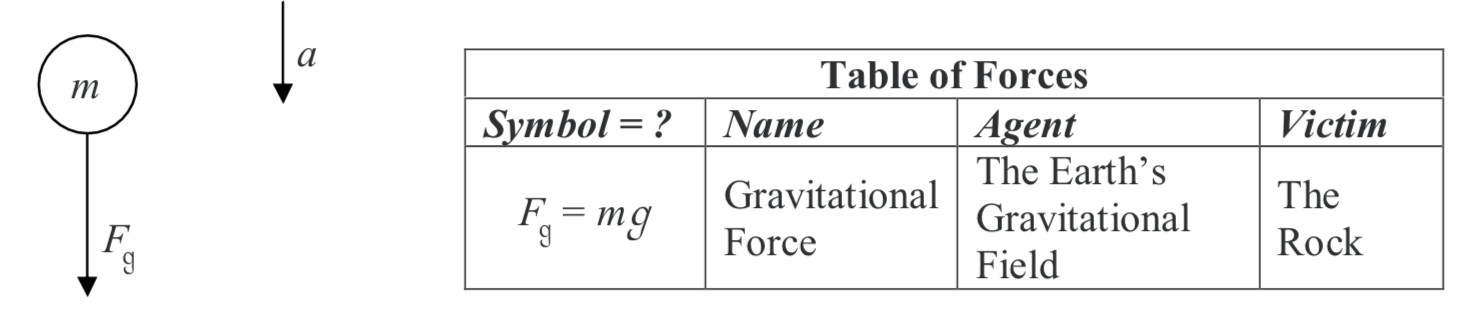
	</div>
			
				
				<div class="footnotes"><div id='162-1'>
<p>Hand from page 127 of Calculus Based Physics, Jeffrey W. Schnick, <a href="https://openlibrary.ecampusontario.ca/catalogue/item/?id=ce74a181-ccde-491c-848d-05489ed182e7" data-url="https://openlibrary.ecampusontario.ca/catalogue/item/?id=ce74a181-ccde-491c-848d-05489ed182e7">https://openlibrary.ecampusontario.ca/catalogue/item/?id=ce74a181-ccde-491c-848d-05489ed182e7</a> &amp; tire from page 828 of Introductory Physics, Ryan Martin et al., <a href="https://openlibrary.ecampusontario.ca/catalogue/item/?id=4c3c2c75-0029-4c9e-967f-41f178bebbbb" data-url="https://openlibrary.ecampusontario.ca/catalogue/item/?id=4c3c2c75-0029-4c9e-967f-41f178bebbbb">https://openlibrary.ecampusontario.ca/catalogue/item/?id=4c3c2c75-0029-4c9e-967f-41f178bebbbb</a>, Edited by author.</p>

</div></div>
	</div>
<div class="chapter standard with-subsections" id="chapter-couples" title="3.2 Couples">
	<div class="chapter-title-wrap">
		<p class="chapter-number">14</p>
		<h1 class="chapter-title">3.2 Couples</h1>
								</div>
	<div class="ugc chapter-ugc">
				 <div class="textbox"><p><span>A&nbsp;</span><strong>couple</strong><span>&nbsp;is a set of equal and opposite forces that exerts a net moment on an object but no net force. Because the couple exerts a net moment without exerting a net force, couples are also sometimes called&nbsp;</span><strong>pure moments</strong><span>.</span></p> <div class="wp-caption aligncenter" id="attachment_2700" aria-describedby="caption-attachment-2700" style="width: 307px"><img src="http://pressbooks.library.upei.ca/statics/wp-content/uploads/sites/56/2021/03/Screenshot-2025-07-16-164859-257x300.png" alt="A wrench applying equal and opposite forces to a wheel to create a couple and exert a moment." class="wp-image-2700" width="307" height="358" srcset="https://pressbooks.library.upei.ca/statics/wp-content/uploads/sites/56/2021/03/Screenshot-2025-07-16-164859-257x300.png 257w, https://pressbooks.library.upei.ca/statics/wp-content/uploads/sites/56/2021/03/Screenshot-2025-07-16-164859-65x76.png 65w, https://pressbooks.library.upei.ca/statics/wp-content/uploads/sites/56/2021/03/Screenshot-2025-07-16-164859-225x262.png 225w, https://pressbooks.library.upei.ca/statics/wp-content/uploads/sites/56/2021/03/Screenshot-2025-07-16-164859-350x408.png 350w, https://pressbooks.library.upei.ca/statics/wp-content/uploads/sites/56/2021/03/Screenshot-2025-07-16-164859.png 561w" sizes="auto, (max-width: 307px) 100vw, 307px" title="" /><div class="wp-caption-text" id="caption-attachment-2700">The two equal and opposite forces exerted on this lug wrench are a couple. They exert a moment on the lug nut on this wheel without exerting any net force on the wheel. Adapted from image by Steffen Heinz Caronna CC-BY-SA 3.0.</div></div> <p>The moment exerted by a couple also differs from the moment exerted by a single force in that it is independent of the location you are taking the moment about. In the example below we have a couple acting on a beam. Each force has a magnitude F and the distance between the two forces is d.</p> <div class="wp-caption aligncenter" id="attachment_2701" aria-describedby="caption-attachment-2701" style="width: 450px"><img src="http://pressbooks.library.upei.ca/statics/wp-content/uploads/sites/56/2021/03/Screenshot-2025-07-16-165137-300x158.png" alt="A horizontal bar with two equal and opposite vertical forces forming a couple, showing distances x and d." class="wp-image-2701" width="450" height="237" srcset="https://pressbooks.library.upei.ca/statics/wp-content/uploads/sites/56/2021/03/Screenshot-2025-07-16-165137-300x158.png 300w, https://pressbooks.library.upei.ca/statics/wp-content/uploads/sites/56/2021/03/Screenshot-2025-07-16-165137-768x405.png 768w, https://pressbooks.library.upei.ca/statics/wp-content/uploads/sites/56/2021/03/Screenshot-2025-07-16-165137-65x34.png 65w, https://pressbooks.library.upei.ca/statics/wp-content/uploads/sites/56/2021/03/Screenshot-2025-07-16-165137-225x119.png 225w, https://pressbooks.library.upei.ca/statics/wp-content/uploads/sites/56/2021/03/Screenshot-2025-07-16-165137-350x185.png 350w, https://pressbooks.library.upei.ca/statics/wp-content/uploads/sites/56/2021/03/Screenshot-2025-07-16-165137.png 949w" sizes="auto, (max-width: 450px) 100vw, 450px" title="" /><div class="wp-caption-text" id="caption-attachment-2701">The moment exerted by this couple is independent of the distance x.</div></div> <p><span>Now we have some point A, which is distance x from the first of the two forces. If we take the moment of each force about point A, and then add these moments together for the net moment about point A we are left with the following formula.</span></p> <p style="text-align: center">$$M=-(F\ast x)+(F\ast(x+d))$$</p> <p><span>If we rearrange and simplify the formula above, we can see that the variable x actually disappears from the equation, leaving the net moment equal to the magnitude of the forces (F) times the distance between the two forces (d).</span></p> <p style="text-align: center">$$M=-(F\ast x)+(F\ast x)+(F\ast d)\\\\M=(F\ast d)$$</p> <p><span>This means that no matter what value of x we have, the magnitude of the moment exerted by the couple will be the same. The magnitude of the moment due to the couple is independent of the location we are taking the moment about. This will also work in two or three dimensions as well. The magnitude of the moment due to a couple will always be equal to the magnitude of the forces times the perpendicular distance between the two forces.</span></p> <p>Source: Engineering Mechanics, Jacob Moore et al., <a href="http://mechanicsmap.psu.edu/websites/3_equilibrium_rigid_body/3-3_couples/couples.html" data-url="http://mechanicsmap.psu.edu/websites/3_equilibrium_rigid_body/3-3_couples/couples.html">http://mechanicsmap.psu.edu/websites/3_equilibrium_rigid_body/3-3_couples/couples.html</a></p> </div> <div class="textbox textbox--key-takeaways"><div class="textbox__header"><p class="textbox__title">Key Takeaways</p> </div> <div class="textbox__content"><p><em>Basically:</em> Couples are made from two forces in opposite directions that create a moment around an axis</p> <p><em>Application</em>: Turning the steering wheel of your car, you push one hand up and the other down to turn the wheel. To calculate the size of the couple, you multiply the force exerted by the distance between your hands (the diameter of the wheel).</p> <p><em>Looking Ahead</em>: While moments are more common in Ch 4 rigid body equations, it’s important to know what couples are and how to find them.</p> </div> </div> <p>&nbsp;</p> 
	</div>


	</div>
<div class="chapter standard with-subsections" id="chapter-distributed-loads" title="3.3 Distributed Loads">
	<div class="chapter-title-wrap">
		<p class="chapter-number">15</p>
		<h1 class="chapter-title">3.3 Distributed Loads</h1>
								</div>
	<div class="ugc chapter-ugc">
				
 <h1 id="chapter-182-section-1" class="section-header">3.3.1 Intensity</h1> <p>Distributed loads are a way to represent a force over a certain distance. Sometimes called <em>intensity</em>, given the variable:</p> <p style="text-align: center"><strong><em>Intensity</em></strong> &nbsp; &nbsp; &nbsp; &nbsp; &nbsp;&nbsp;&nbsp;&nbsp;&nbsp; <em>w = F / d &nbsp; &nbsp; &nbsp; &nbsp;&nbsp;</em> [=]&nbsp;&nbsp;&nbsp; N/m, lb/ft</p> <p>While pressure is force over area (for 3d problems), intensity is force over distance (for 2d problems). It’s like a bunch of mattresses on the back of a truck. You can model it as 1 force acting at the center (an equivalent point load as in 3.3.2, or you can model it as intensity and divide the total force by the width of the truck bed (the distance that’s not visible in this image<span class="footnote"><span class="footnote-indirect" data-fnref="182-1"></span></span>).</p> <p><img src="http://pressbooks.library.upei.ca/statics/wp-content/uploads/sites/56/2021/03/Screen-Shot-2021-07-31-at-12.16.45-AM-1024x529.png" alt="A photo and diagrams of a loaded truck, modeled in 3D and 2D with distributed force intensity." class="aligncenter wp-image-1182 size-large" width="1024" height="529" srcset="https://pressbooks.library.upei.ca/statics/wp-content/uploads/sites/56/2021/03/Screen-Shot-2021-07-31-at-12.16.45-AM-1024x529.png 1024w, https://pressbooks.library.upei.ca/statics/wp-content/uploads/sites/56/2021/03/Screen-Shot-2021-07-31-at-12.16.45-AM-300x155.png 300w, https://pressbooks.library.upei.ca/statics/wp-content/uploads/sites/56/2021/03/Screen-Shot-2021-07-31-at-12.16.45-AM-768x397.png 768w, https://pressbooks.library.upei.ca/statics/wp-content/uploads/sites/56/2021/03/Screen-Shot-2021-07-31-at-12.16.45-AM-1536x794.png 1536w, https://pressbooks.library.upei.ca/statics/wp-content/uploads/sites/56/2021/03/Screen-Shot-2021-07-31-at-12.16.45-AM-65x34.png 65w, https://pressbooks.library.upei.ca/statics/wp-content/uploads/sites/56/2021/03/Screen-Shot-2021-07-31-at-12.16.45-AM-225x116.png 225w, https://pressbooks.library.upei.ca/statics/wp-content/uploads/sites/56/2021/03/Screen-Shot-2021-07-31-at-12.16.45-AM-350x181.png 350w, https://pressbooks.library.upei.ca/statics/wp-content/uploads/sites/56/2021/03/Screen-Shot-2021-07-31-at-12.16.45-AM.png 1908w" sizes="auto, (max-width: 1024px) 100vw, 1024px" title=""></p> <p>&nbsp;</p> <div class="textbox"><p>A distributed load is any force where the <strong>point of application </strong>of the force is an <strong>area </strong>or a <strong>volume</strong>. This means that the “point of application” is not really a point at all. Though distributed loads are more difficult to analyze than point forces, distributed loads are quite common in real-world systems, so it is important to understand how to model them.</p> <p>Distributed loads can be broken down into <strong>surface forces </strong>and <strong>body forces</strong>. Surface forces are distributed forces where the point of application is an area (a surface on the body). Body forces are forces where the point of application is a volume (the force is exerted on all molecules throughout the body). Below are some examples of surface and body forces.</p> <div class="wp-caption aligncenter" id="attachment_2703" aria-describedby="caption-attachment-2703" style="width: 303px"><img src="http://pressbooks.library.upei.ca/statics/wp-content/uploads/sites/56/2021/03/Screenshot-2025-07-16-171019-211x300.png" alt="A large dam holding water." width="303" height="431" class="wp-image-2703" srcset="https://pressbooks.library.upei.ca/statics/wp-content/uploads/sites/56/2021/03/Screenshot-2025-07-16-171019-211x300.png 211w, https://pressbooks.library.upei.ca/statics/wp-content/uploads/sites/56/2021/03/Screenshot-2025-07-16-171019-65x92.png 65w, https://pressbooks.library.upei.ca/statics/wp-content/uploads/sites/56/2021/03/Screenshot-2025-07-16-171019-225x320.png 225w, https://pressbooks.library.upei.ca/statics/wp-content/uploads/sites/56/2021/03/Screenshot-2025-07-16-171019-350x497.png 350w, https://pressbooks.library.upei.ca/statics/wp-content/uploads/sites/56/2021/03/Screenshot-2025-07-16-171019.png 432w" sizes="auto, (max-width: 303px) 100vw, 303px" title=""><div class="wp-caption-text" id="caption-attachment-2703">The water pressure pushing on the surface of this dam is an example of a surface force. Image by Curimedia CC-BY-SA 2.0</div></div> <div class="wp-caption aligncenter" id="attachment_2704" aria-describedby="caption-attachment-2704" style="width: 319px"><img src="http://pressbooks.library.upei.ca/statics/wp-content/uploads/sites/56/2021/03/Screenshot-2025-07-16-171038-234x300.png" alt="A blurred apple falling." width="319" height="409" class="wp-image-2704" srcset="https://pressbooks.library.upei.ca/statics/wp-content/uploads/sites/56/2021/03/Screenshot-2025-07-16-171038-234x300.png 234w, https://pressbooks.library.upei.ca/statics/wp-content/uploads/sites/56/2021/03/Screenshot-2025-07-16-171038-65x83.png 65w, https://pressbooks.library.upei.ca/statics/wp-content/uploads/sites/56/2021/03/Screenshot-2025-07-16-171038-225x289.png 225w, https://pressbooks.library.upei.ca/statics/wp-content/uploads/sites/56/2021/03/Screenshot-2025-07-16-171038-350x449.png 350w, https://pressbooks.library.upei.ca/statics/wp-content/uploads/sites/56/2021/03/Screenshot-2025-07-16-171038.png 428w" sizes="auto, (max-width: 319px) 100vw, 319px" title=""><div class="wp-caption-text" id="caption-attachment-2704">The gravitational force on this apple is distributed over the entire volume of the fruit. Gravitational forces are an example of body forces. Image by Zátonyi Sándor CC-BY 3.0.</div></div> <p>&nbsp;</p> <p><span>Distributed loads are represented as a field of vectors. This is drawn as a number of discrete vectors along a line, over a surface, or over a volume, that are connected with a line or a surface, as shown below.</span></p> <div class="wp-caption aligncenter" id="attachment_2705" aria-describedby="caption-attachment-2705" style="width: 493px"><img src="http://pressbooks.library.upei.ca/statics/wp-content/uploads/sites/56/2021/03/Screenshot-2025-07-16-171610-300x67.png" alt="A 2D surface force distribution diagram with arrows labeled in kN/m." width="493" height="110" class="wp-image-2705" srcset="https://pressbooks.library.upei.ca/statics/wp-content/uploads/sites/56/2021/03/Screenshot-2025-07-16-171610-300x67.png 300w, https://pressbooks.library.upei.ca/statics/wp-content/uploads/sites/56/2021/03/Screenshot-2025-07-16-171610-768x171.png 768w, https://pressbooks.library.upei.ca/statics/wp-content/uploads/sites/56/2021/03/Screenshot-2025-07-16-171610-65x14.png 65w, https://pressbooks.library.upei.ca/statics/wp-content/uploads/sites/56/2021/03/Screenshot-2025-07-16-171610-225x50.png 225w, https://pressbooks.library.upei.ca/statics/wp-content/uploads/sites/56/2021/03/Screenshot-2025-07-16-171610-350x78.png 350w, https://pressbooks.library.upei.ca/statics/wp-content/uploads/sites/56/2021/03/Screenshot-2025-07-16-171610.png 834w" sizes="auto, (max-width: 493px) 100vw, 493px" title=""><div class="wp-caption-text" id="caption-attachment-2705">This is a representation of a surface force in a 2D problem (A force distributed over a line). The magnitude is given in units of force per unit distance.</div></div> <div class="wp-caption aligncenter" id="attachment_2706" aria-describedby="caption-attachment-2706" style="width: 364px"><img src="http://pressbooks.library.upei.ca/statics/wp-content/uploads/sites/56/2021/03/Screenshot-2025-07-16-171624-300x159.png" alt="A 3D surface force distribution diagram with arrows labeled in lbs/in²." width="364" height="193" class="wp-image-2706" srcset="https://pressbooks.library.upei.ca/statics/wp-content/uploads/sites/56/2021/03/Screenshot-2025-07-16-171624-300x159.png 300w, https://pressbooks.library.upei.ca/statics/wp-content/uploads/sites/56/2021/03/Screenshot-2025-07-16-171624-65x34.png 65w, https://pressbooks.library.upei.ca/statics/wp-content/uploads/sites/56/2021/03/Screenshot-2025-07-16-171624-225x119.png 225w, https://pressbooks.library.upei.ca/statics/wp-content/uploads/sites/56/2021/03/Screenshot-2025-07-16-171624-350x185.png 350w, https://pressbooks.library.upei.ca/statics/wp-content/uploads/sites/56/2021/03/Screenshot-2025-07-16-171624.png 579w" sizes="auto, (max-width: 364px) 100vw, 364px" title=""><div class="wp-caption-text" id="caption-attachment-2706">This is a representation of a surface force in a 3D problem (a force distributed over an area). The magnitude is given in units of force per unit area (also called a pressure).</div></div> <p>Though these representations show a discrete number of individual vectors, there is actually a magnitude and direction at all points along the line, surface, or body. The individual vectors represent a sampling of these magnitudes and directions.</p> <p>It is also important to realize that the magnitudes of distributed forces are given in force per unit distance, area, or volume. We must integrate the distributed load over its entire range to convert the force into the usual units of force.</p> <h2>Analyzing Distributed Load:</h2> <p>For analysis purposes in statics and dynamics, we will usually substitute in a single point force that is statically equivalent to the distributed load in the problem. This single point force is called the <strong>equivalent point load </strong>and it will cause the same accelerations or reaction forces as the distributed load while simplifying the math.</p> <p>Source: Engineering Mechanics, Jacob Moore et al., <a href="http://mechanicsmap.psu.edu/websites/4_statically_equivalent_systems/4-4_distributed_forces/distributedforces.html" data-url="http://mechanicsmap.psu.edu/websites/4_statically_equivalent_systems/4-4_distributed_forces/distributedforces.html">http://mechanicsmap.psu.edu/websites/4_statically_equivalent_systems/4-4_distributed_forces/distributedforces.html</a></p> </div> <p>An additional example:<span style="text-align: initial;background-color: initial;font-size: 1em"></span></p> <div class="textbox"><p><a href="https://eng.libretexts.org/Bookshelves/Introduction_to_Engineering/EGR_1010%3A_Introduction_to_Engineering_for_Engineers_and_Scientists/14%3A_Fundamentals_of_Engineering/14.11%3A_Mechanics/14.11.01%3A_Statics" data-url="https://eng.libretexts.org/Bookshelves/Introduction_to_Engineering/EGR_1010%3A_Introduction_to_Engineering_for_Engineers_and_Scientists/14%3A_Fundamentals_of_Engineering/14.11%3A_Mechanics/14.11.01%3A_Statics"><img src="http://pressbooks.library.upei.ca/statics/wp-content/uploads/sites/56/2021/03/complex_distributed_load-1024x347.png" alt="A diagram of an airplane with a distributed force shown over the left wing." class="aligncenter wp-image-1418 size-large" width="1024" height="347" srcset="https://pressbooks.library.upei.ca/statics/wp-content/uploads/sites/56/2021/03/complex_distributed_load-1024x347.png 1024w, https://pressbooks.library.upei.ca/statics/wp-content/uploads/sites/56/2021/03/complex_distributed_load-300x102.png 300w, https://pressbooks.library.upei.ca/statics/wp-content/uploads/sites/56/2021/03/complex_distributed_load-768x260.png 768w, https://pressbooks.library.upei.ca/statics/wp-content/uploads/sites/56/2021/03/complex_distributed_load-65x22.png 65w, https://pressbooks.library.upei.ca/statics/wp-content/uploads/sites/56/2021/03/complex_distributed_load-225x76.png 225w, https://pressbooks.library.upei.ca/statics/wp-content/uploads/sites/56/2021/03/complex_distributed_load-350x118.png 350w, https://pressbooks.library.upei.ca/statics/wp-content/uploads/sites/56/2021/03/complex_distributed_load.png 1152w" sizes="auto, (max-width: 1024px) 100vw, 1024px" title=""></a>This is a more complex example of a distributed load. This is a cartoon of an airplane with its wing covered in a combination of snow and ice. In a real-world situation, loads will not accommodate people for ease of calculation; you get what you get. In this case, we could approximate this shape with two semi-circles on each end of the wing with a triangle <img src="http://localhost:3000/latex?latex=%5Cnabla&amp;fg=000000&amp;font=TeX&amp;svg=1" alt="\nabla" title="\nabla" class="latex mathjax"> in the middle. For more accuracy, we could use a system similar to the trapezoidal rule.</p> <p>Source: ” Statics” by LibreTexts is licensed under CC BY-NC-SA. <a href="https://eng.libretexts.org/Bookshelves/Introduction_to_Engineering/EGR_1010%3A_Introduction_to_Engineering_for_Engineers_and_Scientists/14%3A_Fundamentals_of_Engineering/14.11%3A_Mechanics/14.11.01%3A_Statics" data-url="https://eng.libretexts.org/Bookshelves/Introduction_to_Engineering/EGR_1010%3A_Introduction_to_Engineering_for_Engineers_and_Scientists/14%3A_Fundamentals_of_Engineering/14.11%3A_Mechanics/14.11.01%3A_Statics">https://eng.libretexts.org/Bookshelves/Introduction_to_Engineering/EGR_1010%3A_Introduction_to_Engineering_for_Engineers_and_Scientists/14%3A_Fundamentals_of_Engineering/14.11%3A_Mechanics/14.11.01%3A_Statics</a></p> </div> <h1 id="chapter-182-section-2" class="section-header">3.3.2 Equivalent Point Load &amp; Location</h1> <p>Distributed loads can be modelled as a single point force that is located at the centroid of the object. You can use straightforward algebra, or use integration for more complex shapes. Then you replace the distributed load with the single point load acting at x distance. See the truck example:</p> <p><img src="http://pressbooks.library.upei.ca/statics/wp-content/uploads/sites/56/2021/03/Screen-Shot-2021-07-31-at-12.05.05-AM-1024x335.png" alt="A loaded truck is shown alongside diagrams modeling the load as a distributed force and its equivalent point load." class="aligncenter wp-image-1183 size-large" width="1024" height="335" srcset="https://pressbooks.library.upei.ca/statics/wp-content/uploads/sites/56/2021/03/Screen-Shot-2021-07-31-at-12.05.05-AM-1024x335.png 1024w, https://pressbooks.library.upei.ca/statics/wp-content/uploads/sites/56/2021/03/Screen-Shot-2021-07-31-at-12.05.05-AM-300x98.png 300w, https://pressbooks.library.upei.ca/statics/wp-content/uploads/sites/56/2021/03/Screen-Shot-2021-07-31-at-12.05.05-AM-768x251.png 768w, https://pressbooks.library.upei.ca/statics/wp-content/uploads/sites/56/2021/03/Screen-Shot-2021-07-31-at-12.05.05-AM-1536x503.png 1536w, https://pressbooks.library.upei.ca/statics/wp-content/uploads/sites/56/2021/03/Screen-Shot-2021-07-31-at-12.05.05-AM-65x21.png 65w, https://pressbooks.library.upei.ca/statics/wp-content/uploads/sites/56/2021/03/Screen-Shot-2021-07-31-at-12.05.05-AM-225x74.png 225w, https://pressbooks.library.upei.ca/statics/wp-content/uploads/sites/56/2021/03/Screen-Shot-2021-07-31-at-12.05.05-AM-350x115.png 350w, https://pressbooks.library.upei.ca/statics/wp-content/uploads/sites/56/2021/03/Screen-Shot-2021-07-31-at-12.05.05-AM.png 1882w" sizes="auto, (max-width: 1024px) 100vw, 1024px" title=""></p> <p>There are two ways to calculate this, using integrals and using the area and centroid.</p> <div class="textbox"><p>An equivalent point load is a <strong>single point force </strong>that will have the <strong>same effect </strong>on a body as the original loading condition, which is usually a distributed load. The equivalent point load should always cause the same linear acceleration and angular acceleration as the original load it is equivalent to (or cause the same reaction forces if the body is constrained). Finding the equivalent point load for a distributed load often helps simplify the analysis of a system by removing the integrals from the equations of equilibrium or equations of motion in later analysis.</p> <div class="wp-caption aligncenter" id="attachment_2707" aria-describedby="caption-attachment-2707" style="width: 505px"><img src="http://pressbooks.library.upei.ca/statics/wp-content/uploads/sites/56/2021/03/Screenshot-2025-07-16-172300-300x139.png" alt="Comparison of distributed force and equivalent point load on a beam." width="505" height="234" class="wp-image-2707" srcset="https://pressbooks.library.upei.ca/statics/wp-content/uploads/sites/56/2021/03/Screenshot-2025-07-16-172300-300x139.png 300w, https://pressbooks.library.upei.ca/statics/wp-content/uploads/sites/56/2021/03/Screenshot-2025-07-16-172300-768x356.png 768w, https://pressbooks.library.upei.ca/statics/wp-content/uploads/sites/56/2021/03/Screenshot-2025-07-16-172300-65x30.png 65w, https://pressbooks.library.upei.ca/statics/wp-content/uploads/sites/56/2021/03/Screenshot-2025-07-16-172300-225x104.png 225w, https://pressbooks.library.upei.ca/statics/wp-content/uploads/sites/56/2021/03/Screenshot-2025-07-16-172300-350x162.png 350w, https://pressbooks.library.upei.ca/statics/wp-content/uploads/sites/56/2021/03/Screenshot-2025-07-16-172300.png 930w" sizes="auto, (max-width: 505px) 100vw, 505px" title=""><div class="wp-caption-text" id="caption-attachment-2707">If the body is unconstrained as shown on the left, the equivalent point load (shown as a solid vector) will cause the same linear and angular acceleration as the original distributed load (shown with dashed vectors). If the body is constrained as shown on the right, the equivalent point load (shown as a solid vector) will cause the same reaction forces as the original distributed force (shown with dashed vectors).</div></div> <p>&nbsp;</p> <h2>Finding the Equivalent Point Load</h2> <p>When finding the equivalent point load we need to find the magnitude, direction, and point of application of a single force that is equivalent to the distributed load we are given. In this course we will only deal with distributed loads with a uniform direction, in which case the direction of the equivalent point load will match the uniform direction of the distributed load. This leaves the magnitude and the point of application to be found. There are two options available to find these values:</p> <ol><li>We can find the magnitude and the point of application of the equivalent point load <strong>via integration </strong>of the force functions.</li> <li>We can use the <strong>area/volume and the centroid/center of volume </strong>of the area or volume under the force function.</li> </ol> <p>The first method is more flexible, allowing us to find the equivalent point load for any force function that we can make a mathematical formula for (assuming we have the skill in calculus to integrate that function). The second method is usually faster, assuming that we can look up the values for the area or volume under the force curve and the values for the centroid or center of volume for the area under the curve.</p> <h3>Using Integration in 2D Surface Force Problems:</h3> <p>Finding the equivalent point load via integration always begins by determining the mathematical formula that is the <strong>force function</strong>. The force function mathematically relates the magnitude of the force (F) to the position (x). In this case the force is acting along a single line, so the position can be entirely determined by knowing the x coordinate, but in later problems we may also need to relate the magnitude of the force to the y and z coordinates. In our example below, we can relate magnitude of the force to the position by stating that the magnitude of the force at any point in Newtons per meter is equal to the x position in meters plus one.</p> <div class="wp-caption aligncenter" id="attachment_2708" aria-describedby="caption-attachment-2708" style="width: 352px"><img src="http://pressbooks.library.upei.ca/statics/wp-content/uploads/sites/56/2021/03/Screenshot-2025-07-16-172556-300x208.png" alt="A 2m block with a linearly increasing distributed force defined by F = x + 1." class="wp-image-2708" width="352" height="244" srcset="https://pressbooks.library.upei.ca/statics/wp-content/uploads/sites/56/2021/03/Screenshot-2025-07-16-172556-300x208.png 300w, https://pressbooks.library.upei.ca/statics/wp-content/uploads/sites/56/2021/03/Screenshot-2025-07-16-172556-65x45.png 65w, https://pressbooks.library.upei.ca/statics/wp-content/uploads/sites/56/2021/03/Screenshot-2025-07-16-172556-225x156.png 225w, https://pressbooks.library.upei.ca/statics/wp-content/uploads/sites/56/2021/03/Screenshot-2025-07-16-172556-350x243.png 350w, https://pressbooks.library.upei.ca/statics/wp-content/uploads/sites/56/2021/03/Screenshot-2025-07-16-172556.png 677w" sizes="auto, (max-width: 352px) 100vw, 352px" title=""><div class="wp-caption-text" id="caption-attachment-2708">The block shown above has a distributed force acting on it. The force function relates the magnitude of the force to the x-position along the top of the box.</div></div> <p>The magnitude of the equivalent point load will be equal to the area under the force function. This will be the integral of the force function over its entire length (in this case, from x = 0 to x = 2).</p> <p style="text-align: center">$$F_{eq}=\int_{xmin}^{xmax}F(x)dx$$</p> <p><span>Now that we have the magnitude of the equivalent point load such that it matches the magnitude of the original force, we need to adjust the position (x<sub>eq</sub>) such that it would cause the same&nbsp;</span><strong>moment</strong> <span>as the original distributed force. The moment of the distributed force will be the integral of the force function (F(x)) times the moment arm about the origin (x). The moment of the equivalent point load will be equal to the magnitude of the equivalent point load that we just found times the moment arm for the equivalent point load (x<sub>eq</sub>). If we set these two things equal to one another and then solve for the position of the equivalent point load (x<sub>eq</sub>) we are left with the following equation:</span></p> <p style="text-align: center">$$x_{eq}=\frac{\int_{xmin}^{xmax}(F(x)\ast x)dx}{F_{eq}}$$</p> <p><span>Now that we have the magnitude, direction, and position of the equivalent point load, we can draw the point load in our original diagram. This point force can be used in place of the distributed force in further analysis.</span></p> <div class="wp-caption aligncenter" id="attachment_2709" aria-describedby="caption-attachment-2709" style="width: 340px"><img src="http://pressbooks.library.upei.ca/statics/wp-content/uploads/sites/56/2021/03/Screenshot-2025-07-16-173004-289x300.png" alt="A triangular distributed force and its equivalent point load F_eq located at x_eq." class="wp-image-2709" width="340" height="353" srcset="https://pressbooks.library.upei.ca/statics/wp-content/uploads/sites/56/2021/03/Screenshot-2025-07-16-173004-289x300.png 289w, https://pressbooks.library.upei.ca/statics/wp-content/uploads/sites/56/2021/03/Screenshot-2025-07-16-173004-65x67.png 65w, https://pressbooks.library.upei.ca/statics/wp-content/uploads/sites/56/2021/03/Screenshot-2025-07-16-173004-225x234.png 225w, https://pressbooks.library.upei.ca/statics/wp-content/uploads/sites/56/2021/03/Screenshot-2025-07-16-173004-350x363.png 350w, https://pressbooks.library.upei.ca/statics/wp-content/uploads/sites/56/2021/03/Screenshot-2025-07-16-173004.png 625w" sizes="auto, (max-width: 340px) 100vw, 340px" title=""><div class="wp-caption-text" id="caption-attachment-2709">The values for F_eq and x_eq that we have solved for are the magnitude and position of the equivalent point load.</div></div> <h3>Using the Area and Centroid in 2D Surface Force Problems:</h3> <p>As an alternative to using integration, we can use the area under the force curve and the centroid of the area under the force curve to find the equivalent point load’s magnitude and point of application, respectively.</p> <div class="wp-caption aligncenter" id="attachment_2710" aria-describedby="caption-attachment-2710" style="width: 363px"><img src="http://pressbooks.library.upei.ca/statics/wp-content/uploads/sites/56/2021/03/Screenshot-2025-07-16-173302-300x288.png" alt="Diagram showing that the equivalent point load acts at the centroid of the area under a triangular distributed force." class="wp-image-2710" width="363" height="349" srcset="https://pressbooks.library.upei.ca/statics/wp-content/uploads/sites/56/2021/03/Screenshot-2025-07-16-173302-300x288.png 300w, https://pressbooks.library.upei.ca/statics/wp-content/uploads/sites/56/2021/03/Screenshot-2025-07-16-173302-65x62.png 65w, https://pressbooks.library.upei.ca/statics/wp-content/uploads/sites/56/2021/03/Screenshot-2025-07-16-173302-225x216.png 225w, https://pressbooks.library.upei.ca/statics/wp-content/uploads/sites/56/2021/03/Screenshot-2025-07-16-173302-350x336.png 350w, https://pressbooks.library.upei.ca/statics/wp-content/uploads/sites/56/2021/03/Screenshot-2025-07-16-173302.png 669w" sizes="auto, (max-width: 363px) 100vw, 363px" title=""><div class="wp-caption-text" id="caption-attachment-2710">The magnitude of the equivalent point load is equal to the area under the force function. Also, the equivalent point load will travel through the centroid of the area under the force function.</div></div> <p>The <strong>magnitude</strong>(F<sub>eq</sub>) of the equivalent point load will be equal to the <strong>area under the force function</strong>. We can find this area using calculus, but there are often easier geometry-based ways of finding the area under the force function.</p> <p>The equivalent point load will also <strong>travel through the centroid of the area under the force function</strong>. This allows us to find the value for x<sub>eq</sub>. The centroid for many common shapes can be looked up in tables, and the parallel axis theorem can be used to determine the centroid of more complex shapes (see the centroid page for more details).</p> <p>&nbsp;</p> <p>Source: Engineering Mechanics, Jacob Moore et al., <a href="https://mechanicsmap.psu.edu/websites/4_statically_equivalent_systems/4-5_equivalent_point_load_integration/equivalentpointloadint.html" data-url="https://mechanicsmap.psu.edu/websites/4_statically_equivalent_systems/4-5_equivalent_point_load_integration/equivalentpointloadint.html">Mechanics Map – Equivalent Point Load via Integration</a><a href="http://mechanicsmap.psu.edu/websites/4_statically_equivalent_systems/4-5_equivalent_point_load/equivalentpointload.html" data-url="http://mechanicsmap.psu.edu/websites/4_statically_equivalent_systems/4-5_equivalent_point_load/equivalentpointload.html"></a></p> </div> <p>Here are the equations for some common shapes:</p> <p><img src="http://pressbooks.library.upei.ca/statics/wp-content/uploads/sites/56/2021/03/Screen-Shot-2021-07-31-at-12.48.39-AM-1024x634.png" alt="Comparison of equivalent point loads, force equations, and centroid locations for triangle, square, and trapezoid distributed loads." class="aligncenter wp-image-1187 size-large" width="1024" height="634" srcset="https://pressbooks.library.upei.ca/statics/wp-content/uploads/sites/56/2021/03/Screen-Shot-2021-07-31-at-12.48.39-AM-1024x634.png 1024w, https://pressbooks.library.upei.ca/statics/wp-content/uploads/sites/56/2021/03/Screen-Shot-2021-07-31-at-12.48.39-AM-300x186.png 300w, https://pressbooks.library.upei.ca/statics/wp-content/uploads/sites/56/2021/03/Screen-Shot-2021-07-31-at-12.48.39-AM-768x475.png 768w, https://pressbooks.library.upei.ca/statics/wp-content/uploads/sites/56/2021/03/Screen-Shot-2021-07-31-at-12.48.39-AM-65x40.png 65w, https://pressbooks.library.upei.ca/statics/wp-content/uploads/sites/56/2021/03/Screen-Shot-2021-07-31-at-12.48.39-AM-225x139.png 225w, https://pressbooks.library.upei.ca/statics/wp-content/uploads/sites/56/2021/03/Screen-Shot-2021-07-31-at-12.48.39-AM-350x217.png 350w, https://pressbooks.library.upei.ca/statics/wp-content/uploads/sites/56/2021/03/Screen-Shot-2021-07-31-at-12.48.39-AM.png 1490w" sizes="auto, (max-width: 1024px) 100vw, 1024px" title="">Example 1: Equivalent force and location:</p> <p>What is the resultant force and where does it act from the wall?</p> <div class="wp-caption aligncenter" id="attachment_1252" aria-describedby="caption-attachment-1252" style="width: 578px"><a href="http://mechanicsmap.psu.edu/websites/4_statically_equivalent_systems/4-5_equivalent_point_load" data-url="http://mechanicsmap.psu.edu/websites/4_statically_equivalent_systems/4-5_equivalent_point_load"><img src="http://pressbooks.library.upei.ca/statics/wp-content/uploads/sites/56/2021/03/P1.png" alt="A 10m cantilever beam with a triangular distributed load decreasing from 14 kN/m" class="wp-image-1252" width="578" height="230" srcset="https://pressbooks.library.upei.ca/statics/wp-content/uploads/sites/56/2021/03/P1.png 500w, https://pressbooks.library.upei.ca/statics/wp-content/uploads/sites/56/2021/03/P1-300x119.png 300w, https://pressbooks.library.upei.ca/statics/wp-content/uploads/sites/56/2021/03/P1-65x26.png 65w, https://pressbooks.library.upei.ca/statics/wp-content/uploads/sites/56/2021/03/P1-225x90.png 225w, https://pressbooks.library.upei.ca/statics/wp-content/uploads/sites/56/2021/03/P1-350x139.png 350w" sizes="auto, (max-width: 578px) 100vw, 578px" title=""></a><div class="wp-caption-text" id="caption-attachment-1252">Source: https://mechanicsmap.psu.edu/websites/4_statically_equivalent_systems/4-5_equivalent_point_load_integration/equivalentpointloadint.html</div></div> <p>&nbsp;</p> <p><img src="http://pressbooks.library.upei.ca/statics/wp-content/uploads/sites/56/2021/03/Screen-Shot-2021-07-31-at-12.22.50-AM-1024x412.png" alt="A handwritten solution showing how to convert a triangular distributed load into an equivalent point load of 49 kN acting 5.33 m from the wall." class="aligncenter wp-image-1185 size-large" width="1024" height="412" srcset="https://pressbooks.library.upei.ca/statics/wp-content/uploads/sites/56/2021/03/Screen-Shot-2021-07-31-at-12.22.50-AM-1024x412.png 1024w, https://pressbooks.library.upei.ca/statics/wp-content/uploads/sites/56/2021/03/Screen-Shot-2021-07-31-at-12.22.50-AM-300x121.png 300w, https://pressbooks.library.upei.ca/statics/wp-content/uploads/sites/56/2021/03/Screen-Shot-2021-07-31-at-12.22.50-AM-768x309.png 768w, https://pressbooks.library.upei.ca/statics/wp-content/uploads/sites/56/2021/03/Screen-Shot-2021-07-31-at-12.22.50-AM-1536x618.png 1536w, https://pressbooks.library.upei.ca/statics/wp-content/uploads/sites/56/2021/03/Screen-Shot-2021-07-31-at-12.22.50-AM-65x26.png 65w, https://pressbooks.library.upei.ca/statics/wp-content/uploads/sites/56/2021/03/Screen-Shot-2021-07-31-at-12.22.50-AM-225x90.png 225w, https://pressbooks.library.upei.ca/statics/wp-content/uploads/sites/56/2021/03/Screen-Shot-2021-07-31-at-12.22.50-AM-350x141.png 350w, https://pressbooks.library.upei.ca/statics/wp-content/uploads/sites/56/2021/03/Screen-Shot-2021-07-31-at-12.22.50-AM.png 1980w" sizes="auto, (max-width: 1024px) 100vw, 1024px" title=""></p> <p>See solution here using integration from Engineering Mechanics, Jacob Moore et al., https://mechanicsmap.psu.edu/websites/4_statically_equivalent_systems/4-5_equivalent_point_load_integration/pdf/P1.pdf</p> <p>&nbsp;</p> <div class="textbox"><p>Example 2 (note: 1 kip = 1000 lb):</p> <p><img src="http://pressbooks.library.upei.ca/statics/wp-content/uploads/sites/56/2021/03/1.03-_Equilibrium_Structures_Support_Reactions_Determinacy_and_Stability_of_Beams_and_Frames2-2-1024x651.jpg" alt="Three free body diagrams and reaction forces showing a beam with distributed and point load over 12 ft." class="aligncenter wp-image-1413 size-large" width="1024" height="651" srcset="https://pressbooks.library.upei.ca/statics/wp-content/uploads/sites/56/2021/03/1.03-_Equilibrium_Structures_Support_Reactions_Determinacy_and_Stability_of_Beams_and_Frames2-2-1024x651.jpg 1024w, https://pressbooks.library.upei.ca/statics/wp-content/uploads/sites/56/2021/03/1.03-_Equilibrium_Structures_Support_Reactions_Determinacy_and_Stability_of_Beams_and_Frames2-2-300x191.jpg 300w, https://pressbooks.library.upei.ca/statics/wp-content/uploads/sites/56/2021/03/1.03-_Equilibrium_Structures_Support_Reactions_Determinacy_and_Stability_of_Beams_and_Frames2-2-768x488.jpg 768w, https://pressbooks.library.upei.ca/statics/wp-content/uploads/sites/56/2021/03/1.03-_Equilibrium_Structures_Support_Reactions_Determinacy_and_Stability_of_Beams_and_Frames2-2-1536x976.jpg 1536w, https://pressbooks.library.upei.ca/statics/wp-content/uploads/sites/56/2021/03/1.03-_Equilibrium_Structures_Support_Reactions_Determinacy_and_Stability_of_Beams_and_Frames2-2-65x41.jpg 65w, https://pressbooks.library.upei.ca/statics/wp-content/uploads/sites/56/2021/03/1.03-_Equilibrium_Structures_Support_Reactions_Determinacy_and_Stability_of_Beams_and_Frames2-2-225x143.jpg 225w, https://pressbooks.library.upei.ca/statics/wp-content/uploads/sites/56/2021/03/1.03-_Equilibrium_Structures_Support_Reactions_Determinacy_and_Stability_of_Beams_and_Frames2-2-350x222.jpg 350w, https://pressbooks.library.upei.ca/statics/wp-content/uploads/sites/56/2021/03/1.03-_Equilibrium_Structures_Support_Reactions_Determinacy_and_Stability_of_Beams_and_Frames2-2.jpg 1800w" sizes="auto, (max-width: 1024px) 100vw, 1024px" title=""></p> <p>Example 3:</p> <p><img src="http://pressbooks.library.upei.ca/statics/wp-content/uploads/sites/56/2021/03/1.03-_Equilibrium_Structures_Support_Reactions_Determinacy_and_Stability_of_Beams_and_Frames-1024x877.jpg" alt="Beam with a distributed load and angled point load showing reaction forces and moment at support A." class="aligncenter wp-image-1407 size-large" width="1024" height="877" srcset="https://pressbooks.library.upei.ca/statics/wp-content/uploads/sites/56/2021/03/1.03-_Equilibrium_Structures_Support_Reactions_Determinacy_and_Stability_of_Beams_and_Frames-1024x877.jpg 1024w, https://pressbooks.library.upei.ca/statics/wp-content/uploads/sites/56/2021/03/1.03-_Equilibrium_Structures_Support_Reactions_Determinacy_and_Stability_of_Beams_and_Frames-300x257.jpg 300w, https://pressbooks.library.upei.ca/statics/wp-content/uploads/sites/56/2021/03/1.03-_Equilibrium_Structures_Support_Reactions_Determinacy_and_Stability_of_Beams_and_Frames-768x658.jpg 768w, https://pressbooks.library.upei.ca/statics/wp-content/uploads/sites/56/2021/03/1.03-_Equilibrium_Structures_Support_Reactions_Determinacy_and_Stability_of_Beams_and_Frames-65x56.jpg 65w, https://pressbooks.library.upei.ca/statics/wp-content/uploads/sites/56/2021/03/1.03-_Equilibrium_Structures_Support_Reactions_Determinacy_and_Stability_of_Beams_and_Frames-225x193.jpg 225w, https://pressbooks.library.upei.ca/statics/wp-content/uploads/sites/56/2021/03/1.03-_Equilibrium_Structures_Support_Reactions_Determinacy_and_Stability_of_Beams_and_Frames-350x300.jpg 350w, https://pressbooks.library.upei.ca/statics/wp-content/uploads/sites/56/2021/03/1.03-_Equilibrium_Structures_Support_Reactions_Determinacy_and_Stability_of_Beams_and_Frames.jpg 1282w" sizes="auto, (max-width: 1024px) 100vw, 1024px" title=""></p> <p>Example 4:</p> <p><img src="http://pressbooks.library.upei.ca/statics/wp-content/uploads/sites/56/2021/03/5-1024x983.jpg" alt="L-shaped beam with vertical and horizontal loads, showing reaction forces and moment at the fixed support." class="aligncenter wp-image-1410 size-large" width="1024" height="983" srcset="https://pressbooks.library.upei.ca/statics/wp-content/uploads/sites/56/2021/03/5-1024x983.jpg 1024w, https://pressbooks.library.upei.ca/statics/wp-content/uploads/sites/56/2021/03/5-300x288.jpg 300w, https://pressbooks.library.upei.ca/statics/wp-content/uploads/sites/56/2021/03/5-768x737.jpg 768w, https://pressbooks.library.upei.ca/statics/wp-content/uploads/sites/56/2021/03/5-1536x1475.jpg 1536w, https://pressbooks.library.upei.ca/statics/wp-content/uploads/sites/56/2021/03/5-65x62.jpg 65w, https://pressbooks.library.upei.ca/statics/wp-content/uploads/sites/56/2021/03/5-225x216.jpg 225w, https://pressbooks.library.upei.ca/statics/wp-content/uploads/sites/56/2021/03/5-350x336.jpg 350w, https://pressbooks.library.upei.ca/statics/wp-content/uploads/sites/56/2021/03/5.jpg 1912w" sizes="auto, (max-width: 1024px) 100vw, 1024px" title=""></p> <p>&nbsp;</p> <p>Source: ” Equilibrium Structures, Support Reactions, Determinacy and Stability of Beams and Frames” by LibreTexts is licensed under CC BY-NC-ND . <a href="https://eng.libretexts.org/Bookshelves/Civil_Engineering/Book%3A_Structural_Analysis_(Udoeyo)/01%3A_Chapters/1.03%3A_Equilibrium_Structures_Support_Reactions_Determinacy_and_Stability_of_Beams_and_Frames" data-url="https://eng.libretexts.org/Bookshelves/Civil_Engineering/Book%3A_Structural_Analysis_(Udoeyo)/01%3A_Chapters/1.03%3A_Equilibrium_Structures_Support_Reactions_Determinacy_and_Stability_of_Beams_and_Frames">https://eng.libretexts.org/Bookshelves/Civil_Engineering/Book%3A_Structural_Analysis_(Udoeyo)/01%3A_Chapters/1.03%3A_Equilibrium_Structures_Support_Reactions_Determinacy_and_Stability_of_Beams_and_Frames</a></p> </div> <p>&nbsp;</p> <p>&nbsp;</p> <h1 id="chapter-182-section-3" class="section-header">3.3.3 Composite Distributed Loads</h1> <p>When there is a complicated shape, it can be easier to model it as more than 1 type of distributed load. You calculate each force separately and then use a weighted equation to find the total distance the force acts from a point that you select.</p> <p style="text-align: center"><img src="http://localhost:3000/latex?latex=%5Cquad%5Cquad%5Cquad%5Cquad%5Ctext%7BUsing%20area%3A%20%7D%5Cquad%5Cquad%5Cquad%5Cquad%5Cquad%5Cquad%5Cquad%5Cquad%5Cquad%20%5Ctext%7BUsing%20Integrals%3A%7D%5C%5C%20%20%5Cquad%5Cquad%5Cquad%5Cquad%5Cbar%7Bx%7D%3D%5Cfrac%7B%5Csum%20F_%7Bi%7Dx_i%7D%7B%5Csum%20F_i%7D%20%5Cquad%5Cquad%5Cquad%5Cquad%5Cquad%5Cquad%5Cquad%5Cquad%5Cquad%5Cquad%20%5Cbar%7Bx%7D%3D%5Cfrac%7B%5Cint%20x%20w%28x%29%20d%20x%7D%7B%5Cint%20w%28x%29%20d%20x%7D&amp;fg=000000&amp;font=TeX&amp;svg=1" alt="\quad\quad\quad\quad\text{Using area: }\quad\quad\quad\quad\quad\quad\quad\quad\quad \text{Using Integrals:}\\ \quad\quad\quad\quad\bar{x}=\frac{\sum F_{i}x_i}{\sum F_i} \quad\quad\quad\quad\quad\quad\quad\quad\quad\quad \bar{x}=\frac{\int x w(x) d x}{\int w(x) d x}" title="\quad\quad\quad\quad\text{Using area: }\quad\quad\quad\quad\quad\quad\quad\quad\quad \text{Using Integrals:}\\ \quad\quad\quad\quad\bar{x}=\frac{\sum F_{i}x_i}{\sum F_i} \quad\quad\quad\quad\quad\quad\quad\quad\quad\quad \bar{x}=\frac{\int x w(x) d x}{\int w(x) d x}" class="latex mathjax"></p> <p style="text-align: left">A bit bigger:</p> <p style="text-align: center"><img src="http://pressbooks.library.upei.ca/statics/wp-content/uploads/sites/56/2021/03/Screen-Shot-2021-07-31-at-1.24.12-AM-1024x256.png" alt="Centroid formulas for discrete and continuous force distributions." class="alignnone" width="796" height="199" title=""></p> <p style="text-align: left">For the following complex shape, this is how you find the composite equivalent point force and location (<img src="http://localhost:3000/latex?latex=%5Cbar%7Bx%7D&amp;fg=000000&amp;font=TeX&amp;svg=1" alt="\bar{x}" title="\bar{x}" class="latex mathjax">):</p> <p><img src="http://pressbooks.library.upei.ca/statics/wp-content/uploads/sites/56/2021/03/Screen-Shot-2021-07-31-at-1.03.54-AM-1024x700.png" alt="Trapezoidal load split into triangle and rectangle to calculate total force and its location." class="aligncenter wp-image-1188 size-large" width="1024" height="700" srcset="https://pressbooks.library.upei.ca/statics/wp-content/uploads/sites/56/2021/03/Screen-Shot-2021-07-31-at-1.03.54-AM-1024x700.png 1024w, https://pressbooks.library.upei.ca/statics/wp-content/uploads/sites/56/2021/03/Screen-Shot-2021-07-31-at-1.03.54-AM-300x205.png 300w, https://pressbooks.library.upei.ca/statics/wp-content/uploads/sites/56/2021/03/Screen-Shot-2021-07-31-at-1.03.54-AM-768x525.png 768w, https://pressbooks.library.upei.ca/statics/wp-content/uploads/sites/56/2021/03/Screen-Shot-2021-07-31-at-1.03.54-AM-65x44.png 65w, https://pressbooks.library.upei.ca/statics/wp-content/uploads/sites/56/2021/03/Screen-Shot-2021-07-31-at-1.03.54-AM-225x154.png 225w, https://pressbooks.library.upei.ca/statics/wp-content/uploads/sites/56/2021/03/Screen-Shot-2021-07-31-at-1.03.54-AM-350x239.png 350w, https://pressbooks.library.upei.ca/statics/wp-content/uploads/sites/56/2021/03/Screen-Shot-2021-07-31-at-1.03.54-AM.png 1498w" sizes="auto, (max-width: 1024px) 100vw, 1024px" title=""></p> <p>&nbsp;</p> <p>&nbsp;</p> <div class="textbox textbox--key-takeaways"><div class="textbox__header"><p class="textbox__title">Key Takeaways</p> </div> <div class="textbox__content"><p>Basically: Distributed loads are a way to model forces in 2d. <strong>F = w d. </strong>Sometimes called intensity, distributed loads have units of force over distance: N/m or lb/ft.</p> <p>Application: For a truck carrying a heavy , uneven load, find where the center of the force is.</p> <p>Looking ahead: Distributed load helps to model uneven loads. We’ll see it again as we do the beam analysis</p> </div> </div> <p>&nbsp;</p> 

	</div>
			
				
				<div class="footnotes"><div id='182-1'><p>Image of truck from: https://get.pxhere.com/photo/car-transport-truck-vehicle-market-mattress-full-load-small-business-rwanda-overload-pickup-truck-overfull-automobile-make-612534.jpg</p>
</div></div>
	</div>
<div class="chapter standard with-subsections" id="chapter-reaction-forces" title="3.4 Reactions &#038; Supports">
	<div class="chapter-title-wrap">
		<p class="chapter-number">16</p>
		<h1 class="chapter-title">3.4 Reactions & Supports</h1>
								</div>
	<div class="ugc chapter-ugc">
				 <p>Imagine a beam extending from the wall. How much weight can the beam handle before it breaks away or falls off the wall? It depends on the way it’s attached to the wall. We model these real-world situations using forces and moments. For example, the Grand Canyon Skywalk lets people walk out over the Grand Canyon. You want to be sure that the skywalk is so that the people on it are safe.</p> <p><a href="https://www.flickr.com/photos/mikemcd/539914172" data-url="https://www.flickr.com/photos/mikemcd/539914172"><img src="http://pressbooks.library.upei.ca/statics/wp-content/uploads/sites/56/2021/03/beam.jpg" alt="A cantilever bridge." class="aligncenter wp-image-1231 size-full" width="530" height="363" srcset="https://pressbooks.library.upei.ca/statics/wp-content/uploads/sites/56/2021/03/beam.jpg 530w, https://pressbooks.library.upei.ca/statics/wp-content/uploads/sites/56/2021/03/beam-300x205.jpg 300w, https://pressbooks.library.upei.ca/statics/wp-content/uploads/sites/56/2021/03/beam-65x45.jpg 65w, https://pressbooks.library.upei.ca/statics/wp-content/uploads/sites/56/2021/03/beam-225x154.jpg 225w, https://pressbooks.library.upei.ca/statics/wp-content/uploads/sites/56/2021/03/beam-350x240.jpg 350w" sizes="auto, (max-width: 530px) 100vw, 530px" title="" /></a></p> <p>We call the skywalk a <em>cantilever beam</em> and turn the real world beam into a 2d model with constrains. So we can use the same terminology, it is a <em>fixed </em>constraint, preventing horizontal movement, vertical movement, and rotation.</p> <p><img src="http://pressbooks.library.upei.ca/statics/wp-content/uploads/sites/56/2021/03/IMG-0653-e1619714864376.png" alt="Cantilever beam with fixed support and its reaction forces: axial, shear, and moment." class="aligncenter wp-image-530" width="463" height="186" title="" /></p> <p>Reaction forces and moments are how we model constraints on structures. They are external forces. There are 3 different kinds of constraints we will focus on in this course and they each have different reaction forces and moments:</p> <p>1.&nbsp; Pinned (Frictionless)<img src="http://pressbooks.library.upei.ca/statics/wp-content/uploads/sites/56/2021/03/IMG-0653-e1619714803773.png" alt="Simply supported beam with a pin support showing horizontal and vertical reactions R_x and R_y." class="alignright wp-image-530" width="489" height="114" title="" /></p> <ul><li style="list-style-type: none"><ul><li>Two reaction forces acting perpendicularly in the x and y directions.</li> <li>Pinned constraint and then its free body diagram shown:</li> </ul> </li> </ul> <p>&nbsp;</p> <p>2.&nbsp; Fixed</p> <ul><li style="list-style-type: none"><ul><li>Two reaction forces acting perpendicularly in the x and y directions<img src="http://pressbooks.library.upei.ca/statics/wp-content/uploads/sites/56/2021/03/IMG-0653-e1619714864376.png" alt="Cantilever beam with a fixed support showing reactions: R_x, R_y, and moment M." class="alignright wp-image-530" width="463" height="186" title="" /></li> <li>Moment rotating about fixed constraint (usually a wall), use right hand rule to find its direction</li> <li>This is also called a cantilever beam.</li> <li>Fixed constraint and then FBD shown</li> </ul> </li> </ul> <p>&nbsp;</p> <p>3.&nbsp; Roller (there are multiple kinds)<img src="http://pressbooks.library.upei.ca/statics/wp-content/uploads/sites/56/2021/03/IMG-0653-e1619714960684.png" alt="Various simple supports and roller/pin reactions, all showing vertical force R_y." class="alignright wp-image-530" width="418" height="226" srcset="https://pressbooks.library.upei.ca/statics/wp-content/uploads/sites/56/2021/03/IMG-0653-e1619714960684.png 950w, https://pressbooks.library.upei.ca/statics/wp-content/uploads/sites/56/2021/03/IMG-0653-e1619714960684-300x162.png 300w, https://pressbooks.library.upei.ca/statics/wp-content/uploads/sites/56/2021/03/IMG-0653-e1619714960684-768x415.png 768w, https://pressbooks.library.upei.ca/statics/wp-content/uploads/sites/56/2021/03/IMG-0653-e1619714960684-65x35.png 65w, https://pressbooks.library.upei.ca/statics/wp-content/uploads/sites/56/2021/03/IMG-0653-e1619714960684-225x122.png 225w, https://pressbooks.library.upei.ca/statics/wp-content/uploads/sites/56/2021/03/IMG-0653-e1619714960684-350x189.png 350w" sizes="auto, (max-width: 418px) 100vw, 418px" title="" /></p> <ul><li style="list-style-type: none"><ul><li>Single reaction force acting in the y direction</li> <li>No moment is created</li> <li>This can be the ground that the object rests on as well</li> <li>Free body diagram shown for roller</li> </ul> </li> </ul> <p>&nbsp;</p> <p>Notice that the Fixed restraint is the most restrictive and the roller is the least restrictive. You put a force to show how the restraint restricts motion. The roller only keeps the object from moving vertically, so there is only 1 force. The pinned restraint doesn’t allow horizontal or vertical movement, hence the two forces. The fixed beam restricts vertical translation, horizontal translation, and rotation, so there is a moment and two forces. Note that this applies only to 2d restraints.</p> <p>Here is a summary showing what motion is allowed by that type of constraint:</p> <p>&nbsp;</p> <p>&nbsp;</p> <p>&nbsp;</p> <p><img src="http://pressbooks.library.upei.ca/statics/wp-content/uploads/sites/56/2021/03/Screen-Shot-2021-07-31-at-1.55.01-AM-1024x690.png" alt="Types of supports: Roller (1 reaction), Pinned (2 reactions), Fixed (3 reactions); with allowed motions shown." class="aligncenter wp-image-1199" width="959" height="646" srcset="https://pressbooks.library.upei.ca/statics/wp-content/uploads/sites/56/2021/03/Screen-Shot-2021-07-31-at-1.55.01-AM-1024x690.png 1024w, https://pressbooks.library.upei.ca/statics/wp-content/uploads/sites/56/2021/03/Screen-Shot-2021-07-31-at-1.55.01-AM-300x202.png 300w, https://pressbooks.library.upei.ca/statics/wp-content/uploads/sites/56/2021/03/Screen-Shot-2021-07-31-at-1.55.01-AM-768x518.png 768w, https://pressbooks.library.upei.ca/statics/wp-content/uploads/sites/56/2021/03/Screen-Shot-2021-07-31-at-1.55.01-AM-1536x1035.png 1536w, https://pressbooks.library.upei.ca/statics/wp-content/uploads/sites/56/2021/03/Screen-Shot-2021-07-31-at-1.55.01-AM-65x44.png 65w, https://pressbooks.library.upei.ca/statics/wp-content/uploads/sites/56/2021/03/Screen-Shot-2021-07-31-at-1.55.01-AM-225x152.png 225w, https://pressbooks.library.upei.ca/statics/wp-content/uploads/sites/56/2021/03/Screen-Shot-2021-07-31-at-1.55.01-AM-350x236.png 350w, https://pressbooks.library.upei.ca/statics/wp-content/uploads/sites/56/2021/03/Screen-Shot-2021-07-31-at-1.55.01-AM.png 1724w" sizes="auto, (max-width: 959px) 100vw, 959px" title="" /></p> <p>&nbsp;</p> <p>Typically, reaction forces are either as follows: a roller and a pinned reaction force together (1 reaction force + 2 reaction forces = 3 restraints) <span>or</span> a fixed beam (2 reaction forces and 1 moment = 3 restraints).<span></span><span></span></p> <p><img src="http://pressbooks.library.upei.ca/statics/wp-content/uploads/sites/56/2021/03/Screen-Shot-2021-07-31-at-1.56.36-AM-1024x307.png" alt="Simple diagram showing three support types: roller, pinned, and fixed/cantilever." class="aligncenter wp-image-1201 size-large" width="1024" height="307" srcset="https://pressbooks.library.upei.ca/statics/wp-content/uploads/sites/56/2021/03/Screen-Shot-2021-07-31-at-1.56.36-AM-1024x307.png 1024w, https://pressbooks.library.upei.ca/statics/wp-content/uploads/sites/56/2021/03/Screen-Shot-2021-07-31-at-1.56.36-AM-300x90.png 300w, https://pressbooks.library.upei.ca/statics/wp-content/uploads/sites/56/2021/03/Screen-Shot-2021-07-31-at-1.56.36-AM-768x230.png 768w, https://pressbooks.library.upei.ca/statics/wp-content/uploads/sites/56/2021/03/Screen-Shot-2021-07-31-at-1.56.36-AM-65x19.png 65w, https://pressbooks.library.upei.ca/statics/wp-content/uploads/sites/56/2021/03/Screen-Shot-2021-07-31-at-1.56.36-AM-225x67.png 225w, https://pressbooks.library.upei.ca/statics/wp-content/uploads/sites/56/2021/03/Screen-Shot-2021-07-31-at-1.56.36-AM-350x105.png 350w, https://pressbooks.library.upei.ca/statics/wp-content/uploads/sites/56/2021/03/Screen-Shot-2021-07-31-at-1.56.36-AM.png 1242w" sizes="auto, (max-width: 1024px) 100vw, 1024px" title="" /><br /> The information shown here is to model 2d situations. We don’t get into 3d problems in this statics course, needless to say, there are more reaction forces and moments involved in 3-dimentsions instead of 2 dimensions. The following section provides a second explanation on reactions &amp; supports:</p> <p>&nbsp;</p> <div class="textbox"><p class="h4 lt-eng-17609"><span class="blue1">3.4.1 Pin or Hinge Support</span></p> <p class="noindent lt-eng-17609">A pin support allows rotation about any axis but prevents movement in the horizontal and vertical directions. Its idealized representation and reactions are shown in Table 3.1</p> <p style="text-align: center">Table 3.1 Reaction Representations</p> <p><a href="https://eng.libretexts.org/Bookshelves/Civil_Engineering/Book%3A_Structural_Analysis_(Udoeyo)/01%3A_Chapters/1.03%3A_Equilibrium_Structures_Support_Reactions_Determinacy_and_Stability_of_Beams_and_Frames#tab3-1" data-url="https://eng.libretexts.org/Bookshelves/Civil_Engineering/Book%3A_Structural_Analysis_(Udoeyo)/01%3A_Chapters/1.03%3A_Equilibrium_Structures_Support_Reactions_Determinacy_and_Stability_of_Beams_and_Frames#tab3-1"><img src="http://pressbooks.library.upei.ca/statics/wp-content/uploads/sites/56/2021/03/tab3-1-1024x947.jpg" alt="A table showing support types (pin, roller, rocker, link, fixed) with their reactions and motion restrictions." class="aligncenter wp-image-1401 size-large" width="1024" height="947" srcset="https://pressbooks.library.upei.ca/statics/wp-content/uploads/sites/56/2021/03/tab3-1-1024x947.jpg 1024w, https://pressbooks.library.upei.ca/statics/wp-content/uploads/sites/56/2021/03/tab3-1-300x277.jpg 300w, https://pressbooks.library.upei.ca/statics/wp-content/uploads/sites/56/2021/03/tab3-1-768x710.jpg 768w, https://pressbooks.library.upei.ca/statics/wp-content/uploads/sites/56/2021/03/tab3-1-1536x1420.jpg 1536w, https://pressbooks.library.upei.ca/statics/wp-content/uploads/sites/56/2021/03/tab3-1-65x60.jpg 65w, https://pressbooks.library.upei.ca/statics/wp-content/uploads/sites/56/2021/03/tab3-1-225x208.jpg 225w, https://pressbooks.library.upei.ca/statics/wp-content/uploads/sites/56/2021/03/tab3-1-350x324.jpg 350w, https://pressbooks.library.upei.ca/statics/wp-content/uploads/sites/56/2021/03/tab3-1.jpg 1800w" sizes="auto, (max-width: 1024px) 100vw, 1024px" title="" /></a></p> <p class="h4 lt-eng-17609"><span class="blue1">3.4.2 Roller Support</span></p> <p class="noindent lt-eng-17609">A roller support allows rotation about any axis and translation (horizontal movement) in any direction parallel to the surface on which it rests. It restrains the structure from movement in a vertical direction. The idealized representation of a roller and its reaction are also shown in Table 3.1.</p> <p class="h4 lt-eng-17609"><span class="blue1">3.4.3 Rocker Support</span></p> <p class="noindent lt-eng-17609">The characteristics of a rocker support are like those of the roller support. Its idealized form is depicted in Table 3.1.</p> <p class="h4 lt-eng-17609"><span class="blue1">3.4.4 Link</span></p> <p class="noindent lt-eng-17609">A link has two hinges, one at each end. It permits movement in all direction, except in a direction parallel to its longitudinal axis, which passes through the two hinges. In other words, the reaction force of a link is in the direction of the link, along its longitudinal axis.</p> <p class="h4 lt-eng-17609"><span class="blue1">3.4.5 Fixed Support</span></p> <p class="noindent lt-eng-17609">A fixed support offers a constraint against rotation in any direction, and it prevents movement in both horizontal and vertical directions.</p> <p>&nbsp;</p> <p>Example 1:</p> <p><a href="https://eng.libretexts.org/Bookshelves/Civil_Engineering/Book%3A_Structural_Analysis_(Udoeyo)/01%3A_Chapters/1.03%3A_Equilibrium_Structures_Support_Reactions_Determinacy_and_Stability_of_Beams_and_Frames#tab3-1" data-url="https://eng.libretexts.org/Bookshelves/Civil_Engineering/Book%3A_Structural_Analysis_(Udoeyo)/01%3A_Chapters/1.03%3A_Equilibrium_Structures_Support_Reactions_Determinacy_and_Stability_of_Beams_and_Frames#tab3-1"><img src="http://pressbooks.library.upei.ca/statics/wp-content/uploads/sites/56/2021/03/1.03-_Equilibrium_Structures_Support_Reactions_Determinacy_and_Stability_of_Beams_and_Frames-1024x877.jpg" alt="Beam with fixed support at A, UDL over 2 m, and 16 kN angled load at B with reaction forces and moment shown." class="aligncenter wp-image-1407 size-large" width="1024" height="877" srcset="https://pressbooks.library.upei.ca/statics/wp-content/uploads/sites/56/2021/03/1.03-_Equilibrium_Structures_Support_Reactions_Determinacy_and_Stability_of_Beams_and_Frames-1024x877.jpg 1024w, https://pressbooks.library.upei.ca/statics/wp-content/uploads/sites/56/2021/03/1.03-_Equilibrium_Structures_Support_Reactions_Determinacy_and_Stability_of_Beams_and_Frames-300x257.jpg 300w, https://pressbooks.library.upei.ca/statics/wp-content/uploads/sites/56/2021/03/1.03-_Equilibrium_Structures_Support_Reactions_Determinacy_and_Stability_of_Beams_and_Frames-768x658.jpg 768w, https://pressbooks.library.upei.ca/statics/wp-content/uploads/sites/56/2021/03/1.03-_Equilibrium_Structures_Support_Reactions_Determinacy_and_Stability_of_Beams_and_Frames-65x56.jpg 65w, https://pressbooks.library.upei.ca/statics/wp-content/uploads/sites/56/2021/03/1.03-_Equilibrium_Structures_Support_Reactions_Determinacy_and_Stability_of_Beams_and_Frames-225x193.jpg 225w, https://pressbooks.library.upei.ca/statics/wp-content/uploads/sites/56/2021/03/1.03-_Equilibrium_Structures_Support_Reactions_Determinacy_and_Stability_of_Beams_and_Frames-350x300.jpg 350w, https://pressbooks.library.upei.ca/statics/wp-content/uploads/sites/56/2021/03/1.03-_Equilibrium_Structures_Support_Reactions_Determinacy_and_Stability_of_Beams_and_Frames.jpg 1282w" sizes="auto, (max-width: 1024px) 100vw, 1024px" title="" /></a></p> <p>&nbsp;</p> <p>Example 2 (A<sub>x</sub> added even though it turns out to be 0):</p> <p><a href="https://eng.libretexts.org/Bookshelves/Civil_Engineering/Book%3A_Structural_Analysis_(Udoeyo)/01%3A_Chapters/1.03%3A_Equilibrium_Structures_Support_Reactions_Determinacy_and_Stability_of_Beams_and_Frames#tab3-1" data-url="https://eng.libretexts.org/Bookshelves/Civil_Engineering/Book%3A_Structural_Analysis_(Udoeyo)/01%3A_Chapters/1.03%3A_Equilibrium_Structures_Support_Reactions_Determinacy_and_Stability_of_Beams_and_Frames#tab3-1"><img src="http://pressbooks.library.upei.ca/statics/wp-content/uploads/sites/56/2021/03/1.03-_Equilibrium_Structures_Support_Reactions_Determinacy_and_Stability_of_Beams_and_Frames2-1-1024x651.jpg" alt="Beam with 2 kips point load and 2 kips/ft distributed load, showing supports and reaction forces." class="aligncenter wp-image-1411 size-large" width="1024" height="651" srcset="https://pressbooks.library.upei.ca/statics/wp-content/uploads/sites/56/2021/03/1.03-_Equilibrium_Structures_Support_Reactions_Determinacy_and_Stability_of_Beams_and_Frames2-1-1024x651.jpg 1024w, https://pressbooks.library.upei.ca/statics/wp-content/uploads/sites/56/2021/03/1.03-_Equilibrium_Structures_Support_Reactions_Determinacy_and_Stability_of_Beams_and_Frames2-1-300x191.jpg 300w, https://pressbooks.library.upei.ca/statics/wp-content/uploads/sites/56/2021/03/1.03-_Equilibrium_Structures_Support_Reactions_Determinacy_and_Stability_of_Beams_and_Frames2-1-768x488.jpg 768w, https://pressbooks.library.upei.ca/statics/wp-content/uploads/sites/56/2021/03/1.03-_Equilibrium_Structures_Support_Reactions_Determinacy_and_Stability_of_Beams_and_Frames2-1-1536x976.jpg 1536w, https://pressbooks.library.upei.ca/statics/wp-content/uploads/sites/56/2021/03/1.03-_Equilibrium_Structures_Support_Reactions_Determinacy_and_Stability_of_Beams_and_Frames2-1-65x41.jpg 65w, https://pressbooks.library.upei.ca/statics/wp-content/uploads/sites/56/2021/03/1.03-_Equilibrium_Structures_Support_Reactions_Determinacy_and_Stability_of_Beams_and_Frames2-1-225x143.jpg 225w, https://pressbooks.library.upei.ca/statics/wp-content/uploads/sites/56/2021/03/1.03-_Equilibrium_Structures_Support_Reactions_Determinacy_and_Stability_of_Beams_and_Frames2-1-350x222.jpg 350w, https://pressbooks.library.upei.ca/statics/wp-content/uploads/sites/56/2021/03/1.03-_Equilibrium_Structures_Support_Reactions_Determinacy_and_Stability_of_Beams_and_Frames2-1.jpg 1800w" sizes="auto, (max-width: 1024px) 100vw, 1024px" title="" /></a></p> <p>Example 3:</p> <p><a href="https://eng.libretexts.org/Bookshelves/Civil_Engineering/Book%3A_Structural_Analysis_(Udoeyo)/01%3A_Chapters/1.03%3A_Equilibrium_Structures_Support_Reactions_Determinacy_and_Stability_of_Beams_and_Frames#tab3-1" data-url="https://eng.libretexts.org/Bookshelves/Civil_Engineering/Book%3A_Structural_Analysis_(Udoeyo)/01%3A_Chapters/1.03%3A_Equilibrium_Structures_Support_Reactions_Determinacy_and_Stability_of_Beams_and_Frames#tab3-1"><img src="http://pressbooks.library.upei.ca/statics/wp-content/uploads/sites/56/2021/03/3-887x1024.jpg" alt="L-shaped beam with 4 kips/ft distributed load, 10 kips point load, and 16 kips horizontal load. Also shows fixed support at D with reactions." class="aligncenter wp-image-1409 size-large" width="887" height="1024" srcset="https://pressbooks.library.upei.ca/statics/wp-content/uploads/sites/56/2021/03/3-887x1024.jpg 887w, https://pressbooks.library.upei.ca/statics/wp-content/uploads/sites/56/2021/03/3-260x300.jpg 260w, https://pressbooks.library.upei.ca/statics/wp-content/uploads/sites/56/2021/03/3-768x887.jpg 768w, https://pressbooks.library.upei.ca/statics/wp-content/uploads/sites/56/2021/03/3-1331x1536.jpg 1331w, https://pressbooks.library.upei.ca/statics/wp-content/uploads/sites/56/2021/03/3-1774x2048.jpg 1774w, https://pressbooks.library.upei.ca/statics/wp-content/uploads/sites/56/2021/03/3-65x75.jpg 65w, https://pressbooks.library.upei.ca/statics/wp-content/uploads/sites/56/2021/03/3-225x260.jpg 225w, https://pressbooks.library.upei.ca/statics/wp-content/uploads/sites/56/2021/03/3-350x404.jpg 350w, https://pressbooks.library.upei.ca/statics/wp-content/uploads/sites/56/2021/03/3.jpg 1813w" sizes="auto, (max-width: 887px) 100vw, 887px" title="" /></a></p> <p>Example 4:</p> <p><a href="https://eng.libretexts.org/Bookshelves/Civil_Engineering/Book%3A_Structural_Analysis_(Udoeyo)/01%3A_Chapters/1.03%3A_Equilibrium_Structures_Support_Reactions_Determinacy_and_Stability_of_Beams_and_Frames#tab3-1" data-url="https://eng.libretexts.org/Bookshelves/Civil_Engineering/Book%3A_Structural_Analysis_(Udoeyo)/01%3A_Chapters/1.03%3A_Equilibrium_Structures_Support_Reactions_Determinacy_and_Stability_of_Beams_and_Frames#tab3-1"><img src="http://pressbooks.library.upei.ca/statics/wp-content/uploads/sites/56/2021/03/5-1024x983.jpg" alt="L-shaped beam with triangular distributed load and point load. Fixed at A with shown reaction forces and moment." class="aligncenter wp-image-1410 size-large" width="1024" height="983" srcset="https://pressbooks.library.upei.ca/statics/wp-content/uploads/sites/56/2021/03/5-1024x983.jpg 1024w, https://pressbooks.library.upei.ca/statics/wp-content/uploads/sites/56/2021/03/5-300x288.jpg 300w, https://pressbooks.library.upei.ca/statics/wp-content/uploads/sites/56/2021/03/5-768x737.jpg 768w, https://pressbooks.library.upei.ca/statics/wp-content/uploads/sites/56/2021/03/5-1536x1475.jpg 1536w, https://pressbooks.library.upei.ca/statics/wp-content/uploads/sites/56/2021/03/5-65x62.jpg 65w, https://pressbooks.library.upei.ca/statics/wp-content/uploads/sites/56/2021/03/5-225x216.jpg 225w, https://pressbooks.library.upei.ca/statics/wp-content/uploads/sites/56/2021/03/5-350x336.jpg 350w, https://pressbooks.library.upei.ca/statics/wp-content/uploads/sites/56/2021/03/5.jpg 1912w" sizes="auto, (max-width: 1024px) 100vw, 1024px" title="" /></a></p> <p>Source: ” Equilibrium Structures, Support Reactions, Determinacy and Stability of Beams and Frames” by LibreTexts is licensed under CC BY-NC-ND . <a href="https://eng.libretexts.org/Bookshelves/Civil_Engineering/Book%3A_Structural_Analysis_(Udoeyo)/01%3A_Chapters/1.03%3A_Equilibrium_Structures_Support_Reactions_Determinacy_and_Stability_of_Beams_and_Frames" data-url="https://eng.libretexts.org/Bookshelves/Civil_Engineering/Book%3A_Structural_Analysis_(Udoeyo)/01%3A_Chapters/1.03%3A_Equilibrium_Structures_Support_Reactions_Determinacy_and_Stability_of_Beams_and_Frames">https://eng.libretexts.org/Bookshelves/Civil_Engineering/Book%3A_Structural_Analysis_(Udoeyo)/01%3A_Chapters/1.03%3A_Equilibrium_Structures_Support_Reactions_Determinacy_and_Stability_of_Beams_and_Frames</a></p> </div> <p>&nbsp;</p> <p>&nbsp;</p> <div class="textbox textbox--key-takeaways"><div class="textbox__header"><p class="textbox__title">Key Takeaways</p> </div> <div class="textbox__content"><p><em>Basically:</em> Reaction forces and moments (or constraints) show how motion is restricted, here that is in 2 dimensions.</p> <p><em>Application</em>: A beam attached to the wall has three ways of restricting the motion: horizontal, vertical, and rotational.</p> <p><em>Looking Ahead:</em> Every time we model a scenario, we will use reaction forces to show what type of motion is being restrained. In Chapter 4, we will be able to calculate the reaction forces/moments.</p> </div> </div> <p>&nbsp;</p> <p>Written by Gayla &amp; Libby</p> 
	</div>


	</div>
<div class="chapter standard with-subsections" id="chapter-restraints-and-their-forces" title="3.5 Indeterminate Loads">
	<div class="chapter-title-wrap">
		<p class="chapter-number">17</p>
		<h1 class="chapter-title">3.5 Indeterminate Loads</h1>
								</div>
	<div class="ugc chapter-ugc">
				
 <h1 id="chapter-178-section-1" class="section-header">Determinate Loads</h1> <p><span>Once you have your equilibrium equations, you can solve them for unknowns using algebra. The number of unknowns that you will be able to solve for will be the number of equilibrium equations that you have. In the x-y-z coordinate frame, there are 3 equations. so there can be 3 unknowns. These are statically determinate.</span></p> <p>Typically, reaction forces are either as follows: a roller and a pinned reaction force together (1 reaction force + 2 reaction forces = 3 restraints) or a fixed beam (2 reaction forces and 1 moment = 3 restraints).</p> <p><img src="http://pressbooks.library.upei.ca/statics/wp-content/uploads/sites/56/2021/03/Screen-Shot-2021-07-31-at-1.56.36-AM-1024x307.png" alt="Diagram showing three common beam supports: Roller, pinned, and fixed/cantilever." class="aligncenter wp-image-1201" width="904" height="271" srcset="https://pressbooks.library.upei.ca/statics/wp-content/uploads/sites/56/2021/03/Screen-Shot-2021-07-31-at-1.56.36-AM-1024x307.png 1024w, https://pressbooks.library.upei.ca/statics/wp-content/uploads/sites/56/2021/03/Screen-Shot-2021-07-31-at-1.56.36-AM-300x90.png 300w, https://pressbooks.library.upei.ca/statics/wp-content/uploads/sites/56/2021/03/Screen-Shot-2021-07-31-at-1.56.36-AM-768x230.png 768w, https://pressbooks.library.upei.ca/statics/wp-content/uploads/sites/56/2021/03/Screen-Shot-2021-07-31-at-1.56.36-AM-65x19.png 65w, https://pressbooks.library.upei.ca/statics/wp-content/uploads/sites/56/2021/03/Screen-Shot-2021-07-31-at-1.56.36-AM-225x67.png 225w, https://pressbooks.library.upei.ca/statics/wp-content/uploads/sites/56/2021/03/Screen-Shot-2021-07-31-at-1.56.36-AM-350x105.png 350w, https://pressbooks.library.upei.ca/statics/wp-content/uploads/sites/56/2021/03/Screen-Shot-2021-07-31-at-1.56.36-AM.png 1242w" sizes="auto, (max-width: 904px) 100vw, 904px" title=""></p> <h1 id="chapter-178-section-2" class="section-header">Indeterminate Loads</h1> <p><span>When you have more unknowns than equations, the problem is a </span><span style="text-decoration: underline"><strong>statically <span style="background-color: #ffff00">in</span>determinate problem</strong></span><span><span style="text-decoration: underline">&nbsp;</span>and you will need additional information to solve for the given unknowns. You’ll learn how to model and solve for these problems in your Structures course, but for Statics you need to be able to identify what is determinate and what is indeterminate.<br> </span></p> <p>Essentially, a problem in statically indeterminate if there are more unknown variables then there are equations you can use to solve for the unknowns. This means it cannot be solved using equilibrium equations alone. You would need to simplify the problem or make as assumption for it to be solved. You’ll look into that more in Structures, because in real life, we want redundancy. We want to be sure that structures are strong and one part can fail but that the whole building doesn’t collapse. However, we cannot over-constrain something so that is breaks because it has no way to expand during heat or cooling. All of this makes it harder to model, but safer to use.</p> <p>Here are examples of statically indeterminate problems:<span></span></p> <p><img src="http://pressbooks.library.upei.ca/statics/wp-content/uploads/sites/56/2021/03/Screen-Shot-2021-07-31-at-1.56.36-AM-1024x307-1.png" alt="On the left is a beam with roller, hinge, and pin supports, on the right is a beam fixed at both ends." class="aligncenter wp-image-1234 size-full" width="1024" height="307" srcset="https://pressbooks.library.upei.ca/statics/wp-content/uploads/sites/56/2021/03/Screen-Shot-2021-07-31-at-1.56.36-AM-1024x307-1.png 1024w, https://pressbooks.library.upei.ca/statics/wp-content/uploads/sites/56/2021/03/Screen-Shot-2021-07-31-at-1.56.36-AM-1024x307-1-300x90.png 300w, https://pressbooks.library.upei.ca/statics/wp-content/uploads/sites/56/2021/03/Screen-Shot-2021-07-31-at-1.56.36-AM-1024x307-1-768x230.png 768w, https://pressbooks.library.upei.ca/statics/wp-content/uploads/sites/56/2021/03/Screen-Shot-2021-07-31-at-1.56.36-AM-1024x307-1-65x19.png 65w, https://pressbooks.library.upei.ca/statics/wp-content/uploads/sites/56/2021/03/Screen-Shot-2021-07-31-at-1.56.36-AM-1024x307-1-225x67.png 225w, https://pressbooks.library.upei.ca/statics/wp-content/uploads/sites/56/2021/03/Screen-Shot-2021-07-31-at-1.56.36-AM-1024x307-1-350x105.png 350w" sizes="auto, (max-width: 1024px) 100vw, 1024px" title=""></p> <p>Here is a real world example of beams. Notice the breaks between sections (in the yellow circles) to allow for expansion and contraction. The top beam in between yellow circles would be an example of a pin and roller system where one side is pinned and the other side is a roller allowing for horizontal expansion.</p> <p>&nbsp;</p> <div class="wp-caption aligncenter" id="attachment_1317" aria-describedby="caption-attachment-1317" style="width: 512px"><img src="http://pressbooks.library.upei.ca/statics/wp-content/uploads/sites/56/2021/03/MaxPixel.net-Guangdong-Structure-Shenzhen-Bridge-Metro-Station-5998185-1-1024x961.jpg" alt="" class="wp-image-1317" width="512" height="480" srcset="https://pressbooks.library.upei.ca/statics/wp-content/uploads/sites/56/2021/03/MaxPixel.net-Guangdong-Structure-Shenzhen-Bridge-Metro-Station-5998185-1-1024x961.jpg 1024w, https://pressbooks.library.upei.ca/statics/wp-content/uploads/sites/56/2021/03/MaxPixel.net-Guangdong-Structure-Shenzhen-Bridge-Metro-Station-5998185-1-300x281.jpg 300w, https://pressbooks.library.upei.ca/statics/wp-content/uploads/sites/56/2021/03/MaxPixel.net-Guangdong-Structure-Shenzhen-Bridge-Metro-Station-5998185-1-768x721.jpg 768w, https://pressbooks.library.upei.ca/statics/wp-content/uploads/sites/56/2021/03/MaxPixel.net-Guangdong-Structure-Shenzhen-Bridge-Metro-Station-5998185-1-65x61.jpg 65w, https://pressbooks.library.upei.ca/statics/wp-content/uploads/sites/56/2021/03/MaxPixel.net-Guangdong-Structure-Shenzhen-Bridge-Metro-Station-5998185-1-225x211.jpg 225w, https://pressbooks.library.upei.ca/statics/wp-content/uploads/sites/56/2021/03/MaxPixel.net-Guangdong-Structure-Shenzhen-Bridge-Metro-Station-5998185-1-350x328.jpg 350w, https://pressbooks.library.upei.ca/statics/wp-content/uploads/sites/56/2021/03/MaxPixel.net-Guangdong-Structure-Shenzhen-Bridge-Metro-Station-5998185-1.jpg 1280w" sizes="auto, (max-width: 512px) 100vw, 512px" title=""><div class="wp-caption-text" id="caption-attachment-1317">Source: https://www.maxpixel.net/Guangdong-Structure-Shenzhen-Bridge-Metro-Station-5998185</div></div> <p>Examples of statically indeterminate structures:</p> <div class="textbox"><p><a href="https://eng.libretexts.org/Bookshelves/Civil_Engineering/Book%3A_Structural_Analysis_(Udoeyo)/01%3A_Chapters/1.03%3A_Equilibrium_Structures_Support_Reactions_Determinacy_and_Stability_of_Beams_and_Frames#tab3-1" data-url="https://eng.libretexts.org/Bookshelves/Civil_Engineering/Book%3A_Structural_Analysis_(Udoeyo)/01%3A_Chapters/1.03%3A_Equilibrium_Structures_Support_Reactions_Determinacy_and_Stability_of_Beams_and_Frames#tab3-1"><img src="http://pressbooks.library.upei.ca/statics/wp-content/uploads/sites/56/2021/03/7-1024x161.jpg" alt="Beam fixed on the left with three rollers, and a FBD that shows vertical forces, horizontal force, and moment." class="aligncenter wp-image-1403 size-large" width="1024" height="161" srcset="https://pressbooks.library.upei.ca/statics/wp-content/uploads/sites/56/2021/03/7-1024x161.jpg 1024w, https://pressbooks.library.upei.ca/statics/wp-content/uploads/sites/56/2021/03/7-300x47.jpg 300w, https://pressbooks.library.upei.ca/statics/wp-content/uploads/sites/56/2021/03/7-768x121.jpg 768w, https://pressbooks.library.upei.ca/statics/wp-content/uploads/sites/56/2021/03/7-1536x241.jpg 1536w, https://pressbooks.library.upei.ca/statics/wp-content/uploads/sites/56/2021/03/7-65x10.jpg 65w, https://pressbooks.library.upei.ca/statics/wp-content/uploads/sites/56/2021/03/7-225x35.jpg 225w, https://pressbooks.library.upei.ca/statics/wp-content/uploads/sites/56/2021/03/7-350x55.jpg 350w, https://pressbooks.library.upei.ca/statics/wp-content/uploads/sites/56/2021/03/7.jpg 1800w" sizes="auto, (max-width: 1024px) 100vw, 1024px" title=""></a><a href="https://eng.libretexts.org/Bookshelves/Civil_Engineering/Book%3A_Structural_Analysis_(Udoeyo)/01%3A_Chapters/1.03%3A_Equilibrium_Structures_Support_Reactions_Determinacy_and_Stability_of_Beams_and_Frames#tab3-1" data-url="https://eng.libretexts.org/Bookshelves/Civil_Engineering/Book%3A_Structural_Analysis_(Udoeyo)/01%3A_Chapters/1.03%3A_Equilibrium_Structures_Support_Reactions_Determinacy_and_Stability_of_Beams_and_Frames#tab3-1"><img src="http://pressbooks.library.upei.ca/statics/wp-content/uploads/sites/56/2021/03/8-1024x173.jpg" alt="Beam fixed at both ends with a roller in the middle, also a FBD that shows vertical and horizontal forces plus moments at both ends." class="aligncenter wp-image-1405 size-large" width="1024" height="173" srcset="https://pressbooks.library.upei.ca/statics/wp-content/uploads/sites/56/2021/03/8-1024x173.jpg 1024w, https://pressbooks.library.upei.ca/statics/wp-content/uploads/sites/56/2021/03/8-300x51.jpg 300w, https://pressbooks.library.upei.ca/statics/wp-content/uploads/sites/56/2021/03/8-768x130.jpg 768w, https://pressbooks.library.upei.ca/statics/wp-content/uploads/sites/56/2021/03/8-1536x259.jpg 1536w, https://pressbooks.library.upei.ca/statics/wp-content/uploads/sites/56/2021/03/8-65x11.jpg 65w, https://pressbooks.library.upei.ca/statics/wp-content/uploads/sites/56/2021/03/8-225x38.jpg 225w, https://pressbooks.library.upei.ca/statics/wp-content/uploads/sites/56/2021/03/8-350x59.jpg 350w, https://pressbooks.library.upei.ca/statics/wp-content/uploads/sites/56/2021/03/8.jpg 1800w" sizes="auto, (max-width: 1024px) 100vw, 1024px" title=""></a></p> <p>Source: ” Equilibrium Structures, Support Reactions, Determinacy and Stability of Beams and Frames” by LibreTexts is licensed under CC BY-NC-ND . <a href="https://eng.libretexts.org/Bookshelves/Civil_Engineering/Book%3A_Structural_Analysis_(Udoeyo)/01%3A_Chapters/1.03%3A_Equilibrium_Structures_Support_Reactions_Determinacy_and_Stability_of_Beams_and_Frames" data-url="https://eng.libretexts.org/Bookshelves/Civil_Engineering/Book%3A_Structural_Analysis_(Udoeyo)/01%3A_Chapters/1.03%3A_Equilibrium_Structures_Support_Reactions_Determinacy_and_Stability_of_Beams_and_Frames">https://eng.libretexts.org/Bookshelves/Civil_Engineering/Book%3A_Structural_Analysis_(Udoeyo)/01%3A_Chapters/1.03%3A_Equilibrium_Structures_Support_Reactions_Determinacy_and_Stability_of_Beams_and_Frames</a></p> </div> <p>&nbsp;</p> <p>&nbsp;</p> <p>&nbsp;</p> <div class="textbox textbox--key-takeaways"><div class="textbox__header"><p class="textbox__title">Key Takeaways</p> </div> <div class="textbox__content"><p><em>Basically:</em> <span>When you have more unknowns than equations, the problem is a </span>statically indeterminate problem</p> <p><i>Application: Most situations are statically indeterminate, such as how beams are supported to provide for redundancy; thus, we make assumptions to model a problem using equilibrium equations.</i></p> <p><em>Looking Ahead:</em> In Structures, you will learn how to solve for statically indeterminate problems. In Statics, you need to be able to identify them.</p> </div> </div> <p>&nbsp;</p> <p>Written by Gayla &amp; Libby</p> 

	</div>


	</div>
<div class="chapter standard with-subsections" id="chapter-slug-3-6-examples" title="3.6 Examples">
	<div class="chapter-title-wrap">
		<p class="chapter-number">18</p>
		<h1 class="chapter-title">3.6 Examples</h1>
								</div>
	<div class="ugc chapter-ugc">
				
 <p>Here are examples from Chapter 3 to help you understand these concepts better. These were taken from the real world and supplied by FSDE students in Summer 2021. If you’d like to submit your own examples, please send them to the author <a href="mailto:eosgood@upei.ca" data-url="mailto:eosgood@upei.ca">eosgood@upei.ca</a>.</p> <h1 id="chapter-569-section-1" class="section-header">Example 3.6.1: Reaction Forces, Submitted by Andrew Williamson</h1> <div class="textbox"><p><strong>1. Problem</strong><a href="https://www.google.com/url?sa=i&amp;url=https%3A%2F%2Fwww.maxpixel.net%2FSeat-Couch-Interior-Home-Furniture-Room-Sofa-42817&amp;psig=AOvVaw1_RDGb7_NnDrMzVsitaA-r&amp;ust=1629764899959000&amp;source=images&amp;cd=vfe&amp;ved=0CAoQjRxqFwoTCICj1snxxfICFQAAAAAdAAAAABAD" rel="https://www.google.com/url?sa=i&amp;url=https%3A%2F%2Fwww.maxpixel.net%2FSeat-Couch-Interior-Home-Furniture-Room-Sofa-42817&amp;psig=AOvVaw1_RDGb7_NnDrMzVsitaA-r&amp;ust=1629764899959000&amp;source=images&amp;cd=vfe&amp;ved=0CAoQjRxqFwoTCICj1snxxfICFQAAAAAdAAAAABAD" data-url="https://www.google.com/url?sa=i&amp;url=https%3A%2F%2Fwww.maxpixel.net%2FSeat-Couch-Interior-Home-Furniture-Room-Sofa-42817&amp;psig=AOvVaw1_RDGb7_NnDrMzVsitaA-r&amp;ust=1629764899959000&amp;source=images&amp;cd=vfe&amp;ved=0CAoQjRxqFwoTCICj1snxxfICFQAAAAAdAAAAABAD"></a></p> <div class="textbox shaded"><p>A family is sitting watching TV on their couch. The couch is 5 m long and weighs 120 N. The child is sat 1 m away from one end and has a mass of 30 kg. The mother is sat 0.5 m away from the child and has a mass of 60 kg. The father is 3 m away from the mother and has a mass of 70 kg.</p> <p>a) Draw a free-body diagram of the couch</p> <p>b) Calculate the reaction force on each of the two legs.</p> <p>Assume the couch is supported by two rollers.</p> <div class="wp-caption aligncenter" id="attachment_1380" aria-describedby="caption-attachment-1380" style="width: 1024px"><img src="http://pressbooks.library.upei.ca/statics/wp-content/uploads/sites/56/2021/07/Seat-Couch-Interior-Home-Furniture-Room-Sofa-42817-1024x512.png" alt="A couch" class="wp-image-1380 size-large" width="1024" height="512" srcset="https://pressbooks.library.upei.ca/statics/wp-content/uploads/sites/56/2021/07/Seat-Couch-Interior-Home-Furniture-Room-Sofa-42817-1024x512.png 1024w, https://pressbooks.library.upei.ca/statics/wp-content/uploads/sites/56/2021/07/Seat-Couch-Interior-Home-Furniture-Room-Sofa-42817-300x150.png 300w, https://pressbooks.library.upei.ca/statics/wp-content/uploads/sites/56/2021/07/Seat-Couch-Interior-Home-Furniture-Room-Sofa-42817-768x384.png 768w, https://pressbooks.library.upei.ca/statics/wp-content/uploads/sites/56/2021/07/Seat-Couch-Interior-Home-Furniture-Room-Sofa-42817-65x33.png 65w, https://pressbooks.library.upei.ca/statics/wp-content/uploads/sites/56/2021/07/Seat-Couch-Interior-Home-Furniture-Room-Sofa-42817-225x113.png 225w, https://pressbooks.library.upei.ca/statics/wp-content/uploads/sites/56/2021/07/Seat-Couch-Interior-Home-Furniture-Room-Sofa-42817-350x175.png 350w, https://pressbooks.library.upei.ca/statics/wp-content/uploads/sites/56/2021/07/Seat-Couch-Interior-Home-Furniture-Room-Sofa-42817.png 1280w" sizes="auto, (max-width: 1024px) 100vw, 1024px" title=""><div class="wp-caption-text" id="caption-attachment-1380">Source: https://www.maxpixel.net/Seat-Couch-Interior-Home-Furniture-Room-Sofa-42817</div></div> </div> <hr> <p><strong>2. Draw</strong></p> <p>Sketch:</p> <p><img src="http://pressbooks.library.upei.ca/statics/wp-content/uploads/sites/56/2021/07/Andrew-1-draw-1-300x262.jpg" alt="A free body diagram showing three downward forces (Fc, FM, Ff) acting on a 5 m beam, with distances marked as 1 m, 0.5 m, and 3 m between them." class="aligncenter wp-image-844 size-medium" width="300" height="262" srcset="https://pressbooks.library.upei.ca/statics/wp-content/uploads/sites/56/2021/07/Andrew-1-draw-1-300x262.jpg 300w, https://pressbooks.library.upei.ca/statics/wp-content/uploads/sites/56/2021/07/Andrew-1-draw-1-1024x893.jpg 1024w, https://pressbooks.library.upei.ca/statics/wp-content/uploads/sites/56/2021/07/Andrew-1-draw-1-768x670.jpg 768w, https://pressbooks.library.upei.ca/statics/wp-content/uploads/sites/56/2021/07/Andrew-1-draw-1-1536x1340.jpg 1536w, https://pressbooks.library.upei.ca/statics/wp-content/uploads/sites/56/2021/07/Andrew-1-draw-1-65x57.jpg 65w, https://pressbooks.library.upei.ca/statics/wp-content/uploads/sites/56/2021/07/Andrew-1-draw-1-225x196.jpg 225w, https://pressbooks.library.upei.ca/statics/wp-content/uploads/sites/56/2021/07/Andrew-1-draw-1-350x305.jpg 350w, https://pressbooks.library.upei.ca/statics/wp-content/uploads/sites/56/2021/07/Andrew-1-draw-1.jpg 1600w" sizes="auto, (max-width: 300px) 100vw, 300px" title=""></p> <p><strong>3. Knowns and Unknowns</strong></p> <p>Knowns:</p> <ul><li>g = 9.81 m/s<sup>2</sup></li> <li>m<sub>c</sub> = 30 kg</li> <li>m<sub>m</sub> = 60 kg</li> <li>m<sub>f</sub> = 70 kg</li> <li>F<sub>g</sub> = 120 N</li> <li>r<sub>c</sub> = 1 m</li> <li>r<sub>M</sub> = 1.5 m</li> <li>r<sub>f</sub> = 4.5 m</li> <li>r<sub>B</sub> = 5 m</li> <li>r<sub>g</sub> = 2.5 m</li> </ul> <p>Unknowns:</p> <ul><li>N<sub>A</sub></li> <li>N<sub>B</sub></li> </ul> <p><strong>4. Approach</strong></p> <p>Use equilibrium equations</p> <p><strong>5. Analysis</strong></p> <p>Part a:</p> <p><img src="http://pressbooks.library.upei.ca/statics/wp-content/uploads/sites/56/2021/07/andrew-1-draw-2-300x282.jpg" alt="Free body diagram of a beam with applied forces (Fc, FM, Ff, Fg), reaction forces (NA, NB), and position vectors (rC, rM, rG, rF, rB) shown from point A." class="alignnone wp-image-937" width="369" height="347" srcset="https://pressbooks.library.upei.ca/statics/wp-content/uploads/sites/56/2021/07/andrew-1-draw-2-300x282.jpg 300w, https://pressbooks.library.upei.ca/statics/wp-content/uploads/sites/56/2021/07/andrew-1-draw-2-1024x961.jpg 1024w, https://pressbooks.library.upei.ca/statics/wp-content/uploads/sites/56/2021/07/andrew-1-draw-2-768x721.jpg 768w, https://pressbooks.library.upei.ca/statics/wp-content/uploads/sites/56/2021/07/andrew-1-draw-2-1536x1442.jpg 1536w, https://pressbooks.library.upei.ca/statics/wp-content/uploads/sites/56/2021/07/andrew-1-draw-2-65x61.jpg 65w, https://pressbooks.library.upei.ca/statics/wp-content/uploads/sites/56/2021/07/andrew-1-draw-2-225x211.jpg 225w, https://pressbooks.library.upei.ca/statics/wp-content/uploads/sites/56/2021/07/andrew-1-draw-2-350x328.jpg 350w, https://pressbooks.library.upei.ca/statics/wp-content/uploads/sites/56/2021/07/andrew-1-draw-2.jpg 1708w" sizes="auto, (max-width: 369px) 100vw, 369px" title=""></p> <p>Part b:</p> <p>$$\sum M_A=0=N_B\times r_B-F_c\times r_c-F_M\times r_M-F_f\times r_f-F_g\times r_g\\\\N_B(5m)=(30kg\times 9.81m/s^2)(1m)+(60kg\times 9.81m/s^2)(1.5m)\\+(70kg\times 9.81m/s^2)(4.5m)+(120N)(2.5m)$$$$\\N_B(5m)=294.3Nm+882.9Nm +3090.15Nm+300Nm\\\\N_B(5m)=4567.35N m\\\\N_B\frac{4567.35Nm}{5m}\\\\N_B=913.47N\\\\N_B=913N$$</p> <p>&nbsp;</p> <p>$$\sum F_y=0=N_A+N_B-F_C-F_M-F_f-F_g\\\\N_A=F_C+F_M+F_f+F_g-N_B\\\\N_A=(30kg\times 9.81m/s^2)+(60kg\times 9.81m/s^2)\\+(70kg\times 9.81m/s^2)+120N-913.47N$$$$\\N_A=294.3N+588.6N+686.7N+120N-913.47N$$$$\\N_A=776.13N\\\\\\\underline{N_A=776N}$$</p> <p>&nbsp;</p> <p><strong>6. Review</strong></p> <p>It is interesting that N<sub>B</sub> is larger than N<sub>A</sub>, because the weight of the mother and child combined (80 kg) is larger than that of the father (70 kg). However, when you sum the moments at point B instead of A, you get the same answer. The distance between the reaction forces and the nearest forces is important, as well as the magnitude of the forces themselves. The distance between A and F<sub>c</sub> is 1 m, while the distance between B and F<sub>f</sub> is only 0.5 m.</p> <p>Additionally, it makes sense that both N<sub>A</sub> and N<sub>B</sub> are positive, i.e. are in the positive y direction.</p> </div> <p>&nbsp;</p> <h1 id="chapter-569-section-2" class="section-header">Example 3.6.2: Couples, Submitted by Kirsty MacLellan</h1> <div class="textbox"><p><strong>1. Problem</strong></p> <div class="textbox shaded"><p>A water valve is opened by a wheel with a diameter of 10 inches. It takes 7.5 lb of force to open the valve. What is the moment it takes to open the valve?</p> <p>Real-life scenario:</p> <div class="wp-caption aligncenter" id="attachment_1397" aria-describedby="caption-attachment-1397" style="width: 910px"><img src="http://pressbooks.library.upei.ca/statics/wp-content/uploads/sites/56/2021/07/wheel-valve-heating-line.jpg" alt="Three large gate valves" class="wp-image-1397 size-full" width="910" height="640" srcset="https://pressbooks.library.upei.ca/statics/wp-content/uploads/sites/56/2021/07/wheel-valve-heating-line.jpg 910w, https://pressbooks.library.upei.ca/statics/wp-content/uploads/sites/56/2021/07/wheel-valve-heating-line-300x211.jpg 300w, https://pressbooks.library.upei.ca/statics/wp-content/uploads/sites/56/2021/07/wheel-valve-heating-line-768x540.jpg 768w, https://pressbooks.library.upei.ca/statics/wp-content/uploads/sites/56/2021/07/wheel-valve-heating-line-65x46.jpg 65w, https://pressbooks.library.upei.ca/statics/wp-content/uploads/sites/56/2021/07/wheel-valve-heating-line-225x158.jpg 225w, https://pressbooks.library.upei.ca/statics/wp-content/uploads/sites/56/2021/07/wheel-valve-heating-line-350x246.jpg 350w" sizes="auto, (max-width: 910px) 100vw, 910px" title=""><div class="wp-caption-text" id="caption-attachment-1397">Source: https://www.pxfuel.com/en/free-photo-ekahu</div></div> </div> <hr> <p><strong>2. Draw</strong></p> <p>Sketch:</p> <p><img src="http://pressbooks.library.upei.ca/statics/wp-content/uploads/sites/56/2021/07/Kirsty-1-draw-1-300x281.jpg" alt="10-inch wheel with opposite forces causing rotation." class="alignleft wp-image-926" width="315" height="295" srcset="https://pressbooks.library.upei.ca/statics/wp-content/uploads/sites/56/2021/07/Kirsty-1-draw-1-300x281.jpg 300w, https://pressbooks.library.upei.ca/statics/wp-content/uploads/sites/56/2021/07/Kirsty-1-draw-1-1024x961.jpg 1024w, https://pressbooks.library.upei.ca/statics/wp-content/uploads/sites/56/2021/07/Kirsty-1-draw-1-768x720.jpg 768w, https://pressbooks.library.upei.ca/statics/wp-content/uploads/sites/56/2021/07/Kirsty-1-draw-1-65x61.jpg 65w, https://pressbooks.library.upei.ca/statics/wp-content/uploads/sites/56/2021/07/Kirsty-1-draw-1-225x211.jpg 225w, https://pressbooks.library.upei.ca/statics/wp-content/uploads/sites/56/2021/07/Kirsty-1-draw-1-350x328.jpg 350w, https://pressbooks.library.upei.ca/statics/wp-content/uploads/sites/56/2021/07/Kirsty-1-draw-1.jpg 1212w" sizes="auto, (max-width: 315px) 100vw, 315px" title=""></p> <p>&nbsp;</p> <p>&nbsp;</p> <p>&nbsp;</p> <p>&nbsp;</p> <p>&nbsp;</p> <p>&nbsp;</p> <p>&nbsp;</p> <p>&nbsp;</p> <p>Free-body diagram:</p> <p><img src="http://pressbooks.library.upei.ca/statics/wp-content/uploads/sites/56/2021/07/Kirsty-1-draw-2-1-300x224.jpg" alt="A FBD of a wheel with opposing vertical forces F_A and F_B, and moment arms r_A, r_B." class="alignnone wp-image-934" width="295" height="220" srcset="https://pressbooks.library.upei.ca/statics/wp-content/uploads/sites/56/2021/07/Kirsty-1-draw-2-1-300x224.jpg 300w, https://pressbooks.library.upei.ca/statics/wp-content/uploads/sites/56/2021/07/Kirsty-1-draw-2-1-1024x764.jpg 1024w, https://pressbooks.library.upei.ca/statics/wp-content/uploads/sites/56/2021/07/Kirsty-1-draw-2-1-768x573.jpg 768w, https://pressbooks.library.upei.ca/statics/wp-content/uploads/sites/56/2021/07/Kirsty-1-draw-2-1-1536x1146.jpg 1536w, https://pressbooks.library.upei.ca/statics/wp-content/uploads/sites/56/2021/07/Kirsty-1-draw-2-1-65x48.jpg 65w, https://pressbooks.library.upei.ca/statics/wp-content/uploads/sites/56/2021/07/Kirsty-1-draw-2-1-225x168.jpg 225w, https://pressbooks.library.upei.ca/statics/wp-content/uploads/sites/56/2021/07/Kirsty-1-draw-2-1-350x261.jpg 350w, https://pressbooks.library.upei.ca/statics/wp-content/uploads/sites/56/2021/07/Kirsty-1-draw-2-1.jpg 1708w" sizes="auto, (max-width: 295px) 100vw, 295px" title=""></p> <p>&nbsp;</p> <p><strong>3. Knowns and Unknowns</strong></p> <p>Known:</p> <ul><li>d = 10 in</li> <li>F = 7.5 lb</li> </ul> <p>Unknown:</p> <ul><li><span style="text-decoration: underline">M</span></li> </ul> <p><strong>4. Approach</strong></p> <p>Determine the moment by finding the cross product of <span style="text-decoration: underline">r</span><sub>A</sub> and <span style="text-decoration: underline">F</span><sub>A</sub>, then <span style="text-decoration: underline">r</span><sub>B</sub> and <span style="text-decoration: underline">F</span><sub>B</sub>, then add.</p> <p><strong>5. Analysis</strong></p> <p>Find radius:</p> <p>$$r=\frac{d}{2}\\r=\frac{10in}{2}\\r=5in\\5in\times\frac{1ft}{12in}=0.42ft$$</p> <p>Find <span style="text-decoration: underline">r</span><sub>A</sub>, <span style="text-decoration: underline">F</span><sub>A</sub>, <span style="text-decoration: underline">r</span><sub>B</sub>, and <span style="text-decoration: underline">F</span><sub>B</sub> in vector form:</p> <p>$$ \underline{r}_A= \begin{bmatrix}<br> 0.42 \\<br> 0<br> \end{bmatrix}ft\:\; \underline{F}_A=\begin{bmatrix}<br> 0 \\<br> 7.5<br> \end{bmatrix}lb \\\underline{r}_B=\begin{bmatrix}<br> -0.42 \\<br> 0<br> \end{bmatrix}ft\:\; \underline{F}_B=\begin{bmatrix}<br> 0 \\<br> -7.5<br> \end{bmatrix}lb $$</p> <p>Find <span style="text-decoration: underline">M</span><sub>A</sub>:</p> <p>$$\underline{M}_A=\underline{r}_A\times \underline{F}_A=\begin{bmatrix}<br> \underline{\hat{i}} &amp; \underline{\hat{j}} &amp; \underline{\hat{k}} \\<br> 0.42 &amp; 0 &amp; 0 \\<br> 0 &amp; 7.5 &amp; 0<br> \end{bmatrix}$$ $$\underline{M}_A=\hat{i} \begin{bmatrix}<br> 0 &amp; 0 \\<br> 7.5 &amp; 0<br> \end{bmatrix} -\underline{\hat{j}} \begin{bmatrix}<br> 0.42 &amp; 0 \\<br> 0 &amp; 0<br> \end{bmatrix}+\underline{\hat{k}} \begin{bmatrix}<br> 0.42 &amp; 0 \\<br> 0 &amp; 7.5<br> \end{bmatrix}\\\underline{M}_A=(\underline{\hat{i}}(0)-\underline{\hat{j}}(0)+\underline{\hat{k}}(0.42\cdot 7.5-0\cdot 0))ft\cdot lb\\\underline{M}_A=3.15\underline{\hat{k}} ft\cdot lb$$</p> <p>Find <span style="text-decoration: underline">M</span><sub>B</sub>:</p> <p>$$\underline{M}_B=\underline{r}_B\times \underline{F}_B=\begin{bmatrix}<br> \underline{\hat{i}} &amp; \underline{\hat{j}} &amp; \underline{\hat{k}} \\<br> -0.42 &amp; 0 &amp; 0 \\<br> 0 &amp; -7.5 &amp; 0<br> \end{bmatrix}$$$$\underline{M}_B=\hat{i} \begin{bmatrix}<br> 0 &amp; 0 \\<br> -7.5 &amp; 0<br> \end{bmatrix} -\underline{\hat{j}} \begin{bmatrix}<br> -0.42 &amp; 0 \\<br> 0 &amp; 0<br> \end{bmatrix}+\underline{\hat{k}} \begin{bmatrix}<br> -0.42 &amp; 0 \\<br> 0 &amp; -7.5<br> \end{bmatrix}\\\underline{M}_B=(\underline{\hat{i}}(0)-\hat{j}(0)+\underline{\hat{k}}(-0.42\cdot -7.5-0\cdot 0))ft\cdot lb\\\underline{M}_B=3.15\underline{\hat{k}} ft\cdot lb$$</p> <p>Add <span style="text-decoration: underline">M</span><sub>A</sub> and <span style="text-decoration: underline">M</span><sub>B</sub> to get <span style="text-decoration: underline">M</span>:</p> <p>$$\underline{M}=\underline{M}_A+\underline{M}_B\\\underline{M}=3.15ft\cdot lb+3.15ft\cdot lb\\\underline{M}=6.3\underline{\hat{k}}ft\cdot lb$$</p> <p><strong>6. Review</strong></p> <p>Notice that for the x-coordinates, the positive x-direction was taken to the left, and this was consistently followed in the calculation. It’s important to stay consistent with your chosen direction, as mixing it up can lead to sign errors.</p> <p>This answer makes sense because there is only moment acting in the k direction.</p> <p>Note: We could have come to the same answer using the formula M = F*d, which would have been faster.</p> <p>$$M=f\cdot d\\M=7.5lb\cdot 10in(\frac{1ft}{12in})\\M=7.5lb\cdot \frac{5}{6}ft\\\\M=6.25ft\cdot lb$$</p> <p>This answer is slightly more accurate because we didn’t round when converting between inches and feet (in the original solution, we rounded 0.416667 to 0.42).</p> </div> <p>&nbsp;</p> <h1 id="chapter-569-section-3" class="section-header">Example 3.6.3: Distributed Load, Submitted by Luciana Davila</h1> <div class="textbox"><p><strong>1. Problem</strong></p> <div class="textbox shaded"><p>A shelf on the wall is 1.5 meters away from the floor. The shelf has a length of 100 cm. A person starts putting different objects on it to create a distributed load. The load created a curve described by:</p> <p style="text-align: center">w = 4x<sup>4</sup> +2 N/m.</p> <p>Calculate the resultant force and how far it is acting from the wall (Fixed end).</p> <div class="wp-caption aligncenter" style="width: 300px"><img src="http://pressbooks.library.upei.ca/statics/wp-content/uploads/sites/56/2021/07/shelf-576088_1280-300x150.png" alt="A shelf" width="300" height="150" style="border: 1px solid black" title=""><div class="wp-caption-text">Source: https://pixabay.com/vectors/shelf-floating-bathroom-glass-576088/</div></div> </div> <hr> <p><strong>2. Draw</strong></p> <p>Sketch:</p> <p><img src="http://pressbooks.library.upei.ca/statics/wp-content/uploads/sites/56/2021/07/Luciana-1-draw-2-275x300.jpg" alt="A triangular distributed load on a cantilever beam, 100 cm long and 1.5 m high." class="alignleft wp-image-945 size-medium" width="275" height="300" srcset="https://pressbooks.library.upei.ca/statics/wp-content/uploads/sites/56/2021/07/Luciana-1-draw-2-275x300.jpg 275w, https://pressbooks.library.upei.ca/statics/wp-content/uploads/sites/56/2021/07/Luciana-1-draw-2-939x1024.jpg 939w, https://pressbooks.library.upei.ca/statics/wp-content/uploads/sites/56/2021/07/Luciana-1-draw-2-768x837.jpg 768w, https://pressbooks.library.upei.ca/statics/wp-content/uploads/sites/56/2021/07/Luciana-1-draw-2-1409x1536.jpg 1409w, https://pressbooks.library.upei.ca/statics/wp-content/uploads/sites/56/2021/07/Luciana-1-draw-2-65x71.jpg 65w, https://pressbooks.library.upei.ca/statics/wp-content/uploads/sites/56/2021/07/Luciana-1-draw-2-225x245.jpg 225w, https://pressbooks.library.upei.ca/statics/wp-content/uploads/sites/56/2021/07/Luciana-1-draw-2-350x382.jpg 350w, https://pressbooks.library.upei.ca/statics/wp-content/uploads/sites/56/2021/07/Luciana-1-draw-2.jpg 1437w" sizes="auto, (max-width: 275px) 100vw, 275px" title=""></p> <p>&nbsp;</p> <p>&nbsp;</p> <p>&nbsp;</p> <p>&nbsp;</p> <p>&nbsp;</p> <p>&nbsp;</p> <p>&nbsp;</p> <p>&nbsp;</p> <p>Free-body diagram:</p> <p><img src="http://pressbooks.library.upei.ca/statics/wp-content/uploads/sites/56/2021/07/Luciana-1-draw-1-2-300x156.jpg" alt="Free body diagram of a cantilever beam with a variable load w = 4x^4 + 2, showing reaction forces and moment at the fixed end." class="alignnone wp-image-947" width="440" height="229" srcset="https://pressbooks.library.upei.ca/statics/wp-content/uploads/sites/56/2021/07/Luciana-1-draw-1-2-300x156.jpg 300w, https://pressbooks.library.upei.ca/statics/wp-content/uploads/sites/56/2021/07/Luciana-1-draw-1-2-1024x531.jpg 1024w, https://pressbooks.library.upei.ca/statics/wp-content/uploads/sites/56/2021/07/Luciana-1-draw-1-2-768x398.jpg 768w, https://pressbooks.library.upei.ca/statics/wp-content/uploads/sites/56/2021/07/Luciana-1-draw-1-2-1536x797.jpg 1536w, https://pressbooks.library.upei.ca/statics/wp-content/uploads/sites/56/2021/07/Luciana-1-draw-1-2-2048x1063.jpg 2048w, https://pressbooks.library.upei.ca/statics/wp-content/uploads/sites/56/2021/07/Luciana-1-draw-1-2-65x34.jpg 65w, https://pressbooks.library.upei.ca/statics/wp-content/uploads/sites/56/2021/07/Luciana-1-draw-1-2-225x117.jpg 225w, https://pressbooks.library.upei.ca/statics/wp-content/uploads/sites/56/2021/07/Luciana-1-draw-1-2-350x182.jpg 350w" sizes="auto, (max-width: 440px) 100vw, 440px" title=""></p> <p><strong>3. Knowns and Unknowns</strong></p> <p>Knowns:</p> <ul><li>w = 4x<sup>4</sup> + 2 N/m</li> <li>L = 100 cm = 1m</li> <li>xmin = 0m</li> <li>xmax = 1m</li> </ul> <p>Unknowns:</p> <ul><li>x<sub>r</sub></li> <li>F<sub>r</sub></li> </ul> <p><strong>4. Approach</strong></p> <p>Use distributed load equations:</p> <p>$$F_r=\int^{xmax}_{xmin} wdx\\X_r=\frac{\int^{xmax}_{xmin} x*w(x)*dx}{\int^{xmax}_{xmin}wdx}$$</p> <p><strong>5. Analysis</strong></p> <p>Solve for F<sub>r</sub>:</p> <p>$$ F_r=\int^1_0 (4x^4+2)dx\;\; N\\F_r=(\frac{4x^5}{5}+2x)\vert^1_0\;\;N\\F_r=(\frac{4}{5}+2)N\\F_r=2.8N$$</p> <p>Solve for x<sub>r</sub>:</p> <p>$$X_r=\frac{(\int^1_0x(4x^4+2)dx)N/m}{\int^1_0(4x^4+2)dx)N}\\X_r=\frac{\int^1_0(4x^5+2x)dxN/m}{2.8N}\\X_r=\frac{(\frac{4x^6}{6}+\frac{2x^2}{2})\vert^1_0N/m}{2.8N}\\X_r=\frac{(\frac{2}{3}+1)N/m}{2.8N}\\X_r=0.59m$$</p> <p><strong>6. Review</strong></p> <p>The function shows an increasing curve on the interval, so it makes sense that the resultant force would be applied closer to the right end of the beam than the left end.</p> </div> <h1 id="chapter-569-section-4" class="section-header">Example 3.6.4: Couple, Submitted by Hamza <span>Ben Driouech</span></h1> <div class="textbox"><ol><li><strong>Problem</strong></li> </ol> <div class="textbox shaded"><p>A mason jar lid with a diameter of 11cm is firmly closed and requires a moment of 5.5 Nm to be opened. If you are to open the lid with your finger and thumb, assuming they are applying equal force, determine the force required by your thumb and finger.</p> <div class="wp-caption aligncenter" id="attachment_1847" aria-describedby="caption-attachment-1847" style="width: 409px"><img src="http://pressbooks.library.upei.ca/statics/wp-content/uploads/sites/56/2022/02/jar-lid-opening.jpg" alt="A person tightly gripping and twisting the lid of a jar to open it." class="wp-image-1847" width="409" height="318" srcset="https://pressbooks.library.upei.ca/statics/wp-content/uploads/sites/56/2022/02/jar-lid-opening.jpg 255w, https://pressbooks.library.upei.ca/statics/wp-content/uploads/sites/56/2022/02/jar-lid-opening-65x50.jpg 65w, https://pressbooks.library.upei.ca/statics/wp-content/uploads/sites/56/2022/02/jar-lid-opening-225x175.jpg 225w" sizes="auto, (max-width: 409px) 100vw, 409px" title=""><div class="wp-caption-text" id="caption-attachment-1847">Source: https://commons.wikimedia.org/wiki/File:Fingertip_tightening_lid_on_pickled_beet_jar.jpg</div></div> </div> <p>&nbsp;</p> <p><strong>2. Draw</strong></p> <p><img src="http://pressbooks.library.upei.ca/statics/wp-content/uploads/sites/56/2022/02/Screenshot-2025-05-07-140431-223x300.png" alt="A free-body diagram of a jar lid showing a 5.5 Nm moment." width="223" height="300" style="border: 1px solid black" class="alignnone" title=""></p> <p><strong>3. Knowns and Unknowns</strong></p> <p>Knowns:</p> <ul><li>M = 5.5 Nm</li> <li>d = 11 cm = 0.11 m</li> </ul> <p>Unknowns:</p> <ul><li>F – Force exerted by thumb and finger</li> </ul> <p><strong>4. Approach</strong></p> <p>Using couple to find F</p> <p><strong>5. Analysis</strong></p> <p>Since the forces exerted by the finger and thumb are equal and opposite, it is possible to find the force exerted by the finger and thumb using the couple equation.</p> <p>$$5.5Nm=F\times0.11m$$</p> <p>$$F=\frac{5.5Nm}{0.11m}\\F =50N$$</p> <p>Thus, your thumb and finger are applying a force of 50N each.</p> <p>&nbsp;</p> <p><strong>6. Review</strong></p> <p>The moment equation is applicable since the force of the thumb and finger is equal. The equation produces a reasonable value of 50N</p> </div> <h1 id="chapter-569-section-5" class="section-header">Example 3.6.5: Couple, Submitted by Andrew Williamson.</h1> <div class="textbox"><ol><li><strong>Problem</strong></li> </ol> <div class="textbox shaded"><p>You are driving home from work, and you need to turn right to get into your driveway. To turn the steering, you are applying 115 N with each hand. Consider your steering wheel has a diameter of 40 cm.</p> <p>a. Determine the couple moment produced on the steering wheel.</p> <p>b. Compare the above result with a situation where you use single hand to navigate the wheel. How much force does it take to turn the steering wheel in this case?</p> <div class="wp-caption alignnone" id="attachment_1836" aria-describedby="caption-attachment-1836" style="width: 404px"><img src="http://pressbooks.library.upei.ca/statics/wp-content/uploads/sites/56/2022/02/Andrew-williamson-wheel-problem.jpg" alt="A person turning a steering wheel" class="wp-image-1836" width="404" height="269" srcset="https://pressbooks.library.upei.ca/statics/wp-content/uploads/sites/56/2022/02/Andrew-williamson-wheel-problem.jpg 275w, https://pressbooks.library.upei.ca/statics/wp-content/uploads/sites/56/2022/02/Andrew-williamson-wheel-problem-65x43.jpg 65w, https://pressbooks.library.upei.ca/statics/wp-content/uploads/sites/56/2022/02/Andrew-williamson-wheel-problem-225x150.jpg 225w" sizes="auto, (max-width: 404px) 100vw, 404px" title=""><div class="wp-caption-text" id="caption-attachment-1836">Source:https://commons.wikimedia.org/wiki/File:Woman_hand_steering_wheel_%28Unsplash%29.jpg</div></div> <p>&nbsp;</p> <p><img src="http://pressbooks.library.upei.ca/statics/wp-content/uploads/sites/56/2022/02/hands-on-wheel-andrew-williamson-e1652710940105.jpg" alt="A sketch of a person turning the steering wheel." class="alignnone wp-image-1837" width="326" height="271" srcset="https://pressbooks.library.upei.ca/statics/wp-content/uploads/sites/56/2022/02/hands-on-wheel-andrew-williamson-e1652710940105.jpg 225w, https://pressbooks.library.upei.ca/statics/wp-content/uploads/sites/56/2022/02/hands-on-wheel-andrew-williamson-e1652710940105-65x54.jpg 65w" sizes="auto, (max-width: 326px) 100vw, 326px" title=""></p> </div> <p><strong>2. Draw</strong></p> <p><img src="http://pressbooks.library.upei.ca/statics/wp-content/uploads/sites/56/2022/02/andrew-williamson-steeering-wheel-6.jpg" alt="Two steering wheel setups: one with opposite 115 N forces creating a moment, the other with one angled force F_2." class="alignnone wp-image-1846 size-full" width="701" height="334" srcset="https://pressbooks.library.upei.ca/statics/wp-content/uploads/sites/56/2022/02/andrew-williamson-steeering-wheel-6.jpg 701w, https://pressbooks.library.upei.ca/statics/wp-content/uploads/sites/56/2022/02/andrew-williamson-steeering-wheel-6-300x143.jpg 300w, https://pressbooks.library.upei.ca/statics/wp-content/uploads/sites/56/2022/02/andrew-williamson-steeering-wheel-6-65x31.jpg 65w, https://pressbooks.library.upei.ca/statics/wp-content/uploads/sites/56/2022/02/andrew-williamson-steeering-wheel-6-225x107.jpg 225w, https://pressbooks.library.upei.ca/statics/wp-content/uploads/sites/56/2022/02/andrew-williamson-steeering-wheel-6-350x167.jpg 350w" sizes="auto, (max-width: 701px) 100vw, 701px" title=""></p> <p><strong><span style="text-align: initial;font-size: 1em">3. Knowns and Unknowns</span></strong></p> <p>Knowns:</p> <ul><li>F = 115 N</li> <li>d = 40 cm = 0.40m</li> </ul> <p>Unknowns:</p> <ul><li>Couple moment, M</li> <li>Force applied by hand in the second scenario, F<sub>2</sub></li> </ul> <p><strong>4. Approach</strong></p> <p>Use the couple Moment equation to find the moment, and then use the moment to find the force required to turn the handle single-handedly.</p> <p><strong>5. Analysis</strong></p> <p>a.&nbsp; Both the arms are applying a 115 N force each. The diameter of the wheel is 40 cm.</p> <p><img src="http://pressbooks.library.upei.ca/statics/wp-content/uploads/sites/56/2022/02/hands-on-wheel-andrew-williamson-e1652710940105.jpg" alt="A sketch of a person turning the steering wheel." class="alignnone wp-image-1837 size-full" width="225" height="187" srcset="https://pressbooks.library.upei.ca/statics/wp-content/uploads/sites/56/2022/02/hands-on-wheel-andrew-williamson-e1652710940105.jpg 225w, https://pressbooks.library.upei.ca/statics/wp-content/uploads/sites/56/2022/02/hands-on-wheel-andrew-williamson-e1652710940105-65x54.jpg 65w" sizes="auto, (max-width: 225px) 100vw, 225px" title=""><img src="http://pressbooks.library.upei.ca/statics/wp-content/uploads/sites/56/2022/02/andrew-williamson-steeering-wheel-2.jpg" alt="Two opposite 115 N forces act on a 0.4 m diameter wheel to create a moment." class="alignnone wp-image-1840 size-full" width="306" height="293" srcset="https://pressbooks.library.upei.ca/statics/wp-content/uploads/sites/56/2022/02/andrew-williamson-steeering-wheel-2.jpg 306w, https://pressbooks.library.upei.ca/statics/wp-content/uploads/sites/56/2022/02/andrew-williamson-steeering-wheel-2-300x287.jpg 300w, https://pressbooks.library.upei.ca/statics/wp-content/uploads/sites/56/2022/02/andrew-williamson-steeering-wheel-2-65x62.jpg 65w, https://pressbooks.library.upei.ca/statics/wp-content/uploads/sites/56/2022/02/andrew-williamson-steeering-wheel-2-225x215.jpg 225w" sizes="auto, (max-width: 306px) 100vw, 306px" title=""></p> <p>Therefore,</p> <p>$$\overrightarrow{M}= \overrightarrow{F}\times\overrightarrow{d}=115N\times0.4m$$</p> <p>$$\overrightarrow{M}=46Nm$$</p> <p>b. Consider 46Nm as the required moment to turn the steering wheel.</p> <p>When just one hand applies force on the wheel it forms a moment which is equal to 46 Nm, with distance and angle given we can find the force it takes to turn the steering wheel.</p> <p><img src="http://pressbooks.library.upei.ca/statics/wp-content/uploads/sites/56/2022/02/andrew-williamson-steeering-wheel-4.jpg" alt="Force F_2 is applied to a 0.4 m diameter wheel to produce a moment." class="aligncenter wp-image-1842" width="288" height="249" srcset="https://pressbooks.library.upei.ca/statics/wp-content/uploads/sites/56/2022/02/andrew-williamson-steeering-wheel-4.jpg 256w, https://pressbooks.library.upei.ca/statics/wp-content/uploads/sites/56/2022/02/andrew-williamson-steeering-wheel-4-65x56.jpg 65w, https://pressbooks.library.upei.ca/statics/wp-content/uploads/sites/56/2022/02/andrew-williamson-steeering-wheel-4-225x194.jpg 225w" sizes="auto, (max-width: 288px) 100vw, 288px" title=""></p> <p>$$\overrightarrow{M} = F_{2}\times\frac{d}{2}\times\sin{\theta}\\46Nm =F_{2}\cdot\frac{0.4m}{2}\cdot\sin{90}\\F_{2}=230 N$$</p> <p><strong>6. Review&nbsp;</strong></p> <p>As expected, the force it took to turn the steering wheel is twice the force it took with one hand when both hands are used.</p> </div> <h1 id="chapter-569-section-6" class="section-header">Example 3.6.6: Couple, Submitted by Elliot Fraser</h1> <div class="textbox"><ol><li><strong>Problem</strong></li> </ol> <div class="textbox shaded"><p>Ellen is taking her driving test and is asked to perform a right turn. The diameter of the steering wheel is 15 inches. Ellen’s right hand exerts a force of 200 N, and her left exerts 150 N.</p> <p>a. Calculate the net moment in the above-given situation using the cross product.</p> <p>b. If Ellen were to perform a left turn with the same forces given, what would be the net moment?</p> <div class="wp-caption alignnone" id="attachment_1901" aria-describedby="caption-attachment-1901" style="width: 705px"><img src="http://pressbooks.library.upei.ca/statics/wp-content/uploads/sites/56/2022/02/Elliot-fraser-steering-wheel.jpg" alt="A person turning a Toyota steering wheel with both hands." class="wp-image-1901" width="705" height="470" srcset="https://pressbooks.library.upei.ca/statics/wp-content/uploads/sites/56/2022/02/Elliot-fraser-steering-wheel.jpg 1200w, https://pressbooks.library.upei.ca/statics/wp-content/uploads/sites/56/2022/02/Elliot-fraser-steering-wheel-300x200.jpg 300w, https://pressbooks.library.upei.ca/statics/wp-content/uploads/sites/56/2022/02/Elliot-fraser-steering-wheel-1024x683.jpg 1024w, https://pressbooks.library.upei.ca/statics/wp-content/uploads/sites/56/2022/02/Elliot-fraser-steering-wheel-768x512.jpg 768w, https://pressbooks.library.upei.ca/statics/wp-content/uploads/sites/56/2022/02/Elliot-fraser-steering-wheel-65x43.jpg 65w, https://pressbooks.library.upei.ca/statics/wp-content/uploads/sites/56/2022/02/Elliot-fraser-steering-wheel-225x150.jpg 225w, https://pressbooks.library.upei.ca/statics/wp-content/uploads/sites/56/2022/02/Elliot-fraser-steering-wheel-350x233.jpg 350w" sizes="auto, (max-width: 705px) 100vw, 705px" title=""><div class="wp-caption-text" id="caption-attachment-1901">Source:https://www.wikihow.com/Drive-Safely-in-Fog</div></div> <p>The above image is a close illustration of the problem. In the problem, the hands of the driver are along the diameter.</p> </div> <p>&nbsp;</p> <p><strong>2. Draw&nbsp;</strong></p> <p><img src="http://pressbooks.library.upei.ca/statics/wp-content/uploads/sites/56/2022/02/Elliot-fraser-chap-3-1.jpg" alt="Diagram showing right and left steering turns with opposing forces applied 15 inches apart." class="alignnone wp-image-1905 size-full" width="726" height="426" srcset="https://pressbooks.library.upei.ca/statics/wp-content/uploads/sites/56/2022/02/Elliot-fraser-chap-3-1.jpg 726w, https://pressbooks.library.upei.ca/statics/wp-content/uploads/sites/56/2022/02/Elliot-fraser-chap-3-1-300x176.jpg 300w, https://pressbooks.library.upei.ca/statics/wp-content/uploads/sites/56/2022/02/Elliot-fraser-chap-3-1-65x38.jpg 65w, https://pressbooks.library.upei.ca/statics/wp-content/uploads/sites/56/2022/02/Elliot-fraser-chap-3-1-225x132.jpg 225w, https://pressbooks.library.upei.ca/statics/wp-content/uploads/sites/56/2022/02/Elliot-fraser-chap-3-1-350x205.jpg 350w" sizes="auto, (max-width: 726px) 100vw, 726px" title=""></p> <p>&nbsp;</p> <p><strong>3. Knowns and Unknowns</strong></p> <p>Knowns:</p> <ul><li>Diameter of the wheel = 15 in = 0.381m</li> <li>Right hand force = 200 N</li> <li>left hand force = 150 N</li> </ul> <p>Unknowns:</p> <ul><li>M<sub>1&nbsp;</sub>(for right hand)</li> <li>M<sub>2 </sub>(for left hand)</li> </ul> <p><strong>4. Approach&nbsp;</strong></p> <p>Convert inches to meters and add the cross product of distance and force to find the net moment.</p> <p><strong>5. Analysis&nbsp;</strong></p> <p>a.RIGHT TURN</p> <p><img src="http://pressbooks.library.upei.ca/statics/wp-content/uploads/sites/56/2022/02/Screenshot-21.png" alt="A diagram of a right turn showing a couple: 150 N upward and 200 N downward, 15 in apart." class="alignnone wp-image-1912 size-full" width="383" height="414" srcset="https://pressbooks.library.upei.ca/statics/wp-content/uploads/sites/56/2022/02/Screenshot-21.png 383w, https://pressbooks.library.upei.ca/statics/wp-content/uploads/sites/56/2022/02/Screenshot-21-278x300.png 278w, https://pressbooks.library.upei.ca/statics/wp-content/uploads/sites/56/2022/02/Screenshot-21-65x70.png 65w, https://pressbooks.library.upei.ca/statics/wp-content/uploads/sites/56/2022/02/Screenshot-21-225x243.png 225w, https://pressbooks.library.upei.ca/statics/wp-content/uploads/sites/56/2022/02/Screenshot-21-350x378.png 350w" sizes="auto, (max-width: 383px) 100vw, 383px" title=""></p> <p>Express the radius of the steering wheel and forces in vector form for tight turn.</p> <p><img src="http://localhost:3000/latex?latex=%5Coverrightarrow%20%7Br_%7B1%7D%7D%20%3D%20%5Cbegin%7Bbmatrix%7D-0.1905%5C%5C0%5C%5C0%5Cend%7Bbmatrix%7D%5Ckern%201pc%5Coverrightarrow%20%7Br_%7B2%7D%7D%20%3D%20%5Cbegin%7Bbmatrix%7D0.1905%5C%5C0%5C%5C0%5Cend%7Bbmatrix%7D&amp;fg=000000&amp;font=TeX&amp;svg=1" alt="\overrightarrow {r_{1}} = \begin{bmatrix}-0.1905\\0\\0\end{bmatrix}\kern 1pc\overrightarrow {r_{2}} = \begin{bmatrix}0.1905\\0\\0\end{bmatrix}" title="\overrightarrow {r_{1}} = \begin{bmatrix}-0.1905\\0\\0\end{bmatrix}\kern 1pc\overrightarrow {r_{2}} = \begin{bmatrix}0.1905\\0\\0\end{bmatrix}" class="latex mathjax"></p> <p><img src="http://localhost:3000/latex?latex=%5Coverrightarrow%20%7BF_%7B1%7D%7D%20%3D%20%5Cbegin%7Bbmatrix%7D0%5C%5C150%5C%5C0%5Cend%7Bbmatrix%7D%5Ckern%201pc%5Coverrightarrow%20%7BF_%7B2%7D%7D%20%3D%20%5Cbegin%7Bbmatrix%7D0%5C%5C-200%5C%5C0%5Cend%7Bbmatrix%7D&amp;fg=000000&amp;font=TeX&amp;svg=1" alt="\overrightarrow {F_{1}} = \begin{bmatrix}0\\150\\0\end{bmatrix}\kern 1pc\overrightarrow {F_{2}} = \begin{bmatrix}0\\-200\\0\end{bmatrix}" title="\overrightarrow {F_{1}} = \begin{bmatrix}0\\150\\0\end{bmatrix}\kern 1pc\overrightarrow {F_{2}} = \begin{bmatrix}0\\-200\\0\end{bmatrix}" class="latex mathjax"></p> <p><img src="http://localhost:3000/latex?latex=%5Coverrightarrow%7BM_1%7D%3D%5Coverrightarrow%7Br_%7B1%7D%7D%20%5Ctimes%20%5Coverrightarrow%7BF_%7B1%7D%7D%20%5Ckern%201pc%20%2B%C2%A0%20%5Ckern%201pc%5Coverrightarrow%7Br_%7B2%7D%7D%20%5Ctimes%20%5Coverrightarrow%7BF_%7B2%7D%7D&amp;fg=000000&amp;font=TeX&amp;svg=1" alt="\overrightarrow{M_1}=\overrightarrow{r_{1}} \times \overrightarrow{F_{1}} \kern 1pc +&nbsp; \kern 1pc\overrightarrow{r_{2}} \times \overrightarrow{F_{2}}" title="\overrightarrow{M_1}=\overrightarrow{r_{1}} \times \overrightarrow{F_{1}} \kern 1pc +&nbsp; \kern 1pc\overrightarrow{r_{2}} \times \overrightarrow{F_{2}}" class="latex mathjax"></p> <p><span style="text-align: initial;font-size: 1em"><img src="http://localhost:3000/latex?latex=%5Coverrightarrow%7BM_%7B1%7D%7D%3D%5C%3A%5Cbegin%7Bvmatrix%7D%20%5Chat%7Bi%7D%20%26%20%5Chat%7Bj%7D%20%26%20%5Chat%7Bk%7D%20%5C%5C-0.1905%20%26%200%20%26%200%5C%5C0%20%26%C2%A0%20150%20%26%200%5Cend%7Bvmatrix%7D&amp;fg=000000&amp;font=TeX&amp;svg=1" alt="\overrightarrow{M_{1}}=\:\begin{vmatrix} \hat{i} &amp;amp; \hat{j} &amp;amp; \hat{k} \\-0.1905 &amp;amp; 0 &amp;amp; 0\\0 &amp;amp;&nbsp; 150 &amp;amp; 0\end{vmatrix}" title="\overrightarrow{M_{1}}=\:\begin{vmatrix} \hat{i} &amp;amp; \hat{j} &amp;amp; \hat{k} \\-0.1905 &amp;amp; 0 &amp;amp; 0\\0 &amp;amp;&nbsp; 150 &amp;amp; 0\end{vmatrix}" class="latex mathjax"><img src="http://localhost:3000/latex?latex=%5Ckern%201pc%20%2B%20%5Ckern%201pc%C2%A0%20%5Cbegin%7Bvmatrix%7D%20%5Chat%7Bi%7D%20%26%20%5Chat%7Bj%7D%20%26%20%5Chat%7Bk%7D%20%5C%5C0.1905%20%26%200%20%26%200%5C%5C0%20%26%C2%A0%20-200%C2%A0%20%26%200%5Cend%7Bvmatrix%7D&amp;fg=000000&amp;font=TeX&amp;svg=1" alt="\kern 1pc + \kern 1pc&nbsp; \begin{vmatrix} \hat{i} &amp;amp; \hat{j} &amp;amp; \hat{k} \\0.1905 &amp;amp; 0 &amp;amp; 0\\0 &amp;amp;&nbsp; -200&nbsp; &amp;amp; 0\end{vmatrix}" title="\kern 1pc + \kern 1pc&nbsp; \begin{vmatrix} \hat{i} &amp;amp; \hat{j} &amp;amp; \hat{k} \\0.1905 &amp;amp; 0 &amp;amp; 0\\0 &amp;amp;&nbsp; -200&nbsp; &amp;amp; 0\end{vmatrix}" class="latex mathjax"><img src="http://localhost:3000/latex?latex=%5C%3A%3D-28.575%5C%3A%20%5Chat%7Bk%7D%20-%2038.1%20%5Chat%7Bk%7D&amp;fg=000000&amp;font=TeX&amp;svg=1" alt="\:=-28.575\: \hat{k} - 38.1 \hat{k}" title="\:=-28.575\: \hat{k} - 38.1 \hat{k}" class="latex mathjax"></span></p> <p><img src="http://localhost:3000/latex?latex=%5Coverrightarrow%7BM_%7B1%7D%7D%3D%5C%3A%20-66.675%20%5C%3A%20%5Chat%7Bk%7D&amp;fg=000000&amp;font=TeX&amp;svg=1" alt="\overrightarrow{M_{1}}=\: -66.675 \: \hat{k}" title="\overrightarrow{M_{1}}=\: -66.675 \: \hat{k}" class="latex mathjax"></p> <p>b. LEFT TURN</p> <p><img src="http://pressbooks.library.upei.ca/statics/wp-content/uploads/sites/56/2022/02/Screenshot-22.png" alt="A diagram of a left turn showing a couple: 200 N upward and 150 N downward, 15 in apart." class="alignnone wp-image-1913 size-full" width="361" height="437" srcset="https://pressbooks.library.upei.ca/statics/wp-content/uploads/sites/56/2022/02/Screenshot-22.png 361w, https://pressbooks.library.upei.ca/statics/wp-content/uploads/sites/56/2022/02/Screenshot-22-248x300.png 248w, https://pressbooks.library.upei.ca/statics/wp-content/uploads/sites/56/2022/02/Screenshot-22-65x79.png 65w, https://pressbooks.library.upei.ca/statics/wp-content/uploads/sites/56/2022/02/Screenshot-22-225x272.png 225w, https://pressbooks.library.upei.ca/statics/wp-content/uploads/sites/56/2022/02/Screenshot-22-350x424.png 350w" sizes="auto, (max-width: 361px) 100vw, 361px" title=""></p> <p>Radius and force in vector form</p> <p>Radius is the same as it is for a right turn, but the forces have a different direction.</p> <p><img src="http://localhost:3000/latex?latex=%5Coverrightarrow%20%7Br_%7B1%7D%7D%20%3D%20%5Cbegin%7Bbmatrix%7D-0.1905%5C%5C0%5C%5C0%5Cend%7Bbmatrix%7D%5Ckern%201pc%5Coverrightarrow%20%7Br_%7B2%7D%7D%20%3D%20%5Cbegin%7Bbmatrix%7D0.1905%5C%5C0%5C%5C0%5Cend%7Bbmatrix%7D&amp;fg=000000&amp;font=TeX&amp;svg=1" alt="\overrightarrow {r_{1}} = \begin{bmatrix}-0.1905\\0\\0\end{bmatrix}\kern 1pc\overrightarrow {r_{2}} = \begin{bmatrix}0.1905\\0\\0\end{bmatrix}" title="\overrightarrow {r_{1}} = \begin{bmatrix}-0.1905\\0\\0\end{bmatrix}\kern 1pc\overrightarrow {r_{2}} = \begin{bmatrix}0.1905\\0\\0\end{bmatrix}" class="latex mathjax"></p> <p><img src="http://localhost:3000/latex?latex=%5Coverrightarrow%20%7BF_%7B3%7D%7D%20%3D%20%5Cbegin%7Bbmatrix%7D0%5C%5C-150%5C%5C0%5Cend%7Bbmatrix%7D%5Ckern%201pc%5Coverrightarrow%20%7BF_%7B4%7D%7D%20%3D%20%5Cbegin%7Bbmatrix%7D0%5C%5C200%5C%5C0%5Cend%7Bbmatrix%7D&amp;fg=000000&amp;font=TeX&amp;svg=1" alt="\overrightarrow {F_{3}} = \begin{bmatrix}0\\-150\\0\end{bmatrix}\kern 1pc\overrightarrow {F_{4}} = \begin{bmatrix}0\\200\\0\end{bmatrix}" title="\overrightarrow {F_{3}} = \begin{bmatrix}0\\-150\\0\end{bmatrix}\kern 1pc\overrightarrow {F_{4}} = \begin{bmatrix}0\\200\\0\end{bmatrix}" class="latex mathjax"></p> <p><img src="http://localhost:3000/latex?latex=%5Coverrightarrow%7BM_2%7D%3D%5Coverrightarrow%7Br_%7B1%7D%7D%20%5Ctimes%20%5Coverrightarrow%7BF_%7B3%7D%7D%20%5Ckern%201pc%20%2B%C2%A0%20%5Ckern%201pc%5Coverrightarrow%7Br_%7B2%7D%7D%20%5Ctimes%20%5Coverrightarrow%7BF_%7B4%7D%7D&amp;fg=000000&amp;font=TeX&amp;svg=1" alt="\overrightarrow{M_2}=\overrightarrow{r_{1}} \times \overrightarrow{F_{3}} \kern 1pc +&nbsp; \kern 1pc\overrightarrow{r_{2}} \times \overrightarrow{F_{4}}" title="\overrightarrow{M_2}=\overrightarrow{r_{1}} \times \overrightarrow{F_{3}} \kern 1pc +&nbsp; \kern 1pc\overrightarrow{r_{2}} \times \overrightarrow{F_{4}}" class="latex mathjax"></p> <p><span style="text-align: initial;font-size: 1em"><img src="http://localhost:3000/latex?latex=%5Coverrightarrow%7BM_%7B2%7D%7D%3D%5C%3A%5Cbegin%7Bvmatrix%7D%20%5Chat%7Bi%7D%20%26%20%5Chat%7Bj%7D%20%26%20%5Chat%7Bk%7D%20%5C%5C-0.1905%20%26%200%20%26%200%5C%5C0%20%26%C2%A0%20-150%20%26%200%5Cend%7Bvmatrix%7D&amp;fg=000000&amp;font=TeX&amp;svg=1" alt="\overrightarrow{M_{2}}=\:\begin{vmatrix} \hat{i} &amp;amp; \hat{j} &amp;amp; \hat{k} \\-0.1905 &amp;amp; 0 &amp;amp; 0\\0 &amp;amp;&nbsp; -150 &amp;amp; 0\end{vmatrix}" title="\overrightarrow{M_{2}}=\:\begin{vmatrix} \hat{i} &amp;amp; \hat{j} &amp;amp; \hat{k} \\-0.1905 &amp;amp; 0 &amp;amp; 0\\0 &amp;amp;&nbsp; -150 &amp;amp; 0\end{vmatrix}" class="latex mathjax"><img src="http://localhost:3000/latex?latex=%5Ckern%201pc%20%2B%20%5Ckern%201pc%C2%A0%20%5Cbegin%7Bvmatrix%7D%20%5Chat%7Bi%7D%20%26%20%5Chat%7Bj%7D%20%26%20%5Chat%7Bk%7D%20%5C%5C0.1905%20%26%200%20%26%200%5C%5C0%20%26%C2%A0%20200%C2%A0%20%26%200%5Cend%7Bvmatrix%7D&amp;fg=000000&amp;font=TeX&amp;svg=1" alt="\kern 1pc + \kern 1pc&nbsp; \begin{vmatrix} \hat{i} &amp;amp; \hat{j} &amp;amp; \hat{k} \\0.1905 &amp;amp; 0 &amp;amp; 0\\0 &amp;amp;&nbsp; 200&nbsp; &amp;amp; 0\end{vmatrix}" title="\kern 1pc + \kern 1pc&nbsp; \begin{vmatrix} \hat{i} &amp;amp; \hat{j} &amp;amp; \hat{k} \\0.1905 &amp;amp; 0 &amp;amp; 0\\0 &amp;amp;&nbsp; 200&nbsp; &amp;amp; 0\end{vmatrix}" class="latex mathjax"><img src="http://localhost:3000/latex?latex=%5C%3A%3D28.575%5C%3A%20%5Chat%7Bk%7D%20%2B%2038.1%20%5Chat%7Bk%7D&amp;fg=000000&amp;font=TeX&amp;svg=1" alt="\:=28.575\: \hat{k} + 38.1 \hat{k}" title="\:=28.575\: \hat{k} + 38.1 \hat{k}" class="latex mathjax"></span></p> <p>&nbsp;</p> <p><img src="http://localhost:3000/latex?latex=%5Coverrightarrow%7BM_%7B2%7D%7D%3D%5C%3A%2066.675%20%5C%3A%20%5Chat%7Bk%7D&amp;fg=000000&amp;font=TeX&amp;svg=1" alt="\overrightarrow{M_{2}}=\: 66.675 \: \hat{k}" title="\overrightarrow{M_{2}}=\: 66.675 \: \hat{k}" class="latex mathjax"></p> <p><strong>6. Review&nbsp;</strong></p> <p>Because the radius and force values in both instances have the same magnitude but different directions, the net moments for left and right turns were expected to have the same magnitudes and different directions; thus, the answers make sense.</p> </div> <h1 id="chapter-569-section-7" class="section-header section-header chapter-1676-section-1">Example 3.6.7: Lever Arms, Submitted by Dhruvil Kanani</h1> <div class="textbox"><p>1. <strong>Problem</strong></p> <div class="textbox shaded">Josh has two sons; the older one weighs 50 kg, while the younger one weighs 35 kg. Josh wants to<br> build a Seesaw (tatter-totter) for his sons in a way that both the kids have to apply an equal amount<br> of force. What is the required ratio of the lengths of both arms to achieve this? Acceleration due to gravity is 9.81m/s<sup>2</sup>.</div> <p><strong>2. Sketch:</strong></p> <p><img src="http://pressbooks.library.upei.ca/statics/wp-content/uploads/sites/56/2022/02/Chapter3_Dhru_1-1-300x136.png" alt="A simply supported beam with loads applied at different positions along its length." width="300" height="136" class="alignnone wp-image-2120 size-medium" srcset="https://pressbooks.library.upei.ca/statics/wp-content/uploads/sites/56/2022/02/Chapter3_Dhru_1-1-300x136.png 300w, https://pressbooks.library.upei.ca/statics/wp-content/uploads/sites/56/2022/02/Chapter3_Dhru_1-1-65x30.png 65w, https://pressbooks.library.upei.ca/statics/wp-content/uploads/sites/56/2022/02/Chapter3_Dhru_1-1-225x102.png 225w, https://pressbooks.library.upei.ca/statics/wp-content/uploads/sites/56/2022/02/Chapter3_Dhru_1-1-350x159.png 350w, https://pressbooks.library.upei.ca/statics/wp-content/uploads/sites/56/2022/02/Chapter3_Dhru_1-1.png 622w" sizes="auto, (max-width: 300px) 100vw, 300px" title=""><img src="http://pressbooks.library.upei.ca/statics/wp-content/uploads/sites/56/2022/02/Chapter3_Dhru_2-1-300x125.png" alt="A free body diagram of the problem." width="300" height="125" class="alignnone wp-image-2121 size-medium" srcset="https://pressbooks.library.upei.ca/statics/wp-content/uploads/sites/56/2022/02/Chapter3_Dhru_2-1-300x125.png 300w, https://pressbooks.library.upei.ca/statics/wp-content/uploads/sites/56/2022/02/Chapter3_Dhru_2-1-65x27.png 65w, https://pressbooks.library.upei.ca/statics/wp-content/uploads/sites/56/2022/02/Chapter3_Dhru_2-1-225x94.png 225w, https://pressbooks.library.upei.ca/statics/wp-content/uploads/sites/56/2022/02/Chapter3_Dhru_2-1-350x146.png 350w, https://pressbooks.library.upei.ca/statics/wp-content/uploads/sites/56/2022/02/Chapter3_Dhru_2-1.png 581w" sizes="auto, (max-width: 300px) 100vw, 300px" title=""><br> <strong>3. Knowns and Unknowns:</strong></p> <p>Knowns:</p> <ul><li><span>m</span><sub>1</sub><span>&nbsp;= 35kg</span></li> <li><span>m</span><sub>2</sub> <span>= 50kg</span></li> <li><span>g = 9.81 m/s</span><sup>2</sup></li> </ul> <p>Unknown:</p> <ul><li><span>R</span><sub>1</sub></li> <li><span>R</span><sub>2</sub></li> </ul> <p><strong style="text-align: initial;background-color: initial;font-size: 1em">4. Approach:</strong></p> <p>Convert the masses to forces using gravity<strong>.<br> </strong>Equate the moments caused by each force.<br> Solve for the ratio of lengths.</p> <p><strong>5. Analysis:</strong><br> For the children to apply an equal amount of force while playing on the seesaw, they must create an equal moment.<br> Therefore:<br> $$ M_1 = M_2$$<br> These moments can be rewritten in terms of F and R.<br> $$ F_1 \cdot R_1 = F_2 \cdot R_2$$<br> The F values can be solved by multiplying the child’s mass by gravity to find the force they exert on the seesaw.<br> $$ (m_1 \cdot g) \cdot R_1 = (m_2 \cdot g) \cdot R_2$$<br> Gravity can be cancelled out as it exists on both sides of the equation, leaving:<br> $$m_1&nbsp; \cdot R_1 = m_2 \cdot R_2$$<br> Putting values into this equation gives:<br> $$35kg&nbsp; \cdot R_1 = 50kg \cdot R_2$$<br> The equation can now be adjusted to solve for R<sub>1</sub>/R<sub>2</sub>.<br> $$ \frac{R_1}{R_2} = \frac{50kg}{35kg}$$<br> This can be simplified to give the ratio:<br> $$ \frac{R_1}{R_2} = \frac{10}{7} \\ R_1 : R_2 = 10 : 7$$</p> <p><strong>6. Review</strong></p> <p>It makes sense that the lighter child needs to be further away to produce an equal moment to that of the heavier child. 10:7 is a reasonable ratio that matches the ratio of their weights.</p> </div> <h1 class="section-header section-header" id="chapter-569-section-8">Example 3.6.8: Distributed loads, Submitted by Will Craine</h1> <div class="textbox"><p><strong>1. Problem</strong></p> <div class="textbox shaded"><p>There are 5 cars on a bridge, three in one lane and the rest in the second lane. Each car is of identical dimensions and weight.</p> <p>a. Find the resultant force of the cars from the side of the bridge with 3 cars.</p> <p>b. Find the resultant force of the cars from the side of the bridge, with 2 cars in the opposite direction to the other 3 cars.</p> <p>c. Find the resultant force of all 5 cars and the location of this force using the average of the x and y coordinates.</p> <p style="text-align: center"><img src="http://pressbooks.library.upei.ca/statics/wp-content/uploads/sites/56/2022/02/Updates-car-300x163.jpg" alt="Layout of objects A to E in a 13 m wide area." width="491" height="267" class="aligncenter wp-image-2125" srcset="https://pressbooks.library.upei.ca/statics/wp-content/uploads/sites/56/2022/02/Updates-car-300x163.jpg 300w, https://pressbooks.library.upei.ca/statics/wp-content/uploads/sites/56/2022/02/Updates-car-65x35.jpg 65w, https://pressbooks.library.upei.ca/statics/wp-content/uploads/sites/56/2022/02/Updates-car-225x122.jpg 225w, https://pressbooks.library.upei.ca/statics/wp-content/uploads/sites/56/2022/02/Updates-car-350x190.jpg 350w, https://pressbooks.library.upei.ca/statics/wp-content/uploads/sites/56/2022/02/Updates-car.jpg 748w" sizes="auto, (max-width: 491px) 100vw, 491px" title=""><span style="text-align: initial;font-size: 1em">Figure 1: Top view of the bridge&nbsp;</span></p> <p>&nbsp;</p> <p><img src="http://pressbooks.library.upei.ca/statics/wp-content/uploads/sites/56/2022/02/Screenshot-20-1-e1674753024654.png" alt="A 3D load layout over a 13 m span, and 1000 N/m triangular distributed loads." width="574" height="386" class="aligncenter wp-image-2033" srcset="https://pressbooks.library.upei.ca/statics/wp-content/uploads/sites/56/2022/02/Screenshot-20-1-e1674753024654.png 840w, https://pressbooks.library.upei.ca/statics/wp-content/uploads/sites/56/2022/02/Screenshot-20-1-e1674753024654-300x202.png 300w, https://pressbooks.library.upei.ca/statics/wp-content/uploads/sites/56/2022/02/Screenshot-20-1-e1674753024654-768x517.png 768w, https://pressbooks.library.upei.ca/statics/wp-content/uploads/sites/56/2022/02/Screenshot-20-1-e1674753024654-65x44.png 65w, https://pressbooks.library.upei.ca/statics/wp-content/uploads/sites/56/2022/02/Screenshot-20-1-e1674753024654-225x151.png 225w, https://pressbooks.library.upei.ca/statics/wp-content/uploads/sites/56/2022/02/Screenshot-20-1-e1674753024654-350x235.png 350w" sizes="auto, (max-width: 574px) 100vw, 574px" title=""></p> <p style="text-align: center">Figure 2: Drawing denoting direction and dimension of cars and bridge (Assuming the cars are in a Trapezium Shape).</p> </div> <p>&nbsp;</p> <p><strong>2. Draw</strong></p> <p><img src="http://pressbooks.library.upei.ca/statics/wp-content/uploads/sites/56/2022/02/Screenshot-20-1-e1674753024654.png" alt="A 3D load layout over a 13 m span, and 1000 N/m triangular distributed loads." width="479" height="322" class="alignnone wp-image-2033" srcset="https://pressbooks.library.upei.ca/statics/wp-content/uploads/sites/56/2022/02/Screenshot-20-1-e1674753024654.png 840w, https://pressbooks.library.upei.ca/statics/wp-content/uploads/sites/56/2022/02/Screenshot-20-1-e1674753024654-300x202.png 300w, https://pressbooks.library.upei.ca/statics/wp-content/uploads/sites/56/2022/02/Screenshot-20-1-e1674753024654-768x517.png 768w, https://pressbooks.library.upei.ca/statics/wp-content/uploads/sites/56/2022/02/Screenshot-20-1-e1674753024654-65x44.png 65w, https://pressbooks.library.upei.ca/statics/wp-content/uploads/sites/56/2022/02/Screenshot-20-1-e1674753024654-225x151.png 225w, https://pressbooks.library.upei.ca/statics/wp-content/uploads/sites/56/2022/02/Screenshot-20-1-e1674753024654-350x235.png 350w" sizes="auto, (max-width: 479px) 100vw, 479px" title=""></p> <p><strong>3. Knowns and Unknowns</strong></p> <p>Knowns:</p> <ul><li>Dimensions of the cars and the bridge</li> <li>Weight of one car, w = 1000 N/m</li> </ul> <p>Unknowns:</p> <ul><li>The resultant force on either side of the bridge.</li> <li>The location of the resultant force of all 5 cars.</li> </ul> <p><strong>4.&nbsp; Approach</strong></p> <ul><li>The weight of the cars is distributed along the dimensions. We figure out he resultant forces and the location of the resultant forces along the x direction using the equation <img src="http://localhost:3000/latex?latex=%5Cbar%7Bx%7D%3D%5Cfrac%7B%5Csum%20F_%7Bi%7Dx_i%7D%7B%5Csum%20F_i%7D&amp;fg=000000&amp;font=TeX&amp;svg=1" alt="\bar{x}=\frac{\sum F_{i}x_i}{\sum F_i}" title="\bar{x}=\frac{\sum F_{i}x_i}{\sum F_i}" class="latex mathjax">.</li> <li>Note that the shape of the car consists of a rectangle and an adjacent triangle. Hence, the distributed load is found for both shapes, using equations appropriate to find the area under the force, and then added to form the resultant force of one car.</li> </ul> <p><strong>5. Analysis</strong></p> <p>a. <span style="text-decoration: underline">Finding the location along the x-axis and the magnitude of the resultant force of 3 cars</span></p> <p>Since all 3 cars are identical <img src="http://localhost:3000/latex?latex=F_%7BA%7D%3DF_%7BB%7D%3DF_%7BC%7D&amp;fg=000000&amp;font=TeX&amp;svg=1" alt="F_{A}=F_{B}=F_{C}" title="F_{A}=F_{B}=F_{C}" class="latex mathjax">.</p> <p><img src="http://pressbooks.library.upei.ca/statics/wp-content/uploads/sites/56/2022/02/Screenshot-21-1-e1674754059542.png" alt="Triangular uniform distributed loads over a 3 m span with 1000 N/m." width="604" height="232" class="alignnone wp-image-2036 size-full" srcset="https://pressbooks.library.upei.ca/statics/wp-content/uploads/sites/56/2022/02/Screenshot-21-1-e1674754059542.png 604w, https://pressbooks.library.upei.ca/statics/wp-content/uploads/sites/56/2022/02/Screenshot-21-1-e1674754059542-300x115.png 300w, https://pressbooks.library.upei.ca/statics/wp-content/uploads/sites/56/2022/02/Screenshot-21-1-e1674754059542-65x25.png 65w, https://pressbooks.library.upei.ca/statics/wp-content/uploads/sites/56/2022/02/Screenshot-21-1-e1674754059542-225x86.png 225w, https://pressbooks.library.upei.ca/statics/wp-content/uploads/sites/56/2022/02/Screenshot-21-1-e1674754059542-350x134.png 350w" sizes="auto, (max-width: 604px) 100vw, 604px" title=""></p> <p>From the fig above</p> <p><img src="http://localhost:3000/latex?latex=F_%7BR1%7D%3D1000%20N%2Fm%20%5Ctimes%201.5%20m%20%3D%201500%20N&amp;fg=000000&amp;font=TeX&amp;svg=1" alt="F_{R1}=1000 N/m \times 1.5 m = 1500 N" title="F_{R1}=1000 N/m \times 1.5 m = 1500 N" class="latex mathjax"></p> <p><img src="http://localhost:3000/latex?latex=F_%7BR2%7D%20%3D%20%5Cfrac%7B1%7D%7B2%7D%20%5Ctimes%201.5%20m%20%5Ctimes%201000%20N%2Fm%20%3D%20750%20N&amp;fg=000000&amp;font=TeX&amp;svg=1" alt="F_{R2} = \frac{1}{2} \times 1.5 m \times 1000 N/m = 750 N" title="F_{R2} = \frac{1}{2} \times 1.5 m \times 1000 N/m = 750 N" class="latex mathjax"></p> <p><img src="http://localhost:3000/latex?latex=F_%7BA%7D%20%3D%201500%20N%20%2B%20750%20N%20%3D%202250N&amp;fg=000000&amp;font=TeX&amp;svg=1" alt="F_{A} = 1500 N + 750 N = 2250N" title="F_{A} = 1500 N + 750 N = 2250N" class="latex mathjax"></p> <p><span style="text-decoration: underline"><img src="http://localhost:3000/latex?latex=%5Cbar%20%7Bx%7D&amp;fg=000000&amp;font=TeX&amp;svg=1" alt="\bar {x}" title="\bar {x}" class="latex mathjax"> for resultant force of car A</span></p> <p>&nbsp;</p> <p>From O <img src="http://localhost:3000/latex?latex=F_%7BR1%7D&amp;fg=000000&amp;font=TeX&amp;svg=1" alt="F_{R1}" title="F_{R1}" class="latex mathjax"> locates at <img src="http://localhost:3000/latex?latex=1%2B%20%5Cfrac%7B1%7D%7B2%7D%281.5%29%20%3D%201.75%20m&amp;fg=000000&amp;font=TeX&amp;svg=1" alt="1+ \frac{1}{2}(1.5) = 1.75 m" title="1+ \frac{1}{2}(1.5) = 1.75 m" class="latex mathjax"></p> <p><img src="http://localhost:3000/latex?latex=F_%7BR2%7D&amp;fg=000000&amp;font=TeX&amp;svg=1" alt="F_{R2}" title="F_{R2}" class="latex mathjax"> locates at <img src="http://localhost:3000/latex?latex=1%2B%201.5%2B%20%5Cfrac%7B1%7D%7B3%7D%281.5%29%20%3D%203%20m&amp;fg=000000&amp;font=TeX&amp;svg=1" alt="1+ 1.5+ \frac{1}{3}(1.5) = 3 m" title="1+ 1.5+ \frac{1}{3}(1.5) = 3 m" class="latex mathjax"></p> <p>now, <img src="http://localhost:3000/latex?latex=%5Cbar%7Bx%7D%3D%5Cfrac%7B%5Csum%20F_%7Bi%7Dx_i%7D%7B%5Csum%20F_i%7D&amp;fg=000000&amp;font=TeX&amp;svg=1" alt="\bar{x}=\frac{\sum F_{i}x_i}{\sum F_i}" title="\bar{x}=\frac{\sum F_{i}x_i}{\sum F_i}" class="latex mathjax"></p> <p>thus <img src="http://localhost:3000/latex?latex=%5Cbar%7Bx_%7BA%7D%7D%3D%20%5Cfrac%20%7B%281500%20N%2Fm%5Ctimes%201.75m%2B%28750%20N%2Fm%5Ctimes%203m%29%7D%7B%281500N%20%2B750N%29%7D&amp;fg=000000&amp;font=TeX&amp;svg=1" alt="\bar{x_{A}}= \frac {(1500 N/m\times 1.75m+(750 N/m\times 3m)}{(1500N +750N)}" title="\bar{x_{A}}= \frac {(1500 N/m\times 1.75m+(750 N/m\times 3m)}{(1500N +750N)}" class="latex mathjax"></p> <p><img src="http://localhost:3000/latex?latex=%5Cbar%7Bx_%7BA%7D%7D%20%3D%202.17%20m&amp;fg=000000&amp;font=TeX&amp;svg=1" alt="\bar{x_{A}} = 2.17 m" title="\bar{x_{A}} = 2.17 m" class="latex mathjax"> from left side.</p> <p>Also for one car the <img src="http://localhost:3000/latex?latex=%5Cbar%7Bx%7D&amp;fg=000000&amp;font=TeX&amp;svg=1" alt="\bar{x}" title="\bar{x}" class="latex mathjax"> of 2250 N force is <img src="http://localhost:3000/latex?latex=2.17m%20-%201%20m%20%3D%201.17%20m&amp;fg=000000&amp;font=TeX&amp;svg=1" alt="2.17m - 1 m = 1.17 m" title="2.17m - 1 m = 1.17 m" class="latex mathjax"></p> <p>Using these calculations, the following figure can be drawn.</p> <p><img src="http://pressbooks.library.upei.ca/statics/wp-content/uploads/sites/56/2022/02/Screenshot-24-e1674755299302.png" alt="Locations of forces A, B, and C with their x-coordinates." width="800" height="216" class="alignnone wp-image-2039 size-full" srcset="https://pressbooks.library.upei.ca/statics/wp-content/uploads/sites/56/2022/02/Screenshot-24-e1674755299302.png 800w, https://pressbooks.library.upei.ca/statics/wp-content/uploads/sites/56/2022/02/Screenshot-24-e1674755299302-300x81.png 300w, https://pressbooks.library.upei.ca/statics/wp-content/uploads/sites/56/2022/02/Screenshot-24-e1674755299302-768x207.png 768w, https://pressbooks.library.upei.ca/statics/wp-content/uploads/sites/56/2022/02/Screenshot-24-e1674755299302-65x18.png 65w, https://pressbooks.library.upei.ca/statics/wp-content/uploads/sites/56/2022/02/Screenshot-24-e1674755299302-225x61.png 225w, https://pressbooks.library.upei.ca/statics/wp-content/uploads/sites/56/2022/02/Screenshot-24-e1674755299302-350x95.png 350w" sizes="auto, (max-width: 800px) 100vw, 800px" title=""></p> <p>The total resultant force of all 3 cars is <img src="http://localhost:3000/latex?latex=F_%7BR3%7D%20%3D%202250N%20%5Ctimes%203%20%3D%206750%20N&amp;fg=000000&amp;font=TeX&amp;svg=1" alt="F_{R3} = 2250N \times 3 = 6750 N" title="F_{R3} = 2250N \times 3 = 6750 N" class="latex mathjax"></p> <p><img src="http://localhost:3000/latex?latex=%5Cbar%7Bx%7D%3D%5Cfrac%7B%5Csum%20F_%7Bi%7Dx_i%7D%7B%5Csum%20F_i%7D&amp;fg=000000&amp;font=TeX&amp;svg=1" alt="\bar{x}=\frac{\sum F_{i}x_i}{\sum F_i}" title="\bar{x}=\frac{\sum F_{i}x_i}{\sum F_i}" class="latex mathjax"></p> <p>therefore,</p> <p><img src="http://localhost:3000/latex?latex=%5Cbar%7Bx%7D%20%3D%20%5Cfrac%7B%282.17%20%5Ctimes%202250%29%2B%286.17%5Ctimes%202250%29%2B%2810.17%5Ctimes%202250%29%7D%7B6750%7D&amp;fg=000000&amp;font=TeX&amp;svg=1" alt="\bar{x} = \frac{(2.17 \times 2250)+(6.17\times 2250)+(10.17\times 2250)}{6750}" title="\bar{x} = \frac{(2.17 \times 2250)+(6.17\times 2250)+(10.17\times 2250)}{6750}" class="latex mathjax"></p> <p><img src="http://localhost:3000/latex?latex=%5Cbar%7Bx%7D%20%3D%206.17%20m&amp;fg=000000&amp;font=TeX&amp;svg=1" alt="\bar{x} = 6.17 m" title="\bar{x} = 6.17 m" class="latex mathjax">&nbsp; from left side .</p> <p>&nbsp;</p> <p>b. <span style="text-decoration: underline">Position and magnitude of the resultant force of the 2 cars on the lane.&nbsp;</span></p> <p><img src="http://localhost:3000/latex?latex=F_%7BD%7D%20%3D%20F_%7BE%7D%3D2250%20N&amp;fg=000000&amp;font=TeX&amp;svg=1" alt="F_{D} = F_{E}=2250 N" title="F_{D} = F_{E}=2250 N" class="latex mathjax"></p> <p>Total force of the 2 cars <img src="http://localhost:3000/latex?latex=F_%7BR2%7D%20%3D%202250%20%5Ctimes%202%3D%204500%20N&amp;fg=000000&amp;font=TeX&amp;svg=1" alt="F_{R2} = 2250 \times 2= 4500 N" title="F_{R2} = 2250 \times 2= 4500 N" class="latex mathjax"></p> <p>Position of the resultant forces from the 2 cars,</p> <p><img src="http://localhost:3000/latex?latex=%5Cbar%20%7Bx_%7B2%7D%7D%20%3D%20%5Cfrac%20%7B%284.17%20%5Ctimes%202250%29%20%2B%20%289.17%20%5Ctimes%202250%29%7D%7B4500%7D%3D6.67%20m&amp;fg=000000&amp;font=TeX&amp;svg=1" alt="\bar {x_{2}} = \frac {(4.17 \times 2250) + (9.17 \times 2250)}{4500}=6.67 m" title="\bar {x_{2}} = \frac {(4.17 \times 2250) + (9.17 \times 2250)}{4500}=6.67 m" class="latex mathjax"></p> <p>6.67 m is from the right side, but from the&nbsp; left side&nbsp; <img src="http://localhost:3000/latex?latex=%5Cbar%7Bx_%7B2%7D%7D%20%3D%2013-6.67%20%3D%206.33%20m&amp;fg=000000&amp;font=TeX&amp;svg=1" alt="\bar{x_{2}} = 13-6.67 = 6.33 m" title="\bar{x_{2}} = 13-6.67 = 6.33 m" class="latex mathjax"></p> <p>c. Position and magnitude of the total resultant force on the bridge.</p> <p>Total force on bridge due to the 5 cars <img src="http://localhost:3000/latex?latex=F_%7BR5%7D%20%3DF_%7BR2%7D%20%2BF_%7BR3%7D%20%3D%204500%20N%20%2B%206750%20N%20%3D%2011250%20N&amp;fg=000000&amp;font=TeX&amp;svg=1" alt="F_{R5} =F_{R2} +F_{R3} = 4500 N + 6750 N = 11250 N" title="F_{R5} =F_{R2} +F_{R3} = 4500 N + 6750 N = 11250 N" class="latex mathjax"></p> <p><img src="http://localhost:3000/latex?latex=%5Cbar%7Bx%7D%20%3D%20%5Cfrac%7B%28F_%7BR2%7D%5Ctimes%20%5Cbar%7Bx_%7B2%7D%7D%29%2B%28F_%7BR3%7D%5Ctimes%5Cbar%7Bx_%7B3%7D%7D%29%7D%7BF_%7BR5%7D%7D&amp;fg=000000&amp;font=TeX&amp;svg=1" alt="\bar{x} = \frac{(F_{R2}\times \bar{x_{2}})+(F_{R3}\times\bar{x_{3}})}{F_{R5}}" title="\bar{x} = \frac{(F_{R2}\times \bar{x_{2}})+(F_{R3}\times\bar{x_{3}})}{F_{R5}}" class="latex mathjax"></p> <p><img src="http://localhost:3000/latex?latex=%5Cbar%20%7Bx%7D%20%3D%5Cfrac%7B%20%286.33%20%5Ctimes%204500%29%2B%20%286.17%20%5Ctimes%206750%20%29%7D%7B11250%7D%3D%206.234%20m&amp;fg=000000&amp;font=TeX&amp;svg=1" alt="\bar {x} =\frac{ (6.33 \times 4500)+ (6.17 \times 6750 )}{11250}= 6.234 m" title="\bar {x} =\frac{ (6.33 \times 4500)+ (6.17 \times 6750 )}{11250}= 6.234 m" class="latex mathjax"></p> <p><img src="http://localhost:3000/latex?latex=%5Cbar%20%7By%7D%C2%A0&amp;fg=000000&amp;font=TeX&amp;svg=1" alt="\bar {y}&nbsp;" title="\bar {y}&nbsp;" class="latex mathjax"> for all the cars is half of its width</p> <p>therefore, <img src="http://localhost:3000/latex?latex=%5Cbar%7By_%7B5%7D%7D%20%3D%20%5Cfrac%7B%28%5Cbar%7By_%7B2%7D%7D%5Ctimes%20F_%7BR3%7D%20%29%2B%28%5Cbar%7B%7Dy_%7B3%7D%5C%20times%20F_%7BR3%7D%29%7D%7BF_%7BR5%7D%7D&amp;fg=000000&amp;font=TeX&amp;svg=1" alt="\bar{y_{5}} = \frac{(\bar{y_{2}}\times F_{R3} )+(\bar{}y_{3}\ times F_{R3})}{F_{R5}}" title="\bar{y_{5}} = \frac{(\bar{y_{2}}\times F_{R3} )+(\bar{}y_{3}\ times F_{R3})}{F_{R5}}" class="latex mathjax"></p> <p><img src="http://localhost:3000/latex?latex=%5Cbar%7By_%7B5%7D%7D%20%3D%20%5Cfrac%7B%286m%20%5Ctimes%204500%20N%20%29%2B%282m%20%5Ctimes%206750%20N%29%7D%7B11250%20N%7D&amp;fg=000000&amp;font=TeX&amp;svg=1" alt="\bar{y_{5}} = \frac{(6m \times 4500 N )+(2m \times 6750 N)}{11250 N}" title="\bar{y_{5}} = \frac{(6m \times 4500 N )+(2m \times 6750 N)}{11250 N}" class="latex mathjax"></p> <p><img src="http://localhost:3000/latex?latex=%5Cbar%7By_%7B5%7D%7D%20%3D%203.6%20m&amp;fg=000000&amp;font=TeX&amp;svg=1" alt="\bar{y_{5}} = 3.6 m" title="\bar{y_{5}} = 3.6 m" class="latex mathjax"></p> <p><img src="http://localhost:3000/latex?latex=F_%7BR5%7D%20%3D%2011250%20N%20%5Cquad%20at%20%5Cquad%20%286.234m%20%2C%203.6%20m%20%29&amp;fg=000000&amp;font=TeX&amp;svg=1" alt="F_{R5} = 11250 N \quad at \quad (6.234m , 3.6 m )" title="F_{R5} = 11250 N \quad at \quad (6.234m , 3.6 m )" class="latex mathjax"></p> <p><strong>6. Review</strong></p> <p>This problem is less complex because of the symmetry of the cars and the bridge. The coordinates of the resultant force are just as expected. x is closer to the side with more weight (due to the distribution of weight of the vehicles), and y is less than halfway across the bridge because that side has more vehicles</p> </div> <h1 class="section-header section-header" id="chapter-569-section-9">Example 3.6.9: Couple, Submitted by Anonymous</h1> <div class="textbox"><p><strong>1. Problem</strong></p> <div class="textbox shaded"><p>A boy is trying to close a round-shaped water tap of diameter 1 m with a force of F = 50 N on both sides of the cylinder. Determine the couple moment produced.</p> <p><img src="http://pressbooks.library.upei.ca/statics/wp-content/uploads/sites/56/2022/02/Screenshot-27-e1674758566669.png" alt="A 50 N couple force acting 1 m apart on a cylindrical object." width="180" height="380" class="alignnone wp-image-2044 size-full" srcset="https://pressbooks.library.upei.ca/statics/wp-content/uploads/sites/56/2022/02/Screenshot-27-e1674758566669.png 180w, https://pressbooks.library.upei.ca/statics/wp-content/uploads/sites/56/2022/02/Screenshot-27-e1674758566669-142x300.png 142w, https://pressbooks.library.upei.ca/statics/wp-content/uploads/sites/56/2022/02/Screenshot-27-e1674758566669-65x137.png 65w" sizes="auto, (max-width: 180px) 100vw, 180px" title=""></p> </div> <p>&nbsp;</p> <p><strong>2. Draw</strong></p> <p><img src="http://pressbooks.library.upei.ca/statics/wp-content/uploads/sites/56/2022/02/Screenshot-27-e1674758566669.png" alt="A 50 N couple force acting 1 m apart on a cylindrical object." width="180" height="380" class="alignnone wp-image-2044 size-full" srcset="https://pressbooks.library.upei.ca/statics/wp-content/uploads/sites/56/2022/02/Screenshot-27-e1674758566669.png 180w, https://pressbooks.library.upei.ca/statics/wp-content/uploads/sites/56/2022/02/Screenshot-27-e1674758566669-142x300.png 142w, https://pressbooks.library.upei.ca/statics/wp-content/uploads/sites/56/2022/02/Screenshot-27-e1674758566669-65x137.png 65w" sizes="auto, (max-width: 180px) 100vw, 180px" title=""></p> <p><strong>3. Known and Unknowns&nbsp;</strong></p> <p>Knowns:</p> <ul><li>F =50 N</li> <li>Diameter, d = 1m</li> </ul> <p>Unknown:</p> <ul><li>Couple moments, M</li> </ul> <p><strong>4. Approach&nbsp;</strong></p> <p>Using Equation <img src="http://localhost:3000/latex?latex=M%20%3D%20F%5Ctimes%20d&amp;fg=000000&amp;font=TeX&amp;svg=1" alt="M = F\times d" title="M = F\times d" class="latex mathjax"></p> <p><b>5. Analysis&nbsp;</b></p> <p>Couple moment, <img src="http://localhost:3000/latex?latex=M%20%3D%20F%5Ctimes%20d%20%3D%2050N%20%5Ctimes%201%20m%3D%2050%20Nm%C2%A0&amp;fg=000000&amp;font=TeX&amp;svg=1" alt="M = F\times d = 50N \times 1 m= 50 Nm&nbsp;" title="M = F\times d = 50N \times 1 m= 50 Nm&nbsp;" class="latex mathjax"></p> <p><strong>6. Review&nbsp;&nbsp;</strong></p> <p>Note that in this question, the direction of the rotation of the tap is not mentioned. But the sign of the couple moment changes with respect to the direction of rotation and the coordinates which you choose to be positive.</p> </div> 

	</div>


	</div>

</div>
<div class="part-wrapper" id="part-chapter-4-rigid-bodies-wrapper">
    <div class="part  " id="part-chapter-4-rigid-bodies">
	<div class="part-title-wrap">
		<p class="part-number">IV</p>
		<h1 class="part-title">Chapter 4: Rigid Bodies</h1>
	</div>
	<div class="ugc part-ugc">
		<p>This is arguably the most fundamental chapter for Statics. Learn these concepts and the next two chapters will make a lot of sense. Without this chapter, the next chapters will be much more confusing. When people talk about Statics, this chapter contains the concepts they are talking about. You will use free-body diagrams and the equilibrium equations in many other courses. Here are the sections in this Chapter:</p> <ul><li style="list-style-type: none"><ul><li class="toc__title"><a href="#chapter-external-forces" data-url="https://pressbooks.library.upei.ca/statics/chapter/external-forces/">4.1 External Forces</a> – Types of external forces</li> <li class="toc__title"><a href="#chapter-free-body-diagrams-2" data-url="https://pressbooks.library.upei.ca/statics/chapter/free-body-diagrams-2/">4.2 Rigid Body Free Body Diagrams</a> – How to model problems to be able to solve them <em>** very important section</em></li> <li class="toc__title"><a href="#chapter-rigid-body-equilibrium" data-url="https://pressbooks.library.upei.ca/statics/chapter/rigid-body-equilibrium/">4.3 Rigid Body Equilibrium Equations</a> – How to apply what you learned on particles to rigid bodies</li> <li class="toc__title"><a href="#chapter-friction-and-impending-motion" data-url="https://pressbooks.library.upei.ca/statics/chapter/friction-and-impending-motion/">4.4 Friction and Impending Motion</a> – Special cases of an external force looking at slipping and tipping</li> <li class="toc__title"><a href="#chapter-4-5-examples" data-url="https://pressbooks.library.upei.ca/statics/chapter/4-5-examples/">4.5 Examples&nbsp; </a>– Examples from your peers</li> </ul> </li> </ul> <p>Here are the important equations for this chapter.</p> <p><img src="http://pressbooks.library.upei.ca/statics/wp-content/uploads/sites/56/2021/02/Screen-Shot-2021-08-29-at-7.38.12-PM-1024x599.png" alt="List of equations for chapter 4. These include: Rigid body in 2D and 3D," class="aligncenter wp-image-1495 size-large" width="1024" height="599" srcset="https://pressbooks.library.upei.ca/statics/wp-content/uploads/sites/56/2021/02/Screen-Shot-2021-08-29-at-7.38.12-PM-1024x599.png 1024w, https://pressbooks.library.upei.ca/statics/wp-content/uploads/sites/56/2021/02/Screen-Shot-2021-08-29-at-7.38.12-PM-300x176.png 300w, https://pressbooks.library.upei.ca/statics/wp-content/uploads/sites/56/2021/02/Screen-Shot-2021-08-29-at-7.38.12-PM-768x450.png 768w, https://pressbooks.library.upei.ca/statics/wp-content/uploads/sites/56/2021/02/Screen-Shot-2021-08-29-at-7.38.12-PM-1536x899.png 1536w, https://pressbooks.library.upei.ca/statics/wp-content/uploads/sites/56/2021/02/Screen-Shot-2021-08-29-at-7.38.12-PM-2048x1199.png 2048w, https://pressbooks.library.upei.ca/statics/wp-content/uploads/sites/56/2021/02/Screen-Shot-2021-08-29-at-7.38.12-PM-65x38.png 65w, https://pressbooks.library.upei.ca/statics/wp-content/uploads/sites/56/2021/02/Screen-Shot-2021-08-29-at-7.38.12-PM-225x132.png 225w, https://pressbooks.library.upei.ca/statics/wp-content/uploads/sites/56/2021/02/Screen-Shot-2021-08-29-at-7.38.12-PM-350x205.png 350w" sizes="auto, (max-width: 1024px) 100vw, 1024px" title="" /></p> <p>&nbsp;</p>
	</div>
			
				
	</div>
<div class="chapter standard with-subsections" id="chapter-external-forces" title="4.1 External Forces">
	<div class="chapter-title-wrap">
		<p class="chapter-number">19</p>
		<h1 class="chapter-title">4.1 External Forces</h1>
								</div>
	<div class="ugc chapter-ugc">
				 <p>When we say ‘forces’ in Statics, we are generally talking about external forces (such as the reaction forces discussed in the previous chapter) and internal forces (that we will discuss in Chapters 5 and 6). Generally, external forces include:</p> <ul><li>gravitational force (or weight)</li> <li>normal force</li> <li>frictional force</li> <li>spring force</li> <li>applied force (such as reaction forces &amp; tension) – this also includes applied moments, such as from motors</li> </ul> <p>In science class, you probably learned about the fundamental forces of nature: gravitational, electromagnetic, weak and strong nuclear forces. Normal force, friction, spring, and applied forces are all types of electromagnetic forces. The charged and neutral particles attract or repel each other. For example, the reason your laptop doesn’t fall through the table is that the electrons in the atoms of the two objects are repelling each other, and both objects are being pulled down by another fundamental force: gravitational force. See <a href="https://courses.lumenlearning.com/physics/chapter/4-8-extended-topic-the-four-basic-forces-an-introduction/" data-url="https://courses.lumenlearning.com/physics/chapter/4-8-extended-topic-the-four-basic-forces-an-introduction/">this page</a> for more information. The four fundamental forces are beyond the scope of this Statics class, but it’s important to know the background on how the external forces operate. In this class, we’ll use our understanding of the external forces to learn how to quantify the forces and calculate the value of other forces.</p> <div></div> <div>To calculate each force individually, use the following equations:</div> <div><ul><li>Gravity: F<sub>g</sub> = mg</li> <li>Normal: Calculated</li> <li>Friction: F<sub>f</sub> = mN</li> <li>Spring: F<sub>S</sub> = -kx</li> <li>Applied: Measured or calculated</li> </ul> <p>&nbsp;</p> </div> <div class="textbox"><p><span>Forces are given many names, such as push, pull, thrust, and weight. Traditionally, forces have been grouped into several categories and given names relating to their source, how they are transmitted, or their effects. Several of these categories are discussed in this section.</span></p> <h2>Normal Force</h2> <p><span>Weight (also called the force of gravity) is a pervasive force that acts at all times and must be counteracted to keep an object from falling. You must support the weight of a heavy object by pushing up on it when you hold it stationary</span><span>. But how do inanimate objects like a table support the weight of a mass placed on them, such as shown in the figure below?</span> <span>When the bag of dog food is placed on the table, the table sags slightly under the load. This would be noticeable if the load were placed on a card table, but even a sturdy oak table deforms when a force is applied to it. Unless an object is deformed beyond its limit, it will exert a restoring force much like a deformed spring (or a trampoline or diving board). The greater the deformation, the greater the restoring force. Thus, when the load is placed on the table, the table sags until the restoring force becomes as large as the weight of the load. At this point, the net external force on the load is zero. That is the situation when the load is stationary on the table. The table sags quickly, and the sag is slight, so we do not notice it. But it is similar to the sagging of a trampoline when you climb onto it.</span></p> <div class="wp-caption aligncenter" id="attachment_2719" aria-describedby="caption-attachment-2719" style="width: 461px"><img src="http://pressbooks.library.upei.ca/statics/wp-content/uploads/sites/56/2021/03/Screenshot-2025-07-16-214413-270x300.png" alt="(a) A hand holds a dog food bag, balancing its weight. (b) The bag rests on a sagging table, with the table pushing up with equal force." class="wp-image-2719" width="461" height="512" srcset="https://pressbooks.library.upei.ca/statics/wp-content/uploads/sites/56/2021/03/Screenshot-2025-07-16-214413-270x300.png 270w, https://pressbooks.library.upei.ca/statics/wp-content/uploads/sites/56/2021/03/Screenshot-2025-07-16-214413-65x72.png 65w, https://pressbooks.library.upei.ca/statics/wp-content/uploads/sites/56/2021/03/Screenshot-2025-07-16-214413-225x250.png 225w, https://pressbooks.library.upei.ca/statics/wp-content/uploads/sites/56/2021/03/Screenshot-2025-07-16-214413-350x389.png 350w, https://pressbooks.library.upei.ca/statics/wp-content/uploads/sites/56/2021/03/Screenshot-2025-07-16-214413.png 590w" sizes="auto, (max-width: 461px) 100vw, 461px" title="" /><div class="wp-caption-text" id="caption-attachment-2719">Figure: (a) The person holding the bag of dog food must supply an upward force F̅_hand equal in magnitude and opposite in direction to the weight of the food w̅ so that it doesn’t drop to the ground. (b) The card table sags when the dog food is placed on it, much like a stiff trampoline. Elastic restoring forces in the table grow as it sags until they supply a force N̅ equal in magnitude and opposite in direction to the weight of the load</div></div> <p><span>We must conclude that whatever supports a load, be it animate or not, must supply an upward force equal to the weight of the load, as we assumed in a few of the previous examples. If the force supporting the weight of an object, or a load, is perpendicular to the surface of contact between the load and its support, this force is defined as a&nbsp;</span><strong>normal force</strong> <span>and here is given by the symbol <img src="http://localhost:3000/latex?latex=%5Cvec%20N&amp;fg=000000&amp;font=TeX&amp;svg=1" alt="\vec N" title="\vec N" class="latex mathjax" /> </span><span id="MathJax-Element-4-Frame" class="mjx-chtml MathJax_CHTML">N→." role="presentation" style="font-family: proxima-nova, sans-serif;padding: 1px 0px;margin: 0px;font-size: 17.44px;vertical-align: baseline;background: #ffffff;border: 0px;line-height: 0;text-indent: 0px;text-align: left;text-transform: none;font-style: normal;font-weight: 400;letter-spacing: normal;float: none;direction: ltr;max-width: none;max-height: none;min-width: 0px;min-height: 0px;color: #373d3f"&gt;<span id="MJXc-Node-22" class="mjx-math" aria-hidden="true"><span id="MJXc-Node-23" class="mjx-mrow"><span id="MJXc-Node-24" class="mjx-mover"><span class="mjx-stack"><span class="mjx-over"><span id="MJXc-Node-26" class="mjx-mo"><span class="mjx-char MJXc-TeX-vec-R"><img src="http://pressbooks.library.upei.ca/statics/wp-content/uploads/sites/56/2021/03/IMG-0613-e1619621629880.jpg" alt="" class="alignnone wp-image-447" width="20" height="25" title="" />. </span></span></span></span></span></span></span><span class="MJX_Assistive_MathML" role="presentation"></span></span><span>(This is not the newton unit for force, N.) The word </span><em>normal</em><span>&nbsp;means perpendicular to a surface. This means that the normal force experienced by an object resting on a horizontal surface can be expressed in vector form as follows:</span></p> <p>$$\vec N=-m\vec g$$</p> <p>In scalar form, this becomes:</p> <p>$$N=mg$$</p> <p><span>The normal force can be less than the object’s weight if the object is on an incline.</span></p> <p><span>When an object rests on an incline that makes an angle θ </span><span id="MathJax-Element-30-Frame" class="mjx-chtml MathJax_CHTML">θ" role="presentation" style="font-family: proxima-nova, sans-serif;padding: 1px 0px;margin: 0px;font-size: 17.44px;vertical-align: baseline;background: #ffffff;border: 0px;line-height: 0;text-indent: 0px;text-align: left;text-transform: none;font-style: normal;font-weight: 400;letter-spacing: normal;float: none;direction: ltr;max-width: none;max-height: none;min-width: 0px;min-height: 0px;color: #373d3f"&gt;<span class="MJX_Assistive_MathML" role="presentation"></span></span><span>with the horizontal, the force of gravity acting on the object is divided into two components: a force acting perpendicular to the plane, w<sub>y</sub></span><span id="MathJax-Element-31-Frame" class="mjx-chtml MathJax_CHTML">wy" role="presentation" style="font-family: proxima-nova, sans-serif;padding: 1px 0px;margin: 0px;font-size: 17.44px;vertical-align: baseline;background: #ffffff;border: 0px;line-height: 0;text-indent: 0px;text-align: left;text-transform: none;font-style: normal;font-weight: 400;letter-spacing: normal;float: none;direction: ltr;max-width: none;max-height: none;min-width: 0px;min-height: 0px;color: #373d3f"&gt;<span class="MJX_Assistive_MathML" role="presentation"></span></span><span>, and a force acting parallel to the plane, w<sub>x</sub></span><span>. The normal force <img src="http://localhost:3000/latex?latex=%5Cvec%20N&amp;fg=000000&amp;font=TeX&amp;svg=1" alt="\vec N" title="\vec N" class="latex mathjax" /> <span class="mjx-chtml MathJax_CHTML">N→." role="presentation" style="font-family: proxima-nova, sans-serif;padding: 1px 0px;margin: 0px;font-size: 17.44px;vertical-align: baseline;background: #ffffff;border: 0px;line-height: 0;text-indent: 0px;text-align: left;text-transform: none;font-style: normal;font-weight: 400;letter-spacing: normal;float: none;direction: ltr;max-width: none;max-height: none;min-width: 0px;min-height: 0px;color: #373d3f"&gt;<span class="mjx-math" aria-hidden="true"><span class="mjx-mrow"><span class="mjx-mover"><span class="mjx-stack"><span class="mjx-over"><span class="mjx-mo"><span class="mjx-char MJXc-TeX-vec-R"><img src="http://pressbooks.library.upei.ca/statics/wp-content/uploads/sites/56/2021/03/IMG-0613-e1619621629880.jpg" alt="" class="alignnone wp-image-447" width="20" height="25" title="" /> </span></span></span></span></span></span></span></span></span><span>is typically equal in magnitude and opposite in direction to the perpendicular component of the weight w<sub>y</sub></span><span>. The force acting parallel to the plane, w<sub>x</sub></span><span>, causes the object to accelerate down the incline.</span></p> <div class="wp-caption aligncenter" id="attachment_2720" aria-describedby="caption-attachment-2720" style="width: 580px"><img src="http://pressbooks.library.upei.ca/statics/wp-content/uploads/sites/56/2021/03/Screenshot-2025-07-16-214905-300x118.png" alt="An object on an incline showing weight split into components." class="wp-image-2720" width="580" height="228" srcset="https://pressbooks.library.upei.ca/statics/wp-content/uploads/sites/56/2021/03/Screenshot-2025-07-16-214905-300x118.png 300w, https://pressbooks.library.upei.ca/statics/wp-content/uploads/sites/56/2021/03/Screenshot-2025-07-16-214905-768x301.png 768w, https://pressbooks.library.upei.ca/statics/wp-content/uploads/sites/56/2021/03/Screenshot-2025-07-16-214905-65x25.png 65w, https://pressbooks.library.upei.ca/statics/wp-content/uploads/sites/56/2021/03/Screenshot-2025-07-16-214905-225x88.png 225w, https://pressbooks.library.upei.ca/statics/wp-content/uploads/sites/56/2021/03/Screenshot-2025-07-16-214905-350x137.png 350w, https://pressbooks.library.upei.ca/statics/wp-content/uploads/sites/56/2021/03/Screenshot-2025-07-16-214905.png 877w" sizes="auto, (max-width: 580px) 100vw, 580px" title="" /><div class="wp-caption-text" id="caption-attachment-2720">Figure: An object rests on an incline that makes an angle theta with the horizontal</div></div> <p><span>Be careful when resolving the weight of the object into components. If the incline is at an angle θ </span><span id="MathJax-Element-37-Frame" class="mjx-chtml MathJax_CHTML">θ" role="presentation" style="font-family: proxima-nova, sans-serif;padding: 1px 0px;margin: 0px;font-size: 17.44px;vertical-align: baseline;background: #ffffff;border: 0px;line-height: 0;text-indent: 0px;text-align: left;text-transform: none;font-style: normal;font-weight: 400;letter-spacing: normal;float: none;direction: ltr;max-width: none;max-height: none;min-width: 0px;min-height: 0px;color: #373d3f"&gt;<span class="MJX_Assistive_MathML" role="presentation"></span></span><span>to the horizontal, then the magnitudes of the weight components are:</span></p> <p>$$w_x=w\sin\theta=mg\sin\theta$$</p> <p>and</p> <p>$$w_y=w\cos\theta=mg\cos\theta$$</p> <p><span>We use the second equation to write the normal force experienced by an object resting on an inclined plane:</span></p> <p>$$N=mg\cos\theta$$</p> <p><span>Instead of memorizing these equations, it is helpful to be able to determine them from reason. To do this, we draw the right angle formed by the three weight vectors. The angle θ </span><span id="MathJax-Element-41-Frame" class="mjx-chtml MathJax_CHTML">θ" role="presentation" style="font-family: proxima-nova, sans-serif;padding: 1px 0px;margin: 0px;font-size: 17.44px;vertical-align: baseline;background: #ffffff;border: 0px;line-height: 0;text-indent: 0px;text-align: left;text-transform: none;font-style: normal;font-weight: 400;letter-spacing: normal;float: none;direction: ltr;max-width: none;max-height: none;min-width: 0px;min-height: 0px;color: #373d3f"&gt;<span class="MJX_Assistive_MathML" role="presentation"></span></span><span>of the incline is the same as the angle formed between </span><em>w</em> <span>and w<sub>y</sub></span><span>. Knowing this property, we can use trigonometry to determine the magnitude of the weight components:</span></p> <p>$$\cos\theta=\frac{w_y}{w},\:w_y=w\cos\theta=mg\cos\theta\\\sin\theta=\frac{w_x}{w},\:w_x=w\sin\theta=mg\sin\theta$$</p> <h2>Tension</h2> <p id="fs-id1165038276815">A<span>&nbsp;</span><strong>tension</strong><span>&nbsp;</span>is a force along the length of a medium; in particular, it is a pulling force that acts along a stretched flexible connector, such as a rope or cable. The word “tension” comes from a Latin word meaning “to stretch.” Not coincidentally, the flexible cords that carry muscle forces to other parts of the body are called<span>&nbsp;</span><em>tendons</em>.</p> <p>Any flexible connector, such as a string, rope, chain, wire, or cable, can only exert a pull parallel to its length; thus, a force carried by a flexible connector is a tension with a direction parallel to the connector. Tension is a pull in a connector. Consider the phrase: “You can’t push a rope.” Instead, tension force pulls outward along the two ends of a rope.</p> <p id="fs-id1165036892570">Consider a person holding a mass on a rope. If the 5.00-kg mass in the figure is stationary, then its acceleration is zero and the net force is zero. The only external forces acting on the mass are its weight and the tension supplied by the rope. Thus,</p> <div id="fs-id1165038270373" class="unnumbered"></div> <div>$$F_{net}=T-w=0$$</div> <div></div> <div><span>where&nbsp;</span><em>T</em><span>&nbsp;and&nbsp;</span><em>w</em><span>&nbsp;are the magnitudes of the tension and weight, respectively, and their signs indicate direction, with up being positive. As we proved using Newton’s second law, the tension equals the weight of the supported mass:</span></div> <div></div> <div>$$T=w=mg$$</div> <div></div> <div><span>Thus, for a 5.00-kg mass (neglecting the mass of the rope), we see that</span></div> <div></div> <div>$$T=mg=(5.00kg)(9.80m/s^2)=49.0N$$</div> <div></div> <div><p id="fs-id1165038230020">If we cut the rope and insert a spring, the spring would extend a length corresponding to a force of 49.0 N, providing a direct observation and measure of the tension force in the rope.</p> <div class="wp-caption aligncenter" id="attachment_2721" aria-describedby="caption-attachment-2721" style="width: 323px"><img src="http://pressbooks.library.upei.ca/statics/wp-content/uploads/sites/56/2021/03/Screenshot-2025-07-16-215729-216x300.png" alt="A rope transmitting equal and opposite tension forces between a hand and a hanging mass. Also a free-body diagram showing upward tension vec T and downward weight vec w" class="wp-image-2721" width="323" height="449" srcset="https://pressbooks.library.upei.ca/statics/wp-content/uploads/sites/56/2021/03/Screenshot-2025-07-16-215729-216x300.png 216w, https://pressbooks.library.upei.ca/statics/wp-content/uploads/sites/56/2021/03/Screenshot-2025-07-16-215729-65x90.png 65w, https://pressbooks.library.upei.ca/statics/wp-content/uploads/sites/56/2021/03/Screenshot-2025-07-16-215729-225x313.png 225w, https://pressbooks.library.upei.ca/statics/wp-content/uploads/sites/56/2021/03/Screenshot-2025-07-16-215729-350x487.png 350w, https://pressbooks.library.upei.ca/statics/wp-content/uploads/sites/56/2021/03/Screenshot-2025-07-16-215729.png 483w" sizes="auto, (max-width: 323px) 100vw, 323px" title="" /><div class="wp-caption-text" id="caption-attachment-2721">When a perfectly flexible connector (one requiring no force to bend it) such as this rope transmits a force $\vec{T}$, that force must be parallel to the length of the rope, as shown. By Newton’s third law, the rope pulls with equal force but in opposite directions on the hand and the supported mass (neglecting the weight of the rope). The rope is the medium that carries the equal and opposite forces between the two objects. The tension anywhere in the rope between the hand and the mass is equal. Once you have determined the tension in one location, you have determined the tension at all locations along the rope.</div></div> <p id="fs-id1165038039979">Flexible connectors are often used to transmit forces around corners, such as in a hospital traction system, a tendon, or a bicycle brake cable. If there is no friction, the tension transmission is undiminished; only its direction changes, and it is always parallel to the flexible connector, as shown below:</p> <p><img src="http://pressbooks.library.upei.ca/statics/wp-content/uploads/sites/56/2021/03/Screenshot-2025-07-16-224302-300x50.png" alt="" class="alignnone wp-image-2725 size-medium" width="300" height="50" srcset="https://pressbooks.library.upei.ca/statics/wp-content/uploads/sites/56/2021/03/Screenshot-2025-07-16-224302-300x50.png 300w, https://pressbooks.library.upei.ca/statics/wp-content/uploads/sites/56/2021/03/Screenshot-2025-07-16-224302-1024x169.png 1024w, https://pressbooks.library.upei.ca/statics/wp-content/uploads/sites/56/2021/03/Screenshot-2025-07-16-224302-768x127.png 768w, https://pressbooks.library.upei.ca/statics/wp-content/uploads/sites/56/2021/03/Screenshot-2025-07-16-224302-65x11.png 65w, https://pressbooks.library.upei.ca/statics/wp-content/uploads/sites/56/2021/03/Screenshot-2025-07-16-224302-225x37.png 225w, https://pressbooks.library.upei.ca/statics/wp-content/uploads/sites/56/2021/03/Screenshot-2025-07-16-224302-350x58.png 350w, https://pressbooks.library.upei.ca/statics/wp-content/uploads/sites/56/2021/03/Screenshot-2025-07-16-224302.png 1424w" sizes="auto, (max-width: 300px) 100vw, 300px" title="" /></p> <p><span>If we wish to create a large tension, all we have to do is exert a force perpendicular to a taut flexible connector.</span> <span></span><span>We can see that the tension in the rope is related to the force acting perpendicularly in the following way:</span></p> <p>$$T=\frac{w}{2\sin\theta}$$</p> <p><span>We can extend this expression to describe the tension&nbsp;</span><em>T</em> <span>created when a perpendicular force </span>(F⊥)<span>&nbsp;is exerted at the middle of a flexible connector:</span></p> <p>$$T=\frac{F\perp}{2\sin\theta}$$</p> <p><span>The angle between the horizontal and the bent connector is represented by </span><span style="font-size: 1em">θ</span><span>. In this case,&nbsp;</span><em>T</em><span>&nbsp;becomes large as&nbsp;</span><span style="font-size: 1em">θ </span><span>approaches zero. Even the relatively small weight of any flexible connector will cause it to sag, since an infinite tension would result if it were horizontal (i.e., </span>θ=0 <span>and sin </span>θ=0<span>). For example, the image below</span> <span>shows a situation where we wish to pull a car out of the mud when no tow truck is available. Each time the car moves forward, the chain is tightened to keep it as straight as possible. The tension in the chain is given by<img src="http://localhost:3000/latex?latex=T%3D%5Cfrac%7BF%5Cperp%7D%7B2%5Csin%5Ctheta%7D&amp;fg=000000&amp;font=TeX&amp;svg=1" alt="T=\frac{F\perp}{2\sin\theta}" title="T=\frac{F\perp}{2\sin\theta}" class="latex mathjax" /></span> <span>and since </span><span style="font-size: 1em">θ</span><span style="font-size: 1em;text-align: initial">&nbsp;is small,&nbsp;</span><em style="font-size: 1em;text-align: initial">T</em> <span style="font-size: 1em;text-align: initial">is large. This situation is analogous to the tightrope walker, except that the tensions shown here are those transmitted to the car and the tree rather than those acting at the point where </span>F⊥ <span>is applied.</span></p> <div class="wp-caption aligncenter" id="attachment_2726" aria-describedby="caption-attachment-2726" style="width: 622px"><img src="http://pressbooks.library.upei.ca/statics/wp-content/uploads/sites/56/2021/03/Screenshot-2025-07-16-224302-1-300x50.png" alt="A car connected to a tree trunk by a chain." class="wp-image-2726" width="622" height="104" srcset="https://pressbooks.library.upei.ca/statics/wp-content/uploads/sites/56/2021/03/Screenshot-2025-07-16-224302-1-300x50.png 300w, https://pressbooks.library.upei.ca/statics/wp-content/uploads/sites/56/2021/03/Screenshot-2025-07-16-224302-1-1024x169.png 1024w, https://pressbooks.library.upei.ca/statics/wp-content/uploads/sites/56/2021/03/Screenshot-2025-07-16-224302-1-768x127.png 768w, https://pressbooks.library.upei.ca/statics/wp-content/uploads/sites/56/2021/03/Screenshot-2025-07-16-224302-1-65x11.png 65w, https://pressbooks.library.upei.ca/statics/wp-content/uploads/sites/56/2021/03/Screenshot-2025-07-16-224302-1-225x37.png 225w, https://pressbooks.library.upei.ca/statics/wp-content/uploads/sites/56/2021/03/Screenshot-2025-07-16-224302-1-350x58.png 350w, https://pressbooks.library.upei.ca/statics/wp-content/uploads/sites/56/2021/03/Screenshot-2025-07-16-224302-1.png 1424w" sizes="auto, (max-width: 622px) 100vw, 622px" title="" /><div class="wp-caption-text" id="caption-attachment-2726">Figure: We can create a large tension in the chain, and potentially a big mess, by pushing on it perpendicular to its length, as shown.</div></div> <h2>Friction</h2> <p><span>Friction is a resistive force opposing motion or its tendency. Imagine an object at rest on a horizontal surface. The net force acting on the object must be zero, leading to equality of the weight and the normal force, which act in opposite directions. If the surface is tilted, the normal force balances the component of the weight perpendicular to the surface. If the object does not slide downward, the component of the weight parallel to the inclined plane is balanced by friction. Friction is discussed in greater detail in the next chapter.</span></p> <h2>Spring Force</h2> <p><span>A spring is a special medium with a specific atomic structure that has the ability to restore its shape, if deformed. To restore its shape, a spring exerts a restoring force that is proportional to and in the opposite direction in which it is stretched or compressed. This is the statement of a law known as Hooke’s law, which has the mathematical form</span></p> <p>$$\vec F=-k\vec x$$</p> <p id="fs-id1165038363877">The constant of proportionality <em>k </em>is a measure of the spring’s stiffness. The line of action of this force is parallel to the spring axis, and the sense of the force is in the opposite direction of the displacement vector. The displacement must be measured from the relaxed position; x=0 when the spring is relaxed.</p> <div class="wp-caption aligncenter" id="attachment_2727" aria-describedby="caption-attachment-2727" style="width: 353px"><img src="http://pressbooks.library.upei.ca/statics/wp-content/uploads/sites/56/2021/03/Screenshot-2025-07-16-225850-300x266.png" alt="A spring connected to a block showing relaxed, compressed, and stretched states." class="wp-image-2727" width="353" height="313" srcset="https://pressbooks.library.upei.ca/statics/wp-content/uploads/sites/56/2021/03/Screenshot-2025-07-16-225850-300x266.png 300w, https://pressbooks.library.upei.ca/statics/wp-content/uploads/sites/56/2021/03/Screenshot-2025-07-16-225850-65x58.png 65w, https://pressbooks.library.upei.ca/statics/wp-content/uploads/sites/56/2021/03/Screenshot-2025-07-16-225850-225x199.png 225w, https://pressbooks.library.upei.ca/statics/wp-content/uploads/sites/56/2021/03/Screenshot-2025-07-16-225850-350x310.png 350w, https://pressbooks.library.upei.ca/statics/wp-content/uploads/sites/56/2021/03/Screenshot-2025-07-16-225850.png 589w" sizes="auto, (max-width: 353px) 100vw, 353px" title="" /><div class="wp-caption-text" id="caption-attachment-2727">A spring exerts its force proportional to a displacement, whether it is compressed or stretched. (a) The spring is in a relaxed position and exerts no force on the block. (b) The spring is compressed by displacement [latex]\Delta \vec{x}_1[/latex] of the object and exerts restoring force [latex]-k \Delta \vec{x}_1[/latex]. (c) The spring is stretched by displacement [latex]\Delta \vec{x}_2[/latex] of the object and exerts restoring force [latex]-k \Delta \vec{x}_2[/latex].</div></div> </div> <div>Source: University Physics Volume 1, Openstax CNX.&nbsp; <a href="https://courses.lumenlearning.com/suny-osuniversityphysics/chapter/5-6-common-forces/" data-url="https://courses.lumenlearning.com/suny-osuniversityphysics/chapter/5-6-common-forces/">https://courses.lumenlearning.com/suny-osuniversityphysics/chapter/5-6-common-forces/</a></div> </div> <p>&nbsp;</p> <p>&nbsp;</p> <div><div class="textbox textbox--key-takeaways"><div class="textbox__header"><p class="textbox__title">Key Takeaways</p> </div> <div class="textbox__content"><ul><li>Basically: External forces include: gravitational, applied, normal, frictional, and spring.</li> <li>Application: Everything. A book on a table, Tigger bouncing on his tail, a shooting star, and a soccer ball rolling into the goal.</li> <li>Looking Ahead: Ch 5 and 6 will look at internal forces. Section 4.3 will use the known forces to calculate the unknown forces. Section 4.2 will model the forces on a diagram.</li> </ul> </div> </div> <p>&nbsp;</p> </div> 
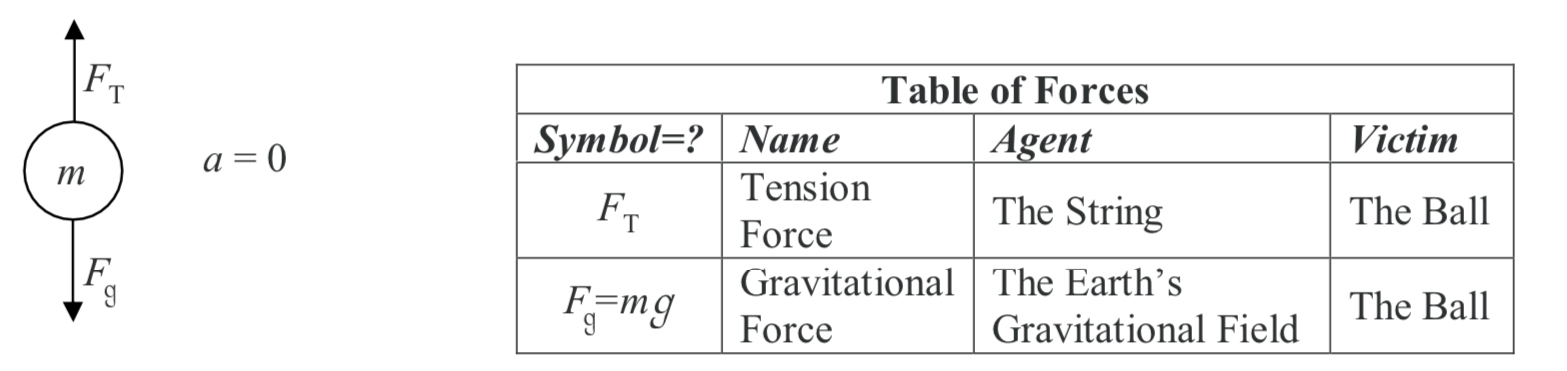
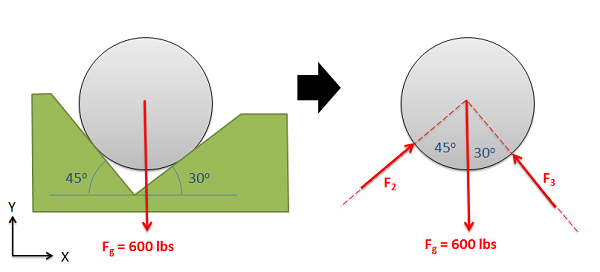
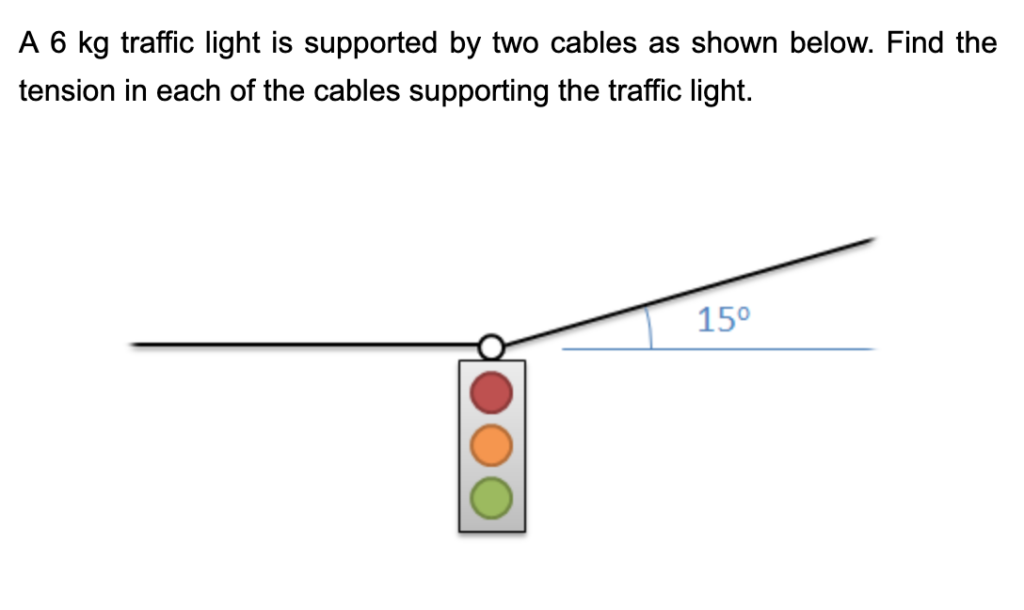
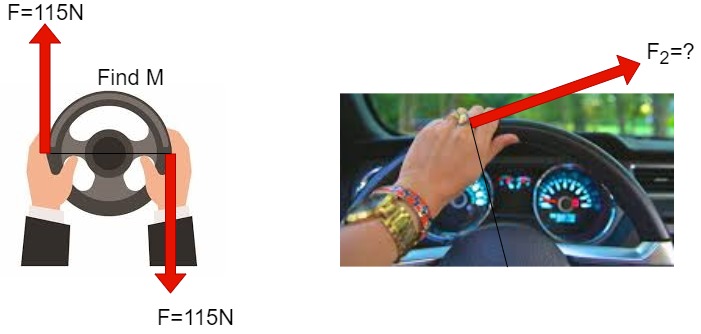
	</div>


	</div>
<div class="chapter standard with-subsections" id="chapter-free-body-diagrams-2" title="4.2 Rigid Body Free Body Diagrams">
	<div class="chapter-title-wrap">
		<p class="chapter-number">20</p>
		<h1 class="chapter-title">4.2 Rigid Body Free Body Diagrams</h1>
								</div>
	<div class="ugc chapter-ugc">
				
 <p>Following what we learned in Section 2.2 on particle Free-Body Diagrams (FBDs), this section will expand on that for rigid bodies. The biggest difference between a particle and a rigid body FBD is <em>where </em>the force is applied. In a rigid body FBD, you have to be precise about pointing the head of the force arrow to the location where it is applied. For example, if we wanted to make an FBD of you and me high-fiving, you would apply the force from your hand onto my hand, not at my center of mass.</p> <p>In this section, first we will learn how to do a FBD for a part, then we will look at how to model a system of multiple objects.</p> <h1 id="chapter-172-section-1" class="section-header">4.2.1 Part FBD</h1> <p>When modelling a single object using an FBD, you are simplifying a complex problem into specific forces using arrows and an object floating in space. The floor becomes a normal force arrow and a frictional force arrow. Pushing or pulling on an object becomes an applied force with the arrow pointing to or from (pushing or pulling) the location where the pushing or pulling occurs. Remember the rules from section 2.2 still apply:</p> <ul><li><span>Add coordinate frame</span> <em>(which way is positive x and positive y?)</em></li> <li><span>Replace surfaces with forces </span><em>(floor, hand, and objects touching it become arrows)</em></li> <li><span>Point forces in the correct direction </span><em>(the head of the arrow points to where the force acts. F<sub>G</sub> acts down)<br> </em></li> <li><span>Use unique (different) names </span><em>(be sure to name each force with a different name).<br> </em></li> </ul> <div><p>Here are some tips to keep in mind about each of the forces:</p> </div> <ul><li>Gravity acts on every particle in an object. Because we don’t want a million little arrows on the object, we sum the effect of gravity at the center of mass. This is also because we generally know the total mass of something and where that occurs on an object (often at the geometric center), so we concentrate the force of gravity at this center of mass.</li> <li>Normal forces always act <span><em>perpendicular to the surface</em></span>, so if the ground is at an angle, then the normal force acts 90 degrees from that angle (perpendicular).</li> <li>Frictional forces act <span><em>parallel to the plane</em></span> between the two surfaces. This makes it a shear force, which we’ll look at in Chapter 6.</li> <li>Friction always <em><span>opposes motion</span>,</em> a fact that will be very important in your dynamics class.</li> <li>Spring force is often shown as negative because the force acts in the opposite direction of the motion travelled. In application, you set the direction of the frictional force to match if it is pushing or pulling.</li> <li>Applied forces (and moments), such as distributed loads, motors, pushing on an object, tension, etc.</li> </ul> <p>The steps to make an FBD are:</p> <ol><li>Draw shape</li> <li>Add coordinate frame</li> <li>Replace forces with arrows</li> <li>Label each force uniquely</li> </ol> <p>To model a book being pushed across the table, you would apply the following forces at the following locations (see image below)</p> <ul><li>The normal force on the bottom of the book (green arrow)</li> <li>The frictional force running along the bottom surface between the book and table (yellow arrow)</li> <li>The gravitational force acting at the center of mass (pink arrow)</li> <li>any applied force at the point of application, such as your hand pushing on the book (blue arrow)</li> </ul> <p><img src="http://pressbooks.library.upei.ca/statics/wp-content/uploads/sites/56/2021/03/Screen-Shot-2021-08-22-at-2.48.24-PM.png" alt="Book with applied force right, friction left, weight down, and normal force up." class="aligncenter wp-image-1247" width="433" height="356" srcset="https://pressbooks.library.upei.ca/statics/wp-content/uploads/sites/56/2021/03/Screen-Shot-2021-08-22-at-2.48.24-PM.png 538w, https://pressbooks.library.upei.ca/statics/wp-content/uploads/sites/56/2021/03/Screen-Shot-2021-08-22-at-2.48.24-PM-300x246.png 300w, https://pressbooks.library.upei.ca/statics/wp-content/uploads/sites/56/2021/03/Screen-Shot-2021-08-22-at-2.48.24-PM-65x53.png 65w, https://pressbooks.library.upei.ca/statics/wp-content/uploads/sites/56/2021/03/Screen-Shot-2021-08-22-at-2.48.24-PM-225x185.png 225w, https://pressbooks.library.upei.ca/statics/wp-content/uploads/sites/56/2021/03/Screen-Shot-2021-08-22-at-2.48.24-PM-350x288.png 350w" sizes="auto, (max-width: 433px) 100vw, 433px" title=""></p> <p>If instead, the book were being pulled by a string, the image would be the same, but the applied force and frictional force would change direction (because friction always opposes motion).</p> <p><img src="http://pressbooks.library.upei.ca/statics/wp-content/uploads/sites/56/2021/03/Screen-Shot-2021-08-22-at-2.55.32-PM.png" alt="Book with applied force left, friction right, weight down, and normal force up." class="aligncenter wp-image-1248" width="405" height="312" srcset="https://pressbooks.library.upei.ca/statics/wp-content/uploads/sites/56/2021/03/Screen-Shot-2021-08-22-at-2.55.32-PM.png 538w, https://pressbooks.library.upei.ca/statics/wp-content/uploads/sites/56/2021/03/Screen-Shot-2021-08-22-at-2.55.32-PM-300x231.png 300w, https://pressbooks.library.upei.ca/statics/wp-content/uploads/sites/56/2021/03/Screen-Shot-2021-08-22-at-2.55.32-PM-65x50.png 65w, https://pressbooks.library.upei.ca/statics/wp-content/uploads/sites/56/2021/03/Screen-Shot-2021-08-22-at-2.55.32-PM-225x173.png 225w, https://pressbooks.library.upei.ca/statics/wp-content/uploads/sites/56/2021/03/Screen-Shot-2021-08-22-at-2.55.32-PM-350x269.png 350w" sizes="auto, (max-width: 405px) 100vw, 405px" title=""></p> <div class="textbox"><p>A free body diagram is a tool used to solve engineering mechanics problems. As the name suggests, the purpose of the diagram is to “free” the body from all other objects and surfaces around it so that it can be studied in isolation. We will also draw in any forces or moments acting on the body, including those forces and moments exerted by the surrounding bodies and surfaces that we removed.</p> <p>The diagram below shows a ladder supporting a person and the free body diagram of that ladder. As you can see, the ladder is separated from all other objects and all forces acting on the ladder are drawn in with key dimensions and angles shown.</p> <div class="wp-caption aligncenter" id="attachment_2729" aria-describedby="caption-attachment-2729" style="width: 475px"><img src="http://pressbooks.library.upei.ca/statics/wp-content/uploads/sites/56/2021/03/Screenshot-2025-07-16-232044-300x215.png" alt="A ladder leaning on a wall with a person on it; the free body diagram shows all forces acting on the ladder." class="wp-image-2729" width="475" height="340" srcset="https://pressbooks.library.upei.ca/statics/wp-content/uploads/sites/56/2021/03/Screenshot-2025-07-16-232044-300x215.png 300w, https://pressbooks.library.upei.ca/statics/wp-content/uploads/sites/56/2021/03/Screenshot-2025-07-16-232044-65x47.png 65w, https://pressbooks.library.upei.ca/statics/wp-content/uploads/sites/56/2021/03/Screenshot-2025-07-16-232044-225x162.png 225w, https://pressbooks.library.upei.ca/statics/wp-content/uploads/sites/56/2021/03/Screenshot-2025-07-16-232044-350x251.png 350w, https://pressbooks.library.upei.ca/statics/wp-content/uploads/sites/56/2021/03/Screenshot-2025-07-16-232044.png 769w" sizes="auto, (max-width: 475px) 100vw, 475px" title=""><div class="wp-caption-text" id="caption-attachment-2729">A ladder with a man standing on it is shown on the left. Assuming friction only at the base, a free body diagram of the ladder is shown on the right.</div></div> <p>The first step in solving most mechanics problems will be to construct a free-body diagram. This simplified diagram will allow us to more easily write out the equilibrium equations for statics or strengths of materials problems, or the equations of motion for dynamics problems.</p> <p>To construct the diagram, we will use the following process.</p> <ol><li>First, draw the body being analyzed, separated from all other surrounding bodies and surfaces. Pay close attention to the boundary, identifying what is part of the body and what is part of the surroundings.</li> <li>Second, draw in all<span>&nbsp;</span><strong>external</strong><span>&nbsp;</span>forces and moments acting directly on the body. Do not include any forces or moments that do not directly act on the body being analyzed. Do not include any forces that are<span>&nbsp;</span><strong>internal</strong><span>&nbsp;</span>to the body being analyzed. Some common types of forces seen in mechanics problems are: <ul><li><strong>Gravitational Forces:</strong><span>&nbsp;</span>Unless otherwise noted, the mass of an object will result in a gravitational weight force applied to that body. This weight is usually given in pounds in the English system, and is modelled as 9.81 (g) times the mass of the body in kilograms for the metric system (resulting in a weight in Newtons). This force will always point down towards the center of the Earth and act on the center of mass of the body.<br> <div class="wp-caption alignnone" id="attachment_2730" aria-describedby="caption-attachment-2730" style="width: 507px"><img src="http://pressbooks.library.upei.ca/statics/wp-content/uploads/sites/56/2021/03/Screenshot-2025-07-16-232351-300x116.png" alt="Two boxes showing gravity acting downward at the center of mass." class="wp-image-2730" width="507" height="196" srcset="https://pressbooks.library.upei.ca/statics/wp-content/uploads/sites/56/2021/03/Screenshot-2025-07-16-232351-300x116.png 300w, https://pressbooks.library.upei.ca/statics/wp-content/uploads/sites/56/2021/03/Screenshot-2025-07-16-232351-65x25.png 65w, https://pressbooks.library.upei.ca/statics/wp-content/uploads/sites/56/2021/03/Screenshot-2025-07-16-232351-225x87.png 225w, https://pressbooks.library.upei.ca/statics/wp-content/uploads/sites/56/2021/03/Screenshot-2025-07-16-232351-350x136.png 350w, https://pressbooks.library.upei.ca/statics/wp-content/uploads/sites/56/2021/03/Screenshot-2025-07-16-232351.png 700w" sizes="auto, (max-width: 507px) 100vw, 507px" title=""><div class="wp-caption-text" id="caption-attachment-2730">Gravitational forces always act downward on the center of mass.</div></div> <ul><li><strong style="text-align: initial;font-size: 1em">Normal Forces (or Reaction Forces):&nbsp;</strong><span style="text-align: initial;font-size: 1em">Every object in direct contact with the body will exert a normal force on that body, which prevents the two objects from occupying the same space at the same time. Note that only objects in direct contact can exert normal forces on the body.</span> <ul><li>An object in contact with another object or surface will experience a normal force that is perpendicular (hence normal) to the surfaces in contact.<br> <div class="wp-caption aligncenter" id="attachment_2731" aria-describedby="caption-attachment-2731" style="width: 411px"><img src="http://pressbooks.library.upei.ca/statics/wp-content/uploads/sites/56/2021/03/Screenshot-2025-07-16-232701-300x159.png" alt="Barrel in a hand truck with normal forces at two contact points." class="wp-image-2731" width="411" height="218" srcset="https://pressbooks.library.upei.ca/statics/wp-content/uploads/sites/56/2021/03/Screenshot-2025-07-16-232701-300x159.png 300w, https://pressbooks.library.upei.ca/statics/wp-content/uploads/sites/56/2021/03/Screenshot-2025-07-16-232701-65x35.png 65w, https://pressbooks.library.upei.ca/statics/wp-content/uploads/sites/56/2021/03/Screenshot-2025-07-16-232701-225x120.png 225w, https://pressbooks.library.upei.ca/statics/wp-content/uploads/sites/56/2021/03/Screenshot-2025-07-16-232701-350x186.png 350w, https://pressbooks.library.upei.ca/statics/wp-content/uploads/sites/56/2021/03/Screenshot-2025-07-16-232701.png 610w" sizes="auto, (max-width: 411px) 100vw, 411px" title=""><div class="wp-caption-text" id="caption-attachment-2731">Normal forces always act perpendicular to the surfaces in contact. The barrel in the hand truck shown on the left has a normal force at each contact point.</div></div> </li> <li>Joints or connections between bodies can also cause reaction forces or moments, and we will have one force or moment for each type of motion or rotation the connection prevents.<br> <div class="wp-caption aligncenter" id="attachment_2732" aria-describedby="caption-attachment-2732" style="width: 451px"><img src="http://pressbooks.library.upei.ca/statics/wp-content/uploads/sites/56/2021/03/Screenshot-2025-07-16-232832-300x252.png" alt="Three types of supports showing roller, pin, and fixed connections with force and moment arrows." class="wp-image-2732" width="451" height="379" srcset="https://pressbooks.library.upei.ca/statics/wp-content/uploads/sites/56/2021/03/Screenshot-2025-07-16-232832-300x252.png 300w, https://pressbooks.library.upei.ca/statics/wp-content/uploads/sites/56/2021/03/Screenshot-2025-07-16-232832-65x55.png 65w, https://pressbooks.library.upei.ca/statics/wp-content/uploads/sites/56/2021/03/Screenshot-2025-07-16-232832-225x189.png 225w, https://pressbooks.library.upei.ca/statics/wp-content/uploads/sites/56/2021/03/Screenshot-2025-07-16-232832-350x294.png 350w, https://pressbooks.library.upei.ca/statics/wp-content/uploads/sites/56/2021/03/Screenshot-2025-07-16-232832.png 588w" sizes="auto, (max-width: 451px) 100vw, 451px" title=""><div class="wp-caption-text" id="caption-attachment-2732">The roller on the left allows for rotation and movement along the surface, but a normal force in the y direction prevents motion vertically. The pin joint in the center allows for rotation, but normal forces in the x and y directions prevent motion in all directions. The fixed connection on the right has a normal force preventing motion in all directions and a reaction moment preventing rotation.</div></div> </li> </ul> </li> <li><strong>Friction Forces:</strong> <span>Objects in direct contact with the body can also exert friction forces on the body, which will resist the two bodies sliding against one another. These forces will always be perpendicular to the surfaces in contact. Friction is the subject of an entire chapter in this book, but for simple scenarios, we usually assume rough or smooth surfaces.</span> <ul><li>For smooth surfaces, we assume that there is no friction force.</li> <li>For rough surfaces, we assume that the bodies will not slide relative to one another, no matter what. In this case, the friction force is always just large enough to prevent this sliding.<br> <div class="wp-caption aligncenter" id="attachment_2733" aria-describedby="caption-attachment-2733" style="width: 418px"><img src="http://pressbooks.library.upei.ca/statics/wp-content/uploads/sites/56/2021/03/Screenshot-2025-07-16-233040-300x216.png" alt="Comparison of forces on smooth and rough surfaces." class="wp-image-2733" width="418" height="301" srcset="https://pressbooks.library.upei.ca/statics/wp-content/uploads/sites/56/2021/03/Screenshot-2025-07-16-233040-300x216.png 300w, https://pressbooks.library.upei.ca/statics/wp-content/uploads/sites/56/2021/03/Screenshot-2025-07-16-233040-65x47.png 65w, https://pressbooks.library.upei.ca/statics/wp-content/uploads/sites/56/2021/03/Screenshot-2025-07-16-233040-225x162.png 225w, https://pressbooks.library.upei.ca/statics/wp-content/uploads/sites/56/2021/03/Screenshot-2025-07-16-233040-350x252.png 350w, https://pressbooks.library.upei.ca/statics/wp-content/uploads/sites/56/2021/03/Screenshot-2025-07-16-233040.png 608w" sizes="auto, (max-width: 418px) 100vw, 418px" title=""><div class="wp-caption-text" id="caption-attachment-2733">For a smooth surface, we assume only a normal force perpendicular to the surface. For a rough surface, we assume normal and friction forces are present.</div></div> </li> </ul> </li> <li><strong>Tension in Cables:</strong><span>&nbsp;</span>Cables, wires or ropes attached to the body will exert a tension force on the body in the direction of the cable. These forces will always pull on the body, as ropes, cables and other flexible tethers cannot be used for pushing.<br> <div class="wp-caption aligncenter" id="attachment_2734" aria-describedby="caption-attachment-2734" style="width: 412px"><img src="http://pressbooks.library.upei.ca/statics/wp-content/uploads/sites/56/2021/03/Screenshot-2025-07-16-233256-300x107.png" alt="Traffic light hanging by two angled cables with labeled tension forces." class="wp-image-2734" width="412" height="147" srcset="https://pressbooks.library.upei.ca/statics/wp-content/uploads/sites/56/2021/03/Screenshot-2025-07-16-233256-300x107.png 300w, https://pressbooks.library.upei.ca/statics/wp-content/uploads/sites/56/2021/03/Screenshot-2025-07-16-233256-65x23.png 65w, https://pressbooks.library.upei.ca/statics/wp-content/uploads/sites/56/2021/03/Screenshot-2025-07-16-233256-225x80.png 225w, https://pressbooks.library.upei.ca/statics/wp-content/uploads/sites/56/2021/03/Screenshot-2025-07-16-233256-350x124.png 350w, https://pressbooks.library.upei.ca/statics/wp-content/uploads/sites/56/2021/03/Screenshot-2025-07-16-233256.png 684w" sizes="auto, (max-width: 412px) 100vw, 412px" title=""><div class="wp-caption-text" id="caption-attachment-2734">The tension force in cables always acts along the direction of the cable and will always be a pulling force.</div></div> </li> <li>The above forces are the most common, but other forces such as pressure from fluids, spring forces and magnetic forces may exist and may act on the body.</li> </ul> </li> </ul> </li> <li>Once the forces are identified and added to the free body diagram, the last step is to label any key dimensions and angles on the diagram.</li> </ol> <p>Source: Engineering Mechanics, Jacob Moore, et al. <a href="http://mechanicsmap.psu.edu/websites/1_mechanics_basics/1-6_free_body_diagrams/free_body_diagrams.html" data-url="http://mechanicsmap.psu.edu/websites/1_mechanics_basics/1-6_free_body_diagrams/free_body_diagrams.html">http://wwhttp://mechanicsmap.psu.edu/websites/1_mechanics_basics/1-6_free_body_diagrams/free_body_diagrams.htmlw.oercommons.org/courses/mechanics-map-open-mechanics-textbook/view</a></p> </div> <p>&nbsp;</p> <h1 id="chapter-172-section-2" class="section-header">4.2.2 System FBD</h1> <p>A system free-body diagram is composed of multiple parts, so you can have multiple ‘levels’ to consider: the system level with all objects on the same FBD, and a part FBD for each individual part. This is especially helpful if you have more unknowns than equations when using the equilibrium equations, so you can find more information by splitting the system up into individual parts.</p> <p>For the system FBD, you look at the parts combined together and add only the external forces (gravity, applied, normal, frictional, spring). When you look at each part separately, you now have to include the interaction between the objects, replacing a part with forces (generally 2 forces: vertical and horizontal forces).</p> <p>For example, if there are 2 books stacked on top of each other, you now need 3 FBDs:</p> <ol><li>a system-level FBD with both books,</li> <li>a part FBD for the bottom book, with the top book replaced by arrows (forces)</li> <li>a part FBD for the top boo,k with the bottom book replaced by arrows (forces)</li> </ol> <p><img src="http://pressbooks.library.upei.ca/statics/wp-content/uploads/sites/56/2021/03/Screen-Shot-2021-08-22-at-5.06.07-PM-1024x665.png" alt="Two stacked books with free-body diagrams showing system and individual forces acting on each book." class="aligncenter wp-image-1262" width="833" height="541" srcset="https://pressbooks.library.upei.ca/statics/wp-content/uploads/sites/56/2021/03/Screen-Shot-2021-08-22-at-5.06.07-PM-1024x665.png 1024w, https://pressbooks.library.upei.ca/statics/wp-content/uploads/sites/56/2021/03/Screen-Shot-2021-08-22-at-5.06.07-PM-300x195.png 300w, https://pressbooks.library.upei.ca/statics/wp-content/uploads/sites/56/2021/03/Screen-Shot-2021-08-22-at-5.06.07-PM-768x499.png 768w, https://pressbooks.library.upei.ca/statics/wp-content/uploads/sites/56/2021/03/Screen-Shot-2021-08-22-at-5.06.07-PM-65x42.png 65w, https://pressbooks.library.upei.ca/statics/wp-content/uploads/sites/56/2021/03/Screen-Shot-2021-08-22-at-5.06.07-PM-225x146.png 225w, https://pressbooks.library.upei.ca/statics/wp-content/uploads/sites/56/2021/03/Screen-Shot-2021-08-22-at-5.06.07-PM-350x227.png 350w, https://pressbooks.library.upei.ca/statics/wp-content/uploads/sites/56/2021/03/Screen-Shot-2021-08-22-at-5.06.07-PM.png 1238w" sizes="auto, (max-width: 833px) 100vw, 833px" title=""></p> <p>To make a system FBD:</p> <ol><li>Draw system FBD using unique consistent labels (ie, a letter or number per part) <ul><li>The system should be floating in space with no surface (such as the floor)</li> <li>Include coordinate frame</li> <li><span style="text-decoration: underline"><em>Use only external forces</em> </span>on system FBD (gravity, applied, normal, frictional, spring).</li> <li>DO NOT include internal forces</li> <li>It is especially important to use unique labels, so the top book forces are labelled 1, and the bottom book forces are labelled 2 (or T for top and B for bottom, or A and B).</li> </ul> </li> <li>Draw a FBD for each part separately &amp; coordinate frame with equal and opposite arrows for internal system forces</li> </ol> <ol><li style="list-style-type: none"><ul><li>The part should be floating in space with no surfaces or other objects</li> <li>Include a coordinate frame (yes, again! This is to ensure you didn’t rotate the object).</li> <li><span style="text-decoration: underline">Copy the external forces </span>onto the part FBD from the system FBD with the identical labels and arrow directions</li> <li><span style="text-decoration: underline"><em>Now add internal forces,</em></span> replacing the other object with force arrows (red arrows)</li> <li>When you draw the second part FBD, follow the above bullets for the second object (with label 2 instead of 1, copying the system-level external force labels). Note, though, that you use the same labels for the internal forces from the first part FBD, but the direction is reversed (left becomes right and up becomes down). Following Newton’s laws, the objects exert equal and opposite forces on each other, and should cancel out at the system level, so they have the same label (magnitude) and opposite directions.</li> </ul> </li> </ol> <p>Some tips:</p> <ul><li>Differentiate one object from the other through the labels, using either a letter or a number for each part. These same labels go on the system-level FBD (except for the internal labels).</li> <li>Use the same labels between the part and system FBDs for external forces. Don’t change the label – that will make the equations impossible to solve and look like you have more unknowns.</li> <li>Use the same unique labels between the internal forces for the part FBDs, but in the opposite direction.</li> <li>If you know the location of the center of mass, you could combine the gravitational forces into 1 system level gravitational force. You could also model the gravitational force into one force per part acting at the center of mass for each object. This is the better method if you have to separate the objects to do the calculations.</li> </ul> <p>&nbsp;</p> <h1 id="chapter-172-section-3" class="section-header">4.2.3 Examples</h1> <p>Here are some examples from: <a href="http://mechanicsmap.psu.edu/websites/1_mechanics_basics/1-6_free_body_diagrams/free_body_diagrams.html" data-url="http://mechanicsmap.psu.edu/websites/1_mechanics_basics/1-6_free_body_diagrams/free_body_diagrams.html">http://mechanicsmap.psu.edu/websites/1_mechanics_basics/1-6_free_body_diagrams/free_body_diagrams.html</a></p> <h2>Example 1: Part FBD</h2> <div class="textbox"><p>The car shown below is moving and then slams on the brakes, locking up all four wheels. The distance between the two wheels is 8 feet, and the center of mass is 3 feet behind and 2.5 feet above the point of contact between the front wheel and the ground. Draw a free-body diagram of the car as it comes to a stop.</p> <p><img src="http://pressbooks.library.upei.ca/statics/wp-content/uploads/sites/56/2021/03/P3.png" alt="A red car" class="aligncenter wp-image-1258 size-full" width="500" height="213" srcset="https://pressbooks.library.upei.ca/statics/wp-content/uploads/sites/56/2021/03/P3.png 500w, https://pressbooks.library.upei.ca/statics/wp-content/uploads/sites/56/2021/03/P3-300x128.png 300w, https://pressbooks.library.upei.ca/statics/wp-content/uploads/sites/56/2021/03/P3-65x28.png 65w, https://pressbooks.library.upei.ca/statics/wp-content/uploads/sites/56/2021/03/P3-225x96.png 225w, https://pressbooks.library.upei.ca/statics/wp-content/uploads/sites/56/2021/03/P3-350x149.png 350w" sizes="auto, (max-width: 500px) 100vw, 500px" title=""></p> <p><img src="http://pressbooks.library.upei.ca/statics/wp-content/uploads/sites/56/2021/03/Screenshot-2025-05-27-114545-300x291.png" alt="A free-body diagram of the problem." width="556" height="540" class="aligncenter wp-image-2384" srcset="https://pressbooks.library.upei.ca/statics/wp-content/uploads/sites/56/2021/03/Screenshot-2025-05-27-114545-300x291.png 300w, https://pressbooks.library.upei.ca/statics/wp-content/uploads/sites/56/2021/03/Screenshot-2025-05-27-114545-65x63.png 65w, https://pressbooks.library.upei.ca/statics/wp-content/uploads/sites/56/2021/03/Screenshot-2025-05-27-114545-225x218.png 225w, https://pressbooks.library.upei.ca/statics/wp-content/uploads/sites/56/2021/03/Screenshot-2025-05-27-114545-350x339.png 350w" sizes="auto, (max-width: 556px) 100vw, 556px" title=""></p> <p>Source: Engineering Mechanics, Jacob Moore et al., <a href="http://mechanicsmap.psu.edu/websites/1_mechanics_basics/1-6_free_body_diagrams/pdf/P3.pdf" data-url="http://mechanicsmap.psu.edu/websites/1_mechanics_basics/1-6_free_body_diagrams/pdf/P3.pdf">http://mechanicsmap.psu.edu/websites/1_mechanics_basics/1-6_free_body_diagrams/pdf/P3.pdf</a></p> </div> <p>&nbsp;</p> <h3>Example 2: Part FBD (a beam)</h3> <div class="textbox"><p><img src="http://pressbooks.library.upei.ca/statics/wp-content/uploads/sites/56/2021/03/Screen-Shot-2021-08-22-at-6.27.24-PM-1024x756.png" alt="Beams with one or two people standing on them and their corresponding free-body diagrams showing support and applied forces." class="aligncenter wp-image-1281 size-large" width="1024" height="756" srcset="https://pressbooks.library.upei.ca/statics/wp-content/uploads/sites/56/2021/03/Screen-Shot-2021-08-22-at-6.27.24-PM-1024x756.png 1024w, https://pressbooks.library.upei.ca/statics/wp-content/uploads/sites/56/2021/03/Screen-Shot-2021-08-22-at-6.27.24-PM-300x222.png 300w, https://pressbooks.library.upei.ca/statics/wp-content/uploads/sites/56/2021/03/Screen-Shot-2021-08-22-at-6.27.24-PM-768x567.png 768w, https://pressbooks.library.upei.ca/statics/wp-content/uploads/sites/56/2021/03/Screen-Shot-2021-08-22-at-6.27.24-PM-65x48.png 65w, https://pressbooks.library.upei.ca/statics/wp-content/uploads/sites/56/2021/03/Screen-Shot-2021-08-22-at-6.27.24-PM-225x166.png 225w, https://pressbooks.library.upei.ca/statics/wp-content/uploads/sites/56/2021/03/Screen-Shot-2021-08-22-at-6.27.24-PM-350x259.png 350w, https://pressbooks.library.upei.ca/statics/wp-content/uploads/sites/56/2021/03/Screen-Shot-2021-08-22-at-6.27.24-PM.png 1186w" sizes="auto, (max-width: 1024px) 100vw, 1024px" title=""></p> <p>Image adapted. Source: Engineering Mechanics, Jacob Moore, et al. <a href="http://mechanicsmap.psu.edu/websites/4_statically_equivalent_systems/4-1_statically_equivalent_systems/images/equivalentexample.png" data-url="http://mechanicsmap.psu.edu/websites/4_statically_equivalent_systems/4-1_statically_equivalent_systems/images/equivalentexample.png">http://mechanicsmap.psu.edu/websites/4_statically_equivalent_systems/4-1_statically_equivalent_systems/images/equivalentexample.png</a></p> </div> <p>&nbsp;</p> <h3>Example 3: System FBD</h3> <div class="textbox"><p>Two equally sized barrels are being transported in a hand truck as shown below. Draw a free-body diagram of each of the two barrels.</p> <p>&nbsp;</p> <p><img src="http://pressbooks.library.upei.ca/statics/wp-content/uploads/sites/56/2021/03/P2.png" alt="Two stacked barrels on a tilted hand truck at a 30° angle. Barrel A weighs 150 lbs, and Barrel B weighs 200 lbs." class="aligncenter wp-image-1260 size-full" width="369" height="362" srcset="https://pressbooks.library.upei.ca/statics/wp-content/uploads/sites/56/2021/03/P2.png 369w, https://pressbooks.library.upei.ca/statics/wp-content/uploads/sites/56/2021/03/P2-300x294.png 300w, https://pressbooks.library.upei.ca/statics/wp-content/uploads/sites/56/2021/03/P2-65x64.png 65w, https://pressbooks.library.upei.ca/statics/wp-content/uploads/sites/56/2021/03/P2-225x221.png 225w, https://pressbooks.library.upei.ca/statics/wp-content/uploads/sites/56/2021/03/P2-350x343.png 350w" sizes="auto, (max-width: 369px) 100vw, 369px" title=""></p> <p>Source: Engineering Mechanics, Jacob Moore et al., <a href="http://mechanicsmap.psu.edu/websites/1_mechanics_basics/1-6_free_body_diagrams/pdf/P2.pdf" data-url="http://mechanicsmap.psu.edu/websites/1_mechanics_basics/1-6_free_body_diagrams/pdf/P2.pdf">http://mechanicsmap.psu.edu/websites/1_mechanics_basics/1-6_free_body_diagrams/pdf/P2.pdf</a></p> </div> <p>&nbsp;</p> <p>External forces are in green, pink, and yellow. Internal forces between the cart and barrels (C and A/B) in red and between the barrels (A &amp; B) in blue. Notice the matching labels for internal forces but opposing directions. Notice that the coordinate frame has been rotated consistently in all of the FBDs.</p> <p><img src="http://pressbooks.library.upei.ca/statics/wp-content/uploads/sites/56/2021/03/Screen-Shot-2021-08-22-at-5.52.55-PM-1024x726.png" alt="System FBD and Part FBD" class="aligncenter wp-image-1265 size-large" width="1024" height="726" srcset="https://pressbooks.library.upei.ca/statics/wp-content/uploads/sites/56/2021/03/Screen-Shot-2021-08-22-at-5.52.55-PM-1024x726.png 1024w, https://pressbooks.library.upei.ca/statics/wp-content/uploads/sites/56/2021/03/Screen-Shot-2021-08-22-at-5.52.55-PM-300x213.png 300w, https://pressbooks.library.upei.ca/statics/wp-content/uploads/sites/56/2021/03/Screen-Shot-2021-08-22-at-5.52.55-PM-768x545.png 768w, https://pressbooks.library.upei.ca/statics/wp-content/uploads/sites/56/2021/03/Screen-Shot-2021-08-22-at-5.52.55-PM-1536x1089.png 1536w, https://pressbooks.library.upei.ca/statics/wp-content/uploads/sites/56/2021/03/Screen-Shot-2021-08-22-at-5.52.55-PM-2048x1453.png 2048w, https://pressbooks.library.upei.ca/statics/wp-content/uploads/sites/56/2021/03/Screen-Shot-2021-08-22-at-5.52.55-PM-65x46.png 65w, https://pressbooks.library.upei.ca/statics/wp-content/uploads/sites/56/2021/03/Screen-Shot-2021-08-22-at-5.52.55-PM-225x160.png 225w, https://pressbooks.library.upei.ca/statics/wp-content/uploads/sites/56/2021/03/Screen-Shot-2021-08-22-at-5.52.55-PM-350x248.png 350w" sizes="auto, (max-width: 1024px) 100vw, 1024px" title=""></p> <p>&nbsp;</p> <div class="textbox textbox--key-takeaways"><div class="textbox__header"><p class="textbox__title">Key Takeaways</p> </div> <div class="textbox__content"><p><em>Basically,</em>&nbsp;A part free-body diagrams (FBDs) give you a way to model complicated problems in a simple way with arrows. Systems FBDs allow you to combine objects and analyze them separately.</p> <p><em>Application</em>: A bat swinging could be modelled as a part FBD with gravity and multiple applied forces (hands on one end and the ball on the other). You could model the moment the bat and ball are touching using a system FBD.</p> <p><em>Looking ahead</em>: You’ll use an FBD in every step 2 in nearly every homework problem. These are especially helpful with Equilibrium Equations in the next section.</p> </div> </div> <p>&nbsp;</p> 
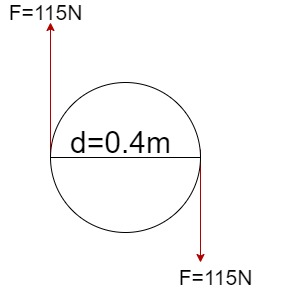
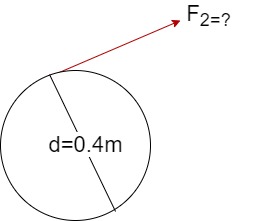
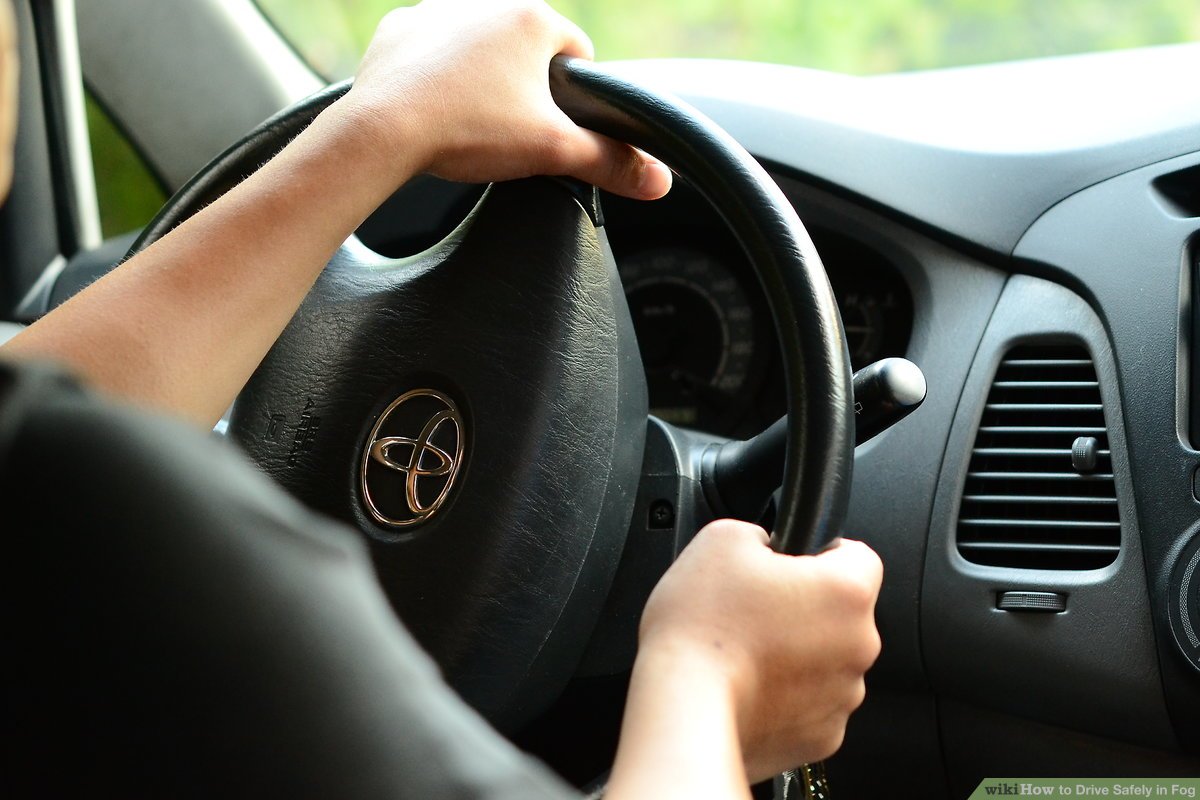
	</div>


	</div>
<div class="chapter standard with-subsections" id="chapter-rigid-body-equilibrium" title="4.3 Rigid Body Equilibrium Equations">
	<div class="chapter-title-wrap">
		<p class="chapter-number">21</p>
		<h1 class="chapter-title">4.3 Rigid Body Equilibrium Equations</h1>
								</div>
	<div class="ugc chapter-ugc">
				 <p>We use the equilibrium equations to calculate any unknown forces &amp; moments using the known forces and values, and the following equations:</p> <p>The particle equilibrium equations were covered in section 2.3. These are:</p> <p>$$<br /> \Sigma F_{x}=0, \Sigma F_{y}=0, \Sigma F_{z}=0<br /> $$</p> <p>Now for a rigid body where forces are analyzed at different points on a body, we can take moments into account. There are 3 equations for 2d and 4 equations for 3d:</p> <p>Rigid Body-Two Dimensions<br /> $$<br /> \Sigma F_{x}=0, \Sigma F_{y}=0, \Sigma M_{O}=0<br /> $$<br /> Rigid Body-Three Dimensions<br /> $$<br /> \begin{gathered}<br /> \Sigma F_{x}=0, \Sigma F_{y}=0, \Sigma F_{z}=0 \\<br /> \Sigma M_{x^{\prime}}=0, \Sigma M_{y^{\prime}}=0, \Sigma M_{z^{\prime}}=0<br /> \end{gathered}<br /> $$</p> <p>Because these are static bodies, the right side of the equations equals 0. In dynamics, they will equal the mass times the acceleration for translation and rotation.</p> <div class="textbox"><p>For a<span>&nbsp;</span><strong>rigid body</strong><span>&nbsp;</span>in static equilibrium, that is, a non-deformable body where forces are not concurrent, the sum of both the<span>&nbsp;</span><strong>forces</strong><span>&nbsp;</span>and the<span>&nbsp;</span><strong>moments</strong><span>&nbsp;</span>acting on the body must be equal to zero. The addition of moments (as opposed to particles, where we only looked at the forces) adds another set of possible equilibrium equations, allowing us to solve for more unknowns as compared to particle problems.</p> <p>Moments, like forces, are vectors. This means that our vector equation needs to be broken down into scalar components before we can solve the equilibrium equations. In a two-dimensional problem, the body can only have clockwise or counterclockwise rotation (corresponding to rotations about the z-axis). This means that a rigid body in a two-dimensional problem has three possible equilibrium equations; that is, the sum of force components in the x and y directions, and the moments about the z axis. The sum of each of these will be equal to zero.</p> <p><span>For a two-dimensional problem, we break our one vector force equation into two scalar component equations.</span></p> <p style="text-align: center">$$\sum\vec F=0\\\sum F_x=0\:\sum F_y=0$$</p> <p><span>The one moment vector equation becomes a single moment scalar equation.</span></p> <p style="text-align: center">$$\sum\vec M=0\\\sum M_z=0$$</p> <p>If we look at a three-dimensional problem, we will increase the number of possible equilibrium equations to six. There are three equilibrium equations for force, where the sum of the components in the x, y, and z directions must be equal to zero. The body may also have moments about each of the three axes. The second set of three equilibrium equations states that the sum of the moment components about the x, y, and z axes must also be equal to zero.</p> <p>We break the forces into three component equations</p> <p style="text-align: center">$$\sum\vec F=0\\\sum F_x=0\:\sum F_y=0\:\sum F_z=0$$</p> <p><span>We break the moments into three component equations</span></p> <p style="text-align: center">$$\sum\vec M=0\\\sum M_x=0\:\sum M_y=0\:\sum M_z=0$$</p> <h2>Finding the Equilibrium Equations:</h2> <p>As with particles, the first step in finding the equilibrium equations is to draw a free-body diagram of the body being analyzed. This diagram should show all the force vectors acting on the body. In the free body diagram, provide values for any of the known magnitudes, directions, and points of application for the force vectors and provide variable names for any unknowns (either magnitudes, directions, or distances).</p> <p>Next, you will need to choose the x, y, and z axes. These axes do need to be perpendicular to one another, but they do not necessarily have to be horizontal or vertical. If you choose coordinate axes that line up with some of your force vectors, you will simplify later analysis.</p> <p>Once you have chosen axes, you need to break down all of the force vectors into components along the x, y and z directions. Your first equation will be the sum of the magnitudes of the components in the x direction being equal to zero, the second equation will be the sum of the magnitudes of the components in the y direction being equal to zero, and the third (if you have a 3D problem) will be the sum of the magnitudes in the z direction being equal to zero.</p> <p>Next, you will need to come up with the moment equations. To do this, you will need to choose a point to take the moments about. Any point should work, but it is usually advantageous to choose a point that will decrease the number of unknowns in the equation. Remember that any force vector that travels through a given point will exert no moment about that point. To write out the moment equations, simply sum the moments exerted by each force (adding in pure moments shown in the diagram) about the given point and the given axis (x, y, or z) and set that sum equal to zero. All moments will be about the z-axis for two-dimensional problems, though moments can be about x, y and z axes for three-dimensional problems.</p> <p>Once you have your equilibrium equations, you can solve these equations for the unknowns. The number of unknowns that you will be able to solve for will again be the number of equations that you have.</p> <p>&nbsp;</p> <p>Source: Engineering Mechanics, Jacob Moore, et al. <a href="https://mechanicsmap.psu.edu/websites/3_equilibrium_rigid_body/3-6_equilibrium_analysis_rigid_body/equilibrium_analysis_rigid_body.html" data-url="https://mechanicsmap.psu.edu/websites/3_equilibrium_rigid_body/3-6_equilibrium_analysis_rigid_body/equilibrium_analysis_rigid_body.html">Mechanics Map – Equilibrium Analysis for a Rigid Body</a></p> </div> <p>&nbsp;</p> <p>Here is a visual example of using the equilibrium equations:</p> <div class="wp-caption aligncenter" id="attachment_1283" aria-describedby="caption-attachment-1283" style="width: 735px"><img src="http://pressbooks.library.upei.ca/statics/wp-content/uploads/sites/56/2021/03/equivalentexample-1.png" alt="Two load distribution diagrams on a beam: one with a single 200 lb person at center, and one with two 100 lb people evenly spaced at center." class="wp-image-1283" width="735" height="527" srcset="https://pressbooks.library.upei.ca/statics/wp-content/uploads/sites/56/2021/03/equivalentexample-1.png 600w, https://pressbooks.library.upei.ca/statics/wp-content/uploads/sites/56/2021/03/equivalentexample-1-300x215.png 300w, https://pressbooks.library.upei.ca/statics/wp-content/uploads/sites/56/2021/03/equivalentexample-1-65x47.png 65w, https://pressbooks.library.upei.ca/statics/wp-content/uploads/sites/56/2021/03/equivalentexample-1-225x161.png 225w, https://pressbooks.library.upei.ca/statics/wp-content/uploads/sites/56/2021/03/equivalentexample-1-350x251.png 350w" sizes="auto, (max-width: 735px) 100vw, 735px" title="" /><div class="wp-caption-text" id="caption-attachment-1283">Source: Engineering Mechanics, Jacob Moore, et al. http://mechanicsmap.psu.edu/websites/4_statically_equivalent_systems/4-1_statically_equivalent_systems/images/equivalentexample.png</div></div> <p>If we only consider the y (vertical) direction, the 200 lbs pushing down on the beam must be balanced by the reaction forces pushing up. The two reaction forces are equivalent because the forces on top are balanced evenly between the reaction forces. If they are at different locations, we use the sum of the moments equation and the distances of the people to determine the size of the reaction forces.</p> <h3>Example 1:</h3> <div class="textbox"><h3></h3> <p>The car below has a mass of 1500 lbs with the center of mass 4 ft behind the front wheels of the car. What are the normal forces on the front and the back wheels of the car?</p> <p><img src="http://pressbooks.library.upei.ca/statics/wp-content/uploads/sites/56/2021/03/P1-1.png" alt="A car with few dimensions." class="aligncenter wp-image-1284" width="423" height="218" srcset="https://pressbooks.library.upei.ca/statics/wp-content/uploads/sites/56/2021/03/P1-1.png 400w, https://pressbooks.library.upei.ca/statics/wp-content/uploads/sites/56/2021/03/P1-1-300x155.png 300w, https://pressbooks.library.upei.ca/statics/wp-content/uploads/sites/56/2021/03/P1-1-65x33.png 65w, https://pressbooks.library.upei.ca/statics/wp-content/uploads/sites/56/2021/03/P1-1-225x116.png 225w, https://pressbooks.library.upei.ca/statics/wp-content/uploads/sites/56/2021/03/P1-1-350x180.png 350w" sizes="auto, (max-width: 423px) 100vw, 423px" title="" /></p> <p><img src="http://pressbooks.library.upei.ca/statics/wp-content/uploads/sites/56/2021/03/Screenshot-2025-05-27-125630-300x268.png" alt="Free-body diagram of a car with force equations used to solve front and back wheel reactions." width="524" height="468" class="aligncenter wp-image-2386" srcset="https://pressbooks.library.upei.ca/statics/wp-content/uploads/sites/56/2021/03/Screenshot-2025-05-27-125630-300x268.png 300w, https://pressbooks.library.upei.ca/statics/wp-content/uploads/sites/56/2021/03/Screenshot-2025-05-27-125630-768x686.png 768w, https://pressbooks.library.upei.ca/statics/wp-content/uploads/sites/56/2021/03/Screenshot-2025-05-27-125630-65x58.png 65w, https://pressbooks.library.upei.ca/statics/wp-content/uploads/sites/56/2021/03/Screenshot-2025-05-27-125630-225x201.png 225w, https://pressbooks.library.upei.ca/statics/wp-content/uploads/sites/56/2021/03/Screenshot-2025-05-27-125630-350x313.png 350w, https://pressbooks.library.upei.ca/statics/wp-content/uploads/sites/56/2021/03/Screenshot-2025-05-27-125630.png 809w" sizes="auto, (max-width: 524px) 100vw, 524px" title="" /></p> <p>Source: Engineering Mechanics, Jacob Moore et al., <a href="https://mechanicsmap.psu.edu/websites/3_equilibrium_rigid_body/3-6_equilibrium_analysis_rigid_body/pdf/P1.pdf" data-url="https://mechanicsmap.psu.edu/websites/3_equilibrium_rigid_body/3-6_equilibrium_analysis_rigid_body/pdf/P1.pdf">P1.pdf</a></p> </div> <h3>Example 2:</h3> <div class="textbox"><p>While sitting in a chair, a person exerts the forces in the diagram below. Determine all forces acting on the chair at points A and B. (Assume A is frictionless and B is a rough surface).</p> <p><img src="http://pressbooks.library.upei.ca/statics/wp-content/uploads/sites/56/2021/03/P5.png" alt="Chair with downward and rightward forces labeled, and dimensions marked." class="aligncenter wp-image-1286 size-full" width="333" height="437" srcset="https://pressbooks.library.upei.ca/statics/wp-content/uploads/sites/56/2021/03/P5.png 333w, https://pressbooks.library.upei.ca/statics/wp-content/uploads/sites/56/2021/03/P5-229x300.png 229w, https://pressbooks.library.upei.ca/statics/wp-content/uploads/sites/56/2021/03/P5-65x85.png 65w, https://pressbooks.library.upei.ca/statics/wp-content/uploads/sites/56/2021/03/P5-225x295.png 225w" sizes="auto, (max-width: 333px) 100vw, 333px" title="" /></p> <p><img src="http://pressbooks.library.upei.ca/statics/wp-content/uploads/sites/56/2021/03/Screen-Shot-2021-08-22-at-7.03.36-PM-939x1024.png" alt="Free body diagram and force calculations for a chair." class="aligncenter wp-image-1287" width="760" height="829" srcset="https://pressbooks.library.upei.ca/statics/wp-content/uploads/sites/56/2021/03/Screen-Shot-2021-08-22-at-7.03.36-PM-939x1024.png 939w, https://pressbooks.library.upei.ca/statics/wp-content/uploads/sites/56/2021/03/Screen-Shot-2021-08-22-at-7.03.36-PM-275x300.png 275w, https://pressbooks.library.upei.ca/statics/wp-content/uploads/sites/56/2021/03/Screen-Shot-2021-08-22-at-7.03.36-PM-768x838.png 768w, https://pressbooks.library.upei.ca/statics/wp-content/uploads/sites/56/2021/03/Screen-Shot-2021-08-22-at-7.03.36-PM-65x71.png 65w, https://pressbooks.library.upei.ca/statics/wp-content/uploads/sites/56/2021/03/Screen-Shot-2021-08-22-at-7.03.36-PM-225x245.png 225w, https://pressbooks.library.upei.ca/statics/wp-content/uploads/sites/56/2021/03/Screen-Shot-2021-08-22-at-7.03.36-PM-350x382.png 350w, https://pressbooks.library.upei.ca/statics/wp-content/uploads/sites/56/2021/03/Screen-Shot-2021-08-22-at-7.03.36-PM.png 1060w" sizes="auto, (max-width: 760px) 100vw, 760px" title="" /></p> <p>Source: Engineering Mechanics, Jacob Moore et al., <a href="https://mechanicsmap.psu.edu/websites/3_equilibrium_rigid_body/3-6_equilibrium_analysis_rigid_body/pdf/P5.pdf" data-url="https://mechanicsmap.psu.edu/websites/3_equilibrium_rigid_body/3-6_equilibrium_analysis_rigid_body/pdf/P5.pdf">P5.pdf</a></p> </div> <p>&nbsp;</p> <p>&nbsp;</p> <p>&nbsp;</p> <div class="textbox textbox--key-takeaways"><div class="textbox__header"><p class="textbox__title">Key Takeaways</p> </div> <div class="textbox__content"><p><em>Basically:</em> The equilibrium equations for rigid bodies are a way to determine unknown forces and moments using known forces and moments, separating the motion in 2 (or 3) directions for translation and rotation. Moments could be calculated because rigid bodies also consider shape and length.</p> <p><em>Application:&nbsp;</em>Calculate the reaction forces from the combined weight of an object.</p> <p><em>Looking Ahead:</em> This method will be used extensively in Ch 5 and 6.</p> </div> </div> <p>&nbsp;</p> 
	</div>


	</div>
<div class="chapter standard with-subsections" id="chapter-friction-and-impending-motion" title="4.4 Friction and Impending Motion">
	<div class="chapter-title-wrap">
		<p class="chapter-number">22</p>
		<h1 class="chapter-title">4.4 Friction and Impending Motion</h1>
								</div>
	<div class="ugc chapter-ugc">
				 <h2 style="text-align: left">Dry Friction</h2> <div class="textbox"><p><strong>Dry friction</strong><span>&nbsp;is the force that opposes one solid surface sliding across another solid surface. Dry friction always opposes the surfaces sliding relative to one another and can have the effect of either opposing motion or causing motion in bodies.</span></p> <p><span>The most commonly used model for dry friction is&nbsp;</span><strong>coulomb friction</strong><span>. This type of friction can further be broken down into static friction and kinetic friction. These two types of friction are illustrated in the diagram below. First imagine a box sitting on a surface. A pushing force is applied parallel to the surface and is constantly being increased. A gravitational force, a normal force, and a frictional force are also acting on the box.</span></p> <div class="wp-caption aligncenter" id="attachment_2737" aria-describedby="caption-attachment-2737" style="width: 409px"><img src="http://pressbooks.library.upei.ca/statics/wp-content/uploads/sites/56/2021/02/Screenshot-2025-07-17-092446-300x184.png" alt="Graph and diagram showing how friction force changes with increasing push force on a book." class="wp-image-2737" width="409" height="251" srcset="https://pressbooks.library.upei.ca/statics/wp-content/uploads/sites/56/2021/02/Screenshot-2025-07-17-092446-300x184.png 300w, https://pressbooks.library.upei.ca/statics/wp-content/uploads/sites/56/2021/02/Screenshot-2025-07-17-092446-768x470.png 768w, https://pressbooks.library.upei.ca/statics/wp-content/uploads/sites/56/2021/02/Screenshot-2025-07-17-092446-65x40.png 65w, https://pressbooks.library.upei.ca/statics/wp-content/uploads/sites/56/2021/02/Screenshot-2025-07-17-092446-225x138.png 225w, https://pressbooks.library.upei.ca/statics/wp-content/uploads/sites/56/2021/02/Screenshot-2025-07-17-092446-350x214.png 350w, https://pressbooks.library.upei.ca/statics/wp-content/uploads/sites/56/2021/02/Screenshot-2025-07-17-092446.png 770w" sizes="auto, (max-width: 409px) 100vw, 409px" title="" /><div class="wp-caption-text" id="caption-attachment-2737">As the pushing force increases, the static friction force will be equal in magnitude and opposite in direction until the point of impending motion. Beyond this point, the box will begin to slip as the pushing force is greater in magnitude than the kinetic friction force opposing motion.</div></div> <p><strong>Static friction</strong><span>&nbsp;</span>occurs prior to the box slipping and moving. In this region, the friction force will be equal in magnitude and opposite in direction to the pushing force itself. As the magnitude of the pushing force increases, so does the magnitude of the friction force.</p> <p>If the magnitude of the pushing force continues to rise, eventually the box will begin to slip. As the box begins to slip, the type of friction opposing the motion of the box changes from static friction to what is called kinetic friction. The point just before the box slips is known as<span>&nbsp;</span><strong>impending motion</strong>. This can also be thought of as the maximum static friction force before slipping. The magnitude of the maximum static friction force is equal to the static coefficient of friction times the normal force existing between the box and the surface. This coefficient of friction is a property that depends on both materials and can usually be looked up in tables.</p> <p><strong>Kinetic friction</strong><span>&nbsp;</span>occurs beyond the point of impending motion when the box is sliding. With kinetic friction, the magnitude of the friction force opposing motion will be equal to the kinetic coefficient of friction times the normal force between the box and the surface. The kinetic coefficient of friction also depends upon the two materials in contact, but will almost always be less than the static coefficient of friction.</p> <p>Source: Engineering Mechanics, Jacob Moore, et al. <a href="http://mechanicsmap.psu.edu/websites/7_friction/7-1_dry_friction/dryfriction.html" data-url="http://mechanicsmap.psu.edu/websites/7_friction/7-1_dry_friction/dryfriction.html">http://mechanicsmap.psu.edu/websites/7_friction/7-1_dry_friction/dryfriction.html</a></p> </div> <h2></h2> <h2 style="text-align: left">Slipping vs. Tipping</h2> <div class="textbox"><p>Imagine a box sitting on a rough surface as shown in the figure below. Now, imagine that we start pushing on the side of the box. Initially, the friction force will resist the pushing force, and the box will sit still. As we increase the force pushing the box, however, one of two things will occur.</p> <ol><li>The pushing force will exceed the maximum static friction force, and the box will begin to slide across the surface (slipping).</li> <li>Or, the pushing force and the friction force will create a strong enough couple that the box will rotate and fall on its side (tipping).</li> </ol> <div class="wp-caption aligncenter" id="attachment_2738" aria-describedby="caption-attachment-2738" style="width: 460px"><img src="http://pressbooks.library.upei.ca/statics/wp-content/uploads/sites/56/2021/02/Screenshot-2025-07-17-093750-300x207.png" alt="Box being pushed showing friction, gravity, and possible tipping or sliding." class="wp-image-2738" width="460" height="318" srcset="https://pressbooks.library.upei.ca/statics/wp-content/uploads/sites/56/2021/02/Screenshot-2025-07-17-093750-300x207.png 300w, https://pressbooks.library.upei.ca/statics/wp-content/uploads/sites/56/2021/02/Screenshot-2025-07-17-093750-768x529.png 768w, https://pressbooks.library.upei.ca/statics/wp-content/uploads/sites/56/2021/02/Screenshot-2025-07-17-093750-65x45.png 65w, https://pressbooks.library.upei.ca/statics/wp-content/uploads/sites/56/2021/02/Screenshot-2025-07-17-093750-225x155.png 225w, https://pressbooks.library.upei.ca/statics/wp-content/uploads/sites/56/2021/02/Screenshot-2025-07-17-093750-350x241.png 350w, https://pressbooks.library.upei.ca/statics/wp-content/uploads/sites/56/2021/02/Screenshot-2025-07-17-093750.png 852w" sizes="auto, (max-width: 460px) 100vw, 460px" title="" /><div class="wp-caption-text" id="caption-attachment-2738">As the pushing force increases on the box, it will either begin to slide along the surface (slipping) or it will begin to rotate (tipping).</div></div> <p><span>When we look at cases where either slipping or tipping may occur, we are usually interested in finding which of the two options will occur first. To determine this, we usually determine both the pushing force necessary to make the body move and the pushing force necessary to make the body tip over. </span>Whichever option requires less force is the option that will occur first.</p> <p><strong>Determining the Force Required to Make an Object “Slip”:</strong></p> <p>A body will slide across a surface if the pushing force exceeds the maximum static friction force that can exist between the two surfaces in contact. As in all dry friction problems, this limit to the friction force is equal to the static coefficient of friction times the normal force between the body. If the pushing force exceeds this value, then the body will slip.</p> <div class="wp-caption aligncenter" id="attachment_2739" aria-describedby="caption-attachment-2739" style="width: 418px"><img src="http://pressbooks.library.upei.ca/statics/wp-content/uploads/sites/56/2021/02/Screenshot-2025-07-17-094137-300x178.png" alt="Box starting to slide when push force is greater than max friction force." class="wp-image-2739" width="418" height="248" srcset="https://pressbooks.library.upei.ca/statics/wp-content/uploads/sites/56/2021/02/Screenshot-2025-07-17-094137-300x178.png 300w, https://pressbooks.library.upei.ca/statics/wp-content/uploads/sites/56/2021/02/Screenshot-2025-07-17-094137-65x39.png 65w, https://pressbooks.library.upei.ca/statics/wp-content/uploads/sites/56/2021/02/Screenshot-2025-07-17-094137-225x134.png 225w, https://pressbooks.library.upei.ca/statics/wp-content/uploads/sites/56/2021/02/Screenshot-2025-07-17-094137-350x208.png 350w, https://pressbooks.library.upei.ca/statics/wp-content/uploads/sites/56/2021/02/Screenshot-2025-07-17-094137.png 643w" sizes="auto, (max-width: 418px) 100vw, 418px" title="" /><div class="wp-caption-text" id="caption-attachment-2739">If the pushing force exceeds the maximum static friction force (μₛ * Fₙ) then the body will begin to slide.</div></div> <p><strong>Determining the Force Required to Make an Object “Tip”:</strong></p> <p>The normal forces supporting bodies are distributed forces. These forces will not only prevent the body from accelerating into the ground due to gravitational forces, but they can also redistribute themselves to prevent a body from rotating when forces cause a moment to act on the body. This redistribution will result in the equivalent point load for the normal force shifting to one side or the other. A body will tip over when the normal force can no longer redistribute itself any further to resist the moment exerted by other forces (such as the pushing force and the friction force).</p> <div class="wp-caption aligncenter" id="attachment_2740" aria-describedby="caption-attachment-2740" style="width: 457px"><img src="http://pressbooks.library.upei.ca/statics/wp-content/uploads/sites/56/2021/02/Screenshot-2025-07-17-094429-300x178.png" alt="Box tipping due to shifting normal force and increasing push." class="wp-image-2740" width="457" height="271" srcset="https://pressbooks.library.upei.ca/statics/wp-content/uploads/sites/56/2021/02/Screenshot-2025-07-17-094429-300x178.png 300w, https://pressbooks.library.upei.ca/statics/wp-content/uploads/sites/56/2021/02/Screenshot-2025-07-17-094429-768x457.png 768w, https://pressbooks.library.upei.ca/statics/wp-content/uploads/sites/56/2021/02/Screenshot-2025-07-17-094429-65x39.png 65w, https://pressbooks.library.upei.ca/statics/wp-content/uploads/sites/56/2021/02/Screenshot-2025-07-17-094429-225x134.png 225w, https://pressbooks.library.upei.ca/statics/wp-content/uploads/sites/56/2021/02/Screenshot-2025-07-17-094429-350x208.png 350w, https://pressbooks.library.upei.ca/statics/wp-content/uploads/sites/56/2021/02/Screenshot-2025-07-17-094429.png 802w" sizes="auto, (max-width: 457px) 100vw, 457px" title="" /><div class="wp-caption-text" id="caption-attachment-2740">At rest (A), the normal force is a uniformly distributed force on the bottom of the body. As a pushing force is applied (B), the distributed normal force is redistributed, moving the equivalent point load to the right. This creates a couple between the gravity force and the normal force that will counter the couple exerted by the pushing force and the friction force. If the pushing force becomes large enough (C), the couple exerted by the gravitational force and the normal force will be unable to counter the couple exerted by the pushing force and the friction force.</div></div> <p>The easiest way to think about the shifting normal force and tipping is to imagine the equivalent point load of the distributed normal force. As we push or pull on the body, the normal force will shift to the left or right. This normal force and the gravitational force create a couple that exerts a moment. This moment will be countering the moment exerted by the couple formed by the pushing force and the friction force.</p> <p>Because the normal force is the direct result of physical contact, we cannot shift the normal force beyond the surfaces in contact (aka. the edge of the box). If countering the moment exerted by the pushing force and the friction force requires shifting the normal force beyond the edge of the box, then the normal force and the gravity force will not be able to counter the moment, and as a result, the box will begin to rotate (aka tip over).</p> <div class="wp-caption aligncenter" id="attachment_2741" aria-describedby="caption-attachment-2741" style="width: 469px"><img src="http://pressbooks.library.upei.ca/statics/wp-content/uploads/sites/56/2021/02/Screenshot-2025-07-17-094715-300x167.png" alt="Box tips when push force creates more turning effect than gravity and support." class="wp-image-2741" width="469" height="261" srcset="https://pressbooks.library.upei.ca/statics/wp-content/uploads/sites/56/2021/02/Screenshot-2025-07-17-094715-300x167.png 300w, https://pressbooks.library.upei.ca/statics/wp-content/uploads/sites/56/2021/02/Screenshot-2025-07-17-094715-768x427.png 768w, https://pressbooks.library.upei.ca/statics/wp-content/uploads/sites/56/2021/02/Screenshot-2025-07-17-094715-65x36.png 65w, https://pressbooks.library.upei.ca/statics/wp-content/uploads/sites/56/2021/02/Screenshot-2025-07-17-094715-225x125.png 225w, https://pressbooks.library.upei.ca/statics/wp-content/uploads/sites/56/2021/02/Screenshot-2025-07-17-094715-350x194.png 350w, https://pressbooks.library.upei.ca/statics/wp-content/uploads/sites/56/2021/02/Screenshot-2025-07-17-094715.png 790w" sizes="auto, (max-width: 469px) 100vw, 469px" title="" /><div class="wp-caption-text" id="caption-attachment-2741">The body will tip when the moment exerted by the pushing and friction forces exceeds the moment exerted by the gravity and normal forces. For an impending motion, the normal force will be acting at the very edge of the body.</div></div> <p>Source: Engineering Mechanics, Jacob Moore, et al. <a href="http://mechanicsmap.psu.edu/websites/7_friction/7-2_slipping_vs_tipping/slippingvstipping.html" data-url="http://mechanicsmap.psu.edu/websites/7_friction/7-2_slipping_vs_tipping/slippingvstipping.html">http://mechanicsmap.psu.edu/websites/7_friction/7-2_slipping_vs_tipping/slippingvstipping.html</a></p> </div> <p>&nbsp;</p> <p>&nbsp;</p> <h3>Example 1</h3> <p><span>The box shown below is pushed as shown. If we keep increasing the pushing force, will the box first begin to slide, or will it tip over?</span><br /> <img src="http://pressbooks.library.upei.ca/statics/wp-content/uploads/sites/56/2021/02/Textbook-1-1-scaled-e1613151678687.jpg" alt="A 60kg Box pushed at a 3m height, slips at 364.6 N, tips at 294 N." class="aligncenter wp-image-135" width="1051" height="523" srcset="https://pressbooks.library.upei.ca/statics/wp-content/uploads/sites/56/2021/02/Textbook-1-1-scaled-e1613151678687.jpg 1657w, https://pressbooks.library.upei.ca/statics/wp-content/uploads/sites/56/2021/02/Textbook-1-1-scaled-e1613151678687-300x149.jpg 300w, https://pressbooks.library.upei.ca/statics/wp-content/uploads/sites/56/2021/02/Textbook-1-1-scaled-e1613151678687-1024x510.jpg 1024w, https://pressbooks.library.upei.ca/statics/wp-content/uploads/sites/56/2021/02/Textbook-1-1-scaled-e1613151678687-768x382.jpg 768w, https://pressbooks.library.upei.ca/statics/wp-content/uploads/sites/56/2021/02/Textbook-1-1-scaled-e1613151678687-1536x765.jpg 1536w, https://pressbooks.library.upei.ca/statics/wp-content/uploads/sites/56/2021/02/Textbook-1-1-scaled-e1613151678687-65x32.jpg 65w, https://pressbooks.library.upei.ca/statics/wp-content/uploads/sites/56/2021/02/Textbook-1-1-scaled-e1613151678687-225x112.jpg 225w, https://pressbooks.library.upei.ca/statics/wp-content/uploads/sites/56/2021/02/Textbook-1-1-scaled-e1613151678687-350x174.jpg 350w" sizes="auto, (max-width: 1051px) 100vw, 1051px" title="" /></p> <p>Therefore, the box will TIP first.</p> <p>Source: Gayla Cameron.</p> <p>&nbsp;</p> <h3>Example 2:</h3> <div class="textbox"><p>A 500 lb box is sitting on a concrete floor. If the static coefficient of friction is .7 and the kinetic coefficient of friction is .6:</p> <ul><li>What is the friction force if the pulling force is 150 lbs?</li> <li>What pulling force would be required to get the box moving?</li> <li>What is the minimum force required to keep the box moving once it has started moving?</li> </ul> <p><img src="http://pressbooks.library.upei.ca/statics/wp-content/uploads/sites/56/2021/02/P1.png" alt="A 500 lb box being pulled to the right." class="aligncenter wp-image-1375 size-full" width="500" height="193" srcset="https://pressbooks.library.upei.ca/statics/wp-content/uploads/sites/56/2021/02/P1.png 500w, https://pressbooks.library.upei.ca/statics/wp-content/uploads/sites/56/2021/02/P1-300x116.png 300w, https://pressbooks.library.upei.ca/statics/wp-content/uploads/sites/56/2021/02/P1-65x25.png 65w, https://pressbooks.library.upei.ca/statics/wp-content/uploads/sites/56/2021/02/P1-225x87.png 225w, https://pressbooks.library.upei.ca/statics/wp-content/uploads/sites/56/2021/02/P1-350x135.png 350w" sizes="auto, (max-width: 500px) 100vw, 500px" title="" /></p> <p>&nbsp;</p> <p><img src="http://pressbooks.library.upei.ca/statics/wp-content/uploads/sites/56/2021/02/Screen-Shot-2021-08-22-at-8.17.10-PM-1024x699.png" alt="Problem solved: Friction force equals pull force of 150 lbs." class="aligncenter wp-image-1291" width="696" height="475" srcset="https://pressbooks.library.upei.ca/statics/wp-content/uploads/sites/56/2021/02/Screen-Shot-2021-08-22-at-8.17.10-PM-1024x699.png 1024w, https://pressbooks.library.upei.ca/statics/wp-content/uploads/sites/56/2021/02/Screen-Shot-2021-08-22-at-8.17.10-PM-300x205.png 300w, https://pressbooks.library.upei.ca/statics/wp-content/uploads/sites/56/2021/02/Screen-Shot-2021-08-22-at-8.17.10-PM-768x524.png 768w, https://pressbooks.library.upei.ca/statics/wp-content/uploads/sites/56/2021/02/Screen-Shot-2021-08-22-at-8.17.10-PM-65x44.png 65w, https://pressbooks.library.upei.ca/statics/wp-content/uploads/sites/56/2021/02/Screen-Shot-2021-08-22-at-8.17.10-PM-225x154.png 225w, https://pressbooks.library.upei.ca/statics/wp-content/uploads/sites/56/2021/02/Screen-Shot-2021-08-22-at-8.17.10-PM-350x239.png 350w, https://pressbooks.library.upei.ca/statics/wp-content/uploads/sites/56/2021/02/Screen-Shot-2021-08-22-at-8.17.10-PM.png 1178w" sizes="auto, (max-width: 696px) 100vw, 696px" title="" /></p> <p><img src="http://pressbooks.library.upei.ca/statics/wp-content/uploads/sites/56/2021/02/Screen-Shot-2021-08-22-at-8.17.18-PM-1.png" alt="Problem solved: Need 350 lbs to start, 300 lbs to keep it moving" class="aligncenter wp-image-1293" width="548" height="448" srcset="https://pressbooks.library.upei.ca/statics/wp-content/uploads/sites/56/2021/02/Screen-Shot-2021-08-22-at-8.17.18-PM-1.png 966w, https://pressbooks.library.upei.ca/statics/wp-content/uploads/sites/56/2021/02/Screen-Shot-2021-08-22-at-8.17.18-PM-1-300x245.png 300w, https://pressbooks.library.upei.ca/statics/wp-content/uploads/sites/56/2021/02/Screen-Shot-2021-08-22-at-8.17.18-PM-1-768x628.png 768w, https://pressbooks.library.upei.ca/statics/wp-content/uploads/sites/56/2021/02/Screen-Shot-2021-08-22-at-8.17.18-PM-1-65x53.png 65w, https://pressbooks.library.upei.ca/statics/wp-content/uploads/sites/56/2021/02/Screen-Shot-2021-08-22-at-8.17.18-PM-1-225x184.png 225w, https://pressbooks.library.upei.ca/statics/wp-content/uploads/sites/56/2021/02/Screen-Shot-2021-08-22-at-8.17.18-PM-1-350x286.png 350w" sizes="auto, (max-width: 548px) 100vw, 548px" title="" /></p> <p>Source: Engineering Mechanics, Jacob Moore, et al. <a href="http://mechanicsmap.psu.edu/websites/7_friction/7-1_dry_friction/pdf/DryFriction_WorkedExample1.pdf" data-url="http://mechanicsmap.psu.edu/websites/7_friction/7-1_dry_friction/pdf/DryFriction_WorkedExample1.pdf">http://mechanicsmap.psu.edu/websites/7_friction/7-1_dry_friction/pdf/DryFriction_WorkedExample1.pdf</a></p> </div> <p>&nbsp;</p> <p>&nbsp;</p> <h3>Example 3:</h3> <div class="textbox"><p>A 30 lb sled is being pulled up an icy incline of 25 degrees. If the static coefficient of friction between the ice and the sled is .4 and the kinetic coefficient of friction is .3, what is the required pulling force needed to keep the sled moving at a constant rate?</p> <p><img src="http://pressbooks.library.upei.ca/statics/wp-content/uploads/sites/56/2021/02/P2.png" alt="Box on a 25° slope being pulled uphill." class="aligncenter wp-image-1376 size-full" width="500" height="305" srcset="https://pressbooks.library.upei.ca/statics/wp-content/uploads/sites/56/2021/02/P2.png 500w, https://pressbooks.library.upei.ca/statics/wp-content/uploads/sites/56/2021/02/P2-300x183.png 300w, https://pressbooks.library.upei.ca/statics/wp-content/uploads/sites/56/2021/02/P2-65x40.png 65w, https://pressbooks.library.upei.ca/statics/wp-content/uploads/sites/56/2021/02/P2-225x137.png 225w, https://pressbooks.library.upei.ca/statics/wp-content/uploads/sites/56/2021/02/P2-350x214.png 350w" sizes="auto, (max-width: 500px) 100vw, 500px" title="" /></p> <p>&nbsp;</p> <p>&nbsp;</p> <p><img src="http://pressbooks.library.upei.ca/statics/wp-content/uploads/sites/56/2021/02/Screen-Shot-2021-08-22-at-8.20.44-PM-849x1024.png" alt="Friction and pulling force calculation on a 30 lb box sliding up a 25° incline." class="aligncenter wp-image-1294" width="565" height="681" srcset="https://pressbooks.library.upei.ca/statics/wp-content/uploads/sites/56/2021/02/Screen-Shot-2021-08-22-at-8.20.44-PM-849x1024.png 849w, https://pressbooks.library.upei.ca/statics/wp-content/uploads/sites/56/2021/02/Screen-Shot-2021-08-22-at-8.20.44-PM-249x300.png 249w, https://pressbooks.library.upei.ca/statics/wp-content/uploads/sites/56/2021/02/Screen-Shot-2021-08-22-at-8.20.44-PM-768x927.png 768w, https://pressbooks.library.upei.ca/statics/wp-content/uploads/sites/56/2021/02/Screen-Shot-2021-08-22-at-8.20.44-PM-65x78.png 65w, https://pressbooks.library.upei.ca/statics/wp-content/uploads/sites/56/2021/02/Screen-Shot-2021-08-22-at-8.20.44-PM-225x272.png 225w, https://pressbooks.library.upei.ca/statics/wp-content/uploads/sites/56/2021/02/Screen-Shot-2021-08-22-at-8.20.44-PM-350x422.png 350w, https://pressbooks.library.upei.ca/statics/wp-content/uploads/sites/56/2021/02/Screen-Shot-2021-08-22-at-8.20.44-PM.png 1016w" sizes="auto, (max-width: 565px) 100vw, 565px" title="" /></p> <p>&nbsp;</p> <p>Source: Engineering Mechanics, Jacob Moore, et al. <a href="http://mechanicsmap.psu.edu/websites/7_friction/7-1_dry_friction/pdf/DryFriction_WorkedExample2.pdf" data-url="http://mechanicsmap.psu.edu/websites/7_friction/7-1_dry_friction/pdf/DryFriction_WorkedExample2.pdf">http://mechanicsmap.psu.edu/websites/7_friction/7-1_dry_friction/pdf/DryFriction_WorkedExample2.pdf</a></p> </div> <h3></h3> <h3>Example 4:</h3> <div class="textbox"><p>A plastic box is sitting on a steel beam. One end of the steel beam is slowly raised, increasing the angle of the surface until the box begins to slip. If the box begins to slip when the beam is at an angle of 41 degrees, what is the static coefficient of friction between the steel beam and the plastic box?</p> <p><img src="http://pressbooks.library.upei.ca/statics/wp-content/uploads/sites/56/2021/02/P3.png" alt="Blue block on a 41° incline." class="aligncenter wp-image-1378 size-full" width="450" height="353" srcset="https://pressbooks.library.upei.ca/statics/wp-content/uploads/sites/56/2021/02/P3.png 450w, https://pressbooks.library.upei.ca/statics/wp-content/uploads/sites/56/2021/02/P3-300x235.png 300w, https://pressbooks.library.upei.ca/statics/wp-content/uploads/sites/56/2021/02/P3-65x51.png 65w, https://pressbooks.library.upei.ca/statics/wp-content/uploads/sites/56/2021/02/P3-225x177.png 225w, https://pressbooks.library.upei.ca/statics/wp-content/uploads/sites/56/2021/02/P3-350x275.png 350w" sizes="auto, (max-width: 450px) 100vw, 450px" title="" /></p> <p>&nbsp;</p> <p><img src="http://pressbooks.library.upei.ca/statics/wp-content/uploads/sites/56/2021/02/Screen-Shot-2021-08-22-at-8.21.57-PM.png" alt="Problem solved" class="aligncenter wp-image-1296" width="488" height="461" srcset="https://pressbooks.library.upei.ca/statics/wp-content/uploads/sites/56/2021/02/Screen-Shot-2021-08-22-at-8.21.57-PM.png 676w, https://pressbooks.library.upei.ca/statics/wp-content/uploads/sites/56/2021/02/Screen-Shot-2021-08-22-at-8.21.57-PM-300x283.png 300w, https://pressbooks.library.upei.ca/statics/wp-content/uploads/sites/56/2021/02/Screen-Shot-2021-08-22-at-8.21.57-PM-65x61.png 65w, https://pressbooks.library.upei.ca/statics/wp-content/uploads/sites/56/2021/02/Screen-Shot-2021-08-22-at-8.21.57-PM-225x212.png 225w, https://pressbooks.library.upei.ca/statics/wp-content/uploads/sites/56/2021/02/Screen-Shot-2021-08-22-at-8.21.57-PM-350x330.png 350w" sizes="auto, (max-width: 488px) 100vw, 488px" title="" /></p> <p><img src="http://pressbooks.library.upei.ca/statics/wp-content/uploads/sites/56/2021/02/Screen-Shot-2021-08-22-at-8.22.05-PM.png" alt="Problem solved" class="aligncenter wp-image-1295" width="381" height="535" srcset="https://pressbooks.library.upei.ca/statics/wp-content/uploads/sites/56/2021/02/Screen-Shot-2021-08-22-at-8.22.05-PM.png 546w, https://pressbooks.library.upei.ca/statics/wp-content/uploads/sites/56/2021/02/Screen-Shot-2021-08-22-at-8.22.05-PM-214x300.png 214w, https://pressbooks.library.upei.ca/statics/wp-content/uploads/sites/56/2021/02/Screen-Shot-2021-08-22-at-8.22.05-PM-65x91.png 65w, https://pressbooks.library.upei.ca/statics/wp-content/uploads/sites/56/2021/02/Screen-Shot-2021-08-22-at-8.22.05-PM-225x316.png 225w, https://pressbooks.library.upei.ca/statics/wp-content/uploads/sites/56/2021/02/Screen-Shot-2021-08-22-at-8.22.05-PM-350x491.png 350w" sizes="auto, (max-width: 381px) 100vw, 381px" title="" /></p> <p>&nbsp;</p> <p>Source: Engineering Mechanics, Jacob Moore, et al. <a href="http://mechanicsmap.psu.edu/websites/7_friction/7-1_dry_friction/pdf/DryFriction_WorkedExample3.pdf" data-url="http://mechanicsmap.psu.edu/websites/7_friction/7-1_dry_friction/pdf/DryFriction_WorkedExample3.pdf">http://mechanicsmap.psu.edu/websites/7_friction/7-1_dry_friction/pdf/DryFriction_WorkedExample3.pdf</a></p> </div> <p>&nbsp;</p> <p>&nbsp;</p> <h3>Example 5: Slipping vs Tipping</h3> <p>Explanation: If it’s tipping, all of the normal force will be at the corner. If it starts slipping, it must overcome the static frictional force. Comparing the pushing force needed to tip or slip, the pushing force is lower to cause tipping occurs than the pushing force to cause slipping, there fore it will tip first.</p> <div class="textbox"><p>The box shown below is pushed as shown. If we keep increasing the pushing force, will the box first begin to slide or will it tip over?</p> <p><img src="http://pressbooks.library.upei.ca/statics/wp-content/uploads/sites/56/2021/02/P1-1.png" alt="60 kg block pushed on a flat surface with μₛ = 0.62." class="aligncenter wp-image-1377 size-full" width="500" height="258" srcset="https://pressbooks.library.upei.ca/statics/wp-content/uploads/sites/56/2021/02/P1-1.png 500w, https://pressbooks.library.upei.ca/statics/wp-content/uploads/sites/56/2021/02/P1-1-300x155.png 300w, https://pressbooks.library.upei.ca/statics/wp-content/uploads/sites/56/2021/02/P1-1-65x34.png 65w, https://pressbooks.library.upei.ca/statics/wp-content/uploads/sites/56/2021/02/P1-1-225x116.png 225w, https://pressbooks.library.upei.ca/statics/wp-content/uploads/sites/56/2021/02/P1-1-350x181.png 350w" sizes="auto, (max-width: 500px) 100vw, 500px" title="" /></p> <p>&nbsp;</p> <p>&nbsp;</p> <p><img src="http://pressbooks.library.upei.ca/statics/wp-content/uploads/sites/56/2021/02/Screen-Shot-2021-08-22-at-8.27.52-PM.png" alt="Problem solved" class="aligncenter wp-image-1297" width="819" height="614" srcset="https://pressbooks.library.upei.ca/statics/wp-content/uploads/sites/56/2021/02/Screen-Shot-2021-08-22-at-8.27.52-PM.png 1000w, https://pressbooks.library.upei.ca/statics/wp-content/uploads/sites/56/2021/02/Screen-Shot-2021-08-22-at-8.27.52-PM-300x225.png 300w, https://pressbooks.library.upei.ca/statics/wp-content/uploads/sites/56/2021/02/Screen-Shot-2021-08-22-at-8.27.52-PM-768x576.png 768w, https://pressbooks.library.upei.ca/statics/wp-content/uploads/sites/56/2021/02/Screen-Shot-2021-08-22-at-8.27.52-PM-65x49.png 65w, https://pressbooks.library.upei.ca/statics/wp-content/uploads/sites/56/2021/02/Screen-Shot-2021-08-22-at-8.27.52-PM-225x169.png 225w, https://pressbooks.library.upei.ca/statics/wp-content/uploads/sites/56/2021/02/Screen-Shot-2021-08-22-at-8.27.52-PM-350x263.png 350w" sizes="auto, (max-width: 819px) 100vw, 819px" title="" /></p> <p>&nbsp;</p> <p>Source: Engineering Mechanics, Jacob Moore, et al. <a href="http://mechanicsmap.psu.edu/websites/7_friction/7-2_slipping_vs_tipping/pdf/TippingVsSlipping_WorkedExample1.pdf" data-url="http://mechanicsmap.psu.edu/websites/7_friction/7-2_slipping_vs_tipping/pdf/TippingVsSlipping_WorkedExample1.pdf">http://mechanicsmap.psu.edu/websites/7_friction/7-2_slipping_vs_tipping/pdf/TippingVsSlipping_WorkedExample1.pdf</a></p> </div> <p>&nbsp;</p> <p>&nbsp;</p> <div class="textbox textbox--key-takeaways"><div class="textbox__header"><p class="textbox__title">Key Takeaways</p> </div> <div class="textbox__content"><p><em>Basically, </em>Friction always opposes motion. The coefficient of static friction is always higher than the coefficient of kinetic friction.</p> <p><em>Application</em>: Slipping and tipping are interesting cases, looking at friction. Depending on the mass, the height of the applied force, and the frictional surface, you can calculate whether the object will tip or slip first.</p> <p><em>Looking Ahead:</em> This will become important in Dynamics.</p> </div> </div> <p>&nbsp;</p> 
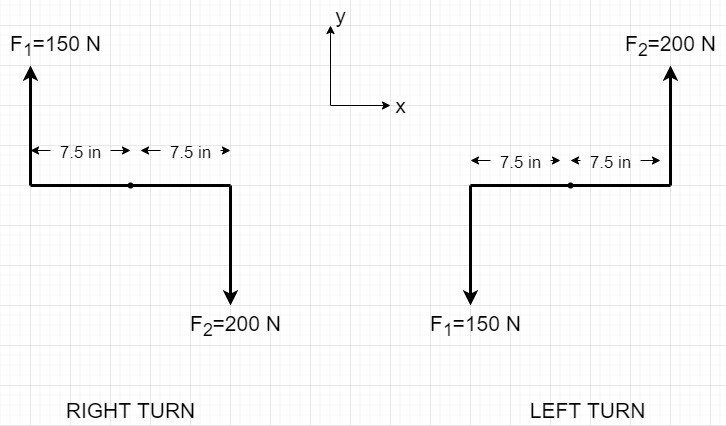
	</div>


	</div>
<div class="chapter standard with-subsections" id="chapter-slug-4-5-examples" title="4.5 Examples">
	<div class="chapter-title-wrap">
		<p class="chapter-number">23</p>
		<h1 class="chapter-title">4.5 Examples</h1>
								</div>
	<div class="ugc chapter-ugc">
				
 <p>Here are examples from Chapter 4 to help you understand these concepts better. These were taken from the real world and supplied by FSDE students in Summer 2021. If you’d like to submit your own examples, please send them to the author <a href="mailto:eosgood@upei.ca" data-url="mailto:eosgood@upei.ca">eosgood@upei.ca</a>.</p> <h1 id="chapter-571-section-1" class="section-header">Example 4.5.1: External Forces, Submitted by Elliott Fraser</h1> <div class="textbox"><p><strong>1. Problem</strong></p> <div class="textbox shaded"><p>Billy (160 lbs), Bobby (180 lbs), and Joe (145 lbs) are walking across a small bridge with a length of 11 feet. Both sides of the bridge are supported by rollers. Billy is 2 feet along the bridge whereas Joe is 9 feet along the bridge. If the maximum force that the left side of the bridge can withstand without failing is 225 lbs, where along the bridge can Bobby stand?</p> <p>Real-life scenario:</p> <div class="wp-caption aligncenter" id="attachment_913" aria-describedby="caption-attachment-913" style="width: 361px"><a href="https://flic.kr/p/2gAGZ17" data-url="https://flic.kr/p/2gAGZ17"><img src="http://pressbooks.library.upei.ca/statics/wp-content/uploads/sites/56/2021/07/Elliott-1-problem-1-1-300x200.jpg" alt="People walking across a bridge." class="wp-image-913" width="361" height="240" srcset="https://pressbooks.library.upei.ca/statics/wp-content/uploads/sites/56/2021/07/Elliott-1-problem-1-1-300x200.jpg 300w, https://pressbooks.library.upei.ca/statics/wp-content/uploads/sites/56/2021/07/Elliott-1-problem-1-1-768x512.jpg 768w, https://pressbooks.library.upei.ca/statics/wp-content/uploads/sites/56/2021/07/Elliott-1-problem-1-1-65x43.jpg 65w, https://pressbooks.library.upei.ca/statics/wp-content/uploads/sites/56/2021/07/Elliott-1-problem-1-1-225x150.jpg 225w, https://pressbooks.library.upei.ca/statics/wp-content/uploads/sites/56/2021/07/Elliott-1-problem-1-1-350x233.jpg 350w, https://pressbooks.library.upei.ca/statics/wp-content/uploads/sites/56/2021/07/Elliott-1-problem-1-1.jpg 1024w" sizes="auto, (max-width: 361px) 100vw, 361px" title=""></a><div class="wp-caption-text" id="caption-attachment-913">Source: https://www.flickr.com/photos/chumlee/48306801162/</div></div> </div> <hr> <p><strong>2.Draw</strong></p> <p>Sketch:</p> <p><img src="http://pressbooks.library.upei.ca/statics/wp-content/uploads/sites/56/2021/07/Elliott-1-draw1-300x203.jpg" alt="A sketch of the problem" class="aligncenter wp-image-916" width="331" height="224" srcset="https://pressbooks.library.upei.ca/statics/wp-content/uploads/sites/56/2021/07/Elliott-1-draw1-300x203.jpg 300w, https://pressbooks.library.upei.ca/statics/wp-content/uploads/sites/56/2021/07/Elliott-1-draw1-1024x694.jpg 1024w, https://pressbooks.library.upei.ca/statics/wp-content/uploads/sites/56/2021/07/Elliott-1-draw1-768x520.jpg 768w, https://pressbooks.library.upei.ca/statics/wp-content/uploads/sites/56/2021/07/Elliott-1-draw1-1536x1041.jpg 1536w, https://pressbooks.library.upei.ca/statics/wp-content/uploads/sites/56/2021/07/Elliott-1-draw1-65x44.jpg 65w, https://pressbooks.library.upei.ca/statics/wp-content/uploads/sites/56/2021/07/Elliott-1-draw1-225x152.jpg 225w, https://pressbooks.library.upei.ca/statics/wp-content/uploads/sites/56/2021/07/Elliott-1-draw1-350x237.jpg 350w, https://pressbooks.library.upei.ca/statics/wp-content/uploads/sites/56/2021/07/Elliott-1-draw1.jpg 1550w" sizes="auto, (max-width: 331px) 100vw, 331px" title=""></p> <p>&nbsp;</p> <p>Free-body diagram:</p> <p><img src="http://pressbooks.library.upei.ca/statics/wp-content/uploads/sites/56/2021/07/Elliott-1-draw-3-300x136.jpg" alt="A FBD of the problem." class="aligncenter wp-image-920" width="394" height="179" srcset="https://pressbooks.library.upei.ca/statics/wp-content/uploads/sites/56/2021/07/Elliott-1-draw-3-300x136.jpg 300w, https://pressbooks.library.upei.ca/statics/wp-content/uploads/sites/56/2021/07/Elliott-1-draw-3-1024x463.jpg 1024w, https://pressbooks.library.upei.ca/statics/wp-content/uploads/sites/56/2021/07/Elliott-1-draw-3-768x347.jpg 768w, https://pressbooks.library.upei.ca/statics/wp-content/uploads/sites/56/2021/07/Elliott-1-draw-3-1536x694.jpg 1536w, https://pressbooks.library.upei.ca/statics/wp-content/uploads/sites/56/2021/07/Elliott-1-draw-3-65x29.jpg 65w, https://pressbooks.library.upei.ca/statics/wp-content/uploads/sites/56/2021/07/Elliott-1-draw-3-225x102.jpg 225w, https://pressbooks.library.upei.ca/statics/wp-content/uploads/sites/56/2021/07/Elliott-1-draw-3-350x158.jpg 350w, https://pressbooks.library.upei.ca/statics/wp-content/uploads/sites/56/2021/07/Elliott-1-draw-3.jpg 1774w" sizes="auto, (max-width: 394px) 100vw, 394px" title=""></p> <p><strong>3. Knowns and Unknowns</strong></p> <p>Knowns:</p> <ul><li>r<sub>Bi</sub> = 2 ft</li> <li>r<sub>J</sub> = 9 ft</li> <li>r<sub>B</sub> = 11 ft</li> <li>F<sub>Bi</sub> = 160 lb</li> <li>F<sub>J</sub> = 145 lb</li> <li>F<sub>Bo</sub> = 180 lb</li> <li>A<sub>y</sub> = 225 lb (since this is the maximum force without failure)</li> </ul> <p>Note: Since the mass of the bridge was not given, we assume it is negligible and ignore it for this question.</p> <p>Unknown:</p> <ul><li>r<sub>Bo</sub></li> </ul> <p><strong>4. Approach</strong></p> <p>Use equilibrium equations ( <img src="http://localhost:3000/latex?latex=%5Csum%5Cunderline%7BF%7D%3D0&amp;fg=000000&amp;font=TeX&amp;svg=1" alt="\sum\underline{F}=0" title="\sum\underline{F}=0" class="latex mathjax"> , <img src="http://localhost:3000/latex?latex=%5Csum%5Cunderline%7BM%7D%3D0&amp;fg=000000&amp;font=TeX&amp;svg=1" alt="\sum\underline{M}=0" title="\sum\underline{M}=0" class="latex mathjax"> ) . Use sum of forces in y to find By; use sum of moments to find where Bobby can stand. Solve for x.</p> <p><strong>5. Analysis</strong></p> <p>$$ \sum F_y=0=-F_{Bi}-F_{Bo}-F_J+A_y+B_y\\\\B_y=F_{Bi}+F_{Bo}+F_J-A_y\\\\B_y=160 lb+180 lb+145 lb-225 lb\\\\\\B_y=260 lb$$</p> <p>$$\sum M_A=0=-(F_{Bi})(r_{Bi})-(F_{Bo})(r_{Bo})-(F_{J})(r_{J})+(B_{y})(r_{B})\\r_{bo}=\frac{-(F_{Bi})(r_{Bi})-(F_{J})(r_{J})+(B_{y})(r_{B})}{F_{Bo}}\\r_{Bo}=\frac{-(160 lb)(2 ft)-(145 lb)(9 ft)+(260 lb)(11 ft)}{180 lb}$$</p> <p>&nbsp;</p> <p>$$\underline{r_{Bo}=6.86 ft}$$</p> <p><strong>6. Review</strong></p> <p>Bobby can stand anywhere from 6.8611 ft – 11 ft from A with no problems. If Bobby were to stand between 0 ft and 6.811 ft, the left side of the bridge would fail.</p> </div> <p>&nbsp;</p> <h1 id="chapter-571-section-2" class="section-header">Example 4.5.2: Free-Body Diagrams, Submitted by Victoria Keefe</h1> <div class="textbox"><p><strong>1. Problem</strong></p> <div class="textbox shaded">A box is sitting on an inclined plane (θ = 15°) and is being pushed down the plane with a force of 20 N. Draw the free-body diagram for the box while it is in static equilibrium.<img src="http://pressbooks.library.upei.ca/statics/wp-content/uploads/sites/56/2021/07/Screenshot-2025-05-27-130931-300x249.png" alt="Box on a slope with weight, normal force, and a 20 N push downhill." class="aligncenter wp-image-2388 size-medium" width="300" height="249" srcset="https://pressbooks.library.upei.ca/statics/wp-content/uploads/sites/56/2021/07/Screenshot-2025-05-27-130931-300x249.png 300w, https://pressbooks.library.upei.ca/statics/wp-content/uploads/sites/56/2021/07/Screenshot-2025-05-27-130931-65x54.png 65w, https://pressbooks.library.upei.ca/statics/wp-content/uploads/sites/56/2021/07/Screenshot-2025-05-27-130931-225x187.png 225w, https://pressbooks.library.upei.ca/statics/wp-content/uploads/sites/56/2021/07/Screenshot-2025-05-27-130931-350x291.png 350w, https://pressbooks.library.upei.ca/statics/wp-content/uploads/sites/56/2021/07/Screenshot-2025-05-27-130931.png 585w" sizes="auto, (max-width: 300px) 100vw, 300px" title="">Source:https://www.omnicalculator.com/physics/normal-force</div> <div></div> <div></div> <p><strong>2. Draw</strong></p> <p><img src="http://pressbooks.library.upei.ca/statics/wp-content/uploads/sites/56/2021/07/Victoria-1-draw-300x188.jpg" alt="A sketch of the problem" class="aligncenter wp-image-1012" width="215" height="135" srcset="https://pressbooks.library.upei.ca/statics/wp-content/uploads/sites/56/2021/07/Victoria-1-draw-300x188.jpg 300w, https://pressbooks.library.upei.ca/statics/wp-content/uploads/sites/56/2021/07/Victoria-1-draw-1024x641.jpg 1024w, https://pressbooks.library.upei.ca/statics/wp-content/uploads/sites/56/2021/07/Victoria-1-draw-768x481.jpg 768w, https://pressbooks.library.upei.ca/statics/wp-content/uploads/sites/56/2021/07/Victoria-1-draw-65x41.jpg 65w, https://pressbooks.library.upei.ca/statics/wp-content/uploads/sites/56/2021/07/Victoria-1-draw-225x141.jpg 225w, https://pressbooks.library.upei.ca/statics/wp-content/uploads/sites/56/2021/07/Victoria-1-draw-350x219.jpg 350w, https://pressbooks.library.upei.ca/statics/wp-content/uploads/sites/56/2021/07/Victoria-1-draw.jpg 1033w" sizes="auto, (max-width: 215px) 100vw, 215px" title=""></p> <p><strong>3. Knowns and Unknowns</strong></p> <p>Knowns:</p> <ul><li>θ = 15°</li> <li>F<sub style="text-align: initial;background-color: initial">A</sub></li> </ul> <p>Unknown:</p> <ul><li>Free-body diagram of box</li> </ul> <p><strong>4. Approach</strong></p> <p>Draw the box, then draw all forces acting on it</p> <p><strong>5. Analysis</strong></p> <p><img src="http://pressbooks.library.upei.ca/statics/wp-content/uploads/sites/56/2021/07/Screenshot-2025-05-27-132845-274x300.png" alt="FBD of the problem" class="aligncenter wp-image-2393 size-medium" width="274" height="300" srcset="https://pressbooks.library.upei.ca/statics/wp-content/uploads/sites/56/2021/07/Screenshot-2025-05-27-132845-274x300.png 274w, https://pressbooks.library.upei.ca/statics/wp-content/uploads/sites/56/2021/07/Screenshot-2025-05-27-132845-65x71.png 65w, https://pressbooks.library.upei.ca/statics/wp-content/uploads/sites/56/2021/07/Screenshot-2025-05-27-132845-225x247.png 225w, https://pressbooks.library.upei.ca/statics/wp-content/uploads/sites/56/2021/07/Screenshot-2025-05-27-132845-350x384.png 350w, https://pressbooks.library.upei.ca/statics/wp-content/uploads/sites/56/2021/07/Screenshot-2025-05-27-132845.png 694w" sizes="auto, (max-width: 274px) 100vw, 274px" title=""></p> <p><strong>6. Review</strong></p> <p>All forces acting upon the box are drawn, including weight/gravitational force, normal force, friction, and applied forces.</p> </div> <p>&nbsp;</p> <h1 id="chapter-571-section-3" class="section-header">Example 4.5.3: Friction, Submitted by Deanna Malone</h1> <div class="textbox"><p><strong>1. Problem</strong></p> <div class="textbox shaded"><div class="wp-caption alignright" style="width: 200px"><a href="https://static.thenounproject.com/png/2745226-200.png" data-url="https://static.thenounproject.com/png/2745226-200.png"><img src="https://static.thenounproject.com/png/2745226-200.png" alt="Man Kicking Box Icons - Download Free Vector Icons | Noun Project" class="n3VNCb" data-noaft="1" width="200" height="200" title=""></a><div class="wp-caption-text">Source: https://static.thenounproject.com/png/2745226-200.png</div></div> <p>A box is being pushed along level ground with a force of 150 N at an angle of 30° with the horizontal. The mass of the box is 12 kg.</p> <p>a) What is the normal force between the box and the floor?</p> <p>b) What is the coefficient of friction between the box and the floor?</p> </div> <p><strong>2. Draw<br> </strong></p> <p>Sketch:</p> <p><img src="http://pressbooks.library.upei.ca/statics/wp-content/uploads/sites/56/2021/07/Deanna-1-Draw-1-300x175.jpg" alt="A sketch of the problem." class="aligncenter wp-image-753" width="317" height="185" srcset="https://pressbooks.library.upei.ca/statics/wp-content/uploads/sites/56/2021/07/Deanna-1-Draw-1-300x175.jpg 300w, https://pressbooks.library.upei.ca/statics/wp-content/uploads/sites/56/2021/07/Deanna-1-Draw-1-1024x596.jpg 1024w, https://pressbooks.library.upei.ca/statics/wp-content/uploads/sites/56/2021/07/Deanna-1-Draw-1-768x447.jpg 768w, https://pressbooks.library.upei.ca/statics/wp-content/uploads/sites/56/2021/07/Deanna-1-Draw-1-1536x894.jpg 1536w, https://pressbooks.library.upei.ca/statics/wp-content/uploads/sites/56/2021/07/Deanna-1-Draw-1-65x38.jpg 65w, https://pressbooks.library.upei.ca/statics/wp-content/uploads/sites/56/2021/07/Deanna-1-Draw-1-225x131.jpg 225w, https://pressbooks.library.upei.ca/statics/wp-content/uploads/sites/56/2021/07/Deanna-1-Draw-1-350x204.jpg 350w, https://pressbooks.library.upei.ca/statics/wp-content/uploads/sites/56/2021/07/Deanna-1-Draw-1.jpg 1994w" sizes="auto, (max-width: 317px) 100vw, 317px" title=""></p> <p>Free Body Diagram:</p> <p><img src="http://pressbooks.library.upei.ca/statics/wp-content/uploads/sites/56/2021/07/Deanna-1-Draw-2-300x194.jpg" alt="A FBD of the problem." class="aligncenter wp-image-754" width="324" height="209" srcset="https://pressbooks.library.upei.ca/statics/wp-content/uploads/sites/56/2021/07/Deanna-1-Draw-2-300x194.jpg 300w, https://pressbooks.library.upei.ca/statics/wp-content/uploads/sites/56/2021/07/Deanna-1-Draw-2-1024x663.jpg 1024w, https://pressbooks.library.upei.ca/statics/wp-content/uploads/sites/56/2021/07/Deanna-1-Draw-2-768x497.jpg 768w, https://pressbooks.library.upei.ca/statics/wp-content/uploads/sites/56/2021/07/Deanna-1-Draw-2-1536x994.jpg 1536w, https://pressbooks.library.upei.ca/statics/wp-content/uploads/sites/56/2021/07/Deanna-1-Draw-2-2048x1325.jpg 2048w, https://pressbooks.library.upei.ca/statics/wp-content/uploads/sites/56/2021/07/Deanna-1-Draw-2-65x42.jpg 65w, https://pressbooks.library.upei.ca/statics/wp-content/uploads/sites/56/2021/07/Deanna-1-Draw-2-225x146.jpg 225w, https://pressbooks.library.upei.ca/statics/wp-content/uploads/sites/56/2021/07/Deanna-1-Draw-2-350x226.jpg 350w" sizes="auto, (max-width: 324px) 100vw, 324px" title=""></p> <p><strong>3. Knowns and Unknowns</strong></p> <p>Knowns:</p> <ul><li>F<sub>A</sub> = 150 N</li> <li>θ = 30°</li> <li>m = 12 kg</li> </ul> <p>Unknowns:</p> <ul><li>F<sub>N</sub></li> <li>μ</li> </ul> <p><strong>4. Approach</strong></p> <p>Use equilibrium equations ( <img src="http://localhost:3000/latex?latex=%5Csum%5Cunderline%7BF%7D%3D0&amp;fg=000000&amp;font=TeX&amp;svg=1" alt="\sum\underline{F}=0" title="\sum\underline{F}=0" class="latex mathjax"> , <img src="http://localhost:3000/latex?latex=%5Csum%5Cunderline%7BM%7D%3D0&amp;fg=000000&amp;font=TeX&amp;svg=1" alt="\sum\underline{M}=0" title="\sum\underline{M}=0" class="latex mathjax"> ), SOH CAH TOA, friction equation</p> <p><strong>5. Analysis<br> </strong></p> <p>Part a:</p> <p class="indent">Find F<sub>g</sub>:</p> <p>$$Fg=m\cdot g\\Fg=(12kg)(9.81m/s^2)\\\\Fg=117.72N$$</p> <p class="indent">Find F<sub>N</sub> using equilibrium equations:</p> <p>$$\sum Fy=0=F_N-F_g-F_A\sin 30^{\circ}\\0=F_N-117.72N-150N\cdot \sin 30^{\circ}\\F_N=117.72+150N\cdot\sin 30^{\circ}\\\\\underline{F_N=192.7 N}$$</p> <p>Part b:</p> <p class="indent">Find two equations for F<sub>f</sub>, set them equal to each other, and solve for μ</p> <div>$$<br> \begin{align*}<br> \sum F_x &amp;= 0 = F_A \cos 30^\circ – F_f \\<br> 0 &amp;= 150\,N \cdot \cos 30^\circ – F_f<br> \end{align*}<br> $$</div> <p><span>$$F_f=150N\cdot\cos 30^{\circ}\\F_f=\mu\cdot F_N\\150N\cdot\cos 30^{\circ}=\mu\cdot F_N$$</span></p> <p><span>$$\mu=\frac{150N\cdot\cos 30^{\circ}}{F_N}\\\mu=\frac{150N\cdot\cos 30^{\circ}}{192.72N}=0.67405$$</span></p> <p>&nbsp;</p> <p><span>$$\underline{\mu=0.67}$$ </span></p> <p><strong>6. Review</strong></p> <p>F<sub>N</sub>, F<sub>g</sub>, and the y component of F<sub>A</sub> are the only forces in the y direction so it makes sense that they need to equal zero for the equilibrium equations. F<sub>N</sub> is the only positive force in the y direction, so it makes sense that it equals the magnitude of the other two put together.</p> <p>The coefficient found between the box and the floor is reasonable as it is less than 1, and it’s reasonable for a box on the floor. For example, if the box was wood and the floor was wood, the coefficient of static friction would be anywhere from 0.5-0.7, so having a coefficient of friction being equal to 0.67 makes sense.</p> </div> <p>&nbsp;</p> <h1 id="chapter-571-section-4" class="section-header">Example 4.5.4: Friction, Submitted by Dhruvil Kanani</h1> <div class="textbox"><p><strong>1. Problem</strong></p> <div class="textbox shaded"><p><img src="http://pressbooks.library.upei.ca/statics/wp-content/uploads/sites/56/2021/07/Dhruvil-1-draw-1-251x300.jpg" alt="A hand holding a brick against the wall." class="alignright wp-image-1024" width="188" height="225" srcset="https://pressbooks.library.upei.ca/statics/wp-content/uploads/sites/56/2021/07/Dhruvil-1-draw-1-251x300.jpg 251w, https://pressbooks.library.upei.ca/statics/wp-content/uploads/sites/56/2021/07/Dhruvil-1-draw-1-65x78.jpg 65w, https://pressbooks.library.upei.ca/statics/wp-content/uploads/sites/56/2021/07/Dhruvil-1-draw-1-225x268.jpg 225w, https://pressbooks.library.upei.ca/statics/wp-content/uploads/sites/56/2021/07/Dhruvil-1-draw-1-350x418.jpg 350w, https://pressbooks.library.upei.ca/statics/wp-content/uploads/sites/56/2021/07/Dhruvil-1-draw-1.jpg 684w" sizes="auto, (max-width: 188px) 100vw, 188px" title=""></p> <p>A person is trying to prevent a brick from sliding on a rough vertical surface by applying force in the direction of wall. Assuming the coefficient of static friction is 0.49 and mass of the brick is 5 kg,</p> <ul><li>a) Determine the minimum force required to prevent the brick from slipping.</li> <li>b) Find the distributed load or intensity if the length of the person’s hands from the tip of his fingers to their wrist is 16 cm.</li> </ul> </div> <p><strong>2. Draw</strong></p> <p>Sketch:</p> <p>Free-body diagram (box):</p> <p><img src="http://pressbooks.library.upei.ca/statics/wp-content/uploads/sites/56/2021/07/Dhruvil-1-draw-2-300x230.jpg" alt="FBD of the problem." class="aligncenter wp-image-1025 size-medium" width="300" height="230" srcset="https://pressbooks.library.upei.ca/statics/wp-content/uploads/sites/56/2021/07/Dhruvil-1-draw-2-300x230.jpg 300w, https://pressbooks.library.upei.ca/statics/wp-content/uploads/sites/56/2021/07/Dhruvil-1-draw-2-1024x784.jpg 1024w, https://pressbooks.library.upei.ca/statics/wp-content/uploads/sites/56/2021/07/Dhruvil-1-draw-2-768x588.jpg 768w, https://pressbooks.library.upei.ca/statics/wp-content/uploads/sites/56/2021/07/Dhruvil-1-draw-2-65x50.jpg 65w, https://pressbooks.library.upei.ca/statics/wp-content/uploads/sites/56/2021/07/Dhruvil-1-draw-2-225x172.jpg 225w, https://pressbooks.library.upei.ca/statics/wp-content/uploads/sites/56/2021/07/Dhruvil-1-draw-2-350x268.jpg 350w, https://pressbooks.library.upei.ca/statics/wp-content/uploads/sites/56/2021/07/Dhruvil-1-draw-2.jpg 1089w" sizes="auto, (max-width: 300px) 100vw, 300px" title=""></p> <p>Free-body diagram (distributed load):</p> <p><img src="http://pressbooks.library.upei.ca/statics/wp-content/uploads/sites/56/2021/07/Dhruvil-1-draw-3-300x140.jpg" alt="FBD of the problem (distributed load)" class="alignnone wp-image-1026 size-medium" width="300" height="140" srcset="https://pressbooks.library.upei.ca/statics/wp-content/uploads/sites/56/2021/07/Dhruvil-1-draw-3-300x140.jpg 300w, https://pressbooks.library.upei.ca/statics/wp-content/uploads/sites/56/2021/07/Dhruvil-1-draw-3-1024x479.jpg 1024w, https://pressbooks.library.upei.ca/statics/wp-content/uploads/sites/56/2021/07/Dhruvil-1-draw-3-768x359.jpg 768w, https://pressbooks.library.upei.ca/statics/wp-content/uploads/sites/56/2021/07/Dhruvil-1-draw-3-65x30.jpg 65w, https://pressbooks.library.upei.ca/statics/wp-content/uploads/sites/56/2021/07/Dhruvil-1-draw-3-225x105.jpg 225w, https://pressbooks.library.upei.ca/statics/wp-content/uploads/sites/56/2021/07/Dhruvil-1-draw-3-350x164.jpg 350w, https://pressbooks.library.upei.ca/statics/wp-content/uploads/sites/56/2021/07/Dhruvil-1-draw-3.jpg 1031w" sizes="auto, (max-width: 300px) 100vw, 300px" title=""></p> <p><strong>3. Knowns and Unknowns</strong></p> <p>Knowns:</p> <ul><li>Mass of brick (m) = 5kg</li> <li>Coefficient of friction (μ<sub>1</sub>) = 0.49</li> <li>Acceleration due to gravity (g) = 9.81m/s2</li> <li>Length of the hand (L) = 16 cm</li> </ul> <p>Unknowns:</p> <ul><li>Applied force (F<sub>A</sub>)</li> <li>Intensity (w)</li> </ul> <p><strong>4. Approach</strong></p> <p>Use equilibrium equations ( <img src="http://localhost:3000/latex?latex=%5Csum%5Cunderline%7BF%7D%3D0&amp;fg=000000&amp;font=TeX&amp;svg=1" alt="\sum\underline{F}=0" title="\sum\underline{F}=0" class="latex mathjax"> , <img src="http://localhost:3000/latex?latex=%5Csum%5Cunderline%7BM%7D%3D0&amp;fg=000000&amp;font=TeX&amp;svg=1" alt="\sum\underline{M}=0" title="\sum\underline{M}=0" class="latex mathjax"> ), equations for F<sub>g</sub> and F<sub>f</sub> (see below).</p> <p>$$F_g=m g\\F_f=\mu F_N$$</p> <p><strong>5. Analysis</strong></p> <p>Part a:</p> <p>$$F_g=m\cdot g\\F_g=5kg\cdot 9.81m/s^2\\F_g=49.05N$$</p> <p>&nbsp;</p> <p>$$\sum F_y=0=-F_g+F_f\\F_f=F_g\\F_f=49.05N$$</p> <p>$$F_f=\mu_1&nbsp; F_N\\F_N=\frac{F_f}{\mu_1}\\F_N=\frac{49.05N}{0.49}$$</p> <p>&nbsp;</p> <p>$$\underline{F_N=100.1N}$$</p> <p>&nbsp;</p> <p>Part b:</p> <p>$$\sum F_x=0=F_N-F_A\\F_A=F_N\\F_A=100.1N$$</p> <p>$$w=\frac{F_A}{L}\\w=\frac{100.1N}{(16cm\times\frac{1m}{100cm})}$$</p> <p>&nbsp;</p> <p>$$\underline{w=625.64N/m}$$</p> <p><strong>6. Review</strong></p> <p>It makes sense that the applied force is larger than the gravitational force. It also makes sense that the normal and applied forces are equal, since they are the only forces in the x direction (same goes for the friction and gravitational forces).</p> </div> <p>&nbsp;</p> <h1 id="chapter-571-section-5" class="section-header">Example 4.5.5: Friction, Submitted by Emma Christensen</h1> <div class="textbox"><p><strong>1. Problem</strong></p> <div class="textbox shaded"><p>&nbsp;</p> <p>A ball is suspended by two ropes and rests on an inclined surface at an angle of 15°. Rope A pulls on the ball with a force of 200 N, and rope B has a force of 150 N. They each have angles of 20° and 60°, respectively, from the inclined surface plane, as shown in the image below.</p> <p><img src="http://pressbooks.library.upei.ca/statics/wp-content/uploads/sites/56/2021/07/balloninclineplane.drawio-300x179.png" alt="A 20kg ball on a 15° slope with two angled forces: 200N at 20° and 150N at 60°." width="298" height="178" class="alignnone wp-image-2140" srcset="https://pressbooks.library.upei.ca/statics/wp-content/uploads/sites/56/2021/07/balloninclineplane.drawio-300x179.png 300w, https://pressbooks.library.upei.ca/statics/wp-content/uploads/sites/56/2021/07/balloninclineplane.drawio-768x457.png 768w, https://pressbooks.library.upei.ca/statics/wp-content/uploads/sites/56/2021/07/balloninclineplane.drawio-65x39.png 65w, https://pressbooks.library.upei.ca/statics/wp-content/uploads/sites/56/2021/07/balloninclineplane.drawio-225x134.png 225w, https://pressbooks.library.upei.ca/statics/wp-content/uploads/sites/56/2021/07/balloninclineplane.drawio-350x208.png 350w, https://pressbooks.library.upei.ca/statics/wp-content/uploads/sites/56/2021/07/balloninclineplane.drawio.png 815w" sizes="auto, (max-width: 298px) 100vw, 298px" title=""></p> <p>a) Draw a free-body diagram of the ball</p> <p>b) Find the friction force</p> </div> <p><strong>2. Draw</strong></p> <p>Sketch:</p> <p><img src="http://pressbooks.library.upei.ca/statics/wp-content/uploads/sites/56/2021/07/balloninclineplane.drawio-300x179.png" alt="A sketch of the problem" width="300" height="179" class="alignnone wp-image-2140 size-medium" srcset="https://pressbooks.library.upei.ca/statics/wp-content/uploads/sites/56/2021/07/balloninclineplane.drawio-300x179.png 300w, https://pressbooks.library.upei.ca/statics/wp-content/uploads/sites/56/2021/07/balloninclineplane.drawio-768x457.png 768w, https://pressbooks.library.upei.ca/statics/wp-content/uploads/sites/56/2021/07/balloninclineplane.drawio-65x39.png 65w, https://pressbooks.library.upei.ca/statics/wp-content/uploads/sites/56/2021/07/balloninclineplane.drawio-225x134.png 225w, https://pressbooks.library.upei.ca/statics/wp-content/uploads/sites/56/2021/07/balloninclineplane.drawio-350x208.png 350w, https://pressbooks.library.upei.ca/statics/wp-content/uploads/sites/56/2021/07/balloninclineplane.drawio.png 815w" sizes="auto, (max-width: 300px) 100vw, 300px" title=""></p> <p><strong>3. Knowns and Unknowns</strong></p> <ul><li>θ<sub>A</sub> = 20°</li> <li>θ<sub>B</sub> = 60°</li> <li>θ<sub>C</sub> = 15°</li> <li>m = 20 kg</li> <li>F<sub>A</sub> = 200 N</li> <li>F<sub>B</sub> = 150 N</li> </ul> <p>Unknown:</p> <ul><li>F<sub>f</sub></li> </ul> <p><strong>4. Approach</strong></p> <p>Draw the ball, then add forces. Use equilibrium equations ( <img src="http://localhost:3000/latex?latex=%5Csum%5Cunderline%7BF%7D%3D0&amp;fg=000000&amp;font=TeX&amp;svg=1" alt="\sum\underline{F}=0" title="\sum\underline{F}=0" class="latex mathjax"> , <img src="http://localhost:3000/latex?latex=%5Csum%5Cunderline%7BM%7D%3D0&amp;fg=000000&amp;font=TeX&amp;svg=1" alt="\sum\underline{M}=0" title="\sum\underline{M}=0" class="latex mathjax"> ) to find the friction force.</p> <p><strong>5. Analysis</strong></p> <p>Part a:</p> <p><img src="http://pressbooks.library.upei.ca/statics/wp-content/uploads/sites/56/2021/07/fEmma-2-solve-1-300x209-1.jpg" alt="FBD of the problem." width="300" height="209" class="aligncenter wp-image-2141 size-full" srcset="https://pressbooks.library.upei.ca/statics/wp-content/uploads/sites/56/2021/07/fEmma-2-solve-1-300x209-1.jpg 300w, https://pressbooks.library.upei.ca/statics/wp-content/uploads/sites/56/2021/07/fEmma-2-solve-1-300x209-1-65x45.jpg 65w, https://pressbooks.library.upei.ca/statics/wp-content/uploads/sites/56/2021/07/fEmma-2-solve-1-300x209-1-225x157.jpg 225w" sizes="auto, (max-width: 300px) 100vw, 300px" title=""></p> <p>Part b:</p> <p><em>Step 1: Find F<sub>G</sub></em></p> <p>$$F_G=m g\\F_G=20kg\cdot 9.81m/s^2\\F_G=196.2N$$</p> <p><em>Step 2: Find the x-component of F<sub>G</sub></em></p> <p><img src="http://pressbooks.library.upei.ca/statics/wp-content/uploads/sites/56/2021/07/Emma-2-solve-3-300x211.jpg" alt="Force diagram showing a triangle split into components F_gx and F_gy from force F_g at a 15° angle." class="alignnone wp-image-1135 size-medium" width="300" height="211" srcset="https://pressbooks.library.upei.ca/statics/wp-content/uploads/sites/56/2021/07/Emma-2-solve-3-300x211.jpg 300w, https://pressbooks.library.upei.ca/statics/wp-content/uploads/sites/56/2021/07/Emma-2-solve-3-768x539.jpg 768w, https://pressbooks.library.upei.ca/statics/wp-content/uploads/sites/56/2021/07/Emma-2-solve-3-65x46.jpg 65w, https://pressbooks.library.upei.ca/statics/wp-content/uploads/sites/56/2021/07/Emma-2-solve-3-225x158.jpg 225w, https://pressbooks.library.upei.ca/statics/wp-content/uploads/sites/56/2021/07/Emma-2-solve-3-350x246.jpg 350w, https://pressbooks.library.upei.ca/statics/wp-content/uploads/sites/56/2021/07/Emma-2-solve-3.jpg 931w" sizes="auto, (max-width: 300px) 100vw, 300px" title=""></p> <p>$$F_{GX}=F_G\sin(15^{\circ})\\F_{GX}=196.2N\cdot\sin(15^{\circ})\\F_{GX}=50.78N$$</p> <p><em>Step 3: Find the x-component of F<sub>A</sub></em></p> <p>$$\cos(20^{\circ})=\frac{F_AX}{F_{A}}\\F_{AX}=F_A\cdot(cos(20^{\circ}))\\F_{AX}=200N\cdot(\cos(20^{\circ}))\\F_{AX}=187.938N$$</p> <p><em>Step 4: Find the x-component of F<sub>B</sub></em></p> <p><img src="http://pressbooks.library.upei.ca/statics/wp-content/uploads/sites/56/2021/07/Emma-2-solve-7-300x152.jpg" alt="Force F_B split into components F_Bx and F_By at a 60° angle." class="alignnone wp-image-1139 size-medium" width="300" height="152" srcset="https://pressbooks.library.upei.ca/statics/wp-content/uploads/sites/56/2021/07/Emma-2-solve-7-300x152.jpg 300w, https://pressbooks.library.upei.ca/statics/wp-content/uploads/sites/56/2021/07/Emma-2-solve-7-1024x520.jpg 1024w, https://pressbooks.library.upei.ca/statics/wp-content/uploads/sites/56/2021/07/Emma-2-solve-7-768x390.jpg 768w, https://pressbooks.library.upei.ca/statics/wp-content/uploads/sites/56/2021/07/Emma-2-solve-7-65x33.jpg 65w, https://pressbooks.library.upei.ca/statics/wp-content/uploads/sites/56/2021/07/Emma-2-solve-7-225x114.jpg 225w, https://pressbooks.library.upei.ca/statics/wp-content/uploads/sites/56/2021/07/Emma-2-solve-7-350x178.jpg 350w, https://pressbooks.library.upei.ca/statics/wp-content/uploads/sites/56/2021/07/Emma-2-solve-7.jpg 1281w" sizes="auto, (max-width: 300px) 100vw, 300px" title=""></p> <p>$$F_{BX}=F_B\cdot(\cos(60^{\circ}))\\F_{BX}=150N\cdot(\cos(60^{\circ}))\\F_{BX}=75N$$</p> <p><em>Step 5: Sum forces in the x-direction to find the frictional force</em></p> <p>$$\sum F_x=0=-F_f+F_{BX}-F_{AX}+F_{GX}\\F_f=-F_{AX}+F_{BX}+F_{GX}\\F_f=-187.938N+75N+50.78N$$</p> <p>$$\underline{F_f=-62.158N}$$</p> <p>Because the frictional force is negative, that means the frictional force actually acts in the opposite direction, so the friction is keeping the ball from going up the plane.</p> <p><strong>6. Review</strong></p> <p>The units of F<sub>f</sub> are newtons, which makes sense because it is a force. It also makes sense that F<sub>Ax</sub> is larger than F<sub>Gx</sub> and F<sub>Bx</sub>.</p> </div> <h1 id="chapter-571-section-6" class="section-header">Example 4.5.6: Friction, Submitted by Riley Fitzpatrick</h1> <div class="textbox"><ol><li><strong>Problem</strong></li> </ol> <div class="textbox shaded"><p>A 6m trailer contains 500 kg that is distributed evenly across its bed, meaning that the weight of the load is acting at the centroid. The trailer has an axle at either end of the bed and a 3m hitch. A truck is towing the load with a force of 5000N.</p> <p>a. Calculate the weight of the load.</p> <p>b. Calculate the total normal force acting on the wheels.</p> <p>c. Calculate the frictional force acting on the wheels.</p> <p>d. Calculate the coefficient of friction between the wheels and the asphalt.</p> <p>e. Given that the static coefficient of friction between the wheels and the asphalt is 0.72. Is the trailer about to slip?</p> <p><img src="http://pressbooks.library.upei.ca/statics/wp-content/uploads/sites/56/2022/02/riley-chap-3-image-e1667953494391.jpg" alt="Truck unloading logs." class="alignnone wp-image-1982" width="548" height="269" srcset="https://pressbooks.library.upei.ca/statics/wp-content/uploads/sites/56/2022/02/riley-chap-3-image-e1667953494391.jpg 228w, https://pressbooks.library.upei.ca/statics/wp-content/uploads/sites/56/2022/02/riley-chap-3-image-e1667953494391-65x32.jpg 65w, https://pressbooks.library.upei.ca/statics/wp-content/uploads/sites/56/2022/02/riley-chap-3-image-e1667953494391-225x111.jpg 225w" sizes="auto, (max-width: 548px) 100vw, 548px" title=""></p> <p>An image relatable to the problem. https://en.wikipedia.org/wiki/Sidelifter#/media/File:Sidelifter_in_forest.jpg</p> <div></div> </div> <p><strong>2. Draw</strong></p> <p><img src="http://pressbooks.library.upei.ca/statics/wp-content/uploads/sites/56/2022/02/Screenshot-11-e1667948472188.png" alt="FBD of the problem." class="alignnone wp-image-1980 size-full" width="524" height="304" srcset="https://pressbooks.library.upei.ca/statics/wp-content/uploads/sites/56/2022/02/Screenshot-11-e1667948472188.png 524w, https://pressbooks.library.upei.ca/statics/wp-content/uploads/sites/56/2022/02/Screenshot-11-e1667948472188-300x174.png 300w, https://pressbooks.library.upei.ca/statics/wp-content/uploads/sites/56/2022/02/Screenshot-11-e1667948472188-65x38.png 65w, https://pressbooks.library.upei.ca/statics/wp-content/uploads/sites/56/2022/02/Screenshot-11-e1667948472188-225x131.png 225w, https://pressbooks.library.upei.ca/statics/wp-content/uploads/sites/56/2022/02/Screenshot-11-e1667948472188-350x203.png 350w" sizes="auto, (max-width: 524px) 100vw, 524px" title=""></p> <p><strong>3. Knowns and Unknowns</strong></p> <p>Knowns:</p> <ul><li>m = 500 kg</li> <li>P = 5000 N</li> <li>9 = 9.81 m/s^2</li> </ul> <p>Unknowns:</p> <ul><li>w</li> <li>N</li> <li>F<sub>F </sub></li> <li><span>µ</span></li> </ul> <p><strong>4. Approach</strong></p> <ul><li>Calculate w using the formula w = mg</li> <li>Calculate N using <img src="http://localhost:3000/latex?latex=%5Csum%7BF_%7By%7D%7D%20%3D%200&amp;fg=000000&amp;font=TeX&amp;svg=1" alt="\sum{F_{y}} = 0" title="\sum{F_{y}} = 0" class="latex mathjax"></li> <li>Calculate F<sub>F</sub> using <img src="http://localhost:3000/latex?latex=%5Csum%7BF_%7Bx%7D%7D%20%3D%200&amp;fg=000000&amp;font=TeX&amp;svg=1" alt="\sum{F_{x}} = 0" title="\sum{F_{x}} = 0" class="latex mathjax"></li> <li>Calculate <span>µ using <img src="http://localhost:3000/latex?latex=%5Cmu%3D%20%5Cdfrac%7BF_%7BF%7D%7D%7BN%7D&amp;fg=000000&amp;font=TeX&amp;svg=1" alt="\mu= \dfrac{F_{F}}{N}" title="\mu= \dfrac{F_{F}}{N}" class="latex mathjax"></span></li> <li>Compare <span>µ to µ<sub>s</sub></span></li> </ul> <p><strong>5.&nbsp; Analysis</strong></p> <p><span style="text-decoration: underline">Calculating w</span></p> <p><img src="http://localhost:3000/latex?latex=w%20%3D%20m%5Ccdot%20g&amp;fg=000000&amp;font=TeX&amp;svg=1" alt="w = m\cdot g" title="w = m\cdot g" class="latex mathjax"></p> <p><img src="http://localhost:3000/latex?latex=%5C%3A%5C%3A%5C%3A%3D500kg%20%5Ccdot%209.81%20m%2Fs%5E2%20%3D%204905%20N&amp;fg=000000&amp;font=TeX&amp;svg=1" alt="\:\:\:=500kg \cdot 9.81 m/s^2 = 4905 N" title="\:\:\:=500kg \cdot 9.81 m/s^2 = 4905 N" class="latex mathjax"></p> <p><strong>w = 4905 N</strong><img src="http://pressbooks.library.upei.ca/statics/wp-content/uploads/sites/56/2022/02/Screenshot-11-e1667948472188.png" alt="Free-body diagram of the trailer supported by two rollers with vertical and horizontal forces." class="alignright wp-image-1980" width="590" height="342" srcset="https://pressbooks.library.upei.ca/statics/wp-content/uploads/sites/56/2022/02/Screenshot-11-e1667948472188.png 524w, https://pressbooks.library.upei.ca/statics/wp-content/uploads/sites/56/2022/02/Screenshot-11-e1667948472188-300x174.png 300w, https://pressbooks.library.upei.ca/statics/wp-content/uploads/sites/56/2022/02/Screenshot-11-e1667948472188-65x38.png 65w, https://pressbooks.library.upei.ca/statics/wp-content/uploads/sites/56/2022/02/Screenshot-11-e1667948472188-225x131.png 225w, https://pressbooks.library.upei.ca/statics/wp-content/uploads/sites/56/2022/02/Screenshot-11-e1667948472188-350x203.png 350w" sizes="auto, (max-width: 590px) 100vw, 590px" title=""></p> <p><span style="text-decoration: underline">Calculating N&nbsp;</span></p> <p><img src="http://localhost:3000/latex?latex=%5Csum%20%7BF_y%7D%20%3D%20N-w%20%3D0&amp;fg=000000&amp;font=TeX&amp;svg=1" alt="\sum {F_y} = N-w =0" title="\sum {F_y} = N-w =0" class="latex mathjax"></p> <p><img src="http://localhost:3000/latex?latex=N%3Dw&amp;fg=000000&amp;font=TeX&amp;svg=1" alt="N=w" title="N=w" class="latex mathjax"></p> <p><strong>N = 4905 N</strong></p> <p>Therefore, N<sub>A&nbsp;</sub>= N<sub>B</sub> = 4905N/2 = 2452.5N</p> <p><span style="text-decoration: underline">Finding F<sub>F</sub></span></p> <p><img src="http://localhost:3000/latex?latex=%5Csum%20%7BF_x%7D%3D%20P-F_%7BF%7D%20%3D%200&amp;fg=000000&amp;font=TeX&amp;svg=1" alt="\sum {F_x}= P-F_{F} = 0" title="\sum {F_x}= P-F_{F} = 0" class="latex mathjax"></p> <p><img src="http://localhost:3000/latex?latex=P%20%3D%20F_%7BF%7D&amp;fg=000000&amp;font=TeX&amp;svg=1" alt="P = F_{F}" title="P = F_{F}" class="latex mathjax"></p> <p><strong>F<sub>F&nbsp;</sub> = 5000 N</strong></p> <p><span style="text-decoration: underline">Finding µ</span></p> <p><img src="http://localhost:3000/latex?latex=%5Cmu%20%3D%20%5Cdfrac%20%7BF_%7BF%7D%7D%7BN%7D%20%3D%20%5Cdfrac%7B5000%20N%20%7D%7B4905%20N%7D&amp;fg=000000&amp;font=TeX&amp;svg=1" alt="\mu = \dfrac {F_{F}}{N} = \dfrac{5000 N }{4905 N}" title="\mu = \dfrac {F_{F}}{N} = \dfrac{5000 N }{4905 N}" class="latex mathjax"></p> <p><strong>µ = 1.019&nbsp;</strong></p> <p><span style="text-decoration: underline">Comparing µ and µ<sub>s</sub></span></p> <p><strong>1.019&gt; 0.72</strong></p> <p><strong>µ &gt; µ<sub>s</sub></strong></p> <p>Thus, the trailer is is in motion, i.e. sliding along the surface.</p> <p><strong>6. Review</strong></p> <p>From initial inspection of the FBD, it is clear that w (acting downwards) is opposite to the normal forces (acting upwards). The sum of the normal forces would not exceed w.</p> <p>F<sub>F&nbsp;</sub>should be equal and opposite to P.</p> </div> <h1 id="chapter-571-section-7" class="section-header">Example 4.5.7: Slip or Tip, Submitted by Luke McCarvill</h1> <div class="textbox"><ol><li><strong>Problem&nbsp;</strong></li> </ol> <div class="textbox shaded"><p>&nbsp;</p> <p>1.8 metres tall Spiderman with strong spider-like webs is attempting to tip over a 10 m tall and 2.5 m wide shipping container sitting upright. Given that the coefficient of static friction between the bottom of the shipping container and the ground is 0.2, and the mass of the container is 2000 kg, how much tension must Spiderman impart on his web in order to barely tip over the container towards him if he is 20 metres away from the bottom of the container?</p> <p>&nbsp;</p> <div class="wp-caption alignnone" id="attachment_1866" aria-describedby="caption-attachment-1866" style="width: 780px"><img src="http://pressbooks.library.upei.ca/statics/wp-content/uploads/sites/56/2022/05/luke-McCarvil-spiderman.jpg" alt="Spiderman pulling a 2000 kg container using a web slanted upward over 20 m." class="wp-image-1866" width="780" height="435" srcset="https://pressbooks.library.upei.ca/statics/wp-content/uploads/sites/56/2022/05/luke-McCarvil-spiderman.jpg 680w, https://pressbooks.library.upei.ca/statics/wp-content/uploads/sites/56/2022/05/luke-McCarvil-spiderman-300x167.jpg 300w, https://pressbooks.library.upei.ca/statics/wp-content/uploads/sites/56/2022/05/luke-McCarvil-spiderman-65x36.jpg 65w, https://pressbooks.library.upei.ca/statics/wp-content/uploads/sites/56/2022/05/luke-McCarvil-spiderman-225x125.jpg 225w, https://pressbooks.library.upei.ca/statics/wp-content/uploads/sites/56/2022/05/luke-McCarvil-spiderman-350x195.jpg 350w" sizes="auto, (max-width: 780px) 100vw, 780px" title=""><div class="wp-caption-text" id="caption-attachment-1866">Source:https://commons.wikimedia.org/wiki/File:Container_%E3%80%90_22G1_%E3%80%91_GVTU_201551(1)_%E3%80%90_Container_pictures_taken_in_Japan_%E3%80%91.jpg</div></div> </div> <p><strong>2. Draw</strong></p> <p><img src="http://pressbooks.library.upei.ca/statics/wp-content/uploads/sites/56/2022/05/luke-McCarvil-spiderman-1.jpg" alt="FBD of the problem." class="alignnone wp-image-1868 size-full" width="734" height="451" srcset="https://pressbooks.library.upei.ca/statics/wp-content/uploads/sites/56/2022/05/luke-McCarvil-spiderman-1.jpg 734w, https://pressbooks.library.upei.ca/statics/wp-content/uploads/sites/56/2022/05/luke-McCarvil-spiderman-1-300x184.jpg 300w, https://pressbooks.library.upei.ca/statics/wp-content/uploads/sites/56/2022/05/luke-McCarvil-spiderman-1-65x40.jpg 65w, https://pressbooks.library.upei.ca/statics/wp-content/uploads/sites/56/2022/05/luke-McCarvil-spiderman-1-225x138.jpg 225w, https://pressbooks.library.upei.ca/statics/wp-content/uploads/sites/56/2022/05/luke-McCarvil-spiderman-1-350x215.jpg 350w" sizes="auto, (max-width: 734px) 100vw, 734px" title=""></p> <p><strong>3. Knowns and Unknowns&nbsp;</strong></p> <p>Knowns:</p> <ul><li>m = 2000 kg</li> <li>h<sub>c</sub>&nbsp;= 10 m</li> <li>h<sub>s</sub>&nbsp;= 1.8 m</li> <li>d = 20 m</li> <li>w =2.5</li> <li><span>μ&nbsp; = 0.2&nbsp;</span></li> </ul> <p>Unknowns:</p> <ul><li>T<sub>x</sub></li> <li>T<sub>y&nbsp;</sub></li> </ul> <p><strong>4. Approach</strong></p> <p>Componentizing forces in the x-y direction and using the summation of moments and forces to be equal to zero.</p> <p><strong>5. Analysis</strong></p> <p>Because mass is given force by gravity, <img src="http://localhost:3000/latex?latex=F_%7Bg%20%7D%3D%20m%5Ctimes%20g%3D19%2C620%20N&amp;fg=000000&amp;font=TeX&amp;svg=1" alt="F_{g }= m\times g=19,620 N" title="F_{g }= m\times g=19,620 N" class="latex mathjax"></p> <p>Since the tension applied by Spider-Man is a force with both x and y components, we would need angle <img src="http://localhost:3000/latex?latex=%5Ctheta&amp;fg=000000&amp;font=TeX&amp;svg=1" alt="\theta" title="\theta" class="latex mathjax"><img src="http://pressbooks.library.upei.ca/statics/wp-content/uploads/sites/56/2022/05/Luke-McCarvill-spidreman-answer.drawio.png" alt="Spiderman pulling a 2000 kg container using web at an angle θ, with a 20 m horizontal distance and height difference (hc − hS)." class="aligncenter wp-image-1872 size-full" width="561" height="351" srcset="https://pressbooks.library.upei.ca/statics/wp-content/uploads/sites/56/2022/05/Luke-McCarvill-spidreman-answer.drawio.png 561w, https://pressbooks.library.upei.ca/statics/wp-content/uploads/sites/56/2022/05/Luke-McCarvill-spidreman-answer.drawio-300x188.png 300w, https://pressbooks.library.upei.ca/statics/wp-content/uploads/sites/56/2022/05/Luke-McCarvill-spidreman-answer.drawio-65x41.png 65w, https://pressbooks.library.upei.ca/statics/wp-content/uploads/sites/56/2022/05/Luke-McCarvill-spidreman-answer.drawio-225x141.png 225w, https://pressbooks.library.upei.ca/statics/wp-content/uploads/sites/56/2022/05/Luke-McCarvill-spidreman-answer.drawio-350x219.png 350w" sizes="auto, (max-width: 561px) 100vw, 561px" title=""></p> <p><img src="http://localhost:3000/latex?latex=%5Ctheta%20%3D%20%5Ctan%5E%7B-1%7D%20%5Cleft%28%20%5Cfrac%7Bh_c%20-%20h_s%7D%7B20%7D%20%5Cright%29%20%3D%2022.3%5E%5Ccirc&amp;fg=000000&amp;font=TeX&amp;svg=1" alt="\theta = \tan^{-1} \left( \frac{h_c - h_s}{20} \right) = 22.3^\circ" title="\theta = \tan^{-1} \left( \frac{h_c - h_s}{20} \right) = 22.3^\circ" class="latex mathjax"></p> <p>Analyzing the force diagram:</p> <p><img src="http://pressbooks.library.upei.ca/statics/wp-content/uploads/sites/56/2021/07/Screenshot-2025-05-27-135055-228x300.png" alt="Force diagram." class="aligncenter wp-image-2396" width="356" height="468" srcset="https://pressbooks.library.upei.ca/statics/wp-content/uploads/sites/56/2021/07/Screenshot-2025-05-27-135055-228x300.png 228w, https://pressbooks.library.upei.ca/statics/wp-content/uploads/sites/56/2021/07/Screenshot-2025-05-27-135055-65x86.png 65w, https://pressbooks.library.upei.ca/statics/wp-content/uploads/sites/56/2021/07/Screenshot-2025-05-27-135055-225x296.png 225w, https://pressbooks.library.upei.ca/statics/wp-content/uploads/sites/56/2021/07/Screenshot-2025-05-27-135055-350x461.png 350w, https://pressbooks.library.upei.ca/statics/wp-content/uploads/sites/56/2021/07/Screenshot-2025-05-27-135055.png 677w" sizes="auto, (max-width: 356px) 100vw, 356px" title=""></p> <p>Looking at the force diagram for the shipping container, it is understood that if the container were to tip towards Spiderman, the sum of moments on point B would equal zero. It is noticeable that among the forces on the container( frictional force, normal force, force of gravity, and tension) only force of gravity and x component of tension contribute to the moment at point B. Therefore, the following equation for the moment at B is derived.</p> <p><img src="http://localhost:3000/latex?latex=M_%7BB%7D%20%3D%5C%3A%20-h_%7Bc%7D%5Ctimes%20T_%7Bx%7D%2B%5Cfrac%7Bw%7D%7B2%7D%5Ctimes%20F_%7Bg%7D%20%5C%3A%3D0%5C%5C%20%5Ckern%C2%A0%20%C2%A0%201pc%20%3D10m%20%5Ctimes%20T_%7Bx%7D%2B%5Cfrac%7B2.5%7D%7B2%7D%5Ctimes%2019%2C620%20N&amp;fg=000000&amp;font=TeX&amp;svg=1" alt="M_{B} =\: -h_{c}\times T_{x}+\frac{w}{2}\times F_{g} \:=0\\ \kern&nbsp; &nbsp; 1pc =10m \times T_{x}+\frac{2.5}{2}\times 19,620 N" title="M_{B} =\: -h_{c}\times T_{x}+\frac{w}{2}\times F_{g} \:=0\\ \kern&nbsp; &nbsp; 1pc =10m \times T_{x}+\frac{2.5}{2}\times 19,620 N" class="latex mathjax"></p> <p>thus,&nbsp; &nbsp;<img src="http://localhost:3000/latex?latex=T_%7Bx%7D%20%3D%202%2C452.5%20N&amp;fg=000000&amp;font=TeX&amp;svg=1" alt="T_{x} = 2,452.5 N" title="T_{x} = 2,452.5 N" class="latex mathjax"></p> <p>Also</p> <p><img src="http://localhost:3000/latex?latex=T_%7Bx%7D%20%3D%20T%5Ccos%7B%5Ctheta%7D&amp;fg=000000&amp;font=TeX&amp;svg=1" alt="T_{x} = T\cos{\theta}" title="T_{x} = T\cos{\theta}" class="latex mathjax"></p> <p><img src="http://localhost:3000/latex?latex=%5Clvert%20T%5Crvert%20%3D%20%5Cfrac%7BT_%7Bx%7D%7D%7B%5Ccos%7B%5Ctheta%7D%7D%3D2%2C651%20N&amp;fg=000000&amp;font=TeX&amp;svg=1" alt="\lvert T\rvert = \frac{T_{x}}{\cos{\theta}}=2,651 N" title="\lvert T\rvert = \frac{T_{x}}{\cos{\theta}}=2,651 N" class="latex mathjax"></p> <p>The required tension to tip the container is 2,651 N</p> <p><strong>6. Review</strong></p> <p>We can ensure that the container will tip, not slip, by examining the role of frictional force in the net force. If the maximum frictional force is greater than the pulling force, the container would tip. To verify this, we analyze the below given force diagram to find the frictional force.</p> <p><img src="http://pressbooks.library.upei.ca/statics/wp-content/uploads/sites/56/2022/02/Luke-McCarvill-spidreman-answer-2.jpg" alt="FBD of the problem solved." class="alignnone wp-image-1894 size-full" width="762" height="581" srcset="https://pressbooks.library.upei.ca/statics/wp-content/uploads/sites/56/2022/02/Luke-McCarvill-spidreman-answer-2.jpg 762w, https://pressbooks.library.upei.ca/statics/wp-content/uploads/sites/56/2022/02/Luke-McCarvill-spidreman-answer-2-300x229.jpg 300w, https://pressbooks.library.upei.ca/statics/wp-content/uploads/sites/56/2022/02/Luke-McCarvill-spidreman-answer-2-65x50.jpg 65w, https://pressbooks.library.upei.ca/statics/wp-content/uploads/sites/56/2022/02/Luke-McCarvill-spidreman-answer-2-225x172.jpg 225w, https://pressbooks.library.upei.ca/statics/wp-content/uploads/sites/56/2022/02/Luke-McCarvill-spidreman-answer-2-350x267.jpg 350w" sizes="auto, (max-width: 762px) 100vw, 762px" title=""></p> <p><img src="http://localhost:3000/latex?latex=%5Cbegin%7Baligned%7D%20%20F_y%20%26%3D%20-T_y%20%2B%20F_n%20-%20F_g%20%5C%5C%20%200%20%26%3D%20-T%20%5Csin%7B%5Ctheta%7D%20%2B%20F_n%20-%20F_g%20%5C%5C%20%200%20%26%3D%20-2651%20%5Ccdot%20%5Csin%7B22.3%5E%5Ccirc%7D%20%2B%20F_n%20-%2019620%20%5C%5C%20%20F_n%20%26%3D%2020626%5C%2CN%20%20%5Cend%7Baligned%7D&amp;fg=000000&amp;font=TeX&amp;svg=1" alt="\begin{aligned} F_y &amp;amp;= -T_y + F_n - F_g \\ 0 &amp;amp;= -T \sin{\theta} + F_n - F_g \\ 0 &amp;amp;= -2651 \cdot \sin{22.3^\circ} + F_n - 19620 \\ F_n &amp;amp;= 20626\,N \end{aligned}" title="\begin{aligned} F_y &amp;amp;= -T_y + F_n - F_g \\ 0 &amp;amp;= -T \sin{\theta} + F_n - F_g \\ 0 &amp;amp;= -2651 \cdot \sin{22.3^\circ} + F_n - 19620 \\ F_n &amp;amp;= 20626\,N \end{aligned}" class="latex mathjax"></p> <p>now <img src="http://localhost:3000/latex?latex=F_%7Bf%7D%3D%5Cmu%20%5Ctimes%20F_%7Bn%7D%20%5C%5C%20F_%7Bf%7D%20%3D%204%2C125%20N&amp;fg=000000&amp;font=TeX&amp;svg=1" alt="F_{f}=\mu \times F_{n} \\ F_{f} = 4,125 N" title="F_{f}=\mu \times F_{n} \\ F_{f} = 4,125 N" class="latex mathjax"></p> <p>Because F<sub>f</sub> &gt; T<sub>x</sub>, the container will tip.</p> </div> <h1 id="chapter-571-section-8" class="section-header">Example 4.5.8: Friction, Submitted by <span data-sheets-value="{&quot;1&quot;:2,&quot;2&quot;:&quot;Michael Oppong-Ampomah&quot;}" data-sheets-userformat="{&quot;2&quot;:156,&quot;5&quot;:{&quot;1&quot;:[{&quot;1&quot;:2,&quot;2&quot;:0,&quot;5&quot;:{&quot;1&quot;:2,&quot;2&quot;:0}},{&quot;1&quot;:0,&quot;2&quot;:0,&quot;3&quot;:3},{&quot;1&quot;:1,&quot;2&quot;:0,&quot;4&quot;:1}]},&quot;6&quot;:{&quot;1&quot;:[{&quot;1&quot;:2,&quot;2&quot;:0,&quot;5&quot;:{&quot;1&quot;:2,&quot;2&quot;:0}},{&quot;1&quot;:0,&quot;2&quot;:0,&quot;3&quot;:3},{&quot;1&quot;:1,&quot;2&quot;:0,&quot;4&quot;:1}]},&quot;7&quot;:{&quot;1&quot;:[{&quot;1&quot;:2,&quot;2&quot;:0,&quot;5&quot;:{&quot;1&quot;:2,&quot;2&quot;:0}},{&quot;1&quot;:0,&quot;2&quot;:0,&quot;3&quot;:3},{&quot;1&quot;:1,&quot;2&quot;:0,&quot;4&quot;:1}]},&quot;10&quot;:1}">Michael Oppong-Ampomah</span></h1> <div class="textbox"><ol><li><strong>Problem&nbsp;</strong></li> </ol> <div class="textbox shaded"><p>Find the frictional force between th<span style="text-align: initial;font-size: 1em">e ramp and the cart of mass 70 kg. A person pulls </span><span style="text-align: initial;font-size: 1em">the cart with a rope with a tension of&nbsp; 300 N, and the ramp is tilted 30 degrees.&nbsp;</span></p> <p><img src="http://pressbooks.library.upei.ca/statics/wp-content/uploads/sites/56/2022/05/michael-chapter-4.png" alt="A person unloading boxes from a ramp." class="aligncenter wp-image-1985" style="margin-bottom: 4.44444em;font-size: 1em" width="368" height="488" srcset="https://pressbooks.library.upei.ca/statics/wp-content/uploads/sites/56/2022/05/michael-chapter-4.png 220w, https://pressbooks.library.upei.ca/statics/wp-content/uploads/sites/56/2022/05/michael-chapter-4-65x86.png 65w" sizes="auto, (max-width: 368px) 100vw, 368px" title=""></p> <p>A relatable scenario as given in the problem. https://en.wikipedia.org/wiki/Baggage_handler#/media/File:BaggageHandlerDetroit7August2006.png</p> </div> <p><strong>2. Draw</strong>&nbsp;<img src="http://pressbooks.library.upei.ca/statics/wp-content/uploads/sites/56/2022/05/Screenshot-12-e1667957018705.png" alt="FBD of the problem." class="aligncenter wp-image-1986 size-full" style="font-size: 1em" width="464" height="384" srcset="https://pressbooks.library.upei.ca/statics/wp-content/uploads/sites/56/2022/05/Screenshot-12-e1667957018705.png 464w, https://pressbooks.library.upei.ca/statics/wp-content/uploads/sites/56/2022/05/Screenshot-12-e1667957018705-300x248.png 300w, https://pressbooks.library.upei.ca/statics/wp-content/uploads/sites/56/2022/05/Screenshot-12-e1667957018705-65x54.png 65w, https://pressbooks.library.upei.ca/statics/wp-content/uploads/sites/56/2022/05/Screenshot-12-e1667957018705-225x186.png 225w, https://pressbooks.library.upei.ca/statics/wp-content/uploads/sites/56/2022/05/Screenshot-12-e1667957018705-350x290.png 350w" sizes="auto, (max-width: 464px) 100vw, 464px" title=""></p> <p><strong>3. Knowns and Unknowns&nbsp;</strong></p> <p>Knowns:</p> <ul><li>m= 70 kg</li> <li>P = 300N</li> <li>θ = 30°</li> </ul> <p>Unknowns:</p> <ul><li>F<sub>g</sub></li> <li>F<sub>F</sub></li> </ul> <p><strong>4. Approach&nbsp;</strong></p> <ul><li>Find F<sub>g&nbsp;</sub>by using F<sub>g</sub> = m<span>⨯g.</span></li> <li>Figuring out forces in x and y components</li> <li>Apply equilibrium equation to figure out the rest of the forces.</li> </ul> <p><strong>5. Analysis&nbsp;</strong></p> <p><span style="text-decoration: underline">Finding F<sub>g</sub></span></p> <p><img src="http://localhost:3000/latex?latex=F_%7Bg%7D%20%3D%20m%20%5Ccdot%20g%20%3D%2070%20kg%20%5Ccdot%209.81m%2Fs%5E2%20%3D%20686.7%20N&amp;fg=000000&amp;font=TeX&amp;svg=1" alt="F_{g} = m \cdot g = 70 kg \cdot 9.81m/s^2 = 686.7 N" title="F_{g} = m \cdot g = 70 kg \cdot 9.81m/s^2 = 686.7 N" class="latex mathjax"></p> <p><span style="text-decoration: underline">Forces in x and y components</span></p> <p>Since P, F<sub>F</sub>, and N are in the direction of either x or y, only F<sub>g&nbsp;</sub> has a x and y components.</p> <p><img src="http://localhost:3000/latex?latex=F_%7Bgx%7D%20%3D686.7%5Ccdot%20%5Csin%7B30%7D&amp;fg=000000&amp;font=TeX&amp;svg=1" alt="F_{gx} =686.7\cdot \sin{30}" title="F_{gx} =686.7\cdot \sin{30}" class="latex mathjax"></p> <p><img src="http://localhost:3000/latex?latex=F_%7Bgx%7D%20%3D343.35N&amp;fg=000000&amp;font=TeX&amp;svg=1" alt="F_{gx} =343.35N" title="F_{gx} =343.35N" class="latex mathjax"></p> <p><span style="text-decoration: underline">Equilibrium equation in x-axis&nbsp;&nbsp;</span></p> <p>∑F<sub>x</sub> = 300N – F<sub>F</sub>− 686.7N sin(30°) = 0</p> <p>F<sub>F</sub>=-43.35N</p> <p>Since this value is negative it just means that the drawing has the force of friction acting in the opposite direction.</p> <p><strong>6. Review&nbsp;</strong></p> <p>The answer obtained makes sense as the force of friction should be small and be working against the cart sliding down the incline. The force of gravity in the x component is only slightly larger than that of the person pulling the cart so the force of friction being only 43.35N makes sense.</p> </div> <h1 id="chapter-571-section-9" class="section-header">Example 4.5.9: Finding the coefficient of friction, Submitted by Liam Murdock</h1> <div class="textbox"><p><strong>1. Problem</strong></p> <div class="textbox shaded"><p>You are developing an accessible gaming platform for a charity to allow everyone to play their favourite games.</p> <p><img src="http://pressbooks.library.upei.ca/statics/wp-content/uploads/sites/56/2022/05/Liam_Chapter4.png" alt="The accessible gaming platform." class="alignnone wp-image-1994 size-full" width="613" height="244" srcset="https://pressbooks.library.upei.ca/statics/wp-content/uploads/sites/56/2022/05/Liam_Chapter4.png 613w, https://pressbooks.library.upei.ca/statics/wp-content/uploads/sites/56/2022/05/Liam_Chapter4-300x119.png 300w, https://pressbooks.library.upei.ca/statics/wp-content/uploads/sites/56/2022/05/Liam_Chapter4-65x26.png 65w, https://pressbooks.library.upei.ca/statics/wp-content/uploads/sites/56/2022/05/Liam_Chapter4-225x90.png 225w, https://pressbooks.library.upei.ca/statics/wp-content/uploads/sites/56/2022/05/Liam_Chapter4-350x139.png 350w" sizes="auto, (max-width: 613px) 100vw, 613px" title=""><br> The platform can be simplified for the calculations into a box 0.8 m long and 0.15m high. The platform has a mass of 4 kg and rests on the two thighs of a person each 0.2m wide and each 0.1 m away from the edges of the platform. Say the charity would want to make sure that a force of 10 N (from any of the top corners of the platform, going parallel to the surface) will not push it over. Make proper assumptions if needed and determine a coefficient of friction so that a material for the base can be chosen.</p> <p><img src="http://pressbooks.library.upei.ca/statics/wp-content/uploads/sites/56/2022/05/Liam_Chapter4_1.png" alt="A sketch of the problem." class="aligncenter wp-image-1995" width="360" height="156" srcset="https://pressbooks.library.upei.ca/statics/wp-content/uploads/sites/56/2022/05/Liam_Chapter4_1.png 337w, https://pressbooks.library.upei.ca/statics/wp-content/uploads/sites/56/2022/05/Liam_Chapter4_1-300x130.png 300w, https://pressbooks.library.upei.ca/statics/wp-content/uploads/sites/56/2022/05/Liam_Chapter4_1-65x28.png 65w, https://pressbooks.library.upei.ca/statics/wp-content/uploads/sites/56/2022/05/Liam_Chapter4_1-225x97.png 225w" sizes="auto, (max-width: 360px) 100vw, 360px" title=""></p> </div> <p><strong>2. Sketch</strong></p> <p>&nbsp;</p> <p><img src="http://pressbooks.library.upei.ca/statics/wp-content/uploads/sites/56/2022/05/Liam_Chapter4_2-1.png" alt="FBD of the problem." class="alignnone wp-image-1998" width="604" height="215" srcset="https://pressbooks.library.upei.ca/statics/wp-content/uploads/sites/56/2022/05/Liam_Chapter4_2-1.png 1991w, https://pressbooks.library.upei.ca/statics/wp-content/uploads/sites/56/2022/05/Liam_Chapter4_2-1-300x107.png 300w, https://pressbooks.library.upei.ca/statics/wp-content/uploads/sites/56/2022/05/Liam_Chapter4_2-1-1024x365.png 1024w, https://pressbooks.library.upei.ca/statics/wp-content/uploads/sites/56/2022/05/Liam_Chapter4_2-1-768x273.png 768w, https://pressbooks.library.upei.ca/statics/wp-content/uploads/sites/56/2022/05/Liam_Chapter4_2-1-1536x547.png 1536w, https://pressbooks.library.upei.ca/statics/wp-content/uploads/sites/56/2022/05/Liam_Chapter4_2-1-65x23.png 65w, https://pressbooks.library.upei.ca/statics/wp-content/uploads/sites/56/2022/05/Liam_Chapter4_2-1-225x80.png 225w, https://pressbooks.library.upei.ca/statics/wp-content/uploads/sites/56/2022/05/Liam_Chapter4_2-1-350x125.png 350w" sizes="auto, (max-width: 604px) 100vw, 604px" title=""><br> <strong>3. Knows and Unknowns:</strong></p> <p>Knowns:</p> <ul><li>F<sub>A</sub> = 10N</li> <li>D<sub>2</sub> = 0.2m</li> <li>D<sub>3</sub> = 0.1m</li> <li>L = 0.8m</li> <li>H = 0.15m</li> <li>m = 4kg</li> </ul> <p>Unknowns:</p> <ul><li>D<sub>1</sub> = ?</li> <li>F<sub>g</sub> = ?</li> <li>F<sub>fa</sub> = ?</li> <li>F<sub>fb</sub> = ?</li> <li>N<sub>A</sub> = ?</li> <li>N<sub>B</sub> = ?</li> <li>μ = ?</li> </ul> <p><strong>4. Approach:</strong></p> <p>Define an origin point to measure all forces from to simplify the problem.<br> Determine D<sub>1</sub> and the coordinates of all forces measured from the origin O.<br> Find F<sub>g</sub>.<br> Use sum of moment around A to find N<sub>B</sub>.<br> Use sum of forces in the Y direction to find N<sub>A</sub>.<br> Use sum of forces in the X direction to find μ.</p> <p><strong>5. Analysis:</strong><br> Defining the origin as the bottom left corner of the gaming platform:<br> $$ N_A\ is\ measured\ D_3 + \frac{1}{2} D_2\ from\ the\ origin. \\ N_B\ is\ measured\ D_3 + D_2 + D_1 + \frac{1}{2} D_2 \ from\ the\ origin. \\ F_g\ is\ measured\ D_3 + D_2 + \frac{1}{2} D_1 \ from\ the\ origin.$$<br> To find D<sub>1</sub>:<br> $$ L = 2D_3 + 2D_2 + D_1 \\ D_1 = L – 2D_3 – 2D_2 \\ D_1 = 0.8m – 2 \cdot 0.1m – 2 \cdot 0.2m \\ D_1 = 0.2m$$<br> To find&nbsp;F<sub>g</sub>:<br> $$ F_g = mg = 4kg \cdot 9.81 m/s^2 = 39.24N$$<br> The coordinates of these forces can now be shown as:<br> $$N_A\ is\ at\ [0.2, 0]m \\ N_B\ is\ at\ [0.6, 0]m \\ F_g\ is\ at\ [0.4, 0]m \\ F_A\ is\ at\ [0, 0.15]m$$</p> <p>The sum of moments around point A can now be done to find N<sub>B</sub>. The distance between each force and point A is the difference of their coordinates.<br> $$\sum M_A = 0 = -F_g&nbsp; \cdot (0.4m – 0.2m) + N_B \cdot (0.6m – 0.2m) – F_A (0.15m – 0m) \\ N_B = \frac{F_g \cdot 0.2m + F_A \cdot 0.15m}{0.4m} \\ N_B = \frac{39.24N \cdot 0.2m + 10N \cdot 0.15m}{0.4m} \\ N_B = 23.37 N$$<br> The Sum of forces in the Y direction can be used to find N<sub>A</sub> now:<br> $$\sum F_y = 0 = -F_g + N_A + N_B \\ N_A = F_g – N_B = 39.24N – 23.37N \\ N_A = 15.87N$$<br> Before the sum of forces in the X is done, it must be noted that F<sub>fa</sub> and F<sub>fb</sub> are equivalent to μN<sub>A</sub> and μN<sub>B</sub> , respectively.<br> $$\sum F_x = 0 = F_A – F_{fa} – F_{fb} = F_A – \mu \cdot N_A – \mu \cdot N_B \\ -F_A = -\mu \cdot N_A – \mu \cdot N_B \\ \frac{-F_A}{\mu} = -N_A – N_B \\ \frac{1}{\mu} = \frac{-N_A – N_B}{-F_A} \\ \mu = \frac{-F_A}{-N_A – N_B} \\ \mu = \frac{-10N}{-15.87N – 23.37N} \\ \mu = 0.25$$</p> <p><strong>6. Review:</strong></p> <p>To review this solution, the value for N<sub>A</sub> can be solved for by taking the moment around point B.<br> $$ \sum M_B = 0 = F_g \cdot (0.6m – 0.4m) – N_A \cdot (0.6m – 0.2m) – F_A \cdot (0.15m) \\ N_A = \frac{(F_g \cdot 0.2m ) – (F_A \cdot 0.15m)}{0.4m} \\ N_A = \frac{(39.24N \cdot 0.2m) – (10N \cdot 0.15)}{0.15m}{0.4m} \\ N_A = 15.87N$$<br> The value found is the same value originally found, providing evidence that there was no error in the calculation.</p> </div> 
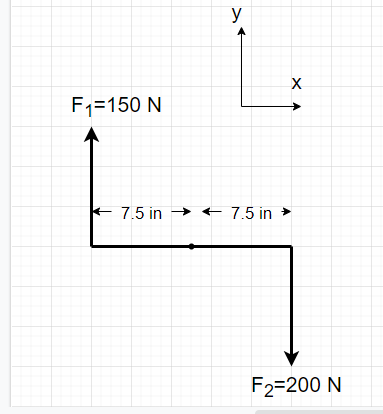
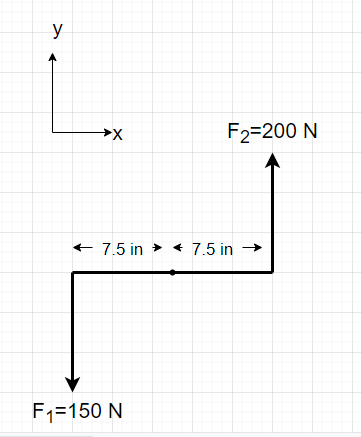
	</div>


	</div>

</div>
<div class="part-wrapper" id="part-chapter-5-trusses-wrapper">
    <div class="part  " id="part-chapter-5-trusses">
	<div class="part-title-wrap">
		<p class="part-number">V</p>
		<h1 class="part-title">Chapter 5: Trusses</h1>
	</div>
	<div class="ugc part-ugc">
		<p>This chapter will introduce you to a special type of structure called a ‘truss’. You’ll analyze these structures more in your Structures course, but for Statics you will need to know how to calculate the force in each member, using two methods: method of joints and method of sections. At first this might seem confusing, but there is something quite elegant and magical about the method once you understand it. Here are the sections in this Chapter:</p> <ul><li class="toc__title"><a href="#chapter-trusses-introduction" data-url="https://pressbooks.library.upei.ca/statics/chapter/trusses-introduction/">5.1 Trusses Introduction</a> – what are trusses?</li> <li class="toc__title"><a href="#chapter-method-of-joints" data-url="https://pressbooks.library.upei.ca/statics/chapter/method-of-joints/">5.2 Method of Joints</a> – one method of finding the forces in the truss</li> <li class="toc__title"><a href="#chapter-method-of-sections" data-url="https://pressbooks.library.upei.ca/statics/chapter/method-of-sections/">5.3 Method of Sections</a>– another method to find the forces in the truss</li> <li class="toc__title"><a href="#chapter-5-4-zero-force-members" data-url="https://pressbooks.library.upei.ca/statics/chapter/5-4-zero-force-members/">5.4 Zero-Force Members</a> – how to identify members with no forces</li> <li class="toc__title"><a href="#chapter-5-5-examples" data-url="https://pressbooks.library.upei.ca/statics/chapter/5-5-examples/">5.5 Examples&nbsp; </a>– Examples from your peers</li> </ul> <p>Here are the important equations for this chapter:</p> <p><img src="http://pressbooks.library.upei.ca/statics/wp-content/uploads/sites/56/2021/02/Screen-Shot-2021-08-29-at-7.38.37-PM-1024x576.png" alt="List of equations for Chapter 5: Method of joints, method of sections, zero force members." class="aligncenter wp-image-1492 size-large" width="1024" height="576" srcset="https://pressbooks.library.upei.ca/statics/wp-content/uploads/sites/56/2021/02/Screen-Shot-2021-08-29-at-7.38.37-PM-1024x576.png 1024w, https://pressbooks.library.upei.ca/statics/wp-content/uploads/sites/56/2021/02/Screen-Shot-2021-08-29-at-7.38.37-PM-300x169.png 300w, https://pressbooks.library.upei.ca/statics/wp-content/uploads/sites/56/2021/02/Screen-Shot-2021-08-29-at-7.38.37-PM-768x432.png 768w, https://pressbooks.library.upei.ca/statics/wp-content/uploads/sites/56/2021/02/Screen-Shot-2021-08-29-at-7.38.37-PM-1536x865.png 1536w, https://pressbooks.library.upei.ca/statics/wp-content/uploads/sites/56/2021/02/Screen-Shot-2021-08-29-at-7.38.37-PM-2048x1153.png 2048w, https://pressbooks.library.upei.ca/statics/wp-content/uploads/sites/56/2021/02/Screen-Shot-2021-08-29-at-7.38.37-PM-65x37.png 65w, https://pressbooks.library.upei.ca/statics/wp-content/uploads/sites/56/2021/02/Screen-Shot-2021-08-29-at-7.38.37-PM-225x127.png 225w, https://pressbooks.library.upei.ca/statics/wp-content/uploads/sites/56/2021/02/Screen-Shot-2021-08-29-at-7.38.37-PM-350x197.png 350w" sizes="auto, (max-width: 1024px) 100vw, 1024px" title="" /></p> <p>&nbsp;</p>
	</div>
			
				
	</div>
<div class="chapter standard with-subsections" id="chapter-trusses-introduction" title="5.1 Trusses Introduction">
	<div class="chapter-title-wrap">
		<p class="chapter-number">24</p>
		<h1 class="chapter-title">5.1 Trusses Introduction</h1>
								</div>
	<div class="ugc chapter-ugc">
				
 <p>Trusses are rigid structures made up of two-force members, which are objects with exactly two forces/connections. Trusses are commonly found in the frame of a roof and the sides of a bridge:</p> <div class="wp-caption aligncenter" id="attachment_1372" aria-describedby="caption-attachment-1372" style="width: 400px"><img src="http://pressbooks.library.upei.ca/statics/wp-content/uploads/sites/56/2021/03/bridge.jpg" alt="Metal truss bridge." class="wp-image-1372 size-full" width="400" height="200" srcset="https://pressbooks.library.upei.ca/statics/wp-content/uploads/sites/56/2021/03/bridge.jpg 400w, https://pressbooks.library.upei.ca/statics/wp-content/uploads/sites/56/2021/03/bridge-300x150.jpg 300w, https://pressbooks.library.upei.ca/statics/wp-content/uploads/sites/56/2021/03/bridge-65x33.jpg 65w, https://pressbooks.library.upei.ca/statics/wp-content/uploads/sites/56/2021/03/bridge-225x113.jpg 225w, https://pressbooks.library.upei.ca/statics/wp-content/uploads/sites/56/2021/03/bridge-350x175.jpg 350w" sizes="auto, (max-width: 400px) 100vw, 400px" title=""><div class="wp-caption-text" id="caption-attachment-1372">Source:Engineering Mechanics, Jacob Moore, et al. http://mechanicsmap.psu.edu/websites/5_structures/5-1_structures/structures.html</div></div> <p>&nbsp;</p> <p>&nbsp;</p> <div class="wp-caption aligncenter" id="attachment_552" aria-describedby="caption-attachment-552" style="width: 472px"><a href="https://commons.wikimedia.org/w/index.php?curid=47868177" data-url="https://commons.wikimedia.org/w/index.php?curid=47868177"><img src="http://pressbooks.library.upei.ca/statics/wp-content/uploads/sites/56/2021/03/Queen-post-truss.png" alt="A labelled truss system." class="wp-image-552" width="472" height="239" srcset="https://pressbooks.library.upei.ca/statics/wp-content/uploads/sites/56/2021/03/Queen-post-truss.png 504w, https://pressbooks.library.upei.ca/statics/wp-content/uploads/sites/56/2021/03/Queen-post-truss-300x152.png 300w, https://pressbooks.library.upei.ca/statics/wp-content/uploads/sites/56/2021/03/Queen-post-truss-65x33.png 65w, https://pressbooks.library.upei.ca/statics/wp-content/uploads/sites/56/2021/03/Queen-post-truss-225x114.png 225w, https://pressbooks.library.upei.ca/statics/wp-content/uploads/sites/56/2021/03/Queen-post-truss-350x177.png 350w" sizes="auto, (max-width: 472px) 100vw, 472px" title=""></a><div class="wp-caption-text" id="caption-attachment-552">Image Source: Billbeee at English Wikipedia. – Transferred from en.wikipedia to Commons., CC BY-SA 3.0,</div></div> <p>You’ll analyze these structures more in your Structures course, but for Statics, you will need to know how to calculate the force in each member, using the method of joints and the method of sections. The method of joints is more like a particle analysis, wherein you use only x and y equilibrium equations. The method of sections is more like a rigid body analysis, where you can also include the moment equilibrium equation. Those are in the next sections.</p> <h1 id="chapter-184-section-1" class="section-header">5.1.1 Two Force Members</h1> <p>Before we discuss the structure of trusses, we must begin by defining two force members:</p> <div class="textbox"><p><span>A&nbsp;</span><strong>two-force member</strong> <span>is a body that has forces (and only forces, no moments) acting on it in only two locations. In order to have a two-force member in static equilibrium, the net force at each location must be equal, opposite, and collinear. This will result in both force members being in either tension or compression as shown in the diagram below.</span></p> <div class="wp-caption aligncenter" id="attachment_2747" aria-describedby="caption-attachment-2747" style="width: 391px"><img src="http://pressbooks.library.upei.ca/statics/wp-content/uploads/sites/56/2021/03/Screenshot-2025-07-17-103727-300x122.png" alt="Diagram showing tension with arrows pulling outward and compression with arrows pushing inward on a bar." class="wp-image-2747" width="391" height="159" srcset="https://pressbooks.library.upei.ca/statics/wp-content/uploads/sites/56/2021/03/Screenshot-2025-07-17-103727-300x122.png 300w, https://pressbooks.library.upei.ca/statics/wp-content/uploads/sites/56/2021/03/Screenshot-2025-07-17-103727-65x26.png 65w, https://pressbooks.library.upei.ca/statics/wp-content/uploads/sites/56/2021/03/Screenshot-2025-07-17-103727-225x91.png 225w, https://pressbooks.library.upei.ca/statics/wp-content/uploads/sites/56/2021/03/Screenshot-2025-07-17-103727-350x142.png 350w, https://pressbooks.library.upei.ca/statics/wp-content/uploads/sites/56/2021/03/Screenshot-2025-07-17-103727.png 690w" sizes="auto, (max-width: 391px) 100vw, 391px" title=""><div class="wp-caption-text" id="caption-attachment-2747">The forces acting on two force members need to be equal, opposite, and collinear for the body to be in equilibrium.</div></div> <p>Imagine a beam where forces are only exerted at each end of the beam (a two-force member). The body has some non-zero force acting at one end of the beam, which we can draw as a force vector. If this body is in equilibrium, then we know two things: 1) the sum of the forces must be equal to zero, and 2) the sum of the moments must be equal to zero.</p> <p>In order to have the sum of the forces equal to zero, the force vector on the other side of the beam must be equal in magnitude and opposite in direction. This is the only way to ensure that the sum of the forces is equal to zero with only two forces.</p> <p>In order to have the sum of the moments equal to zero, the forces must be collinear. If the forces were not collinear, then the two equal and opposite forces would form a couple. This couple would exert a moment on the beam when there are no other moments to counteract the couple. Because the moment exerted by the two forces must be equal to zero, the perpendicular distance between the forces (d) must be equal to zero. The only way to achieve this is to have the forces be collinear.</p> <div class="wp-caption aligncenter" id="attachment_2748" aria-describedby="caption-attachment-2748" style="width: 449px"><img src="http://pressbooks.library.upei.ca/statics/wp-content/uploads/sites/56/2021/03/Screenshot-2025-07-17-104056-300x186.png" alt="Two-force member showing angled vs collinear forces." class="wp-image-2748" width="449" height="279" srcset="https://pressbooks.library.upei.ca/statics/wp-content/uploads/sites/56/2021/03/Screenshot-2025-07-17-104056-300x186.png 300w, https://pressbooks.library.upei.ca/statics/wp-content/uploads/sites/56/2021/03/Screenshot-2025-07-17-104056-768x476.png 768w, https://pressbooks.library.upei.ca/statics/wp-content/uploads/sites/56/2021/03/Screenshot-2025-07-17-104056-65x40.png 65w, https://pressbooks.library.upei.ca/statics/wp-content/uploads/sites/56/2021/03/Screenshot-2025-07-17-104056-225x139.png 225w, https://pressbooks.library.upei.ca/statics/wp-content/uploads/sites/56/2021/03/Screenshot-2025-07-17-104056-350x217.png 350w, https://pressbooks.library.upei.ca/statics/wp-content/uploads/sites/56/2021/03/Screenshot-2025-07-17-104056.png 781w" sizes="auto, (max-width: 449px) 100vw, 449px" title=""><div class="wp-caption-text" id="caption-attachment-2748">In order to have the sum of the moments be equal to zero, the forces acting on two force members must always be collinear, acting along the line connecting the two points where forces are applied.</div></div> <p>Source: Engineering Mechanics, Jacob Moore, et al. <a href="http://mechanicsmap.psu.edu/websites/5_structures/5-1_structures/structures.html" data-url="http://mechanicsmap.psu.edu/websites/5_structures/5-1_structures/structures.html">http://mechanicsmap.psu.edu/websites/5_structures/5-1_structures/structures.html</a></p> </div> <h1 id="chapter-184-section-2" class="section-header">5.1.2 Trusses</h1> <div class="textbox"><div class="wp-caption alignright" id="attachment_1373" aria-describedby="caption-attachment-1373" style="width: 250px"><img src="http://pressbooks.library.upei.ca/statics/wp-content/uploads/sites/56/2021/03/stringer.png" alt="Truss bridge with labeled plane trusses and stringers above and below the road." class="wp-image-1373 size-full" width="250" height="208" srcset="https://pressbooks.library.upei.ca/statics/wp-content/uploads/sites/56/2021/03/stringer.png 250w, https://pressbooks.library.upei.ca/statics/wp-content/uploads/sites/56/2021/03/stringer-65x54.png 65w, https://pressbooks.library.upei.ca/statics/wp-content/uploads/sites/56/2021/03/stringer-225x187.png 225w" sizes="auto, (max-width: 250px) 100vw, 250px" title=""><div class="wp-caption-text" id="caption-attachment-1373">Adapted from image by ToddC4176 CC-BY-SA 3.0</div></div> <p><span>A&nbsp;</span><strong>truss</strong><span>&nbsp;is an engineering structure that is made entirely of&nbsp;</span><strong><span class="glossary-term">two force members</span></strong><span>. In addition, statically determinate trusses (trusses that can be analyzed completely using the equilibrium equations), must be&nbsp;</span><strong>independently rigid</strong><span>. This means that if the truss was separated from its connection points, no one part would be able to move independently with respect to the rest of the truss.</span></p> <p>When we talk about analyzing a truss, we are usually looking to identify not only the external forces acting on the truss structure, but also the forces acting on each member internally in the truss. Because each member of the truss is a two-force member, we simply need to identify the magnitude of the force on each member and determine if each member is in tension or compression.</p> <p>To determine these unknowns, we have two methods available: the <strong>method of joints</strong>&nbsp;and the <strong>method of sections</strong>. Both will give the same results, but each through a different process.</p> <p>The method of joints focuses on the joints, or the connection points where the members come together. We assume we have a pin at each of these points that we model as a particle, we draw out the free body diagram for each pin, and then write out the equilibrium equations for each pin. This will result in a large number of equilibrium equations that we can use to solve for a large number of unknown forces.</p> <p>The method of sections involves pretending to split the truss into two or more different sections and then analyzing each section as a separate rigid body in equilibrium. In this method, we determine the appropriate sections, draw free-body diagrams for each section, and then write out the equilibrium equations for each section.</p> <p>The method of joints is usually the easiest and fastest method for solving for all the unknown forces in a truss. The method of sections, on the other hand, is better suited to targeting and solving for the forces in just a few members without having to solve for all the unknowns. In addition, these methods can be combined if needed to best suit the goals of the problem solver.</p> <p>Source: Engineering Mechanics, Jacob Moore, et al. https://mechanicsmap.psu.edu/websites/5_structures/5-1_structures/structures.html</p> </div> <p>&nbsp;</p> <p>Here are common types of bridge trusses:</p> <div class="wp-caption aligncenter" id="attachment_1438" aria-describedby="caption-attachment-1438" style="width: 1024px"><a href="https://eng.libretexts.org/Bookshelves/Civil_Engineering/Book%3A_Structural_Analysis_(Udoeyo)/01%3A_Chapters/1.05%3A_Internal_Forces_in_Plane_Trusses" data-url="https://eng.libretexts.org/Bookshelves/Civil_Engineering/Book%3A_Structural_Analysis_(Udoeyo)/01%3A_Chapters/1.05%3A_Internal_Forces_in_Plane_Trusses"><img src="http://pressbooks.library.upei.ca/statics/wp-content/uploads/sites/56/2021/03/bridge-truss-1024x540.jpg" alt="Pictures of different types of bridge trusses: Pratt, Howe, Baltimore, Warren, K." class="wp-image-1438 size-large" width="1024" height="540" srcset="https://pressbooks.library.upei.ca/statics/wp-content/uploads/sites/56/2021/03/bridge-truss-1024x540.jpg 1024w, https://pressbooks.library.upei.ca/statics/wp-content/uploads/sites/56/2021/03/bridge-truss-300x158.jpg 300w, https://pressbooks.library.upei.ca/statics/wp-content/uploads/sites/56/2021/03/bridge-truss-768x405.jpg 768w, https://pressbooks.library.upei.ca/statics/wp-content/uploads/sites/56/2021/03/bridge-truss-1536x810.jpg 1536w, https://pressbooks.library.upei.ca/statics/wp-content/uploads/sites/56/2021/03/bridge-truss-65x34.jpg 65w, https://pressbooks.library.upei.ca/statics/wp-content/uploads/sites/56/2021/03/bridge-truss-225x119.jpg 225w, https://pressbooks.library.upei.ca/statics/wp-content/uploads/sites/56/2021/03/bridge-truss-350x185.jpg 350w, https://pressbooks.library.upei.ca/statics/wp-content/uploads/sites/56/2021/03/bridge-truss.jpg 1800w" sizes="auto, (max-width: 1024px) 100vw, 1024px" title=""></a><div class="wp-caption-text" id="caption-attachment-1438">Source: https://eng.libretexts.org/Bookshelves/Civil_Engineering/Book%3A_Structural_Analysis_(Udoeyo)/01%3A_Chapters/1.05%3A_Internal_Forces_in_Plane_Trusses</div></div> <p>&nbsp;</p> <p>Here are common types of roof trusses:</p> <div class="wp-caption aligncenter" id="attachment_1439" aria-describedby="caption-attachment-1439" style="width: 1024px"><a href="https://eng.libretexts.org/Bookshelves/Civil_Engineering/Book%3A_Structural_Analysis_(Udoeyo)/01%3A_Chapters/1.05%3A_Internal_Forces_in_Plane_Trusses" data-url="https://eng.libretexts.org/Bookshelves/Civil_Engineering/Book%3A_Structural_Analysis_(Udoeyo)/01%3A_Chapters/1.05%3A_Internal_Forces_in_Plane_Trusses"><img src="http://pressbooks.library.upei.ca/statics/wp-content/uploads/sites/56/2021/03/roof-truss-1024x402.jpg" alt="Pictures of different types of roof trusses: Howe, Pratt, Warren, Fink ." class="wp-image-1439 size-large" width="1024" height="402" srcset="https://pressbooks.library.upei.ca/statics/wp-content/uploads/sites/56/2021/03/roof-truss-1024x402.jpg 1024w, https://pressbooks.library.upei.ca/statics/wp-content/uploads/sites/56/2021/03/roof-truss-300x118.jpg 300w, https://pressbooks.library.upei.ca/statics/wp-content/uploads/sites/56/2021/03/roof-truss-768x302.jpg 768w, https://pressbooks.library.upei.ca/statics/wp-content/uploads/sites/56/2021/03/roof-truss-1536x603.jpg 1536w, https://pressbooks.library.upei.ca/statics/wp-content/uploads/sites/56/2021/03/roof-truss-65x26.jpg 65w, https://pressbooks.library.upei.ca/statics/wp-content/uploads/sites/56/2021/03/roof-truss-225x88.jpg 225w, https://pressbooks.library.upei.ca/statics/wp-content/uploads/sites/56/2021/03/roof-truss-350x137.jpg 350w, https://pressbooks.library.upei.ca/statics/wp-content/uploads/sites/56/2021/03/roof-truss.jpg 1800w" sizes="auto, (max-width: 1024px) 100vw, 1024px" title=""></a><div class="wp-caption-text" id="caption-attachment-1439">Source: https://eng.libretexts.org/Bookshelves/Civil_Engineering/Book%3A_Structural_Analysis_(Udoeyo)/01%3A_Chapters/1.05%3A_Internal_Forces_in_Plane_Trusses</div></div> <p>&nbsp;</p> <h1 id="chapter-184-section-3" class="section-header">5.1.3 Parts of a Truss</h1> <p>A truss is composed of:</p> <ul><li>joints</li> <li>members, and</li> <li>external forces (reaction forces and applied forces).</li> </ul> <p>&nbsp;</p> <p>The <strong><span style="text-decoration: underline"><em>joints</em></span></strong> are often labelled with a letter and are where the external forces and members connect.</p> <p><img src="http://pressbooks.library.upei.ca/statics/wp-content/uploads/sites/56/2021/03/Screen-Shot-2021-08-23-at-7.15.10-PM-1024x403.png" alt="A sketch of a truss system with each joint labelled a through g." class="aligncenter wp-image-1329 size-large" width="1024" height="403" srcset="https://pressbooks.library.upei.ca/statics/wp-content/uploads/sites/56/2021/03/Screen-Shot-2021-08-23-at-7.15.10-PM-1024x403.png 1024w, https://pressbooks.library.upei.ca/statics/wp-content/uploads/sites/56/2021/03/Screen-Shot-2021-08-23-at-7.15.10-PM-300x118.png 300w, https://pressbooks.library.upei.ca/statics/wp-content/uploads/sites/56/2021/03/Screen-Shot-2021-08-23-at-7.15.10-PM-768x302.png 768w, https://pressbooks.library.upei.ca/statics/wp-content/uploads/sites/56/2021/03/Screen-Shot-2021-08-23-at-7.15.10-PM-1536x605.png 1536w, https://pressbooks.library.upei.ca/statics/wp-content/uploads/sites/56/2021/03/Screen-Shot-2021-08-23-at-7.15.10-PM-2048x807.png 2048w, https://pressbooks.library.upei.ca/statics/wp-content/uploads/sites/56/2021/03/Screen-Shot-2021-08-23-at-7.15.10-PM-65x26.png 65w, https://pressbooks.library.upei.ca/statics/wp-content/uploads/sites/56/2021/03/Screen-Shot-2021-08-23-at-7.15.10-PM-225x89.png 225w, https://pressbooks.library.upei.ca/statics/wp-content/uploads/sites/56/2021/03/Screen-Shot-2021-08-23-at-7.15.10-PM-350x138.png 350w" sizes="auto, (max-width: 1024px) 100vw, 1024px" title="">Here is an example of just the joints without the members:</p> <div></div> <div class="textbox"><p>&nbsp;</p> <div class="wp-caption aligncenter" id="attachment_2749" aria-describedby="caption-attachment-2749" style="width: 444px"><img src="http://pressbooks.library.upei.ca/statics/wp-content/uploads/sites/56/2021/03/Screenshot-2025-07-17-105039-300x146.png" alt="Truss structure with labeled members and support reaction forces, including a 6 kN downward force at the center." class="wp-image-2749" width="444" height="216" srcset="https://pressbooks.library.upei.ca/statics/wp-content/uploads/sites/56/2021/03/Screenshot-2025-07-17-105039-300x146.png 300w, https://pressbooks.library.upei.ca/statics/wp-content/uploads/sites/56/2021/03/Screenshot-2025-07-17-105039-768x374.png 768w, https://pressbooks.library.upei.ca/statics/wp-content/uploads/sites/56/2021/03/Screenshot-2025-07-17-105039-65x32.png 65w, https://pressbooks.library.upei.ca/statics/wp-content/uploads/sites/56/2021/03/Screenshot-2025-07-17-105039-225x110.png 225w, https://pressbooks.library.upei.ca/statics/wp-content/uploads/sites/56/2021/03/Screenshot-2025-07-17-105039-350x170.png 350w, https://pressbooks.library.upei.ca/statics/wp-content/uploads/sites/56/2021/03/Screenshot-2025-07-17-105039.png 930w" sizes="auto, (max-width: 444px) 100vw, 444px" title=""><div class="wp-caption-text" id="caption-attachment-2749">Treat the entire truss as a rigid body and solve for the reaction forces supporting the truss structure.</div></div> <p><a href="http://mechanicsmap.psu.edu/websites/5_structures/5-4_method_of_joints/methodofjoints.html" data-url="http://mechanicsmap.psu.edu/websites/5_structures/5-4_method_of_joints/methodofjoints.html"><img src="http://pressbooks.library.upei.ca/statics/wp-content/uploads/sites/56/2021/03/MOJjoints2.png" alt="Free body diagrams for joints 1, 2, 3, and 4 in a truss, showing the directions and magnitudes of internal member forces and external loads." class="aligncenter wp-image-1426 size-full" width="400" height="215" srcset="https://pressbooks.library.upei.ca/statics/wp-content/uploads/sites/56/2021/03/MOJjoints2.png 400w, https://pressbooks.library.upei.ca/statics/wp-content/uploads/sites/56/2021/03/MOJjoints2-300x161.png 300w, https://pressbooks.library.upei.ca/statics/wp-content/uploads/sites/56/2021/03/MOJjoints2-65x35.png 65w, https://pressbooks.library.upei.ca/statics/wp-content/uploads/sites/56/2021/03/MOJjoints2-225x121.png 225w, https://pressbooks.library.upei.ca/statics/wp-content/uploads/sites/56/2021/03/MOJjoints2-350x188.png 350w" sizes="auto, (max-width: 400px) 100vw, 400px" title=""></a>Source: Engineering Mechanics, Jacob Moore, et al. https://mechanicsmap.psu.edu/websites/5_structures/5-3_method_of_joints/methodofjoints.html&nbsp;<a href="http://mechanicsmap.psu.edu/websites/5_structures/5-4_method_of_joints/methodofjoints.html" data-url="http://mechanicsmap.psu.edu/websites/5_structures/5-4_method_of_joints/methodofjoints.html"></a></p> </div> <p>The <em><span style="text-decoration: underline"><strong>members</strong></span></em> are the metal or wooden beams that are labelled with the connection between joints. For example member AB connects joints A and B.</p> <p><img src="http://pressbooks.library.upei.ca/statics/wp-content/uploads/sites/56/2021/03/members-1024x347.png" alt="A sketch of a truss system with each member labelled." class="aligncenter wp-image-1326 size-large" width="1024" height="347" srcset="https://pressbooks.library.upei.ca/statics/wp-content/uploads/sites/56/2021/03/members-1024x347.png 1024w, https://pressbooks.library.upei.ca/statics/wp-content/uploads/sites/56/2021/03/members-300x102.png 300w, https://pressbooks.library.upei.ca/statics/wp-content/uploads/sites/56/2021/03/members-768x260.png 768w, https://pressbooks.library.upei.ca/statics/wp-content/uploads/sites/56/2021/03/members-1536x521.png 1536w, https://pressbooks.library.upei.ca/statics/wp-content/uploads/sites/56/2021/03/members-2048x694.png 2048w, https://pressbooks.library.upei.ca/statics/wp-content/uploads/sites/56/2021/03/members-65x22.png 65w, https://pressbooks.library.upei.ca/statics/wp-content/uploads/sites/56/2021/03/members-225x76.png 225w, https://pressbooks.library.upei.ca/statics/wp-content/uploads/sites/56/2021/03/members-350x119.png 350w" sizes="auto, (max-width: 1024px) 100vw, 1024px" title=""></p> <p>The <strong><span style="text-decoration: underline"><em>external forces</em></span></strong> are the reaction forces and the applied forces. The applied forces come from the load distributed across the bridge or from the roof.</p> <p><img src="http://pressbooks.library.upei.ca/statics/wp-content/uploads/sites/56/2021/03/Screen-Shot-2021-08-23-at-7.15.21-PM-1024x427.png" alt="A sketch of a truss system with external forces shown." class="aligncenter wp-image-1328 size-large" width="1024" height="427" srcset="https://pressbooks.library.upei.ca/statics/wp-content/uploads/sites/56/2021/03/Screen-Shot-2021-08-23-at-7.15.21-PM-1024x427.png 1024w, https://pressbooks.library.upei.ca/statics/wp-content/uploads/sites/56/2021/03/Screen-Shot-2021-08-23-at-7.15.21-PM-300x125.png 300w, https://pressbooks.library.upei.ca/statics/wp-content/uploads/sites/56/2021/03/Screen-Shot-2021-08-23-at-7.15.21-PM-768x320.png 768w, https://pressbooks.library.upei.ca/statics/wp-content/uploads/sites/56/2021/03/Screen-Shot-2021-08-23-at-7.15.21-PM-1536x641.png 1536w, https://pressbooks.library.upei.ca/statics/wp-content/uploads/sites/56/2021/03/Screen-Shot-2021-08-23-at-7.15.21-PM-2048x855.png 2048w, https://pressbooks.library.upei.ca/statics/wp-content/uploads/sites/56/2021/03/Screen-Shot-2021-08-23-at-7.15.21-PM-65x27.png 65w, https://pressbooks.library.upei.ca/statics/wp-content/uploads/sites/56/2021/03/Screen-Shot-2021-08-23-at-7.15.21-PM-225x94.png 225w, https://pressbooks.library.upei.ca/statics/wp-content/uploads/sites/56/2021/03/Screen-Shot-2021-08-23-at-7.15.21-PM-350x146.png 350w" sizes="auto, (max-width: 1024px) 100vw, 1024px" title=""></p> <p>The applied force/load from trucks and cars goes from the deck to the stringers, across the beams, to the joints of the truss, where it is carried as applied (external) forces on the edges of the bridge.</p> <p>&nbsp;</p> <div class="wp-caption aligncenter" id="attachment_1319" aria-describedby="caption-attachment-1319" style="width: 1024px"><a href="https://upload.wikimedia.org/wikipedia/en/2/25/Nine_stringers%2C_2_floorbeams.jpg" data-url="https://upload.wikimedia.org/wikipedia/en/2/25/Nine_stringers%2C_2_floorbeams.jpg"><img src="http://pressbooks.library.upei.ca/statics/wp-content/uploads/sites/56/2021/03/Nine_stringers_2_floorbeams-1024x700.jpg" alt="Bridge deck showing how the load transfers from the deck to the stringers, across the beams, and finally to the truss joints." class="wp-image-1319 size-large" width="1024" height="700" srcset="https://pressbooks.library.upei.ca/statics/wp-content/uploads/sites/56/2021/03/Nine_stringers_2_floorbeams-1024x700.jpg 1024w, https://pressbooks.library.upei.ca/statics/wp-content/uploads/sites/56/2021/03/Nine_stringers_2_floorbeams-300x205.jpg 300w, https://pressbooks.library.upei.ca/statics/wp-content/uploads/sites/56/2021/03/Nine_stringers_2_floorbeams-768x525.jpg 768w, https://pressbooks.library.upei.ca/statics/wp-content/uploads/sites/56/2021/03/Nine_stringers_2_floorbeams-1536x1050.jpg 1536w, https://pressbooks.library.upei.ca/statics/wp-content/uploads/sites/56/2021/03/Nine_stringers_2_floorbeams-2048x1399.jpg 2048w, https://pressbooks.library.upei.ca/statics/wp-content/uploads/sites/56/2021/03/Nine_stringers_2_floorbeams-65x44.jpg 65w, https://pressbooks.library.upei.ca/statics/wp-content/uploads/sites/56/2021/03/Nine_stringers_2_floorbeams-225x154.jpg 225w, https://pressbooks.library.upei.ca/statics/wp-content/uploads/sites/56/2021/03/Nine_stringers_2_floorbeams-350x239.jpg 350w" sizes="auto, (max-width: 1024px) 100vw, 1024px" title=""></a><div class="wp-caption-text" id="caption-attachment-1319">Image annotated from original source: https://upload.wikimedia.org/wikipedia/en/2/25/Nine_stringers%2C_2_floorbeams.jpg</div></div> <p>&nbsp;</p> <p>Here is a second type of structure. Which are the <span style="color: #3366ff"><em><span style="text-decoration: underline"><strong>stringers</strong></span></em> </span>and which are the <span style="text-decoration: underline"><em><strong><span style="color: #3366ff;text-decoration: underline">beams</span></strong></em></span>?</p> <p>&nbsp;</p> <div class="wp-caption aligncenter" id="attachment_1321" aria-describedby="caption-attachment-1321" style="width: 1024px"><a href="https://www.maxpixel.net/static/photo/1x/Buildings-Leaves-Park-Autumn-Road-Fall-Structure-5623840.jpg" data-url="https://www.maxpixel.net/static/photo/1x/Buildings-Leaves-Park-Autumn-Road-Fall-Structure-5623840.jpg"><img src="http://pressbooks.library.upei.ca/statics/wp-content/uploads/sites/56/2021/03/MaxPixel.net-Buildings-Leaves-Park-Autumn-Road-Fall-Structure-5623840-1024x628.jpg" alt="Curved steel canopy structure with coloured arrows pointing to different structural elements in question." class="wp-image-1321 size-large" width="1024" height="628" srcset="https://pressbooks.library.upei.ca/statics/wp-content/uploads/sites/56/2021/03/MaxPixel.net-Buildings-Leaves-Park-Autumn-Road-Fall-Structure-5623840-1024x628.jpg 1024w, https://pressbooks.library.upei.ca/statics/wp-content/uploads/sites/56/2021/03/MaxPixel.net-Buildings-Leaves-Park-Autumn-Road-Fall-Structure-5623840-300x184.jpg 300w, https://pressbooks.library.upei.ca/statics/wp-content/uploads/sites/56/2021/03/MaxPixel.net-Buildings-Leaves-Park-Autumn-Road-Fall-Structure-5623840-768x471.jpg 768w, https://pressbooks.library.upei.ca/statics/wp-content/uploads/sites/56/2021/03/MaxPixel.net-Buildings-Leaves-Park-Autumn-Road-Fall-Structure-5623840-1536x942.jpg 1536w, https://pressbooks.library.upei.ca/statics/wp-content/uploads/sites/56/2021/03/MaxPixel.net-Buildings-Leaves-Park-Autumn-Road-Fall-Structure-5623840-65x40.jpg 65w, https://pressbooks.library.upei.ca/statics/wp-content/uploads/sites/56/2021/03/MaxPixel.net-Buildings-Leaves-Park-Autumn-Road-Fall-Structure-5623840-225x138.jpg 225w, https://pressbooks.library.upei.ca/statics/wp-content/uploads/sites/56/2021/03/MaxPixel.net-Buildings-Leaves-Park-Autumn-Road-Fall-Structure-5623840-350x215.jpg 350w, https://pressbooks.library.upei.ca/statics/wp-content/uploads/sites/56/2021/03/MaxPixel.net-Buildings-Leaves-Park-Autumn-Road-Fall-Structure-5623840.jpg 1784w" sizes="auto, (max-width: 1024px) 100vw, 1024px" title=""></a><div class="wp-caption-text" id="caption-attachment-1321">Annotations added from original image source: https://www.maxpixel.net/static/photo/1x/Buildings-Leaves-Park-Autumn-Road-Fall-Structure-5623840.jpg</div></div> <p>.</p> <p>.</p> <p>.</p> <p>.</p> <p>.</p> <p>.</p> <p>Any ideas?</p> <p>.</p> <p>.</p> <p>.</p> <p>.</p> <p>.</p> <p>Here’s the answer!</p> <p>&nbsp;</p> <div class="wp-caption aligncenter" id="attachment_1322" aria-describedby="caption-attachment-1322" style="width: 1024px"><img src="http://pressbooks.library.upei.ca/statics/wp-content/uploads/sites/56/2021/03/updated-1024x617.jpg" alt="Curved steel canopy structure with coloured arrows pointing to different structural elements in question.Answer: Beams=red arrows and stringers=yellow arrows." class="wp-image-1322 size-large" width="1024" height="617" srcset="https://pressbooks.library.upei.ca/statics/wp-content/uploads/sites/56/2021/03/updated-1024x617.jpg 1024w, https://pressbooks.library.upei.ca/statics/wp-content/uploads/sites/56/2021/03/updated-300x181.jpg 300w, https://pressbooks.library.upei.ca/statics/wp-content/uploads/sites/56/2021/03/updated-768x463.jpg 768w, https://pressbooks.library.upei.ca/statics/wp-content/uploads/sites/56/2021/03/updated-1536x925.jpg 1536w, https://pressbooks.library.upei.ca/statics/wp-content/uploads/sites/56/2021/03/updated-65x39.jpg 65w, https://pressbooks.library.upei.ca/statics/wp-content/uploads/sites/56/2021/03/updated-225x136.jpg 225w, https://pressbooks.library.upei.ca/statics/wp-content/uploads/sites/56/2021/03/updated-350x211.jpg 350w, https://pressbooks.library.upei.ca/statics/wp-content/uploads/sites/56/2021/03/updated.jpg 1831w" sizes="auto, (max-width: 1024px) 100vw, 1024px" title=""><div class="wp-caption-text" id="caption-attachment-1322">Annotations added from original source: https://www.maxpixel.net/static/photo/1x/Buildings-Leaves-Park-Autumn-Road-Fall-Structure-5623840.jpg</div></div> <p>&nbsp;</p> <p>Here are some examples of how to convert the reaction forces/moments for a truss. Note: these are the same as in section 3.4.</p> <div class="textbox"><p><img src="http://pressbooks.library.upei.ca/statics/wp-content/uploads/sites/56/2021/03/ex-1024x303.jpg" alt="Free-body diagram of a bridge truss showing external support reactions." class="aligncenter wp-image-1441 size-large" width="1024" height="303" srcset="https://pressbooks.library.upei.ca/statics/wp-content/uploads/sites/56/2021/03/ex-1024x303.jpg 1024w, https://pressbooks.library.upei.ca/statics/wp-content/uploads/sites/56/2021/03/ex-300x89.jpg 300w, https://pressbooks.library.upei.ca/statics/wp-content/uploads/sites/56/2021/03/ex-768x227.jpg 768w, https://pressbooks.library.upei.ca/statics/wp-content/uploads/sites/56/2021/03/ex-1536x455.jpg 1536w, https://pressbooks.library.upei.ca/statics/wp-content/uploads/sites/56/2021/03/ex-65x19.jpg 65w, https://pressbooks.library.upei.ca/statics/wp-content/uploads/sites/56/2021/03/ex-225x67.jpg 225w, https://pressbooks.library.upei.ca/statics/wp-content/uploads/sites/56/2021/03/ex-350x104.jpg 350w, https://pressbooks.library.upei.ca/statics/wp-content/uploads/sites/56/2021/03/ex.jpg 1713w" sizes="auto, (max-width: 1024px) 100vw, 1024px" title=""><img src="http://pressbooks.library.upei.ca/statics/wp-content/uploads/sites/56/2021/03/ex3-1024x307.jpg" alt="Bridge truss with its free-body diagram (FBD) showing support reactions." class="aligncenter wp-image-1443 size-large" width="1024" height="307" srcset="https://pressbooks.library.upei.ca/statics/wp-content/uploads/sites/56/2021/03/ex3-1024x307.jpg 1024w, https://pressbooks.library.upei.ca/statics/wp-content/uploads/sites/56/2021/03/ex3-300x90.jpg 300w, https://pressbooks.library.upei.ca/statics/wp-content/uploads/sites/56/2021/03/ex3-768x231.jpg 768w, https://pressbooks.library.upei.ca/statics/wp-content/uploads/sites/56/2021/03/ex3-1536x461.jpg 1536w, https://pressbooks.library.upei.ca/statics/wp-content/uploads/sites/56/2021/03/ex3-65x20.jpg 65w, https://pressbooks.library.upei.ca/statics/wp-content/uploads/sites/56/2021/03/ex3-225x68.jpg 225w, https://pressbooks.library.upei.ca/statics/wp-content/uploads/sites/56/2021/03/ex3-350x105.jpg 350w, https://pressbooks.library.upei.ca/statics/wp-content/uploads/sites/56/2021/03/ex3.jpg 1589w" sizes="auto, (max-width: 1024px) 100vw, 1024px" title=""><img src="http://pressbooks.library.upei.ca/statics/wp-content/uploads/sites/56/2021/03/ex2-1024x243.jpg" alt="Bridge truss and its free-body diagram showing support reactions." class="aligncenter wp-image-1442 size-large" width="1024" height="243" srcset="https://pressbooks.library.upei.ca/statics/wp-content/uploads/sites/56/2021/03/ex2-1024x243.jpg 1024w, https://pressbooks.library.upei.ca/statics/wp-content/uploads/sites/56/2021/03/ex2-300x71.jpg 300w, https://pressbooks.library.upei.ca/statics/wp-content/uploads/sites/56/2021/03/ex2-768x182.jpg 768w, https://pressbooks.library.upei.ca/statics/wp-content/uploads/sites/56/2021/03/ex2-1536x365.jpg 1536w, https://pressbooks.library.upei.ca/statics/wp-content/uploads/sites/56/2021/03/ex2-65x15.jpg 65w, https://pressbooks.library.upei.ca/statics/wp-content/uploads/sites/56/2021/03/ex2-225x53.jpg 225w, https://pressbooks.library.upei.ca/statics/wp-content/uploads/sites/56/2021/03/ex2-350x83.jpg 350w, https://pressbooks.library.upei.ca/statics/wp-content/uploads/sites/56/2021/03/ex2.jpg 1862w" sizes="auto, (max-width: 1024px) 100vw, 1024px" title=""><img src="http://pressbooks.library.upei.ca/statics/wp-content/uploads/sites/56/2021/03/ex2-1024x243.jpg" alt="Bridge truss and its free-body diagram showing support reactions." class="aligncenter wp-image-1442 size-large" width="1024" height="243" srcset="https://pressbooks.library.upei.ca/statics/wp-content/uploads/sites/56/2021/03/ex2-1024x243.jpg 1024w, https://pressbooks.library.upei.ca/statics/wp-content/uploads/sites/56/2021/03/ex2-300x71.jpg 300w, https://pressbooks.library.upei.ca/statics/wp-content/uploads/sites/56/2021/03/ex2-768x182.jpg 768w, https://pressbooks.library.upei.ca/statics/wp-content/uploads/sites/56/2021/03/ex2-1536x365.jpg 1536w, https://pressbooks.library.upei.ca/statics/wp-content/uploads/sites/56/2021/03/ex2-65x15.jpg 65w, https://pressbooks.library.upei.ca/statics/wp-content/uploads/sites/56/2021/03/ex2-225x53.jpg 225w, https://pressbooks.library.upei.ca/statics/wp-content/uploads/sites/56/2021/03/ex2-350x83.jpg 350w, https://pressbooks.library.upei.ca/statics/wp-content/uploads/sites/56/2021/03/ex2.jpg 1862w" sizes="auto, (max-width: 1024px) 100vw, 1024px" title=""></p> <p>Source: Internal Forces in Beams and Frames, Libretexts. <a href="https://eng.libretexts.org/Bookshelves/Civil_Engineering/Book%3A_Structural_Analysis_(Udoeyo)/01%3A_Chapters/1.05%3A_Internal_Forces_in_Plane_Trusses" data-url="https://eng.libretexts.org/Bookshelves/Civil_Engineering/Book%3A_Structural_Analysis_(Udoeyo)/01%3A_Chapters/1.05%3A_Internal_Forces_in_Plane_Trusses">https://eng.libretexts.org/Bookshelves/Civil_Engineering/Book%3A_Structural_Analysis_(Udoeyo)/01%3A_Chapters/1.05%3A_Internal_Forces_in_Plane_Trusses</a></p> </div> <h1 id="chapter-184-section-4" class="section-header">5.1.4 Tension &amp; Compression</h1> <p>The two-force members carry internal forces in either tension or compression between the joints. One standard sign convention is to assume all members are in tension, labelled as positive (+), then any negative number (-) means the member is in compression.</p> <p>&nbsp;</p> <div class="wp-caption aligncenter" id="attachment_1335" aria-describedby="caption-attachment-1335" style="width: 410px"><a href="https://www.flickr.com/photos/121935927@N06/13580545445" data-url="https://www.flickr.com/photos/121935927@N06/13580545445"><img src="http://pressbooks.library.upei.ca/statics/wp-content/uploads/sites/56/2021/03/Screen-Shot-2021-08-23-at-7.36.47-PM-1024x858.png" alt="Visual showing effects of compression and tension forces on a rectangular object." class="wp-image-1335" width="410" height="344" srcset="https://pressbooks.library.upei.ca/statics/wp-content/uploads/sites/56/2021/03/Screen-Shot-2021-08-23-at-7.36.47-PM-1024x858.png 1024w, https://pressbooks.library.upei.ca/statics/wp-content/uploads/sites/56/2021/03/Screen-Shot-2021-08-23-at-7.36.47-PM-300x251.png 300w, https://pressbooks.library.upei.ca/statics/wp-content/uploads/sites/56/2021/03/Screen-Shot-2021-08-23-at-7.36.47-PM-768x644.png 768w, https://pressbooks.library.upei.ca/statics/wp-content/uploads/sites/56/2021/03/Screen-Shot-2021-08-23-at-7.36.47-PM-65x54.png 65w, https://pressbooks.library.upei.ca/statics/wp-content/uploads/sites/56/2021/03/Screen-Shot-2021-08-23-at-7.36.47-PM-225x189.png 225w, https://pressbooks.library.upei.ca/statics/wp-content/uploads/sites/56/2021/03/Screen-Shot-2021-08-23-at-7.36.47-PM-350x293.png 350w, https://pressbooks.library.upei.ca/statics/wp-content/uploads/sites/56/2021/03/Screen-Shot-2021-08-23-at-7.36.47-PM.png 1532w" sizes="auto, (max-width: 410px) 100vw, 410px" title=""></a><div class="wp-caption-text" id="caption-attachment-1335">Source: https://www.flickr.com/photos/121935927@N06/13580545445</div></div> <p>Following Newton’s 3rd law regarding equal and opposite reactions, when there is tension in a member, there is also tension in a joint. Pulling on the member (tension) in turn pulls on the joint. Similarly, pushing on a member (compression) pushes on the joint as well.</p> <p><img src="http://pressbooks.library.upei.ca/statics/wp-content/uploads/sites/56/2021/03/tens-compr-1024x214.png" alt="Diagram showing tension as pulling and compression as pushing forces at joints and members in a truss structure." class="aligncenter wp-image-1331 size-large" width="1024" height="214" srcset="https://pressbooks.library.upei.ca/statics/wp-content/uploads/sites/56/2021/03/tens-compr-1024x214.png 1024w, https://pressbooks.library.upei.ca/statics/wp-content/uploads/sites/56/2021/03/tens-compr-300x63.png 300w, https://pressbooks.library.upei.ca/statics/wp-content/uploads/sites/56/2021/03/tens-compr-768x160.png 768w, https://pressbooks.library.upei.ca/statics/wp-content/uploads/sites/56/2021/03/tens-compr-1536x321.png 1536w, https://pressbooks.library.upei.ca/statics/wp-content/uploads/sites/56/2021/03/tens-compr-2048x428.png 2048w, https://pressbooks.library.upei.ca/statics/wp-content/uploads/sites/56/2021/03/tens-compr-65x14.png 65w, https://pressbooks.library.upei.ca/statics/wp-content/uploads/sites/56/2021/03/tens-compr-225x47.png 225w, https://pressbooks.library.upei.ca/statics/wp-content/uploads/sites/56/2021/03/tens-compr-350x73.png 350w" sizes="auto, (max-width: 1024px) 100vw, 1024px" title=""></p> <p>Similarly, the force from member AB (F<sub>ab</sub>) is distributed from joint a through member ab to joint b. Shown here in compression, F<sub>ab </sub>is negative. The magnitude of F<sub>ab</sub> on <span style="text-decoration: underline">joint a</span> is the same as the magnitude on <span style="text-decoration: underline">joint b</span>, even though they are pointing in two different directions (hence equal and opposite). Member bc will have a different magnitude.</p> <p><img src="http://pressbooks.library.upei.ca/statics/wp-content/uploads/sites/56/2021/03/force-in-member-1024x331.png" alt="Diagram of a truss member ab under tension, showing equal and opposite forces F_ab acting on joints a and b." class="aligncenter wp-image-1332 size-large" width="1024" height="331" srcset="https://pressbooks.library.upei.ca/statics/wp-content/uploads/sites/56/2021/03/force-in-member-1024x331.png 1024w, https://pressbooks.library.upei.ca/statics/wp-content/uploads/sites/56/2021/03/force-in-member-300x97.png 300w, https://pressbooks.library.upei.ca/statics/wp-content/uploads/sites/56/2021/03/force-in-member-768x249.png 768w, https://pressbooks.library.upei.ca/statics/wp-content/uploads/sites/56/2021/03/force-in-member-65x21.png 65w, https://pressbooks.library.upei.ca/statics/wp-content/uploads/sites/56/2021/03/force-in-member-225x73.png 225w, https://pressbooks.library.upei.ca/statics/wp-content/uploads/sites/56/2021/03/force-in-member-350x113.png 350w, https://pressbooks.library.upei.ca/statics/wp-content/uploads/sites/56/2021/03/force-in-member.png 1502w" sizes="auto, (max-width: 1024px) 100vw, 1024px" title=""></p> <p>When you look at each joint, compression (-) appears to be pushing on the joint while tension (+) is pulling on it with the force named for the member ( F<sub>ab</sub> ).<img src="http://pressbooks.library.upei.ca/statics/wp-content/uploads/sites/56/2021/03/joint-1.png" alt="Free body diagram of joint a showing forces either in compression or tension acting on it." class="aligncenter wp-image-1333" width="330" height="248" srcset="https://pressbooks.library.upei.ca/statics/wp-content/uploads/sites/56/2021/03/joint-1.png 728w, https://pressbooks.library.upei.ca/statics/wp-content/uploads/sites/56/2021/03/joint-1-300x225.png 300w, https://pressbooks.library.upei.ca/statics/wp-content/uploads/sites/56/2021/03/joint-1-65x49.png 65w, https://pressbooks.library.upei.ca/statics/wp-content/uploads/sites/56/2021/03/joint-1-225x169.png 225w, https://pressbooks.library.upei.ca/statics/wp-content/uploads/sites/56/2021/03/joint-1-350x263.png 350w" sizes="auto, (max-width: 330px) 100vw, 330px" title=""></p> <p>In the next section, we will discuss each of these methods in greater detail and how to solve problems using them.</p> <p>&nbsp;</p> <div class="textbox textbox--key-takeaways"><div class="textbox__header"><p class="textbox__title">Key Takeaways</p> </div> <div class="textbox__content"><p><em>Basically</em>: A truss is a rigid structure composed of two force members (where forces are applied at only two locations) that connect at joints and have external forces applied. The internal forces of the truss put members in compression (-) or tension (+). <strong><br> </strong></p> <p><em>Application:</em> The frame of a roof is often composed of a wooden truss, and trusses are commonly found in wooden and metal bridges.</p> <p><em>Looking Ahead:</em> The next two sections discuss the method for calculating the force in the members &amp; you’ll talk about trusses more in your Structures course.</p> </div> </div> <p>&nbsp;</p> 

	</div>


	</div>
<div class="chapter standard with-subsections" id="chapter-method-of-joints" title="5.2 Method of Joints">
	<div class="chapter-title-wrap">
		<p class="chapter-number">25</p>
		<h1 class="chapter-title">5.2 Method of Joints</h1>
								</div>
	<div class="ugc chapter-ugc">
				 <p>The <span style="text-decoration: underline"><strong><em>method of joints</em></strong></span> is a form of particle analysis. After solving for the reaction forces, you solve for the unknown forces at each joint until you have found the value of each member. You start with your model:</p> <p><img src="http://pressbooks.library.upei.ca/statics/wp-content/uploads/sites/56/2021/03/1-Model-1024x515.png" alt="Truss bridge with loads of 100 lb at joint g and 50 lb at joint f, supported at joints a and e." class="aligncenter wp-image-1339 size-large" width="1024" height="515" srcset="https://pressbooks.library.upei.ca/statics/wp-content/uploads/sites/56/2021/03/1-Model-1024x515.png 1024w, https://pressbooks.library.upei.ca/statics/wp-content/uploads/sites/56/2021/03/1-Model-300x151.png 300w, https://pressbooks.library.upei.ca/statics/wp-content/uploads/sites/56/2021/03/1-Model-768x386.png 768w, https://pressbooks.library.upei.ca/statics/wp-content/uploads/sites/56/2021/03/1-Model-1536x773.png 1536w, https://pressbooks.library.upei.ca/statics/wp-content/uploads/sites/56/2021/03/1-Model-65x33.png 65w, https://pressbooks.library.upei.ca/statics/wp-content/uploads/sites/56/2021/03/1-Model-225x113.png 225w, https://pressbooks.library.upei.ca/statics/wp-content/uploads/sites/56/2021/03/1-Model-350x176.png 350w, https://pressbooks.library.upei.ca/statics/wp-content/uploads/sites/56/2021/03/1-Model.png 1868w" sizes="auto, (max-width: 1024px) 100vw, 1024px" title="" /></p> <p>Convert the constraints into reaction forces with the appropriate labels:</p> <p><img src="http://pressbooks.library.upei.ca/statics/wp-content/uploads/sites/56/2021/03/Screen-Shot-2021-08-23-at-8.38.01-PM-1024x431.png" alt="FBD of the truss bridge." class="aligncenter wp-image-1345 size-large" width="1024" height="431" srcset="https://pressbooks.library.upei.ca/statics/wp-content/uploads/sites/56/2021/03/Screen-Shot-2021-08-23-at-8.38.01-PM-1024x431.png 1024w, https://pressbooks.library.upei.ca/statics/wp-content/uploads/sites/56/2021/03/Screen-Shot-2021-08-23-at-8.38.01-PM-300x126.png 300w, https://pressbooks.library.upei.ca/statics/wp-content/uploads/sites/56/2021/03/Screen-Shot-2021-08-23-at-8.38.01-PM-768x323.png 768w, https://pressbooks.library.upei.ca/statics/wp-content/uploads/sites/56/2021/03/Screen-Shot-2021-08-23-at-8.38.01-PM-65x27.png 65w, https://pressbooks.library.upei.ca/statics/wp-content/uploads/sites/56/2021/03/Screen-Shot-2021-08-23-at-8.38.01-PM-225x95.png 225w, https://pressbooks.library.upei.ca/statics/wp-content/uploads/sites/56/2021/03/Screen-Shot-2021-08-23-at-8.38.01-PM-350x147.png 350w, https://pressbooks.library.upei.ca/statics/wp-content/uploads/sites/56/2021/03/Screen-Shot-2021-08-23-at-8.38.01-PM.png 1244w" sizes="auto, (max-width: 1024px) 100vw, 1024px" title="" /></p> <p>&nbsp;</p> <p>Now solve for the reaction forces (R<sub>ax&nbsp;</sub> R<sub>ay</sub>&nbsp; R<sub>e</sub>) looking only at the external forces using the equilibrium equations for a rigid body:</p> <p style="text-align: center">$$\sum F_x=0\\\sum F_y=0\\\sum M=0$$</p> <p>Assuming the length of each member is L:</p> <p style="text-align: center">$$\sum F_x=R_{ax} = 0, \\\underline{R_{ax} = 0}$$</p> <p>&nbsp;</p> <p style="text-align: center">$$\sum F_y=R_{ay}+R_e – F_g – F_f= 0, \\R_{ay} +R_e = 150 lb$$</p> <p>&nbsp;</p> <p style="text-align: center">$$\sum M_a= -L*F_g – 2L * F_f+3L*R_e = 0\\R_e = \frac{100L + 100L}{3L}\\\underline{R_e =66.7 lb} $$</p> <p>&nbsp;</p> <p style="text-align: center">$$ R_{ay} = 150 lb – 66.7 lb\\ \underline{ R_{ay}= 83.3 lb }$$</p> <p>&nbsp;</p> <p>Next, pick a joint where there are 2 or fewer unknown values such as a or e. This is because you only have 2 equations available to find the unknowns: <img src="http://localhost:3000/latex?latex=%5Csum%20F_x%3D0%C2%A0%20%5Ctext%7B%2C%C2%A0%C2%A0%20%7D%20%5Csum%20F_y%3D0&amp;fg=000000&amp;font=TeX&amp;svg=1" alt="\sum F_x=0&nbsp; \text{,&nbsp;&nbsp; } \sum F_y=0" title="\sum F_x=0&nbsp; \text{,&nbsp;&nbsp; } \sum F_y=0" class="latex mathjax" />. The following table shows the number of known and unknown forces at each joint.</p> <table class="grid aligncenter" style="border-collapse: collapse;width: 0%;height: 45px"><tbody><tr style="height: 15px"><td style="width: 29.5315%;height: 15px"><em>Joint:</em></td> <td style="width: 3.01205%;height: 15px;text-align: center"><em>a</em></td> <td style="width: 6.76847%;height: 15px;text-align: center"><em>b</em></td> <td style="width: 6.91928%;height: 15px;text-align: center"><em>c</em></td> <td style="width: 7.82425%;height: 15px;text-align: center"><em>d</em></td> <td style="width: 7.82425%;height: 15px;text-align: center"><em>e</em></td> <td style="width: 7.37174%;height: 15px;text-align: center"><em>f</em></td> <td style="width: 6.72245%;height: 15px;text-align: center"><em>g</em></td> </tr> <tr style="height: 15px"><td style="width: 29.5315%;height: 15px"><em>Known forces:</em></td> <td style="width: 3.01205%;height: 15px;text-align: center">2</td> <td style="width: 6.76847%;height: 15px;text-align: center">0</td> <td style="width: 6.91928%;height: 15px;text-align: center">0</td> <td style="width: 7.82425%;height: 15px;text-align: center">0</td> <td style="width: 7.82425%;height: 15px;text-align: center">1</td> <td style="width: 7.37174%;height: 15px;text-align: center">1</td> <td style="width: 6.72245%;height: 15px;text-align: center">1</td> </tr> <tr style="height: 15px"><td style="width: 29.5315%;height: 15px"><em>Unknown forces:</em></td> <td style="width: 3.01205%;height: 15px;text-align: center">2</td> <td style="width: 6.76847%;height: 15px;text-align: center">3</td> <td style="width: 6.91928%;height: 15px;text-align: center">4</td> <td style="width: 7.82425%;height: 15px;text-align: center">3</td> <td style="width: 7.82425%;height: 15px;text-align: center">2</td> <td style="width: 7.37174%;height: 15px;text-align: center">4</td> <td style="width: 6.72245%;height: 15px;text-align: center">4</td> </tr> </tbody> </table> <p>Choosing joint a (or e), do a particle analysis, assuming all of the members are in tension. That way, if the force is negative, that means it is in compression. Notice R<sub>ax</sub> has been excluded because it is equal to zero.</p> <p><img src="http://pressbooks.library.upei.ca/statics/wp-content/uploads/sites/56/2021/03/Screen-Shot-2021-08-23-at-8.38.57-PM.png" alt="Free-body diagram of joint a with forces: Fab angled at 60°, Fag horizontal, and a vertical reaction force Ray = 83.7 lb." class="alignleft wp-image-1344" width="157" height="160" srcset="https://pressbooks.library.upei.ca/statics/wp-content/uploads/sites/56/2021/03/Screen-Shot-2021-08-23-at-8.38.57-PM.png 376w, https://pressbooks.library.upei.ca/statics/wp-content/uploads/sites/56/2021/03/Screen-Shot-2021-08-23-at-8.38.57-PM-294x300.png 294w, https://pressbooks.library.upei.ca/statics/wp-content/uploads/sites/56/2021/03/Screen-Shot-2021-08-23-at-8.38.57-PM-65x66.png 65w, https://pressbooks.library.upei.ca/statics/wp-content/uploads/sites/56/2021/03/Screen-Shot-2021-08-23-at-8.38.57-PM-225x230.png 225w, https://pressbooks.library.upei.ca/statics/wp-content/uploads/sites/56/2021/03/Screen-Shot-2021-08-23-at-8.38.57-PM-350x357.png 350w" sizes="auto, (max-width: 157px) 100vw, 157px" title="" /></p> <p>&nbsp;</p> <p style="text-align: center">$$\sum F_y=0\\R_{ay}+F_{ab}sin(60^\circ) = 0\\F_{ab}=-\frac{R_{ay}}{sin(60^\circ)}=-\frac{83.3 \text{ lb}}{ 0.866} \\\underline{F_{ab} = – 96.2 \text{ lb}} \text{(compression)}$$</p> <p>&nbsp;</p> <p style="text-align: center">$$\sum F_x=0\\F_{ag} + F_{ab}cos(60^\circ) = 0 \\F_{ag} =- F_{ab}cos(60^\circ) = – (-96.2 \text{ lb}) * (0.5) \\ \underline{F_{ag} = + 48.1 \text{ lb}} \text{(tension)}$$</p> <p>Next, move to joint b because you now only have 2 unknowns at joint b (F<sub>bc</sub> and F<sub>bg</sub>).</p> <p>Keep analyzing joints until you’ve calculated the load in all members:</p> <p><img src="http://pressbooks.library.upei.ca/statics/wp-content/uploads/sites/56/2021/03/Screen-Shot-2021-08-23-at-9.29.47-PM-1024x381.png" alt="Truss structure showing all member forces labeled with magnitude and type (Tension or Compression)." class="aligncenter wp-image-1347 size-large" width="1024" height="381" srcset="https://pressbooks.library.upei.ca/statics/wp-content/uploads/sites/56/2021/03/Screen-Shot-2021-08-23-at-9.29.47-PM-1024x381.png 1024w, https://pressbooks.library.upei.ca/statics/wp-content/uploads/sites/56/2021/03/Screen-Shot-2021-08-23-at-9.29.47-PM-300x112.png 300w, https://pressbooks.library.upei.ca/statics/wp-content/uploads/sites/56/2021/03/Screen-Shot-2021-08-23-at-9.29.47-PM-768x286.png 768w, https://pressbooks.library.upei.ca/statics/wp-content/uploads/sites/56/2021/03/Screen-Shot-2021-08-23-at-9.29.47-PM-1536x571.png 1536w, https://pressbooks.library.upei.ca/statics/wp-content/uploads/sites/56/2021/03/Screen-Shot-2021-08-23-at-9.29.47-PM-2048x761.png 2048w, https://pressbooks.library.upei.ca/statics/wp-content/uploads/sites/56/2021/03/Screen-Shot-2021-08-23-at-9.29.47-PM-65x24.png 65w, https://pressbooks.library.upei.ca/statics/wp-content/uploads/sites/56/2021/03/Screen-Shot-2021-08-23-at-9.29.47-PM-225x84.png 225w, https://pressbooks.library.upei.ca/statics/wp-content/uploads/sites/56/2021/03/Screen-Shot-2021-08-23-at-9.29.47-PM-350x130.png 350w" sizes="auto, (max-width: 1024px) 100vw, 1024px" title="" /></p> <table class="grid aligncenter" style="width: 179px"><tbody><tr><td style="width: 84.8333px"><em>Member</em></td> <td style="width: 15.25px;text-align: center;vertical-align: middle"><em>ab</em></td> <td style="width: 14.1833px;text-align: center;vertical-align: middle"><em>bc</em></td> <td style="width: 14.8167px;text-align: center;vertical-align: middle"><em>cd</em></td> <td style="width: 14.8667px;text-align: center;vertical-align: middle"><em>de</em></td> <td style="width: 11.55px;text-align: center;vertical-align: middle"><em>ef</em></td> <td style="width: 12.15px;text-align: center;vertical-align: middle"><em>fg</em></td> <td style="width: 15.35px;text-align: center;vertical-align: middle"><em>ag</em></td> <td style="width: 0px;text-align: center;vertical-align: middle"><em>bg<br /> </em></td> <td style="width: 0px;text-align: center;vertical-align: middle"><em>cg<br /> </em></td> <td style="width: 0px;text-align: center;vertical-align: middle"><em>cf<br /> </em></td> <td style="width: 0px;text-align: center;vertical-align: middle"><em>df<br /> </em></td> </tr> <tr><td style="width: 84.8333px"><em>Force (lb)<br /> </em></td> <td style="width: 15.25px;text-align: center;vertical-align: middle">96.2</td> <td style="width: 14.1833px;text-align: center;vertical-align: middle">96.2</td> <td style="width: 14.8167px;text-align: center;vertical-align: middle">77.0</td> <td style="width: 14.8667px;text-align: center;vertical-align: middle">77.0</td> <td style="width: 11.55px;text-align: center;vertical-align: middle">38.5</td> <td style="width: 12.15px;text-align: center;vertical-align: middle">86.6</td> <td style="width: 15.35px;text-align: center;vertical-align: middle">48.1</td> <td style="width: 0px;text-align: center;vertical-align: middle">96.2</td> <td style="width: 0px;text-align: center;vertical-align: middle">19.3</td> <td style="width: 0px;text-align: center;vertical-align: middle">19.3</td> <td style="width: 0px;text-align: center;vertical-align: middle">77.0</td> </tr> <tr><td style="width: 84.8333px"><em>Tension or </em><em>Compression<br /> </em></td> <td style="width: 15.25px;text-align: center;vertical-align: middle">C</td> <td style="width: 14.1833px;text-align: center;vertical-align: middle">C</td> <td style="width: 14.8167px;text-align: center;vertical-align: middle">C</td> <td style="width: 14.8667px;text-align: center;vertical-align: middle">C</td> <td style="width: 11.55px;text-align: center;vertical-align: middle">T</td> <td style="width: 12.15px;text-align: center;vertical-align: middle">T</td> <td style="width: 15.35px;text-align: center;vertical-align: middle">T</td> <td style="width: 0px;text-align: center;vertical-align: middle">T</td> <td style="width: 0px;text-align: center;vertical-align: middle">T</td> <td style="width: 0px;text-align: center;vertical-align: middle">C</td> <td style="width: 0px;text-align: center;vertical-align: middle">T</td> </tr> </tbody> </table> <p>And that’s it! If you don’t specify compression or tension, you should use positive and negative to denote tension and compression, respectively.</p> <p>&nbsp;</p> <p>Here is a second explanation on how to solve using the method of joints:</p> <div class="textbox"><p><span>The <strong>method of joints</strong> is a process used to solve for the unknown forces acting on members of a <strong>truss</strong>. The method centers on the joints or connection points between the members, and it is usually the fastest and easiest way to solve for all the unknown forces in a truss structure.</span></p> <h2>Using This Method:</h2> <p>The process used in the method of joints is outlined below:</p> <ol><li>In the beginning, it is usually useful to label the members and the joints in your truss. This will help you keep everything organized and consistent in later analysis. In this book, the members will be labelled with letters, and the joints will be labelled with numbers.<br /> <div class="wp-caption aligncenter" id="attachment_2752" aria-describedby="caption-attachment-2752" style="width: 457px"><img src="http://pressbooks.library.upei.ca/statics/wp-content/uploads/sites/56/2021/03/Screenshot-2025-07-17-113822-300x163.png" alt="Labeled truss diagram with joints numbered 1 to 4 and 3 at the center, and members labeled A to E. A 6 kN downward force is also applied at joint 3." class="wp-image-2752" width="457" height="248" srcset="https://pressbooks.library.upei.ca/statics/wp-content/uploads/sites/56/2021/03/Screenshot-2025-07-17-113822-300x163.png 300w, https://pressbooks.library.upei.ca/statics/wp-content/uploads/sites/56/2021/03/Screenshot-2025-07-17-113822-65x35.png 65w, https://pressbooks.library.upei.ca/statics/wp-content/uploads/sites/56/2021/03/Screenshot-2025-07-17-113822-225x122.png 225w, https://pressbooks.library.upei.ca/statics/wp-content/uploads/sites/56/2021/03/Screenshot-2025-07-17-113822-350x190.png 350w, https://pressbooks.library.upei.ca/statics/wp-content/uploads/sites/56/2021/03/Screenshot-2025-07-17-113822.png 755w" sizes="auto, (max-width: 457px) 100vw, 457px" title="" /><div class="wp-caption-text" id="caption-attachment-2752">The first step in the method of joints is to label each joint and each member.</div></div> </li> <li>Treating the entire truss structure as a rigid body, draw a free body diagram, write out the equilibrium equations, and solve for the external reacting forces acting on the truss structure. This analysis should not differ from the analysis of a single rigid body.<br /> <div class="wp-caption aligncenter" id="attachment_2753" aria-describedby="caption-attachment-2753" style="width: 458px"><img src="http://pressbooks.library.upei.ca/statics/wp-content/uploads/sites/56/2021/03/Screenshot-2025-07-17-114103-300x140.png" alt="Truss diagram showing external reaction forces at supports: horizontal and vertical at joint 1, and vertical at joint 4. A 6 kN downward force is applied at joint 3." class="wp-image-2753" width="458" height="214" srcset="https://pressbooks.library.upei.ca/statics/wp-content/uploads/sites/56/2021/03/Screenshot-2025-07-17-114103-300x140.png 300w, https://pressbooks.library.upei.ca/statics/wp-content/uploads/sites/56/2021/03/Screenshot-2025-07-17-114103-65x30.png 65w, https://pressbooks.library.upei.ca/statics/wp-content/uploads/sites/56/2021/03/Screenshot-2025-07-17-114103-225x105.png 225w, https://pressbooks.library.upei.ca/statics/wp-content/uploads/sites/56/2021/03/Screenshot-2025-07-17-114103-350x164.png 350w, https://pressbooks.library.upei.ca/statics/wp-content/uploads/sites/56/2021/03/Screenshot-2025-07-17-114103.png 755w" sizes="auto, (max-width: 458px) 100vw, 458px" title="" /><div class="wp-caption-text" id="caption-attachment-2753">Treat the entire truss as a rigid body and solve for the reaction forces supporting the truss structure.</div></div> </li> <li><span>Assume there is a pin or some other small amount of material at each of the connection points between the members. Next, you will draw a free-body diagram for each connection point. Remember to include:</span> <ul><li>Any external reaction or load forces that may be acting at that joint.</li> <li>A normal force for each of the two force members connected to that joint. Remember that for a two-force member, the force will be acting along the line between the two connection points on the member. We will also need to guess if it will be a tensile or a compressive force. An incorrect guess now, though, will simply lead to a negative solution later on. A common strategy then is to assume all forces are tensile, then later in the solution, any positive forces will be tensile forces, and any negative forces will be compressive forces.</li> <li>Label each force in the diagram. Include any known magnitudes and directions, and provide variable names for each unknown.<br /> <div class="wp-caption aligncenter" id="attachment_2754" aria-describedby="caption-attachment-2754" style="width: 521px"><img src="http://pressbooks.library.upei.ca/statics/wp-content/uploads/sites/56/2021/03/Screenshot-2025-07-17-114338-300x137.png" alt="Free body diagrams of joints 1, 2, 3, and 4 with labeled forces, and external loads." class="wp-image-2754" width="521" height="238" srcset="https://pressbooks.library.upei.ca/statics/wp-content/uploads/sites/56/2021/03/Screenshot-2025-07-17-114338-300x137.png 300w, https://pressbooks.library.upei.ca/statics/wp-content/uploads/sites/56/2021/03/Screenshot-2025-07-17-114338-65x30.png 65w, https://pressbooks.library.upei.ca/statics/wp-content/uploads/sites/56/2021/03/Screenshot-2025-07-17-114338-225x103.png 225w, https://pressbooks.library.upei.ca/statics/wp-content/uploads/sites/56/2021/03/Screenshot-2025-07-17-114338-350x160.png 350w, https://pressbooks.library.upei.ca/statics/wp-content/uploads/sites/56/2021/03/Screenshot-2025-07-17-114338.png 755w" sizes="auto, (max-width: 521px) 100vw, 521px" title="" /><div class="wp-caption-text" id="caption-attachment-2754">Drawing a free body diagram of each joint, we draw in the known forces as well as tensile forces from each two force member.</div></div> </li> </ul> </li> <li>Write out the equilibrium equations for<span>&nbsp;</span><strong>each of the joints</strong>. You should treat the joints as particles, so there will be force equations but no moment equations. This should give you a large number of equations. <ul><li>The sum of the forces in the x direction will be zero, and the sum of the forces in the y direction will be zero for each of the joints.$$\sum\vec F=0\\\sum F_x=0\:\sum F_y=0$$</li> </ul> </li> <li>Finally, solve the equilibrium equations for the unknowns. You can do this algebraically, solving for one variable at a time, or you can use matrix equations to solve for everything at once. If you assumed that all forces were tensile earlier, remember that negative answers indicate compressive forces in the members.</li> </ol> <p>Source: Engineering Mechanics, Jacob Moore, et al. https://mechanicsmap.psu.edu/websites/5_structures/5-3_method_of_joints/methodofjoints.html&nbsp;<a href="http://mechanicsmap.psu.edu/websites/5_structures/5-4_method_of_joints/methodofjoints.html" data-url="http://mechanicsmap.psu.edu/websites/5_structures/5-4_method_of_joints/methodofjoints.html"></a></p> </div> <p>Additional examples from the <a href="https://mechanicsmap.psu.edu/websites/5_structures/5-3_method_of_joints/methodofjoints.html" data-url="https://mechanicsmap.psu.edu/websites/5_structures/5-3_method_of_joints/methodofjoints.html">Mechanics Map – Method of Joints</a></p> <h3><a href="https://mechanicsmap.psu.edu/websites/5_structures/5-3_method_of_joints/pdf/MethodOfJoints_WorkedExample1.pdf" data-url="https://mechanicsmap.psu.edu/websites/5_structures/5-3_method_of_joints/pdf/MethodOfJoints_WorkedExample1.pdf">Example 1:</a></h3> <div class="textbox"><p>Find the force acting in each of the members in the truss bridge shown below. Remember to specify if each member is in tension or compression.</p> <p><img src="http://pressbooks.library.upei.ca/statics/wp-content/uploads/sites/56/2021/03/P1-3.png" alt="Truss with loads at B (60 kN) and D (80 kN)." class="aligncenter wp-image-1369 size-full" width="500" height="232" srcset="https://pressbooks.library.upei.ca/statics/wp-content/uploads/sites/56/2021/03/P1-3.png 500w, https://pressbooks.library.upei.ca/statics/wp-content/uploads/sites/56/2021/03/P1-3-300x139.png 300w, https://pressbooks.library.upei.ca/statics/wp-content/uploads/sites/56/2021/03/P1-3-65x30.png 65w, https://pressbooks.library.upei.ca/statics/wp-content/uploads/sites/56/2021/03/P1-3-225x104.png 225w, https://pressbooks.library.upei.ca/statics/wp-content/uploads/sites/56/2021/03/P1-3-350x162.png 350w" sizes="auto, (max-width: 500px) 100vw, 500px" title="" /></p> <p>Solution:</p> <p><a href="http://mechanicsmap.psu.edu/websites/5_structures/5-4_method_of_joints/methodofjoints.html" data-url="http://mechanicsmap.psu.edu/websites/5_structures/5-4_method_of_joints/methodofjoints.html"><img src="http://pressbooks.library.upei.ca/statics/wp-content/uploads/sites/56/2021/03/Screen-Shot-2021-08-23-at-9.39.13-PM-1024x951.png" alt="Solution to the problem." class="aligncenter wp-image-1348" width="427" height="397" srcset="https://pressbooks.library.upei.ca/statics/wp-content/uploads/sites/56/2021/03/Screen-Shot-2021-08-23-at-9.39.13-PM-1024x951.png 1024w, https://pressbooks.library.upei.ca/statics/wp-content/uploads/sites/56/2021/03/Screen-Shot-2021-08-23-at-9.39.13-PM-300x279.png 300w, https://pressbooks.library.upei.ca/statics/wp-content/uploads/sites/56/2021/03/Screen-Shot-2021-08-23-at-9.39.13-PM-768x713.png 768w, https://pressbooks.library.upei.ca/statics/wp-content/uploads/sites/56/2021/03/Screen-Shot-2021-08-23-at-9.39.13-PM-1536x1426.png 1536w, https://pressbooks.library.upei.ca/statics/wp-content/uploads/sites/56/2021/03/Screen-Shot-2021-08-23-at-9.39.13-PM-65x60.png 65w, https://pressbooks.library.upei.ca/statics/wp-content/uploads/sites/56/2021/03/Screen-Shot-2021-08-23-at-9.39.13-PM-225x209.png 225w, https://pressbooks.library.upei.ca/statics/wp-content/uploads/sites/56/2021/03/Screen-Shot-2021-08-23-at-9.39.13-PM-350x325.png 350w, https://pressbooks.library.upei.ca/statics/wp-content/uploads/sites/56/2021/03/Screen-Shot-2021-08-23-at-9.39.13-PM.png 1564w" sizes="auto, (max-width: 427px) 100vw, 427px" title="" /></a></p> <p><a href="http://mechanicsmap.psu.edu/websites/5_structures/5-4_method_of_joints/methodofjoints.html" data-url="http://mechanicsmap.psu.edu/websites/5_structures/5-4_method_of_joints/methodofjoints.html"><img src="http://pressbooks.library.upei.ca/statics/wp-content/uploads/sites/56/2021/03/Screen-Shot-2021-08-23-at-9.39.47-PM-964x1024.png" alt="Solution to the problem." class="aligncenter wp-image-1349" width="559" height="594" srcset="https://pressbooks.library.upei.ca/statics/wp-content/uploads/sites/56/2021/03/Screen-Shot-2021-08-23-at-9.39.47-PM-964x1024.png 964w, https://pressbooks.library.upei.ca/statics/wp-content/uploads/sites/56/2021/03/Screen-Shot-2021-08-23-at-9.39.47-PM-282x300.png 282w, https://pressbooks.library.upei.ca/statics/wp-content/uploads/sites/56/2021/03/Screen-Shot-2021-08-23-at-9.39.47-PM-768x816.png 768w, https://pressbooks.library.upei.ca/statics/wp-content/uploads/sites/56/2021/03/Screen-Shot-2021-08-23-at-9.39.47-PM-1446x1536.png 1446w, https://pressbooks.library.upei.ca/statics/wp-content/uploads/sites/56/2021/03/Screen-Shot-2021-08-23-at-9.39.47-PM-65x69.png 65w, https://pressbooks.library.upei.ca/statics/wp-content/uploads/sites/56/2021/03/Screen-Shot-2021-08-23-at-9.39.47-PM-225x239.png 225w, https://pressbooks.library.upei.ca/statics/wp-content/uploads/sites/56/2021/03/Screen-Shot-2021-08-23-at-9.39.47-PM-350x372.png 350w, https://pressbooks.library.upei.ca/statics/wp-content/uploads/sites/56/2021/03/Screen-Shot-2021-08-23-at-9.39.47-PM.png 1600w" sizes="auto, (max-width: 559px) 100vw, 559px" title="" /></a><img src="http://pressbooks.library.upei.ca/statics/wp-content/uploads/sites/56/2021/03/Screen-Shot-2021-08-23-at-9.41.15-PM-715x1024.png" alt="Solution to the problem." class="aligncenter wp-image-1350" width="487" height="697" srcset="https://pressbooks.library.upei.ca/statics/wp-content/uploads/sites/56/2021/03/Screen-Shot-2021-08-23-at-9.41.15-PM-715x1024.png 715w, https://pressbooks.library.upei.ca/statics/wp-content/uploads/sites/56/2021/03/Screen-Shot-2021-08-23-at-9.41.15-PM-210x300.png 210w, https://pressbooks.library.upei.ca/statics/wp-content/uploads/sites/56/2021/03/Screen-Shot-2021-08-23-at-9.41.15-PM-768x1099.png 768w, https://pressbooks.library.upei.ca/statics/wp-content/uploads/sites/56/2021/03/Screen-Shot-2021-08-23-at-9.41.15-PM-1073x1536.png 1073w, https://pressbooks.library.upei.ca/statics/wp-content/uploads/sites/56/2021/03/Screen-Shot-2021-08-23-at-9.41.15-PM-65x93.png 65w, https://pressbooks.library.upei.ca/statics/wp-content/uploads/sites/56/2021/03/Screen-Shot-2021-08-23-at-9.41.15-PM-225x322.png 225w, https://pressbooks.library.upei.ca/statics/wp-content/uploads/sites/56/2021/03/Screen-Shot-2021-08-23-at-9.41.15-PM-350x501.png 350w, https://pressbooks.library.upei.ca/statics/wp-content/uploads/sites/56/2021/03/Screen-Shot-2021-08-23-at-9.41.15-PM.png 1270w" sizes="auto, (max-width: 487px) 100vw, 487px" title="" /></p> <p>Source: Engineering Mechanics, Jacob Moore, et al. <a href="https://mechanicsmap.psu.edu/websites/5_structures/5-3_method_of_joints/pdf/MethodOfJoints_WorkedExample1.pdf" data-url="https://mechanicsmap.psu.edu/websites/5_structures/5-3_method_of_joints/pdf/MethodOfJoints_WorkedExample1.pdf">MethodOfJoints_WorkedExample1.pdf</a></p> </div> <h4><a href="https://mechanicsmap.psu.edu/websites/5_structures/5-3_method_of_joints/pdf/MethodOfJoints_WorkedExample2.pdf" data-url="https://mechanicsmap.psu.edu/websites/5_structures/5-3_method_of_joints/pdf/MethodOfJoints_WorkedExample2.pdf">Example 2:</a></h4> <p>Find the force acting in each of the members of the truss shown below. Remember to specify if each member is in tension or compression.</p> <p><img src="http://pressbooks.library.upei.ca/statics/wp-content/uploads/sites/56/2021/03/P2-2.png" alt="A cantilever truss with 500 lbs load at the tip." class="aligncenter wp-image-1370 size-full" width="500" height="303" srcset="https://pressbooks.library.upei.ca/statics/wp-content/uploads/sites/56/2021/03/P2-2.png 500w, https://pressbooks.library.upei.ca/statics/wp-content/uploads/sites/56/2021/03/P2-2-300x182.png 300w, https://pressbooks.library.upei.ca/statics/wp-content/uploads/sites/56/2021/03/P2-2-65x39.png 65w, https://pressbooks.library.upei.ca/statics/wp-content/uploads/sites/56/2021/03/P2-2-225x136.png 225w, https://pressbooks.library.upei.ca/statics/wp-content/uploads/sites/56/2021/03/P2-2-350x212.png 350w" sizes="auto, (max-width: 500px) 100vw, 500px" title="" /></p> <p><a href="https://mechanicsmap.psu.edu/websites/5_structures/5-3_method_of_joints/pdf/MethodOfJoints_WorkedExample2.pdf" data-url="https://mechanicsmap.psu.edu/websites/5_structures/5-3_method_of_joints/pdf/MethodOfJoints_WorkedExample2.pdf">Solution here.</a></p> <p>&nbsp;</p> <p>In summary:</p> <p><img src="http://pressbooks.library.upei.ca/statics/wp-content/uploads/sites/56/2021/03/meth-of-joints-1024x961.png" alt="Summary of the method of joints approach." class="aligncenter wp-image-1351 size-large" width="1024" height="961" srcset="https://pressbooks.library.upei.ca/statics/wp-content/uploads/sites/56/2021/03/meth-of-joints-1024x961.png 1024w, https://pressbooks.library.upei.ca/statics/wp-content/uploads/sites/56/2021/03/meth-of-joints-300x281.png 300w, https://pressbooks.library.upei.ca/statics/wp-content/uploads/sites/56/2021/03/meth-of-joints-768x720.png 768w, https://pressbooks.library.upei.ca/statics/wp-content/uploads/sites/56/2021/03/meth-of-joints-65x61.png 65w, https://pressbooks.library.upei.ca/statics/wp-content/uploads/sites/56/2021/03/meth-of-joints-225x211.png 225w, https://pressbooks.library.upei.ca/statics/wp-content/uploads/sites/56/2021/03/meth-of-joints-350x328.png 350w, https://pressbooks.library.upei.ca/statics/wp-content/uploads/sites/56/2021/03/meth-of-joints.png 1164w" sizes="auto, (max-width: 1024px) 100vw, 1024px" title="" /></p> <div class="textbox textbox--key-takeaways"><div class="textbox__header"><p class="textbox__title">Key Takeaways</p> </div> <div class="textbox__content"><p><em>Basically</em>: Method of joints is an analysis technique to find the forces in the members of a truss. It looks at each joint individually using the particle equilibrium equations.</p> <p><em>Application</em>: To calculate the loads on bridges and roofs, especially if you need to know all of the values of the members.</p> <p><em>Looking Ahead</em>: The next section explores a method to solve for one or two members of a truss (instead of finding all of them).</p> </div> </div> <p>&nbsp;</p> 
	</div>


	</div>
<div class="chapter standard with-subsections" id="chapter-method-of-sections" title="5.3 Method of Sections">
	<div class="chapter-title-wrap">
		<p class="chapter-number">26</p>
		<h1 class="chapter-title">5.3 Method of Sections</h1>
								</div>
	<div class="ugc chapter-ugc">
				 <p>The <span style="text-decoration: underline"><em><strong>method of sections</strong> </em></span>uses rigid body analysis to solve for a specific member or two. Instead of looking at each joint, you make a cut through the truss, turning the members along that line into internal forces (assume in tension). Then you solve the rigid body using the equilibrium equations for a rigid body: <img src="http://localhost:3000/latex?latex=%5Csum%20F_x%3D0%5C%3B%5Csum%20F_y%3D0%5C%3B%5Csum%20M_z%3D0&amp;fg=000000&amp;font=TeX&amp;svg=1" alt="\sum F_x=0\;\sum F_y=0\;\sum M_z=0" title="\sum F_x=0\;\sum F_y=0\;\sum M_z=0" class="latex mathjax" /></p> <p>The truss:</p> <p>&nbsp;</p> <div class="wp-caption aligncenter" id="attachment_1365" aria-describedby="caption-attachment-1365" style="width: 424px"><a href="http://mechanicsmap.psu.edu/websites/5_structures/5-5_method_of_sections/methodofsections.html" data-url="http://mechanicsmap.psu.edu/websites/5_structures/5-5_method_of_sections/methodofsections.html"><img src="http://pressbooks.library.upei.ca/statics/wp-content/uploads/sites/56/2021/03/MOSlabels.png" alt="Truss bridge with 60 kN and 80 kN vertical loads." class="wp-image-1365" width="424" height="215" srcset="https://pressbooks.library.upei.ca/statics/wp-content/uploads/sites/56/2021/03/MOSlabels.png 400w, https://pressbooks.library.upei.ca/statics/wp-content/uploads/sites/56/2021/03/MOSlabels-300x152.png 300w, https://pressbooks.library.upei.ca/statics/wp-content/uploads/sites/56/2021/03/MOSlabels-65x33.png 65w, https://pressbooks.library.upei.ca/statics/wp-content/uploads/sites/56/2021/03/MOSlabels-225x114.png 225w, https://pressbooks.library.upei.ca/statics/wp-content/uploads/sites/56/2021/03/MOSlabels-350x178.png 350w" sizes="auto, (max-width: 424px) 100vw, 424px" title="" /></a><div class="wp-caption-text" id="caption-attachment-1365">Source: Engineering Mechanics, Jacob Moore, et al. <a href="https://mechanicsmap.psu.edu/websites/5_structures/5-4_method_of_sections/methodofsections.html" data-url="https://mechanicsmap.psu.edu/websites/5_structures/5-4_method_of_sections/methodofsections.html">http://mechanicsmap.psu.edu/websites/5_structures/5-5_method_of_sections/methodofsections.html</a></div></div> <p>is split into two to solve for F<sub>E</sub>.</p> <div class="wp-caption aligncenter" id="attachment_1356" aria-describedby="caption-attachment-1356" style="width: 400px"><a href="http://mechanicsmap.psu.edu/websites/5_structures/5-5_method_of_sections/methodofsections.html" data-url="http://mechanicsmap.psu.edu/websites/5_structures/5-5_method_of_sections/methodofsections.html"><img src="http://pressbooks.library.upei.ca/statics/wp-content/uploads/sites/56/2021/03/MOSsection.png" alt="Free-body diagram of left truss section with labeled forces and angles." class="wp-image-1356 size-full" width="400" height="270" srcset="https://pressbooks.library.upei.ca/statics/wp-content/uploads/sites/56/2021/03/MOSsection.png 400w, https://pressbooks.library.upei.ca/statics/wp-content/uploads/sites/56/2021/03/MOSsection-300x203.png 300w, https://pressbooks.library.upei.ca/statics/wp-content/uploads/sites/56/2021/03/MOSsection-65x44.png 65w, https://pressbooks.library.upei.ca/statics/wp-content/uploads/sites/56/2021/03/MOSsection-225x152.png 225w, https://pressbooks.library.upei.ca/statics/wp-content/uploads/sites/56/2021/03/MOSsection-350x236.png 350w" sizes="auto, (max-width: 400px) 100vw, 400px" title="" /></a><div class="wp-caption-text" id="caption-attachment-1356">Source: Engineering Mechanics, Jacob Moore, et al. <a href="https://mechanicsmap.psu.edu/websites/5_structures/5-4_method_of_sections/methodofsections.html" data-url="https://mechanicsmap.psu.edu/websites/5_structures/5-4_method_of_sections/methodofsections.html">http://mechanicsmap.psu.edu/websites/5_structures/5-5_method_of_sections/methodofsections.html</a></div></div> <p>For this example, you could choose the right half or the left half. For some problems, being strategic is necessary; otherwise, you need to make multiple cuts. In this problem, you had to solve for the reaction forces first, but that isn’t always the case, as you can sometimes just make the cut (see example 2 below).</p> <p>&nbsp;</p> <p>Here are more examples of how to make a cut and show the naming convention:</p> <div class="textbox"><p>&nbsp;</p> <p><img src="http://pressbooks.library.upei.ca/statics/wp-content/uploads/sites/56/2021/03/sections1-1024x342.jpg" alt="Section cut of a truss to analyze internal forces using method of sections." class="aligncenter wp-image-1446 size-large" width="1024" height="342" srcset="https://pressbooks.library.upei.ca/statics/wp-content/uploads/sites/56/2021/03/sections1-1024x342.jpg 1024w, https://pressbooks.library.upei.ca/statics/wp-content/uploads/sites/56/2021/03/sections1-300x100.jpg 300w, https://pressbooks.library.upei.ca/statics/wp-content/uploads/sites/56/2021/03/sections1-768x257.jpg 768w, https://pressbooks.library.upei.ca/statics/wp-content/uploads/sites/56/2021/03/sections1-1536x514.jpg 1536w, https://pressbooks.library.upei.ca/statics/wp-content/uploads/sites/56/2021/03/sections1-65x22.jpg 65w, https://pressbooks.library.upei.ca/statics/wp-content/uploads/sites/56/2021/03/sections1-225x75.jpg 225w, https://pressbooks.library.upei.ca/statics/wp-content/uploads/sites/56/2021/03/sections1-350x117.jpg 350w, https://pressbooks.library.upei.ca/statics/wp-content/uploads/sites/56/2021/03/sections1.jpg 1758w" sizes="auto, (max-width: 1024px) 100vw, 1024px" title="" /></p> <p><img src="http://pressbooks.library.upei.ca/statics/wp-content/uploads/sites/56/2021/03/section-2-1024x277.jpg" alt="Truss cut and isolated joint diagram showing internal forces and reactions." class="aligncenter wp-image-1447 size-large" width="1024" height="277" srcset="https://pressbooks.library.upei.ca/statics/wp-content/uploads/sites/56/2021/03/section-2-1024x277.jpg 1024w, https://pressbooks.library.upei.ca/statics/wp-content/uploads/sites/56/2021/03/section-2-300x81.jpg 300w, https://pressbooks.library.upei.ca/statics/wp-content/uploads/sites/56/2021/03/section-2-768x208.jpg 768w, https://pressbooks.library.upei.ca/statics/wp-content/uploads/sites/56/2021/03/section-2-1536x416.jpg 1536w, https://pressbooks.library.upei.ca/statics/wp-content/uploads/sites/56/2021/03/section-2-65x18.jpg 65w, https://pressbooks.library.upei.ca/statics/wp-content/uploads/sites/56/2021/03/section-2-225x61.jpg 225w, https://pressbooks.library.upei.ca/statics/wp-content/uploads/sites/56/2021/03/section-2-350x95.jpg 350w, https://pressbooks.library.upei.ca/statics/wp-content/uploads/sites/56/2021/03/section-2.jpg 1707w" sizes="auto, (max-width: 1024px) 100vw, 1024px" title="" /></p> <p><img src="http://pressbooks.library.upei.ca/statics/wp-content/uploads/sites/56/2021/03/joints-1024x664.jpg" alt="Multiple views of a truss with loads, reactions, and internal force analysis using sections." class="aligncenter wp-image-1448 size-large" width="1024" height="664" srcset="https://pressbooks.library.upei.ca/statics/wp-content/uploads/sites/56/2021/03/joints-1024x664.jpg 1024w, https://pressbooks.library.upei.ca/statics/wp-content/uploads/sites/56/2021/03/joints-300x195.jpg 300w, https://pressbooks.library.upei.ca/statics/wp-content/uploads/sites/56/2021/03/joints-768x498.jpg 768w, https://pressbooks.library.upei.ca/statics/wp-content/uploads/sites/56/2021/03/joints-1536x996.jpg 1536w, https://pressbooks.library.upei.ca/statics/wp-content/uploads/sites/56/2021/03/joints-65x42.jpg 65w, https://pressbooks.library.upei.ca/statics/wp-content/uploads/sites/56/2021/03/joints-225x146.jpg 225w, https://pressbooks.library.upei.ca/statics/wp-content/uploads/sites/56/2021/03/joints-350x227.jpg 350w, https://pressbooks.library.upei.ca/statics/wp-content/uploads/sites/56/2021/03/joints.jpg 1966w" sizes="auto, (max-width: 1024px) 100vw, 1024px" title="" /></p> <p>Source: Internal Forces in Beams and Frames, Libretexts. https://eng.libretexts.org/Bookshelves/Civil_Engineering/Book%3A_Structural_Analysis_(Udoeyo)/01%3A_Chapters/1.05%3A_Internal_Forces_in_Plane_Trusses</p> </div> <p>Here is a detailed explanation:</p> <div class="textbox"><p><span>The&nbsp;</span><strong>method of sections</strong><span>&nbsp;is a process used to solve for the unknown forces acting on members of a&nbsp;</span><strong>truss</strong><span>. The method involves breaking the truss down into individual sections and analyzing each section as a separate rigid body. The method of sections is usually the fastest and easiest way to determine the unknown forces acting in a specific member of the truss.</span></p> <h2>Using This Method:</h2> <p>The process used in the method of sections is outlined below:</p> <ol><li>In the beginning, it is usually useful to label the members in your truss. This will help you keep everything organized and consistent in later analysis. In this book, the members will be labelled with letters.<br /> <div class="wp-caption aligncenter" id="attachment_2756" aria-describedby="caption-attachment-2756" style="width: 441px"><img src="http://pressbooks.library.upei.ca/statics/wp-content/uploads/sites/56/2021/03/Screenshot-2025-07-17-122450-300x145.png" alt="Truss with labeled members and loads." class="wp-image-2756" width="441" height="213" srcset="https://pressbooks.library.upei.ca/statics/wp-content/uploads/sites/56/2021/03/Screenshot-2025-07-17-122450-300x145.png 300w, https://pressbooks.library.upei.ca/statics/wp-content/uploads/sites/56/2021/03/Screenshot-2025-07-17-122450-65x31.png 65w, https://pressbooks.library.upei.ca/statics/wp-content/uploads/sites/56/2021/03/Screenshot-2025-07-17-122450-225x109.png 225w, https://pressbooks.library.upei.ca/statics/wp-content/uploads/sites/56/2021/03/Screenshot-2025-07-17-122450-350x169.png 350w, https://pressbooks.library.upei.ca/statics/wp-content/uploads/sites/56/2021/03/Screenshot-2025-07-17-122450.png 705w" sizes="auto, (max-width: 441px) 100vw, 441px" title="" /><div class="wp-caption-text" id="caption-attachment-2756">The first step in the method of sections is to label each member.</div></div> </li> <li>Treating the entire truss structure as a rigid body, draw a free body diagram, write out the equilibrium equations, and solve for the external reacting forces acting on the truss structure. This analysis should not differ from the analysis of a single rigid body.<br /> <div class="wp-caption aligncenter" id="attachment_2757" aria-describedby="caption-attachment-2757" style="width: 442px"><img src="http://pressbooks.library.upei.ca/statics/wp-content/uploads/sites/56/2021/03/Screenshot-2025-07-17-122612-300x150.png" alt="Truss with vertical loads." class="wp-image-2757" width="442" height="221" srcset="https://pressbooks.library.upei.ca/statics/wp-content/uploads/sites/56/2021/03/Screenshot-2025-07-17-122612-300x150.png 300w, https://pressbooks.library.upei.ca/statics/wp-content/uploads/sites/56/2021/03/Screenshot-2025-07-17-122612-65x32.png 65w, https://pressbooks.library.upei.ca/statics/wp-content/uploads/sites/56/2021/03/Screenshot-2025-07-17-122612-225x112.png 225w, https://pressbooks.library.upei.ca/statics/wp-content/uploads/sites/56/2021/03/Screenshot-2025-07-17-122612-350x174.png 350w, https://pressbooks.library.upei.ca/statics/wp-content/uploads/sites/56/2021/03/Screenshot-2025-07-17-122612.png 694w" sizes="auto, (max-width: 442px) 100vw, 442px" title="" /><div class="wp-caption-text" id="caption-attachment-2757">Treat the entire truss as a rigid body and solve for the reaction forces supporting the truss structure.</div></div> </li> <li>Next, you will imagine cutting your truss into two separate sections. The cut should travel through the member that you are trying to solve for the forces in, and should cut through as few members as possible (The cut does not need to be a straight line).<br /> <div class="wp-caption aligncenter" id="attachment_2758" aria-describedby="caption-attachment-2758" style="width: 482px"><img src="http://pressbooks.library.upei.ca/statics/wp-content/uploads/sites/56/2021/03/Screenshot-2025-07-17-122950-300x160.png" alt="Truss with vertical forces and a dashed line showing an imaginary cut through members D, E, and F." class="wp-image-2758" width="482" height="257" srcset="https://pressbooks.library.upei.ca/statics/wp-content/uploads/sites/56/2021/03/Screenshot-2025-07-17-122950-300x160.png 300w, https://pressbooks.library.upei.ca/statics/wp-content/uploads/sites/56/2021/03/Screenshot-2025-07-17-122950-65x35.png 65w, https://pressbooks.library.upei.ca/statics/wp-content/uploads/sites/56/2021/03/Screenshot-2025-07-17-122950-225x120.png 225w, https://pressbooks.library.upei.ca/statics/wp-content/uploads/sites/56/2021/03/Screenshot-2025-07-17-122950-350x187.png 350w, https://pressbooks.library.upei.ca/statics/wp-content/uploads/sites/56/2021/03/Screenshot-2025-07-17-122950.png 687w" sizes="auto, (max-width: 482px) 100vw, 482px" title="" /><div class="wp-caption-text" id="caption-attachment-2758">Next, you will imagine cutting the truss into two parts. If you want to find the forces in a specific member, be sure to cut through that member. It also makes things easier if you cut through as few members as possible.</div></div> </li> <li><span>Next, you will draw a free-body diagram for either one or both sections that you created. Be sure to include all the forces acting on each section.</span> <ul><li>Any external reaction or load forces that may be acting on the section.</li> <li>An internal force in each member that was cut when splitting the truss into sections. Remember that for a two-force member, the force will be acting along the line between the two connection points on the member. We will also need to guess if it will be a tensile or a compressive force. An incorrect guess now, though, will simply lead to a negative solution later on. A common strategy then is to assume all forces are tensile, then later in the solution, any positive forces will be tensile forces, and any negative forces will be compressive forces.</li> <li>Label each force in the diagram. Include any known magnitudes and directions, and provide variable names for each unknown.<br /> <div class="wp-caption aligncenter" id="attachment_2759" aria-describedby="caption-attachment-2759" style="width: 400px"><img src="http://pressbooks.library.upei.ca/statics/wp-content/uploads/sites/56/2021/03/Screenshot-2025-07-17-123407-300x188.png" alt="Truss cut with forces FD, FE, FF shown on right side." class="wp-image-2759" width="400" height="251" srcset="https://pressbooks.library.upei.ca/statics/wp-content/uploads/sites/56/2021/03/Screenshot-2025-07-17-123407-300x188.png 300w, https://pressbooks.library.upei.ca/statics/wp-content/uploads/sites/56/2021/03/Screenshot-2025-07-17-123407-65x41.png 65w, https://pressbooks.library.upei.ca/statics/wp-content/uploads/sites/56/2021/03/Screenshot-2025-07-17-123407-225x141.png 225w, https://pressbooks.library.upei.ca/statics/wp-content/uploads/sites/56/2021/03/Screenshot-2025-07-17-123407-350x219.png 350w, https://pressbooks.library.upei.ca/statics/wp-content/uploads/sites/56/2021/03/Screenshot-2025-07-17-123407.png 703w" sizes="auto, (max-width: 400px) 100vw, 400px" title="" /><div class="wp-caption-text" id="caption-attachment-2759">Next, draw a free-body diagram of one or both halves of the truss. Add the known forces, as well as the unknown tensile forces for each member that you cut.</div></div> </li> </ul> </li> <li>Write out the equilibrium equations for each section for which you drew a free body diagram. These will be extended bodies, so you will need to write out the force and the moment equations. <ul><li>You will have three possible equations for each section: two force equations and one moment equation.$$\sum\vec F=0\; \; \sum\vec M=0\\\sum F_x=0\; \; \sum F_y=0\; \; \sum M_z=0$$</li> </ul> </li> <li>Finally, solve the equilibrium equations for the unknowns. You can do this algebraically, solving for one variable at a time, or you can use matrix equations to solve for everything at once. If you assumed that all forces were tensile earlier, remember that negative answers indicate compressive forces in the members.</li> </ol> <p>Source: Engineering Mechanics, Jacob Moore, et al. https://mechanicsmap.psu.edu/websites/5_structures/5-4_method_of_sections/methodofsections.html&nbsp;<a href="http://mechanicsmap.psu.edu/websites/5_structures/5-5_method_of_sections/methodofsections.html" data-url="http://mechanicsmap.psu.edu/websites/5_structures/5-5_method_of_sections/methodofsections.html"></a></p> </div> <p>Additional examples from the <a href="https://mechanicsmap.psu.edu/websites/5_structures/5-4_method_of_sections/methodofsections.html" data-url="https://mechanicsmap.psu.edu/websites/5_structures/5-4_method_of_sections/methodofsections.html">Engineering Mechanics webpage</a></p> <h3><a href="https://mechanicsmap.psu.edu/websites/5_structures/5-4_method_of_sections/pdf/MethodOfSections_WorkedExample1.pdf" data-url="https://mechanicsmap.psu.edu/websites/5_structures/5-4_method_of_sections/pdf/MethodOfSections_WorkedExample1.pdf">Example 1:</a></h3> <div class="textbox"><p>Find the forces acting on members BD and CE. Be sure to indicate if the forces are tensile or compressive.</p> <p><img src="http://pressbooks.library.upei.ca/statics/wp-content/uploads/sites/56/2021/03/P1-2.png" alt="Bridge truss with 60 kN and 80 kN downward loads spaced 10 m apart." class="aligncenter wp-image-1366 size-full" width="500" height="270" srcset="https://pressbooks.library.upei.ca/statics/wp-content/uploads/sites/56/2021/03/P1-2.png 500w, https://pressbooks.library.upei.ca/statics/wp-content/uploads/sites/56/2021/03/P1-2-300x162.png 300w, https://pressbooks.library.upei.ca/statics/wp-content/uploads/sites/56/2021/03/P1-2-65x35.png 65w, https://pressbooks.library.upei.ca/statics/wp-content/uploads/sites/56/2021/03/P1-2-225x122.png 225w, https://pressbooks.library.upei.ca/statics/wp-content/uploads/sites/56/2021/03/P1-2-350x189.png 350w" sizes="auto, (max-width: 500px) 100vw, 500px" title="" /></p> <p><img src="http://pressbooks.library.upei.ca/statics/wp-content/uploads/sites/56/2021/03/Screen-Shot-2021-08-23-at-9.57.59-PM-1002x1024.png" alt="Solution to the problem." class="aligncenter wp-image-1357" width="382" height="391" srcset="https://pressbooks.library.upei.ca/statics/wp-content/uploads/sites/56/2021/03/Screen-Shot-2021-08-23-at-9.57.59-PM-1002x1024.png 1002w, https://pressbooks.library.upei.ca/statics/wp-content/uploads/sites/56/2021/03/Screen-Shot-2021-08-23-at-9.57.59-PM-294x300.png 294w, https://pressbooks.library.upei.ca/statics/wp-content/uploads/sites/56/2021/03/Screen-Shot-2021-08-23-at-9.57.59-PM-768x785.png 768w, https://pressbooks.library.upei.ca/statics/wp-content/uploads/sites/56/2021/03/Screen-Shot-2021-08-23-at-9.57.59-PM-65x66.png 65w, https://pressbooks.library.upei.ca/statics/wp-content/uploads/sites/56/2021/03/Screen-Shot-2021-08-23-at-9.57.59-PM-225x230.png 225w, https://pressbooks.library.upei.ca/statics/wp-content/uploads/sites/56/2021/03/Screen-Shot-2021-08-23-at-9.57.59-PM-350x358.png 350w, https://pressbooks.library.upei.ca/statics/wp-content/uploads/sites/56/2021/03/Screen-Shot-2021-08-23-at-9.57.59-PM.png 1182w" sizes="auto, (max-width: 382px) 100vw, 382px" title="" /></p> <p><img src="http://pressbooks.library.upei.ca/statics/wp-content/uploads/sites/56/2021/03/Screen-Shot-2021-08-23-at-9.58.48-PM-667x1024.png" alt="Solution to the problem." class="aligncenter wp-image-1358" width="506" height="777" srcset="https://pressbooks.library.upei.ca/statics/wp-content/uploads/sites/56/2021/03/Screen-Shot-2021-08-23-at-9.58.48-PM-667x1024.png 667w, https://pressbooks.library.upei.ca/statics/wp-content/uploads/sites/56/2021/03/Screen-Shot-2021-08-23-at-9.58.48-PM-195x300.png 195w, https://pressbooks.library.upei.ca/statics/wp-content/uploads/sites/56/2021/03/Screen-Shot-2021-08-23-at-9.58.48-PM-768x1179.png 768w, https://pressbooks.library.upei.ca/statics/wp-content/uploads/sites/56/2021/03/Screen-Shot-2021-08-23-at-9.58.48-PM-1000x1536.png 1000w, https://pressbooks.library.upei.ca/statics/wp-content/uploads/sites/56/2021/03/Screen-Shot-2021-08-23-at-9.58.48-PM-65x100.png 65w, https://pressbooks.library.upei.ca/statics/wp-content/uploads/sites/56/2021/03/Screen-Shot-2021-08-23-at-9.58.48-PM-225x346.png 225w, https://pressbooks.library.upei.ca/statics/wp-content/uploads/sites/56/2021/03/Screen-Shot-2021-08-23-at-9.58.48-PM-350x537.png 350w, https://pressbooks.library.upei.ca/statics/wp-content/uploads/sites/56/2021/03/Screen-Shot-2021-08-23-at-9.58.48-PM.png 1094w" sizes="auto, (max-width: 506px) 100vw, 506px" title="" /></p> <p><img src="http://pressbooks.library.upei.ca/statics/wp-content/uploads/sites/56/2021/03/Screen-Shot-2021-08-23-at-9.59.14-PM-1024x422.png" alt="Solutions to the problem." class="aligncenter wp-image-1359" width="495" height="204" srcset="https://pressbooks.library.upei.ca/statics/wp-content/uploads/sites/56/2021/03/Screen-Shot-2021-08-23-at-9.59.14-PM-1024x422.png 1024w, https://pressbooks.library.upei.ca/statics/wp-content/uploads/sites/56/2021/03/Screen-Shot-2021-08-23-at-9.59.14-PM-300x124.png 300w, https://pressbooks.library.upei.ca/statics/wp-content/uploads/sites/56/2021/03/Screen-Shot-2021-08-23-at-9.59.14-PM-768x316.png 768w, https://pressbooks.library.upei.ca/statics/wp-content/uploads/sites/56/2021/03/Screen-Shot-2021-08-23-at-9.59.14-PM-65x27.png 65w, https://pressbooks.library.upei.ca/statics/wp-content/uploads/sites/56/2021/03/Screen-Shot-2021-08-23-at-9.59.14-PM-225x93.png 225w, https://pressbooks.library.upei.ca/statics/wp-content/uploads/sites/56/2021/03/Screen-Shot-2021-08-23-at-9.59.14-PM-350x144.png 350w, https://pressbooks.library.upei.ca/statics/wp-content/uploads/sites/56/2021/03/Screen-Shot-2021-08-23-at-9.59.14-PM.png 1122w" sizes="auto, (max-width: 495px) 100vw, 495px" title="" /></p> <p style="text-align: center">Source: Engineering Mechanics, Jacob Moore, et al. https://mechanicsmap.psu.edu/websites/5_structures/5-4_method_of_sections/pdf/MethodOfSections_WorkedExample1.pdf</p> </div> <p>&nbsp;</p> <h4><a href="https://mechanicsmap.psu.edu/websites/5_structures/5-4_method_of_sections/pdf/MethodOfSections_WorkedExample2.pdf" data-url="https://mechanicsmap.psu.edu/websites/5_structures/5-4_method_of_sections/pdf/MethodOfSections_WorkedExample2.pdf">Example 2:</a></h4> <div class="textbox"><p>Find the forces acting on members AC, BC, and BD of the truss. Be sure to indicate if the forces are tensile or compressive.</p> <p><img src="http://pressbooks.library.upei.ca/statics/wp-content/uploads/sites/56/2021/03/P2-1.png" alt="Vertical truss with two angled loads: 40 kN and 50 kN at the top ends." class="aligncenter wp-image-1367 size-full" width="500" height="345" srcset="https://pressbooks.library.upei.ca/statics/wp-content/uploads/sites/56/2021/03/P2-1.png 500w, https://pressbooks.library.upei.ca/statics/wp-content/uploads/sites/56/2021/03/P2-1-300x207.png 300w, https://pressbooks.library.upei.ca/statics/wp-content/uploads/sites/56/2021/03/P2-1-65x45.png 65w, https://pressbooks.library.upei.ca/statics/wp-content/uploads/sites/56/2021/03/P2-1-225x155.png 225w, https://pressbooks.library.upei.ca/statics/wp-content/uploads/sites/56/2021/03/P2-1-350x242.png 350w" sizes="auto, (max-width: 500px) 100vw, 500px" title="" /></p> <p>If we make a cut in the top section, we don’t need to solve for the reaction forces.</p> <p><img src="http://pressbooks.library.upei.ca/statics/wp-content/uploads/sites/56/2021/03/Screen-Shot-2021-08-23-at-10.02.51-PM-757x1024.png" alt="Solution to the problem." class="aligncenter wp-image-1360" width="491" height="664" srcset="https://pressbooks.library.upei.ca/statics/wp-content/uploads/sites/56/2021/03/Screen-Shot-2021-08-23-at-10.02.51-PM-757x1024.png 757w, https://pressbooks.library.upei.ca/statics/wp-content/uploads/sites/56/2021/03/Screen-Shot-2021-08-23-at-10.02.51-PM-222x300.png 222w, https://pressbooks.library.upei.ca/statics/wp-content/uploads/sites/56/2021/03/Screen-Shot-2021-08-23-at-10.02.51-PM-768x1039.png 768w, https://pressbooks.library.upei.ca/statics/wp-content/uploads/sites/56/2021/03/Screen-Shot-2021-08-23-at-10.02.51-PM-1136x1536.png 1136w, https://pressbooks.library.upei.ca/statics/wp-content/uploads/sites/56/2021/03/Screen-Shot-2021-08-23-at-10.02.51-PM-65x88.png 65w, https://pressbooks.library.upei.ca/statics/wp-content/uploads/sites/56/2021/03/Screen-Shot-2021-08-23-at-10.02.51-PM-225x304.png 225w, https://pressbooks.library.upei.ca/statics/wp-content/uploads/sites/56/2021/03/Screen-Shot-2021-08-23-at-10.02.51-PM-350x473.png 350w, https://pressbooks.library.upei.ca/statics/wp-content/uploads/sites/56/2021/03/Screen-Shot-2021-08-23-at-10.02.51-PM.png 1310w" sizes="auto, (max-width: 491px) 100vw, 491px" title="" /></p> <p><img src="http://pressbooks.library.upei.ca/statics/wp-content/uploads/sites/56/2021/03/Screen-Shot-2021-08-23-at-10.03.05-PM-1024x737.png" alt="Solution to the problem." class="aligncenter wp-image-1361" width="413" height="297" srcset="https://pressbooks.library.upei.ca/statics/wp-content/uploads/sites/56/2021/03/Screen-Shot-2021-08-23-at-10.03.05-PM-1024x737.png 1024w, https://pressbooks.library.upei.ca/statics/wp-content/uploads/sites/56/2021/03/Screen-Shot-2021-08-23-at-10.03.05-PM-300x216.png 300w, https://pressbooks.library.upei.ca/statics/wp-content/uploads/sites/56/2021/03/Screen-Shot-2021-08-23-at-10.03.05-PM-768x553.png 768w, https://pressbooks.library.upei.ca/statics/wp-content/uploads/sites/56/2021/03/Screen-Shot-2021-08-23-at-10.03.05-PM-65x47.png 65w, https://pressbooks.library.upei.ca/statics/wp-content/uploads/sites/56/2021/03/Screen-Shot-2021-08-23-at-10.03.05-PM-225x162.png 225w, https://pressbooks.library.upei.ca/statics/wp-content/uploads/sites/56/2021/03/Screen-Shot-2021-08-23-at-10.03.05-PM-350x252.png 350w, https://pressbooks.library.upei.ca/statics/wp-content/uploads/sites/56/2021/03/Screen-Shot-2021-08-23-at-10.03.05-PM.png 1170w" sizes="auto, (max-width: 413px) 100vw, 413px" title="" /></p> <p>Source: Engineering Mechanics, Jacob Moore, et al.&nbsp; https://mechanicsmap.psu.edu/websites/5_structures/5-4_method_of_sections/pdf/MethodOfSections_WorkedExample2.pdf</p> </div> <p>&nbsp;</p> <p>Even more examples are available at: <a href="https://eng.libretexts.org/Bookshelves/Civil_Engineering/Book%3A_Structural_Analysis_(Udoeyo)/01%3A_Chapters/1.05%3A_Internal_Forces_in_Plane_Trusses" data-url="https://eng.libretexts.org/Bookshelves/Civil_Engineering/Book%3A_Structural_Analysis_(Udoeyo)/01%3A_Chapters/1.05%3A_Internal_Forces_in_Plane_Trusses">https://eng.libretexts.org/Bookshelves/Civil_Engineering/Book%3A_Structural_Analysis_(Udoeyo)/01%3A_Chapters/1.05%3A_Internal_Forces_in_Plane_Trusses</a></p> <p>&nbsp;</p> <p>In summary:</p> <p><img src="http://pressbooks.library.upei.ca/statics/wp-content/uploads/sites/56/2021/03/Meth-of-sections-1024x839.png" alt="Summary of the method of sections approach." class="aligncenter wp-image-1363 size-large" width="1024" height="839" srcset="https://pressbooks.library.upei.ca/statics/wp-content/uploads/sites/56/2021/03/Meth-of-sections-1024x839.png 1024w, https://pressbooks.library.upei.ca/statics/wp-content/uploads/sites/56/2021/03/Meth-of-sections-300x246.png 300w, https://pressbooks.library.upei.ca/statics/wp-content/uploads/sites/56/2021/03/Meth-of-sections-768x629.png 768w, https://pressbooks.library.upei.ca/statics/wp-content/uploads/sites/56/2021/03/Meth-of-sections-1536x1259.png 1536w, https://pressbooks.library.upei.ca/statics/wp-content/uploads/sites/56/2021/03/Meth-of-sections-65x53.png 65w, https://pressbooks.library.upei.ca/statics/wp-content/uploads/sites/56/2021/03/Meth-of-sections-225x184.png 225w, https://pressbooks.library.upei.ca/statics/wp-content/uploads/sites/56/2021/03/Meth-of-sections-350x287.png 350w, https://pressbooks.library.upei.ca/statics/wp-content/uploads/sites/56/2021/03/Meth-of-sections.png 1568w" sizes="auto, (max-width: 1024px) 100vw, 1024px" title="" /></p> <div class="textbox textbox--key-takeaways"><div class="textbox__header"><p class="textbox__title">Key Takeaways</p> </div> <div class="textbox__content"><div class="textbox__content"><p><i>Basically, the Method of Sections is an analysis technique to find the forces in some members of a truss.</i> It separates the truss into two sections and then uses the rigid body equilibrium equations.</p> <p><em>Application</em>: To calculate the loads on bridges and roofs, especially if you need to know only one or two of the members.</p> <p><em>Looking Ahead</em>: The next section explores a trick that makes solving faster, especially for the method of joints.</p> </div> </div> </div> 
	</div>


	</div>
<div class="chapter standard with-subsections" id="chapter-slug-5-4-zero-force-members" title="5.4 Zero-Force Members">
	<div class="chapter-title-wrap">
		<p class="chapter-number">27</p>
		<h1 class="chapter-title">5.4 Zero-Force Members</h1>
								</div>
	<div class="ugc chapter-ugc">
				 <p>This is a special case that is especially useful for the method of joints and the method of sections. These special types of members, called zero-force members, ensure the truss stays in a particular shape as a rigid body, but carries no load.</p> <p>Zero-force members are members that you can tell just by inspection carry no load. They are important to the structure to ensure it stays in a rigid shape.</p> <p>Zero-force members can be found by considering the equilibrium equations. Look at the joint E below. In the y direction, there is only 1 force: F<sub>eh</sub>. So if the sum of the forces in the y direction <img src="http://localhost:3000/latex?latex=%5Csum%20F_%7By%7D&amp;fg=000000&amp;font=TeX&amp;svg=1" alt="\sum F_{y}" title="\sum F_{y}" class="latex mathjax" />= 0, then F<sub>eh</sub> = 0. Similarly, F<sub>mk </sub>and F<sub>cp</sub> are zero-force members (if you look at joint m and c). Note that if you looked at joint k or p, you couldn’t tell that F<sub>mk </sub>and F<sub>cp</sub> are zero-force members.</p> <p>&nbsp;</p> <div class="wp-caption aligncenter" id="attachment_1383" aria-describedby="caption-attachment-1383" style="width: 489px"><img src="http://pressbooks.library.upei.ca/statics/wp-content/uploads/sites/56/2021/04/zero-force.png" alt="Labeled truss with external forces at points G and L with some member highlighted" class="wp-image-1383" width="489" height="590" srcset="https://pressbooks.library.upei.ca/statics/wp-content/uploads/sites/56/2021/04/zero-force.png 612w, https://pressbooks.library.upei.ca/statics/wp-content/uploads/sites/56/2021/04/zero-force-249x300.png 249w, https://pressbooks.library.upei.ca/statics/wp-content/uploads/sites/56/2021/04/zero-force-65x78.png 65w, https://pressbooks.library.upei.ca/statics/wp-content/uploads/sites/56/2021/04/zero-force-225x271.png 225w, https://pressbooks.library.upei.ca/statics/wp-content/uploads/sites/56/2021/04/zero-force-350x422.png 350w" sizes="auto, (max-width: 489px) 100vw, 489px" title="" /><div class="wp-caption-text" id="caption-attachment-1383">Adapted from original source: https://demo.webwork.rochester.edu/webwork2_files/tmp/daemon_course/images/4cbba3a2-d72c-3d22-bba6-f6856747dafd___50b8ddcf-dab2-3209-b817-0ab27426a1d4.png</div></div> <p>There isn’t a huge problem if you can’t find zero-force members just from inspection, but you might find that certain joints are not able to be solved as easily. (Zero-force members let you have one less unknown.)</p> <p>Also, see that L and G have no zero-force members because the externally applied loads balance the members.</p> <p>Here are some examples to practice on:</p> <h4>Example 1</h4> <div class="wp-caption aligncenter" id="attachment_1384" aria-describedby="caption-attachment-1384" style="width: 1024px"><img src="http://pressbooks.library.upei.ca/statics/wp-content/uploads/sites/56/2021/04/Camelback-truss.svg_-1024x344.png" alt="Camelback truss bridge with 5 pieces on the top chord." class="wp-image-1384 size-large" width="1024" height="344" srcset="https://pressbooks.library.upei.ca/statics/wp-content/uploads/sites/56/2021/04/Camelback-truss.svg_-1024x344.png 1024w, https://pressbooks.library.upei.ca/statics/wp-content/uploads/sites/56/2021/04/Camelback-truss.svg_-300x101.png 300w, https://pressbooks.library.upei.ca/statics/wp-content/uploads/sites/56/2021/04/Camelback-truss.svg_-768x258.png 768w, https://pressbooks.library.upei.ca/statics/wp-content/uploads/sites/56/2021/04/Camelback-truss.svg_-65x22.png 65w, https://pressbooks.library.upei.ca/statics/wp-content/uploads/sites/56/2021/04/Camelback-truss.svg_-225x76.png 225w, https://pressbooks.library.upei.ca/statics/wp-content/uploads/sites/56/2021/04/Camelback-truss.svg_-350x118.png 350w, https://pressbooks.library.upei.ca/statics/wp-content/uploads/sites/56/2021/04/Camelback-truss.svg_.png 1364w" sizes="auto, (max-width: 1024px) 100vw, 1024px" title="" /><div class="wp-caption-text" id="caption-attachment-1384">Source: https://commons.wikimedia.org/wiki/File:Camelback-truss.svg</div></div> <p>&nbsp;</p> <p>(I count 3 zero-force members, assuming there are no loads on the bridge at the joints).</p> <h4>Example 2</h4> <div class="wp-caption aligncenter" id="attachment_1385" aria-describedby="caption-attachment-1385" style="width: 640px"><img src="http://pressbooks.library.upei.ca/statics/wp-content/uploads/sites/56/2021/04/Bowstring-truss.svg_.png" alt="Bowstring truss bridge with top chord and Pratt-like members." class="wp-image-1385 size-full" width="640" height="186" srcset="https://pressbooks.library.upei.ca/statics/wp-content/uploads/sites/56/2021/04/Bowstring-truss.svg_.png 640w, https://pressbooks.library.upei.ca/statics/wp-content/uploads/sites/56/2021/04/Bowstring-truss.svg_-300x87.png 300w, https://pressbooks.library.upei.ca/statics/wp-content/uploads/sites/56/2021/04/Bowstring-truss.svg_-65x19.png 65w, https://pressbooks.library.upei.ca/statics/wp-content/uploads/sites/56/2021/04/Bowstring-truss.svg_-225x65.png 225w, https://pressbooks.library.upei.ca/statics/wp-content/uploads/sites/56/2021/04/Bowstring-truss.svg_-350x102.png 350w" sizes="auto, (max-width: 640px) 100vw, 640px" title="" /><div class="wp-caption-text" id="caption-attachment-1385">Source: https://commons.wikimedia.org/wiki/File:Bowstring-truss.svg</div></div> <p>(I count 1 zero-force member, assuming there are no loads on the bridge at the joints.)</p> <h4>Example 3</h4> <div class="wp-caption aligncenter" id="attachment_1386" aria-describedby="caption-attachment-1386" style="width: 1024px"><img src="http://pressbooks.library.upei.ca/statics/wp-content/uploads/sites/56/2021/04/railway_railway_bridge_high_bridge_canal_bridge_hochdonn_canal_bridge-995729.jpgd_-1024x651.jpg" alt="Train crossing a steel truss bridge." class="wp-image-1386 size-large" width="1024" height="651" srcset="https://pressbooks.library.upei.ca/statics/wp-content/uploads/sites/56/2021/04/railway_railway_bridge_high_bridge_canal_bridge_hochdonn_canal_bridge-995729.jpgd_-1024x651.jpg 1024w, https://pressbooks.library.upei.ca/statics/wp-content/uploads/sites/56/2021/04/railway_railway_bridge_high_bridge_canal_bridge_hochdonn_canal_bridge-995729.jpgd_-300x191.jpg 300w, https://pressbooks.library.upei.ca/statics/wp-content/uploads/sites/56/2021/04/railway_railway_bridge_high_bridge_canal_bridge_hochdonn_canal_bridge-995729.jpgd_-768x488.jpg 768w, https://pressbooks.library.upei.ca/statics/wp-content/uploads/sites/56/2021/04/railway_railway_bridge_high_bridge_canal_bridge_hochdonn_canal_bridge-995729.jpgd_-65x41.jpg 65w, https://pressbooks.library.upei.ca/statics/wp-content/uploads/sites/56/2021/04/railway_railway_bridge_high_bridge_canal_bridge_hochdonn_canal_bridge-995729.jpgd_-225x143.jpg 225w, https://pressbooks.library.upei.ca/statics/wp-content/uploads/sites/56/2021/04/railway_railway_bridge_high_bridge_canal_bridge_hochdonn_canal_bridge-995729.jpgd_-350x223.jpg 350w, https://pressbooks.library.upei.ca/statics/wp-content/uploads/sites/56/2021/04/railway_railway_bridge_high_bridge_canal_bridge_hochdonn_canal_bridge-995729.jpgd_.jpg 1200w" sizes="auto, (max-width: 1024px) 100vw, 1024px" title="" /><div class="wp-caption-text" id="caption-attachment-1386">Source: https://pxhere.com/en/photo/995729</div></div> <p>(Looking at only 1 side of the bridge, in theory there are 7 zero-force members, but because there is a load on the deck it is more likely that all of them would be carrying a load).</p> <p>Admittedly, zero-force members are more theoretical than actual.</p> <div class="textbox textbox--key-takeaways"><div class="textbox__header"><p class="textbox__title">Key Takeaways</p> </div> <div class="textbox__content"><p><em>Basically</em>: Zero-force members are two-force members that do not carry any load but help keep the structure into a certain shape.</p> <p><em>Application:</em> In trusses.</p> <p><em>Looking ahead: </em>We will talk about this again in sections 1.3 on vectors and in section 1.4 and 1.5 on dot products and cross products.</p> </div> </div> 
	</div>


	</div>
<div class="chapter standard with-subsections" id="chapter-slug-5-5-examples" title="5.5 Examples">
	<div class="chapter-title-wrap">
		<p class="chapter-number">28</p>
		<h1 class="chapter-title">5.5 Examples</h1>
								</div>
	<div class="ugc chapter-ugc">
				
 <p>Here are examples from Chapter 5 to help you understand these concepts better. These were taken from the real world and supplied by FSDE students in Summer 2021. If you’d like to submit your own examples, please send them to the author <a href="mailto:eosgood@upei.ca" data-url="mailto:eosgood@upei.ca">eosgood@upei.ca</a>.</p> <h1 id="chapter-574-section-1" class="section-header">Example 5.5.1: Method of Sections, Submitted by Riley Fitzpatrick</h1> <div class="textbox"><p><strong>1. Problem</strong></p> <div class="textbox shaded"><p>A flower cart at a local garden center is being pushed with a force of 500N at joint G. Its back wheels (A) are locked, so it is not moving. There is 1 meter of space between each of the four shelves in height, and each shelf is four meters long.</p> <p>a) Calculate the reaction forces of the locked wheels and the unlocked wheels.</p> <p>b) Calculate the load carried by F<sub>CG</sub>, and whether it is in tension or compression</p> <p>Which method did you use, joints or sections? Which is faster for the style of questions? How would your strategy change if you were calculating the load in each member?</p> <div class="wp-caption aligncenter" id="attachment_790" aria-describedby="caption-attachment-790" style="width: 398px"><a href="https://flic.kr/p/txjSpP" data-url="https://flic.kr/p/txjSpP"><img src="http://pressbooks.library.upei.ca/statics/wp-content/uploads/sites/56/2021/07/Riley-1-problem-300x200.jpg" alt="Colorful flower pots arranged on shelves." class="wp-image-790" width="398" height="265" srcset="https://pressbooks.library.upei.ca/statics/wp-content/uploads/sites/56/2021/07/Riley-1-problem-300x200.jpg 300w, https://pressbooks.library.upei.ca/statics/wp-content/uploads/sites/56/2021/07/Riley-1-problem-768x512.jpg 768w, https://pressbooks.library.upei.ca/statics/wp-content/uploads/sites/56/2021/07/Riley-1-problem-65x43.jpg 65w, https://pressbooks.library.upei.ca/statics/wp-content/uploads/sites/56/2021/07/Riley-1-problem-225x150.jpg 225w, https://pressbooks.library.upei.ca/statics/wp-content/uploads/sites/56/2021/07/Riley-1-problem-350x233.jpg 350w, https://pressbooks.library.upei.ca/statics/wp-content/uploads/sites/56/2021/07/Riley-1-problem.jpg 1024w" sizes="auto, (max-width: 398px) 100vw, 398px" title=""></a><div class="wp-caption-text" id="caption-attachment-790">Source: https://flic.kr/p/txjSpP</div></div> <p><img src="http://pressbooks.library.upei.ca/statics/wp-content/uploads/sites/56/2021/07/Riley-1-draw-1-300x236.jpg" alt="A sketch of the problem." class="aligncenter wp-image-800 size-medium" width="300" height="236" srcset="https://pressbooks.library.upei.ca/statics/wp-content/uploads/sites/56/2021/07/Riley-1-draw-1-300x236.jpg 300w, https://pressbooks.library.upei.ca/statics/wp-content/uploads/sites/56/2021/07/Riley-1-draw-1-1024x804.jpg 1024w, https://pressbooks.library.upei.ca/statics/wp-content/uploads/sites/56/2021/07/Riley-1-draw-1-768x603.jpg 768w, https://pressbooks.library.upei.ca/statics/wp-content/uploads/sites/56/2021/07/Riley-1-draw-1-1536x1207.jpg 1536w, https://pressbooks.library.upei.ca/statics/wp-content/uploads/sites/56/2021/07/Riley-1-draw-1-65x51.jpg 65w, https://pressbooks.library.upei.ca/statics/wp-content/uploads/sites/56/2021/07/Riley-1-draw-1-225x177.jpg 225w, https://pressbooks.library.upei.ca/statics/wp-content/uploads/sites/56/2021/07/Riley-1-draw-1-350x275.jpg 350w, https://pressbooks.library.upei.ca/statics/wp-content/uploads/sites/56/2021/07/Riley-1-draw-1.jpg 2014w" sizes="auto, (max-width: 300px) 100vw, 300px" title=""></p> </div> <p><strong>2. Draw</strong></p> <p>Sketch:</p> <p><img src="http://pressbooks.library.upei.ca/statics/wp-content/uploads/sites/56/2021/07/Riley-1-draw-1-300x236.jpg" alt="A sketch of the problem." class="aligncenter wp-image-800 size-medium" width="300" height="236" srcset="https://pressbooks.library.upei.ca/statics/wp-content/uploads/sites/56/2021/07/Riley-1-draw-1-300x236.jpg 300w, https://pressbooks.library.upei.ca/statics/wp-content/uploads/sites/56/2021/07/Riley-1-draw-1-1024x804.jpg 1024w, https://pressbooks.library.upei.ca/statics/wp-content/uploads/sites/56/2021/07/Riley-1-draw-1-768x603.jpg 768w, https://pressbooks.library.upei.ca/statics/wp-content/uploads/sites/56/2021/07/Riley-1-draw-1-1536x1207.jpg 1536w, https://pressbooks.library.upei.ca/statics/wp-content/uploads/sites/56/2021/07/Riley-1-draw-1-65x51.jpg 65w, https://pressbooks.library.upei.ca/statics/wp-content/uploads/sites/56/2021/07/Riley-1-draw-1-225x177.jpg 225w, https://pressbooks.library.upei.ca/statics/wp-content/uploads/sites/56/2021/07/Riley-1-draw-1-350x275.jpg 350w, https://pressbooks.library.upei.ca/statics/wp-content/uploads/sites/56/2021/07/Riley-1-draw-1.jpg 2014w" sizes="auto, (max-width: 300px) 100vw, 300px" title=""></p> <p>Free-body Diagram:</p> <p><img src="http://pressbooks.library.upei.ca/statics/wp-content/uploads/sites/56/2021/07/Riley-1-draw-2-1-300x231.jpg" alt="A FBD of the problem." class="aligncenter wp-image-804 size-medium" width="300" height="231" srcset="https://pressbooks.library.upei.ca/statics/wp-content/uploads/sites/56/2021/07/Riley-1-draw-2-1-300x231.jpg 300w, https://pressbooks.library.upei.ca/statics/wp-content/uploads/sites/56/2021/07/Riley-1-draw-2-1-1024x787.jpg 1024w, https://pressbooks.library.upei.ca/statics/wp-content/uploads/sites/56/2021/07/Riley-1-draw-2-1-768x590.jpg 768w, https://pressbooks.library.upei.ca/statics/wp-content/uploads/sites/56/2021/07/Riley-1-draw-2-1-1536x1181.jpg 1536w, https://pressbooks.library.upei.ca/statics/wp-content/uploads/sites/56/2021/07/Riley-1-draw-2-1-2048x1574.jpg 2048w, https://pressbooks.library.upei.ca/statics/wp-content/uploads/sites/56/2021/07/Riley-1-draw-2-1-65x50.jpg 65w, https://pressbooks.library.upei.ca/statics/wp-content/uploads/sites/56/2021/07/Riley-1-draw-2-1-225x173.jpg 225w, https://pressbooks.library.upei.ca/statics/wp-content/uploads/sites/56/2021/07/Riley-1-draw-2-1-350x269.jpg 350w" sizes="auto, (max-width: 300px) 100vw, 300px" title=""></p> <p><strong>3. Knowns and Unknowns</strong></p> <p>Knowns:</p> <ul><li class="indent">P = 500 N</li> <li class="indent">Width = 4 m</li> <li class="indent">Total height = 3 m</li> </ul> <p>Unknowns:</p> <ul><li>R<sub>Ax</sub></li> <li>R<sub>Ay</sub></li> <li>R<sub>By</sub></li> <li>F<sub>CG</sub></li> </ul> <p><strong>4. Approach</strong></p> <p>Part a: Determine reaction forces using equilibrium equations</p> <p>Part b: Calculate F<sub>CG</sub> using the method of sections. Make a cut, then solve internal forces using equilibrium equations</p> <p><strong>5. Analysis</strong></p> <p>Part a:</p> <p>Solving for R<sub>Ax</sub>:</p> <p>$$\sum F_x=0=P+R_{Ax}\\R_{Ax}=-P\\R_{Ax}=-500N$$</p> <p>Solving for R<sub>By</sub>:</p> <p>$$\sum M_A=0=(r_{BA}\cdot R_{By})-(r_{GA}\cdot P)\\r_{BA}\cdot R_{By}=r_{GA}\cdot P\\R_{By}=\frac{r_{GA}\cdot P}{r_{BA}}\\R_{By}=\frac{2m\cdot 500N}{4m}\\R_{By}=250N$$</p> <p>Solving for R<sub>Ay</sub>:</p> <p>$$\sum F_y=0=R_{By}+R_{Ay}\\R_{Ay}=-R_{By}\\R_{Ay}=-250N$$</p> <p>The answers we got that were negative numbers mean that the direction of the vector is drawn wrong on our original diagram (in reference to our coordinate frame). This makes sense as R<sub>A</sub><sub>y</sub> and R<sub>B</sub><sub>y</sub> are the only external forces in the y direction, so they have to cancel each other for the equilibrium equations to be true (Same for the vectors in the x direction.) Therefore, one of them should have a negative direction. We will leave this answer as is for now, but the next time we draw the system, we will change the direction of the arrow.</p> <p>$$ \underline{R_{Ax}=-500N,\; R_{Ay}=-250N, \; R_{By}=250N}$$</p> <p>Part b:</p> <p>Firstly, we redraw the diagram, changing the direction of the R<sub>Ay</sub> and R<sub>Ax.</sub> Then, since we are using the method of sections, we make a cut so that the member F<sub>CG</sub> (the one we want to find) is cut.</p> <p><img src="http://pressbooks.library.upei.ca/statics/wp-content/uploads/sites/56/2021/07/Screenshot-2025-05-31-122912-300x224.png" alt="Truss with external load P and support reactions marked, section cut across the middle." class="aligncenter wp-image-2423" width="420" height="314" srcset="https://pressbooks.library.upei.ca/statics/wp-content/uploads/sites/56/2021/07/Screenshot-2025-05-31-122912-300x224.png 300w, https://pressbooks.library.upei.ca/statics/wp-content/uploads/sites/56/2021/07/Screenshot-2025-05-31-122912-65x48.png 65w, https://pressbooks.library.upei.ca/statics/wp-content/uploads/sites/56/2021/07/Screenshot-2025-05-31-122912-225x168.png 225w, https://pressbooks.library.upei.ca/statics/wp-content/uploads/sites/56/2021/07/Screenshot-2025-05-31-122912-350x261.png 350w, https://pressbooks.library.upei.ca/statics/wp-content/uploads/sites/56/2021/07/Screenshot-2025-05-31-122912.png 739w" sizes="auto, (max-width: 420px) 100vw, 420px" title=""></p> <p>Now we redraw, choosing one of the pieces from the cut. Here, the top half is chosen, but you could also choose the bottom half and get the right answer. The only reason the top half was chosen here is because there are fewer external forces to consider for the top.</p> <p><img src="http://pressbooks.library.upei.ca/statics/wp-content/uploads/sites/56/2021/07/Riley-1-solve-6-300x179.jpg" alt="Free-body diagram of the cut truss section showing applied load P and now internal forces." class="aligncenter wp-image-815" width="343" height="205" srcset="https://pressbooks.library.upei.ca/statics/wp-content/uploads/sites/56/2021/07/Riley-1-solve-6-300x179.jpg 300w, https://pressbooks.library.upei.ca/statics/wp-content/uploads/sites/56/2021/07/Riley-1-solve-6-1024x612.jpg 1024w, https://pressbooks.library.upei.ca/statics/wp-content/uploads/sites/56/2021/07/Riley-1-solve-6-768x459.jpg 768w, https://pressbooks.library.upei.ca/statics/wp-content/uploads/sites/56/2021/07/Riley-1-solve-6-65x39.jpg 65w, https://pressbooks.library.upei.ca/statics/wp-content/uploads/sites/56/2021/07/Riley-1-solve-6-225x134.jpg 225w, https://pressbooks.library.upei.ca/statics/wp-content/uploads/sites/56/2021/07/Riley-1-solve-6-350x209.jpg 350w, https://pressbooks.library.upei.ca/statics/wp-content/uploads/sites/56/2021/07/Riley-1-solve-6.jpg 1270w" sizes="auto, (max-width: 343px) 100vw, 343px" title=""></p> <p>Solve for the member we are looking for:</p> <p><span style="text-align: initial;background-color: initial;font-size: 1em">&nbsp;</span>$$\sum F_x=0=P+\frac{4}{\sqrt{17}}F_{CG}\\\frac{4}{\sqrt{17}}F_{CG}=-P\\F_{CG}=-P(\frac{\sqrt{17}}{4})\\F_{CG}=-500N(\frac{\sqrt{17}}{4})\\F_{CG}=-515.388N$$</p> <p>Again, the number we get is negative. The way we drew F<sub>CG</sub> originally was as if the member was in tension. The negative number just means that it is actually compression, not tension.</p> <p>$$ \underline{F_{CG}=515 \text{N (Compression)}}$$</p> <p>Part C:</p> <p>For part b, I used the method of sections, as it would be the fastest method. The method of joints would require the lower joints to be solved first, which would be a much slower process, whereas with this method, a simple cut can be made and the member’s load can be quickly solved using equilibrium equations. Had the question asked for all member loads to be solved, however, the method of joints would have been the faster approach.</p> <p><strong>6. Review</strong></p> <p>Part a:</p> <p>R<sub>Ax</sub> is equal and opposite to P so we know it is correct, and the value of R<sub>By</sub> should also be correct as its moment about A (250 * 4m = 1000 Nm), is equal and opposite to the moment of P about A, (500 N * 2 m = 1000 Nm). as R<sub>Ay</sub> is equal and opposite to R<sub>By</sub> it is also correct.</p> <p>Part b:</p> <p>The x component of the calculated value of F<sub>CG</sub> is equal in magnitude to P (see equation below), and it is the only cut member acting in the x direction. Therefore, it must be correct.</p> <p>$$\frac{4}{\sqrt{17}}(515 N)=500 N$$</p> <p>Part C:</p> <p>The method of sections allows you to solve a very specific area of the system’s internal forces (the members that are cut), whereas the method of joints usually requires you to solve most, if not all, of the internal forces of the system. Therefore, the method of sections is the most efficient for finding the internal forces of specific parts of the system, whereas the method of joints is more efficient for solving the whole system.</p> </div> <h1 id="chapter-574-section-2" class="section-header">Example 5.5.2: Zero-Force Members, Submitted by Michael Oppong-Ampomah</h1> <div class="textbox"><p><strong>1. Problem</strong></p> <div class="textbox shaded"><p>A bridge with uneven ground has been built as shown below. Force is applied at three points on the top of the bridge.</p> <p>a). Find any zero-force members</p> <p>b). What purpose do these members serve?</p> <p><img src="http://pressbooks.library.upei.ca/statics/wp-content/uploads/sites/56/2021/07/Michael-1-draw-1-1-300x257.jpg" alt="A sketch of the problem." class="alignnone wp-image-1041 size-medium" width="300" height="257" srcset="https://pressbooks.library.upei.ca/statics/wp-content/uploads/sites/56/2021/07/Michael-1-draw-1-1-300x257.jpg 300w, https://pressbooks.library.upei.ca/statics/wp-content/uploads/sites/56/2021/07/Michael-1-draw-1-1-1024x878.jpg 1024w, https://pressbooks.library.upei.ca/statics/wp-content/uploads/sites/56/2021/07/Michael-1-draw-1-1-768x658.jpg 768w, https://pressbooks.library.upei.ca/statics/wp-content/uploads/sites/56/2021/07/Michael-1-draw-1-1-65x56.jpg 65w, https://pressbooks.library.upei.ca/statics/wp-content/uploads/sites/56/2021/07/Michael-1-draw-1-1-225x193.jpg 225w, https://pressbooks.library.upei.ca/statics/wp-content/uploads/sites/56/2021/07/Michael-1-draw-1-1-350x300.jpg 350w, https://pressbooks.library.upei.ca/statics/wp-content/uploads/sites/56/2021/07/Michael-1-draw-1-1.jpg 1416w" sizes="auto, (max-width: 300px) 100vw, 300px" title=""></p> </div> <p><strong>2. Draw</strong></p> <p>Free-body diagram:</p> <p><img src="http://pressbooks.library.upei.ca/statics/wp-content/uploads/sites/56/2021/07/Michael-1-solve-1-1-300x180.jpg" alt="A FBD of the problem." class="alignnone wp-image-1042" width="383" height="230" srcset="https://pressbooks.library.upei.ca/statics/wp-content/uploads/sites/56/2021/07/Michael-1-solve-1-1-300x180.jpg 300w, https://pressbooks.library.upei.ca/statics/wp-content/uploads/sites/56/2021/07/Michael-1-solve-1-1-1024x614.jpg 1024w, https://pressbooks.library.upei.ca/statics/wp-content/uploads/sites/56/2021/07/Michael-1-solve-1-1-768x460.jpg 768w, https://pressbooks.library.upei.ca/statics/wp-content/uploads/sites/56/2021/07/Michael-1-solve-1-1-1536x921.jpg 1536w, https://pressbooks.library.upei.ca/statics/wp-content/uploads/sites/56/2021/07/Michael-1-solve-1-1-2048x1227.jpg 2048w, https://pressbooks.library.upei.ca/statics/wp-content/uploads/sites/56/2021/07/Michael-1-solve-1-1-65x39.jpg 65w, https://pressbooks.library.upei.ca/statics/wp-content/uploads/sites/56/2021/07/Michael-1-solve-1-1-225x135.jpg 225w, https://pressbooks.library.upei.ca/statics/wp-content/uploads/sites/56/2021/07/Michael-1-solve-1-1-350x210.jpg 350w" sizes="auto, (max-width: 383px) 100vw, 383px" title=""></p> <p><strong>3. Knowns and Unknowns</strong></p> <p>Knowns:</p> <ul><li>All of the known values do not mean anything – we only need to know where the forces exist</li> </ul> <p>Unknown:</p> <ul><li>Which members are zero-force</li> </ul> <p><strong>4. Approach</strong></p> <p>Look at each joint and determine how many forces are in each direction. If there is only one force in a direction, that member is zero-force.</p> <p><strong>5. Analysis</strong></p> <p>Part a:</p> <p>Let’s start with joint C. If we think of the forces acting in the x and y directions as shown below by the coordinate frame, we see that there are two forces acting in the y direction, and only one in the x direction. Therefore, assuming the joint is in static equilibrium, member CE is a zero-force.</p> <p><img src="http://pressbooks.library.upei.ca/statics/wp-content/uploads/sites/56/2021/07/Michael-1-solve-3-1-300x190.jpg" alt="Internal forces at joint C." class="aligncenter wp-image-1044 size-medium" width="300" height="190" srcset="https://pressbooks.library.upei.ca/statics/wp-content/uploads/sites/56/2021/07/Michael-1-solve-3-1-300x190.jpg 300w, https://pressbooks.library.upei.ca/statics/wp-content/uploads/sites/56/2021/07/Michael-1-solve-3-1-1024x649.jpg 1024w, https://pressbooks.library.upei.ca/statics/wp-content/uploads/sites/56/2021/07/Michael-1-solve-3-1-768x487.jpg 768w, https://pressbooks.library.upei.ca/statics/wp-content/uploads/sites/56/2021/07/Michael-1-solve-3-1-65x41.jpg 65w, https://pressbooks.library.upei.ca/statics/wp-content/uploads/sites/56/2021/07/Michael-1-solve-3-1-225x143.jpg 225w, https://pressbooks.library.upei.ca/statics/wp-content/uploads/sites/56/2021/07/Michael-1-solve-3-1-350x222.jpg 350w, https://pressbooks.library.upei.ca/statics/wp-content/uploads/sites/56/2021/07/Michael-1-solve-3-1.jpg 1167w" sizes="auto, (max-width: 300px) 100vw, 300px" title=""></p> <p>If we do the same type of analysis for the other joints and remove the zero-force members, the structure now looks like this:</p> <p><img src="http://pressbooks.library.upei.ca/statics/wp-content/uploads/sites/56/2021/07/Michael-1-solve-2-1-300x266.jpg" alt="Updated sketch of the problem" class="aligncenter wp-image-1043" width="367" height="325" srcset="https://pressbooks.library.upei.ca/statics/wp-content/uploads/sites/56/2021/07/Michael-1-solve-2-1-300x266.jpg 300w, https://pressbooks.library.upei.ca/statics/wp-content/uploads/sites/56/2021/07/Michael-1-solve-2-1-1024x909.jpg 1024w, https://pressbooks.library.upei.ca/statics/wp-content/uploads/sites/56/2021/07/Michael-1-solve-2-1-768x682.jpg 768w, https://pressbooks.library.upei.ca/statics/wp-content/uploads/sites/56/2021/07/Michael-1-solve-2-1-1536x1364.jpg 1536w, https://pressbooks.library.upei.ca/statics/wp-content/uploads/sites/56/2021/07/Michael-1-solve-2-1-65x58.jpg 65w, https://pressbooks.library.upei.ca/statics/wp-content/uploads/sites/56/2021/07/Michael-1-solve-2-1-225x200.jpg 225w, https://pressbooks.library.upei.ca/statics/wp-content/uploads/sites/56/2021/07/Michael-1-solve-2-1-350x311.jpg 350w, https://pressbooks.library.upei.ca/statics/wp-content/uploads/sites/56/2021/07/Michael-1-solve-2-1.jpg 1698w" sizes="auto, (max-width: 367px) 100vw, 367px" title=""></p> <p>After one more analysis of the joints, we find one more zero-force member, as shown below.</p> <p><img src="http://pressbooks.library.upei.ca/statics/wp-content/uploads/sites/56/2021/07/Michael-1-solve-4-300x190.jpg" alt="New sketch of the problem without any zero force member present." class="aligncenter wp-image-1045" width="391" height="248" srcset="https://pressbooks.library.upei.ca/statics/wp-content/uploads/sites/56/2021/07/Michael-1-solve-4-300x190.jpg 300w, https://pressbooks.library.upei.ca/statics/wp-content/uploads/sites/56/2021/07/Michael-1-solve-4-1024x649.jpg 1024w, https://pressbooks.library.upei.ca/statics/wp-content/uploads/sites/56/2021/07/Michael-1-solve-4-768x486.jpg 768w, https://pressbooks.library.upei.ca/statics/wp-content/uploads/sites/56/2021/07/Michael-1-solve-4-1536x973.jpg 1536w, https://pressbooks.library.upei.ca/statics/wp-content/uploads/sites/56/2021/07/Michael-1-solve-4-2048x1297.jpg 2048w, https://pressbooks.library.upei.ca/statics/wp-content/uploads/sites/56/2021/07/Michael-1-solve-4-65x41.jpg 65w, https://pressbooks.library.upei.ca/statics/wp-content/uploads/sites/56/2021/07/Michael-1-solve-4-225x143.jpg 225w, https://pressbooks.library.upei.ca/statics/wp-content/uploads/sites/56/2021/07/Michael-1-solve-4-350x222.jpg 350w" sizes="auto, (max-width: 391px) 100vw, 391px" title=""></p> <p>Answer: CE, DG, and FG are zero-force members.</p> <p>Part b:</p> <p>Zero-force members exist to provide stability to the truss, to keep the shape rigid.</p> <p><strong>6. Review</strong></p> <p>Although the new truss (without zero-force members) looks strange, there are no joints where there’s only one force in one direction; therefore, there are no more zero-force members.</p> </div> <h1 id="chapter-574-section-3" class="section-header">Example 5.5.3: Method of Joints, Submitted by Deanna Malone</h1> <div class="textbox"><ol><li><strong>Problem&nbsp;</strong></li> </ol> <div class="textbox shaded"><p>A small truss bridge is over a river, and it has a bucket full of water hanging off the middle. The mass of the water bucket is 15 kg.</p> <p>a. Solve for the reaction forces.</p> <p>b. Use the method of joints to solve each member.</p> <p>c. Draw forces and how they act.</p> <p>In the real world, the truss bridge might be similar to this,</p> <div class="wp-caption alignnone" id="attachment_1829" aria-describedby="caption-attachment-1829" style="width: 761px"><img src="http://pressbooks.library.upei.ca/statics/wp-content/uploads/sites/56/2022/02/Bridge_above_river-truss-deanna-scaled.jpg" alt="A truss bridge." class="wp-image-1829" width="761" height="403" srcset="https://pressbooks.library.upei.ca/statics/wp-content/uploads/sites/56/2022/02/Bridge_above_river-truss-deanna-scaled.jpg 2560w, https://pressbooks.library.upei.ca/statics/wp-content/uploads/sites/56/2022/02/Bridge_above_river-truss-deanna-300x159.jpg 300w, https://pressbooks.library.upei.ca/statics/wp-content/uploads/sites/56/2022/02/Bridge_above_river-truss-deanna-1024x543.jpg 1024w, https://pressbooks.library.upei.ca/statics/wp-content/uploads/sites/56/2022/02/Bridge_above_river-truss-deanna-768x407.jpg 768w, https://pressbooks.library.upei.ca/statics/wp-content/uploads/sites/56/2022/02/Bridge_above_river-truss-deanna-1536x814.jpg 1536w, https://pressbooks.library.upei.ca/statics/wp-content/uploads/sites/56/2022/02/Bridge_above_river-truss-deanna-2048x1085.jpg 2048w, https://pressbooks.library.upei.ca/statics/wp-content/uploads/sites/56/2022/02/Bridge_above_river-truss-deanna-65x34.jpg 65w, https://pressbooks.library.upei.ca/statics/wp-content/uploads/sites/56/2022/02/Bridge_above_river-truss-deanna-225x119.jpg 225w, https://pressbooks.library.upei.ca/statics/wp-content/uploads/sites/56/2022/02/Bridge_above_river-truss-deanna-350x185.jpg 350w" sizes="auto, (max-width: 761px) 100vw, 761px" title=""><div class="wp-caption-text" id="caption-attachment-1829">Source:https://commons.wikimedia.org/wiki/File:Railroad_Truss_bridge_over_trinity_river_near_Goodrich,_Texas.jpg.</div></div> </div> <p><strong>2. Draw</strong></p> <p><img src="http://pressbooks.library.upei.ca/statics/wp-content/uploads/sites/56/2022/02/Screenshot-20-150x137.png" alt="x and y coordinates." class="alignleft wp-image-1831" style="margin-bottom: 4.44444em" width="94" height="86" title=""><img src="http://pressbooks.library.upei.ca/statics/wp-content/uploads/sites/56/2022/02/deanna-malone-first-truss-image--292x300.png" alt="A sketch of the problem." class="alignnone wp-image-1698" width="349" height="359" srcset="https://pressbooks.library.upei.ca/statics/wp-content/uploads/sites/56/2022/02/deanna-malone-first-truss-image--292x300.png 292w, https://pressbooks.library.upei.ca/statics/wp-content/uploads/sites/56/2022/02/deanna-malone-first-truss-image--65x67.png 65w, https://pressbooks.library.upei.ca/statics/wp-content/uploads/sites/56/2022/02/deanna-malone-first-truss-image--225x231.png 225w, https://pressbooks.library.upei.ca/statics/wp-content/uploads/sites/56/2022/02/deanna-malone-first-truss-image-.png 350w" sizes="auto, (max-width: 349px) 100vw, 349px" title=""></p> <p><strong>3. Knowns and Unknowns</strong></p> <p>Knowns:</p> <ul><li>F<sub>g&nbsp;</sub>= 15 kg . 9.81 m/s<sup>2</sup> = 147.15 N</li> <li>r<sub>AF</sub> = r<sub>BD</sub> = r<sub>CE</sub> =2 m</li> <li>r<sub>DF</sub> = r<sub>AB</sub> = 6 m</li> </ul> <p>Unknowns:</p> <ul><li>R<sub>A</sub><sub>x</sub></li> <li>R<sub>Ay</sub></li> <li>R<sub>By</sub></li> <li>F<sub>EF</sub></li> <li>F<sub>ED</sub></li> <li>F<sub>BD</sub></li> <li>F<sub>BE</sub></li> <li>F<sub>CE</sub></li> <li>F<sub>AE</sub></li> <li>F<sub>AC</sub></li> <li>F<sub>BC</sub></li> <li>F<sub>A</sub><sub>F</sub></li> </ul> <p><strong>4. Approach&nbsp;</strong></p> <p>First, use the equilibrium equations to find the reaction forces. Apply these reaction forces in the method of joints to find the force of each member.</p> <p><strong>5. Analysis&nbsp;</strong></p> <p><img src="http://pressbooks.library.upei.ca/statics/wp-content/uploads/sites/56/2022/02/truss-second-image-deanna-.png" alt="FBD of the problem." class="alignnone wp-image-1699" width="469" height="381" srcset="https://pressbooks.library.upei.ca/statics/wp-content/uploads/sites/56/2022/02/truss-second-image-deanna-.png 372w, https://pressbooks.library.upei.ca/statics/wp-content/uploads/sites/56/2022/02/truss-second-image-deanna--300x244.png 300w, https://pressbooks.library.upei.ca/statics/wp-content/uploads/sites/56/2022/02/truss-second-image-deanna--65x53.png 65w, https://pressbooks.library.upei.ca/statics/wp-content/uploads/sites/56/2022/02/truss-second-image-deanna--225x183.png 225w, https://pressbooks.library.upei.ca/statics/wp-content/uploads/sites/56/2022/02/truss-second-image-deanna--350x284.png 350w" sizes="auto, (max-width: 469px) 100vw, 469px" title=""><img src="http://pressbooks.library.upei.ca/statics/wp-content/uploads/sites/56/2022/02/Screenshot-20-150x137.png" alt="x and y coordinates." class="alignleft wp-image-1831" style="margin-bottom: 4.44444em" width="94" height="86" title=""></p> <p>a. Calculating the reaction forces using the equilibrium equations and the diagram.</p> <p>$$\sum F_x=0=R_{Ax}\\R_{Ax}=0N$$</p> <p>Solving for R<sub>By</sub>:</p> <p>$$\sum M_A=0= -(r_{AC}\cdot F_g)+(r_{AB}\cdot R_{By})\\r_{AB}\cdot R_{By}=r_{AC}\cdot&nbsp; F_g $$</p> <p>$$R_{By}=\frac{r_{AC}\cdot F_g}{r_{AB}}\\R_{By}=\frac{3m\cdot 147.15 N}{6m} $$</p> <p><span style="text-align: initial;background-color: initial;font-size: 1em">$$R_{By}=73.575 N$$</span></p> <p>Solving for R<sub>Ay</sub>:</p> <p>$$\sum F_y=0=R_{By}+R_{Ay} -F_g\\R_{Ay}=F_g-R_{By}\\R_{By}=73.575N$$</p> <p>b. F<sub>AF</sub>, F <sub>EF</sub>, F<sub>DE</sub>, F<sub>BD</sub> are zero force members because for joints F and D, there are only 2 members each, and there is no external load.</p> <p>Finding the angle between AC and AE:</p> <p>tan <span>θ = </span>r<sub>CE</sub>/r<sub>AC</sub></p> <p>therefore, <span>θ = 33.7 °</span></p> <p>Analyzing joint A:</p> <p><img src="http://pressbooks.library.upei.ca/statics/wp-content/uploads/sites/56/2022/02/Screenshot-20-150x137.png" alt="x and y coordinates." class="alignleft wp-image-1831" style="margin-bottom: 4.44444em" width="94" height="86" title=""><img src="http://pressbooks.library.upei.ca/statics/wp-content/uploads/sites/56/2022/02/Screenshot-120.png" alt="Sketch of forces at joint A" class="alignnone wp-image-1700 size-full" width="231" height="214" srcset="https://pressbooks.library.upei.ca/statics/wp-content/uploads/sites/56/2022/02/Screenshot-120.png 231w, https://pressbooks.library.upei.ca/statics/wp-content/uploads/sites/56/2022/02/Screenshot-120-65x60.png 65w, https://pressbooks.library.upei.ca/statics/wp-content/uploads/sites/56/2022/02/Screenshot-120-225x208.png 225w" sizes="auto, (max-width: 231px) 100vw, 231px" title=""></p> <p>$$\sum F_y=0 = R_{Ay}+ F_{AE}\cdot sin 33.7 \\ =\frac{-73.575 N}{sin 33.7} $$</p> <p>$$ F_{AE} = -132.6 N $$</p> <p>$$\sum F_x=0 = F_{AC} + F_{AE} cos 33.7\\ F_{AC}=132.6N\cdot \cos {33.7}$$</p> <p>$$ F_{AC} = 110.32 N $$</p> <p>Analyzing Joint C:</p> <p><img src="http://pressbooks.library.upei.ca/statics/wp-content/uploads/sites/56/2022/02/Screenshot-2025-05-31-140213-300x218.png" alt="A sketch of forces at joint C." class="alignnone wp-image-2431" width="413" height="300" srcset="https://pressbooks.library.upei.ca/statics/wp-content/uploads/sites/56/2022/02/Screenshot-2025-05-31-140213-300x218.png 300w, https://pressbooks.library.upei.ca/statics/wp-content/uploads/sites/56/2022/02/Screenshot-2025-05-31-140213-65x47.png 65w, https://pressbooks.library.upei.ca/statics/wp-content/uploads/sites/56/2022/02/Screenshot-2025-05-31-140213-225x163.png 225w, https://pressbooks.library.upei.ca/statics/wp-content/uploads/sites/56/2022/02/Screenshot-2025-05-31-140213-350x254.png 350w, https://pressbooks.library.upei.ca/statics/wp-content/uploads/sites/56/2022/02/Screenshot-2025-05-31-140213.png 635w" sizes="auto, (max-width: 413px) 100vw, 413px" title=""><img src="http://pressbooks.library.upei.ca/statics/wp-content/uploads/sites/56/2022/02/Screenshot-20-150x137.png" alt="x and y coordinates." class="alignleft wp-image-1831" style="margin-bottom: 4.44444em" width="94" height="86" title=""></p> <p>From the FBD,</p> <p>F<sub>AC</sub>= F<sub>BC&nbsp;</sub>= 110.32 N</p> <p>Also, F<sub>g&nbsp; </sub>=F<sub>CE</sub> = 147.15 N</p> <p>Analyzing Joint B</p> <p><img src="http://pressbooks.library.upei.ca/statics/wp-content/uploads/sites/56/2022/02/Screenshot-20-150x137.png" alt="x and y coordinates." class="alignleft wp-image-1831" style="margin-bottom: 4.44444em" width="94" height="86" title=""><img src="http://pressbooks.library.upei.ca/statics/wp-content/uploads/sites/56/2022/02/truss-joint-b-deanna-.png" alt="A sketch of forces at joint B." class="alignnone wp-image-1701 size-full" width="214" height="282" srcset="https://pressbooks.library.upei.ca/statics/wp-content/uploads/sites/56/2022/02/truss-joint-b-deanna-.png 214w, https://pressbooks.library.upei.ca/statics/wp-content/uploads/sites/56/2022/02/truss-joint-b-deanna--65x86.png 65w" sizes="auto, (max-width: 214px) 100vw, 214px" title=""></p> <p>$$\sum F_y=0 = R_{By} +F_{BE}\cdot sin 33.7&nbsp; $$</p> <p>$$ F_{BE} = -132.6 N $$</p> <p>$$\sum F_x=0 = F_{BC} -F_{BE} cos 33.7\\ F_{BC}=132.6N\cdot \cos {33.7}$$</p> <p>$$ F_{BC} = 110.32 N $$</p> <p>c.</p> <p><img src="http://pressbooks.library.upei.ca/statics/wp-content/uploads/sites/56/2022/02/Picture1-300x213.png" alt="Labeled truss diagram showing internal forces in each member and support reactions." width="394" height="280" class="aligncenter wp-image-2156" srcset="https://pressbooks.library.upei.ca/statics/wp-content/uploads/sites/56/2022/02/Picture1-300x213.png 300w, https://pressbooks.library.upei.ca/statics/wp-content/uploads/sites/56/2022/02/Picture1-65x46.png 65w, https://pressbooks.library.upei.ca/statics/wp-content/uploads/sites/56/2022/02/Picture1-225x160.png 225w, https://pressbooks.library.upei.ca/statics/wp-content/uploads/sites/56/2022/02/Picture1-350x249.png 350w, https://pressbooks.library.upei.ca/statics/wp-content/uploads/sites/56/2022/02/Picture1.png 624w" sizes="auto, (max-width: 394px) 100vw, 394px" title=""></p> <p><strong>6. Review&nbsp;</strong></p> <p>The answers make sense because F<sub>CE</sub>is in tension as imagined due to the weight of the bucket. Members AC and BC are under reaction forces, are equally under tension, and members AE and BE are balanced by compression. The identified zero-force members also make sense due to the rules being met.</p> </div> <h1 id="chapter-574-section-4" class="section-header"><strong>Example 5.5.4&nbsp; Method of Joints, Submitted by Luke McCarvill</strong></h1> <div class="textbox"><p><strong>1. Problem</strong></p> <div class="textbox shaded"><p>Jeffery is unsuccessfully pushing a 2-dimensional shopping cart shown below with a force of 70N. It is made up of steel (8g/cm<sup>3</sup>) rods with 2cm diameters. The wheel of the cart that is closest to him is stuck (pinned) while the front wheel is free to roll (roller). The total height of the cart is 0.75m, and its total length is 1.5m.</p> <p>What is the total mass of the cart? (For the purposes of the equilibrium equations, assume the total weight acts only at the centre point of the system, and otherwise the rods are massless.) What are the reaction forces on the wheels?<br> <img src="http://pressbooks.library.upei.ca/statics/wp-content/uploads/sites/56/2022/02/Luke1.png" alt="A digital sketch of the problem." class="alignnone wp-image-1857" width="538" height="244" srcset="https://pressbooks.library.upei.ca/statics/wp-content/uploads/sites/56/2022/02/Luke1.png 908w, https://pressbooks.library.upei.ca/statics/wp-content/uploads/sites/56/2022/02/Luke1-300x136.png 300w, https://pressbooks.library.upei.ca/statics/wp-content/uploads/sites/56/2022/02/Luke1-768x348.png 768w, https://pressbooks.library.upei.ca/statics/wp-content/uploads/sites/56/2022/02/Luke1-65x29.png 65w, https://pressbooks.library.upei.ca/statics/wp-content/uploads/sites/56/2022/02/Luke1-225x102.png 225w, https://pressbooks.library.upei.ca/statics/wp-content/uploads/sites/56/2022/02/Luke1-350x159.png 350w" sizes="auto, (max-width: 538px) 100vw, 538px" title=""></p> </div> <p><strong>2. Draw</strong></p> <p><img src="http://pressbooks.library.upei.ca/statics/wp-content/uploads/sites/56/2022/02/Luke2.png" alt="A FBD of the problem." class="alignnone wp-image-1875" width="722" height="387" srcset="https://pressbooks.library.upei.ca/statics/wp-content/uploads/sites/56/2022/02/Luke2.png 908w, https://pressbooks.library.upei.ca/statics/wp-content/uploads/sites/56/2022/02/Luke2-300x161.png 300w, https://pressbooks.library.upei.ca/statics/wp-content/uploads/sites/56/2022/02/Luke2-768x412.png 768w, https://pressbooks.library.upei.ca/statics/wp-content/uploads/sites/56/2022/02/Luke2-65x35.png 65w, https://pressbooks.library.upei.ca/statics/wp-content/uploads/sites/56/2022/02/Luke2-225x121.png 225w, https://pressbooks.library.upei.ca/statics/wp-content/uploads/sites/56/2022/02/Luke2-350x188.png 350w" sizes="auto, (max-width: 722px) 100vw, 722px" title=""></p> <p><strong>3. Knowns and Unknowns</strong></p> <p>Knowns:</p> <p>• <img src="http://localhost:3000/latex?latex=P%20%3D%2070%5C%2CN&amp;fg=000000&amp;font=TeX&amp;svg=1" alt="P = 70\,N" title="P = 70\,N" class="latex mathjax"><br> • <img src="http://localhost:3000/latex?latex=%5Csum%20M%20%3D%200&amp;fg=000000&amp;font=TeX&amp;svg=1" alt="\sum M = 0" title="\sum M = 0" class="latex mathjax"><br> • <img src="http://localhost:3000/latex?latex=h%20%3D%200.75%5C%2Cm&amp;fg=000000&amp;font=TeX&amp;svg=1" alt="h = 0.75\,m" title="h = 0.75\,m" class="latex mathjax"><br> • <img src="http://localhost:3000/latex?latex=%5Ctheta_p%20%3D%2015%5E%5Ccirc&amp;fg=000000&amp;font=TeX&amp;svg=1" alt="\theta_p = 15^\circ" title="\theta_p = 15^\circ" class="latex mathjax"><br> • <img src="http://localhost:3000/latex?latex=d_%7B%5Ctext%7Brod%7D%7D%20%3D%202%5C%2C%5Ctext%7Bcm%20%28diameter%29%7D&amp;fg=000000&amp;font=TeX&amp;svg=1" alt="d_{\text{rod}} = 2\,\text{cm (diameter)}" title="d_{\text{rod}} = 2\,\text{cm (diameter)}" class="latex mathjax"><br> • <img src="http://localhost:3000/latex?latex=%5Csum%20F%20%3D%200&amp;fg=000000&amp;font=TeX&amp;svg=1" alt="\sum F = 0" title="\sum F = 0" class="latex mathjax"><br> • <img src="http://localhost:3000/latex?latex=%5Crho%20%3D%208.00%5C%2C%5Ctext%7Bg%2Fcm%7D%5E3&amp;fg=000000&amp;font=TeX&amp;svg=1" alt="\rho = 8.00\,\text{g/cm}^3" title="\rho = 8.00\,\text{g/cm}^3" class="latex mathjax"><br> • <img src="http://localhost:3000/latex?latex=V_%7B%5Ctext%7Bcylinder%7D%7D%20%3D%20%5Cpi%20r%5E2%20h&amp;fg=000000&amp;font=TeX&amp;svg=1" alt="V_{\text{cylinder}} = \pi r^2 h" title="V_{\text{cylinder}} = \pi r^2 h" class="latex mathjax"></p> <p>Unknowns:</p> <p>• <img src="http://localhost:3000/latex?latex=m_%7B%5Ctext%7Btot%7D%7D%20%3D%20%5C%2C%20%3F&amp;fg=000000&amp;font=TeX&amp;svg=1" alt="m_{\text{tot}} = \, ?" title="m_{\text{tot}} = \, ?" class="latex mathjax"><br> • <img src="http://localhost:3000/latex?latex=P_x%20%3D%20%5C%2C%20%3F&amp;fg=000000&amp;font=TeX&amp;svg=1" alt="P_x = \, ?" title="P_x = \, ?" class="latex mathjax"><br> • <img src="http://localhost:3000/latex?latex=P_y%20%3D%20%5C%2C%20%3F&amp;fg=000000&amp;font=TeX&amp;svg=1" alt="P_y = \, ?" title="P_y = \, ?" class="latex mathjax"><br> • <img src="http://localhost:3000/latex?latex=R_%7BAx%7D%20%3D%20%5C%2C%20%3F&amp;fg=000000&amp;font=TeX&amp;svg=1" alt="R_{Ax} = \, ?" title="R_{Ax} = \, ?" class="latex mathjax"><br> • <img src="http://localhost:3000/latex?latex=R_%7BAy%7D%20%3D%20%5C%2C%20%3F&amp;fg=000000&amp;font=TeX&amp;svg=1" alt="R_{Ay} = \, ?" title="R_{Ay} = \, ?" class="latex mathjax"><br> • <img src="http://localhost:3000/latex?latex=R_%7BBy%7D%20%3D%20%5C%2C%20%3F&amp;fg=000000&amp;font=TeX&amp;svg=1" alt="R_{By} = \, ?" title="R_{By} = \, ?" class="latex mathjax"><br> • <img src="http://localhost:3000/latex?latex=F_g%20%3D%20%5C%2C%20%3F&amp;fg=000000&amp;font=TeX&amp;svg=1" alt="F_g = \, ?" title="F_g = \, ?" class="latex mathjax"></p> <p><strong>4. Approach</strong></p> <p>Use trigonometry and equilibrium equations, as well as the method of joints, to calculate unknowns</p> <p><strong>5. Analysis</strong></p> <p>Finding total mass:</p> <p>There are four 75cm rods, two rods that are <img src="http://localhost:3000/latex?latex=75%5Csqrt%7B2%7D&amp;fg=000000&amp;font=TeX&amp;svg=1" alt="75\sqrt{2}" title="75\sqrt{2}" class="latex mathjax">cm, and one rod that is 1.5m long, all of which have a diameter of 2cm. The total mass is therefore $$ 8g/cm^3 \cdot ((4 \pi \cdot (1cm)^2\cdot (75cm) + 2\pi\cdot (1cm)^2 \cdot \\ (75 \sqrt(2)cm) + \pi&nbsp; (1cm)^2 \cdot (150cm)) \\ \approx 16,641g = 16.641kg = m_{tot}$$</p> <p>F<sub>g</sub> can then be found using $$ F_g = g \cdot m_{tot} = -9.81m/s^2 \cdot 16.641kg \approx -163.25N$$</p> <p>The sum of forces and moments can now be used to determine reaction forces</p> <p>$$ \sum F_x = P_x – R_{Ax} \\ R_{Ax} = P \cdot cos(\theta) = 70N cos(15^\circ) \\ R_{Ax} \approx 67.6N$$</p> <p>$$\sum F_y = -F_g – P_y + R_{Ay} + R_{By} = 0$$</p> <p>With two unknowns, sum of moments must be considered. Summing moments around point A finds:</p> <p>$$ \sum M_A = 0 = -(0.75m \cdot Pcos(\theta)) – (0.75m \cdot F_g) + (1.5m \cdot R_{By}) $$</p> <p>$$ \sum M_A = 0 = -(0.75m \cdot 70N cos(15^\circ)) – (0.75m \cdot 163.25N) + (1.5m \cdot R_{By})$$</p> <p>$$ R_{By} \approx 115.43N$$</p> <p>Sum of Forces in Y can now be used to find R<sub>Ay</sub></p> <p>$$ F_y = -F_g – P_y + R_{Ay} +R_{By} = 0$$</p> <p>$$ R_{Ay} \approx 65.94N $$</p> <p>The method of joints can now be used to determine if any zero-force members exist in the shopping cart.</p> <p>Looking at Point A, it can be found that <img src="http://localhost:3000/latex?latex=F_%7BAO%7D%20%3D%2065.94%5C%2CN&amp;fg=000000&amp;font=TeX&amp;svg=1" alt="F_{AO} = 65.94\,N" title="F_{AO} = 65.94\,N" class="latex mathjax"> in compression and <img src="http://localhost:3000/latex?latex=F_%7BAC%7D%20%3D%2067.6%5C%2CN&amp;fg=000000&amp;font=TeX&amp;svg=1" alt="F_{AC} = 67.6\,N" title="F_{AC} = 67.6\,N" class="latex mathjax"> in tension. Continuing through each joint, it can be found that member CB is a zero-force member as point B only has one component in the X direction, which, in a static system, implies that the force must be zero.</p> <p><strong>6. Review</strong></p> <p>Given the high weight of the cart creating a large F<sub>g</sub> and the applied force of 70N, the reaction forces found and the internal forces all seem to be of appropriate magnitude and direction.</p> </div> <h1 id="chapter-574-section-5" class="section-header"><strong>Example 5.5.5: Method of Sections, Submitted by Liam Murdock</strong></h1> <div class="textbox"><p><strong>1. Problem</strong></p> <div class="textbox shaded">You are designing a shelf for a friend, and it can be analyzed as a truss shown below. If you know the forces in the member CD can take a tensile force of 25 N, and GH can take a compressive force of 15 N before breaking. If w = 10 cm and h = 20 cm, what mass can be supported if it is situated exactly on point E?<br> <img src="http://pressbooks.library.upei.ca/statics/wp-content/uploads/sites/56/2022/02/Liam_Chapter5_1.png" alt="A digital sketch of the problem." class="alignnone wp-image-2009 size-full" width="509" height="471" srcset="https://pressbooks.library.upei.ca/statics/wp-content/uploads/sites/56/2022/02/Liam_Chapter5_1.png 509w, https://pressbooks.library.upei.ca/statics/wp-content/uploads/sites/56/2022/02/Liam_Chapter5_1-300x278.png 300w, https://pressbooks.library.upei.ca/statics/wp-content/uploads/sites/56/2022/02/Liam_Chapter5_1-65x60.png 65w, https://pressbooks.library.upei.ca/statics/wp-content/uploads/sites/56/2022/02/Liam_Chapter5_1-225x208.png 225w, https://pressbooks.library.upei.ca/statics/wp-content/uploads/sites/56/2022/02/Liam_Chapter5_1-350x324.png 350w" sizes="auto, (max-width: 509px) 100vw, 509px" title=""></div> <p><strong>2. Sketch</strong><br> Draw a free-body diagram of the truss with a slice through CD, GH, and IH.</p> <p><img src="http://pressbooks.library.upei.ca/statics/wp-content/uploads/sites/56/2022/02/Liam_Chapter5_2-1.png" alt="A FBD showing cut sections of the problem." class="alignnone wp-image-2011 size-full" width="294" height="408" srcset="https://pressbooks.library.upei.ca/statics/wp-content/uploads/sites/56/2022/02/Liam_Chapter5_2-1.png 294w, https://pressbooks.library.upei.ca/statics/wp-content/uploads/sites/56/2022/02/Liam_Chapter5_2-1-216x300.png 216w, https://pressbooks.library.upei.ca/statics/wp-content/uploads/sites/56/2022/02/Liam_Chapter5_2-1-65x90.png 65w, https://pressbooks.library.upei.ca/statics/wp-content/uploads/sites/56/2022/02/Liam_Chapter5_2-1-225x312.png 225w" sizes="auto, (max-width: 294px) 100vw, 294px" title=""><br> <strong>3. Knowns and Unknowns</strong></p> <p>Knowns:</p> <ul><li>w = 0.1 m</li> <li>h = 0.2 m</li> <li>F<sub>CD</sub> = -25 N</li> <li>F<sub>GH</sub> = 15 N</li> </ul> <p>Unknowns:</p> <ul><li>F<sub>HI</sub> =?</li> <li>d<sub>HI</sub> = ?</li> <li>P =?</li> <li>m = ?</li> </ul> <p><strong>4. Approach<br> </strong>Use the method of sections to show internal forces and analyze as a rigid body.</p> <p><strong>5. Analysis</strong><br> First, the distance d<sub>HI</sub> can be found:<br> $$ d_{HI} = \sqrt{(0.1 m)^2 + (0.2 m)^2} \\ d_{HI} = 0.2236 m$$<br> This value can be used to find the equivalents to cosθ and sinθ:<br> $$ \cos{\theta} = \frac{0.1 m}{0.2236 m} \\ \sin{\theta} = \frac{0.2 m}{0.2236 m} $$<br> The sum of forces in the X direction can be used to determine the value of F<sub>HI</sub>:<br> $$ \sum F_x = 0 = -F_{CD} + F_{GH} + F_{HI} \cdot \cos{\theta} \\ F_{HI} = \frac{(F_{CD} – F_{GH})}{\cos{\theta}} \\ F_{HI} = \frac{0.2236 m}{0.1 m} \cdot (25 N – 15 N) \\ F_{HI} = 22.36N$$<br> The sum of forces in the Y direction can now be used to determine the value of P:<br> $$ \sum F_y = 0 = -P + F_{HI} \cdot \sin{\theta} \\ P = F_{HI} \cdot \sin{\theta} \\ P = (22.36 N) \cdot \frac{0.2 m}{0.2236 m} \\ P = 20 N$$<br> The mass can now be simply found by dividing the force by gravity:<br> $$ P = mg \\ m = \frac{P}{g} \\ m = \frac{20 N}{9.81 \frac{m}{s^2}} \\ m = 2.04 kg$$</p> <p><strong>6. Review<br> </strong>A brief review of this question is the sign and magnitude of the result. The force generated by the mass pushes downwards with gravity, which is expected. The magnitude of the mass, while defining this shelf as one that is particularly flimsy, is a reasonable mass.</p> </div> 
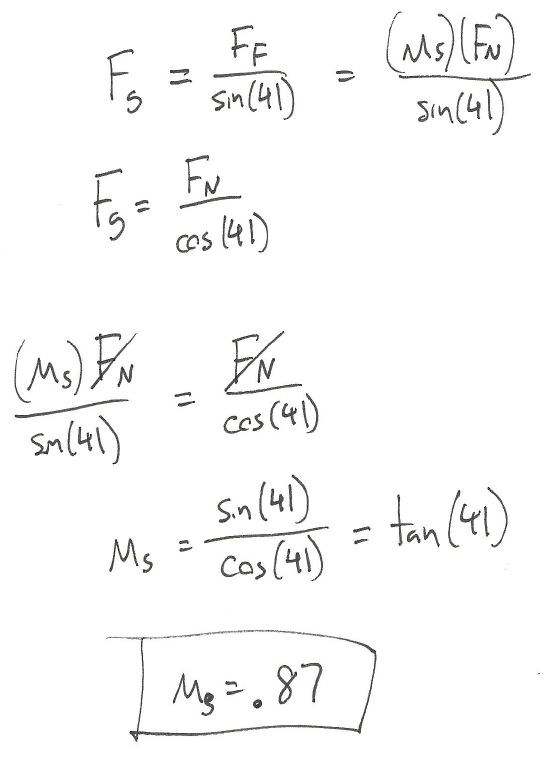
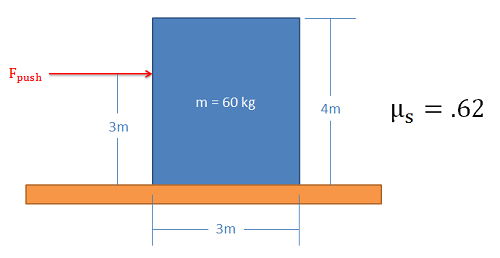
	</div>


	</div>

</div>
<div class="part-wrapper" id="part-chapter-6-internal-forces-wrapper">
    <div class="part  " id="part-chapter-6-internal-forces">
	<div class="part-title-wrap">
		<p class="part-number">VI</p>
		<h1 class="part-title">Chapter 6: Internal Forces</h1>
	</div>
	<div class="ugc part-ugc">
		<p>In the last chapter we looked at the normal (axial) force running through beams joined into trusses by analyzing either the joints or a whole section of the truss.</p> <p>In this chapter, we look at what happens <em>along </em>a <em>single </em>beam. We will look at three types of internal forces and moments. Note that when we say ‘internal forces’, we really mean ‘internal forces and moments’. Inside a beam, we will calculate the normal and shear forces as well as the bending moment at any point in the beam.</p> <p>For this chapter: the shear force and bending moment change throughout the beam because additional transverse forces are applied. However, the normal force usually stays the same, because it’s uncommon to have applied axial forces along the beam.</p> <p>Here are the sections in this Chapter:</p> <ul><li class="toc__title"><a href="#chapter-3-types-of-internal-forces" data-url="https://pressbooks.library.upei.ca/statics/chapter/3-types-of-internal-forces/">6.1 Types of Internal Forces</a> – shear force, normal force and bending moment</li> <li class="toc__title"><a href="#chapter-shear-moment-diagrams" data-url="https://pressbooks.library.upei.ca/statics/chapter/shear-moment-diagrams/">6.2 Shear/Moment Diagrams</a> – graphing the shear force and bending moment</li> <li class="toc__title"><a href="#chapter-6-3-examples" data-url="https://pressbooks.library.upei.ca/statics/chapter/6-3-examples/">6.3 Examples</a> – Examples from your peers</li> </ul> <p>Here are the important equations for this chapter:</p> <p><img src="http://pressbooks.library.upei.ca/statics/wp-content/uploads/sites/56/2021/02/Screen-Shot-2021-08-29-at-8.05.57-PM-1024x576.png" alt="List of equations for chapter 6. These include: shear, normal and moment." class="aligncenter wp-image-1506 size-large" width="1024" height="576" srcset="https://pressbooks.library.upei.ca/statics/wp-content/uploads/sites/56/2021/02/Screen-Shot-2021-08-29-at-8.05.57-PM-1024x576.png 1024w, https://pressbooks.library.upei.ca/statics/wp-content/uploads/sites/56/2021/02/Screen-Shot-2021-08-29-at-8.05.57-PM-300x169.png 300w, https://pressbooks.library.upei.ca/statics/wp-content/uploads/sites/56/2021/02/Screen-Shot-2021-08-29-at-8.05.57-PM-768x432.png 768w, https://pressbooks.library.upei.ca/statics/wp-content/uploads/sites/56/2021/02/Screen-Shot-2021-08-29-at-8.05.57-PM-1536x864.png 1536w, https://pressbooks.library.upei.ca/statics/wp-content/uploads/sites/56/2021/02/Screen-Shot-2021-08-29-at-8.05.57-PM-2048x1152.png 2048w, https://pressbooks.library.upei.ca/statics/wp-content/uploads/sites/56/2021/02/Screen-Shot-2021-08-29-at-8.05.57-PM-65x37.png 65w, https://pressbooks.library.upei.ca/statics/wp-content/uploads/sites/56/2021/02/Screen-Shot-2021-08-29-at-8.05.57-PM-225x127.png 225w, https://pressbooks.library.upei.ca/statics/wp-content/uploads/sites/56/2021/02/Screen-Shot-2021-08-29-at-8.05.57-PM-350x197.png 350w" sizes="auto, (max-width: 1024px) 100vw, 1024px" title="" /></p>
	</div>
			
				
	</div>
<div class="chapter standard with-subsections" id="chapter-slug-3-types-of-internal-forces" title="6.1 Types of Internal Forces">
	<div class="chapter-title-wrap">
		<p class="chapter-number">29</p>
		<h1 class="chapter-title">6.1 Types of Internal Forces</h1>
								</div>
	<div class="ugc chapter-ugc">
				
 <p>When you make a cut in an object, similar to a fixed reaction, we describe what is happening at that point using one horizontal force (called normal force), one vertical force (called shear force), and a bending moment.</p> <div class="wp-caption aligncenter" id="attachment_1435" aria-describedby="caption-attachment-1435" style="width: 500px"><a href="http://mechanicsmap.psu.edu/websites/6_internal_forces/6-2_internal_forces_equilibrium/internal_forces_equilibrium.html" data-url="http://mechanicsmap.psu.edu/websites/6_internal_forces/6-2_internal_forces_equilibrium/internal_forces_equilibrium.html"><img src="http://pressbooks.library.upei.ca/statics/wp-content/uploads/sites/56/2021/03/internalforces-1.png" alt="Beam with point loads showing bending moment, shear force, and axial force at a section." class="wp-image-1435 size-full" width="500" height="372" srcset="https://pressbooks.library.upei.ca/statics/wp-content/uploads/sites/56/2021/03/internalforces-1.png 500w, https://pressbooks.library.upei.ca/statics/wp-content/uploads/sites/56/2021/03/internalforces-1-300x223.png 300w, https://pressbooks.library.upei.ca/statics/wp-content/uploads/sites/56/2021/03/internalforces-1-65x48.png 65w, https://pressbooks.library.upei.ca/statics/wp-content/uploads/sites/56/2021/03/internalforces-1-225x167.png 225w, https://pressbooks.library.upei.ca/statics/wp-content/uploads/sites/56/2021/03/internalforces-1-350x260.png 350w" sizes="auto, (max-width: 500px) 100vw, 500px" title=""></a><div class="wp-caption-text" id="caption-attachment-1435">Adapted from source: Engineering Mechanics, Jacob Moore, et al. http://mechanicsmap.psu.edu/websites/6_internal_forces/6-2_internal_forces_equilibrium/internal_forces_equilibrium.html</div></div> <h1 id="chapter-190-section-1" class="section-header">6.1.1 Types of Internal Forces</h1> <p>There are 3 types of internal forces (&amp; moments):</p> <ul><li>Normal force (N) – the horizontal force we calculated in trusses in the last chapter</li> <li>Shear force (V) – the vertical force that changes based on the applied loads</li> <li>bending moment (M) – changes based on the applied loads and applied moments</li> </ul> <p>Normal force is represented by ‘N’. Shear force, the vertical force, is represented by ‘V’. Bending moment is ‘M’.&nbsp; Normal and shear have units of N or lb, and bending moment has units of Nm or ft-lb. The following table summarizes information on internal forces (and moments).</p> <table class="grid aligncenter" style="border-collapse: collapse;width: 70.5882%;height: 92px"><tbody><tr style="height: 47px"><td style="width: 20.6656%;height: 47px"><strong><em>Force/Moment</em></strong></td> <td style="width: 18.8081%;height: 47px"><strong><em>Abbreviation</em></strong></td> <td style="width: 16.4861%;height: 47px"><strong><em>Unit</em></strong></td> <td style="width: 14.6285%;height: 47px"><strong><em>Directions for a horizontal beam</em></strong></td> </tr> <tr style="height: 15px"><td style="width: 20.6656%;text-align: center;height: 15px">Normal Force</td> <td style="width: 18.8081%;text-align: center;height: 15px">N</td> <td style="width: 16.4861%;height: 15px">N&nbsp; or lb</td> <td style="width: 14.6285%;height: 15px">horizontal</td> </tr> <tr style="height: 15px"><td style="width: 20.6656%;text-align: center;height: 15px">Shear Force</td> <td style="width: 18.8081%;text-align: center;height: 15px">V</td> <td style="width: 16.4861%;height: 15px">N&nbsp; or lb</td> <td style="width: 14.6285%;height: 15px">vertical</td> </tr> <tr style="height: 15px"><td style="width: 20.6656%;text-align: center;height: 15px">Moment</td> <td style="width: 18.8081%;text-align: center;height: 15px">M</td> <td style="width: 16.4861%;height: 15px">Nm or ft-lb</td> <td style="width: 14.6285%;height: 15px">rotation</td> </tr> </tbody> </table> <p>Note that for a vertical column, the normal force would be vertical. For this reason, the normal force is often called ‘axial’ as in: along the axis. The shear force for a column would be horizontal and is sometimes called ‘transverse’.</p> <p>This is for a 2d analysis of the beam, assuming there is negligible loading in the third dimension.</p> <p>&nbsp;</p> <div class="textbox"><p><span>When a beam or frame is subjected to transverse loadings, the three possible internal forces that are developed are the normal or axial force, the shearing force, and the bending moment, as shown in section&nbsp;</span><i>k</i><span>&nbsp;of the cantilever of the figure below</span><span>. To predict the behaviour of structures, the magnitudes of these forces must be known. In this chapter, the student will learn how to determine the magnitude of the shearing force and bending moment at any section of a beam or frame and how to present the computed values in a graphical form, which is referred to as the “shearing force” and the “bending moment diagrams.” Bending moment and shearing force diagrams aid immeasurably during design, as they show the maximum bending moments and shearing forces needed for sizing structural members.</span></p> <p><img src="http://pressbooks.library.upei.ca/statics/wp-content/uploads/sites/56/2021/03/1.04-_Internal_Forces_in_Beams_and_Frames-3-1024x615.jpg" alt="Free-body diagram of a beam under two point loads, showing internal axial force N, shear force V, and bending moment M at section k." class="aligncenter wp-image-1499" width="572" height="343" srcset="https://pressbooks.library.upei.ca/statics/wp-content/uploads/sites/56/2021/03/1.04-_Internal_Forces_in_Beams_and_Frames-3-1024x615.jpg 1024w, https://pressbooks.library.upei.ca/statics/wp-content/uploads/sites/56/2021/03/1.04-_Internal_Forces_in_Beams_and_Frames-3-300x180.jpg 300w, https://pressbooks.library.upei.ca/statics/wp-content/uploads/sites/56/2021/03/1.04-_Internal_Forces_in_Beams_and_Frames-3-768x461.jpg 768w, https://pressbooks.library.upei.ca/statics/wp-content/uploads/sites/56/2021/03/1.04-_Internal_Forces_in_Beams_and_Frames-3-65x39.jpg 65w, https://pressbooks.library.upei.ca/statics/wp-content/uploads/sites/56/2021/03/1.04-_Internal_Forces_in_Beams_and_Frames-3-225x135.jpg 225w, https://pressbooks.library.upei.ca/statics/wp-content/uploads/sites/56/2021/03/1.04-_Internal_Forces_in_Beams_and_Frames-3-350x210.jpg 350w, https://pressbooks.library.upei.ca/statics/wp-content/uploads/sites/56/2021/03/1.04-_Internal_Forces_in_Beams_and_Frames-3.jpg 1353w" sizes="auto, (max-width: 572px) 100vw, 572px" title=""></p> <h2 class="h40 lt-eng-17610"><span class="blue1">Normal Force</span></h2> <p class="noindent lt-eng-17610">The normal force at any section of a structure is defined as the algebraic sum of the axial forces acting on either side of the section.</p> <h3 class="h4 lt-eng-17610"><span class="blue1">Shearing Force</span></h3> <p class="noindent lt-eng-17610"><span class="right_1" title="90"></span>The shearing force (SF) is defined as the algebraic sum of all the transverse forces acting on either side of the section of a beam or a frame. The phrase “on either side” is important, as it implies that at any particular instance, the shearing force can be obtained by summing up the transverse forces on the left side of the section or on the right side of the section.</p> <h3 class="noindent lt-eng-17610"><span class="blue1">Bending Moment</span></h3> <p class="noindent lt-eng-17610">The bending moment (BM) is defined as the algebraic sum of all the forces’ moments acting on either side of the section of a beam or a frame.</p> <p>Source: Internal Forces in Beams and Frames, Libretexts. <a href="https://eng.libretexts.org/Bookshelves/Civil_Engineering/Book%3A_Structural_Analysis_(Udoeyo)/01%3A_Chapters/1.04%3A_Internal_Forces_in_Beams_and_Frames" data-url="https://eng.libretexts.org/Bookshelves/Civil_Engineering/Book%3A_Structural_Analysis_(Udoeyo)/01%3A_Chapters/1.04%3A_Internal_Forces_in_Beams_and_Frames">https://eng.libretexts.org/Bookshelves/Civil_Engineering/Book%3A_Structural_Analysis_(Udoeyo)/01%3A_Chapters/1.04%3A_Internal_Forces_in_Beams_and_Frames</a></p> </div> <p>&nbsp;</p> <p>In 3 dimensions, there are:</p> <ul><li>1 normal force (N)</li> <li>2 shear forces (V<sub>1</sub> &amp; V<sub>2</sub>), and</li> <li>3 bending moments (M<sub>1</sub>, M<sub>2</sub>, &amp; T – torsion).</li> </ul> <div class="wp-caption aligncenter" id="attachment_1436" aria-describedby="caption-attachment-1436" style="width: 321px"><a href="http://mechanicsmap.psu.edu/websites/6_internal_forces/6-2_internal_forces_equilibrium/internal_forces_equilibrium.html" data-url="http://mechanicsmap.psu.edu/websites/6_internal_forces/6-2_internal_forces_equilibrium/internal_forces_equilibrium.html"><img src="http://pressbooks.library.upei.ca/statics/wp-content/uploads/sites/56/2021/03/freebodydiagram3D.png" alt="3D internal force diagram showing axial force (N), shear forces (V₁, V₂), bending moments (M₁, M₂), and torsion (T)." class="wp-image-1436 size-full" width="321" height="355" srcset="https://pressbooks.library.upei.ca/statics/wp-content/uploads/sites/56/2021/03/freebodydiagram3D.png 321w, https://pressbooks.library.upei.ca/statics/wp-content/uploads/sites/56/2021/03/freebodydiagram3D-271x300.png 271w, https://pressbooks.library.upei.ca/statics/wp-content/uploads/sites/56/2021/03/freebodydiagram3D-65x72.png 65w, https://pressbooks.library.upei.ca/statics/wp-content/uploads/sites/56/2021/03/freebodydiagram3D-225x249.png 225w" sizes="auto, (max-width: 321px) 100vw, 321px" title=""></a><div class="wp-caption-text" id="caption-attachment-1436">Source: Engineering Mechanics, Jacob Moore, et al. http://mechanicsmap.psu.edu/websites/6_internal_forces/6-2_internal_forces_equilibrium/internal_forces_equilibrium.html</div></div> <h1 class="section-header noindent lt-eng-17610" id="chapter-190-section-2">6.1.2 Sign Convention</h1> <p>So that there is a standard within the industry, a sign convention is necessary so we agree on what is positive and what is negative. On the right, shear-up is positive. Notice that both of the following figures show the identical sign convention.</p> <div class="wp-caption aligncenter" id="attachment_1497" aria-describedby="caption-attachment-1497" style="width: 515px"><img src="http://pressbooks.library.upei.ca/statics/wp-content/uploads/sites/56/2021/03/Screen-Shot-2021-08-29-at-7.55.21-PM-1024x460.png" alt="Internal force diagram showing normal force (N), shear force (V), and bending moment (M) at a section cut in a beam." class="wp-image-1497" width="515" height="231" srcset="https://pressbooks.library.upei.ca/statics/wp-content/uploads/sites/56/2021/03/Screen-Shot-2021-08-29-at-7.55.21-PM-1024x460.png 1024w, https://pressbooks.library.upei.ca/statics/wp-content/uploads/sites/56/2021/03/Screen-Shot-2021-08-29-at-7.55.21-PM-300x135.png 300w, https://pressbooks.library.upei.ca/statics/wp-content/uploads/sites/56/2021/03/Screen-Shot-2021-08-29-at-7.55.21-PM-768x345.png 768w, https://pressbooks.library.upei.ca/statics/wp-content/uploads/sites/56/2021/03/Screen-Shot-2021-08-29-at-7.55.21-PM-1536x689.png 1536w, https://pressbooks.library.upei.ca/statics/wp-content/uploads/sites/56/2021/03/Screen-Shot-2021-08-29-at-7.55.21-PM-65x29.png 65w, https://pressbooks.library.upei.ca/statics/wp-content/uploads/sites/56/2021/03/Screen-Shot-2021-08-29-at-7.55.21-PM-225x101.png 225w, https://pressbooks.library.upei.ca/statics/wp-content/uploads/sites/56/2021/03/Screen-Shot-2021-08-29-at-7.55.21-PM-350x157.png 350w, https://pressbooks.library.upei.ca/statics/wp-content/uploads/sites/56/2021/03/Screen-Shot-2021-08-29-at-7.55.21-PM.png 1662w" sizes="auto, (max-width: 515px) 100vw, 515px" title=""><div class="wp-caption-text" id="caption-attachment-1497">Positive sign convention adapted from source: https://eng.libretexts.org/Bookshelves/Civil_Engineering/Book%3A_Structural_Analysis_(Udoeyo)/01%3A_Chapters/1.04%3A_Internal_Forces_in_Beams_and_Frames</div></div> <p>When you look at the beam as a whole (in the figure below), positive shear is right side down. When you cut into the beam, for it to be in static equilibrium, the positive shear must then be up on the right to be equal and opposite to the overall motion.</p> <p>&nbsp;</p> <div class="textbox"><p><img src="http://pressbooks.library.upei.ca/statics/wp-content/uploads/sites/56/2021/03/IMG-0633.jpg" alt="Illustration of internal force sign conventions" class="aligncenter wp-image-486 size-full" width="2078" height="928" srcset="https://pressbooks.library.upei.ca/statics/wp-content/uploads/sites/56/2021/03/IMG-0633.jpg 2078w, https://pressbooks.library.upei.ca/statics/wp-content/uploads/sites/56/2021/03/IMG-0633-300x134.jpg 300w, https://pressbooks.library.upei.ca/statics/wp-content/uploads/sites/56/2021/03/IMG-0633-1024x457.jpg 1024w, https://pressbooks.library.upei.ca/statics/wp-content/uploads/sites/56/2021/03/IMG-0633-768x343.jpg 768w, https://pressbooks.library.upei.ca/statics/wp-content/uploads/sites/56/2021/03/IMG-0633-1536x686.jpg 1536w, https://pressbooks.library.upei.ca/statics/wp-content/uploads/sites/56/2021/03/IMG-0633-2048x915.jpg 2048w, https://pressbooks.library.upei.ca/statics/wp-content/uploads/sites/56/2021/03/IMG-0633-65x29.jpg 65w, https://pressbooks.library.upei.ca/statics/wp-content/uploads/sites/56/2021/03/IMG-0633-225x100.jpg 225w, https://pressbooks.library.upei.ca/statics/wp-content/uploads/sites/56/2021/03/IMG-0633-350x156.jpg 350w" sizes="auto, (max-width: 2078px) 100vw, 2078px" title=""></p> <h2><span class="blue1">Axial (Normal) Force</span></h2> <p class="noindent lt-eng-17610">An axial force is regarded as positive if it tends to tier the member at the section under consideration. Such a force is regarded as tensile, while the member is said to be subjected to axial tension. On the other hand, an axial force is considered negative if it tends to crush the member at the section being considered. Such force is regarded as compressive, while the member is said to be in axial compression.</p> <h3 class="h4 lt-eng-17610"><span class="blue1">Shear Force</span></h3> <p class="noindent lt-eng-17610">A shear force that tends to move the left of the section upward or the right side of the section downward will be regarded as positive. Similarly, a shear force that has the tendency to move the left side of the section downward or the right side upward will be considered a negative shear force.</p> <h3 class="h4 lt-eng-17610"><span class="blue1">Bending Moment</span></h3> <p class="noindent lt-eng-17610">A bending moment is considered positive if it tends to cause concavity upward (sagging). If the bending moment tends to cause concavity downward (hogging), it will be considered a negative bending moment.</p> <p>Source: Internal Forces in Beams and Frames, Libretexts. <a href="https://eng.libretexts.org/Bookshelves/Civil_Engineering/Book%3A_Structural_Analysis_(Udoeyo)/01%3A_Chapters/1.04%3A_Internal_Forces_in_Beams_and_Frames" data-url="https://eng.libretexts.org/Bookshelves/Civil_Engineering/Book%3A_Structural_Analysis_(Udoeyo)/01%3A_Chapters/1.04%3A_Internal_Forces_in_Beams_and_Frames">https://eng.libretexts.org/Bookshelves/Civil_Engineering/Book%3A_Structural_Analysis_(Udoeyo)/01%3A_Chapters/1.04%3A_Internal_Forces_in_Beams_and_Frames</a></p> </div> <h1 id="chapter-190-section-3" class="section-header">6.1.3 Calculating the Internal Forces</h1> <p>To solve the internal forces at a certain point along the beam,</p> <div class="wp-caption alignright" id="attachment_1498" aria-describedby="caption-attachment-1498" style="width: 408px"><img src="http://pressbooks.library.upei.ca/statics/wp-content/uploads/sites/56/2021/03/Screen-Shot-2021-08-29-at-7.55.21-PM-1-1024x460.png" alt="Internal force diagram showing normal force (N), shear force (V), and bending moment (M) at a section cut in a beam." class="wp-image-1498" width="408" height="183" srcset="https://pressbooks.library.upei.ca/statics/wp-content/uploads/sites/56/2021/03/Screen-Shot-2021-08-29-at-7.55.21-PM-1-1024x460.png 1024w, https://pressbooks.library.upei.ca/statics/wp-content/uploads/sites/56/2021/03/Screen-Shot-2021-08-29-at-7.55.21-PM-1-300x135.png 300w, https://pressbooks.library.upei.ca/statics/wp-content/uploads/sites/56/2021/03/Screen-Shot-2021-08-29-at-7.55.21-PM-1-768x345.png 768w, https://pressbooks.library.upei.ca/statics/wp-content/uploads/sites/56/2021/03/Screen-Shot-2021-08-29-at-7.55.21-PM-1-1536x689.png 1536w, https://pressbooks.library.upei.ca/statics/wp-content/uploads/sites/56/2021/03/Screen-Shot-2021-08-29-at-7.55.21-PM-1-65x29.png 65w, https://pressbooks.library.upei.ca/statics/wp-content/uploads/sites/56/2021/03/Screen-Shot-2021-08-29-at-7.55.21-PM-1-225x101.png 225w, https://pressbooks.library.upei.ca/statics/wp-content/uploads/sites/56/2021/03/Screen-Shot-2021-08-29-at-7.55.21-PM-1-350x157.png 350w, https://pressbooks.library.upei.ca/statics/wp-content/uploads/sites/56/2021/03/Screen-Shot-2021-08-29-at-7.55.21-PM-1.png 1662w" sizes="auto, (max-width: 408px) 100vw, 408px" title=""><div class="wp-caption-text" id="caption-attachment-1498">Positive sign convention adapted from https://eng.libretexts.org/Bookshelves/Civil_Engineering/Book%3A_Structural_Analysis_(Udoeyo)/01%3A_Chapters/1.04%3A_Internal_Forces_in_Beams_and_Frames</div></div> <p>&nbsp;</p> <ol><li>Find the external &amp; reaction forces</li> <li>Make a cut.</li> <li>In a FBD of one side of the cut, add the internal forces (and moments) using the positive sign convention.</li> <li>Use the equilibrium equations to solve for the unknown internal forces and moments.</li> </ol> <p>&nbsp;</p> <p>&nbsp;</p> <p>Example: For the following distributed load, a) what are the reaction forces? b) What are the internal forces at the midpoint B between the reaction forces?</p> <div class="wp-caption aligncenter" id="attachment_1451" aria-describedby="caption-attachment-1451" style="width: 608px"><img src="http://pressbooks.library.upei.ca/statics/wp-content/uploads/sites/56/2021/03/1.04-_Internal_Forces_in_Beams_and_Frames.jpg" alt="Simply supported beam with a 100 lb/ft uniform distributed load, supported at points A and C." class="wp-image-1451 size-full" width="608" height="291" srcset="https://pressbooks.library.upei.ca/statics/wp-content/uploads/sites/56/2021/03/1.04-_Internal_Forces_in_Beams_and_Frames.jpg 608w, https://pressbooks.library.upei.ca/statics/wp-content/uploads/sites/56/2021/03/1.04-_Internal_Forces_in_Beams_and_Frames-300x144.jpg 300w, https://pressbooks.library.upei.ca/statics/wp-content/uploads/sites/56/2021/03/1.04-_Internal_Forces_in_Beams_and_Frames-65x31.jpg 65w, https://pressbooks.library.upei.ca/statics/wp-content/uploads/sites/56/2021/03/1.04-_Internal_Forces_in_Beams_and_Frames-225x108.jpg 225w, https://pressbooks.library.upei.ca/statics/wp-content/uploads/sites/56/2021/03/1.04-_Internal_Forces_in_Beams_and_Frames-350x168.jpg 350w" sizes="auto, (max-width: 608px) 100vw, 608px" title=""><div class="wp-caption-text" id="caption-attachment-1451">Adapted from: Source: Engineering Mechanics, Jacob Moore, et al. http://mechanicsmap.psu.edu/websites/6_internal_forces/6-3_axial_torque_diagrams/axial_torque_diagrams.html</div></div> <p>1. Solve external forces:</p> <div class="wp-caption aligncenter" id="attachment_1452" aria-describedby="caption-attachment-1452" style="width: 673px"><img src="http://pressbooks.library.upei.ca/statics/wp-content/uploads/sites/56/2021/03/1.04-_Internal_Forces_in_Beams_and_Frames-2.jpg" alt="FBD of the problem" class="wp-image-1452 size-full" width="673" height="236" srcset="https://pressbooks.library.upei.ca/statics/wp-content/uploads/sites/56/2021/03/1.04-_Internal_Forces_in_Beams_and_Frames-2.jpg 673w, https://pressbooks.library.upei.ca/statics/wp-content/uploads/sites/56/2021/03/1.04-_Internal_Forces_in_Beams_and_Frames-2-300x105.jpg 300w, https://pressbooks.library.upei.ca/statics/wp-content/uploads/sites/56/2021/03/1.04-_Internal_Forces_in_Beams_and_Frames-2-65x23.jpg 65w, https://pressbooks.library.upei.ca/statics/wp-content/uploads/sites/56/2021/03/1.04-_Internal_Forces_in_Beams_and_Frames-2-225x79.jpg 225w, https://pressbooks.library.upei.ca/statics/wp-content/uploads/sites/56/2021/03/1.04-_Internal_Forces_in_Beams_and_Frames-2-350x123.jpg 350w" sizes="auto, (max-width: 673px) 100vw, 673px" title=""><div class="wp-caption-text" id="caption-attachment-1452">Adapted from: Source: Engineering Mechanics, Jacob Moore, et al. http://mechanicsmap.psu.edu/websites/6_internal_forces/6-3_axial_torque_diagrams/axial_torque_diagrams.html</div></div> <p><img src="http://localhost:3000/latex?latex=%5Csum%20F_%7BX%7D%3DA_%7Bx%7D%3D0&amp;fg=000000&amp;font=TeX&amp;svg=1" alt="\sum F_{X}=A_{x}=0" title="\sum F_{X}=A_{x}=0" class="latex mathjax"><br> <img src="http://localhost:3000/latex?latex=%5Csum%20F_%7By%7D%3DA_%7By%7D%2BC-%5Comega%20L%3D0&amp;fg=000000&amp;font=TeX&amp;svg=1" alt="\sum F_{y}=A_{y}+C-\omega L=0" title="\sum F_{y}=A_{y}+C-\omega L=0" class="latex mathjax"><br> <img src="http://localhost:3000/latex?latex=%5Csum%20M_%7BA%7D%3D-%28%5Comega%20L%29%5Cleft%28%5Cfrac%7BL%7D%7B2%7D%5Cright%29%2Bd_%7BA%20C%7D%20C%3D0&amp;fg=000000&amp;font=TeX&amp;svg=1" alt="\sum M_{A}=-(\omega L)\left(\frac{L}{2}\right)+d_{A C} C=0" title="\sum M_{A}=-(\omega L)\left(\frac{L}{2}\right)+d_{A C} C=0" class="latex mathjax"><br> $$C = \left(\frac{\omega L^2}{2d_{A C}}\right) = \frac{(100 \frac{lb}{ft} )*(7ft)^2}{2 * (4ft)} = 612.5 lb \text{ (+j direction)} $$<br> $$A_y = \omega*L- C = (100 \frac{lb}{ft})*(7 ft) – 612.5 lb = 87.5 lb \text{ (+j direction) }$$<br> $$\underline{A_x = 0 \qquad A_y = 87.5 \text{ (+j )} \qquad C = 612.5 lb \text{ (+j )} }$$</p> <p><img src="http://pressbooks.library.upei.ca/statics/wp-content/uploads/sites/56/2021/03/admin-ajax.php_.png" alt="Solving for distributed load." class="aligncenter wp-image-1458" width="165" height="159" srcset="https://pressbooks.library.upei.ca/statics/wp-content/uploads/sites/56/2021/03/admin-ajax.php_.png 283w, https://pressbooks.library.upei.ca/statics/wp-content/uploads/sites/56/2021/03/admin-ajax.php_-65x62.png 65w, https://pressbooks.library.upei.ca/statics/wp-content/uploads/sites/56/2021/03/admin-ajax.php_-225x216.png 225w" sizes="auto, (max-width: 165px) 100vw, 165px" title=""></p> <p>2. Make a cut at B.</p> <p>3. In a FBD of one side of the cut, add the internal forces (and moments) using the positive sign convention.</p> <p><img src="http://pressbooks.library.upei.ca/statics/wp-content/uploads/sites/56/2021/03/Screen-Shot-2021-08-29-at-12.30.15-PM-1024x606.png" alt="Solving for internal forces." class="aligncenter wp-image-1454" width="287" height="170" srcset="https://pressbooks.library.upei.ca/statics/wp-content/uploads/sites/56/2021/03/Screen-Shot-2021-08-29-at-12.30.15-PM-1024x606.png 1024w, https://pressbooks.library.upei.ca/statics/wp-content/uploads/sites/56/2021/03/Screen-Shot-2021-08-29-at-12.30.15-PM-300x178.png 300w, https://pressbooks.library.upei.ca/statics/wp-content/uploads/sites/56/2021/03/Screen-Shot-2021-08-29-at-12.30.15-PM-768x455.png 768w, https://pressbooks.library.upei.ca/statics/wp-content/uploads/sites/56/2021/03/Screen-Shot-2021-08-29-at-12.30.15-PM-65x38.png 65w, https://pressbooks.library.upei.ca/statics/wp-content/uploads/sites/56/2021/03/Screen-Shot-2021-08-29-at-12.30.15-PM-225x133.png 225w, https://pressbooks.library.upei.ca/statics/wp-content/uploads/sites/56/2021/03/Screen-Shot-2021-08-29-at-12.30.15-PM-350x207.png 350w, https://pressbooks.library.upei.ca/statics/wp-content/uploads/sites/56/2021/03/Screen-Shot-2021-08-29-at-12.30.15-PM.png 1142w" sizes="auto, (max-width: 287px) 100vw, 287px" title=""></p> <p>4. Use the equilibrium equations to solve for the unknown internal forces and moments.</p> <p>For just this portion, the force from intensity is: F<sub>w</sub> = ( 100 lb/ft ) * ( 2 ft) = 200 lb and acts 1 ft from the left, so the moment due to intensity is: M<sub>w</sub> = w * 2 ft * 1 ft = F<sub>w</sub> * 1 ft = ( 100 lb/ft ) * ( 2 ft) * (1 ft)&nbsp; =&nbsp; 200 ft-lb</p> <p style="text-align: left">$$\sum F_y = 87.5 lb – 200 lb – V = 0 \\ V = -112.5 lb \text{ (- indicates going up not down)} $$</p> <p>&nbsp;</p> <p style="text-align: left">$$ \sum M_A = – (w * 2 ft) * (1 ft) – V * (2 ft)&nbsp; + M = 0 \\ M = (100 \frac{lb}{ft}) * 2 ft + (-112.5 lb) * (2 ft) \\ M = 200 ft \cdot lb – 225 ft \cdot lb \\ M = -25 ft \cdot lb \text{ (- indicates going reverse direction)} $$</p> <p>&nbsp;</p> <p>$$\underline{N = 0 \qquad V = -112.5 lb \text{ (+j )} \qquad M = -25 ft \cdot lb \text{ (clockwise)} }$$</p> <p>&nbsp;</p> <div class="textbox textbox--key-takeaways"><div class="textbox__header"><p class="textbox__title">Key Takeaways</p> </div> <div class="textbox__content"><p><em>Basically</em>: The internal forces (and moments) for a 2d beam are: shear, normal, and bending moment. There is a positive sign convention to use when making a cut along a beam to determine the forces inside: on the left, shear down, normal out, moment up.</p> <p><em>Application</em>: A bridge that has different loads applied (from cars, trucks, lampposts, etc). Use this method to calculate the internal loads at a particular point of interest.</p> <p><em>Looking Ahead</em>: In the next section, we’ll look at how to calculate the internal force across the whole beam and display the results graphically.</p> </div> </div> <p>&nbsp;</p> 
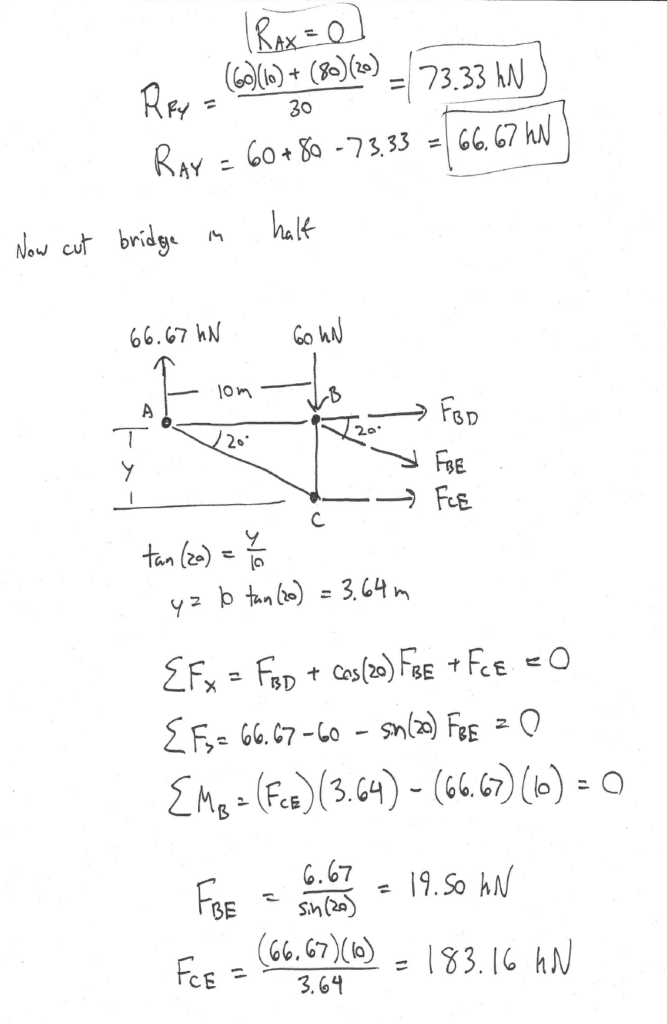
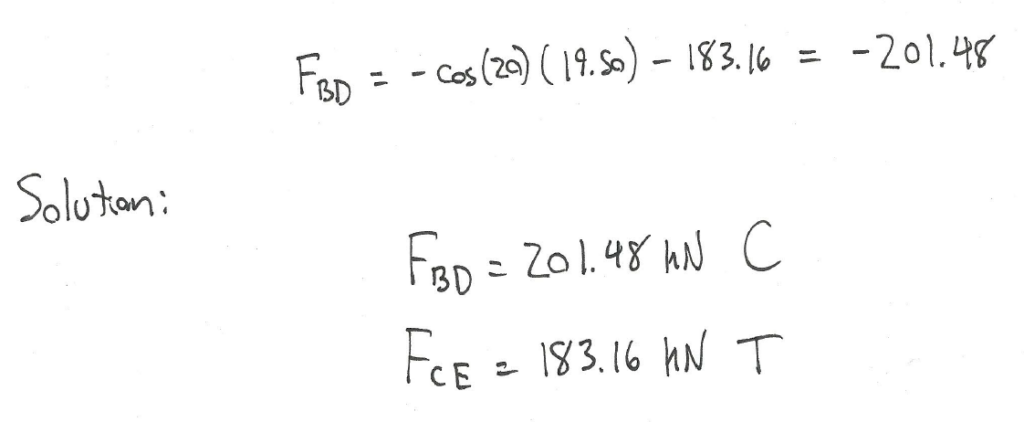
	</div>


	</div>
<div class="chapter standard with-subsections" id="chapter-shear-moment-diagrams" title="6.2 Shear/Moment Diagrams">
	<div class="chapter-title-wrap">
		<p class="chapter-number">30</p>
		<h1 class="chapter-title">6.2 Shear/Moment Diagrams</h1>
								</div>
	<div class="ugc chapter-ugc">
				
 <h1 id="chapter-192-section-1" class="section-header">6.2.1 What are Shear/Moment Diagrams?</h1> <p>Shear/Moment diagrams are graphical representations of the internal shear force and bending moment along the whole beam.</p> <p>&nbsp;</p> <div class="wp-caption aligncenter" id="attachment_554" aria-describedby="caption-attachment-554" style="width: 569px"><a href="https://commons.wikimedia.org/w/index.php?curid=29178249" data-url="https://commons.wikimedia.org/w/index.php?curid=29178249"><img src="http://pressbooks.library.upei.ca/statics/wp-content/uploads/sites/56/2021/03/Shear_Moment_Diagram.svg_.png" alt="Simply supported beam with a centered point load P, shear force diagram (blue), and bending moment diagram (red)." class="wp-image-554" width="569" height="350" srcset="https://pressbooks.library.upei.ca/statics/wp-content/uploads/sites/56/2021/03/Shear_Moment_Diagram.svg_.png 400w, https://pressbooks.library.upei.ca/statics/wp-content/uploads/sites/56/2021/03/Shear_Moment_Diagram.svg_-300x185.png 300w, https://pressbooks.library.upei.ca/statics/wp-content/uploads/sites/56/2021/03/Shear_Moment_Diagram.svg_-65x40.png 65w, https://pressbooks.library.upei.ca/statics/wp-content/uploads/sites/56/2021/03/Shear_Moment_Diagram.svg_-225x138.png 225w, https://pressbooks.library.upei.ca/statics/wp-content/uploads/sites/56/2021/03/Shear_Moment_Diagram.svg_-350x215.png 350w" sizes="auto, (max-width: 569px) 100vw, 569px" title=""></a><div class="wp-caption-text" id="caption-attachment-554">Source (image): By XFEM Skier – Own work, CC BY-SA 3.0, https://commons.wikimedia.org/w/index.php?curid=29178249</div></div> <div class="textbox"><h2 class="h4 lt-eng-17610"><span class="blue1">Shearing Force Diagram</span></h2> <p class="noindent lt-eng-17610">This is a graphical representation of the variation of the shearing force on a portion or the entire length of a beam or frame. As a convention, the shearing force diagram can be drawn above or below the<span>&nbsp;</span><i>x</i>-centroidal axis of the structure, but it must be indicated if it is a positive or negative shear force.</p> <h3 class="h4 lt-eng-17610"><span class="blue1">Bending Moment Diagram</span></h3> <p class="noindent lt-eng-17610">This is a graphical representation of the variation of the bending moment on a segment or the entire length of a beam or frame. As a convention, the positive bending moments are drawn above the<span>&nbsp;</span><i>x</i>-centroidal axis of the structure, while the negative bending moments are drawn below the axis.</p> <p>Below is a simple example of what shear and moment diagrams look like. Afterwards, the relation between the load on the beam and the diagrams will be discussed.</p> <p>Source: Internal Forces in Beams and Frames, LibreTexts. <a href="https://eng.libretexts.org/Bookshelves/Civil_Engineering/Book%3A_Structural_Analysis_(Udoeyo)/01%3A_Chapters/1.04%3A_Internal_Forces_in_Beams_and_Frames" data-url="https://eng.libretexts.org/Bookshelves/Civil_Engineering/Book%3A_Structural_Analysis_(Udoeyo)/01%3A_Chapters/1.04%3A_Internal_Forces_in_Beams_and_Frames">https://eng.libretexts.org/Bookshelves/Civil_Engineering/Book%3A_Structural_Analysis_(Udoeyo)/01%3A_Chapters/1.04%3A_Internal_Forces_in_Beams_and_Frames</a></p> </div> <p>&nbsp;</p> <p>&nbsp;</p> <h1 id="chapter-192-section-2" class="section-header">6.2.2 Distributed Loads &amp; Shear/Moment Diagrams</h1> <p class="h3 lt-eng-17610">There is a relationship between distributed loads and shear/moment diagrams. Simply put:</p> <p style="text-align: center"><img src="http://localhost:3000/latex?latex=%5Cfrac%7BdM%7D%7Bdx%7D%3DV%28x%29&amp;fg=000000&amp;font=TeX&amp;svg=1" alt="\frac{dM}{dx}=V(x)" title="\frac{dM}{dx}=V(x)" class="latex mathjax"></p> <p style="text-align: center"><img src="http://localhost:3000/latex?latex=%5Cfrac%7BdV%7D%7Bdx%7D%3D-w%28x%29&amp;fg=000000&amp;font=TeX&amp;svg=1" alt="\frac{dV}{dx}=-w(x)" title="\frac{dV}{dx}=-w(x)" class="latex mathjax"></p> <p style="text-align: center"><img src="http://localhost:3000/latex?latex=%5Cfrac%7Bd%5E2M%7D%7Bdx%5E2%7D%3D-w%28x%29&amp;fg=000000&amp;font=TeX&amp;svg=1" alt="\frac{d^2M}{dx^2}=-w(x)" title="\frac{d^2M}{dx^2}=-w(x)" class="latex mathjax"></p> <p>Or:</p> <p style="text-align: center"><img src="http://localhost:3000/latex?latex=%5CDelta%20M%3D%5Cint%20V%28x%29dx&amp;fg=000000&amp;font=TeX&amp;svg=1" alt="\Delta M=\int V(x)dx" title="\Delta M=\int V(x)dx" class="latex mathjax"></p> <p style="text-align: center"><img src="http://localhost:3000/latex?latex=%5CDelta%20V%3D%5Cint%20w%28x%29dx&amp;fg=000000&amp;font=TeX&amp;svg=1" alt="\Delta V=\int w(x)dx" title="\Delta V=\int w(x)dx" class="latex mathjax"></p> <p>So, if there is a constant distributed load, then the slope of shear will be linear, and the slope of the moment will be parabolic. If the distributed load is 0, then the shear will be constant and the slope of the moment will be linear (as shown in Example 1 in the next section).</p> <p>&nbsp;</p> <p>&nbsp;</p> <div class="textbox"><p class="noindent lt-eng-17610">For the derivation of the relations among<span>&nbsp;</span><i>w, V</i>, and<span>&nbsp;</span><i>M</i>, consider a simply supported beam subjected to a uniformly distributed load throughout its length, as shown in <span>the figure below</span>. Let the shear force and bending moment at a section located at a distance of<span>&nbsp;</span><i>x</i><span>&nbsp;</span>from the left support be<span>&nbsp;</span><i>V</i><span>&nbsp;</span>and<span>&nbsp;</span><i>M</i>, respectively, and at a section<span>&nbsp;</span><i>x</i><span>&nbsp;</span>+<span>&nbsp;</span><i>dx</i><span>&nbsp;</span>be<span>&nbsp;</span><i>V</i><span>&nbsp;</span>+<span>&nbsp;</span><i>dV</i><span>&nbsp;</span>and<span>&nbsp;</span><i>M</i><span>&nbsp;</span>+<span>&nbsp;</span><i>dM</i>, respectively. The total load acting through the center of the infinitesimal length is<span>&nbsp;</span><i>wdx</i>.</p> <p><img src="http://pressbooks.library.upei.ca/statics/wp-content/uploads/sites/56/2021/03/IMG-0634.jpg" alt="Beam under distributed load showing internal shear force and bending moment." class="alignnone wp-image-489" width="611" height="210" srcset="https://pressbooks.library.upei.ca/statics/wp-content/uploads/sites/56/2021/03/IMG-0634.jpg 2056w, https://pressbooks.library.upei.ca/statics/wp-content/uploads/sites/56/2021/03/IMG-0634-300x103.jpg 300w, https://pressbooks.library.upei.ca/statics/wp-content/uploads/sites/56/2021/03/IMG-0634-1024x352.jpg 1024w, https://pressbooks.library.upei.ca/statics/wp-content/uploads/sites/56/2021/03/IMG-0634-768x264.jpg 768w, https://pressbooks.library.upei.ca/statics/wp-content/uploads/sites/56/2021/03/IMG-0634-1536x528.jpg 1536w, https://pressbooks.library.upei.ca/statics/wp-content/uploads/sites/56/2021/03/IMG-0634-2048x704.jpg 2048w, https://pressbooks.library.upei.ca/statics/wp-content/uploads/sites/56/2021/03/IMG-0634-65x22.jpg 65w, https://pressbooks.library.upei.ca/statics/wp-content/uploads/sites/56/2021/03/IMG-0634-225x77.jpg 225w, https://pressbooks.library.upei.ca/statics/wp-content/uploads/sites/56/2021/03/IMG-0634-350x120.jpg 350w" sizes="auto, (max-width: 611px) 100vw, 611px" title=""></p> <p>To compute the bending moment at section x + dx, use the following:</p> <p><img src="http://localhost:3000/latex?latex=%5Cbegin%7Baligned%7D%20%20M_%7Bx%2Bdx%7D%20%26%3D%20M%20%2B%20Vdx%20-%20wdx%20%5Ccdot%20%5Cfrac%7Bdx%7D%7B2%7D%20%5C%5C%20%20%26%3D%20M%20%2B%20Vdx%20%5Cquad%20%5Ctext%7B%28neglecting%20the%20small%20second%20order%20term%20%7D%20%5Cfrac%7Bwdx%5E2%7D%7B2%7D%20%5Ctext%7B%29%7D%20%20%5Cend%7Baligned%7D&amp;fg=000000&amp;font=TeX&amp;svg=1" alt="\begin{aligned} M_{x+dx} &amp;amp;= M + Vdx - wdx \cdot \frac{dx}{2} \\ &amp;amp;= M + Vdx \quad \text{(neglecting the small second order term } \frac{wdx^2}{2} \text{)} \end{aligned}" title="\begin{aligned} M_{x+dx} &amp;amp;= M + Vdx - wdx \cdot \frac{dx}{2} \\ &amp;amp;= M + Vdx \quad \text{(neglecting the small second order term } \frac{wdx^2}{2} \text{)} \end{aligned}" class="latex mathjax"></p> <p>or</p> <p style="text-align: center"><img src="http://localhost:3000/latex?latex=%5Cfrac%7BdM%7D%7Bdx%7D%3DV%28x%29&amp;fg=000000&amp;font=TeX&amp;svg=1" alt="\frac{dM}{dx}=V(x)" title="\frac{dM}{dx}=V(x)" class="latex mathjax">&nbsp; (Equation 6.1)</p> <p><span>Equation 6.1 implies that the first derivative of the bending moment with respect to the distance is equal to the shearing force. The equation also suggests that the slope of the moment diagram at a particular point is equal to the shear force at that same point.&nbsp;</span><a class="mt-disabled" rel="broken" data-url="">Equation 6.1</a><span>&nbsp;suggests the following expression:</span></p> <p style="text-align: center"><img src="http://localhost:3000/latex?latex=%5CDelta%20M%3D%5Cint%20V%28x%29dx&amp;fg=000000&amp;font=TeX&amp;svg=1" alt="\Delta M=\int V(x)dx" title="\Delta M=\int V(x)dx" class="latex mathjax"> (Equation 6.2)</p> <p><span>Equation 6.2 states that the change in moment equals the area under the shear diagram. Similarly, the shearing force at section&nbsp;</span><i>x</i><span>&nbsp;+&nbsp;</span><i>dx</i><span>&nbsp;is as follows:</span></p> <p style="text-align: center"><img src="http://localhost:3000/latex?latex=V_%7Bx%2Bdx%7D%3DV-wdx%5C%5CV%2BdV%3DV-wdx&amp;fg=000000&amp;font=TeX&amp;svg=1" alt="V_{x+dx}=V-wdx\\V+dV=V-wdx" title="V_{x+dx}=V-wdx\\V+dV=V-wdx" class="latex mathjax"></p> <p>or</p> <p style="text-align: center"><img src="http://localhost:3000/latex?latex=%5Cfrac%7BdV%7D%7Bdx%7D%3D-w%28x%29&amp;fg=000000&amp;font=TeX&amp;svg=1" alt="\frac{dV}{dx}=-w(x)" title="\frac{dV}{dx}=-w(x)" class="latex mathjax">&nbsp; (Equation 6.3)</p> <p class="noindent lt-eng-17610">Equation 6.3 implies that the first derivative of the shearing force with respect to the distance is equal to the intensity of the distributed load.<span>&nbsp;</span><a class="mt-disabled" rel="broken" data-url="">Equation 6.3</a><span>&nbsp;</span>suggests the following expression:</p> <p style="text-align: center"><img src="http://localhost:3000/latex?latex=%5CDelta%20V%3D%5Cint%20w%28x%29dx&amp;fg=000000&amp;font=TeX&amp;svg=1" alt="\Delta V=\int w(x)dx" title="\Delta V=\int w(x)dx" class="latex mathjax"> (Equation 6.4)</p> <p><span>Equation 6.4 states that the change in the shear force is equal to the area under the load diagram.&nbsp;</span><a class="mt-disabled" rel="broken" data-url="">Equations 6.1</a><span>&nbsp;and 6</span><a class="mt-disabled" rel="broken" data-url="">.3</a><span>&nbsp;suggest the following:</span></p> <p style="text-align: center"><img src="http://localhost:3000/latex?latex=%5Cfrac%7Bd%5E2M%7D%7Bdx%5E2%7D%3D-w%28x%29&amp;fg=000000&amp;font=TeX&amp;svg=1" alt="\frac{d^2M}{dx^2}=-w(x)" title="\frac{d^2M}{dx^2}=-w(x)" class="latex mathjax"> (Equation 6.5)</p> <p class="noindent lt-eng-17610"><span>Equation 6.5 </span>implies that the second derivative of the bending moment with respect to the distance is equal to the intensity of the distributed load.</p> <p>Source: Internal Forces in Beams and Frames, LibreTexts. <a href="https://eng.libretexts.org/Bookshelves/Civil_Engineering/Book%3A_Structural_Analysis_(Udoeyo)/01%3A_Chapters/1.04%3A_Internal_Forces_in_Beams_and_Frames" data-url="https://eng.libretexts.org/Bookshelves/Civil_Engineering/Book%3A_Structural_Analysis_(Udoeyo)/01%3A_Chapters/1.04%3A_Internal_Forces_in_Beams_and_Frames">https://eng.libretexts.org/Bookshelves/Civil_Engineering/Book%3A_Structural_Analysis_(Udoeyo)/01%3A_Chapters/1.04%3A_Internal_Forces_in_Beams_and_Frames</a></p> </div> <p>&nbsp;</p> <p>&nbsp;</p> <h1 id="chapter-192-section-3" class="section-header">6.2.3 Producing a Shear/Moment Diagram</h1> <p>There are many methods you can use to solve a shear/moment diagram. First, you can find the equation for each portion and integrate using the above equations.</p> <p>Second, you could use the method shown in the previous section to calculate the internal forces at important points (where loads are applied, the start and end of distributed loads, at reaction points). Plot these points on the V and M plots at the x locations, then connect the dots using the appropriate shape slope (more on this at the bottom of this page).</p> <p>Third, you can find the equations by using the equilibrium equations (so there’s no integration/differentiation).</p> <ol><li><div class="wp-caption alignright" id="attachment_1501" aria-describedby="caption-attachment-1501" style="width: 334px"><img src="http://pressbooks.library.upei.ca/statics/wp-content/uploads/sites/56/2021/03/Screen-Shot-2021-08-29-at-7.55.21-PM-2-1024x460.png" alt="Internal force diagram showing normal force (N), shear force (V), and bending moment (M) at a section cut in a beam." class="wp-image-1501" width="334" height="150" srcset="https://pressbooks.library.upei.ca/statics/wp-content/uploads/sites/56/2021/03/Screen-Shot-2021-08-29-at-7.55.21-PM-2-1024x460.png 1024w, https://pressbooks.library.upei.ca/statics/wp-content/uploads/sites/56/2021/03/Screen-Shot-2021-08-29-at-7.55.21-PM-2-300x135.png 300w, https://pressbooks.library.upei.ca/statics/wp-content/uploads/sites/56/2021/03/Screen-Shot-2021-08-29-at-7.55.21-PM-2-768x345.png 768w, https://pressbooks.library.upei.ca/statics/wp-content/uploads/sites/56/2021/03/Screen-Shot-2021-08-29-at-7.55.21-PM-2-1536x689.png 1536w, https://pressbooks.library.upei.ca/statics/wp-content/uploads/sites/56/2021/03/Screen-Shot-2021-08-29-at-7.55.21-PM-2-65x29.png 65w, https://pressbooks.library.upei.ca/statics/wp-content/uploads/sites/56/2021/03/Screen-Shot-2021-08-29-at-7.55.21-PM-2-225x101.png 225w, https://pressbooks.library.upei.ca/statics/wp-content/uploads/sites/56/2021/03/Screen-Shot-2021-08-29-at-7.55.21-PM-2-350x157.png 350w, https://pressbooks.library.upei.ca/statics/wp-content/uploads/sites/56/2021/03/Screen-Shot-2021-08-29-at-7.55.21-PM-2.png 1662w" sizes="auto, (max-width: 334px) 100vw, 334px" title=""><div class="wp-caption-text" id="caption-attachment-1501">Adapted from original source https://eng.libretexts.org/Bookshelves/Civil_Engineering/Book%3A_Structural_Analysis_(Udoeyo)/01%3A_Chapters/1.04%3A_Internal_Forces_in_Beams_and_Frames</div></div> <p>Draw a FBD of the structure</p></li> <li>Calculate the reactions using the equilibrium equations (may not need to do this if choosing a cantilever beam and using the free side for the FBD).</li> <li>Make a cut and add internal forces N V and M using the positive sign convention. Depending on the number of loads, you may need multiple cuts. Recall the positive convention:</li> <li>For shear, find an equation (expression) of the shear that is x distance from the origin (often the reaction) for each cut.</li> <li>For moment, find an equation (expression) of the shear that is x distance from the origin (often the reaction) for each cut.</li> <li>Plot these equations on a plot on top of each other.</li> </ol> <p>&nbsp;</p> <p>The rest of this section will use this method.</p> <h2>Example 1</h2> <p><em>(adapted from <a href="https://eng.libretexts.org/Bookshelves/Civil_Engineering/Book%3A_Structural_Analysis_(Udoeyo)/01%3A_Chapters/1.04%3A_Internal_Forces_in_Beams_and_Frames" data-url="https://eng.libretexts.org/Bookshelves/Civil_Engineering/Book%3A_Structural_Analysis_(Udoeyo)/01%3A_Chapters/1.04%3A_Internal_Forces_in_Beams_and_Frames">https://eng.libretexts.org/Bookshelves/Civil_Engineering/Book%3A_Structural_Analysis_(Udoeyo)/01%3A_Chapters/1.04%3A_Internal_Forces_in_Beams_and_Frames</a>)</em></p> <p class="noindent lt-eng-17610">Draw the shear force and bending moment diagrams for the cantilever beam supporting a concentrated load of 5 lb at the free end 3 ft from the wall.</p> <p><img src="http://pressbooks.library.upei.ca/statics/wp-content/uploads/sites/56/2021/03/1-1.jpg" alt="Cantilever beam with a 5 lb point load at the free end (A) and fixed support at end B." class="aligncenter wp-image-1466" width="482" height="195" srcset="https://pressbooks.library.upei.ca/statics/wp-content/uploads/sites/56/2021/03/1-1.jpg 843w, https://pressbooks.library.upei.ca/statics/wp-content/uploads/sites/56/2021/03/1-1-300x121.jpg 300w, https://pressbooks.library.upei.ca/statics/wp-content/uploads/sites/56/2021/03/1-1-768x311.jpg 768w, https://pressbooks.library.upei.ca/statics/wp-content/uploads/sites/56/2021/03/1-1-65x26.jpg 65w, https://pressbooks.library.upei.ca/statics/wp-content/uploads/sites/56/2021/03/1-1-225x91.jpg 225w, https://pressbooks.library.upei.ca/statics/wp-content/uploads/sites/56/2021/03/1-1-350x142.jpg 350w" sizes="auto, (max-width: 482px) 100vw, 482px" title=""></p> <p><em>1. Draw a FBD of the structure</em></p> <p><img src="http://pressbooks.library.upei.ca/statics/wp-content/uploads/sites/56/2021/03/2-1.jpg" alt="A FBD of the problem." class="aligncenter wp-image-1467" width="513" height="192" srcset="https://pressbooks.library.upei.ca/statics/wp-content/uploads/sites/56/2021/03/2-1.jpg 1010w, https://pressbooks.library.upei.ca/statics/wp-content/uploads/sites/56/2021/03/2-1-300x112.jpg 300w, https://pressbooks.library.upei.ca/statics/wp-content/uploads/sites/56/2021/03/2-1-768x287.jpg 768w, https://pressbooks.library.upei.ca/statics/wp-content/uploads/sites/56/2021/03/2-1-65x24.jpg 65w, https://pressbooks.library.upei.ca/statics/wp-content/uploads/sites/56/2021/03/2-1-225x84.jpg 225w, https://pressbooks.library.upei.ca/statics/wp-content/uploads/sites/56/2021/03/2-1-350x131.jpg 350w" sizes="auto, (max-width: 513px) 100vw, 513px" title=""></p> <p>&nbsp;</p> <p><em>2. Calculate the reactions using the equilibrium equations (may not need to do this if choosing a cantilever beam and using the free side for the FBD).</em></p> <p class="noindent lt-eng-17610">First, compute the reactions at the support. Since the support at <i>B</i> is fixed, there will be three reactions at that support, namely <i>B<sub>y</sub></i>, <i>B<sub>x</sub></i>, and <i>M<sub>B</sub></i>. Applying the conditions of equilibrium suggests the following:</p> <p><img src="http://localhost:3000/latex?latex=%5Csum%20F_%7Bx%7D%3D0%3A%20%5Cquad%20%5Cunderline%7BB_%7Bx%7D%3D0%7D&amp;fg=000000&amp;font=TeX&amp;svg=1" alt="\sum F_{x}=0: \quad \underline{B_{x}=0}" title="\sum F_{x}=0: \quad \underline{B_{x}=0}" class="latex mathjax"></p> <p><img src="http://localhost:3000/latex?latex=%5Csum%20F_%7By%7D%3D0%3A%20%5Cquad-5%20lb%2BB_%7By%7D%3D0&amp;fg=000000&amp;font=TeX&amp;svg=1" alt="\sum F_{y}=0: \quad-5 lb+B_{y}=0" title="\sum F_{y}=0: \quad-5 lb+B_{y}=0" class="latex mathjax"><br> <img src="http://localhost:3000/latex?latex=%5Cqquad%20%5Cquad%20%5Cunderline%7BB_%7By%7D%3D5%20lb%7D&amp;fg=000000&amp;font=TeX&amp;svg=1" alt="\qquad \quad \underline{B_{y}=5 lb}" title="\qquad \quad \underline{B_{y}=5 lb}" class="latex mathjax"></p> <p><img src="http://localhost:3000/latex?latex=%5Csum%20M_%7BB%7D%3D0%3A%20%5Cquad%285%20lb%20%29%283%20%5Cmathrm%7Bft%7D%29-M%3D0&amp;fg=000000&amp;font=TeX&amp;svg=1" alt="\sum M_{B}=0: \quad(5 lb )(3 \mathrm{ft})-M=0" title="\sum M_{B}=0: \quad(5 lb )(3 \mathrm{ft})-M=0" class="latex mathjax"><br> <img src="http://localhost:3000/latex?latex=%5Cqquad%20%5Cquad%20%5Cunderline%7BM%3D15%20ft%20%5Ccdot%20lb%7D&amp;fg=000000&amp;font=TeX&amp;svg=1" alt="\qquad \quad \underline{M=15 ft \cdot lb}" title="\qquad \quad \underline{M=15 ft \cdot lb}" class="latex mathjax"></p> <p class="noindent1 lt-eng-17610"><span class="blue1">&nbsp;</span></p> <p><em>3. Make a cut and add internal forces N V and M using the positive sign convention. Depending on the number of loads, you may need multiple cuts</em></p> <p>Only 1 cut needed because only 1 load is added at the end. (If it were in the middle there would be 2 sections to consider). The value x could be 0 to 3 ft.</p> <p><img src="http://pressbooks.library.upei.ca/statics/wp-content/uploads/sites/56/2021/03/4-1-2.jpg" alt="Diagram to calculate internal forces." class="aligncenter wp-image-1503" width="295" height="211" srcset="https://pressbooks.library.upei.ca/statics/wp-content/uploads/sites/56/2021/03/4-1-2.jpg 469w, https://pressbooks.library.upei.ca/statics/wp-content/uploads/sites/56/2021/03/4-1-2-300x214.jpg 300w, https://pressbooks.library.upei.ca/statics/wp-content/uploads/sites/56/2021/03/4-1-2-65x46.jpg 65w, https://pressbooks.library.upei.ca/statics/wp-content/uploads/sites/56/2021/03/4-1-2-225x161.jpg 225w, https://pressbooks.library.upei.ca/statics/wp-content/uploads/sites/56/2021/03/4-1-2-350x250.jpg 350w" sizes="auto, (max-width: 295px) 100vw, 295px" title=""></p> <p><em>4. For shear, find an equation (expression) of the shear that is x distance from the origin (often the reaction) for each cut.</em></p> <p class="noindent1 lt-eng-17610"><i>x</i> is the distance from the free end of the cantilever beam to the cut. The shearing force at that section is due to the applied load. Using the equilibrium equations,</p> <p><img src="http://localhost:3000/latex?latex=%5Csum%20F_y%20%3D%20-5%20lb%20-%20V%20%3D%200%20%5C%5C%20%5Cqquad%20%5Cquad%20%5Cunderline%7BV%20%3D%20-%205%20lb%7D%20%5Ctext%7B%C2%A0%20%28-%20indicates%20V%20acts%20in%20opposite%20direction%29%7D&amp;fg=000000&amp;font=TeX&amp;svg=1" alt="\sum F_y = -5 lb - V = 0 \\ \qquad \quad \underline{V = - 5 lb} \text{&nbsp; (- indicates V acts in opposite direction)}" title="\sum F_y = -5 lb - V = 0 \\ \qquad \quad \underline{V = - 5 lb} \text{&nbsp; (- indicates V acts in opposite direction)}" class="latex mathjax"></p> <p>The constant number for shear means that it doesn’t change or vary by x. (If there were a distributed load, x would be part of the equation).</p> <p class="noindent lt-eng-17610"><span class="right_1" title="95"></span>The negative sign indicates the shear actually goes the opposite direction. (This is due to the fact that the sign convention for a shearing force states that a downward transverse force on the left of the section under consideration will cause a negative shearing force on that section.)</p> <p><img src="http://pressbooks.library.upei.ca/statics/wp-content/uploads/sites/56/2021/03/4-1-1.jpg" alt="Cantilever beam showing internal forces due to a 5 lb load." class="aligncenter wp-image-1502" width="637" height="235" srcset="https://pressbooks.library.upei.ca/statics/wp-content/uploads/sites/56/2021/03/4-1-1.jpg 916w, https://pressbooks.library.upei.ca/statics/wp-content/uploads/sites/56/2021/03/4-1-1-300x111.jpg 300w, https://pressbooks.library.upei.ca/statics/wp-content/uploads/sites/56/2021/03/4-1-1-768x283.jpg 768w, https://pressbooks.library.upei.ca/statics/wp-content/uploads/sites/56/2021/03/4-1-1-65x24.jpg 65w, https://pressbooks.library.upei.ca/statics/wp-content/uploads/sites/56/2021/03/4-1-1-225x83.jpg 225w, https://pressbooks.library.upei.ca/statics/wp-content/uploads/sites/56/2021/03/4-1-1-350x129.jpg 350w" sizes="auto, (max-width: 637px) 100vw, 637px" title=""></p> <p><em>5. For the moment, find an equation (expression) of the shear that is x distance from the origin (often the reaction) for each cut.</em></p> <p>Here, x is measured from the left. Using sum of the moments equations, find an expression for M. You could choose to sum the moments about the end point where the load is applied, or you could do it at the moving point x. Both take the same effort for this problem, so let’s choose the left hand side where the 5 lb are being applied.</p> <p><img src="http://localhost:3000/latex?latex=%5Csum%20M_L%20%3D%20-Vx%20-%20M%20%3D%200&amp;fg=000000&amp;font=TeX&amp;svg=1" alt="\sum M_L = -Vx - M = 0" title="\sum M_L = -Vx - M = 0" class="latex mathjax"></p> <p><img src="http://localhost:3000/latex?latex=%5Cqquad%20%5Cquad%20M%20%3D%20%2B%20Vx%20%3D%20%28-5%20lb%29%20%2A%20x&amp;fg=000000&amp;font=TeX&amp;svg=1" alt="\qquad \quad M = + Vx = (-5 lb) * x" title="\qquad \quad M = + Vx = (-5 lb) * x" class="latex mathjax"></p> <p><img src="http://localhost:3000/latex?latex=%5Cqquad%20%5Cquad%20%5Cunderline%7BM%20%3D%20-%285lb%29x%20%7D%20%5Ctext%7B%C2%A0%20%28the%20negative%20sign%20indicates%20the%20arrow%20goes%20the%20other%20direction.%7D&amp;fg=000000&amp;font=TeX&amp;svg=1" alt="\qquad \quad \underline{M = -(5lb)x } \text{&nbsp; (the negative sign indicates the arrow goes the other direction.}" title="\qquad \quad \underline{M = -(5lb)x } \text{&nbsp; (the negative sign indicates the arrow goes the other direction.}" class="latex mathjax"></p> <p><img src="http://pressbooks.library.upei.ca/statics/wp-content/uploads/sites/56/2021/03/5-1-1024x394.png" alt="Cantilever beam showing internal forces and moment due to a 5 lb load." class="aligncenter wp-image-1504" width="538" height="207" srcset="https://pressbooks.library.upei.ca/statics/wp-content/uploads/sites/56/2021/03/5-1-1024x394.png 1024w, https://pressbooks.library.upei.ca/statics/wp-content/uploads/sites/56/2021/03/5-1-300x115.png 300w, https://pressbooks.library.upei.ca/statics/wp-content/uploads/sites/56/2021/03/5-1-768x295.png 768w, https://pressbooks.library.upei.ca/statics/wp-content/uploads/sites/56/2021/03/5-1-65x25.png 65w, https://pressbooks.library.upei.ca/statics/wp-content/uploads/sites/56/2021/03/5-1-225x86.png 225w, https://pressbooks.library.upei.ca/statics/wp-content/uploads/sites/56/2021/03/5-1-350x135.png 350w, https://pressbooks.library.upei.ca/statics/wp-content/uploads/sites/56/2021/03/5-1.png 1452w" sizes="auto, (max-width: 538px) 100vw, 538px" title=""></p> <p class="noindent lt-eng-17610">The obtained expression is valid for the entire beam (the region 0 &lt; <i>x</i> &lt; 3 ft). The negative sign indicates a negative moment, which was established from the sign convention for the moment, so the moment actually goes in the opposite direction. The moment due to the 5 lb force tends to cause the segment of the beam on the left side of the section to exhibit a downward concavity, and that corresponds to a negative bending moment, according to the sign convention for bending moment.</p> <p>&nbsp;</p> <p><em>6. Plot these equations on a plot on top of each other.</em></p> <p class="noindent1 lt-eng-17610">Note that because the shearing force is a constant, it must be of the same magnitude at any point along the beam. As a convention, the shearing force diagram is plotted above or below a line corresponding to the neutral axis of the beam, but a plus sign must be indicated if it is a positive shearing force, and a minus sign should be indicated if it is a negative shearing force. A way to check the answer is to ensure the reaction force brings the problem back to 0. The shear is -5 until the last moment when the reaction force of +5lb brings the force to 0.</p> <p class="noindent1 lt-eng-17610">Since the function for the bending moment is linear, the bending moment diagram is a straight line. Thus, it is enough to use the two principal values of bending moments determined at <i>x</i> = 0 ft and at <i>x</i> = 3 ft to plot the bending moment diagram. As a convention, negative bending moment diagrams are plotted below the neutral axis of the beam, while positive bending moment diagrams are plotted above the axis of the beam.</p> <p><img src="http://pressbooks.library.upei.ca/statics/wp-content/uploads/sites/56/2021/03/3-2.jpg" alt="Shear and moment diagrams." class="aligncenter wp-image-1465" width="423" height="385" srcset="https://pressbooks.library.upei.ca/statics/wp-content/uploads/sites/56/2021/03/3-2.jpg 890w, https://pressbooks.library.upei.ca/statics/wp-content/uploads/sites/56/2021/03/3-2-300x273.jpg 300w, https://pressbooks.library.upei.ca/statics/wp-content/uploads/sites/56/2021/03/3-2-768x699.jpg 768w, https://pressbooks.library.upei.ca/statics/wp-content/uploads/sites/56/2021/03/3-2-65x59.jpg 65w, https://pressbooks.library.upei.ca/statics/wp-content/uploads/sites/56/2021/03/3-2-225x205.jpg 225w, https://pressbooks.library.upei.ca/statics/wp-content/uploads/sites/56/2021/03/3-2-350x319.jpg 350w" sizes="auto, (max-width: 423px) 100vw, 423px" title=""></p> <p><em>Notice the units are included in the axes.</em></p> <p>&nbsp;</p> <p>Here is a second explanation for how to create shear/moment diagrams:</p> <div class="textbox"><p><em>Shear Diagram</em></p> <p>To create the shear force diagram, we will use the following process.</p> <ol><li>Solve for all <strong>external forces</strong> acting on the body.</li> <li>Draw out a <strong>free body diagram</strong> of the body <strong>horizontally</strong>. Leave all distributed forces as distributed forces and do not replace them with the equivalent point load.</li> <li>Lined up below the free body diagram, draw a set of axes. The x-axis will represent the location (lined up with the free body diagram above), and the y-axis will represent the internal shear force.</li> <li>Starting at zero at the right side of the plot, you will move to the right, pay attention to forces in the free body diagram above. As you move right in your plot, keep steady except… <ul><li>Jump <strong>upwards</strong> by the magnitude of the force for any point forces going up.</li> <li>Jump <strong>downwards</strong> by the magnitude of the force for any point forces going down.</li> <li>For any <strong>uniform distributed forces</strong> you will have a <strong>linear slope</strong> where the magnitude of the distributed force is the slope of the line (positive slopes for upwards distributed forces, negative slopes for downwards distributed forces).</li> <li>For <strong>non-uniform distributed forces</strong>, the shape of the shear diagram plot will be the <strong>integral of the force function</strong>.</li> <li>You can ignore any moments or horizontal forces applied to the body.</li> </ul> <p>By the time you get to the left end of the plot, you should always wind up coming <strong>back to zero</strong>. If you don’t wind up back at zero, go back and check your previous work.</p></li> </ol> <p><img src="http://pressbooks.library.upei.ca/statics/wp-content/uploads/sites/56/2021/03/sheardiagram.png" alt="Image on how to plot shear diagrams." class="aligncenter wp-image-1471 size-full" width="600" height="403" srcset="https://pressbooks.library.upei.ca/statics/wp-content/uploads/sites/56/2021/03/sheardiagram.png 600w, https://pressbooks.library.upei.ca/statics/wp-content/uploads/sites/56/2021/03/sheardiagram-300x202.png 300w, https://pressbooks.library.upei.ca/statics/wp-content/uploads/sites/56/2021/03/sheardiagram-65x44.png 65w, https://pressbooks.library.upei.ca/statics/wp-content/uploads/sites/56/2021/03/sheardiagram-225x151.png 225w, https://pressbooks.library.upei.ca/statics/wp-content/uploads/sites/56/2021/03/sheardiagram-350x235.png 350w" sizes="auto, (max-width: 600px) 100vw, 600px" title=""></p> <p><img src="http://pressbooks.library.upei.ca/statics/wp-content/uploads/sites/56/2021/03/shearforces.png" alt="Positive and negative shearing forces." class="alignright wp-image-1472 size-full" width="150" height="210" srcset="https://pressbooks.library.upei.ca/statics/wp-content/uploads/sites/56/2021/03/shearforces.png 150w, https://pressbooks.library.upei.ca/statics/wp-content/uploads/sites/56/2021/03/shearforces-65x91.png 65w" sizes="auto, (max-width: 150px) 100vw, 150px" title="">To read the plot, you simply need to find the location of interest from the free body diagram above, and read the corresponding value on the y-axis from your plot. Positive numbers represent an upward internal shearing force to the right of the cross section and a downward force on the left, and negative numbers indicate a downward internal shearing force to the right of the cross section and an upward force on the left. A visual of these forces can be seen in the diagram to the right.</p> <p>&nbsp;</p> <p><em>Moment Diagram</em></p> <p>The moment diagram will plot out the internal bending moment within a horizontal beam that is subjected to multiple forces and moments perpendicular to the length of the beam. For practical purposes, this diagram is often used in the same circumstances as the shear diagram, and generally, both diagrams will be created for analysis in these scenarios.</p> <p>To create the moment diagram for a shaft, we will use the following process.</p> <ol><li>Solve for all external forces and moments, create a free body diagram, and create the shear diagram.</li> <li>Lined up below the shear diagram, draw a set of axes. The x-axis will represent the location (lined up with the shear diagram and free body diagram above), and the y-axis will represent the internal bending moment.</li> <li>Starting at zero on the right side of the plot, you will move to the right, pay attention to the shear diagram and the moments in the free body diagram above. As you move right in your plot, the moment diagram will primarily be the <strong>integral of the shear diagram</strong>, except… <ul><li>Jump <strong>upwards</strong> by the magnitude of the moment for any negative <strong>(clockwise)</strong> moments.</li> <li>Jump <strong>downwards</strong> by the magnitude of the moment for any positive <strong>(counter-clockwise)</strong> moments.</li> <li>You can ignore any forces in the free body diagram.</li> </ul> <p>By the time you get to the left end of the plot, you should always wind up coming <strong>back to zero</strong>. If you don’t wind up back at zero, go back and check your previous work.</p></li> </ol> <p><img src="http://pressbooks.library.upei.ca/statics/wp-content/uploads/sites/56/2021/03/momentdiagram.png" alt="Image on how to plot shear and moment diagrams." class="aligncenter wp-image-1473 size-full" width="600" height="528" srcset="https://pressbooks.library.upei.ca/statics/wp-content/uploads/sites/56/2021/03/momentdiagram.png 600w, https://pressbooks.library.upei.ca/statics/wp-content/uploads/sites/56/2021/03/momentdiagram-300x264.png 300w, https://pressbooks.library.upei.ca/statics/wp-content/uploads/sites/56/2021/03/momentdiagram-65x57.png 65w, https://pressbooks.library.upei.ca/statics/wp-content/uploads/sites/56/2021/03/momentdiagram-225x198.png 225w, https://pressbooks.library.upei.ca/statics/wp-content/uploads/sites/56/2021/03/momentdiagram-350x308.png 350w" sizes="auto, (max-width: 600px) 100vw, 600px" title=""></p> <p><img src="http://pressbooks.library.upei.ca/statics/wp-content/uploads/sites/56/2021/03/bendingmoments.png" alt="Positive and negative moment forces." class="alignright wp-image-1474 size-full" width="150" height="218" srcset="https://pressbooks.library.upei.ca/statics/wp-content/uploads/sites/56/2021/03/bendingmoments.png 150w, https://pressbooks.library.upei.ca/statics/wp-content/uploads/sites/56/2021/03/bendingmoments-65x94.png 65w" sizes="auto, (max-width: 150px) 100vw, 150px" title="">To read the plot, you simply need to take the find the location of interest from the free body diagram above, and read the corresponding value on the y-axis from your plot. Positive internal moments would cause the beam to bow downwards (think a smile shape) negative internal moments will cause the beam to bow upwards (think a frown shape). You can also see the positive and negative internal moments in the figure to the right.</p> <p>&nbsp;</p> <p>&nbsp;</p> <p>Source: Engineering Mechanics, Jacob Moore, et al.&nbsp; http://mechanicsmap.psu.edu/websites/6_internal_forces/6-4_shear_moment_diagrams/shear_moment_diagrams.html</p> </div> <p>&nbsp;</p> <p>&nbsp;</p> <h3>Example 2</h3> <div class="textbox"><p class="noindent lt-eng-17610">Draw the shearing force and bending moment diagrams for the cantilever beam subjected to a uniformly distributed load in its entire length, as shown in <a class="mt-self-link" href="https://eng.libretexts.org/Bookshelves/Civil_Engineering/Book%3A_Structural_Analysis_(Udoeyo)/01%3A_Chapters/1.04%3A_Internal_Forces_in_Beams_and_Frames#fig4-5" rel="internal" data-url="https://eng.libretexts.org/Bookshelves/Civil_Engineering/Book%3A_Structural_Analysis_(Udoeyo)/01%3A_Chapters/1.04%3A_Internal_Forces_in_Beams_and_Frames#fig4-5">Figure 4.5a</a>.</p> <p><img src="http://pressbooks.library.upei.ca/statics/wp-content/uploads/sites/56/2021/03/fig4-5-1024x193.jpg" alt="Beam with 20 kN/m load and support reactions" class="aligncenter wp-image-1475 size-large" width="1024" height="193" srcset="https://pressbooks.library.upei.ca/statics/wp-content/uploads/sites/56/2021/03/fig4-5-1024x193.jpg 1024w, https://pressbooks.library.upei.ca/statics/wp-content/uploads/sites/56/2021/03/fig4-5-300x57.jpg 300w, https://pressbooks.library.upei.ca/statics/wp-content/uploads/sites/56/2021/03/fig4-5-768x145.jpg 768w, https://pressbooks.library.upei.ca/statics/wp-content/uploads/sites/56/2021/03/fig4-5-1536x289.jpg 1536w, https://pressbooks.library.upei.ca/statics/wp-content/uploads/sites/56/2021/03/fig4-5-65x12.jpg 65w, https://pressbooks.library.upei.ca/statics/wp-content/uploads/sites/56/2021/03/fig4-5-225x42.jpg 225w, https://pressbooks.library.upei.ca/statics/wp-content/uploads/sites/56/2021/03/fig4-5-350x66.jpg 350w, https://pressbooks.library.upei.ca/statics/wp-content/uploads/sites/56/2021/03/fig4-5.jpg 1800w" sizes="auto, (max-width: 1024px) 100vw, 1024px" title=""></p> <p>Answer:</p> <p><img src="http://pressbooks.library.upei.ca/statics/wp-content/uploads/sites/56/2021/03/f0096-01.jpg" alt="Shear and moment diagrams." class="aligncenter wp-image-1476" width="350" height="296" srcset="https://pressbooks.library.upei.ca/statics/wp-content/uploads/sites/56/2021/03/f0096-01.jpg 915w, https://pressbooks.library.upei.ca/statics/wp-content/uploads/sites/56/2021/03/f0096-01-300x253.jpg 300w, https://pressbooks.library.upei.ca/statics/wp-content/uploads/sites/56/2021/03/f0096-01-768x649.jpg 768w, https://pressbooks.library.upei.ca/statics/wp-content/uploads/sites/56/2021/03/f0096-01-65x55.jpg 65w, https://pressbooks.library.upei.ca/statics/wp-content/uploads/sites/56/2021/03/f0096-01-225x190.jpg 225w, https://pressbooks.library.upei.ca/statics/wp-content/uploads/sites/56/2021/03/f0096-01-350x296.jpg 350w" sizes="auto, (max-width: 350px) 100vw, 350px" title=""></p> <p class="noindent lt-eng-17610"><em><span class="blue1">Support reactions.</span> </em></p> <p class="noindent lt-eng-17610">First, compute the reactions at the support. Since the support at <i>B</i> is fixed, there will possibly be three reactions at that support, namely <i>B<sub>y</sub></i>, <i>B<sub>x</sub></i>, and <i>M<sub>B</sub></i>, as shown in the free-body diagram in <a class="mt-self-link" href="https://eng.libretexts.org/Bookshelves/Civil_Engineering/Book%3A_Structural_Analysis_(Udoeyo)/01%3A_Chapters/1.04%3A_Internal_Forces_in_Beams_and_Frames#fig4-4" rel="internal" data-url="https://eng.libretexts.org/Bookshelves/Civil_Engineering/Book%3A_Structural_Analysis_(Udoeyo)/01%3A_Chapters/1.04%3A_Internal_Forces_in_Beams_and_Frames#fig4-4">Figure 4.4b</a>. Applying the conditions of equilibrium suggests the following:</p> <p class="imagel1 lt-eng-17610"><img src="http://pressbooks.library.upei.ca/statics/wp-content/uploads/sites/56/2021/03/Picture11-300x152.jpg" alt="Calculation for reaction forces." width="381" height="193" class="aligncenter wp-image-2618" srcset="https://pressbooks.library.upei.ca/statics/wp-content/uploads/sites/56/2021/03/Picture11-300x152.jpg 300w, https://pressbooks.library.upei.ca/statics/wp-content/uploads/sites/56/2021/03/Picture11-1024x518.jpg 1024w, https://pressbooks.library.upei.ca/statics/wp-content/uploads/sites/56/2021/03/Picture11-768x389.jpg 768w, https://pressbooks.library.upei.ca/statics/wp-content/uploads/sites/56/2021/03/Picture11-1536x777.jpg 1536w, https://pressbooks.library.upei.ca/statics/wp-content/uploads/sites/56/2021/03/Picture11-65x33.jpg 65w, https://pressbooks.library.upei.ca/statics/wp-content/uploads/sites/56/2021/03/Picture11-225x114.jpg 225w, https://pressbooks.library.upei.ca/statics/wp-content/uploads/sites/56/2021/03/Picture11-350x177.jpg 350w, https://pressbooks.library.upei.ca/statics/wp-content/uploads/sites/56/2021/03/Picture11.jpg 1950w" sizes="auto, (max-width: 381px) 100vw, 381px" title=""></p> <p class="noindent lt-eng-17610"><span class="blue1"><em>Shear Force Function</em><br> </span></p> <p class="noindent1 lt-eng-17610"><span class="right_1" title="97"></span>Let <i>x</i> be the distance of an arbitrary section from the free end of the cantilever beam, as shown in <a class="mt-self-link" href="https://eng.libretexts.org/Bookshelves/Civil_Engineering/Book%3A_Structural_Analysis_(Udoeyo)/01%3A_Chapters/1.04%3A_Internal_Forces_in_Beams_and_Frames#fig4-5" rel="internal" data-url="https://eng.libretexts.org/Bookshelves/Civil_Engineering/Book%3A_Structural_Analysis_(Udoeyo)/01%3A_Chapters/1.04%3A_Internal_Forces_in_Beams_and_Frames#fig4-5">Figure 4.5b</a>. The shearing force of all the forces acting on the segment of the beam to the left of the section, as shown in <a class="mt-self-link" href="https://eng.libretexts.org/Bookshelves/Civil_Engineering/Book%3A_Structural_Analysis_(Udoeyo)/01%3A_Chapters/1.04%3A_Internal_Forces_in_Beams_and_Frames#fig4-5" rel="internal" data-url="https://eng.libretexts.org/Bookshelves/Civil_Engineering/Book%3A_Structural_Analysis_(Udoeyo)/01%3A_Chapters/1.04%3A_Internal_Forces_in_Beams_and_Frames#fig4-5">Figure 4.5e</a>, is determined as follows:</p> <p class="images lt-eng-17610"><img src="http://pressbooks.library.upei.ca/statics/wp-content/uploads/sites/56/2021/03/Picture12-300x81.jpg" alt="Obtaining shear values/expressions." width="585" height="158" class="aligncenter wp-image-2620" srcset="https://pressbooks.library.upei.ca/statics/wp-content/uploads/sites/56/2021/03/Picture12-300x81.jpg 300w, https://pressbooks.library.upei.ca/statics/wp-content/uploads/sites/56/2021/03/Picture12-1024x276.jpg 1024w, https://pressbooks.library.upei.ca/statics/wp-content/uploads/sites/56/2021/03/Picture12-768x207.jpg 768w, https://pressbooks.library.upei.ca/statics/wp-content/uploads/sites/56/2021/03/Picture12-1536x414.jpg 1536w, https://pressbooks.library.upei.ca/statics/wp-content/uploads/sites/56/2021/03/Picture12-65x18.jpg 65w, https://pressbooks.library.upei.ca/statics/wp-content/uploads/sites/56/2021/03/Picture12-225x61.jpg 225w, https://pressbooks.library.upei.ca/statics/wp-content/uploads/sites/56/2021/03/Picture12-350x94.jpg 350w, https://pressbooks.library.upei.ca/statics/wp-content/uploads/sites/56/2021/03/Picture12.jpg 1950w" sizes="auto, (max-width: 585px) 100vw, 585px" title=""><span style="background-color: initial;font-size: 1em;text-align: initial">The obtained expression is valid for the entire beam. The negative sign indicates a negative shearing force, which was established from the sign convention for a shearing force. The expression also shows that the shearing force varies linearly with the length of the beam.</span></p> <p class="noindent1 lt-eng-17610"><span class="blue1">Shearing force diagram.</span> Note that because the expression for the shearing force is linear, its diagram will consist of straight lines. The shearing forces at <i>x</i> = 0 m and <i>x</i> = 5 m were determined and used for plotting the shearing force diagram, as shown in <a class="mt-self-link" href="https://eng.libretexts.org/Bookshelves/Civil_Engineering/Book%3A_Structural_Analysis_(Udoeyo)/01%3A_Chapters/1.04%3A_Internal_Forces_in_Beams_and_Frames#fig4-5" rel="internal" data-url="https://eng.libretexts.org/Bookshelves/Civil_Engineering/Book%3A_Structural_Analysis_(Udoeyo)/01%3A_Chapters/1.04%3A_Internal_Forces_in_Beams_and_Frames#fig4-5">Figure 4.5c</a>. As shown in the diagram, the shearing force varies from zero at the free end of the beam to 100 kN at the fixed end. The computed vertical reaction of <i>B<sub>y</sub></i> at the support can be regarded as a check for the accuracy of the analysis and diagram.</p> <p>&nbsp;</p> <p class="noindent1 lt-eng-17610"><span class="blue1"><em>Bending Moment Function</em><br> </span></p> <p class="noindent1 lt-eng-17610">The expression for the bending moment at a section of a distance <i>x</i> from the free end of the cantilever beam is as follows:</p> <p class="images lt-eng-17610"><img src="http://pressbooks.library.upei.ca/statics/wp-content/uploads/sites/56/2021/03/Picture13-300x62.jpg" alt="Obtaining moment values/expressions." width="522" height="108" class="aligncenter wp-image-2621" srcset="https://pressbooks.library.upei.ca/statics/wp-content/uploads/sites/56/2021/03/Picture13-300x62.jpg 300w, https://pressbooks.library.upei.ca/statics/wp-content/uploads/sites/56/2021/03/Picture13-1024x211.jpg 1024w, https://pressbooks.library.upei.ca/statics/wp-content/uploads/sites/56/2021/03/Picture13-768x158.jpg 768w, https://pressbooks.library.upei.ca/statics/wp-content/uploads/sites/56/2021/03/Picture13-1536x316.jpg 1536w, https://pressbooks.library.upei.ca/statics/wp-content/uploads/sites/56/2021/03/Picture13-65x13.jpg 65w, https://pressbooks.library.upei.ca/statics/wp-content/uploads/sites/56/2021/03/Picture13-225x46.jpg 225w, https://pressbooks.library.upei.ca/statics/wp-content/uploads/sites/56/2021/03/Picture13-350x72.jpg 350w, https://pressbooks.library.upei.ca/statics/wp-content/uploads/sites/56/2021/03/Picture13.jpg 1950w" sizes="auto, (max-width: 522px) 100vw, 522px" title=""><span style="text-align: initial;background-color: initial;font-size: 1em">The negative sign indicates a negative moment, which was established from the sign convention for moment. As seen in </span><a class="mt-self-link" href="https://eng.libretexts.org/Bookshelves/Civil_Engineering/Book%3A_Structural_Analysis_(Udoeyo)/01%3A_Chapters/1.04%3A_Internal_Forces_in_Beams_and_Frames#fig4-5" rel="internal" style="text-align: initial;background-color: initial;font-size: 1em" data-url="https://eng.libretexts.org/Bookshelves/Civil_Engineering/Book%3A_Structural_Analysis_(Udoeyo)/01%3A_Chapters/1.04%3A_Internal_Forces_in_Beams_and_Frames#fig4-5">Figure 4.5f</a><span style="text-align: initial;background-color: initial;font-size: 1em">, the moment due to the distributed load tends to cause the segment of the beam on the left side of the section to exhibit an upward concavity, and that corresponds to a negative bending moment, according to the sign convention for bending moment.</span></p> <p class="noindent1 lt-eng-17610"><span class="blue1">Bending moment diagram.</span> Since the function for the bending moment is parabolic, the bending moment diagram is a curve. In addition to the two principal values of bending moment at <i>x</i> = 0 m and at <i>x</i> = 5 m, the moments at other intermediate points should be determined to correctly <span class="right_1" title="98"></span>draw the bending moment diagram. The bending moment diagram of the beam is shown in <a class="mt-self-link" href="https://eng.libretexts.org/Bookshelves/Civil_Engineering/Book%3A_Structural_Analysis_(Udoeyo)/01%3A_Chapters/1.04%3A_Internal_Forces_in_Beams_and_Frames#fig4-5" rel="internal" data-url="https://eng.libretexts.org/Bookshelves/Civil_Engineering/Book%3A_Structural_Analysis_(Udoeyo)/01%3A_Chapters/1.04%3A_Internal_Forces_in_Beams_and_Frames#fig4-5">Figure 4.5d</a>.</p> <p>Source: Internal Forces in Beams and Frames, Libretexts.&nbsp;<a href="https://eng.libretexts.org/Bookshelves/Civil_Engineering/Book%3A_Structural_Analysis_(Udoeyo)/01%3A_Chapters/1.04%3A_Internal_Forces_in_Beams_and_Frames" data-url="https://eng.libretexts.org/Bookshelves/Civil_Engineering/Book%3A_Structural_Analysis_(Udoeyo)/01%3A_Chapters/1.04%3A_Internal_Forces_in_Beams_and_Frames">https://eng.libretexts.org/Bookshelves/Civil_Engineering/Book%3A_Structural_Analysis_(Udoeyo)/01%3A_Chapters/1.04%3A_Internal_Forces_in_Beams_and_Frames</a></p> </div> <p>&nbsp;</p> <p>The following examples show the shear and moment diagrams for each beam. For details on how to solve each, go to:&nbsp;<a href="https://eng.libretexts.org/Bookshelves/Civil_Engineering/Book%3A_Structural_Analysis_(Udoeyo)/01%3A_Chapters/1.04%3A_Internal_Forces_in_Beams_and_Frames" data-url="https://eng.libretexts.org/Bookshelves/Civil_Engineering/Book%3A_Structural_Analysis_(Udoeyo)/01%3A_Chapters/1.04%3A_Internal_Forces_in_Beams_and_Frames">https://eng.libretexts.org/Bookshelves/Civil_Engineering/Book%3A_Structural_Analysis_(Udoeyo)/01%3A_Chapters/1.04%3A_Internal_Forces_in_Beams_and_Frames</a></p> <div class="textbox"><p>Example 3</p> <p><img src="http://pressbooks.library.upei.ca/statics/wp-content/uploads/sites/56/2021/03/1.04-_Internal_Forces_in_Beams_and_Frames-1-1024x262.jpg" alt="Loaded beam showing supports, point loads, distributed load, and dimensions." class="aligncenter wp-image-1477 size-large" width="1024" height="262" srcset="https://pressbooks.library.upei.ca/statics/wp-content/uploads/sites/56/2021/03/1.04-_Internal_Forces_in_Beams_and_Frames-1-1024x262.jpg 1024w, https://pressbooks.library.upei.ca/statics/wp-content/uploads/sites/56/2021/03/1.04-_Internal_Forces_in_Beams_and_Frames-1-300x77.jpg 300w, https://pressbooks.library.upei.ca/statics/wp-content/uploads/sites/56/2021/03/1.04-_Internal_Forces_in_Beams_and_Frames-1-768x197.jpg 768w, https://pressbooks.library.upei.ca/statics/wp-content/uploads/sites/56/2021/03/1.04-_Internal_Forces_in_Beams_and_Frames-1-65x17.jpg 65w, https://pressbooks.library.upei.ca/statics/wp-content/uploads/sites/56/2021/03/1.04-_Internal_Forces_in_Beams_and_Frames-1-225x58.jpg 225w, https://pressbooks.library.upei.ca/statics/wp-content/uploads/sites/56/2021/03/1.04-_Internal_Forces_in_Beams_and_Frames-1-350x90.jpg 350w, https://pressbooks.library.upei.ca/statics/wp-content/uploads/sites/56/2021/03/1.04-_Internal_Forces_in_Beams_and_Frames-1.jpg 1386w" sizes="auto, (max-width: 1024px) 100vw, 1024px" title=""></p> <p><img src="http://pressbooks.library.upei.ca/statics/wp-content/uploads/sites/56/2021/03/2-2-849x1024.jpg" alt="Shear and moment diagrams" class="aligncenter wp-image-1478" width="336" height="405" srcset="https://pressbooks.library.upei.ca/statics/wp-content/uploads/sites/56/2021/03/2-2-849x1024.jpg 849w, https://pressbooks.library.upei.ca/statics/wp-content/uploads/sites/56/2021/03/2-2-249x300.jpg 249w, https://pressbooks.library.upei.ca/statics/wp-content/uploads/sites/56/2021/03/2-2-768x927.jpg 768w, https://pressbooks.library.upei.ca/statics/wp-content/uploads/sites/56/2021/03/2-2-65x78.jpg 65w, https://pressbooks.library.upei.ca/statics/wp-content/uploads/sites/56/2021/03/2-2-225x272.jpg 225w, https://pressbooks.library.upei.ca/statics/wp-content/uploads/sites/56/2021/03/2-2-350x422.jpg 350w, https://pressbooks.library.upei.ca/statics/wp-content/uploads/sites/56/2021/03/2-2.jpg 900w" sizes="auto, (max-width: 336px) 100vw, 336px" title=""></p> <p><em>Example 4</em></p> <p><img src="http://pressbooks.library.upei.ca/statics/wp-content/uploads/sites/56/2021/03/3-3-1024x209.jpg" alt="Beam with slant uniform loads, supported at A and B." class="aligncenter wp-image-1479 size-large" width="1024" height="209" srcset="https://pressbooks.library.upei.ca/statics/wp-content/uploads/sites/56/2021/03/3-3-1024x209.jpg 1024w, https://pressbooks.library.upei.ca/statics/wp-content/uploads/sites/56/2021/03/3-3-300x61.jpg 300w, https://pressbooks.library.upei.ca/statics/wp-content/uploads/sites/56/2021/03/3-3-768x157.jpg 768w, https://pressbooks.library.upei.ca/statics/wp-content/uploads/sites/56/2021/03/3-3-1536x314.jpg 1536w, https://pressbooks.library.upei.ca/statics/wp-content/uploads/sites/56/2021/03/3-3-65x13.jpg 65w, https://pressbooks.library.upei.ca/statics/wp-content/uploads/sites/56/2021/03/3-3-225x46.jpg 225w, https://pressbooks.library.upei.ca/statics/wp-content/uploads/sites/56/2021/03/3-3-350x72.jpg 350w, https://pressbooks.library.upei.ca/statics/wp-content/uploads/sites/56/2021/03/3-3.jpg 1904w" sizes="auto, (max-width: 1024px) 100vw, 1024px" title=""><img src="http://pressbooks.library.upei.ca/statics/wp-content/uploads/sites/56/2021/03/4-2.jpg" alt="Shear and moment diagrams." class="aligncenter wp-image-1480" width="384" height="393" srcset="https://pressbooks.library.upei.ca/statics/wp-content/uploads/sites/56/2021/03/4-2.jpg 870w, https://pressbooks.library.upei.ca/statics/wp-content/uploads/sites/56/2021/03/4-2-293x300.jpg 293w, https://pressbooks.library.upei.ca/statics/wp-content/uploads/sites/56/2021/03/4-2-768x786.jpg 768w, https://pressbooks.library.upei.ca/statics/wp-content/uploads/sites/56/2021/03/4-2-65x66.jpg 65w, https://pressbooks.library.upei.ca/statics/wp-content/uploads/sites/56/2021/03/4-2-225x230.jpg 225w, https://pressbooks.library.upei.ca/statics/wp-content/uploads/sites/56/2021/03/4-2-350x358.jpg 350w" sizes="auto, (max-width: 384px) 100vw, 384px" title=""></p> <p><em>Example 5</em></p> <p><img src="http://pressbooks.library.upei.ca/statics/wp-content/uploads/sites/56/2021/03/5-1-837x1024.jpg" alt="L shaped beam with support and reactions, alongside the shear and moment diagrams." class="aligncenter wp-image-1481 size-large" width="837" height="1024" srcset="https://pressbooks.library.upei.ca/statics/wp-content/uploads/sites/56/2021/03/5-1-837x1024.jpg 837w, https://pressbooks.library.upei.ca/statics/wp-content/uploads/sites/56/2021/03/5-1-245x300.jpg 245w, https://pressbooks.library.upei.ca/statics/wp-content/uploads/sites/56/2021/03/5-1-768x940.jpg 768w, https://pressbooks.library.upei.ca/statics/wp-content/uploads/sites/56/2021/03/5-1-1255x1536.jpg 1255w, https://pressbooks.library.upei.ca/statics/wp-content/uploads/sites/56/2021/03/5-1-65x80.jpg 65w, https://pressbooks.library.upei.ca/statics/wp-content/uploads/sites/56/2021/03/5-1-225x275.jpg 225w, https://pressbooks.library.upei.ca/statics/wp-content/uploads/sites/56/2021/03/5-1-350x428.jpg 350w, https://pressbooks.library.upei.ca/statics/wp-content/uploads/sites/56/2021/03/5-1.jpg 1471w" sizes="auto, (max-width: 837px) 100vw, 837px" title=""></p> <p><em>Example 6</em></p> <p><img src="http://pressbooks.library.upei.ca/statics/wp-content/uploads/sites/56/2021/03/6-1024x242.jpg" alt="A cantilever beam with distributed load at the free end." class="aligncenter wp-image-1482 size-large" width="1024" height="242" srcset="https://pressbooks.library.upei.ca/statics/wp-content/uploads/sites/56/2021/03/6-1024x242.jpg 1024w, https://pressbooks.library.upei.ca/statics/wp-content/uploads/sites/56/2021/03/6-300x71.jpg 300w, https://pressbooks.library.upei.ca/statics/wp-content/uploads/sites/56/2021/03/6-768x182.jpg 768w, https://pressbooks.library.upei.ca/statics/wp-content/uploads/sites/56/2021/03/6-1536x363.jpg 1536w, https://pressbooks.library.upei.ca/statics/wp-content/uploads/sites/56/2021/03/6-65x15.jpg 65w, https://pressbooks.library.upei.ca/statics/wp-content/uploads/sites/56/2021/03/6-225x53.jpg 225w, https://pressbooks.library.upei.ca/statics/wp-content/uploads/sites/56/2021/03/6-350x83.jpg 350w, https://pressbooks.library.upei.ca/statics/wp-content/uploads/sites/56/2021/03/6.jpg 1948w" sizes="auto, (max-width: 1024px) 100vw, 1024px" title=""></p> <p><img src="http://pressbooks.library.upei.ca/statics/wp-content/uploads/sites/56/2021/03/7-2.jpg" alt="Shear and moment diagrams" class="aligncenter wp-image-1483" width="302" height="397" srcset="https://pressbooks.library.upei.ca/statics/wp-content/uploads/sites/56/2021/03/7-2.jpg 757w, https://pressbooks.library.upei.ca/statics/wp-content/uploads/sites/56/2021/03/7-2-228x300.jpg 228w, https://pressbooks.library.upei.ca/statics/wp-content/uploads/sites/56/2021/03/7-2-65x86.jpg 65w, https://pressbooks.library.upei.ca/statics/wp-content/uploads/sites/56/2021/03/7-2-225x296.jpg 225w, https://pressbooks.library.upei.ca/statics/wp-content/uploads/sites/56/2021/03/7-2-350x461.jpg 350w" sizes="auto, (max-width: 302px) 100vw, 302px" title=""></p> <p class="noindent lt-eng-17610">Source: Internal Forces in Beams and Frames, Libretexts.&nbsp;<a href="https://eng.libretexts.org/Bookshelves/Civil_Engineering/Book%3A_Structural_Analysis_(Udoeyo)/01%3A_Chapters/1.04%3A_Internal_Forces_in_Beams_and_Frames" data-url="https://eng.libretexts.org/Bookshelves/Civil_Engineering/Book%3A_Structural_Analysis_(Udoeyo)/01%3A_Chapters/1.04%3A_Internal_Forces_in_Beams_and_Frames">https://eng.libretexts.org/Bookshelves/Civil_Engineering/Book%3A_Structural_Analysis_(Udoeyo)/01%3A_Chapters/1.04%3A_Internal_Forces_in_Beams_and_Frames</a></p> </div> <h1 id="chapter-192-section-4" class="section-header">6.2.4 Tips &amp; Plot Shapes</h1> <p>Though there are exceptions, these rules are generally true:</p> <ul><li>+V means increasing M</li> <li>-V means decreasing M</li> <li>When V = 0, that’s max or min M</li> </ul> <p><img src="http://pressbooks.library.upei.ca/statics/wp-content/uploads/sites/56/2021/03/Screen-Shot-2021-08-29-at-7.01.08-PM-1024x781.png" alt="Beams with shear and moment diagrams under different load types." class="aligncenter wp-image-1487" width="734" height="560" srcset="https://pressbooks.library.upei.ca/statics/wp-content/uploads/sites/56/2021/03/Screen-Shot-2021-08-29-at-7.01.08-PM-1024x781.png 1024w, https://pressbooks.library.upei.ca/statics/wp-content/uploads/sites/56/2021/03/Screen-Shot-2021-08-29-at-7.01.08-PM-300x229.png 300w, https://pressbooks.library.upei.ca/statics/wp-content/uploads/sites/56/2021/03/Screen-Shot-2021-08-29-at-7.01.08-PM-768x585.png 768w, https://pressbooks.library.upei.ca/statics/wp-content/uploads/sites/56/2021/03/Screen-Shot-2021-08-29-at-7.01.08-PM-1536x1171.png 1536w, https://pressbooks.library.upei.ca/statics/wp-content/uploads/sites/56/2021/03/Screen-Shot-2021-08-29-at-7.01.08-PM-65x50.png 65w, https://pressbooks.library.upei.ca/statics/wp-content/uploads/sites/56/2021/03/Screen-Shot-2021-08-29-at-7.01.08-PM-225x172.png 225w, https://pressbooks.library.upei.ca/statics/wp-content/uploads/sites/56/2021/03/Screen-Shot-2021-08-29-at-7.01.08-PM-350x267.png 350w, https://pressbooks.library.upei.ca/statics/wp-content/uploads/sites/56/2021/03/Screen-Shot-2021-08-29-at-7.01.08-PM.png 1918w" sizes="auto, (max-width: 734px) 100vw, 734px" title=""></p> <p><img src="http://pressbooks.library.upei.ca/statics/wp-content/uploads/sites/56/2021/03/Screen-Shot-2021-08-29-at-7.01.54-PM-990x1024.png" alt="Beams with shear and moment diagrams under different load types." class="aligncenter wp-image-1488" width="613" height="634" srcset="https://pressbooks.library.upei.ca/statics/wp-content/uploads/sites/56/2021/03/Screen-Shot-2021-08-29-at-7.01.54-PM-990x1024.png 990w, https://pressbooks.library.upei.ca/statics/wp-content/uploads/sites/56/2021/03/Screen-Shot-2021-08-29-at-7.01.54-PM-290x300.png 290w, https://pressbooks.library.upei.ca/statics/wp-content/uploads/sites/56/2021/03/Screen-Shot-2021-08-29-at-7.01.54-PM-768x794.png 768w, https://pressbooks.library.upei.ca/statics/wp-content/uploads/sites/56/2021/03/Screen-Shot-2021-08-29-at-7.01.54-PM-65x67.png 65w, https://pressbooks.library.upei.ca/statics/wp-content/uploads/sites/56/2021/03/Screen-Shot-2021-08-29-at-7.01.54-PM-225x233.png 225w, https://pressbooks.library.upei.ca/statics/wp-content/uploads/sites/56/2021/03/Screen-Shot-2021-08-29-at-7.01.54-PM-350x362.png 350w, https://pressbooks.library.upei.ca/statics/wp-content/uploads/sites/56/2021/03/Screen-Shot-2021-08-29-at-7.01.54-PM.png 1352w" sizes="auto, (max-width: 613px) 100vw, 613px" title=""></p> <p>How does each plot start/end? Reactions only if no applied load/moment at ends:</p> <ul><li>Cantilever: <ul><li>At start/reaction:&nbsp; Nonzero V and M</li> <li>At end/unsupported end: 0 for both</li> </ul> </li> <li>Simply supported <ul><li>&nbsp; For V: Start and end with reaction forces</li> <li>&nbsp; For M: Start and end at zero</li> </ul> </li> <li>Where are the ‘jumps’ or inflection points where lines change? <ul><li>In V, forces ‘jump’ up or down where applied forces are, matching the direction they are applied (also reactions)</li> <li>In M, moments jump up or down where applied moments are, matching the direction.</li> </ul> </li> <li>Relationship between graphs <ul><li>When there is an increasing slope in M, then Shear should be positive</li> <li>When there is a decreasing slope in M, then Shear should be negative</li> <li>When V is positive, M should be increasing</li> <li>When V is negative, M should be decreasing</li> <li>When intensity is positive, V should be increasing</li> <li>When intensity is negative, V should be decreasing</li> <li>Inflection points in the M plot (where the slope of the line changes from negative to positive &amp; max/min values) should be 0 in the V plot</li> <li>A zero value in the V plot should produce a max or min value in the M plot</li> </ul> </li> </ul> <p>The following figure shows the relationship between the derivatives. Remember that the derivative of x2 (quadratic) = x (linear). The derivative of x (linear) is a constant number. The derivative of a constant number is 0. The derivative of the moment is shear, so if you have the shape of the moment, use this figure to approximate the shape of shear by going down the plots.</p> <p>The reverse is true when going from shear to moment. The integral of shear is moment. The integral of 0 is a constant number. The integral of a constant number is linear. The integral of linear is quadratic. (The integral of quadratic is cubic). This progression moves up the plots from the bottom to the top.</p> <p><img src="http://pressbooks.library.upei.ca/statics/wp-content/uploads/sites/56/2021/03/Screen-Shot-2021-08-29-at-5.03.22-PM-732x1024.png" alt="Graphs showing how moment and shear relate as quadratic, linear, constant, or zero." class="aligncenter wp-image-1485" width="576" height="806" srcset="https://pressbooks.library.upei.ca/statics/wp-content/uploads/sites/56/2021/03/Screen-Shot-2021-08-29-at-5.03.22-PM-732x1024.png 732w, https://pressbooks.library.upei.ca/statics/wp-content/uploads/sites/56/2021/03/Screen-Shot-2021-08-29-at-5.03.22-PM-215x300.png 215w, https://pressbooks.library.upei.ca/statics/wp-content/uploads/sites/56/2021/03/Screen-Shot-2021-08-29-at-5.03.22-PM-768x1074.png 768w, https://pressbooks.library.upei.ca/statics/wp-content/uploads/sites/56/2021/03/Screen-Shot-2021-08-29-at-5.03.22-PM-65x91.png 65w, https://pressbooks.library.upei.ca/statics/wp-content/uploads/sites/56/2021/03/Screen-Shot-2021-08-29-at-5.03.22-PM-225x315.png 225w, https://pressbooks.library.upei.ca/statics/wp-content/uploads/sites/56/2021/03/Screen-Shot-2021-08-29-at-5.03.22-PM-350x489.png 350w, https://pressbooks.library.upei.ca/statics/wp-content/uploads/sites/56/2021/03/Screen-Shot-2021-08-29-at-5.03.22-PM.png 1010w" sizes="auto, (max-width: 576px) 100vw, 576px" title=""></p> <p>There are a few online programs that can help confirm the shape that you found or help you learn how to translate loads into shear and moment diagrams. These are not acceptable to use on the exam or in homework and have limited free versions. This is not an endorsement of any of the sites, just showing learning tools.</p> <ul><li>https://skyciv.com/free-beam-calculator/</li> <li>https://clearcalcs.com/freetools/beam-analysis/au</li> <li>https://beamguru.com/beam/</li> </ul> <p>&nbsp;</p> <div class="textbox textbox--key-takeaways"><div class="textbox__header"><p class="textbox__title">Key Takeaways</p> </div> <div class="textbox__content"><p><em>Basically:</em> Shear / Moment diagrams graphically display the internal loads along a beam.</p> <p><em>Application</em>: This can help you identify the major stress points to provide a safer design.</p> <p><em>Looking Ahead</em>: You will use this more in your structures class.</p> </div> </div> 
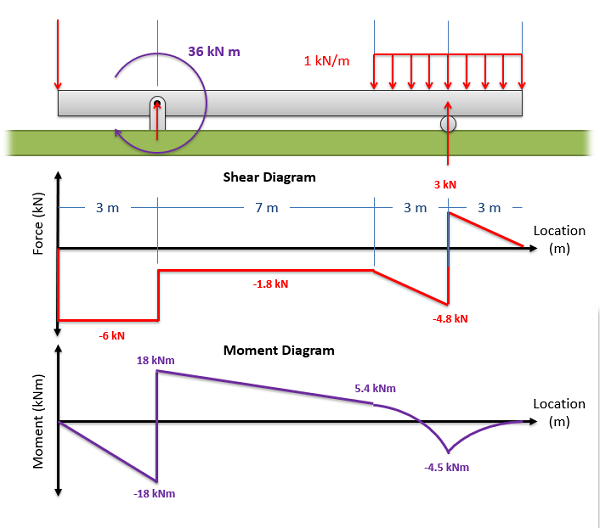

	</div>


	</div>
<div class="chapter standard with-subsections" id="chapter-slug-6-3-examples" title="6.3 Examples">
	<div class="chapter-title-wrap">
		<p class="chapter-number">31</p>
		<h1 class="chapter-title">6.3 Examples</h1>
								</div>
	<div class="ugc chapter-ugc">
				
 <p>Here are examples from Chapter 6 to help you understand these concepts better. These were taken from the real world and supplied by FSDE students in Summer 2021. If you’d like to submit your own examples, please send them to the author <a href="mailto:eosgood@upei.ca" data-url="mailto:eosgood@upei.ca">eosgood@upei.ca</a>.</p> <h1 id="chapter-575-section-1" class="section-header">Example 6.3.1: Internal Forces, Submitted by Emma Christensen</h1> <div class="textbox"><p><strong>1. Problem</strong></p> <div class="textbox shaded"><p>The setup that holds the solar panels at the UPEI FSDE is modelled below. Considering beam S (1.9 m length), find the internal forces at point C. Assume the intensity of the solar panel on the beam is 220 N/m.</p> <p>Sketch:</p> <p><img src="http://pressbooks.library.upei.ca/statics/wp-content/uploads/sites/56/2021/07/Emma-1-draw-1-1-300x265.jpg" alt="A sketch of the problem." class="aligncenter wp-image-1124" width="350" height="309" srcset="https://pressbooks.library.upei.ca/statics/wp-content/uploads/sites/56/2021/07/Emma-1-draw-1-1-300x265.jpg 300w, https://pressbooks.library.upei.ca/statics/wp-content/uploads/sites/56/2021/07/Emma-1-draw-1-1-1024x903.jpg 1024w, https://pressbooks.library.upei.ca/statics/wp-content/uploads/sites/56/2021/07/Emma-1-draw-1-1-768x678.jpg 768w, https://pressbooks.library.upei.ca/statics/wp-content/uploads/sites/56/2021/07/Emma-1-draw-1-1-65x57.jpg 65w, https://pressbooks.library.upei.ca/statics/wp-content/uploads/sites/56/2021/07/Emma-1-draw-1-1-225x198.jpg 225w, https://pressbooks.library.upei.ca/statics/wp-content/uploads/sites/56/2021/07/Emma-1-draw-1-1-350x309.jpg 350w, https://pressbooks.library.upei.ca/statics/wp-content/uploads/sites/56/2021/07/Emma-1-draw-1-1.jpg 1443w" sizes="auto, (max-width: 350px) 100vw, 350px" title=""></p> <p>Model:</p> <p><img src="http://pressbooks.library.upei.ca/statics/wp-content/uploads/sites/56/2021/07/Emma-1-draw-2-300x198.jpg" alt="A more detailed sketch of the problem." class="aligncenter wp-image-1112 size-medium" width="300" height="198" srcset="https://pressbooks.library.upei.ca/statics/wp-content/uploads/sites/56/2021/07/Emma-1-draw-2-300x198.jpg 300w, https://pressbooks.library.upei.ca/statics/wp-content/uploads/sites/56/2021/07/Emma-1-draw-2-1024x675.jpg 1024w, https://pressbooks.library.upei.ca/statics/wp-content/uploads/sites/56/2021/07/Emma-1-draw-2-768x506.jpg 768w, https://pressbooks.library.upei.ca/statics/wp-content/uploads/sites/56/2021/07/Emma-1-draw-2-65x43.jpg 65w, https://pressbooks.library.upei.ca/statics/wp-content/uploads/sites/56/2021/07/Emma-1-draw-2-225x148.jpg 225w, https://pressbooks.library.upei.ca/statics/wp-content/uploads/sites/56/2021/07/Emma-1-draw-2-350x231.jpg 350w, https://pressbooks.library.upei.ca/statics/wp-content/uploads/sites/56/2021/07/Emma-1-draw-2.jpg 1243w" sizes="auto, (max-width: 300px) 100vw, 300px" title=""></p> </div> <p><strong>2. Draw</strong></p> <p>Free-body diagram:</p> <p><img src="http://pressbooks.library.upei.ca/statics/wp-content/uploads/sites/56/2021/07/Emma-1-solve-1-300x197.jpg" alt="A FBD of the problem" class="alignnone wp-image-1114" width="394" height="259" srcset="https://pressbooks.library.upei.ca/statics/wp-content/uploads/sites/56/2021/07/Emma-1-solve-1-300x197.jpg 300w, https://pressbooks.library.upei.ca/statics/wp-content/uploads/sites/56/2021/07/Emma-1-solve-1-1024x671.jpg 1024w, https://pressbooks.library.upei.ca/statics/wp-content/uploads/sites/56/2021/07/Emma-1-solve-1-768x503.jpg 768w, https://pressbooks.library.upei.ca/statics/wp-content/uploads/sites/56/2021/07/Emma-1-solve-1-1536x1007.jpg 1536w, https://pressbooks.library.upei.ca/statics/wp-content/uploads/sites/56/2021/07/Emma-1-solve-1-65x43.jpg 65w, https://pressbooks.library.upei.ca/statics/wp-content/uploads/sites/56/2021/07/Emma-1-solve-1-225x147.jpg 225w, https://pressbooks.library.upei.ca/statics/wp-content/uploads/sites/56/2021/07/Emma-1-solve-1-350x229.jpg 350w, https://pressbooks.library.upei.ca/statics/wp-content/uploads/sites/56/2021/07/Emma-1-solve-1.jpg 1584w" sizes="auto, (max-width: 394px) 100vw, 394px" title=""></p> <p><strong>3. Knowns and Unknowns</strong></p> <p>Knowns:</p> <ul><li>w = 220 N/m</li> <li>OA = 0.5 m</li> <li>AC = 0.2 m</li> <li>AB = 0.4 m</li> <li>L = 1.9 m</li> </ul> <p>Unknowns:</p> <ul><li>N<sub>c</sub></li> <li>V<sub>c</sub></li> <li>M<sub>c</sub></li> </ul> <p><strong>4. Approach</strong></p> <p>Use equilibrium equations. First, solve for reaction forces, then make a cut at C and solve for the internal forces.</p> <p><strong>5. Analysis</strong></p> <p>$$w=\frac{F}{L}\\F=wL\\F_R=220N/m\cdot 1.9m\\F_R=418N\\\sum F_X=0=B_X$$</p> <p>Find reaction forces:</p> <p>$$\sum M_A=0=B_y(0.4m)-F_R(0.45m)\\(0.4m)B_y=418N(0.45m)\\B_y=\frac{188.1 N\cdot m}{0.4m}\\B_y=470.25N$$</p> <p>$$\sum F_y=0=-F_R+A_y+B_y\\A_y=F_R-B_y\\A_y=418N-470.25N\\A_y=-52.25N$$</p> <p>The answer we got for A<sub>y</sub> is negative, which means that the arrow should be drawn in the other direction. We will change it for our next sketch.</p> <p>Make a cut at C:</p> <p><img src="http://pressbooks.library.upei.ca/statics/wp-content/uploads/sites/56/2021/07/Emma-1-solve-6-1-300x264.jpg" alt="A sketch showing the internal forces at cut C." class="alignnone wp-image-1121 size-medium" width="300" height="264" srcset="https://pressbooks.library.upei.ca/statics/wp-content/uploads/sites/56/2021/07/Emma-1-solve-6-1-300x264.jpg 300w, https://pressbooks.library.upei.ca/statics/wp-content/uploads/sites/56/2021/07/Emma-1-solve-6-1-1024x901.jpg 1024w, https://pressbooks.library.upei.ca/statics/wp-content/uploads/sites/56/2021/07/Emma-1-solve-6-1-768x676.jpg 768w, https://pressbooks.library.upei.ca/statics/wp-content/uploads/sites/56/2021/07/Emma-1-solve-6-1-65x57.jpg 65w, https://pressbooks.library.upei.ca/statics/wp-content/uploads/sites/56/2021/07/Emma-1-solve-6-1-225x198.jpg 225w, https://pressbooks.library.upei.ca/statics/wp-content/uploads/sites/56/2021/07/Emma-1-solve-6-1-350x308.jpg 350w, https://pressbooks.library.upei.ca/statics/wp-content/uploads/sites/56/2021/07/Emma-1-solve-6-1.jpg 1352w" sizes="auto, (max-width: 300px) 100vw, 300px" title=""></p> <p>Now solve for the internal forces:</p> <p>$$\sum F_x=0\:\:;\:\:N_c=0\\\sum F_y=0=-A_y-V_c-(w\cdot L_A)\\V_c=-52.25N-(220N/m\cdot 0.7m)\\V_c=-206.25 N\\\sum M_c=A_y(0.2m)+M_c+(F_{Rc}\cdot 0.35m)\\M_c=52.25 N (0.2m)+(220N/m\cdot 0.7m\cdot 0.35m)\\M_c=64.35N\cdot m$$</p> <p>Final FBD, showing the arrows in the correct directions:</p> <p><img src="http://pressbooks.library.upei.ca/statics/wp-content/uploads/sites/56/2021/07/Emma-1-solve-7-1-300x216.jpg" alt="Final FBD showing arrows in the correct directions." class="alignnone wp-image-1122" width="388" height="279" srcset="https://pressbooks.library.upei.ca/statics/wp-content/uploads/sites/56/2021/07/Emma-1-solve-7-1-300x216.jpg 300w, https://pressbooks.library.upei.ca/statics/wp-content/uploads/sites/56/2021/07/Emma-1-solve-7-1-1024x738.jpg 1024w, https://pressbooks.library.upei.ca/statics/wp-content/uploads/sites/56/2021/07/Emma-1-solve-7-1-768x553.jpg 768w, https://pressbooks.library.upei.ca/statics/wp-content/uploads/sites/56/2021/07/Emma-1-solve-7-1-65x47.jpg 65w, https://pressbooks.library.upei.ca/statics/wp-content/uploads/sites/56/2021/07/Emma-1-solve-7-1-225x162.jpg 225w, https://pressbooks.library.upei.ca/statics/wp-content/uploads/sites/56/2021/07/Emma-1-solve-7-1-350x252.jpg 350w, https://pressbooks.library.upei.ca/statics/wp-content/uploads/sites/56/2021/07/Emma-1-solve-7-1.jpg 1503w" sizes="auto, (max-width: 388px) 100vw, 388px" title=""></p> <p><strong>6. Review</strong></p> <p>It makes sense that A<sub>y</sub> and B<sub>y</sub> are in different directions, because the resultant force Fr of the solar panel on the beam is not between A and B. It also makes sense that the moment at C is in the counterclockwise direction rather than the clockwise direction, when you think about the direction of the forces applied to the beam.</p> </div> <h1 id="chapter-575-section-2" class="section-header">Example 6.3.2: Shear/Moment Diagrams, Submitted by Deanna Malone</h1> <div class="textbox"><p><strong>1. Problem</strong></p> <div class="textbox shaded"><p>A beam that is simply supported has two point loads acting on it. One acts 2 m from point A, and the other acts at 2.5 m from C. Point B is in the middle of the beam. The first point load is 500 N and the second is 300 N. What are the internal forces at point B? Solve for reaction forces and include a shear/moment diagram.</p> <p><img src="http://pressbooks.library.upei.ca/statics/wp-content/uploads/sites/56/2021/07/Deanna-2-draw-1-300x257.jpg" alt="A sketch of the problem." class="aligncenter wp-image-1003" width="307" height="263" srcset="https://pressbooks.library.upei.ca/statics/wp-content/uploads/sites/56/2021/07/Deanna-2-draw-1-300x257.jpg 300w, https://pressbooks.library.upei.ca/statics/wp-content/uploads/sites/56/2021/07/Deanna-2-draw-1-1024x876.jpg 1024w, https://pressbooks.library.upei.ca/statics/wp-content/uploads/sites/56/2021/07/Deanna-2-draw-1-768x657.jpg 768w, https://pressbooks.library.upei.ca/statics/wp-content/uploads/sites/56/2021/07/Deanna-2-draw-1-1536x1314.jpg 1536w, https://pressbooks.library.upei.ca/statics/wp-content/uploads/sites/56/2021/07/Deanna-2-draw-1-65x56.jpg 65w, https://pressbooks.library.upei.ca/statics/wp-content/uploads/sites/56/2021/07/Deanna-2-draw-1-225x192.jpg 225w, https://pressbooks.library.upei.ca/statics/wp-content/uploads/sites/56/2021/07/Deanna-2-draw-1-350x299.jpg 350w, https://pressbooks.library.upei.ca/statics/wp-content/uploads/sites/56/2021/07/Deanna-2-draw-1.jpg 1799w" sizes="auto, (max-width: 307px) 100vw, 307px" title=""></p> </div> <p><strong>2. Draw</strong></p> <p>Sketch:</p> <p><img src="http://pressbooks.library.upei.ca/statics/wp-content/uploads/sites/56/2021/07/Deanna-2-draw-1-300x257.jpg" alt="A sketch of the problem." class="alignnone wp-image-1003" width="307" height="263" srcset="https://pressbooks.library.upei.ca/statics/wp-content/uploads/sites/56/2021/07/Deanna-2-draw-1-300x257.jpg 300w, https://pressbooks.library.upei.ca/statics/wp-content/uploads/sites/56/2021/07/Deanna-2-draw-1-1024x876.jpg 1024w, https://pressbooks.library.upei.ca/statics/wp-content/uploads/sites/56/2021/07/Deanna-2-draw-1-768x657.jpg 768w, https://pressbooks.library.upei.ca/statics/wp-content/uploads/sites/56/2021/07/Deanna-2-draw-1-1536x1314.jpg 1536w, https://pressbooks.library.upei.ca/statics/wp-content/uploads/sites/56/2021/07/Deanna-2-draw-1-65x56.jpg 65w, https://pressbooks.library.upei.ca/statics/wp-content/uploads/sites/56/2021/07/Deanna-2-draw-1-225x192.jpg 225w, https://pressbooks.library.upei.ca/statics/wp-content/uploads/sites/56/2021/07/Deanna-2-draw-1-350x299.jpg 350w, https://pressbooks.library.upei.ca/statics/wp-content/uploads/sites/56/2021/07/Deanna-2-draw-1.jpg 1799w" sizes="auto, (max-width: 307px) 100vw, 307px" title=""></p> <p>Free-body diagram:</p> <p><img src="http://pressbooks.library.upei.ca/statics/wp-content/uploads/sites/56/2021/07/Deanna-2-draw-2-300x165.jpg" alt="A FBD of the problem." class="alignnone wp-image-1004" width="407" height="224" srcset="https://pressbooks.library.upei.ca/statics/wp-content/uploads/sites/56/2021/07/Deanna-2-draw-2-300x165.jpg 300w, https://pressbooks.library.upei.ca/statics/wp-content/uploads/sites/56/2021/07/Deanna-2-draw-2-1024x565.jpg 1024w, https://pressbooks.library.upei.ca/statics/wp-content/uploads/sites/56/2021/07/Deanna-2-draw-2-768x424.jpg 768w, https://pressbooks.library.upei.ca/statics/wp-content/uploads/sites/56/2021/07/Deanna-2-draw-2-1536x847.jpg 1536w, https://pressbooks.library.upei.ca/statics/wp-content/uploads/sites/56/2021/07/Deanna-2-draw-2-2048x1129.jpg 2048w, https://pressbooks.library.upei.ca/statics/wp-content/uploads/sites/56/2021/07/Deanna-2-draw-2-65x36.jpg 65w, https://pressbooks.library.upei.ca/statics/wp-content/uploads/sites/56/2021/07/Deanna-2-draw-2-225x124.jpg 225w, https://pressbooks.library.upei.ca/statics/wp-content/uploads/sites/56/2021/07/Deanna-2-draw-2-350x193.jpg 350w" sizes="auto, (max-width: 407px) 100vw, 407px" title=""></p> <p><strong>3. Knowns and Unknowns</strong></p> <p>Knowns:</p> <ul><li>F1 = 500 N</li> <li>F2 = 300 N</li> </ul> <p>Unknowns:</p> <ul><li>A<sub>y</sub></li> <li>A<sub>x</sub></li> <li>C<sub>y</sub></li> <li>V<sub>B</sub></li> <li>M<sub>B</sub></li> <li>N<sub>B</sub></li> </ul> <p><strong>4. Approach</strong></p> <p>Shear/moment equations, EOM equations</p> <p><strong>5. Analysis</strong></p> <p>Solve for reaction forces:</p> <p>(Ax, Cy)</p> <p>\begin{aligned}<br> \sum F_{x}=0=A_{x}=0 \\<br> \sum M_{A}=0 &amp;=-F_{1} \cdot 2 m-F_{2} \cdot 5.5 m+C_{y} \cdot 8 m \\<br> C_{y}=&amp;\frac{F_{1} \cdot 2 m+F_{2} \cdot 5.5 m}{8m} \\<br> C_{y} &amp;=\frac{500 N \cdot 2 m+300 N \cdot 5.5 m}{8 m} \\<br> C_{y} &amp;=331.25 \mathrm{~N}<br> \end{aligned}</p> <p>(Ay)</p> <p>\begin{aligned}<br> \sum F_{y}=0 &amp;=A_{y}+C_{y}-F_{1}-F_{2} \\<br> A_{y} &amp;=F_{1}+F_{2}-C_{y} \\<br> A_{y} &amp;=500 \mathrm{~N}+300 \mathrm{~N} – 331.25 \mathrm{~N} \\<br> A_{y} &amp;=468.75 \mathrm{~N}<br> \end{aligned}</p> <p>Cut 1: at B</p> <p><img src="http://pressbooks.library.upei.ca/statics/wp-content/uploads/sites/56/2021/07/deanna-2-solve-1-300x133.jpg" alt="A sketch showing the cut at B" class="alignnone wp-image-1005" width="399" height="177" srcset="https://pressbooks.library.upei.ca/statics/wp-content/uploads/sites/56/2021/07/deanna-2-solve-1-300x133.jpg 300w, https://pressbooks.library.upei.ca/statics/wp-content/uploads/sites/56/2021/07/deanna-2-solve-1-1024x453.jpg 1024w, https://pressbooks.library.upei.ca/statics/wp-content/uploads/sites/56/2021/07/deanna-2-solve-1-768x339.jpg 768w, https://pressbooks.library.upei.ca/statics/wp-content/uploads/sites/56/2021/07/deanna-2-solve-1-1536x679.jpg 1536w, https://pressbooks.library.upei.ca/statics/wp-content/uploads/sites/56/2021/07/deanna-2-solve-1-65x29.jpg 65w, https://pressbooks.library.upei.ca/statics/wp-content/uploads/sites/56/2021/07/deanna-2-solve-1-225x99.jpg 225w, https://pressbooks.library.upei.ca/statics/wp-content/uploads/sites/56/2021/07/deanna-2-solve-1-350x155.jpg 350w, https://pressbooks.library.upei.ca/statics/wp-content/uploads/sites/56/2021/07/deanna-2-solve-1.jpg 1855w" sizes="auto, (max-width: 399px) 100vw, 399px" title=""></p> <p>\begin{aligned}<br> \sum F_{X}=0=A_{X} &amp;+N_{B}=0 \\<br> &amp; N_{B}=0 \\<br> \sum F_{y}=0 &amp;=A_{y}-V_{B}-F_{1} \\<br> V_{B} &amp;=A_{y}-F_{1} \\<br> V_{B} &amp;=468.75 N – 500 N \\<br> V_{B}=-31.25 N<br> \end{aligned}</p> <p>\begin{aligned}<br> \sum M_{B}=&amp; 0=-A_{y}(4 m)+F_{1}(2 m)+M_{B} \\<br> &amp; M_{B}=A_{y}(4 m)-F_{1}(2 m) \\<br> &amp; M_{B}=468.75 N(4 m)-500 N(2 m) \\<br> M_{B} &amp;=875 \mathrm{~N} \cdot \mathrm{m}<br> \end{aligned}</p> <p>Cut 2: At the point where F<sub>1</sub> is applied</p> <p><img src="http://pressbooks.library.upei.ca/statics/wp-content/uploads/sites/56/2021/07/deanna-2-solve-2-300x139.jpg" alt="A sketch showing the cut at F1" class="alignnone wp-image-1006" width="376" height="174" srcset="https://pressbooks.library.upei.ca/statics/wp-content/uploads/sites/56/2021/07/deanna-2-solve-2-300x139.jpg 300w, https://pressbooks.library.upei.ca/statics/wp-content/uploads/sites/56/2021/07/deanna-2-solve-2-1024x475.jpg 1024w, https://pressbooks.library.upei.ca/statics/wp-content/uploads/sites/56/2021/07/deanna-2-solve-2-768x356.jpg 768w, https://pressbooks.library.upei.ca/statics/wp-content/uploads/sites/56/2021/07/deanna-2-solve-2-1536x713.jpg 1536w, https://pressbooks.library.upei.ca/statics/wp-content/uploads/sites/56/2021/07/deanna-2-solve-2-65x30.jpg 65w, https://pressbooks.library.upei.ca/statics/wp-content/uploads/sites/56/2021/07/deanna-2-solve-2-225x104.jpg 225w, https://pressbooks.library.upei.ca/statics/wp-content/uploads/sites/56/2021/07/deanna-2-solve-2-350x162.jpg 350w, https://pressbooks.library.upei.ca/statics/wp-content/uploads/sites/56/2021/07/deanna-2-solve-2.jpg 1884w" sizes="auto, (max-width: 376px) 100vw, 376px" title=""></p> <p>\begin{aligned}<br> \sum M_{1}=0 &amp;=-A_{y}(2 m)+M_{1}=0 \\<br> M_{1} &amp;=A_{y}(2 m) \\<br> M_{1} &amp;=468.75 N(2 m) \\<br> M_{1} &amp;=937.5 \mathrm{~N} \cdot m<br> \end{aligned}</p> <p>Cut 3: At the point where F<sub>2</sub> is applied</p> <p><img src="http://pressbooks.library.upei.ca/statics/wp-content/uploads/sites/56/2021/07/deanna-2-solve-3-300x109.jpg" alt="A sketch showing the cut at F2." class="alignnone wp-image-1007" width="377" height="137" srcset="https://pressbooks.library.upei.ca/statics/wp-content/uploads/sites/56/2021/07/deanna-2-solve-3-300x109.jpg 300w, https://pressbooks.library.upei.ca/statics/wp-content/uploads/sites/56/2021/07/deanna-2-solve-3-1024x371.jpg 1024w, https://pressbooks.library.upei.ca/statics/wp-content/uploads/sites/56/2021/07/deanna-2-solve-3-768x278.jpg 768w, https://pressbooks.library.upei.ca/statics/wp-content/uploads/sites/56/2021/07/deanna-2-solve-3-1536x556.jpg 1536w, https://pressbooks.library.upei.ca/statics/wp-content/uploads/sites/56/2021/07/deanna-2-solve-3-2048x741.jpg 2048w, https://pressbooks.library.upei.ca/statics/wp-content/uploads/sites/56/2021/07/deanna-2-solve-3-65x24.jpg 65w, https://pressbooks.library.upei.ca/statics/wp-content/uploads/sites/56/2021/07/deanna-2-solve-3-225x81.jpg 225w, https://pressbooks.library.upei.ca/statics/wp-content/uploads/sites/56/2021/07/deanna-2-solve-3-350x127.jpg 350w" sizes="auto, (max-width: 377px) 100vw, 377px" title=""></p> <p>\begin{aligned}<br> \sum M_{2}=0 =-A_{y}(5.5 \mathrm{~m})+F_{1}(3.5 \mathrm{~m})+M_{2} \\<br> M_{2} =A_{y}(5.5 \mathrm{~m})-F_{1}(3.5 \mathrm{~m}) \\<br> M_{2} =468.75 \mathrm{~N}(5.5 \mathrm{~m})-500 \mathrm{~N}(3.5 \mathrm{~m}) \\<br> M_{2} =828.125 \mathrm{~N} \cdot \mathrm{m}<br> \end{aligned}</p> <p>Answer: N<sub>B</sub> = 0, V<sub>B</sub> = -31.25 N, M<sub>B</sub> = 875 Nm</p> <p><img src="http://pressbooks.library.upei.ca/statics/wp-content/uploads/sites/56/2021/07/Deanna-2-solve-final-252x300.jpg" alt="A final diagram of the beam, shear and moment diagrams." class="alignnone wp-image-1008" width="404" height="481" srcset="https://pressbooks.library.upei.ca/statics/wp-content/uploads/sites/56/2021/07/Deanna-2-solve-final-252x300.jpg 252w, https://pressbooks.library.upei.ca/statics/wp-content/uploads/sites/56/2021/07/Deanna-2-solve-final-859x1024.jpg 859w, https://pressbooks.library.upei.ca/statics/wp-content/uploads/sites/56/2021/07/Deanna-2-solve-final-768x915.jpg 768w, https://pressbooks.library.upei.ca/statics/wp-content/uploads/sites/56/2021/07/Deanna-2-solve-final-1289x1536.jpg 1289w, https://pressbooks.library.upei.ca/statics/wp-content/uploads/sites/56/2021/07/Deanna-2-solve-final-65x77.jpg 65w, https://pressbooks.library.upei.ca/statics/wp-content/uploads/sites/56/2021/07/Deanna-2-solve-final-225x268.jpg 225w, https://pressbooks.library.upei.ca/statics/wp-content/uploads/sites/56/2021/07/Deanna-2-solve-final-350x417.jpg 350w, https://pressbooks.library.upei.ca/statics/wp-content/uploads/sites/56/2021/07/Deanna-2-solve-final.jpg 1365w" sizes="auto, (max-width: 404px) 100vw, 404px" title=""></p> <p><strong>6. Review</strong></p> <p>The reaction forces make sense as they offset the applied forces. The shear/moment diagrams returned to zero, so they are correct too. The moment found at B is in the moment diagram; it is smaller than the maximum.</p> </div> <h1 id="chapter-575-section-3" class="section-header">Example 6.3.3: V/M Diagrams, Submitted by Luciana Davila</h1> <div class="textbox"><ol><li><strong>Problem&nbsp;</strong></li> </ol> <div class="textbox shaded"><p>For the 8cm simply supported beam given below, if Fg, which is applied at the center of the beam, is given as 30 N, find the internal forces between the reaction forces and draw the V-M diagram for the beam.</p> <p><img src="http://pressbooks.library.upei.ca/statics/wp-content/uploads/sites/56/2022/02/simply-supported.jpg" alt="An image of a simply supported bridge." width="551" height="640" class="alignnone wp-image-2205 size-full" srcset="https://pressbooks.library.upei.ca/statics/wp-content/uploads/sites/56/2022/02/simply-supported.jpg 551w, https://pressbooks.library.upei.ca/statics/wp-content/uploads/sites/56/2022/02/simply-supported-258x300.jpg 258w, https://pressbooks.library.upei.ca/statics/wp-content/uploads/sites/56/2022/02/simply-supported-65x75.jpg 65w, https://pressbooks.library.upei.ca/statics/wp-content/uploads/sites/56/2022/02/simply-supported-225x261.jpg 225w, https://pressbooks.library.upei.ca/statics/wp-content/uploads/sites/56/2022/02/simply-supported-350x407.jpg 350w" sizes="auto, (max-width: 551px) 100vw, 551px" title=""></p> <p>Simply supported girder bridge: https://www.geograph.org.uk/photo/2780207</p> <p><img src="http://pressbooks.library.upei.ca/statics/wp-content/uploads/sites/56/2022/02/chapter-6-unknown-V-m-diagram-question.jpg" width="491" height="192" class="alignnone" alt="A digital sketch of the problem." title=""></p> </div> <p><strong>2. Draw&nbsp;</strong></p> <p><img src="http://pressbooks.library.upei.ca/statics/wp-content/uploads/sites/56/2022/02/chapter-6-unknown-V-m-diagram-question-2.jpg" alt="A FBD of the problem." class="alignnone wp-image-1823 size-full" width="608" height="264" srcset="https://pressbooks.library.upei.ca/statics/wp-content/uploads/sites/56/2022/02/chapter-6-unknown-V-m-diagram-question-2.jpg 608w, https://pressbooks.library.upei.ca/statics/wp-content/uploads/sites/56/2022/02/chapter-6-unknown-V-m-diagram-question-2-300x130.jpg 300w, https://pressbooks.library.upei.ca/statics/wp-content/uploads/sites/56/2022/02/chapter-6-unknown-V-m-diagram-question-2-65x28.jpg 65w, https://pressbooks.library.upei.ca/statics/wp-content/uploads/sites/56/2022/02/chapter-6-unknown-V-m-diagram-question-2-225x98.jpg 225w, https://pressbooks.library.upei.ca/statics/wp-content/uploads/sites/56/2022/02/chapter-6-unknown-V-m-diagram-question-2-350x152.jpg 350w" sizes="auto, (max-width: 608px) 100vw, 608px" title=""></p> <p>&nbsp;</p> <p><strong>3. Knowns and Unknowns&nbsp;</strong></p> <p>Knowns:</p> <ul><li>F<sub>g</sub> = 30N</li> <li>r <sub style="text-align: initial;background-color: initial">AB</sub> <span style="text-align: initial;background-color: initial;font-size: 1em">=&nbsp; r </span><sub style="text-align: initial;background-color: initial">BC </sub><span style="text-align: initial;background-color: initial;font-size: 1em">=&nbsp; 0.04 m</span></li> </ul> <p>Unknowns:</p> <ul><li>Reaction forces = R<sub>Ax</sub>, R<sub>Ay</sub>, R<sub>Cy</sub></li> <li>For the segment of beam AB nd BC,</li> <li>Shear = V, V<sub style="text-align: initial;background-color: initial">2</sub></li> <li>Bending Moment = M, M<sub style="text-align: initial;background-color: initial">2</sub></li> <li>Normal force = N, N<sub style="text-align: initial;background-color: initial">2</sub></li> </ul> <p><strong>4. Approach&nbsp;</strong></p> <p>Find reaction forces from equilibrium equations. Use them to find the shear and bending moment of segment AB and BC. Draw the V-M diagram from the answers.</p> <p><strong>5. Analysis&nbsp;</strong></p> <p>Finding reaction forces:</p> <p>$$\sum F_x=0=R_{Ax}\\R_{Ax}=0N$$</p> <p>Solving for RC<sub>y</sub>:</p> <p>$$\sum M_A=0= -(r_{AB}\cdot F_g)+(r_{AC}\cdot R_{Cy})\\r_{AB}\cdot F_{g}=r_{AC}\cdot R_{Cy} $$</p> <p>$$R_{Cy}=\frac{r_{AB}\cdot F_g}{r_{AC}}\\R_{By}=\frac{0.04m\cdot 30 N}{0.08 m} $$</p> <p><span style="text-align: initial;background-color: initial;font-size: 1em">$$R_{Cy}=15 N$$</span></p> <p>Solving for RA<sub>y</sub>:</p> <p>$$\sum F_y=0=R_{Cy}+R_{Ay} -F_g\\R_{Ay}=F_g-R_{Cy}\\R_{Ay}= 15 N$$</p> <p>Finding shear and Moment from A to B :</p> <p><img src="http://pressbooks.library.upei.ca/statics/wp-content/uploads/sites/56/2022/02/Luciana-beam-AB-3.png" alt="A sketch to find the internal forces between a and b." class="alignnone wp-image-1713" width="340" height="202" srcset="https://pressbooks.library.upei.ca/statics/wp-content/uploads/sites/56/2022/02/Luciana-beam-AB-3.png 248w, https://pressbooks.library.upei.ca/statics/wp-content/uploads/sites/56/2022/02/Luciana-beam-AB-3-65x39.png 65w, https://pressbooks.library.upei.ca/statics/wp-content/uploads/sites/56/2022/02/Luciana-beam-AB-3-225x133.png 225w" sizes="auto, (max-width: 340px) 100vw, 340px" title=""></p> <p>$$\sum F_x=0\\N=0N$$</p> <p>Solving for V</p> <p>$$\sum F_y=0=R_{Ay}+-V\\ V= 15 N$$</p> <p>Solving for M :</p> <p>$$\sum M_A=0= -( V\cdot 0.04) +M\\M = 15\cdot 0.04\\M=0.6N $$</p> <p>Finding shear and Moment from B to C:</p> <p><img src="http://pressbooks.library.upei.ca/statics/wp-content/uploads/sites/56/2022/02/Luciana-BC-4-300x166.png" alt="A sketch to find the internal forces between b and c." class="alignnone wp-image-1714" width="363" height="201" srcset="https://pressbooks.library.upei.ca/statics/wp-content/uploads/sites/56/2022/02/Luciana-BC-4-300x166.png 300w, https://pressbooks.library.upei.ca/statics/wp-content/uploads/sites/56/2022/02/Luciana-BC-4-65x36.png 65w, https://pressbooks.library.upei.ca/statics/wp-content/uploads/sites/56/2022/02/Luciana-BC-4-225x125.png 225w, https://pressbooks.library.upei.ca/statics/wp-content/uploads/sites/56/2022/02/Luciana-BC-4-350x194.png 350w, https://pressbooks.library.upei.ca/statics/wp-content/uploads/sites/56/2022/02/Luciana-BC-4.png 373w" sizes="auto, (max-width: 363px) 100vw, 363px" title=""></p> <p>$$\sum F_x=0\\N=0N$$</p> <p>Solving for V</p> <p>$$\sum F_y=0=R_{Cy}+V_2\\ V_2= -15 N$$</p> <p>Solving for M :</p> <p>$$\sum M_C=0= -( V_2\cdot(0.04) -M_2\\M_2 = 15\cdot 0.04\\M=0.6N $$</p> <p>V-M diagram:</p> <p>For V-x graph, from A to B there constant shear that is 15 N then from B to C the shear has same magnitude but different direction.&nbsp; To plot the M-x graph, substitute x in the equation for M and M<sub>2</sub> to find the peak bending moment. Also, because M is the integral of shear force, horizontal plots in shear correspond to a linear plot in the M-x graph.</p> <p><img src="http://pressbooks.library.upei.ca/statics/wp-content/uploads/sites/56/2022/02/V-m-chapter-6.jpg" alt="Shear and moment diagrams" class="alignnone wp-image-1824" width="431" height="823" srcset="https://pressbooks.library.upei.ca/statics/wp-content/uploads/sites/56/2022/02/V-m-chapter-6.jpg 511w, https://pressbooks.library.upei.ca/statics/wp-content/uploads/sites/56/2022/02/V-m-chapter-6-157x300.jpg 157w, https://pressbooks.library.upei.ca/statics/wp-content/uploads/sites/56/2022/02/V-m-chapter-6-65x124.jpg 65w, https://pressbooks.library.upei.ca/statics/wp-content/uploads/sites/56/2022/02/V-m-chapter-6-225x430.jpg 225w, https://pressbooks.library.upei.ca/statics/wp-content/uploads/sites/56/2022/02/V-m-chapter-6-350x668.jpg 350w" sizes="auto, (max-width: 431px) 100vw, 431px" title=""></p> <p><strong>6. Review&nbsp;</strong></p> <p>The answers make sense. The moment, shear, and reaction forces are equal in both segments of the beam. This is as expected because of the symmetry of the beam.</p> </div> <h1 id="chapter-575-section-4" class="section-header">Example 6.3.4: V/M Diagrams, Submitted by Michael Oppong-Ampomah</h1> <div class="textbox"><p><strong>1. Problem</strong></p> <div class="textbox shaded">Roughly sketch the shear and moment diagram for the following structure. Measure from point A.<br> <img src="http://pressbooks.library.upei.ca/statics/wp-content/uploads/sites/56/2022/02/Michael1-300x133.png" alt="A cantilever beam with distributed load at the free end." class="alignnone wp-image-1768 size-medium" width="300" height="133" srcset="https://pressbooks.library.upei.ca/statics/wp-content/uploads/sites/56/2022/02/Michael1-300x133.png 300w, https://pressbooks.library.upei.ca/statics/wp-content/uploads/sites/56/2022/02/Michael1-65x29.png 65w, https://pressbooks.library.upei.ca/statics/wp-content/uploads/sites/56/2022/02/Michael1-225x100.png 225w, https://pressbooks.library.upei.ca/statics/wp-content/uploads/sites/56/2022/02/Michael1-350x155.png 350w, https://pressbooks.library.upei.ca/statics/wp-content/uploads/sites/56/2022/02/Michael1.png 685w" sizes="auto, (max-width: 300px) 100vw, 300px" title=""></div> <p><strong>2. Sketch</strong></p> <p>N/A, Sketch Provided.</p> <p><strong>3. Knows and Unknowns:</strong></p> <p>Knowns:</p> <ul><li>Distributed Load: w</li> <li>Dimensions and shown</li> </ul> <p>Unknown:</p> <ul><li>Shear/Moment Diagram</li> </ul> <p><strong>4. Approach:</strong></p> <p>Break the beam into sections as forces change.</p> <p>Determine the plotted shape of the shear and moment of each section.</p> <p>Draw the V/M diagrams using these shape diagrams.</p> <p><strong>5. Analysis:</strong></p> <p>A distributed load creates a linear section across it, with the magnitude of the shear force increasing across the load. The maximum shear will be at the end of the distributed load. With no other forces being applied except for reactions, section B-C should be constant. Since the beam is static, the reactions must bring the shear back to zero.<br> <img src="http://pressbooks.library.upei.ca/statics/wp-content/uploads/sites/56/2022/02/Michael2-300x133.png" alt="Shear diagram of the problem." class="alignnone wp-image-1769 size-medium" width="300" height="133" srcset="https://pressbooks.library.upei.ca/statics/wp-content/uploads/sites/56/2022/02/Michael2-300x133.png 300w, https://pressbooks.library.upei.ca/statics/wp-content/uploads/sites/56/2022/02/Michael2-65x29.png 65w, https://pressbooks.library.upei.ca/statics/wp-content/uploads/sites/56/2022/02/Michael2-225x100.png 225w, https://pressbooks.library.upei.ca/statics/wp-content/uploads/sites/56/2022/02/Michael2-350x155.png 350w, https://pressbooks.library.upei.ca/statics/wp-content/uploads/sites/56/2022/02/Michael2.png 652w" sizes="auto, (max-width: 300px) 100vw, 300px" title=""></p> <p>The moment can be drawn using the knowledge that dM = V. Section A-B in the shear diagram is linear; integrating a linear function gives a quadratic function, thus, section A-B in the moment diagram must be curved. Section B-C is constant in shear. Integrating a constant function gives a linear function; therefore, the moment across this section must be linear, and since the shear is negative, the slope of the moment must be negative. Finally, because the beam is static, the moment must return to zero due to the reaction forces.<br> <img src="http://pressbooks.library.upei.ca/statics/wp-content/uploads/sites/56/2022/02/Michael3-300x173.png" alt="Moment diagram of the problem." class="alignnone wp-image-1770 size-medium" width="300" height="173" srcset="https://pressbooks.library.upei.ca/statics/wp-content/uploads/sites/56/2022/02/Michael3-300x173.png 300w, https://pressbooks.library.upei.ca/statics/wp-content/uploads/sites/56/2022/02/Michael3-65x37.png 65w, https://pressbooks.library.upei.ca/statics/wp-content/uploads/sites/56/2022/02/Michael3-225x130.png 225w, https://pressbooks.library.upei.ca/statics/wp-content/uploads/sites/56/2022/02/Michael3-350x201.png 350w, https://pressbooks.library.upei.ca/statics/wp-content/uploads/sites/56/2022/02/Michael3.png 608w" sizes="auto, (max-width: 300px) 100vw, 300px" title=""></p> <p><strong>6. Review</strong></p> <p>Using principles of shear force (V) and moments and their integral/derivative relationship, the shear and moment diagrams make sense for their general shape.</p> </div> <h1 id="chapter-575-section-5" class="section-header">Example 6.3.5: V/M Diagrams, Submitted by William Craine</h1> <div class="textbox"><p><strong>1. Problem</strong></p> <div class="textbox shaded">Find the reaction forces and create the shear and moment diagrams for the beam.<br> <img src="http://pressbooks.library.upei.ca/statics/wp-content/uploads/sites/56/2022/02/William1-4-1024x629.png" alt="A cantilever beam with triangular distributed load at its free end." class="alignnone wp-image-1780" width="544" height="334" srcset="https://pressbooks.library.upei.ca/statics/wp-content/uploads/sites/56/2022/02/William1-4-1024x629.png 1024w, https://pressbooks.library.upei.ca/statics/wp-content/uploads/sites/56/2022/02/William1-4-300x184.png 300w, https://pressbooks.library.upei.ca/statics/wp-content/uploads/sites/56/2022/02/William1-4-768x472.png 768w, https://pressbooks.library.upei.ca/statics/wp-content/uploads/sites/56/2022/02/William1-4-1536x944.png 1536w, https://pressbooks.library.upei.ca/statics/wp-content/uploads/sites/56/2022/02/William1-4-2048x1258.png 2048w, https://pressbooks.library.upei.ca/statics/wp-content/uploads/sites/56/2022/02/William1-4-65x40.png 65w, https://pressbooks.library.upei.ca/statics/wp-content/uploads/sites/56/2022/02/William1-4-225x138.png 225w, https://pressbooks.library.upei.ca/statics/wp-content/uploads/sites/56/2022/02/William1-4-350x215.png 350w" sizes="auto, (max-width: 544px) 100vw, 544px" title=""></div> <p><strong>2. Draw</strong></p> <p>$$ 4N/m \cdot \frac{5.5m}{2} = 11N$$</p> <p>$$ \bar{x} = 1/3 \cdot 5.5m = 1.83m$$</p> <p>$$ \bar{x} \ from&nbsp; A = 4m + 4.5m + 1.83m = 10.3m$$</p> <p><img src="http://pressbooks.library.upei.ca/statics/wp-content/uploads/sites/56/2022/02/William2-1-1024x545.png" alt="A FBD of the problem." class="alignnone wp-image-1781" width="597" height="318" srcset="https://pressbooks.library.upei.ca/statics/wp-content/uploads/sites/56/2022/02/William2-1-1024x545.png 1024w, https://pressbooks.library.upei.ca/statics/wp-content/uploads/sites/56/2022/02/William2-1-300x160.png 300w, https://pressbooks.library.upei.ca/statics/wp-content/uploads/sites/56/2022/02/William2-1-768x409.png 768w, https://pressbooks.library.upei.ca/statics/wp-content/uploads/sites/56/2022/02/William2-1-1536x817.png 1536w, https://pressbooks.library.upei.ca/statics/wp-content/uploads/sites/56/2022/02/William2-1-2048x1090.png 2048w, https://pressbooks.library.upei.ca/statics/wp-content/uploads/sites/56/2022/02/William2-1-65x35.png 65w, https://pressbooks.library.upei.ca/statics/wp-content/uploads/sites/56/2022/02/William2-1-225x120.png 225w, https://pressbooks.library.upei.ca/statics/wp-content/uploads/sites/56/2022/02/William2-1-350x186.png 350w" sizes="auto, (max-width: 597px) 100vw, 597px" title=""><br> <strong>3. Knowns and Unknowns</strong></p> <p>Knowns:</p> <ul><li>Applied Forces:</li> <li>F<sub>B</sub> = -20N</li> <li>F<sub>C</sub> = -400N</li> <li>F<sub>D</sub> = 500N</li> <li>F<sub>Load</sub> = -4N/m</li> <li>Dimensions as shown</li> </ul> <p>Unknowns:</p> <ul><li>Reaction Forces: R<sub>AX, </sub>R<sub>AY, </sub>M<sub>A</sub></li> <li>Shear/Moment Diagram</li> </ul> <p><strong>4. Approach</strong></p> <ol><li>Use equilibrium equation to find the reaction forces</li> <li>Use beam analysis/cutting between forces to find equations for the shear/moment diagram.</li> </ol> <p><strong>5. Analysis</strong></p> <p>First, use the sum of forces and the sum of moments to determine R<sub>Ay</sub> and M<sub>A</sub>.</p> <p>$$ \sum F_x = R_{Ax} = 0$$</p> <p>$$ \sum F_y = -R_{Ay} – 20N – 400N – 11N +500N = 0$$</p> <p>$$ R_{Ay} = 69N$$</p> <p>$$ \sum M_A = – M_A – (20N \cdot 4m) – (400N \cdot 8.5m) – (11N \cdot 10.3m) + (500 N \cdot 14m) = 0 $$</p> <p>$$ M_A = 3406.7Nm$$</p> <p>Next, cut the beam between A and B and analyze the internal forces.</p> <p><img src="http://pressbooks.library.upei.ca/statics/wp-content/uploads/sites/56/2022/02/William3-1024x422.png" alt="A sketch of the internal forces from A to B." class="alignnone wp-image-1788" width="469" height="193" srcset="https://pressbooks.library.upei.ca/statics/wp-content/uploads/sites/56/2022/02/William3-1024x422.png 1024w, https://pressbooks.library.upei.ca/statics/wp-content/uploads/sites/56/2022/02/William3-300x124.png 300w, https://pressbooks.library.upei.ca/statics/wp-content/uploads/sites/56/2022/02/William3-768x317.png 768w, https://pressbooks.library.upei.ca/statics/wp-content/uploads/sites/56/2022/02/William3-1536x633.png 1536w, https://pressbooks.library.upei.ca/statics/wp-content/uploads/sites/56/2022/02/William3-2048x844.png 2048w, https://pressbooks.library.upei.ca/statics/wp-content/uploads/sites/56/2022/02/William3-65x27.png 65w, https://pressbooks.library.upei.ca/statics/wp-content/uploads/sites/56/2022/02/William3-225x93.png 225w, https://pressbooks.library.upei.ca/statics/wp-content/uploads/sites/56/2022/02/William3-350x144.png 350w" sizes="auto, (max-width: 469px) 100vw, 469px" title=""></p> <p>$$ \sum F_x = N + 0 = 0 \\ N = 0$$</p> <p>$$ \sum F_y = -69N -V = 0 \\ V= -69N$$</p> <p>$$ \sum M_{cut} =&nbsp; M + (69N \cdot x) – (3406.7Nm) = 0 \\ M = -69x + 3406.7$$</p> <p>Repeat the analysis of internal forces from A to C.</p> <p><img src="http://pressbooks.library.upei.ca/statics/wp-content/uploads/sites/56/2022/02/William4-1024x367.png" alt="A sketch of the internal forces from A to C." class="alignnone wp-image-1792 size-large" width="1024" height="367" srcset="https://pressbooks.library.upei.ca/statics/wp-content/uploads/sites/56/2022/02/William4-1024x367.png 1024w, https://pressbooks.library.upei.ca/statics/wp-content/uploads/sites/56/2022/02/William4-300x107.png 300w, https://pressbooks.library.upei.ca/statics/wp-content/uploads/sites/56/2022/02/William4-768x275.png 768w, https://pressbooks.library.upei.ca/statics/wp-content/uploads/sites/56/2022/02/William4-1536x550.png 1536w, https://pressbooks.library.upei.ca/statics/wp-content/uploads/sites/56/2022/02/William4-2048x734.png 2048w, https://pressbooks.library.upei.ca/statics/wp-content/uploads/sites/56/2022/02/William4-65x23.png 65w, https://pressbooks.library.upei.ca/statics/wp-content/uploads/sites/56/2022/02/William4-225x81.png 225w, https://pressbooks.library.upei.ca/statics/wp-content/uploads/sites/56/2022/02/William4-350x125.png 350w" sizes="auto, (max-width: 1024px) 100vw, 1024px" title=""></p> <p>$$ \sum F_x = N + 0 = 0 \\ N = 0$$</p> <p>$$ \sum F_y = -69N – 20N -V = 0 \\ V = -89N$$</p> <p>$$ \sum M_{cut} = M + (69N \cdot x) + (20N \cdot{(x-4m)}) – 3406.7Nm = 0 \\ M+89x-3326.7Nm = 0 \\ M = -89x + 3326.7$$</p> <p>Finally,&nbsp; analyze the beam in the area from C to D. Ensure that the value of X used is now taken from point D.</p> <p><img src="http://pressbooks.library.upei.ca/statics/wp-content/uploads/sites/56/2022/02/William5-1024x792.png" alt="A sketch of the internal forces from C to D." class="alignnone wp-image-1796" width="442" height="342" srcset="https://pressbooks.library.upei.ca/statics/wp-content/uploads/sites/56/2022/02/William5-1024x792.png 1024w, https://pressbooks.library.upei.ca/statics/wp-content/uploads/sites/56/2022/02/William5-300x232.png 300w, https://pressbooks.library.upei.ca/statics/wp-content/uploads/sites/56/2022/02/William5-768x594.png 768w, https://pressbooks.library.upei.ca/statics/wp-content/uploads/sites/56/2022/02/William5-1536x1188.png 1536w, https://pressbooks.library.upei.ca/statics/wp-content/uploads/sites/56/2022/02/William5-65x50.png 65w, https://pressbooks.library.upei.ca/statics/wp-content/uploads/sites/56/2022/02/William5-225x174.png 225w, https://pressbooks.library.upei.ca/statics/wp-content/uploads/sites/56/2022/02/William5-350x271.png 350w, https://pressbooks.library.upei.ca/statics/wp-content/uploads/sites/56/2022/02/William5.png 1851w" sizes="auto, (max-width: 442px) 100vw, 442px" title=""></p> <p>$$ \sum F_x = -N = 0 \\ N = 0$$</p> <p>Since the section does not reach the end of the distributed load, the slope of the load must be calculated:</p> <p>$$\frac{4}{5.5} = \frac{m}{14-x} \\ m = \frac{56-4x}{5.5}$$</p> <p>This can be used to find the equivalent point load in terms of x.</p> <p>$$ F_{eq} = \frac{\frac{56-4x}{5.5} \cdot (14-x)}{2} \\ F_{eq} = \frac{4x^2}{11} – \frac{112x}{11} + \frac{784}{11}$$</p> <p>This point load can be used when summing forces to find v.</p> <p>$$\sum F_y = 0 = V – F_{eq} + 500 \\ V = F_{eq} – 500 \\ V = \frac{4x^2}{11} – \frac{112x}{11} + \frac{784}{11} – 500 \\ V = \frac{4x^2}{11} – \frac{112x}{11} – 428.7$$</p> <p>To save time, rather than use the sum of moments to determine the equation for moments in this section, the moment can be found by the integral of V.</p> <p>$$ M = \int \frac{4x^2}{11} – \frac{112x}{11} – 428.7 dx&nbsp; \\ M = \frac{4x^3}{33} – \frac{112x^2}{22} – 428.7x +C$$</p> <p>We know that for this beam to be static, the moment at x=14m must be 0. This can be used to determine C.</p> <p>$$ M(14) = 0 =&nbsp; \frac{4(14)^3}{33} – \frac{112(14)^2}{22} – 428.7(14) +C \\ C = 6667 \\ Therefore: M_{cd}(x) = \frac{4x^3}{33} – \frac{112x^2}{22} – 428.7x + 6667$$</p> <p>With the values for internal forces found between each change in force, the internal forces can be plotted.</p> <p><img src="http://pressbooks.library.upei.ca/statics/wp-content/uploads/sites/56/2022/02/William6.PNG.png" alt="A sketch of the shear and moment diagrams." class="alignnone wp-image-1991" width="614" height="915" srcset="https://pressbooks.library.upei.ca/statics/wp-content/uploads/sites/56/2022/02/William6.PNG.png 3706w, https://pressbooks.library.upei.ca/statics/wp-content/uploads/sites/56/2022/02/William6.PNG-201x300.png 201w, https://pressbooks.library.upei.ca/statics/wp-content/uploads/sites/56/2022/02/William6.PNG-687x1024.png 687w, https://pressbooks.library.upei.ca/statics/wp-content/uploads/sites/56/2022/02/William6.PNG-768x1145.png 768w, https://pressbooks.library.upei.ca/statics/wp-content/uploads/sites/56/2022/02/William6.PNG-1031x1536.png 1031w, https://pressbooks.library.upei.ca/statics/wp-content/uploads/sites/56/2022/02/William6.PNG-1374x2048.png 1374w, https://pressbooks.library.upei.ca/statics/wp-content/uploads/sites/56/2022/02/William6.PNG-65x97.png 65w, https://pressbooks.library.upei.ca/statics/wp-content/uploads/sites/56/2022/02/William6.PNG-225x335.png 225w, https://pressbooks.library.upei.ca/statics/wp-content/uploads/sites/56/2022/02/William6.PNG-350x522.png 350w" sizes="auto, (max-width: 614px) 100vw, 614px" title=""></p> <p><strong>6. Review</strong></p> <p>Using principles of shear force (V) and moments and their integral/derivative relationship, the shear and moment diagrams make sense for their general shape. The numerical values calculated align with the variables provided.</p> </div> <h1 id="chapter-575-section-6" class="section-header">Example 6.3.6: Internal Forces, Submitted by Riley Fitzpatrick</h1> <div class="textbox"><p><strong>1. Problem</strong></p> <div><div class="textbox shaded"><div>A person who weighs 140lbs is standing on the edge of a 10ft long diving board. The board is secured by a pin at 0ft and supported by a roller at 4ft.</div> <div></div> <div>a. Calculate the reaction forces on the board.</div> <div>b. Calculate the internal forces at the midpoint between A and B.</div> <div>c. Calculate the internal forces at the midpoint between B and C.</div> <div>d. Draw the shear and moment diagram.</div> <div></div> <div><img src="http://pressbooks.library.upei.ca/statics/wp-content/uploads/sites/56/2022/02/Riley-chap-6-e1654109214997.jpg" alt="A person at the edge of a diving board." class="alignnone wp-image-1958 size-full" width="391" height="686" srcset="https://pressbooks.library.upei.ca/statics/wp-content/uploads/sites/56/2022/02/Riley-chap-6-e1654109214997.jpg 391w, https://pressbooks.library.upei.ca/statics/wp-content/uploads/sites/56/2022/02/Riley-chap-6-e1654109214997-171x300.jpg 171w, https://pressbooks.library.upei.ca/statics/wp-content/uploads/sites/56/2022/02/Riley-chap-6-e1654109214997-65x114.jpg 65w, https://pressbooks.library.upei.ca/statics/wp-content/uploads/sites/56/2022/02/Riley-chap-6-e1654109214997-225x395.jpg 225w, https://pressbooks.library.upei.ca/statics/wp-content/uploads/sites/56/2022/02/Riley-chap-6-e1654109214997-350x614.jpg 350w" sizes="auto, (max-width: 391px) 100vw, 391px" title=""></div> <div>source: https://www.flickr.com/photos/lac-bac/40229806264</div> <div></div> <div><img src="http://pressbooks.library.upei.ca/statics/wp-content/uploads/sites/56/2022/02/Screenshot-2025-07-08-095515-1-300x131.png" alt="A sketch of the problem." width="470" height="205" class="alignnone wp-image-2500" srcset="https://pressbooks.library.upei.ca/statics/wp-content/uploads/sites/56/2022/02/Screenshot-2025-07-08-095515-1-300x131.png 300w, https://pressbooks.library.upei.ca/statics/wp-content/uploads/sites/56/2022/02/Screenshot-2025-07-08-095515-1-65x28.png 65w, https://pressbooks.library.upei.ca/statics/wp-content/uploads/sites/56/2022/02/Screenshot-2025-07-08-095515-1-225x98.png 225w, https://pressbooks.library.upei.ca/statics/wp-content/uploads/sites/56/2022/02/Screenshot-2025-07-08-095515-1-350x153.png 350w, https://pressbooks.library.upei.ca/statics/wp-content/uploads/sites/56/2022/02/Screenshot-2025-07-08-095515-1.png 669w" sizes="auto, (max-width: 470px) 100vw, 470px" title=""></div> <div></div> </div> <p><strong>2. Draw&nbsp;</strong></p> <p><img src="http://pressbooks.library.upei.ca/statics/wp-content/uploads/sites/56/2022/02/Screenshot-2025-07-08-100645-300x148.png" alt="A FBD of the problem." class="alignnone wp-image-2502" width="475" height="234" srcset="https://pressbooks.library.upei.ca/statics/wp-content/uploads/sites/56/2022/02/Screenshot-2025-07-08-100645-300x148.png 300w, https://pressbooks.library.upei.ca/statics/wp-content/uploads/sites/56/2022/02/Screenshot-2025-07-08-100645-65x32.png 65w, https://pressbooks.library.upei.ca/statics/wp-content/uploads/sites/56/2022/02/Screenshot-2025-07-08-100645-225x111.png 225w, https://pressbooks.library.upei.ca/statics/wp-content/uploads/sites/56/2022/02/Screenshot-2025-07-08-100645-350x173.png 350w, https://pressbooks.library.upei.ca/statics/wp-content/uploads/sites/56/2022/02/Screenshot-2025-07-08-100645.png 691w" sizes="auto, (max-width: 475px) 100vw, 475px" title=""></p> <p><strong>3. Knowns and Unknowns&nbsp;</strong></p> <p>Knowns:</p> <ul><li>F<sub>g</sub> = 140 lbs</li> <li>X<sub>A</sub>= 0 ft</li> <li>X<sub>B</sub>= 4 ft</li> <li>X<sub>C</sub>= 10 ft</li> </ul> <p>Unknowns:</p> <ul><li>R<sub>Ax</sub></li> <li>R<sub>Bx</sub></li> <li>R<sub>Ay</sub></li> <li>Internal forces N, V, M between B and C, &amp; A and B</li> </ul> <p><strong>4. Approach&nbsp;</strong></p> <p>Calculate the reaction forces using equilibrium equations. Cut the diving board between A &amp; B, and use equilibrium equations to find internal forces. Do the same to find internal forces between B and C. Use the values to draw the shear and moment diagram.</p> <p><strong>5. Analysis</strong></p> <p>a.</p> </div> <p><img src="http://pressbooks.library.upei.ca/statics/wp-content/uploads/sites/56/2022/02/Screenshot-2025-07-08-101136-300x143.png" alt="A FBD of the problem." class="alignnone wp-image-2505" width="445" height="212" srcset="https://pressbooks.library.upei.ca/statics/wp-content/uploads/sites/56/2022/02/Screenshot-2025-07-08-101136-300x143.png 300w, https://pressbooks.library.upei.ca/statics/wp-content/uploads/sites/56/2022/02/Screenshot-2025-07-08-101136-65x31.png 65w, https://pressbooks.library.upei.ca/statics/wp-content/uploads/sites/56/2022/02/Screenshot-2025-07-08-101136-225x107.png 225w, https://pressbooks.library.upei.ca/statics/wp-content/uploads/sites/56/2022/02/Screenshot-2025-07-08-101136-350x167.png 350w, https://pressbooks.library.upei.ca/statics/wp-content/uploads/sites/56/2022/02/Screenshot-2025-07-08-101136.png 683w" sizes="auto, (max-width: 445px) 100vw, 445px" title=""></p> <p><img src="http://localhost:3000/latex?latex=%5Csum%7BF_%7Bx%7D%7D%20%3D%200%3DR_%7BAx%7D&amp;fg=000000&amp;font=TeX&amp;svg=1" alt="\sum{F_{x}} = 0=R_{Ax}" title="\sum{F_{x}} = 0=R_{Ax}" class="latex mathjax"></p> <p><img src="http://localhost:3000/latex?latex=%5Csum%7BF_%7By%7D%7D%3D0%3DR_%7BAy%7D%2BR_%7BBy%7D-140%20lb%20%5C%5CR_%7BAy%7D%2BR_%7BBy%7D%3D140%20lb&amp;fg=000000&amp;font=TeX&amp;svg=1" alt="\sum{F_{y}}=0=R_{Ay}+R_{By}-140 lb \\R_{Ay}+R_{By}=140 lb" title="\sum{F_{y}}=0=R_{Ay}+R_{By}-140 lb \\R_{Ay}+R_{By}=140 lb" class="latex mathjax"></p> <p><img src="http://localhost:3000/latex?latex=%5Csum%7BM_%7BA%7D%7D%3D%5Cleft%28X_%7BB%7D%20%5Ccdot%20R_%7BBy%7D%5Cright%29-%5Cleft%28X_%7Bc%7D%20%5Ccdot%20F_%7Bg%7D%5Cright%29%3D0&amp;fg=000000&amp;font=TeX&amp;svg=1" alt="\sum{M_{A}}=\left(X_{B} \cdot R_{By}\right)-\left(X_{c} \cdot F_{g}\right)=0" title="\sum{M_{A}}=\left(X_{B} \cdot R_{By}\right)-\left(X_{c} \cdot F_{g}\right)=0" class="latex mathjax"></p> <p><img src="http://localhost:3000/latex?latex=R_%7BBy%7D%3D%20%5Cfrac%7BX_%7Bc%7D%5Ccdot%20F_%7Bg%7D%7D%7BX_%7BB%7D%7D%5C%5CR_%7BBy%7D%3D%20%5Cfrac%7B10%20ft%5Ccdot%20140%20lb%7D%7B4%20ft%7D&amp;fg=000000&amp;font=TeX&amp;svg=1" alt="R_{By}= \frac{X_{c}\cdot F_{g}}{X_{B}}\\R_{By}= \frac{10 ft\cdot 140 lb}{4 ft}" title="R_{By}= \frac{X_{c}\cdot F_{g}}{X_{B}}\\R_{By}= \frac{10 ft\cdot 140 lb}{4 ft}" class="latex mathjax"></p> <p><img src="http://localhost:3000/latex?latex=R_%7BBy%7D%3D350%20lb&amp;fg=000000&amp;font=TeX&amp;svg=1" alt="R_{By}=350 lb" title="R_{By}=350 lb" class="latex mathjax"></p> <p>now, <img src="http://localhost:3000/latex?latex=R_%7BAy%7D%3D140%20lb%20-%20R_%7BBy%7D%5C%5C%20%5Ckern%201pc%3D140%20lb%20-%20350%20lb%20%5C%5C%20%5Ckern%201pc%20%3D-210%20lb&amp;fg=000000&amp;font=TeX&amp;svg=1" alt="R_{Ay}=140 lb - R_{By}\\ \kern 1pc=140 lb - 350 lb \\ \kern 1pc =-210 lb" title="R_{Ay}=140 lb - R_{By}\\ \kern 1pc=140 lb - 350 lb \\ \kern 1pc =-210 lb" class="latex mathjax"></p> <p>The negative sign for <img src="http://localhost:3000/latex?latex=R_%7BAy%7D&amp;fg=000000&amp;font=TeX&amp;svg=1" alt="R_{Ay}" title="R_{Ay}" class="latex mathjax"> means that the direction of <img src="http://localhost:3000/latex?latex=R_%7BAy%7D&amp;fg=000000&amp;font=TeX&amp;svg=1" alt="R_{Ay}" title="R_{Ay}" class="latex mathjax">&nbsp; is not +y but in the -y direction.</p> <p>Thus, the reation forces are <img src="http://localhost:3000/latex?latex=R_%7BAy%7D%3D-210%20lb%2C%20R_%7BBy%7D%20%3D%20350%20lb%2C%20R_%7BAx%7D%3D0&amp;fg=000000&amp;font=TeX&amp;svg=1" alt="R_{Ay}=-210 lb, R_{By} = 350 lb, R_{Ax}=0" title="R_{Ay}=-210 lb, R_{By} = 350 lb, R_{Ax}=0" class="latex mathjax"></p> <p>b. <span style="text-decoration: underline">Finding internal forces between A and B&nbsp;</span></p> <p>To find the internal forces between A and B, cut in the middle of A and B, giving <img src="http://localhost:3000/latex?latex=x%20%3D%20%5Cfrac%7BX_%7BB%7D%7D%7B2%7D%20%3D2%20ft&amp;fg=000000&amp;font=TeX&amp;svg=1" alt="x = \frac{X_{B}}{2} =2 ft" title="x = \frac{X_{B}}{2} =2 ft" class="latex mathjax"></p> <p><img src="http://pressbooks.library.upei.ca/statics/wp-content/uploads/sites/56/2022/02/Screenshot-2025-07-08-102906-300x135.png" alt="A sketch of the internal forces between A and B" class="alignnone wp-image-2507 size-medium" width="300" height="135" srcset="https://pressbooks.library.upei.ca/statics/wp-content/uploads/sites/56/2022/02/Screenshot-2025-07-08-102906-300x135.png 300w, https://pressbooks.library.upei.ca/statics/wp-content/uploads/sites/56/2022/02/Screenshot-2025-07-08-102906-65x29.png 65w, https://pressbooks.library.upei.ca/statics/wp-content/uploads/sites/56/2022/02/Screenshot-2025-07-08-102906-225x101.png 225w, https://pressbooks.library.upei.ca/statics/wp-content/uploads/sites/56/2022/02/Screenshot-2025-07-08-102906-350x157.png 350w, https://pressbooks.library.upei.ca/statics/wp-content/uploads/sites/56/2022/02/Screenshot-2025-07-08-102906.png 688w" sizes="auto, (max-width: 300px) 100vw, 300px" title=""></p> <p><img src="http://localhost:3000/latex?latex=%5Csum%7BF_%7Bx%7D%7D%20%3D%200%3DR_%7BAx%7D%20%2B%20N%5C%5C%20N%20%3D%200&amp;fg=000000&amp;font=TeX&amp;svg=1" alt="\sum{F_{x}} = 0=R_{Ax} + N\\ N = 0" title="\sum{F_{x}} = 0=R_{Ax} + N\\ N = 0" class="latex mathjax"></p> <p><img src="http://localhost:3000/latex?latex=%5Csum%7BF_%7By%7D%7D%3D0%3D-V%20-%20R_%7BAy%7D%5C%5C%20V%20%3D%20-R_%7BAy%7D%5C%5CV%3D-210%20lb&amp;fg=000000&amp;font=TeX&amp;svg=1" alt="\sum{F_{y}}=0=-V - R_{Ay}\\ V = -R_{Ay}\\V=-210 lb" title="\sum{F_{y}}=0=-V - R_{Ay}\\ V = -R_{Ay}\\V=-210 lb" class="latex mathjax"></p> <p><img src="http://localhost:3000/latex?latex=%5Csum%7BM_%7BA%7D%7D%3D0%5C%5C%20%5Ckern%202pc%20%3DM-xV%5C%5C%20%5Ckern%202pc%20%3D%20M-%20%5Cfrac%7B4%20ft%7D%7B2%7D%5Cleft%28-210%20lb%5Cright%29%5C%5C%C2%A0%20M%20%3D-420%20lb%20ft&amp;fg=000000&amp;font=TeX&amp;svg=1" alt="\sum{M_{A}}=0\\ \kern 2pc =M-xV\\ \kern 2pc = M- \frac{4 ft}{2}\left(-210 lb\right)\\&nbsp; M =-420 lb ft" title="\sum{M_{A}}=0\\ \kern 2pc =M-xV\\ \kern 2pc = M- \frac{4 ft}{2}\left(-210 lb\right)\\&nbsp; M =-420 lb ft" class="latex mathjax"></p> <p>Internal forces between A and B are <img src="http://localhost:3000/latex?latex=N%20%3D%200%2C%20V%3D%20-210%20lb%2C%20M%3D-420%20lb%20ft&amp;fg=000000&amp;font=TeX&amp;svg=1" alt="N = 0, V= -210 lb, M=-420 lb ft" title="N = 0, V= -210 lb, M=-420 lb ft" class="latex mathjax"></p> <p>c.&nbsp; <span style="text-decoration: underline">Finding internal forces between B and C</span></p> <p>Cut at the midpoint between B and C to find the internal forces.</p> <p><span style="text-decoration: underline">Finding x</span></p> <p>To apply the equilibrium equation, you need to find x in this scenario.</p> <p><img src="http://localhost:3000/latex?latex=x%3D%20X_%7BB%7D%2B%5Cfrac%7BX_%7Bc%7D-X_%7BB%7D%7D%7B2%7D%5C%5C%20%3D%204%20ft%20%2B%5Cfrac%7B10%20ft%20-4%20ft%7D%7B2%7D%5C%5C%20x%20%3D7%20ft&amp;fg=000000&amp;font=TeX&amp;svg=1" alt="x= X_{B}+\frac{X_{c}-X_{B}}{2}\\ = 4 ft +\frac{10 ft -4 ft}{2}\\ x =7 ft" title="x= X_{B}+\frac{X_{c}-X_{B}}{2}\\ = 4 ft +\frac{10 ft -4 ft}{2}\\ x =7 ft" class="latex mathjax"></p> <p>&nbsp;</p> <p><img src="http://pressbooks.library.upei.ca/statics/wp-content/uploads/sites/56/2022/02/Screenshot-2025-07-08-103051-300x142.png" alt="A sketch of the internal forces between B and C." class="alignnone wp-image-2508 size-medium" width="300" height="142" srcset="https://pressbooks.library.upei.ca/statics/wp-content/uploads/sites/56/2022/02/Screenshot-2025-07-08-103051-300x142.png 300w, https://pressbooks.library.upei.ca/statics/wp-content/uploads/sites/56/2022/02/Screenshot-2025-07-08-103051-65x31.png 65w, https://pressbooks.library.upei.ca/statics/wp-content/uploads/sites/56/2022/02/Screenshot-2025-07-08-103051-225x106.png 225w, https://pressbooks.library.upei.ca/statics/wp-content/uploads/sites/56/2022/02/Screenshot-2025-07-08-103051-350x166.png 350w, https://pressbooks.library.upei.ca/statics/wp-content/uploads/sites/56/2022/02/Screenshot-2025-07-08-103051.png 691w" sizes="auto, (max-width: 300px) 100vw, 300px" title=""></p> <p>&nbsp;</p> <p><img src="http://localhost:3000/latex?latex=%5Csum%7BF_%7Bx%7D%7D%20%3D%200%3DR_%7BAx%7D%20%2B%20N%5C%5C%20N%20%3D%200&amp;fg=000000&amp;font=TeX&amp;svg=1" alt="\sum{F_{x}} = 0=R_{Ax} + N\\ N = 0" title="\sum{F_{x}} = 0=R_{Ax} + N\\ N = 0" class="latex mathjax"></p> <p><img src="http://localhost:3000/latex?latex=%5Csum%7BF_%7By%7D%7D%3D0%3DR_%7BBy%7D-R_%7BAy%7D-V%5C%5C%20%5Ckern%201pc%20V%3DR_%7BBy%7D%20-R_%7BAy%7D%20%5C%5C%20%5Ckern%201pc%20V%20%3D%20350%20lb%20-210%20lb%5C%5C%20V%3D%20140%20lb&amp;fg=000000&amp;font=TeX&amp;svg=1" alt="\sum{F_{y}}=0=R_{By}-R_{Ay}-V\\ \kern 1pc V=R_{By} -R_{Ay} \\ \kern 1pc V = 350 lb -210 lb\\ V= 140 lb" title="\sum{F_{y}}=0=R_{By}-R_{Ay}-V\\ \kern 1pc V=R_{By} -R_{Ay} \\ \kern 1pc V = 350 lb -210 lb\\ V= 140 lb" class="latex mathjax"></p> <p>now,</p> <p><img src="http://localhost:3000/latex?latex=%5Csum%7BM_%7BA%7D%7D%3D0&amp;fg=000000&amp;font=TeX&amp;svg=1" alt="\sum{M_{A}}=0" title="\sum{M_{A}}=0" class="latex mathjax"></p> <p><img src="http://localhost:3000/latex?latex=M%20%3D-%20%5Cleft%28%20X_%7BB%7D%20%5Ccdot%20R_%7BBy%7D%20%5Cright%29%20%2B%20xV%5C%5C%20%5Ckern%201%20pc%20%3D%20-%5Cleft%284%20ft%20%5Ccdot%20350%20lb%5Cright%29%20%2B%5Cleft%28%207%20ft%20%5Ccdot140%20lb%5Cright%29%20%5C%5C%20%5Ckern%201%20pc%20%3D%20980%20lb%20ft-%201400%20lb%20ft&amp;fg=000000&amp;font=TeX&amp;svg=1" alt="M =- \left( X_{B} \cdot R_{By} \right) + xV\\ \kern 1 pc = -\left(4 ft \cdot 350 lb\right) +\left( 7 ft \cdot140 lb\right) \\ \kern 1 pc = 980 lb ft- 1400 lb ft" title="M =- \left( X_{B} \cdot R_{By} \right) + xV\\ \kern 1 pc = -\left(4 ft \cdot 350 lb\right) +\left( 7 ft \cdot140 lb\right) \\ \kern 1 pc = 980 lb ft- 1400 lb ft" class="latex mathjax"></p> <p><img src="http://localhost:3000/latex?latex=M%20%3D-420%20lb%20ft&amp;fg=000000&amp;font=TeX&amp;svg=1" alt="M =-420 lb ft" title="M =-420 lb ft" class="latex mathjax"></p> <p>Internal forces between C and B are <img src="http://localhost:3000/latex?latex=N%20%3D%200%2C%20V%3D%20140%20lb%2C%20M%3D-420%20lb%20ft&amp;fg=000000&amp;font=TeX&amp;svg=1" alt="N = 0, V= 140 lb, M=-420 lb ft" title="N = 0, V= 140 lb, M=-420 lb ft" class="latex mathjax"></p> <p>d. <span style="text-decoration: underline">Shear and Moment diagram&nbsp;</span></p> <p><img src="http://pressbooks.library.upei.ca/statics/wp-content/uploads/sites/56/2022/02/riley-chap-6-shear-and-moment-1.jpg" alt="A sketch of the shear and moment diagrams." class="alignnone wp-image-1957" width="572" height="721" srcset="https://pressbooks.library.upei.ca/statics/wp-content/uploads/sites/56/2022/02/riley-chap-6-shear-and-moment-1.jpg 626w, https://pressbooks.library.upei.ca/statics/wp-content/uploads/sites/56/2022/02/riley-chap-6-shear-and-moment-1-238x300.jpg 238w, https://pressbooks.library.upei.ca/statics/wp-content/uploads/sites/56/2022/02/riley-chap-6-shear-and-moment-1-65x82.jpg 65w, https://pressbooks.library.upei.ca/statics/wp-content/uploads/sites/56/2022/02/riley-chap-6-shear-and-moment-1-225x284.jpg 225w, https://pressbooks.library.upei.ca/statics/wp-content/uploads/sites/56/2022/02/riley-chap-6-shear-and-moment-1-350x441.jpg 350w" sizes="auto, (max-width: 572px) 100vw, 572px" title=""></p> <p><strong>6. Review&nbsp;</strong></p> <p>There is no force in the x direction; therefore, it makes sense that the reaction force, R<sub>Ax, </sub>is zero. Because the moment at A is generated by the person’s weight, R<sub>By&nbsp;</sub>should be considerably large. As R<sub>By</sub> is larger than the person’s weight, R<sub>Ay&nbsp;</sub>should act downwards and would be of the same magnitude as the difference between R<sub>By</sub> and the person’s weight&nbsp;to make the system stable.</p> <p>For section b, the shear force between A and B is equal and opposite to the reaction force R<sub>Ay.&nbsp;</sub>Similarly, with the concept of equilibrium, shear is equal and opposite to R<sub>Ax,</sub> and the moment in this section is the negative of the moment generated at A.</p> <p>It also makes sense that the shear between B and C is equal to the difference between R<sub>By&nbsp;</sub>and R<sub>Ay, </sub>and as expected, acting downward, thus it equals the weight of the person.</p> </div> <h1 id="chapter-575-section-7" class="section-header">Example 6.3.7: Internal Forces and Shear/Moment Diagrams, Submitted by Odegua Obehi-Arhebun</h1> <div class="textbox"><p><strong>1. Problem</strong></p> <div class="textbox shaded"><p>A bolt attached to a stair rail is to be removed by a technician. A solid wrench of length 30cm, arched horizontally to the bolt and assumed to be rigidly connected. The technician applies a downward vertical force of 200N at the free end of the wrench. Determine the internal normal force, shear force and bending moment at a point 0.15m along the wrench. Draw the full shear and moment diagram.</p> <div class="wp-caption alignnone" id="attachment_2539" aria-describedby="caption-attachment-2539" style="width: 300px"><img src="http://pressbooks.library.upei.ca/statics/wp-content/uploads/sites/56/2021/07/bolt-and-wrench-isolated-on-white-3d-rendering-P89T2R-300x215.jpg" alt="A wrench unscrewing a bolt." class="wp-image-2539 size-medium" width="300" height="215" srcset="https://pressbooks.library.upei.ca/statics/wp-content/uploads/sites/56/2021/07/bolt-and-wrench-isolated-on-white-3d-rendering-P89T2R-300x215.jpg 300w, https://pressbooks.library.upei.ca/statics/wp-content/uploads/sites/56/2021/07/bolt-and-wrench-isolated-on-white-3d-rendering-P89T2R-1024x734.jpg 1024w, https://pressbooks.library.upei.ca/statics/wp-content/uploads/sites/56/2021/07/bolt-and-wrench-isolated-on-white-3d-rendering-P89T2R-768x551.jpg 768w, https://pressbooks.library.upei.ca/statics/wp-content/uploads/sites/56/2021/07/bolt-and-wrench-isolated-on-white-3d-rendering-P89T2R-65x47.jpg 65w, https://pressbooks.library.upei.ca/statics/wp-content/uploads/sites/56/2021/07/bolt-and-wrench-isolated-on-white-3d-rendering-P89T2R-225x161.jpg 225w, https://pressbooks.library.upei.ca/statics/wp-content/uploads/sites/56/2021/07/bolt-and-wrench-isolated-on-white-3d-rendering-P89T2R-350x251.jpg 350w, https://pressbooks.library.upei.ca/statics/wp-content/uploads/sites/56/2021/07/bolt-and-wrench-isolated-on-white-3d-rendering-P89T2R.jpg 1300w" sizes="auto, (max-width: 300px) 100vw, 300px" title=""><div class="wp-caption-text" id="caption-attachment-2539">Source: https://www.alamy.com/bolt-and-wrench-isolated-on-white-3d-rendering-image211658127.html</div></div> <p><img src="http://pressbooks.library.upei.ca/statics/wp-content/uploads/sites/56/2021/07/Screenshot-2025-07-09-122411-300x216.png" alt="A sketch of the problem." width="300" height="216" class="alignnone wp-image-2544 size-medium" srcset="https://pressbooks.library.upei.ca/statics/wp-content/uploads/sites/56/2021/07/Screenshot-2025-07-09-122411-300x216.png 300w, https://pressbooks.library.upei.ca/statics/wp-content/uploads/sites/56/2021/07/Screenshot-2025-07-09-122411-65x47.png 65w, https://pressbooks.library.upei.ca/statics/wp-content/uploads/sites/56/2021/07/Screenshot-2025-07-09-122411-225x162.png 225w, https://pressbooks.library.upei.ca/statics/wp-content/uploads/sites/56/2021/07/Screenshot-2025-07-09-122411-350x252.png 350w, https://pressbooks.library.upei.ca/statics/wp-content/uploads/sites/56/2021/07/Screenshot-2025-07-09-122411.png 625w" sizes="auto, (max-width: 300px) 100vw, 300px" title=""></p> </div> <p><strong>2. Draw</strong></p> <p>Free-body diagram:</p> <p><img src="http://pressbooks.library.upei.ca/statics/wp-content/uploads/sites/56/2021/07/Screenshot-2025-07-09-123303-300x193.png" alt="A FBD of the problem." class="alignnone wp-image-2545" width="354" height="228" srcset="https://pressbooks.library.upei.ca/statics/wp-content/uploads/sites/56/2021/07/Screenshot-2025-07-09-123303-300x193.png 300w, https://pressbooks.library.upei.ca/statics/wp-content/uploads/sites/56/2021/07/Screenshot-2025-07-09-123303-65x42.png 65w, https://pressbooks.library.upei.ca/statics/wp-content/uploads/sites/56/2021/07/Screenshot-2025-07-09-123303-225x145.png 225w, https://pressbooks.library.upei.ca/statics/wp-content/uploads/sites/56/2021/07/Screenshot-2025-07-09-123303-350x225.png 350w, https://pressbooks.library.upei.ca/statics/wp-content/uploads/sites/56/2021/07/Screenshot-2025-07-09-123303.png 652w" sizes="auto, (max-width: 354px) 100vw, 354px" title=""></p> <p><strong>3. Knowns and Unknowns</strong></p> <p>Knowns:</p> <ul><li>F=200N</li> <li>L= 30cm =&gt; 0.3m</li> </ul> <p>Unknowns:</p> <ul><li>Internal normal force, shear force and bending moment at point B</li> <li>Shear + moment diagram</li> </ul> <p><strong>4. Approach</strong></p> <p>Solve for reaction forces at A, then take arbitrary sections between A and B and between B and C to derive V and M equations. Plot results.</p> <p><strong>5. Analysis</strong></p> <p>Solve for reaction forces:</p> <p>\begin{aligned}<br> \sum M_{A} &amp;= 0 = -200\,\mathrm{N} \cdot 0.3\,\mathrm{m} – M_A \\<br> M_A &amp;= -60\,\mathrm{Nm}<br> \end{aligned}</p> <p>\begin{aligned}<br> \sum F_{y} &amp;= 0 = A_y – 200\,\mathrm{N} \\<br> A_y &amp;= 200\,\mathrm{N}<br> \end{aligned}</p> <p>\begin{aligned}<br> \sum F_{x} &amp;= 0 = N \\<br> N &amp;= 0<br> \end{aligned}</p> <p>No force in the x-direction</p> <p>Cut 1: With reaction forces known, cut a section between A and B</p> <p>0m&lt;x&lt;0.15m</p> <p><img src="http://pressbooks.library.upei.ca/statics/wp-content/uploads/sites/56/2021/07/Screenshot-2025-07-09-133112-300x195.png" alt="A sketch showing the internal forces between 0m to 0.15m." width="300" height="195" class="alignnone wp-image-2554 size-medium" srcset="https://pressbooks.library.upei.ca/statics/wp-content/uploads/sites/56/2021/07/Screenshot-2025-07-09-133112-300x195.png 300w, https://pressbooks.library.upei.ca/statics/wp-content/uploads/sites/56/2021/07/Screenshot-2025-07-09-133112-65x42.png 65w, https://pressbooks.library.upei.ca/statics/wp-content/uploads/sites/56/2021/07/Screenshot-2025-07-09-133112-225x146.png 225w, https://pressbooks.library.upei.ca/statics/wp-content/uploads/sites/56/2021/07/Screenshot-2025-07-09-133112-350x227.png 350w, https://pressbooks.library.upei.ca/statics/wp-content/uploads/sites/56/2021/07/Screenshot-2025-07-09-133112.png 631w" sizes="auto, (max-width: 300px) 100vw, 300px" title=""></p> <p>\begin{aligned}<br> \sum F_{y} &amp;= 0 = A_y – V \\<br> V &amp;= A_y = 200\,\mathrm{N}<br> \end{aligned}</p> <p>\begin{aligned}<br> \sum M_x &amp;= 0 = -M_A – A_y \cdot x +M(x) \\<br> M(x) &amp;= 200x-60\,\mathrm{Nm}<br> \end{aligned}</p> <p>You can also cut the section between B and C</p> <p>0.15m&lt;x&lt;0.3m</p> <p><img src="http://pressbooks.library.upei.ca/statics/wp-content/uploads/sites/56/2021/07/Screenshot-2025-07-09-134813-300x191.png" alt="A sketch showing the internal forces between 0.15m to 0.3m." class="alignnone wp-image-2557" width="352" height="224" srcset="https://pressbooks.library.upei.ca/statics/wp-content/uploads/sites/56/2021/07/Screenshot-2025-07-09-134813-300x191.png 300w, https://pressbooks.library.upei.ca/statics/wp-content/uploads/sites/56/2021/07/Screenshot-2025-07-09-134813-65x41.png 65w, https://pressbooks.library.upei.ca/statics/wp-content/uploads/sites/56/2021/07/Screenshot-2025-07-09-134813-225x143.png 225w, https://pressbooks.library.upei.ca/statics/wp-content/uploads/sites/56/2021/07/Screenshot-2025-07-09-134813-350x223.png 350w, https://pressbooks.library.upei.ca/statics/wp-content/uploads/sites/56/2021/07/Screenshot-2025-07-09-134813.png 632w" sizes="auto, (max-width: 352px) 100vw, 352px" title=""></p> <p>\begin{aligned}<br> \sum F_{y} &amp;= 0 = A_y – V \\<br> V &amp;= A_y = 200\,\mathrm{N}<br> \end{aligned}</p> <p>\begin{aligned}<br> \sum M_x &amp;= 0 = M_x – M_A- A_y \cdot x \\<br> M(x) &amp;= 200x – 60\,\mathrm{Nm}<br> \end{aligned}</p> <p>\begin{aligned}<br> \text{At } x = 0, \quad &amp;M = 0 \\<br> \text{At } x = 0.15\,\mathrm{m}, \quad &amp;M = -30\,\mathrm{Nm} \\<br> \text{At } x = 0.3\,\mathrm{m}, \quad &amp;M = 0<br> \end{aligned}</p> <p>Answer: N = 0, V = 200 N, M<sub>x</sub> = 200x-60 Nm</p> <p><img src="http://pressbooks.library.upei.ca/statics/wp-content/uploads/sites/56/2021/07/Screenshot-2025-07-09-140735-208x300.png" alt="A sketch of the shear and moment diagrams" class="alignnone wp-image-2561" width="306" height="441" srcset="https://pressbooks.library.upei.ca/statics/wp-content/uploads/sites/56/2021/07/Screenshot-2025-07-09-140735-208x300.png 208w, https://pressbooks.library.upei.ca/statics/wp-content/uploads/sites/56/2021/07/Screenshot-2025-07-09-140735-65x94.png 65w, https://pressbooks.library.upei.ca/statics/wp-content/uploads/sites/56/2021/07/Screenshot-2025-07-09-140735-225x324.png 225w, https://pressbooks.library.upei.ca/statics/wp-content/uploads/sites/56/2021/07/Screenshot-2025-07-09-140735-350x504.png 350w, https://pressbooks.library.upei.ca/statics/wp-content/uploads/sites/56/2021/07/Screenshot-2025-07-09-140735.png 644w" sizes="auto, (max-width: 306px) 100vw, 306px" title=""></p> <p><strong>6. Review</strong></p> <p>Negative sign for M<sub>A </sub>indicates that it should be in the other direction, as shown in the final diagram above. The shear force remains constant at 200N from A to C, then drops to zero at the end where the load is applied. The shear force is constant, hence it makes sense that the moment is linear.</p> </div> <h1 id="chapter-575-section-8" class="section-header">Example 6.3.8: Internal Forces, Submitted by Celina Areoye</h1> <div class="textbox"><p><strong>1. Problem</strong></p> <div class="textbox shaded"><p>A Uniform rectangular light frame of mass 3kg and length 0.8m is suspended from the ceiling by two vertical rods. The rods are 0.2m apart and connected symmetrically to the ceiling plate. Also, there are 5 evenly spaced identical bulbs, each 0.5kg each mounted on the frame. Determine the tension in each vertical rod and the internal forces at the points where the vertical rod is connected to the frame.</p> <p><img src="http://pressbooks.library.upei.ca/statics/wp-content/uploads/sites/56/2021/07/Picture2-300x275.png" alt="A rectangular frame hanging from the ceiling." class="alignnone wp-image-2564 size-medium" width="300" height="275" srcset="https://pressbooks.library.upei.ca/statics/wp-content/uploads/sites/56/2021/07/Picture2-300x275.png 300w, https://pressbooks.library.upei.ca/statics/wp-content/uploads/sites/56/2021/07/Picture2-1024x940.png 1024w, https://pressbooks.library.upei.ca/statics/wp-content/uploads/sites/56/2021/07/Picture2-768x705.png 768w, https://pressbooks.library.upei.ca/statics/wp-content/uploads/sites/56/2021/07/Picture2-65x60.png 65w, https://pressbooks.library.upei.ca/statics/wp-content/uploads/sites/56/2021/07/Picture2-225x207.png 225w, https://pressbooks.library.upei.ca/statics/wp-content/uploads/sites/56/2021/07/Picture2-350x321.png 350w, https://pressbooks.library.upei.ca/statics/wp-content/uploads/sites/56/2021/07/Picture2.png 1135w" sizes="auto, (max-width: 300px) 100vw, 300px" title=""></p> </div> <p><strong>2. Draw</strong></p> <p>Free-body diagram:</p> <p><img src="http://pressbooks.library.upei.ca/statics/wp-content/uploads/sites/56/2021/07/Picture3-300x186.png" alt="A FBD of the problem." class="alignnone wp-image-2565" width="405" height="251" srcset="https://pressbooks.library.upei.ca/statics/wp-content/uploads/sites/56/2021/07/Picture3-300x186.png 300w, https://pressbooks.library.upei.ca/statics/wp-content/uploads/sites/56/2021/07/Picture3-1024x634.png 1024w, https://pressbooks.library.upei.ca/statics/wp-content/uploads/sites/56/2021/07/Picture3-768x475.png 768w, https://pressbooks.library.upei.ca/statics/wp-content/uploads/sites/56/2021/07/Picture3-65x40.png 65w, https://pressbooks.library.upei.ca/statics/wp-content/uploads/sites/56/2021/07/Picture3-225x139.png 225w, https://pressbooks.library.upei.ca/statics/wp-content/uploads/sites/56/2021/07/Picture3-350x217.png 350w, https://pressbooks.library.upei.ca/statics/wp-content/uploads/sites/56/2021/07/Picture3.png 1354w" sizes="auto, (max-width: 405px) 100vw, 405px" title=""></p> <p><strong>3. Knowns and Unknowns</strong></p> <p>Knowns:</p> <ul><li>Mass of frame (𝑀𝑓) = 3kg</li> <li>Length of frame (𝐿𝑓) = 0.8m</li> <li>Mass of each lightbulb (𝑀𝑏) = 0.5kg</li> </ul> <p>Unknowns:</p> <ul><li>Tension in each rod (𝑇<sub>1</sub> 𝑎𝑛𝑑 𝑇<sub>2</sub>)</li> <li>Internal forces at point D (𝑁<sub>D</sub>, 𝑉<sub>D</sub>, 𝑎𝑛𝑑 𝑀<sub>D</sub>)</li> </ul> <p><strong>4. Approach</strong></p> <p>Assuming the vertical rods are positioned centrally between the bulbs, and the internal forces at points C and D are the same (use any point to get the internal forces). First, find the tension and then use it in calculating internal forces.</p> <p><strong>5. Analysis</strong></p> <p>Weight of frame (𝑊𝑓) = 𝑀𝑓𝑔 = 3kg × 9.81m/s<sup>2</sup> = 29.43N</p> <p>Weight of one bulb (𝑊𝑏) = 𝑀𝑏𝑔 = 0.5kg × 9.81m/s<sup>2</sup> = 4.905N</p> <p>The bulbs are evenly spaced, so the distance between 2 bulbs (from centre to centre):</p> <p><img src="http://localhost:3000/latex?latex=%5Cfrac%7B0.8%5C%2C%5Cmathrm%7Bm%7D%7D%7B4%7D%20%3D%200.2%5C%2C%5Cmathrm%7Bm%7D&amp;fg=000000&amp;font=TeX&amp;svg=1" alt="\frac{0.8\,\mathrm{m}}{4} = 0.2\,\mathrm{m}" title="\frac{0.8\,\mathrm{m}}{4} = 0.2\,\mathrm{m}" class="latex mathjax"></p> <p>To get the tension in each rod:</p> <p><img src="http://localhost:3000/latex?latex=%2B%5Cuparrow%20%5Csum%20F_y%20%3D%200%20%5Cquad%20%3B%20%5Cquad%20T_1%20%2B%20T_2%20-%205W_b%20-%20W_f%20%3D%200&amp;fg=000000&amp;font=TeX&amp;svg=1" alt="+\uparrow \sum F_y = 0 \quad ; \quad T_1 + T_2 - 5W_b - W_f = 0" title="+\uparrow \sum F_y = 0 \quad ; \quad T_1 + T_2 - 5W_b - W_f = 0" class="latex mathjax"></p> <p>Since the rods are connected symmetrically, they are equal (𝑇<sub>1</sub> = 𝑇<sub>2</sub> ), therefore:</p> <div><img src="http://localhost:3000/latex?latex=2T%20-%205%284.905%5C%2C%5Cmathrm%7BN%7D%29%20-%2029.43%5C%2C%5Cmathrm%7BN%7D%20%3D%200&amp;fg=000000&amp;font=TeX&amp;svg=1" alt="2T - 5(4.905\,\mathrm{N}) - 29.43\,\mathrm{N} = 0" title="2T - 5(4.905\,\mathrm{N}) - 29.43\,\mathrm{N} = 0" class="latex mathjax"></div> <div></div> <div><img src="http://localhost:3000/latex?latex=2T%20%3D%2053.955%5C%2C%5Cmathrm%7BN%7D%2C%20%5Cquad%20T%20%3D%2026.98%5C%2C%5Cmathrm%7BN%7D&amp;fg=000000&amp;font=TeX&amp;svg=1" alt="2T = 53.955\,\mathrm{N}, \quad T = 26.98\,\mathrm{N}" title="2T = 53.955\,\mathrm{N}, \quad T = 26.98\,\mathrm{N}" class="latex mathjax"></div> <div>The tension in each vertical rod is <strong>26.98N.</strong></div> <p>To get the internal forces at point D, taking the right side of the diagram:</p> <p><img src="http://pressbooks.library.upei.ca/statics/wp-content/uploads/sites/56/2021/07/Picture4-300x208.png" alt="A sketch showing the internal forces at point D (right side)." width="338" height="234" class="alignnone wp-image-2567" srcset="https://pressbooks.library.upei.ca/statics/wp-content/uploads/sites/56/2021/07/Picture4-300x208.png 300w, https://pressbooks.library.upei.ca/statics/wp-content/uploads/sites/56/2021/07/Picture4-1024x710.png 1024w, https://pressbooks.library.upei.ca/statics/wp-content/uploads/sites/56/2021/07/Picture4-768x533.png 768w, https://pressbooks.library.upei.ca/statics/wp-content/uploads/sites/56/2021/07/Picture4-65x45.png 65w, https://pressbooks.library.upei.ca/statics/wp-content/uploads/sites/56/2021/07/Picture4-225x156.png 225w, https://pressbooks.library.upei.ca/statics/wp-content/uploads/sites/56/2021/07/Picture4-350x243.png 350w, https://pressbooks.library.upei.ca/statics/wp-content/uploads/sites/56/2021/07/Picture4.png 1195w" sizes="auto, (max-width: 338px) 100vw, 338px" title=""></p> <p>Since the rods are positioned centrally between the bulbs, the distance from point D to the bulb is</p> <p><img src="http://localhost:3000/latex?latex=%5Cfrac%7B0.2%5C%2C%5Cmathrm%7Bm%7D%7D%7B2%7D%20%3D%200.1%5C%2C%5Cmathrm%7Bm%7D&amp;fg=000000&amp;font=TeX&amp;svg=1" alt="\frac{0.2\,\mathrm{m}}{2} = 0.1\,\mathrm{m}" title="\frac{0.2\,\mathrm{m}}{2} = 0.1\,\mathrm{m}" class="latex mathjax"></p> <div><img src="http://localhost:3000/latex?latex=%2B%20%5Crightarrow%20%5Csum%20F_x%20%3D%200%2C%20%5Cquad%20N_D%20%3D%200%5C%2C%5Cmathrm%7BN%7D&amp;fg=000000&amp;font=TeX&amp;svg=1" alt="+ \rightarrow \sum F_x = 0, \quad N_D = 0\,\mathrm{N}" title="+ \rightarrow \sum F_x = 0, \quad N_D = 0\,\mathrm{N}" class="latex mathjax"></div> <div></div> <div><img src="http://localhost:3000/latex?latex=%2B%20%5Cuparrow%20%5Csum%20F_y%20%3D%200%3B%20%5Cquad%20V_D%20%2B%20T_2%20-%202W_b%20%3D%200&amp;fg=000000&amp;font=TeX&amp;svg=1" alt="+ \uparrow \sum F_y = 0; \quad V_D + T_2 - 2W_b = 0" title="+ \uparrow \sum F_y = 0; \quad V_D + T_2 - 2W_b = 0" class="latex mathjax"></div> <div></div> <div><img src="http://localhost:3000/latex?latex=V_D%20%3D%202%284.905%5C%2C%5Cmathrm%7BN%7D%29%20-%2026.98%5C%2C%5Cmathrm%7BN%7D%20%3D%20-17.17%5C%2C%5Cmathrm%7BN%7D&amp;fg=000000&amp;font=TeX&amp;svg=1" alt="V_D = 2(4.905\,\mathrm{N}) - 26.98\,\mathrm{N} = -17.17\,\mathrm{N}" title="V_D = 2(4.905\,\mathrm{N}) - 26.98\,\mathrm{N} = -17.17\,\mathrm{N}" class="latex mathjax"></div> <div></div> <div><img src="http://localhost:3000/latex?latex=%5Ctext%7BTherefore%2C%20%7D%20V_D%20%3D%2017.17%5C%2C%5Cmathrm%7BN%7D%20%5Ctext%7B%20%28opposite%20direction%29%7D%20%5Cdownarrow&amp;fg=000000&amp;font=TeX&amp;svg=1" alt="\text{Therefore, } V_D = 17.17\,\mathrm{N} \text{ (opposite direction)} \downarrow" title="\text{Therefore, } V_D = 17.17\,\mathrm{N} \text{ (opposite direction)} \downarrow" class="latex mathjax"></div> <div></div> <div><img src="http://localhost:3000/latex?latex=%2B%20%5Ctext%7B%20anticlockwise%20%7D%20%5Csum%20M_D%20%3D%200%3B%20%5Cquad%20-%20%284.905%5C%2C%5Cmathrm%7BN%7D%20%5Ctimes%200.3%5C%2C%5Cmathrm%7Bm%7D%29%20-%20%284.905%5C%2C%5Cmathrm%7BN%7D%20%5Ctimes%200.1%5C%2C%5Cmathrm%7Bm%7D%29%20-%20M_D%20%3D%200&amp;fg=000000&amp;font=TeX&amp;svg=1" alt="+ \text{ anticlockwise } \sum M_D = 0; \quad - (4.905\,\mathrm{N} \times 0.3\,\mathrm{m}) - (4.905\,\mathrm{N} \times 0.1\,\mathrm{m}) - M_D = 0" title="+ \text{ anticlockwise } \sum M_D = 0; \quad - (4.905\,\mathrm{N} \times 0.3\,\mathrm{m}) - (4.905\,\mathrm{N} \times 0.1\,\mathrm{m}) - M_D = 0" class="latex mathjax"></div> <div></div> <div><img src="http://localhost:3000/latex?latex=M_D%20%3D%20-1.962%5C%2C%5Cmathrm%7BNm%7D&amp;fg=000000&amp;font=TeX&amp;svg=1" alt="M_D = -1.962\,\mathrm{Nm}" title="M_D = -1.962\,\mathrm{Nm}" class="latex mathjax"></div> <div></div> <div><img src="http://localhost:3000/latex?latex=%5Ctext%7BTherefore%2C%20%7D%20M_D%20%3D%201.962%5C%2C%5Cmathrm%7BNm%7D%20%5Ctext%7B%20%28clockwise%20direction%29%7D&amp;fg=000000&amp;font=TeX&amp;svg=1" alt="\text{Therefore, } M_D = 1.962\,\mathrm{Nm} \text{ (clockwise direction)}" title="\text{Therefore, } M_D = 1.962\,\mathrm{Nm} \text{ (clockwise direction)}" class="latex mathjax"></div> <div></div> <p>No force in the x-direction</p> <p><strong>6. Review</strong></p> <p>To check, taking the left side of the diagram</p> <p><img src="http://pressbooks.library.upei.ca/statics/wp-content/uploads/sites/56/2021/07/Picture5-300x229.png" alt="A sketch showing the internal forces at point D (left side)." width="300" height="229" class="alignnone wp-image-2568 size-medium" srcset="https://pressbooks.library.upei.ca/statics/wp-content/uploads/sites/56/2021/07/Picture5-300x229.png 300w, https://pressbooks.library.upei.ca/statics/wp-content/uploads/sites/56/2021/07/Picture5-1024x783.png 1024w, https://pressbooks.library.upei.ca/statics/wp-content/uploads/sites/56/2021/07/Picture5-768x587.png 768w, https://pressbooks.library.upei.ca/statics/wp-content/uploads/sites/56/2021/07/Picture5-65x50.png 65w, https://pressbooks.library.upei.ca/statics/wp-content/uploads/sites/56/2021/07/Picture5-225x172.png 225w, https://pressbooks.library.upei.ca/statics/wp-content/uploads/sites/56/2021/07/Picture5-350x268.png 350w, https://pressbooks.library.upei.ca/statics/wp-content/uploads/sites/56/2021/07/Picture5.png 1364w" sizes="auto, (max-width: 300px) 100vw, 300px" title=""></p> <div><img src="http://localhost:3000/latex?latex=%2B%20%5Cuparrow%20%5Csum%20F_y%20%3D%200%3B%20%5Cquad%20V_D%20%2B%20T_1%20-%203W_b%20-%20W_f%20%3D%200&amp;fg=000000&amp;font=TeX&amp;svg=1" alt="+ \uparrow \sum F_y = 0; \quad V_D + T_1 - 3W_b - W_f = 0" title="+ \uparrow \sum F_y = 0; \quad V_D + T_1 - 3W_b - W_f = 0" class="latex mathjax"></div> <div></div> <div><img src="http://localhost:3000/latex?latex=17.17%5C%2C%5Cmathrm%7BN%7D%20%2B%2026.98%5C%2C%5Cmathrm%7BN%7D%20-%203%284.905%5C%2C%5Cmathrm%7BN%7D%29%20-%2029.43%5C%2C%5Cmathrm%7BN%7D%20%3D%200&amp;fg=000000&amp;font=TeX&amp;svg=1" alt="17.17\,\mathrm{N} + 26.98\,\mathrm{N} - 3(4.905\,\mathrm{N}) - 29.43\,\mathrm{N} = 0" title="17.17\,\mathrm{N} + 26.98\,\mathrm{N} - 3(4.905\,\mathrm{N}) - 29.43\,\mathrm{N} = 0" class="latex mathjax"></div> </div> <div><h1 id="chapter-575-section-9" class="section-header">Example 6.3.9: Internal Forces, Submitted by Okino Itopa Farooq</h1> <div class="textbox"><p><strong>1. Problem</strong></p> <div class="textbox shaded"><p>A uniform horizontal shelf of total length 100 cm and mass 2 kg is supported at both ends by pin connections. The shelf supports a group of 5 books placed together, each with a thickness of 4 cm and a mass of 0.5 kg. The collection of books is positioned such that it is located at a space 50 cm from the left end and 30 cm from the right end of the shelf. Assuming static equilibrium and neglecting the thickness of the shelf, determine the following at a point located 60 cm from the left end of the shelf:</p> <ol><li>The shear force</li> <li>The normal (axial) force</li> <li>The bending moment</li> </ol> <div class="wp-caption aligncenter" id="attachment_2577" aria-describedby="caption-attachment-2577" style="width: 388px"><img src="http://pressbooks.library.upei.ca/statics/wp-content/uploads/sites/56/2021/07/StockSnap_LGFGZZC671-300x201.jpg" alt="Books on a shelf." class="wp-image-2577" width="388" height="260" srcset="https://pressbooks.library.upei.ca/statics/wp-content/uploads/sites/56/2021/07/StockSnap_LGFGZZC671-300x201.jpg 300w, https://pressbooks.library.upei.ca/statics/wp-content/uploads/sites/56/2021/07/StockSnap_LGFGZZC671-1024x687.jpg 1024w, https://pressbooks.library.upei.ca/statics/wp-content/uploads/sites/56/2021/07/StockSnap_LGFGZZC671-768x516.jpg 768w, https://pressbooks.library.upei.ca/statics/wp-content/uploads/sites/56/2021/07/StockSnap_LGFGZZC671-1536x1031.jpg 1536w, https://pressbooks.library.upei.ca/statics/wp-content/uploads/sites/56/2021/07/StockSnap_LGFGZZC671-2048x1375.jpg 2048w, https://pressbooks.library.upei.ca/statics/wp-content/uploads/sites/56/2021/07/StockSnap_LGFGZZC671-65x44.jpg 65w, https://pressbooks.library.upei.ca/statics/wp-content/uploads/sites/56/2021/07/StockSnap_LGFGZZC671-225x151.jpg 225w, https://pressbooks.library.upei.ca/statics/wp-content/uploads/sites/56/2021/07/StockSnap_LGFGZZC671-350x235.jpg 350w" sizes="auto, (max-width: 388px) 100vw, 388px" title=""><div class="wp-caption-text" id="caption-attachment-2577">Source: https://stocksnap.io/photo/books-shelf-LGFGZZC671</div></div> </div> <p><strong>2. Draw</strong></p> <p>Free-body diagram:</p> <p><img src="http://pressbooks.library.upei.ca/statics/wp-content/uploads/sites/56/2021/07/Screenshot-2025-07-10-191320-300x233.png" alt="A FBD of the problem." width="411" height="319" class="alignnone wp-image-2609" srcset="https://pressbooks.library.upei.ca/statics/wp-content/uploads/sites/56/2021/07/Screenshot-2025-07-10-191320-300x233.png 300w, https://pressbooks.library.upei.ca/statics/wp-content/uploads/sites/56/2021/07/Screenshot-2025-07-10-191320-65x50.png 65w, https://pressbooks.library.upei.ca/statics/wp-content/uploads/sites/56/2021/07/Screenshot-2025-07-10-191320-225x175.png 225w, https://pressbooks.library.upei.ca/statics/wp-content/uploads/sites/56/2021/07/Screenshot-2025-07-10-191320-350x272.png 350w, https://pressbooks.library.upei.ca/statics/wp-content/uploads/sites/56/2021/07/Screenshot-2025-07-10-191320.png 733w" sizes="auto, (max-width: 411px) 100vw, 411px" title=""></p> <p><strong>3. Knowns and Unknowns</strong></p> <p>Knowns:</p> <ul><li>Total length of shelf = 100cm = 1m</li> <li>Mass of shelf = 2kg</li> <li>Thickness of each book = 4cm = 0.04m</li> <li>Mass of each book = 0.5kg</li> <li>g = 9.81 m/s<sup>2</sup></li> </ul> <p>Unknowns:</p> <ul><li>The shear force, normal force, and bending moment at 60cm (0.6m) from the left end of the shelf</li> </ul> <p><strong>4. Approach</strong></p> <p>First, resolve the distributed loads, then find reaction forces, and then calculate the internal forces</p> <p><strong>5. Analysis</strong></p> <p>Finding the force acting per m covered by the books</p> <p><img src="http://localhost:3000/latex?latex=%5Cleft%28%20%5Cfrac%7B0.5%7D%7B0.04%7D%20%5Cright%29%20%5C%2C%20%5Ctext%7Bkg%2Fm%7D%20%3D%20%5Cleft%28%20%5Cfrac%7B0.5%7D%7B0.04%7D%20%5Cright%29%20%5C%2C%20%5Ctext%7Bkg%2Fm%7D%20%5Ctimes%209.81%20%3D%20122.625%20%5C%2C%20%5Ctext%7BN%2Fm%7D&amp;fg=000000&amp;font=TeX&amp;svg=1" alt="\left( \frac{0.5}{0.04} \right) \, \text{kg/m} = \left( \frac{0.5}{0.04} \right) \, \text{kg/m} \times 9.81 = 122.625 \, \text{N/m}" title="\left( \frac{0.5}{0.04} \right) \, \text{kg/m} = \left( \frac{0.5}{0.04} \right) \, \text{kg/m} \times 9.81 = 122.625 \, \text{N/m}" class="latex mathjax"></p> <p>Weight of the shelf</p> <p><img src="http://localhost:3000/latex?latex=2%20%5C%2C%20%5Ctext%7Bkg%7D%20%5Ctimes%209.81%20%5C%2C%20%5Ctext%7Bm%2Fs%7D%5E2%20%3D%2019.62%20%5C%2C%20%5Ctext%7BN%7D&amp;fg=000000&amp;font=TeX&amp;svg=1" alt="2 \, \text{kg} \times 9.81 \, \text{m/s}^2 = 19.62 \, \text{N}" title="2 \, \text{kg} \times 9.81 \, \text{m/s}^2 = 19.62 \, \text{N}" class="latex mathjax"></p> <p>We first resolve the distributed load</p> <p><img src="http://pressbooks.library.upei.ca/statics/wp-content/uploads/sites/56/2021/07/Screenshot-2025-07-10-193706-300x201.png" alt="A sketch shown resolving the distributed load." width="300" height="201" class="alignnone wp-image-2610 size-medium" srcset="https://pressbooks.library.upei.ca/statics/wp-content/uploads/sites/56/2021/07/Screenshot-2025-07-10-193706-300x201.png 300w, https://pressbooks.library.upei.ca/statics/wp-content/uploads/sites/56/2021/07/Screenshot-2025-07-10-193706-65x44.png 65w, https://pressbooks.library.upei.ca/statics/wp-content/uploads/sites/56/2021/07/Screenshot-2025-07-10-193706-225x151.png 225w, https://pressbooks.library.upei.ca/statics/wp-content/uploads/sites/56/2021/07/Screenshot-2025-07-10-193706-350x235.png 350w, https://pressbooks.library.upei.ca/statics/wp-content/uploads/sites/56/2021/07/Screenshot-2025-07-10-193706.png 666w" sizes="auto, (max-width: 300px) 100vw, 300px" title=""></p> <p><img src="http://localhost:3000/latex?latex=C%20%3D%20122.625%20%5C%2C%20%5Ctext%7BN%2Fm%7D%20%5Ctimes%200.2%20%5C%2C%20%5Ctext%7Bm%7D%20%3D%2024.525%20%5C%2C%20%5Ctext%7BN%7D&amp;fg=000000&amp;font=TeX&amp;svg=1" alt="C = 122.625 \, \text{N/m} \times 0.2 \, \text{m} = 24.525 \, \text{N}" title="C = 122.625 \, \text{N/m} \times 0.2 \, \text{m} = 24.525 \, \text{N}" class="latex mathjax"><br> <img src="http://localhost:3000/latex?latex=X%20%3D%20%5Cfrac%7B0.2%7D%7B2%7D%20%3D%200.1%20%5C%2C%20%5Ctext%7Bm%7D%20%5C%2C%20%5Ctext%7B%280.6%20m%20from%20A%29%7D&amp;fg=000000&amp;font=TeX&amp;svg=1" alt="X = \frac{0.2}{2} = 0.1 \, \text{m} \, \text{(0.6 m from A)}" title="X = \frac{0.2}{2} = 0.1 \, \text{m} \, \text{(0.6 m from A)}" class="latex mathjax"></p> <p>The new FBD should look like this:</p> <p><img src="http://pressbooks.library.upei.ca/statics/wp-content/uploads/sites/56/2021/07/Screenshot-2025-07-10-194707-300x234.png" alt="Updated FBD, including found values." width="379" height="296" class="alignnone wp-image-2611" srcset="https://pressbooks.library.upei.ca/statics/wp-content/uploads/sites/56/2021/07/Screenshot-2025-07-10-194707-300x234.png 300w, https://pressbooks.library.upei.ca/statics/wp-content/uploads/sites/56/2021/07/Screenshot-2025-07-10-194707-65x51.png 65w, https://pressbooks.library.upei.ca/statics/wp-content/uploads/sites/56/2021/07/Screenshot-2025-07-10-194707-225x175.png 225w, https://pressbooks.library.upei.ca/statics/wp-content/uploads/sites/56/2021/07/Screenshot-2025-07-10-194707-350x272.png 350w, https://pressbooks.library.upei.ca/statics/wp-content/uploads/sites/56/2021/07/Screenshot-2025-07-10-194707.png 749w" sizes="auto, (max-width: 379px) 100vw, 379px" title=""></p> <p>Using equilibrium equations to find the reaction forces</p> <div><img src="http://localhost:3000/latex?latex=%5Csum%20F_x%20%3D%200%20%5CRightarrow%20A_x%20%3D%20B_x%20%3D%200&amp;fg=000000&amp;font=TeX&amp;svg=1" alt="\sum F_x = 0 \Rightarrow A_x = B_x = 0" title="\sum F_x = 0 \Rightarrow A_x = B_x = 0" class="latex mathjax"></div> <div><img src="http://localhost:3000/latex?latex=%5Csum%20F_y%20%3D%200%20%5CRightarrow%20A_y%20%2B%20B_y%20%3D%2019.62%20%2B%2024.525&amp;fg=000000&amp;font=TeX&amp;svg=1" alt="\sum F_y = 0 \Rightarrow A_y + B_y = 19.62 + 24.525" title="\sum F_y = 0 \Rightarrow A_y + B_y = 19.62 + 24.525" class="latex mathjax"></div> <div><img src="http://localhost:3000/latex?latex=A_y%20%2B%20B_y%20%3D%2044.145%20%5C%2C%20%5Ctext%7BN%7D%20%5Cquad%20%5Ccdots%20%28i%29&amp;fg=000000&amp;font=TeX&amp;svg=1" alt="A_y + B_y = 44.145 \, \text{N} \quad \cdots (i)" title="A_y + B_y = 44.145 \, \text{N} \quad \cdots (i)" class="latex mathjax"></div> <div></div> <div><img src="http://localhost:3000/latex?latex=%5Csum%20M_A%5E%2B%20%3D%200%20%5CRightarrow%20B_y%280.1%29%20-%2024.525%280.6%29%20-%2019.62%280.5%29%20%3D%200&amp;fg=000000&amp;font=TeX&amp;svg=1" alt="\sum M_A^+ = 0 \Rightarrow B_y(0.1) - 24.525(0.6) - 19.62(0.5) = 0" title="\sum M_A^+ = 0 \Rightarrow B_y(0.1) - 24.525(0.6) - 19.62(0.5) = 0" class="latex mathjax"></div> <div><img src="http://localhost:3000/latex?latex=B_y%20%3D%20%5Cfrac%7B24.525%7D%7B0.1%7D%20%3D%20245.25%20%5C%2C%20%5Ctext%7BN%7D&amp;fg=000000&amp;font=TeX&amp;svg=1" alt="B_y = \frac{24.525}{0.1} = 245.25 \, \text{N}" title="B_y = \frac{24.525}{0.1} = 245.25 \, \text{N}" class="latex mathjax"></div> <div></div> <div><img src="http://localhost:3000/latex?latex=%5Ctext%7BSubstitute%20in%20%28i%29%3A%7D&amp;fg=000000&amp;font=TeX&amp;svg=1" alt="\text{Substitute in (i):}" title="\text{Substitute in (i):}" class="latex mathjax"></div> <div><img src="http://localhost:3000/latex?latex=A_y%20%3D%2044.145%20%5C%2C%20%5Ctext%7BN%7D%20-%20245.25%20%5C%2C%20%5Ctext%7BN%7D%20%3D%20-201.105%20%5C%2C%20%5Ctext%7BN%7D&amp;fg=000000&amp;font=TeX&amp;svg=1" alt="A_y = 44.145 \, \text{N} - 245.25 \, \text{N} = -201.105 \, \text{N}" title="A_y = 44.145 \, \text{N} - 245.25 \, \text{N} = -201.105 \, \text{N}" class="latex mathjax"></div> <div></div> <div>A<sub>y </sub>= -201.105N, B<sub>y</sub> = 245.25N, A<sub>x&nbsp;</sub>= B<sub>x&nbsp;</sub>= 0</div> <div></div> <p>Now that we know the Components A<sub>y</sub> and B<sub>y</sub>, we can start calculating the Shear, Normal and Bending moment at the point 0.6m from A, which will cut into the distributed load</p> <p><img src="http://pressbooks.library.upei.ca/statics/wp-content/uploads/sites/56/2021/07/Screenshot-2025-07-10-201715-300x221.png" alt="A sketch showing the internal forces in the distributed load." width="424" height="312" class="alignnone wp-image-2613" srcset="https://pressbooks.library.upei.ca/statics/wp-content/uploads/sites/56/2021/07/Screenshot-2025-07-10-201715-300x221.png 300w, https://pressbooks.library.upei.ca/statics/wp-content/uploads/sites/56/2021/07/Screenshot-2025-07-10-201715-65x48.png 65w, https://pressbooks.library.upei.ca/statics/wp-content/uploads/sites/56/2021/07/Screenshot-2025-07-10-201715-225x165.png 225w, https://pressbooks.library.upei.ca/statics/wp-content/uploads/sites/56/2021/07/Screenshot-2025-07-10-201715-350x257.png 350w, https://pressbooks.library.upei.ca/statics/wp-content/uploads/sites/56/2021/07/Screenshot-2025-07-10-201715.png 726w" sizes="auto, (max-width: 424px) 100vw, 424px" title=""></p> <p>With V<sub>f</sub> = Shear Force, N<sub>f</sub> = Normal Force and M<sub>e</sub> = Bending Moment. The remaining distributed load is also resolved</p> <p><img src="http://localhost:3000/latex?latex=122.625%20%5C%2C%20%5Ctext%7BN%2Fm%7D%20%5Ctimes%200.1%20%5C%2C%20%5Ctext%7Bm%7D%20%3D%2012.2625%20%5C%2C%20%5Ctext%7BN%7D&amp;fg=000000&amp;font=TeX&amp;svg=1" alt="122.625 \, \text{N/m} \times 0.1 \, \text{m} = 12.2625 \, \text{N}" title="122.625 \, \text{N/m} \times 0.1 \, \text{m} = 12.2625 \, \text{N}" class="latex mathjax"><br> <img src="http://localhost:3000/latex?latex=%5Ctext%7B%28Located%20%7D%200.05%20%5C%2C%20%5Ctext%7Bm%20from%20the%20cut%20E%20and%20%7D%200.55%20%5C%2C%20%5Ctext%7Bm%20from%20A%29%7D&amp;fg=000000&amp;font=TeX&amp;svg=1" alt="\text{(Located } 0.05 \, \text{m from the cut E and } 0.55 \, \text{m from A)}" title="\text{(Located } 0.05 \, \text{m from the cut E and } 0.55 \, \text{m from A)}" class="latex mathjax"></p> <p>With all the info gathered, we can calculate the three forces.</p> <p>Normal force is zero, as there are no horizontal forces to consider</p> <p>For shear force:</p> <p><img src="http://localhost:3000/latex?latex=%5Csum%20F_y%20%3D%200%3B%20%5Cquad%20-201.105%20-%2019.62%20-%2012.2625%20-%20V_F%C2%A0%20%3D%200%5C%5C%20%20V_F%20%3D%20-233%5C%2C%20%5Ctext%7BN%7D%20%3D%20233%5C%2C%20%5Ctext%7BN%7D%20%5Cuparrow&amp;fg=000000&amp;font=TeX&amp;svg=1" alt="\sum F_y = 0; \quad -201.105 - 19.62 - 12.2625 - V_F&nbsp; = 0\\ V_F = -233\, \text{N} = 233\, \text{N} \uparrow" title="\sum F_y = 0; \quad -201.105 - 19.62 - 12.2625 - V_F&nbsp; = 0\\ V_F = -233\, \text{N} = 233\, \text{N} \uparrow" class="latex mathjax"></p> <p>For Bending Moment:</p> <p><img src="http://localhost:3000/latex?latex=%5Csum%20M_E%20%3D%200%3B%20%5Cquad%20M_E%20%2B%20122.625%280.05%29%20%2B%2019.62%280.1%29%20%2B%20201.105%280.6%29%20%3D%200%20%5C%5C%20%20M_E%20%3D%20-129%5C%2C%20%5Ctext%7BN%7D%5Ccdot%5Ctext%7Bm%7D&amp;fg=000000&amp;font=TeX&amp;svg=1" alt="\sum M_E = 0; \quad M_E + 122.625(0.05) + 19.62(0.1) + 201.105(0.6) = 0 \\ M_E = -129\, \text{N}\cdot\text{m}" title="\sum M_E = 0; \quad M_E + 122.625(0.05) + 19.62(0.1) + 201.105(0.6) = 0 \\ M_E = -129\, \text{N}\cdot\text{m}" class="latex mathjax"></p> <p>Therefore, V<sub>f&nbsp;</sub>=-233N and M<sub>E&nbsp;</sub>=-129Nm</p> <p><strong>6. Review</strong></p> <p>Negative signs for V<sub>f </sub>and M<sub>E </sub>indicate that it should go in the other direction. It makes sense that A<sub>y&nbsp;</sub>and B<sub>y&nbsp;</sub>go in opposite directions.</p> </div> </div> 

	</div>


	</div>

</div>
<div class="part-wrapper" id="part-chapter-8-inertia-wrapper">
    <div class="part  " id="part-chapter-8-inertia">
	<div class="part-title-wrap">
		<p class="part-number">VII</p>
		<h1 class="part-title">Chapter 7: Inertia</h1>
	</div>
	<div class="ugc part-ugc">
		<p>This chapter is a major preparation for objects that rotate during dynamics class. We will cover cg, inertia, composite shapes, and rotating about axes other than the centre of mass (cm) using the parallel axis theorem. Here are the sections in this Chapter:</p> <ul><li><a href="#chapter-centre-of-gravity-single-objects" data-url="https://pressbooks.library.upei.ca/statics/chapter/centre-of-gravity-single-objects/">7.1 Center of Mass: Single Objects</a> – How to find the cm of a single object</li> <li class="toc__title"><a href="#chapter-centre-of-mass-composite-shapes" data-url="https://pressbooks.library.upei.ca/statics/chapter/centre-of-mass-composite-shapes/">7.2 Center of Mass: Composite Shapes</a> – Finding the cm for multiple objects or complex objects</li> <li class="toc__title"><a href="#chapter-inertia-intro-different-kinds-of-inertia" data-url="https://pressbooks.library.upei.ca/statics/chapter/inertia-intro-different-kinds-of-inertia/">7.3 Types of Inertia</a> – Wait – there’s more than one type of inertia!</li> <li class="toc__title"><a href="#chapter-mass-moment-of-inertia" data-url="https://pressbooks.library.upei.ca/statics/chapter/mass-moment-of-inertia/">7.4 Mass Moment of Inertia</a> – How to calculate the mass moment of inertia for rotational motion for single objects</li> <li class="toc__title"><a href="#chapter-inertia-intro-parallel-axis-theorem" data-url="https://pressbooks.library.upei.ca/statics/chapter/inertia-intro-parallel-axis-theorem/">7.5 Inertia Intro: Parallel Axis Theorem</a> – Calculating the inertia for single objects rotating about a different axis or for composite problem<a href="#chapter-solving-inertia-problems" data-url="https://pressbooks.library.upei.ca/statics/chapter/solving-inertia-problems/"></a></li> <li class="toc__title"><span><a href="#chapter-7-7-examples" data-url="https://pressbooks.library.upei.ca/statics/chapter/7-7-examples/">7.6 Examples</a></span> – Examples from your peers</li> </ul> <p>Here are the important equations for this chapter:</p> <p><img src="http://pressbooks.library.upei.ca/statics/wp-content/uploads/sites/56/2021/02/Screen-Shot-2021-08-31-at-12.27.42-AM-1024x579.png" alt="List of equations for chapter 7. These includes: Center of Mass, Mass moment of inertia." class="aligncenter wp-image-1608 size-large" width="1024" height="579" srcset="https://pressbooks.library.upei.ca/statics/wp-content/uploads/sites/56/2021/02/Screen-Shot-2021-08-31-at-12.27.42-AM-1024x579.png 1024w, https://pressbooks.library.upei.ca/statics/wp-content/uploads/sites/56/2021/02/Screen-Shot-2021-08-31-at-12.27.42-AM-300x170.png 300w, https://pressbooks.library.upei.ca/statics/wp-content/uploads/sites/56/2021/02/Screen-Shot-2021-08-31-at-12.27.42-AM-768x434.png 768w, https://pressbooks.library.upei.ca/statics/wp-content/uploads/sites/56/2021/02/Screen-Shot-2021-08-31-at-12.27.42-AM-1536x869.png 1536w, https://pressbooks.library.upei.ca/statics/wp-content/uploads/sites/56/2021/02/Screen-Shot-2021-08-31-at-12.27.42-AM-2048x1158.png 2048w, https://pressbooks.library.upei.ca/statics/wp-content/uploads/sites/56/2021/02/Screen-Shot-2021-08-31-at-12.27.42-AM-65x37.png 65w, https://pressbooks.library.upei.ca/statics/wp-content/uploads/sites/56/2021/02/Screen-Shot-2021-08-31-at-12.27.42-AM-225x127.png 225w, https://pressbooks.library.upei.ca/statics/wp-content/uploads/sites/56/2021/02/Screen-Shot-2021-08-31-at-12.27.42-AM-350x198.png 350w" sizes="auto, (max-width: 1024px) 100vw, 1024px" title="" /></p>
	</div>
			
				
	</div>
<div class="chapter standard with-subsections" id="chapter-centre-of-gravity-single-objects" title="7.1 Center of Mass: Single Objects">
	<div class="chapter-title-wrap">
		<p class="chapter-number">32</p>
		<h1 class="chapter-title">7.1 Center of Mass: Single Objects</h1>
								</div>
	<div class="ugc chapter-ugc">
				
 <p>To start, let’s calculate the center of mass! This is a weighted function, similar to when we found the location of the resultant force from multiple distributed loads and forces.</p> <p style="text-align: center"><img src="http://localhost:3000/latex?latex=%5Cbar%7Bx%7D%3D%5Cfrac%7Bm_1%2Ax_1%7D%7Bm_1%2Bm_2%7D%2B%5Cfrac%7Bm_2%2Ax_2%7D%7Bm_1%2Bm_2%7D&amp;fg=000000&amp;font=TeX&amp;svg=1" alt="\bar{x}=\frac{m_1*x_1}{m_1+m_2}+\frac{m_2*x_2}{m_1+m_2}" title="\bar{x}=\frac{m_1*x_1}{m_1+m_2}+\frac{m_2*x_2}{m_1+m_2}" class="latex mathjax"></p> <p>When the density is the same throughout a shape, the center of mass is also the centroid (geometric center).</p> <h1 id="chapter-66-section-1" class="section-header"><strong>7.1.1 Center of Mass of Two Particles</strong></h1> <div class="textbox"><p>Consider two particles, having one and the same mass m, each of which is at a different position on the x-axis of a Cartesian coordinate system.</p> <p><img src="http://pressbooks.library.upei.ca/statics/wp-content/uploads/sites/56/2021/02/IMG_0279-300x143.jpg" alt="Graph showing a mass on x-axis at different positions." class="aligncenter wp-image-81 size-medium" width="300" height="143" srcset="https://pressbooks.library.upei.ca/statics/wp-content/uploads/sites/56/2021/02/IMG_0279-300x143.jpg 300w, https://pressbooks.library.upei.ca/statics/wp-content/uploads/sites/56/2021/02/IMG_0279-1024x489.jpg 1024w, https://pressbooks.library.upei.ca/statics/wp-content/uploads/sites/56/2021/02/IMG_0279-768x367.jpg 768w, https://pressbooks.library.upei.ca/statics/wp-content/uploads/sites/56/2021/02/IMG_0279-65x31.jpg 65w, https://pressbooks.library.upei.ca/statics/wp-content/uploads/sites/56/2021/02/IMG_0279-225x108.jpg 225w, https://pressbooks.library.upei.ca/statics/wp-content/uploads/sites/56/2021/02/IMG_0279-350x167.jpg 350w, https://pressbooks.library.upei.ca/statics/wp-content/uploads/sites/56/2021/02/IMG_0279.jpg 1465w" sizes="auto, (max-width: 300px) 100vw, 300px" title=""></p> <p>Common sense tells you that the average position of the material making up the two particles is midway between the two particles. Common sense is right. We give the name “center of mass” to the average position of the material making up a distribution, and the center of mass of a pair of same-mass particles is indeed midway between the two particles. How about if one of the particles is more massive than the other? One would expect the center of mass to be closer to the more massive particle, and again, one would be right. To determine the position of the center of mass of the distribution of matter in such a case, we compute a weighted sum of the positions of the particles in the distribution, where the weighting factor for a given particle is that fraction of the total mass that the particle’s own mass is. Thus, for two particles on the x axis, one of mass m<sub>1</sub>, at x<sub>1</sub>, and the other of mass m<sub>2</sub>, at x<sub>2</sub>,</p> <p><img src="http://pressbooks.library.upei.ca/statics/wp-content/uploads/sites/56/2021/02/IMG_0280-300x121.jpg" alt="Graph showing 2 equal masses on x-axis at 2 different positions." class="aligncenter wp-image-82 size-medium" width="300" height="121" srcset="https://pressbooks.library.upei.ca/statics/wp-content/uploads/sites/56/2021/02/IMG_0280-300x121.jpg 300w, https://pressbooks.library.upei.ca/statics/wp-content/uploads/sites/56/2021/02/IMG_0280-768x310.jpg 768w, https://pressbooks.library.upei.ca/statics/wp-content/uploads/sites/56/2021/02/IMG_0280-65x26.jpg 65w, https://pressbooks.library.upei.ca/statics/wp-content/uploads/sites/56/2021/02/IMG_0280-225x91.jpg 225w, https://pressbooks.library.upei.ca/statics/wp-content/uploads/sites/56/2021/02/IMG_0280-350x141.jpg 350w, https://pressbooks.library.upei.ca/statics/wp-content/uploads/sites/56/2021/02/IMG_0280.jpg 962w" sizes="auto, (max-width: 300px) 100vw, 300px" title=""></p> <p>The position x of the center of mass is given by equation 8-1:</p> <p style="text-align: center"><img src="http://localhost:3000/latex?latex=%5Cbar%7Bx%7D%3D%5Cfrac%7Bm_1%2Ax_1%7D%7Bm_1%2Bm_2%7D%2B%5Cfrac%7Bm_2%2Ax_2%7D%7Bm_1%2Bm_2%7D&amp;fg=000000&amp;font=TeX&amp;svg=1" alt="\bar{x}=\frac{m_1*x_1}{m_1+m_2}+\frac{m_2*x_2}{m_1+m_2}" title="\bar{x}=\frac{m_1*x_1}{m_1+m_2}+\frac{m_2*x_2}{m_1+m_2}" class="latex mathjax"></p> <p>&nbsp;</p> <p>Note that each weighting factor is a proper fraction and that the sum of the weighting factors is always 1. Also note that if, for instance, m<sub>1</sub> is greater than m<sub>2</sub>, then the position x<sub>1</sub> of particle 1 will count more in the sum, thus ensuring that the center of mass is found to be closer to the more massive particle (as we know it must be). Further note that if m<sub>1</sub> = m<sub>2</sub>, each weighting factor is 1/2, as is evident when we substitute m for both m<sub>1</sub> and m<sub>2</sub> in equation 8-1:</p> <p>$$\bar{x}=\frac{m}{m+m}x_1+\frac{m}{m+m}x_2\\\bar{x}=\frac{1}{2}x_1+\frac{1}{2}x_2\\\bar{x}=\frac{x_1+x_2}{2}$$</p> <p>&nbsp;</p> <p>The center of mass is found to be midway between the two particles, right where common sense tells us it has to be.</p> <p>Source: <span>Calculus-Based Physics 1, Jeffery W. Schnick. p142, </span><a href="https://openlibrary.ecampusontario.ca/catalogue/item/?id=ce74a181-ccde-491c-848d-05489ed182e7" data-url="https://openlibrary.ecampusontario.ca/catalogue/item/?id=ce74a181-ccde-491c-848d-05489ed182e7">https://openlibrary.ecampusontario.ca/catalogue/item/?id=ce74a181-ccde-491c-848d-05489ed182e7</a></p> </div> <p>&nbsp;</p> <p>Below is a more visual representation of where the COM would be for two different weighing particles.</p> <div class="wp-caption aligncenter" id="attachment_557" aria-describedby="caption-attachment-557" style="width: 285px"><img src="http://pressbooks.library.upei.ca/statics/wp-content/uploads/sites/56/2021/02/530px-Jacobi_coordinates.svg_.png" alt="Two masses with arrows pointing to the center of mass." class="wp-image-557" width="285" height="156" srcset="https://pressbooks.library.upei.ca/statics/wp-content/uploads/sites/56/2021/02/530px-Jacobi_coordinates.svg_.png 530w, https://pressbooks.library.upei.ca/statics/wp-content/uploads/sites/56/2021/02/530px-Jacobi_coordinates.svg_-300x164.png 300w, https://pressbooks.library.upei.ca/statics/wp-content/uploads/sites/56/2021/02/530px-Jacobi_coordinates.svg_-65x36.png 65w, https://pressbooks.library.upei.ca/statics/wp-content/uploads/sites/56/2021/02/530px-Jacobi_coordinates.svg_-225x123.png 225w, https://pressbooks.library.upei.ca/statics/wp-content/uploads/sites/56/2021/02/530px-Jacobi_coordinates.svg_-350x192.png 350w" sizes="auto, (max-width: 285px) 100vw, 285px" title=""><div class="wp-caption-text" id="caption-attachment-557">Source (image): Two_body_jacobi.svg: CWitte, from JPG by Brews O’Hare derivative work: WillowW via Wikimedia Commons https://zh.wikipedia.org/wiki/File:Jacobi_coordinates.svg</div></div> <p>A second explanation:</p> <div class="textbox"><p>The most common real-life example of a system like this is a playground seesaw, or teeter-totter, with children of different weights sitting at different distances from the center. On a seesaw, if one child sits at each end, the heavier child sinks down and the lighter child is lifted into the air. If the heavier child slides in toward the center, though, the seesaw balances. Applying this concept to the masses on the rod, we note that the masses balance each other if and only if m<sub>1</sub>d<sub>1</sub> = m<sub>2</sub>d<sub>2</sub>.</p> <p><img src="http://pressbooks.library.upei.ca/statics/wp-content/uploads/sites/56/2021/02/14.8.3.05-_Moments_and_Centers_of_Mass.jpg" alt="Two masses on a line showing center of mass." class="aligncenter wp-image-1522 size-full" width="403" height="81" srcset="https://pressbooks.library.upei.ca/statics/wp-content/uploads/sites/56/2021/02/14.8.3.05-_Moments_and_Centers_of_Mass.jpg 403w, https://pressbooks.library.upei.ca/statics/wp-content/uploads/sites/56/2021/02/14.8.3.05-_Moments_and_Centers_of_Mass-300x60.jpg 300w, https://pressbooks.library.upei.ca/statics/wp-content/uploads/sites/56/2021/02/14.8.3.05-_Moments_and_Centers_of_Mass-65x13.jpg 65w, https://pressbooks.library.upei.ca/statics/wp-content/uploads/sites/56/2021/02/14.8.3.05-_Moments_and_Centers_of_Mass-225x45.jpg 225w, https://pressbooks.library.upei.ca/statics/wp-content/uploads/sites/56/2021/02/14.8.3.05-_Moments_and_Centers_of_Mass-350x70.jpg 350w" sizes="auto, (max-width: 403px) 100vw, 403px" title=""></p> <p>This idea is not limited just to two-point masses. In general, if <span class="MathJax_Preview"></span><span class="MathJax" id="MathJax-Element-22-Frame">n" role="presentation"&gt;<span class="math" id="MathJax-Span-318"><span><span class="mrow" id="MathJax-Span-319"><span class="mi" id="MathJax-Span-320">𝑛</span></span></span><span></span></span></span> masses, <span class="MathJax_Preview"></span><span class="MathJax" id="MathJax-Element-23-Frame">m1,m2,…,mn," role="presentation"&gt;<span class="math" id="MathJax-Span-321"><span><span class="mrow" id="MathJax-Span-322"><span class="msubsup" id="MathJax-Span-323"><span class="mi" id="MathJax-Span-324">𝑚</span><sub><span class="mn" id="MathJax-Span-325">1</span></sub></span><span class="mo" id="MathJax-Span-326">, </span><span class="msubsup" id="MathJax-Span-327"><span class="mi" id="MathJax-Span-328">𝑚</span><sub><span class="mn" id="MathJax-Span-329">2</span></sub></span><span class="mo" id="MathJax-Span-330">,</span><span class="mo" id="MathJax-Span-331">…</span><span class="mo" id="MathJax-Span-332">,</span><span class="msubsup" id="MathJax-Span-333"><span class="mi" id="MathJax-Span-334">𝑚</span><sub><span class="mi" id="MathJax-Span-335">𝑛</span></sub></span><span class="mo" id="MathJax-Span-336">,</span></span></span><span></span></span></span> are placed on a number line at points <span class="MathJax_Preview"></span><span class="MathJax" id="MathJax-Element-24-Frame">x1,x2,…,xn," role="presentation"&gt;<span class="math" id="MathJax-Span-337"><span><span class="mrow" id="MathJax-Span-338"><span class="msubsup" id="MathJax-Span-339"><span class="mi" id="MathJax-Span-340">𝑥</span><sub><span class="mn" id="MathJax-Span-341">1</span></sub></span><span class="mo" id="MathJax-Span-342">,</span><span class="msubsup" id="MathJax-Span-343"><span class="mi" id="MathJax-Span-344">𝑥</span><sub><span class="mn" id="MathJax-Span-345">2</span></sub></span><span class="mo" id="MathJax-Span-346">,</span><span class="mo" id="MathJax-Span-347">…</span><span class="mo" id="MathJax-Span-348">,</span><span class="msubsup" id="MathJax-Span-349"><span class="mi" id="MathJax-Span-350">𝑥</span><sub><span class="mi" id="MathJax-Span-351">𝑛</span></sub></span><span class="mo" id="MathJax-Span-352">,</span></span></span><span></span></span></span> respectively, then the center of mass of the system is given by:</p> <p>$$ \bar x=\frac{\sum_{i=1}^n m_i x_i}{\sum_{i=1}^nm_i}$$</p> <p>&nbsp;</p> <h2 class="lt-math-2524 lt-eng-67237"><em>Example 1: </em></h2> <p class="lt-math-2524 lt-eng-67237"><em>Suppose four point masses are placed on a number line as follows:</em></p> <ul><li><span class="MathJax_Preview"></span><span class="MathJax" id="MathJax-Element-32-Frame">m1=30kg," role="presentation"&gt;<span class="math" id="MathJax-Span-500"><span><span class="mrow" id="MathJax-Span-501"><span class="msubsup" id="MathJax-Span-502"><span class="mi" id="MathJax-Span-503">𝑚</span><span class="mn" id="MathJax-Span-504">1</span></span><span class="mo" id="MathJax-Span-505">=</span><span class="mn" id="MathJax-Span-506">30</span><span class="mspace" id="MathJax-Span-507"></span><span class="mi" id="MathJax-Span-508">𝑘</span><span class="mi" id="MathJax-Span-509">𝑔</span><span class="mo" id="MathJax-Span-510">, </span></span></span><span></span></span></span>placed at <span class="MathJax_Preview"></span><span class="MathJax" id="MathJax-Element-33-Frame">x1=−2m" role="presentation"&gt;<span class="math" id="MathJax-Span-511"><span><span class="mrow" id="MathJax-Span-512"><span class="msubsup" id="MathJax-Span-513"><span class="mi" id="MathJax-Span-514">𝑥</span><span class="mn" id="MathJax-Span-515">1</span></span><span class="mo" id="MathJax-Span-516">=</span><span class="mo" id="MathJax-Span-517">−</span><span class="mn" id="MathJax-Span-518">2</span><span class="mi" id="MathJax-Span-519">𝑚</span></span></span><span></span></span></span></li> <li><span class="MathJax_Preview"></span><span class="MathJax" id="MathJax-Element-34-Frame">m2=5kg," role="presentation"&gt;<span class="math" id="MathJax-Span-520"><span><span class="mrow" id="MathJax-Span-521"><span class="msubsup" id="MathJax-Span-522"><span class="mi" id="MathJax-Span-523">𝑚</span><span class="mn" id="MathJax-Span-524">2</span></span><span class="mo" id="MathJax-Span-525">=</span><span class="mn" id="MathJax-Span-526">5</span><span class="mspace" id="MathJax-Span-527"></span><span class="mi" id="MathJax-Span-528">𝑘</span><span class="mi" id="MathJax-Span-529">𝑔</span><span class="mo" id="MathJax-Span-530">, </span></span></span><span></span></span></span>placed at <span class="MathJax_Preview"></span><span class="MathJax" id="MathJax-Element-35-Frame">x2=3m" role="presentation"&gt;<span class="math" id="MathJax-Span-531"><span><span class="mrow" id="MathJax-Span-532"><span class="msubsup" id="MathJax-Span-533"><span class="mi" id="MathJax-Span-534">𝑥</span><span class="mn" id="MathJax-Span-535">2</span></span><span class="mo" id="MathJax-Span-536">=</span><span class="mn" id="MathJax-Span-537">3</span><span class="mi" id="MathJax-Span-538">𝑚</span></span></span><span></span></span></span></li> <li><span class="MathJax_Preview"></span><span class="MathJax" id="MathJax-Element-36-Frame">m3=10kg," role="presentation"&gt;<span class="math" id="MathJax-Span-539"><span><span class="mrow" id="MathJax-Span-540"><span class="msubsup" id="MathJax-Span-541"><span class="mi" id="MathJax-Span-542">𝑚</span><span class="mn" id="MathJax-Span-543">3</span></span><span class="mo" id="MathJax-Span-544">=</span><span class="mn" id="MathJax-Span-545">10</span><span class="mspace" id="MathJax-Span-546"></span><span class="mi" id="MathJax-Span-547">𝑘</span><span class="mi" id="MathJax-Span-548">𝑔</span><span class="mo" id="MathJax-Span-549">,</span></span></span><span></span></span></span>placed at <span class="MathJax_Preview"></span><span class="MathJax">x3=6m" role="presentation"&gt;<span class="math" id="MathJax-Span-550"><span><span class="mrow" id="MathJax-Span-551"><span class="msubsup" id="MathJax-Span-552"><span class="mi" id="MathJax-Span-553">𝑥</span><span class="mn" id="MathJax-Span-554">3</span></span><span class="mo" id="MathJax-Span-555">=</span><span class="mn" id="MathJax-Span-556">6</span><span class="mi" id="MathJax-Span-557">𝑚</span></span></span><span></span></span></span></li> <li><span class="MathJax_Preview"></span><span class="MathJax" id="MathJax-Element-38-Frame">m4=15kg," role="presentation"&gt;<span class="math" id="MathJax-Span-558"><span><span class="mrow" id="MathJax-Span-559"><span class="msubsup" id="MathJax-Span-560"><span class="mi" id="MathJax-Span-561">𝑚</span><span class="mn" id="MathJax-Span-562">4</span></span><span class="mo" id="MathJax-Span-563">=</span><span class="mn" id="MathJax-Span-564">15</span><span class="mspace" id="MathJax-Span-565"></span><span class="mi" id="MathJax-Span-566">𝑘</span><span class="mi" id="MathJax-Span-567">𝑔</span><span class="mo" id="MathJax-Span-568">,</span></span></span><span></span></span></span>placed at <span class="MathJax_Preview"></span><span class="MathJax" id="MathJax-Element-39-Frame">x4=−3m." role="presentation"&gt;<span class="math" id="MathJax-Span-569"><span><span class="mrow" id="MathJax-Span-570"><span class="msubsup" id="MathJax-Span-571"><span class="mi" id="MathJax-Span-572">𝑥</span><span class="mn" id="MathJax-Span-573">4</span></span><span class="mo" id="MathJax-Span-574">=</span><span class="mo" id="MathJax-Span-575">−</span><span class="mn" id="MathJax-Span-576">3</span><span class="mi" id="MathJax-Span-577">𝑚</span><span class="mo" id="MathJax-Span-578">.</span></span></span><span></span></span></span></li> </ul> <p class="lt-math-2524 lt-eng-67237"><strong>Solution</strong></p> <p>Find the moment of the system with respect to the origin and find the center of mass of the system.</p> <p>First, we need to calculate the moment of the system (the top part of the fraction):</p> <p><img src="http://localhost:3000/latex?latex=M%20%3D%5Csum_%7Bi%3D1%7D%5E4%20m_i%20%2Ax_i%20%5C%5C%5Cqquad%20%5Cquad%20%3D%20%2830kg%29%2A%28-2m%29%20%2B%20%285kg%29%2A%283m%29%2B%2810kg%29%2A%286m%29%2B%2815kg%29%2A%28-3m%29%20%5C%5C%5Cqquad%5Cquad%20%3D%20%28-60%2B15%2B60-45%29kg%2Am%20%5C%5C%5Cqquad%5Cquad%20%3D%20-30%20kg%2Am&amp;fg=000000&amp;font=TeX&amp;svg=1" alt="M =\sum_{i=1}^4 m_i *x_i \\\qquad \quad = (30kg)*(-2m) + (5kg)*(3m)+(10kg)*(6m)+(15kg)*(-3m) \\\qquad\quad = (-60+15+60-45)kg*m \\\qquad\quad = -30 kg*m" title="M =\sum_{i=1}^4 m_i *x_i \\\qquad \quad = (30kg)*(-2m) + (5kg)*(3m)+(10kg)*(6m)+(15kg)*(-3m) \\\qquad\quad = (-60+15+60-45)kg*m \\\qquad\quad = -30 kg*m" class="latex mathjax"></p> <p>&nbsp;</p> <p>Now, to find the center of mass, we need the total mass of the system:</p> <p>$$ m = \sum_{i=1}^4 m_i&nbsp; = (30+5+10+15) kg = 60kg $$</p> <p>&nbsp;</p> <p>Then we have <img src="http://localhost:3000/latex?latex=%5Cbar%7Bx%7D%20%3D%20%5Cfrac%7BM%7D%7Bm%7D%20%3D%20%5Cfrac%7B-30%20kg%2Am%7D%7B60kg%7D%20%3D%20-0.5%20m&amp;fg=000000&amp;font=TeX&amp;svg=1" alt="\bar{x} = \frac{M}{m} = \frac{-30 kg*m}{60kg} = -0.5 m" title="\bar{x} = \frac{M}{m} = \frac{-30 kg*m}{60kg} = -0.5 m" class="latex mathjax"></p> <p>&nbsp;</p> <p>The center of mass is located 1/2 m to the left of the origin.</p> <p>&nbsp;</p> <p>Source: “Moments and Centers of Mass” by <a href="https://eng.libretexts.org/@go/page/67237" data-url="https://eng.libretexts.org/@go/page/67237">LibreTexts, </a><a href="https://eng.libretexts.org/@go/page/67237" data-url="https://eng.libretexts.org/@go/page/67237">https://eng.libretexts.org/@go/page/67237</a><a href="https://eng.libretexts.org/@go/page/67237" data-url="https://eng.libretexts.org/@go/page/67237"></a></p> </div> <h1 id="chapter-66-section-2" class="section-header">7.1.2 Center of Mass in 2D &amp; 3D</h1> <p>When we are looking at multiple objects in 2D or 3D, we perform the center of mass equation multiple times in the x, y, and z directions.</p> <p>$$ \bar x=\frac{\sum_{i=1}^n m_i x_i}{\sum_{i=1}^nm_i} \qquad \bar y=\frac{\sum_{i=1}^n m_i y_i}{\sum_{i=1}^nm_i} \qquad \bar z=\frac{\sum_{i=1}^n m_i z_i}{\sum_{i=1}^nm_i}$$</p> <p>&nbsp;</p> <div class="textbox"><p><span>In some sense, one can think about the center of mass of a single object as its “average position.” Let’s consider the simplest case of an “object” consisting of two tiny particles separated along the x</span><span class="MathJax_Preview"></span><span>-axis, as seen below:</span></p> <p><img src="http://pressbooks.library.upei.ca/statics/wp-content/uploads/sites/56/2021/02/IMG_0283.jpg" alt="Two point masses on a line at positions x_1 and x_2." class="aligncenter wp-image-89" width="496" height="89" srcset="https://pressbooks.library.upei.ca/statics/wp-content/uploads/sites/56/2021/02/IMG_0283.jpg 1106w, https://pressbooks.library.upei.ca/statics/wp-content/uploads/sites/56/2021/02/IMG_0283-300x54.jpg 300w, https://pressbooks.library.upei.ca/statics/wp-content/uploads/sites/56/2021/02/IMG_0283-1024x184.jpg 1024w, https://pressbooks.library.upei.ca/statics/wp-content/uploads/sites/56/2021/02/IMG_0283-768x138.jpg 768w, https://pressbooks.library.upei.ca/statics/wp-content/uploads/sites/56/2021/02/IMG_0283-65x12.jpg 65w, https://pressbooks.library.upei.ca/statics/wp-content/uploads/sites/56/2021/02/IMG_0283-225x40.jpg 225w, https://pressbooks.library.upei.ca/statics/wp-content/uploads/sites/56/2021/02/IMG_0283-350x63.jpg 350w" sizes="auto, (max-width: 496px) 100vw, 496px" title=""></p> <p><span>If the two particles have equal mass, then it’s pretty clear that the “average position” of the two-particle system is halfway between them. If the masses of the two particles are different, would the “average position” still be halfway between them? Perhaps in some sense this is true, but we are not looking for a&nbsp;<span class="mt-color-ff33ff"><em>geometric center</em></span>; we are looking for the average placement of mass. If m<sub>1</sub>&nbsp;has twice the mass of m<sub>2</sub><span class="MathJax_Preview"></span>, then when it comes to the average placement of mass, m<sub>1</sub><span class="MathJax_Preview"></span>&nbsp;gets “two votes.” With more of the mass concentrated at the position x<sub>1</sub><span class="MathJax_Preview"></span>&nbsp;than at x<sub>2</sub><span class="MathJax_Preview"></span>, the center of mass should be closer to x<sub>1</sub><span class="MathJax_Preview"></span>&nbsp;than x<sub>2</sub><span class="MathJax_Preview"></span>. We achieve the perfect balance by “weighting” the positions by the fraction of the total mass that is located there. Accordingly, we define the center of mass:</span></p> <p>$$\bar x_{cm}=(\frac{m_1}{m_1+m_2})x_1+(\frac{m_2}{m_1+m_2})x_2=\frac{m_1x_1+m_2x_2}{M_{system}}$$</p> <p><span>If there are more than two particles, we simply add all of them into the sum in the numerator. To extend this definition of the center of mass into three dimensions, we simply need to do the same things in the y </span><span class="MathJax_Preview"></span><span>and z</span><span>&nbsp;directions. A position vector for the center of mass of a system of many particles would then be:</span></p> <p>$$\vec{r}_{cm}=\bar x_{cm}\underline{\hat{i}}+\bar y_{cm}\underline{\hat{j}}+ \bar z_{cm}\underline{\hat{k}}\\=\frac{[m_1 x_1+m_2 x_2+…]}{M}\underline{\hat{i}}+\frac{[m_1y_1+m_2y_2+…]}{M}\underline{\hat{j}}+\frac{[m_1 z_1+m_2 z_2+…]}{M}\underline{\hat{k}}\\=\frac{m_1[x_1\underline{\hat{i}}+y_1\underline{\hat{j}}+z_1\underline{\hat{k}}]+m_2[x_2\underline{\hat{i}}+y_2\underline{\hat{j}}+z_2\underline{\hat{k}}]+…}{M}\\=\frac{m_1\vec r_1+m_2\vec r_2+…}{M}$$</p> <p>Source: ” Center of Mass” by Tom Weideman, <a href="https://phys.libretexts.org/Courses/University_of_California_Davis/UCD%3A_Physics_9A__Classical_Mechanics/4%3A_Linear_Momentum/4.2%3A_Center_of_Mass" data-url="https://phys.libretexts.org/Courses/University_of_California_Davis/UCD%3A_Physics_9A__Classical_Mechanics/4%3A_Linear_Momentum/4.2%3A_Center_of_Mass">https://phys.libretexts.org/Courses/University_of_California_Davis/UCD%3A_Physics_9A__Classical_Mechanics/4%3A_Linear_Momentum/4.2%3A_Center_of_Mass</a></p> </div> <h2>Example 2:</h2> <div class="textbox"><p><em>Suppose three point masses are placed in the x-y plane as follows (assume coordinates are given in meters):</em></p> <ul><li><em>m<sub>1</sub> = 2 kg placed at (-1, 3)m,</em></li> <li><em>m<sub>2</sub> = 6 kg placed at (1, 1)m, and</em></li> <li><em>m<sub>3</sub> = 4 kg placed at (2, -2)m.</em></li> </ul> <p><em>Find the center of mass of the system.</em></p> <p><strong>Solution</strong><br> First, we calculate the total mass of the system:</p> <p>$$ m = \sum_{i=1}^3 m_i&nbsp; = (2 + 6 + 4) kg = 12 kg $$</p> <p>Next, we find the moments with respect to the x- and y-axes:</p> <p><img src="http://localhost:3000/latex?latex=M_x%20%3D%5Csum_%7Bi%3D1%7D%5E3%20m_i%20%2Ax_i%20%5C%5C%5Cqquad%20%5Cquad%20%3D%20%282kg%29%2A%28-1m%29%20%2B%20%286kg%29%2A%281m%29%2B%284kg%29%2A%282m%29%20%5C%5C%5Cqquad%5Cquad%20%3D%20%28-2%2B6%2B8%29kg%2Am%20%5C%5C%5Cqquad%5Cquad%20%3D%2012%20kg%2Am&amp;fg=000000&amp;font=TeX&amp;svg=1" alt="M_x =\sum_{i=1}^3 m_i *x_i \\\qquad \quad = (2kg)*(-1m) + (6kg)*(1m)+(4kg)*(2m) \\\qquad\quad = (-2+6+8)kg*m \\\qquad\quad = 12 kg*m" title="M_x =\sum_{i=1}^3 m_i *x_i \\\qquad \quad = (2kg)*(-1m) + (6kg)*(1m)+(4kg)*(2m) \\\qquad\quad = (-2+6+8)kg*m \\\qquad\quad = 12 kg*m" class="latex mathjax"></p> <p><img src="http://localhost:3000/latex?latex=M_y%20%3D%5Csum_%7Bi%3D1%7D%5E3%20m_i%20%2Ay_i%20%5C%5C%5Cqquad%20%5Cquad%20%3D%20%282kg%29%2A%283m%29%20%2B%20%286kg%29%2A%281m%29%2B%284kg%29%2A%28-2m%29%20%5C%5C%5Cqquad%5Cquad%20%3D%20%286%2B6-8%29kg%2Am%20%5C%5C%5Cqquad%5Cquad%20%3D%204%20kg%2Am&amp;fg=000000&amp;font=TeX&amp;svg=1" alt="M_y =\sum_{i=1}^3 m_i *y_i \\\qquad \quad = (2kg)*(3m) + (6kg)*(1m)+(4kg)*(-2m) \\\qquad\quad = (6+6-8)kg*m \\\qquad\quad = 4 kg*m" title="M_y =\sum_{i=1}^3 m_i *y_i \\\qquad \quad = (2kg)*(3m) + (6kg)*(1m)+(4kg)*(-2m) \\\qquad\quad = (6+6-8)kg*m \\\qquad\quad = 4 kg*m" class="latex mathjax"></p> <p>Then we have</p> <p><img src="http://localhost:3000/latex?latex=%5Cbar%7Bx%7D%20%3D%20%5Cfrac%7BM_x%7D%7Bm%7D%20%3D%20%5Cfrac%7B12%20kgm%7D%7B12m%7D%20%3D%201%C2%A0%20m&amp;fg=000000&amp;font=TeX&amp;svg=1" alt="\bar{x} = \frac{M_x}{m} = \frac{12 kgm}{12m} = 1&nbsp; m" title="\bar{x} = \frac{M_x}{m} = \frac{12 kgm}{12m} = 1&nbsp; m" class="latex mathjax"></p> <p><img src="http://localhost:3000/latex?latex=%5Cbar%7By%7D%20%3D%20%5Cfrac%7BM_y%7D%7Bm%7D%20%3D%20%5Cfrac%7B4%20kgm%7D%7B12m%7D%20%3D%200.333%20m&amp;fg=000000&amp;font=TeX&amp;svg=1" alt="\bar{y} = \frac{M_y}{m} = \frac{4 kgm}{12m} = 0.333 m" title="\bar{y} = \frac{M_y}{m} = \frac{4 kgm}{12m} = 0.333 m" class="latex mathjax"></p> <p>&nbsp;</p> <p>The center of mass of the system is: (1, 0.333)m.</p> <p>Source: “Moments and Centers of Mass” by LibreTexts, <a href="https://eng.libretexts.org/@go/page/67237" data-url="https://eng.libretexts.org/@go/page/67237">https://eng.libretexts.org/@go/page/67237</a></p> </div> <h1 id="chapter-66-section-3" class="section-header"><strong>7.1.3 The Center of Mass of a Thin Uniform Rod (Calculus Method)<br> </strong></h1> <div class="textbox"><p>Quite often, when the finding of the position of the center of mass of a distribution of particles is called for, the distribution of particles is the set of particles making up a rigid body. The easiest rigid body for which to calculate the center of mass is the thin rod because it extends in only one dimension. (Here, we discuss an ideal thin rod. A physical thin rod must have some nonzero diameter. The ideal thin rod, however, is a good approximation to the physical thin rod as long as the diameter of the rod is small compared to its length.)</p> <p>In the simplest case, the calculation of the position of the center of mass is trivial. The simplest case involves a <em>uniform</em> thin rod. A uniform thin rod is one for which the linear mass density <em>µ</em>, the mass per length of the rod, has one and the same value at all points on the rod. The center of mass of a uniform rod is at the center of the rod. So, for instance, the center of mass of a uniform rod that extends along the x-axis from x = 0 to x = L is at (L/2, 0).</p> <p>The <em>linear mass density</em> <em>µ</em>, typically called <em>linear density</em> when the context is clear, is a measure of how closely packed the elementary particles making up the rod are. Where the linear density is high, the particles are close together.</p> <p>To picture what is meant by a non-uniform rod, a rod whose linear density is a function of position, imagine a thin rod made of an alloy consisting of lead and aluminum. Further imagine that the percentage of lead in the rod varies smoothly from 0% at one end of the rod to 100% at the other. The linear density of such a rod would be a function of the position along the length of the rod. A one-millimeter segment of the rod at one position would have a different mass than that of a one-millimeter segment of the rod at a different position.</p> <p>People with some exposure to calculus have an easier time understanding what linear density is than calculus-deprived individuals do because linear density is just the ratio of the amount of mass in a rod segment to the length of the segment, in the limit as the length of the segment goes to zero. Consider a rod that extends from 0 to L along the x-axis. Now suppose that m<sub>s</sub>(x) is the mass of that segment of the rod extending from 0 to x where x ≥ 0 but x &lt; L. Then, the linear density of the rod at any point x along the rod is just dm<sub>8</sub>/dx evaluated at the value of x in question.</p> <p><img src="http://pressbooks.library.upei.ca/statics/wp-content/uploads/sites/56/2021/02/Screen-Shot-2021-08-29-at-11.55.54-PM.png" alt="Thin rod along x-axis with small element dx." class="aligncenter wp-image-1527 size-full" width="928" height="468" srcset="https://pressbooks.library.upei.ca/statics/wp-content/uploads/sites/56/2021/02/Screen-Shot-2021-08-29-at-11.55.54-PM.png 928w, https://pressbooks.library.upei.ca/statics/wp-content/uploads/sites/56/2021/02/Screen-Shot-2021-08-29-at-11.55.54-PM-300x151.png 300w, https://pressbooks.library.upei.ca/statics/wp-content/uploads/sites/56/2021/02/Screen-Shot-2021-08-29-at-11.55.54-PM-768x387.png 768w, https://pressbooks.library.upei.ca/statics/wp-content/uploads/sites/56/2021/02/Screen-Shot-2021-08-29-at-11.55.54-PM-65x33.png 65w, https://pressbooks.library.upei.ca/statics/wp-content/uploads/sites/56/2021/02/Screen-Shot-2021-08-29-at-11.55.54-PM-225x113.png 225w, https://pressbooks.library.upei.ca/statics/wp-content/uploads/sites/56/2021/02/Screen-Shot-2021-08-29-at-11.55.54-PM-350x177.png 350w" sizes="auto, (max-width: 928px) 100vw, 928px" title=""></p> <p>Source: <span>Calculus-Based Physics 1, Jeffery W. Schnick. p143, </span><a href="https://openlibrary.ecampusontario.ca/catalogue/item/?id=ce74a181-ccde-491c-848d-05489ed182e7" data-url="https://openlibrary.ecampusontario.ca/catalogue/item/?id=ce74a181-ccde-491c-848d-05489ed182e7">https://openlibrary.ecampusontario.ca/catalogue/item/?id=ce74a181-ccde-491c-848d-05489ed182e7</a></p> </div> <h1 id="chapter-66-section-4" class="section-header"><strong>7.1.4 The Center of Mass of a Non-Uniform Rod</strong></h1> <div class="textbox"><p>Now that you have a good idea of what we mean by linear mass density, we are going to illustrate how one determines the position of the center of mass of a non-uniform thin rod by means of an example.</p> <h2><em>Example 3:</em></h2> <p><em>Find the position of the center of mass of a thin rod that extends from 0 to 0.890 m along the x-axis of a Cartesian coordinate system and has a linear density given by µ = 0.650 kg/m<sup>3</sup></em></p> <p>In order to be able to determine the position of the center of mass of a rod with a given length and a given linear density as a function of position, you first need to be able to find the mass of such a rod. To do that, one might be tempted to use a method that works only for the special case of a uniform rod, namely, to try using m = µL with L being the length of the rod. The problem with this is that µ varies along the entire length of the rod. What value would one use for µ? One might be tempted to evaluate the given µ at x = L and use that, but that would be acting as if the linear density were constant at µ = µ(L). It is not. In fact, in the case at hand, µ(L) is the maximum linear density of the rod; it only has that value at one point on the rod.</p> <p>Instead, using integration, we find the equation:</p> <p style="text-align: center"><img src="http://localhost:3000/latex?latex=m%3D%5Cfrac%7BbL%5E3%7D%7B3%7D&amp;fg=000000&amp;font=TeX&amp;svg=1" alt="m=\frac{bL^3}{3}" title="m=\frac{bL^3}{3}" class="latex mathjax"></p> <p>That can now be used to calculate the mass of a nonlinear rod. The value of <em>L</em> is given as 0.890 m, and we defined <em>b</em> to be the constant 0.650 kg/m<sup>3</sup>, therefore</p> <p>$$m=\frac{0.650\frac{kg}{m^3}(0.890m)^3}{3}\\m=0.1527kg$$</p> <p>That’s a value that will come in handy when we calculate the position of the center of mass.</p> <p>Now, when we calculated the center of mass of a set of discrete particles (where a discrete particle is one that is by itself, as opposed, for instance, to being part of a rigid body) we just carried out a weighted sum in which each term was the position of a particle times its weighting factor and the weighting factor was that fraction, of the total mass, represented by the mass of the particle. We carry out a similar procedure for a continuous distribution of mass such as that which makes up the rod in question.</p> <p>Once again, using integration, we find the equation:</p> <p style="text-align: center"><img src="http://localhost:3000/latex?latex=%5Cbar%7Bx%7D%3D%5Cfrac%7BbL%5E4%7D%7B4m%7D&amp;fg=000000&amp;font=TeX&amp;svg=1" alt="\bar{x}=\frac{bL^4}{4m}" title="\bar{x}=\frac{bL^4}{4m}" class="latex mathjax"></p> <p>Now we substitute variables with values; the mass m of the rod that we found earlier, the constant b that we defined to simplify the appearance of the linear density function, and the given length L of the rod:</p> <p>$$m= \frac{\left( 0.650\frac{kg}{m^3} \right) (0.890m)^4}{4(0.1527kg)}\\\bar{x}=0.668m$$</p> <p>This is our final answer for the position of the center of mass. Note that it is closer to the denser end of the rod, as we would expect.</p> <p>Source: <span>Calculus-Based Physics 1, Jeffery W. Schnick. p144, </span><a href="https://openlibrary.ecampusontario.ca/catalogue/item/?id=ce74a181-ccde-491c-848d-05489ed182e7" data-url="https://openlibrary.ecampusontario.ca/catalogue/item/?id=ce74a181-ccde-491c-848d-05489ed182e7">https://openlibrary.ecampusontario.ca/catalogue/item/?id=ce74a181-ccde-491c-848d-05489ed182e7</a></p> </div> <p>&nbsp;</p> <p>&nbsp;</p> <div class="textbox textbox--key-takeaways"><div class="textbox__header"><p class="textbox__title">Key Takeaways</p> </div> <div class="textbox__content"><p><em>Basically</em>: When there are multiple objects, the center of mass is the location in the x, y, and z directions between the objects.</p> <p><em>Application</em>: To calculate the acceleration or use F = ma, m is the total mass at the center of mass.</p> <p><em>Looking Ahead</em>: The next section will look at how to calculate the center of mass for a complex object.</p> </div> </div> 
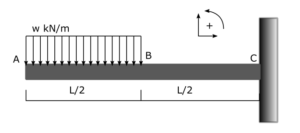
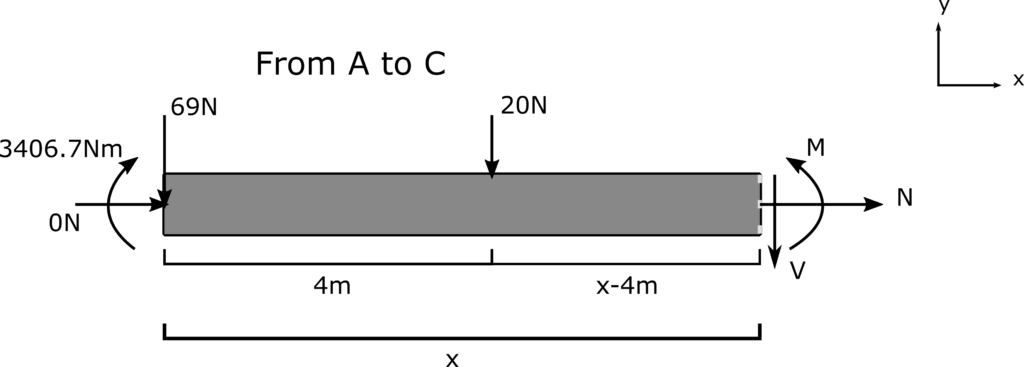
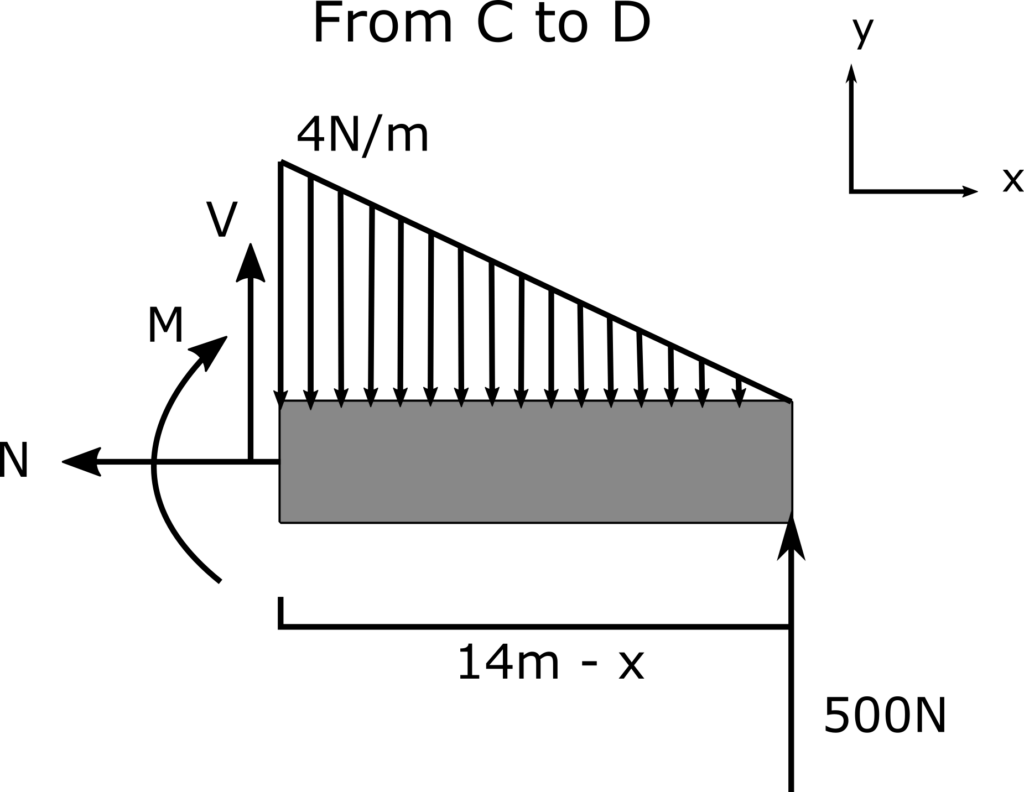
	</div>


	</div>
<div class="chapter standard with-subsections" id="chapter-centre-of-mass-composite-shapes" title="7.2 Center of Mass: Composite Shapes">
	<div class="chapter-title-wrap">
		<p class="chapter-number">33</p>
		<h1 class="chapter-title">7.2 Center of Mass: Composite Shapes</h1>
								</div>
	<div class="ugc chapter-ugc">
				
 <p>Instead of integrating to find the center of mass, we can split an object up into recognizable shapes to determine the center of mass. This is faster than the integration method, and allows for many different ways to find the answer.</p> <p>In this section, the terms ‘centroid’ and ‘center of mass’ are used, somewhat interchangeably. The centroid is the geometric center. The center of mass takes into account the density of an object. If the density is the same throughout an object, then the centroid is the same as the center of mass. For the rigid beams we will be looking at in statics, the centroid is at the same location as the center of mass.</p> <h1 id="chapter-68-section-1" class="section-header">7.2.1 Centroid Tables</h1> <p>We use the centroid tables that are listed below to combine the locations of the centers of mass for each shape. Approximations are needed as real-life objects are rarely perfectly square or circular, but if they are symmetric, it makes it easier to approximate.</p> <p>The locations of the center of mass (<em>r<sub>cm</sub></em>) are as follows. The source for the images are from Jacob Moore et al. <a href="http://mechanicsmap.psu.edu/websites/centroidtables/centroids2D/centroids2D.html" data-url="http://mechanicsmap.psu.edu/websites/centroidtables/centroids2D/centroids2D.html">http://mechanicsmap.psu.edu/websites/centroidtables/centroids2D/centroids2D.html</a></p> <p>&nbsp;</p> <table class="grid" style="border-collapse: collapse;width: 97.4545%"><tbody><tr><td style="width: 11.1073%"><em>Shape</em></td> <td style="width: 62.9254%">Images from the link above (Jacob Moore et al.)<a href="https://eng.libretexts.org/@go/page/58050" data-url="https://eng.libretexts.org/@go/page/58050"></a></td> <td style="width: 52.2013%;text-align: center"><em>r<sub>cm</sub></em></td> </tr> <tr><td style="width: 11.1073%;text-align: center"><strong><em>Rectangle</em></strong></td> <td style="width: 62.9254%"><img src="http://pressbooks.library.upei.ca/statics/wp-content/uploads/sites/56/2021/02/Picture1.png" alt="A Rectangle with centroid at center." class="aligncenter wp-image-1531 size-full" width="490" height="372" srcset="https://pressbooks.library.upei.ca/statics/wp-content/uploads/sites/56/2021/02/Picture1.png 490w, https://pressbooks.library.upei.ca/statics/wp-content/uploads/sites/56/2021/02/Picture1-300x228.png 300w, https://pressbooks.library.upei.ca/statics/wp-content/uploads/sites/56/2021/02/Picture1-65x49.png 65w, https://pressbooks.library.upei.ca/statics/wp-content/uploads/sites/56/2021/02/Picture1-225x171.png 225w, https://pressbooks.library.upei.ca/statics/wp-content/uploads/sites/56/2021/02/Picture1-350x266.png 350w" sizes="auto, (max-width: 490px) 100vw, 490px" title=""></td> <td style="width: 52.2013%"><img src="http://localhost:3000/latex?latex=Area%20%3D%20bh&amp;fg=000000&amp;font=TeX&amp;svg=1" alt="Area = bh" title="Area = bh" class="latex mathjax"> <p>&nbsp;</p> <p><img src="http://localhost:3000/latex?latex=r_%7Bcm%7D%20%3D%20%5Cleft%5B%5Cfrac%7Bb%7D%7B2%7D%2C%20%5Cfrac%7Bh%7D%7B2%7D%5Cright%5D&amp;fg=000000&amp;font=TeX&amp;svg=1" alt="r_{cm} = \left[\frac{b}{2}, \frac{h}{2}\right]" title="r_{cm} = \left[\frac{b}{2}, \frac{h}{2}\right]" class="latex mathjax"></p></td> </tr> <tr><td style="width: 11.1073%;text-align: center"><strong><em>Right Triangle</em></strong></td> <td style="width: 62.9254%"><img src="http://pressbooks.library.upei.ca/statics/wp-content/uploads/sites/56/2021/02/2.png" alt="A right triangle with its located centroid." class="aligncenter wp-image-1532 size-full" width="510" height="392" srcset="https://pressbooks.library.upei.ca/statics/wp-content/uploads/sites/56/2021/02/2.png 510w, https://pressbooks.library.upei.ca/statics/wp-content/uploads/sites/56/2021/02/2-300x231.png 300w, https://pressbooks.library.upei.ca/statics/wp-content/uploads/sites/56/2021/02/2-65x50.png 65w, https://pressbooks.library.upei.ca/statics/wp-content/uploads/sites/56/2021/02/2-225x173.png 225w, https://pressbooks.library.upei.ca/statics/wp-content/uploads/sites/56/2021/02/2-350x269.png 350w" sizes="auto, (max-width: 510px) 100vw, 510px" title=""></td> <td style="width: 52.2013%"><img src="http://localhost:3000/latex?latex=Area%20%3D%C2%A0%20%5Cfrac%7B1%7D%7B2%7Dbh&amp;fg=000000&amp;font=TeX&amp;svg=1" alt="Area =&nbsp; \frac{1}{2}bh" title="Area =&nbsp; \frac{1}{2}bh" class="latex mathjax"> <p>&nbsp;</p> <p><img src="http://localhost:3000/latex?latex=r_%7Bcm%7D%20%3D%20%5Cleft%5B%5Cfrac%7Bb%7D%7B3%7D%2C%20%5Cfrac%7Bh%7D%7B3%7D%5Cright%5D&amp;fg=000000&amp;font=TeX&amp;svg=1" alt="r_{cm} = \left[\frac{b}{3}, \frac{h}{3}\right]" title="r_{cm} = \left[\frac{b}{3}, \frac{h}{3}\right]" class="latex mathjax"></p></td> </tr> <tr><td style="width: 11.1073%;text-align: center"><strong><em>Triangle</em></strong></td> <td style="width: 62.9254%"><img src="http://pressbooks.library.upei.ca/statics/wp-content/uploads/sites/56/2021/02/3.png" alt="A triangle with its located centroid." class="aligncenter wp-image-1533 size-full" width="516" height="372" srcset="https://pressbooks.library.upei.ca/statics/wp-content/uploads/sites/56/2021/02/3.png 516w, https://pressbooks.library.upei.ca/statics/wp-content/uploads/sites/56/2021/02/3-300x216.png 300w, https://pressbooks.library.upei.ca/statics/wp-content/uploads/sites/56/2021/02/3-65x47.png 65w, https://pressbooks.library.upei.ca/statics/wp-content/uploads/sites/56/2021/02/3-225x162.png 225w, https://pressbooks.library.upei.ca/statics/wp-content/uploads/sites/56/2021/02/3-350x252.png 350w" sizes="auto, (max-width: 516px) 100vw, 516px" title=""></td> <td style="width: 52.2013%"><img src="http://localhost:3000/latex?latex=Area%20%3D%C2%A0%20%5Cfrac%7B1%7D%7B2%7Dbh&amp;fg=000000&amp;font=TeX&amp;svg=1" alt="Area =&nbsp; \frac{1}{2}bh" title="Area =&nbsp; \frac{1}{2}bh" class="latex mathjax"> <p>&nbsp;</p> <p><img src="http://localhost:3000/latex?latex=r_%7Bcm%7D%20%3D%20%5Cleft%5B%5Cfrac%7Bb%7D%7B2%7D%2C%20%5Cfrac%7Bh%7D%7B3%7D%5Cright%5D&amp;fg=000000&amp;font=TeX&amp;svg=1" alt="r_{cm} = \left[\frac{b}{2}, \frac{h}{3}\right]" title="r_{cm} = \left[\frac{b}{2}, \frac{h}{3}\right]" class="latex mathjax"></p></td> </tr> <tr><td style="width: 11.1073%;text-align: center"><strong><em>Circle</em></strong></td> <td style="width: 62.9254%"><img src="http://pressbooks.library.upei.ca/statics/wp-content/uploads/sites/56/2021/02/4.png" alt="A circle with its located centroid." class="aligncenter wp-image-1534 size-full" width="350" height="332" srcset="https://pressbooks.library.upei.ca/statics/wp-content/uploads/sites/56/2021/02/4.png 350w, https://pressbooks.library.upei.ca/statics/wp-content/uploads/sites/56/2021/02/4-300x285.png 300w, https://pressbooks.library.upei.ca/statics/wp-content/uploads/sites/56/2021/02/4-65x62.png 65w, https://pressbooks.library.upei.ca/statics/wp-content/uploads/sites/56/2021/02/4-225x213.png 225w" sizes="auto, (max-width: 350px) 100vw, 350px" title=""></td> <td style="width: 52.2013%"><img src="http://localhost:3000/latex?latex=Area%20%3D%C2%A0%20%5Cpi%20r%5E2&amp;fg=000000&amp;font=TeX&amp;svg=1" alt="Area =&nbsp; \pi r^2" title="Area =&nbsp; \pi r^2" class="latex mathjax"> <p>&nbsp;</p> <p><img src="http://localhost:3000/latex?latex=r_%7Bcm%7D%20%3D%20%5Cleft%5B0%2C0%5Cright%5D&amp;fg=000000&amp;font=TeX&amp;svg=1" alt="r_{cm} = \left[0,0\right]" title="r_{cm} = \left[0,0\right]" class="latex mathjax"></p></td> </tr> <tr><td style="width: 11.1073%;text-align: center"><strong><em>Circular Annulus</em></strong></td> <td style="width: 62.9254%"><img src="http://pressbooks.library.upei.ca/statics/wp-content/uploads/sites/56/2021/02/5.png" alt="A circular annulus with its located centroid." class="aligncenter wp-image-1535 size-full" width="438" height="434" srcset="https://pressbooks.library.upei.ca/statics/wp-content/uploads/sites/56/2021/02/5.png 438w, https://pressbooks.library.upei.ca/statics/wp-content/uploads/sites/56/2021/02/5-300x297.png 300w, https://pressbooks.library.upei.ca/statics/wp-content/uploads/sites/56/2021/02/5-150x150.png 150w, https://pressbooks.library.upei.ca/statics/wp-content/uploads/sites/56/2021/02/5-65x64.png 65w, https://pressbooks.library.upei.ca/statics/wp-content/uploads/sites/56/2021/02/5-225x223.png 225w, https://pressbooks.library.upei.ca/statics/wp-content/uploads/sites/56/2021/02/5-350x347.png 350w" sizes="auto, (max-width: 438px) 100vw, 438px" title=""></td> <td style="width: 52.2013%"><img src="http://localhost:3000/latex?latex=Area%20%3D%C2%A0%20%5Cpi%20%28r_o%5E2-r_i%5E2%29%C2%A0%20%5C%5Cr_o%3D%5Ctext%7Bouter%20radius%7D%5C%5Cr_i%3D%5Ctext%7Binner%20radius%7D&amp;fg=000000&amp;font=TeX&amp;svg=1" alt="Area =&nbsp; \pi (r_o^2-r_i^2)&nbsp; \\r_o=\text{outer radius}\\r_i=\text{inner radius}" title="Area =&nbsp; \pi (r_o^2-r_i^2)&nbsp; \\r_o=\text{outer radius}\\r_i=\text{inner radius}" class="latex mathjax"> <p>&nbsp;</p> <p><img src="http://localhost:3000/latex?latex=r_%7Bcm%7D%20%3D%20%5Cleft%5B0%2C0%5Cright%5D&amp;fg=000000&amp;font=TeX&amp;svg=1" alt="r_{cm} = \left[0,0\right]" title="r_{cm} = \left[0,0\right]" class="latex mathjax"></p></td> </tr> <tr><td style="width: 11.1073%;text-align: center"><strong><em>Semicircle</em></strong></td> <td style="width: 62.9254%"><img src="http://pressbooks.library.upei.ca/statics/wp-content/uploads/sites/56/2021/02/6.png" alt="A semi-circle with its located centroid." class="aligncenter wp-image-1536 size-full" width="532" height="284" srcset="https://pressbooks.library.upei.ca/statics/wp-content/uploads/sites/56/2021/02/6.png 532w, https://pressbooks.library.upei.ca/statics/wp-content/uploads/sites/56/2021/02/6-300x160.png 300w, https://pressbooks.library.upei.ca/statics/wp-content/uploads/sites/56/2021/02/6-65x35.png 65w, https://pressbooks.library.upei.ca/statics/wp-content/uploads/sites/56/2021/02/6-225x120.png 225w, https://pressbooks.library.upei.ca/statics/wp-content/uploads/sites/56/2021/02/6-350x187.png 350w" sizes="auto, (max-width: 532px) 100vw, 532px" title=""></td> <td style="width: 52.2013%"><img src="http://localhost:3000/latex?latex=Area%20%3D%20%5Cfrac%7B%5Cpi%7D%7B2%7Dr%5E2&amp;fg=000000&amp;font=TeX&amp;svg=1" alt="Area = \frac{\pi}{2}r^2" title="Area = \frac{\pi}{2}r^2" class="latex mathjax"> <p>&nbsp;</p> <p><img src="http://localhost:3000/latex?latex=r_%7Bcm%7D%20%3D%20%5Cleft%5B0%2C%5Cfrac%7B4%7D%7B3%5Cpi%7Dr%5Cright%5D&amp;fg=000000&amp;font=TeX&amp;svg=1" alt="r_{cm} = \left[0,\frac{4}{3\pi}r\right]" title="r_{cm} = \left[0,\frac{4}{3\pi}r\right]" class="latex mathjax"></p></td> </tr> <tr><td style="width: 11.1073%;text-align: center"><strong><em>Quarter Circle</em></strong></td> <td style="width: 62.9254%"><img src="http://pressbooks.library.upei.ca/statics/wp-content/uploads/sites/56/2021/02/7.png" alt="A quarter circle with its located centroid." class="aligncenter wp-image-1537 size-full" width="498" height="476" srcset="https://pressbooks.library.upei.ca/statics/wp-content/uploads/sites/56/2021/02/7.png 498w, https://pressbooks.library.upei.ca/statics/wp-content/uploads/sites/56/2021/02/7-300x287.png 300w, https://pressbooks.library.upei.ca/statics/wp-content/uploads/sites/56/2021/02/7-65x62.png 65w, https://pressbooks.library.upei.ca/statics/wp-content/uploads/sites/56/2021/02/7-225x215.png 225w, https://pressbooks.library.upei.ca/statics/wp-content/uploads/sites/56/2021/02/7-350x335.png 350w" sizes="auto, (max-width: 498px) 100vw, 498px" title=""></td> <td style="width: 52.2013%"><img src="http://localhost:3000/latex?latex=Area%20%3D%20%5Cfrac%7B%5Cpi%7D%7B4%7Dr%5E2&amp;fg=000000&amp;font=TeX&amp;svg=1" alt="Area = \frac{\pi}{4}r^2" title="Area = \frac{\pi}{4}r^2" class="latex mathjax"> <p>&nbsp;</p> <p><img src="http://localhost:3000/latex?latex=r_%7Bcm%7D%3D%5Cleft%5B%5Cfrac%7B4%7D%7B3%5Cpi%7Dr%2C%5Cfrac%7B4%7D%7B3%5Cpi%7Dr%5Cright%5D&amp;fg=000000&amp;font=TeX&amp;svg=1" alt="r_{cm}=\left[\frac{4}{3\pi}r,\frac{4}{3\pi}r\right]" title="r_{cm}=\left[\frac{4}{3\pi}r,\frac{4}{3\pi}r\right]" class="latex mathjax"></p></td> </tr> <tr><td style="width: 11.1073%;text-align: center"><strong><em>Ellipse</em></strong></td> <td style="width: 62.9254%"><img src="http://pressbooks.library.upei.ca/statics/wp-content/uploads/sites/56/2021/02/8.png" alt="An ellipse with its located centroid." class="aligncenter wp-image-1538 size-full" width="492" height="310" srcset="https://pressbooks.library.upei.ca/statics/wp-content/uploads/sites/56/2021/02/8.png 492w, https://pressbooks.library.upei.ca/statics/wp-content/uploads/sites/56/2021/02/8-300x189.png 300w, https://pressbooks.library.upei.ca/statics/wp-content/uploads/sites/56/2021/02/8-65x41.png 65w, https://pressbooks.library.upei.ca/statics/wp-content/uploads/sites/56/2021/02/8-225x142.png 225w, https://pressbooks.library.upei.ca/statics/wp-content/uploads/sites/56/2021/02/8-350x221.png 350w" sizes="auto, (max-width: 492px) 100vw, 492px" title=""></td> <td style="width: 52.2013%"><img src="http://localhost:3000/latex?latex=Area%20%3D%20%5Cpi%20a%20b&amp;fg=000000&amp;font=TeX&amp;svg=1" alt="Area = \pi a b" title="Area = \pi a b" class="latex mathjax"> <p>&nbsp;</p> <p><img src="http://localhost:3000/latex?latex=r_%7Bcm%7D%20%3D%20%5Cleft%5B0%2C0%5Cright%5D&amp;fg=000000&amp;font=TeX&amp;svg=1" alt="r_{cm} = \left[0,0\right]" title="r_{cm} = \left[0,0\right]" class="latex mathjax"></p></td> </tr> </tbody> </table> <p>&nbsp;</p> <h2><em>Example 1: A Single Object</em></h2> <p><img src="http://pressbooks.library.upei.ca/statics/wp-content/uploads/sites/56/2021/02/Screen-Shot-2021-08-30-at-4.18.14-PM-1024x757.png" alt="A quarter circle with 8cm radius." class="aligncenter wp-image-1542" width="348" height="257" srcset="https://pressbooks.library.upei.ca/statics/wp-content/uploads/sites/56/2021/02/Screen-Shot-2021-08-30-at-4.18.14-PM-1024x757.png 1024w, https://pressbooks.library.upei.ca/statics/wp-content/uploads/sites/56/2021/02/Screen-Shot-2021-08-30-at-4.18.14-PM-300x222.png 300w, https://pressbooks.library.upei.ca/statics/wp-content/uploads/sites/56/2021/02/Screen-Shot-2021-08-30-at-4.18.14-PM-768x568.png 768w, https://pressbooks.library.upei.ca/statics/wp-content/uploads/sites/56/2021/02/Screen-Shot-2021-08-30-at-4.18.14-PM-65x48.png 65w, https://pressbooks.library.upei.ca/statics/wp-content/uploads/sites/56/2021/02/Screen-Shot-2021-08-30-at-4.18.14-PM-225x166.png 225w, https://pressbooks.library.upei.ca/statics/wp-content/uploads/sites/56/2021/02/Screen-Shot-2021-08-30-at-4.18.14-PM-350x259.png 350w, https://pressbooks.library.upei.ca/statics/wp-content/uploads/sites/56/2021/02/Screen-Shot-2021-08-30-at-4.18.14-PM.png 1168w" sizes="auto, (max-width: 348px) 100vw, 348px" title=""></p> <p>To find the CM, select the appropriate shape from the above table.</p> <p style="text-align: center">.</p> <p style="text-align: center">.</p> <p style="text-align: center">.</p> <p style="text-align: center">.</p> <p style="text-align: center">.</p> <p><img src="http://pressbooks.library.upei.ca/statics/wp-content/uploads/sites/56/2021/02/Screen-Shot-2021-08-30-at-4.20.52-PM-1024x590.png" alt="Equations for the centroid of a quarter circle." class="aligncenter wp-image-1543" width="517" height="298" srcset="https://pressbooks.library.upei.ca/statics/wp-content/uploads/sites/56/2021/02/Screen-Shot-2021-08-30-at-4.20.52-PM-1024x590.png 1024w, https://pressbooks.library.upei.ca/statics/wp-content/uploads/sites/56/2021/02/Screen-Shot-2021-08-30-at-4.20.52-PM-300x173.png 300w, https://pressbooks.library.upei.ca/statics/wp-content/uploads/sites/56/2021/02/Screen-Shot-2021-08-30-at-4.20.52-PM-768x442.png 768w, https://pressbooks.library.upei.ca/statics/wp-content/uploads/sites/56/2021/02/Screen-Shot-2021-08-30-at-4.20.52-PM-65x37.png 65w, https://pressbooks.library.upei.ca/statics/wp-content/uploads/sites/56/2021/02/Screen-Shot-2021-08-30-at-4.20.52-PM-225x130.png 225w, https://pressbooks.library.upei.ca/statics/wp-content/uploads/sites/56/2021/02/Screen-Shot-2021-08-30-at-4.20.52-PM-350x202.png 350w, https://pressbooks.library.upei.ca/statics/wp-content/uploads/sites/56/2021/02/Screen-Shot-2021-08-30-at-4.20.52-PM.png 1368w" sizes="auto, (max-width: 517px) 100vw, 517px" title=""></p> <p>&nbsp;</p> <p>Use the equation to solve for r<sub>cm</sub>.</p> <p><img src="http://pressbooks.library.upei.ca/statics/wp-content/uploads/sites/56/2021/02/Screen-Shot-2021-08-30-at-4.19.46-PM-539x1024.png" alt="Solutions to r_cm" class="aligncenter wp-image-1544" width="160" height="304" srcset="https://pressbooks.library.upei.ca/statics/wp-content/uploads/sites/56/2021/02/Screen-Shot-2021-08-30-at-4.19.46-PM-539x1024.png 539w, https://pressbooks.library.upei.ca/statics/wp-content/uploads/sites/56/2021/02/Screen-Shot-2021-08-30-at-4.19.46-PM-158x300.png 158w, https://pressbooks.library.upei.ca/statics/wp-content/uploads/sites/56/2021/02/Screen-Shot-2021-08-30-at-4.19.46-PM-65x123.png 65w, https://pressbooks.library.upei.ca/statics/wp-content/uploads/sites/56/2021/02/Screen-Shot-2021-08-30-at-4.19.46-PM-225x427.png 225w, https://pressbooks.library.upei.ca/statics/wp-content/uploads/sites/56/2021/02/Screen-Shot-2021-08-30-at-4.19.46-PM-350x665.png 350w, https://pressbooks.library.upei.ca/statics/wp-content/uploads/sites/56/2021/02/Screen-Shot-2021-08-30-at-4.19.46-PM.png 738w" sizes="auto, (max-width: 160px) 100vw, 160px" title=""></p> <p>This is an appropriate answer as it is less than the midpoint, where it would be for a square:</p> <p style="text-align: center"><img src="http://localhost:3000/latex?latex=%5Cunderline%7B%5Cvec%20r%7D_%7Bcm%7D%20%3D%20%5B3.4cm%2C%203.4cm%2C%200%5D&amp;fg=000000&amp;font=TeX&amp;svg=1" alt="\underline{\vec r}_{cm} = [3.4cm, 3.4cm, 0]" title="\underline{\vec r}_{cm} = [3.4cm, 3.4cm, 0]" class="latex mathjax">.</p> <h1 id="chapter-68-section-2" class="section-header">7.2.2 Composite Shapes</h1> <p>To find the center of mass of an object, you:</p> <ol><li>Define an origin</li> <li>Split the object up into recognizable shapes</li> <li>Find the center of mass (cm) of each shape from the origin</li> <li>Calculate the mass of each part: <img src="http://localhost:3000/latex?latex=%5Crho%20%3D%20%5Cfrac%7Bm%7D%7BV%7D&amp;fg=000000&amp;font=TeX&amp;svg=1" alt="\rho = \frac{m}{V}" title="\rho = \frac{m}{V}" class="latex mathjax"> (To find the centroid, this step can be skipped and only the area or volume is used).</li> <li>Use the weighted cm equations to find the x cm. Repeat for y and z.</li> </ol> <p>$$ \bar x=\frac{\sum m_i x_i}{\sum m_i} \qquad \bar y=\frac{\sum m_i y_i}{\sum m_i} \qquad \bar z=\frac{\sum m_i z_i}{\sum m_i}$$</p> <p>&nbsp;</p> <div class="textbox"><p>Start the process by labeling an origin point and axes on your shape. It will be important to measure all locations from the same point. Next, we must break our complex shape down into several simpler shapes. This may include areas or volumes (which we will count as positive areas or volumes) or holes (which we will count as negative areas or volumes). Each of these shapes will have a centroid (𝐶) or center of mass (𝐺) listed on the diagram.</p> <div class="wp-caption aligncenter" id="attachment_1539" aria-describedby="caption-attachment-1539" style="width: 260px"><img src="http://pressbooks.library.upei.ca/statics/wp-content/uploads/sites/56/2021/02/breakdown.png" alt="A trapezium with a circle hole." class="wp-image-1539" width="260" height="232" srcset="https://pressbooks.library.upei.ca/statics/wp-content/uploads/sites/56/2021/02/breakdown.png 400w, https://pressbooks.library.upei.ca/statics/wp-content/uploads/sites/56/2021/02/breakdown-300x268.png 300w, https://pressbooks.library.upei.ca/statics/wp-content/uploads/sites/56/2021/02/breakdown-65x58.png 65w, https://pressbooks.library.upei.ca/statics/wp-content/uploads/sites/56/2021/02/breakdown-225x201.png 225w, https://pressbooks.library.upei.ca/statics/wp-content/uploads/sites/56/2021/02/breakdown-350x312.png 350w" sizes="auto, (max-width: 260px) 100vw, 260px" title=""><div class="wp-caption-text" id="caption-attachment-1539">For the shape shown at the top, we can break it down into a rectangle (1), a right triangle (2), and a circular hole (3). Each of these simple shapes is something we have listed in the centroid table to the right.</div></div> <p>Once we have identified the different parts, we will create a table listing the area or volume of each piece, and the 𝑥 and 𝑦 centroid coordinates (or 𝑥, 𝑦, and 𝑧 coordinates in 3D). It is important to remember that each coordinate you list should be relative to the same base origin point that you drew in earlier. You may need to mentally adjust diagrams in the centroid tables so that the shape is oriented in the right direction, and account for the placement of the shape relative to the axes in your diagram.</p> <div class="wp-caption aligncenter" id="attachment_1540" aria-describedby="caption-attachment-1540" style="width: 403px"><img src="http://pressbooks.library.upei.ca/statics/wp-content/uploads/sites/56/2021/02/table.png" alt="A trapezium with a circle hole and a table below for area and centroid coordinates." class="wp-image-1540" width="403" height="314" srcset="https://pressbooks.library.upei.ca/statics/wp-content/uploads/sites/56/2021/02/table.png 500w, https://pressbooks.library.upei.ca/statics/wp-content/uploads/sites/56/2021/02/table-300x234.png 300w, https://pressbooks.library.upei.ca/statics/wp-content/uploads/sites/56/2021/02/table-65x51.png 65w, https://pressbooks.library.upei.ca/statics/wp-content/uploads/sites/56/2021/02/table-225x176.png 225w, https://pressbooks.library.upei.ca/statics/wp-content/uploads/sites/56/2021/02/table-350x273.png 350w" sizes="auto, (max-width: 403px) 100vw, 403px" title=""><div class="wp-caption-text" id="caption-attachment-1540">For each of the shapes, we need to find the area and the x and y coordinates of the centroid. Remember to find the centroid coordinates relative to a single set of axes that is the same for all shapes.</div></div> <p>&nbsp;</p> <p>Once you have the areas and centroid coordinates for each shape relative to your origin point, you can find the 𝑥 and 𝑦coordinate of the centroid for the overall shape with the following formulas. Remember that areas or volumes for any shape that is a hole or cutout in the design will be a negative area in your formula.</p> <p style="text-align: center">$$ \bar x=\frac{\sum_{i=1}^n m_i x_i}{\sum_{i=1}^nm_i} \qquad \bar y=\frac{\sum_{i=1}^n m_i y_i}{\sum_{i=1}^nm_i} $$</p> <p>This generalized formula to find the centroid’s 𝑥-location is simply Area 1 times <img src="http://localhost:3000/latex?latex=%5Cbar%20x_1&amp;fg=000000&amp;font=TeX&amp;svg=1" alt="\bar x_1" title="\bar x_1" class="latex mathjax"> plus Area 2 times <img src="http://localhost:3000/latex?latex=%5Cbar%20x_2&amp;fg=000000&amp;font=TeX&amp;svg=1" alt="\bar x_2" title="\bar x_2" class="latex mathjax">, plus Area 3 times <img src="http://localhost:3000/latex?latex=%5Cbar%20x_3&amp;fg=000000&amp;font=TeX&amp;svg=1" alt="\bar x_3" title="\bar x_3" class="latex mathjax">, adding up as many shapes as you have in this fashion and then dividing by the overall area of your combined shape. The equations are the same for the 𝑦-location of the overall centroid, except you will instead be using <img src="http://localhost:3000/latex?latex=%5Cbar%20y&amp;fg=000000&amp;font=TeX&amp;svg=1" alt="\bar y" title="\bar y" class="latex mathjax">-values in your equations.</p> <p>For centroids in three dimensions, we will simply use volumes in place of areas, and we will have a 𝑧 coordinate for our centroid as well as the 𝑥 and 𝑦 coordinates.</p> <p>Source:&nbsp; Jacob Moore et al. <a href="https://mechanicsmap.psu.edu/websites/A2_moment_intergrals/A2-4_method_of_composite_parts/methodofcompositeparts.html" data-url="https://mechanicsmap.psu.edu/websites/A2_moment_intergrals/A2-4_method_of_composite_parts/methodofcompositeparts.html">http://mechanicsmap.psu.edu/websites/A2_moment_intergrals/method_of_composite_parts/methodofcompositeparts.html</a></p> </div> <h2>Example 2 – A Composite Object</h2> <p>For the following C shape, where is the center of mass?</p> <p><img src="http://pressbooks.library.upei.ca/statics/wp-content/uploads/sites/56/2021/02/Screen-Shot-2021-08-30-at-4.29.46-PM-1024x387.png" alt="C-shaped 2D object with labeled dimensions." class="aligncenter wp-image-1545" width="608" height="230" srcset="https://pressbooks.library.upei.ca/statics/wp-content/uploads/sites/56/2021/02/Screen-Shot-2021-08-30-at-4.29.46-PM-1024x387.png 1024w, https://pressbooks.library.upei.ca/statics/wp-content/uploads/sites/56/2021/02/Screen-Shot-2021-08-30-at-4.29.46-PM-300x113.png 300w, https://pressbooks.library.upei.ca/statics/wp-content/uploads/sites/56/2021/02/Screen-Shot-2021-08-30-at-4.29.46-PM-768x290.png 768w, https://pressbooks.library.upei.ca/statics/wp-content/uploads/sites/56/2021/02/Screen-Shot-2021-08-30-at-4.29.46-PM-65x25.png 65w, https://pressbooks.library.upei.ca/statics/wp-content/uploads/sites/56/2021/02/Screen-Shot-2021-08-30-at-4.29.46-PM-225x85.png 225w, https://pressbooks.library.upei.ca/statics/wp-content/uploads/sites/56/2021/02/Screen-Shot-2021-08-30-at-4.29.46-PM-350x132.png 350w, https://pressbooks.library.upei.ca/statics/wp-content/uploads/sites/56/2021/02/Screen-Shot-2021-08-30-at-4.29.46-PM.png 1424w" sizes="auto, (max-width: 608px) 100vw, 608px" title=""></p> <p><img src="http://pressbooks.library.upei.ca/statics/wp-content/uploads/sites/56/2021/02/Screen-Shot-2021-08-30-at-4.32.27-PM-1024x370.png" alt="Steps to find center of mass of a C-shaped object: (1) Choose a reference point, (2) Divide shape into smaller labeled shapes." class="aligncenter wp-image-1546" width="735" height="266" srcset="https://pressbooks.library.upei.ca/statics/wp-content/uploads/sites/56/2021/02/Screen-Shot-2021-08-30-at-4.32.27-PM-1024x370.png 1024w, https://pressbooks.library.upei.ca/statics/wp-content/uploads/sites/56/2021/02/Screen-Shot-2021-08-30-at-4.32.27-PM-300x108.png 300w, https://pressbooks.library.upei.ca/statics/wp-content/uploads/sites/56/2021/02/Screen-Shot-2021-08-30-at-4.32.27-PM-768x278.png 768w, https://pressbooks.library.upei.ca/statics/wp-content/uploads/sites/56/2021/02/Screen-Shot-2021-08-30-at-4.32.27-PM-1536x555.png 1536w, https://pressbooks.library.upei.ca/statics/wp-content/uploads/sites/56/2021/02/Screen-Shot-2021-08-30-at-4.32.27-PM-65x23.png 65w, https://pressbooks.library.upei.ca/statics/wp-content/uploads/sites/56/2021/02/Screen-Shot-2021-08-30-at-4.32.27-PM-225x81.png 225w, https://pressbooks.library.upei.ca/statics/wp-content/uploads/sites/56/2021/02/Screen-Shot-2021-08-30-at-4.32.27-PM-350x126.png 350w, https://pressbooks.library.upei.ca/statics/wp-content/uploads/sites/56/2021/02/Screen-Shot-2021-08-30-at-4.32.27-PM.png 1926w" sizes="auto, (max-width: 735px) 100vw, 735px" title=""></p> <p><img src="http://pressbooks.library.upei.ca/statics/wp-content/uploads/sites/56/2021/02/Screen-Shot-2021-08-30-at-4.37.15-PM-1024x956.png" alt="Solutions to the problem." class="aligncenter wp-image-1547" width="507" height="473" srcset="https://pressbooks.library.upei.ca/statics/wp-content/uploads/sites/56/2021/02/Screen-Shot-2021-08-30-at-4.37.15-PM-1024x956.png 1024w, https://pressbooks.library.upei.ca/statics/wp-content/uploads/sites/56/2021/02/Screen-Shot-2021-08-30-at-4.37.15-PM-300x280.png 300w, https://pressbooks.library.upei.ca/statics/wp-content/uploads/sites/56/2021/02/Screen-Shot-2021-08-30-at-4.37.15-PM-768x717.png 768w, https://pressbooks.library.upei.ca/statics/wp-content/uploads/sites/56/2021/02/Screen-Shot-2021-08-30-at-4.37.15-PM-1536x1434.png 1536w, https://pressbooks.library.upei.ca/statics/wp-content/uploads/sites/56/2021/02/Screen-Shot-2021-08-30-at-4.37.15-PM-65x61.png 65w, https://pressbooks.library.upei.ca/statics/wp-content/uploads/sites/56/2021/02/Screen-Shot-2021-08-30-at-4.37.15-PM-225x210.png 225w, https://pressbooks.library.upei.ca/statics/wp-content/uploads/sites/56/2021/02/Screen-Shot-2021-08-30-at-4.37.15-PM-350x327.png 350w, https://pressbooks.library.upei.ca/statics/wp-content/uploads/sites/56/2021/02/Screen-Shot-2021-08-30-at-4.37.15-PM.png 1836w" sizes="auto, (max-width: 507px) 100vw, 507px" title=""></p> <p><img src="http://pressbooks.library.upei.ca/statics/wp-content/uploads/sites/56/2021/02/Screen-Shot-2021-08-30-at-4.39.50-PM-1024x1006.png" alt="Solutions to problems" class="aligncenter wp-image-1548" width="507" height="498" srcset="https://pressbooks.library.upei.ca/statics/wp-content/uploads/sites/56/2021/02/Screen-Shot-2021-08-30-at-4.39.50-PM-1024x1006.png 1024w, https://pressbooks.library.upei.ca/statics/wp-content/uploads/sites/56/2021/02/Screen-Shot-2021-08-30-at-4.39.50-PM-300x295.png 300w, https://pressbooks.library.upei.ca/statics/wp-content/uploads/sites/56/2021/02/Screen-Shot-2021-08-30-at-4.39.50-PM-768x755.png 768w, https://pressbooks.library.upei.ca/statics/wp-content/uploads/sites/56/2021/02/Screen-Shot-2021-08-30-at-4.39.50-PM-1536x1510.png 1536w, https://pressbooks.library.upei.ca/statics/wp-content/uploads/sites/56/2021/02/Screen-Shot-2021-08-30-at-4.39.50-PM-65x64.png 65w, https://pressbooks.library.upei.ca/statics/wp-content/uploads/sites/56/2021/02/Screen-Shot-2021-08-30-at-4.39.50-PM-225x221.png 225w, https://pressbooks.library.upei.ca/statics/wp-content/uploads/sites/56/2021/02/Screen-Shot-2021-08-30-at-4.39.50-PM-350x344.png 350w, https://pressbooks.library.upei.ca/statics/wp-content/uploads/sites/56/2021/02/Screen-Shot-2021-08-30-at-4.39.50-PM.png 1740w" sizes="auto, (max-width: 507px) 100vw, 507px" title=""></p> <p>This example used the density to calculate mass. To find the centroid, the area could have been used instead of the mass. However, to find the center of mass, the density was used to calculate the mass of each object individually: <img src="http://localhost:3000/latex?latex=%5Crho%20%3D%20%5Cfrac%7Bm%7D%7BV%7D&amp;fg=000000&amp;font=TeX&amp;svg=1" alt="\rho = \frac{m}{V}" title="\rho = \frac{m}{V}" class="latex mathjax">.</p> <p>&nbsp;</p> <h2>Example 3: Using Subtraction instead of Addition</h2> <p>For the following C shape, where is the center of mass? (Use different shapes than above).</p> <p><img src="http://pressbooks.library.upei.ca/statics/wp-content/uploads/sites/56/2021/02/Screen-Shot-2021-08-30-at-4.29.46-PM-1024x387.png" alt="C-shaped 2D object with labeled dimensions." class="aligncenter wp-image-1545" width="608" height="230" srcset="https://pressbooks.library.upei.ca/statics/wp-content/uploads/sites/56/2021/02/Screen-Shot-2021-08-30-at-4.29.46-PM-1024x387.png 1024w, https://pressbooks.library.upei.ca/statics/wp-content/uploads/sites/56/2021/02/Screen-Shot-2021-08-30-at-4.29.46-PM-300x113.png 300w, https://pressbooks.library.upei.ca/statics/wp-content/uploads/sites/56/2021/02/Screen-Shot-2021-08-30-at-4.29.46-PM-768x290.png 768w, https://pressbooks.library.upei.ca/statics/wp-content/uploads/sites/56/2021/02/Screen-Shot-2021-08-30-at-4.29.46-PM-65x25.png 65w, https://pressbooks.library.upei.ca/statics/wp-content/uploads/sites/56/2021/02/Screen-Shot-2021-08-30-at-4.29.46-PM-225x85.png 225w, https://pressbooks.library.upei.ca/statics/wp-content/uploads/sites/56/2021/02/Screen-Shot-2021-08-30-at-4.29.46-PM-350x132.png 350w, https://pressbooks.library.upei.ca/statics/wp-content/uploads/sites/56/2021/02/Screen-Shot-2021-08-30-at-4.29.46-PM.png 1424w" sizes="auto, (max-width: 608px) 100vw, 608px" title=""></p> <p><img src="http://pressbooks.library.upei.ca/statics/wp-content/uploads/sites/56/2021/02/Screen-Shot-2021-08-30-at-4.41.50-PM-899x1024.png" alt="Solutions to the problem." class="aligncenter wp-image-1549" width="579" height="660" srcset="https://pressbooks.library.upei.ca/statics/wp-content/uploads/sites/56/2021/02/Screen-Shot-2021-08-30-at-4.41.50-PM-899x1024.png 899w, https://pressbooks.library.upei.ca/statics/wp-content/uploads/sites/56/2021/02/Screen-Shot-2021-08-30-at-4.41.50-PM-263x300.png 263w, https://pressbooks.library.upei.ca/statics/wp-content/uploads/sites/56/2021/02/Screen-Shot-2021-08-30-at-4.41.50-PM-768x875.png 768w, https://pressbooks.library.upei.ca/statics/wp-content/uploads/sites/56/2021/02/Screen-Shot-2021-08-30-at-4.41.50-PM-65x74.png 65w, https://pressbooks.library.upei.ca/statics/wp-content/uploads/sites/56/2021/02/Screen-Shot-2021-08-30-at-4.41.50-PM-225x256.png 225w, https://pressbooks.library.upei.ca/statics/wp-content/uploads/sites/56/2021/02/Screen-Shot-2021-08-30-at-4.41.50-PM-350x399.png 350w, https://pressbooks.library.upei.ca/statics/wp-content/uploads/sites/56/2021/02/Screen-Shot-2021-08-30-at-4.41.50-PM.png 1138w" sizes="auto, (max-width: 579px) 100vw, 579px" title=""></p> <p>The same answer is reached! This method involved only 2 shapes instead of 3.</p> <p>There are more examples at&nbsp;<a href="https://mechanicsmap.psu.edu/websites/A2_moment_intergrals/A2-4_method_of_composite_parts/methodofcompositeparts.html" data-url="https://mechanicsmap.psu.edu/websites/A2_moment_intergrals/A2-4_method_of_composite_parts/methodofcompositeparts.html">http://mechanicsmap.psu.edu/websites/A2_moment_intergrals/method_of_composite_parts/methodofcompositeparts.html</a> with PDFs and video solutions.</p> <div class="textbox textbox--key-takeaways"><div class="textbox__header"><p class="textbox__title">Key Takeaways</p> </div> <div class="textbox__content"><div class="textbox__content"><p><i>Basically, When there are complicated shapes, the center of mass can be found by breaking the shape up into better-known shapes.</i></p> <p><em>Application</em>: To calculate the inertia of an object rotating about its center of mass, you will need to know where the center of mass is.</p> <p><em>Looking Ahead</em>: The next section will look at types of inertia.</p> </div> </div> </div> 
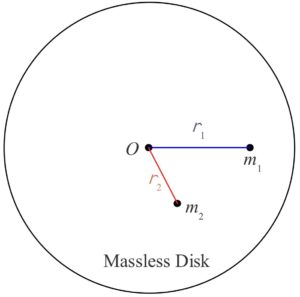
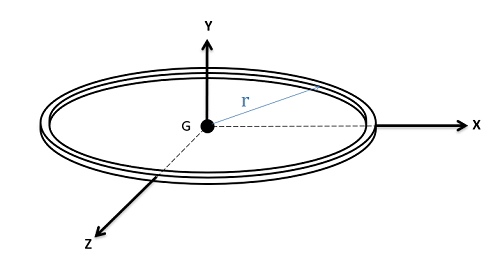
	</div>


	</div>
<div class="chapter standard with-subsections" id="chapter-inertia-intro-different-kinds-of-inertia" title="7.3 Types of Inertia">
	<div class="chapter-title-wrap">
		<p class="chapter-number">34</p>
		<h1 class="chapter-title">7.3 Types of Inertia</h1>
								</div>
	<div class="ugc chapter-ugc">
				 <p>There are multiple kinds of inertia. In this course, when we talk about inertia, we usually refer to the mass moment of inertia. For this course, you need to know the names of three types of moment of inertia (MOI), when to use each, and the units for each.</p> <p>Area moment of inertia is used in structures to determine how stiff a beam is or how much it will deflect. The unit is m<sup>4</sup> or ft<sup>4</sup>.</p> <div class="wp-caption aligncenter" id="attachment_1560" aria-describedby="caption-attachment-1560" style="width: 1024px"><img src="http://pressbooks.library.upei.ca/statics/wp-content/uploads/sites/56/2021/02/Piezo_bending_principle-1024x279.jpg" alt="Diagram showing a beam bending motion." class="wp-image-1560 size-large" width="1024" height="279" srcset="https://pressbooks.library.upei.ca/statics/wp-content/uploads/sites/56/2021/02/Piezo_bending_principle-1024x279.jpg 1024w, https://pressbooks.library.upei.ca/statics/wp-content/uploads/sites/56/2021/02/Piezo_bending_principle-300x82.jpg 300w, https://pressbooks.library.upei.ca/statics/wp-content/uploads/sites/56/2021/02/Piezo_bending_principle-768x209.jpg 768w, https://pressbooks.library.upei.ca/statics/wp-content/uploads/sites/56/2021/02/Piezo_bending_principle-1536x419.jpg 1536w, https://pressbooks.library.upei.ca/statics/wp-content/uploads/sites/56/2021/02/Piezo_bending_principle-65x18.jpg 65w, https://pressbooks.library.upei.ca/statics/wp-content/uploads/sites/56/2021/02/Piezo_bending_principle-225x61.jpg 225w, https://pressbooks.library.upei.ca/statics/wp-content/uploads/sites/56/2021/02/Piezo_bending_principle-350x95.jpg 350w, https://pressbooks.library.upei.ca/statics/wp-content/uploads/sites/56/2021/02/Piezo_bending_principle.jpg 1600w" sizes="auto, (max-width: 1024px) 100vw, 1024px" title="" /><div class="wp-caption-text" id="caption-attachment-1560">Source: Sonitron Support https://commons.wikimedia.org/wiki/File:Piezo_bending_principle.jpg</div></div> <p>&nbsp;</p> <p>Product moment of inertia is a shaft’s resistance to torsion (or twisting).&nbsp;The unit is m<sup>4</sup> or ft<sup>4</sup>.</p> <div class="wp-caption aligncenter" id="attachment_1561" aria-describedby="caption-attachment-1561" style="width: 347px"><img src="http://pressbooks.library.upei.ca/statics/wp-content/uploads/sites/56/2021/02/Twisted_bar.png" alt="A beam under torsion." class="wp-image-1561" width="347" height="153" srcset="https://pressbooks.library.upei.ca/statics/wp-content/uploads/sites/56/2021/02/Twisted_bar.png 424w, https://pressbooks.library.upei.ca/statics/wp-content/uploads/sites/56/2021/02/Twisted_bar-300x132.png 300w, https://pressbooks.library.upei.ca/statics/wp-content/uploads/sites/56/2021/02/Twisted_bar-65x29.png 65w, https://pressbooks.library.upei.ca/statics/wp-content/uploads/sites/56/2021/02/Twisted_bar-225x99.png 225w, https://pressbooks.library.upei.ca/statics/wp-content/uploads/sites/56/2021/02/Twisted_bar-350x154.png 350w" sizes="auto, (max-width: 347px) 100vw, 347px" title="" /><div class="wp-caption-text" id="caption-attachment-1561">Source: Orion8 https://commons.wikimedia.org/wiki/File:Twisted_bar.png</div></div> <p>The mass moment of inertia is the rotational equivalent of mass. A really heavy object is hard to move, hence it resists motion. An object with a really big inertia is hard to rotate, hence it resists rotation. Inertia is a quantity of how mass is distributed around a body, such as an ice skater spinning with their arms in or spread out. The unit is kgm<sup>2</sup> or slugft<sup>2</sup>. We will talk more about the mass moment of inertia in the next sections.</p> <div class="wp-caption alignleft" id="attachment_1562" aria-describedby="caption-attachment-1562" style="width: 146px"><img src="http://pressbooks.library.upei.ca/statics/wp-content/uploads/sites/56/2021/02/Elena_Sokolova_04_NHK_2.jpg" alt="A girl ice skating." class="wp-image-1562" width="146" height="195" srcset="https://pressbooks.library.upei.ca/statics/wp-content/uploads/sites/56/2021/02/Elena_Sokolova_04_NHK_2.jpg 300w, https://pressbooks.library.upei.ca/statics/wp-content/uploads/sites/56/2021/02/Elena_Sokolova_04_NHK_2-225x300.jpg 225w, https://pressbooks.library.upei.ca/statics/wp-content/uploads/sites/56/2021/02/Elena_Sokolova_04_NHK_2-65x87.jpg 65w" sizes="auto, (max-width: 146px) 100vw, 146px" title="" /><div class="wp-caption-text" id="caption-attachment-1562">Source: K. “bird” https://commons.wikimedia.org/wiki/File:Elena_Sokolova_04_NHK_2.jpg</div></div> <div class="wp-caption alignleft" id="attachment_1563" aria-describedby="caption-attachment-1563" style="width: 269px"><img src="http://pressbooks.library.upei.ca/statics/wp-content/uploads/sites/56/2021/02/2020-01-11_Womens_Single_Figure_Skating_Short_Program_2020_Winter_Youth_Olympics_by_Sandro_Halank–668-1024x708.jpg" alt="A girl ice skating." class="wp-image-1563" width="269" height="186" srcset="https://pressbooks.library.upei.ca/statics/wp-content/uploads/sites/56/2021/02/2020-01-11_Womens_Single_Figure_Skating_Short_Program_2020_Winter_Youth_Olympics_by_Sandro_Halank–668-1024x708.jpg 1024w, https://pressbooks.library.upei.ca/statics/wp-content/uploads/sites/56/2021/02/2020-01-11_Womens_Single_Figure_Skating_Short_Program_2020_Winter_Youth_Olympics_by_Sandro_Halank–668-300x207.jpg 300w, https://pressbooks.library.upei.ca/statics/wp-content/uploads/sites/56/2021/02/2020-01-11_Womens_Single_Figure_Skating_Short_Program_2020_Winter_Youth_Olympics_by_Sandro_Halank–668-768x531.jpg 768w, https://pressbooks.library.upei.ca/statics/wp-content/uploads/sites/56/2021/02/2020-01-11_Womens_Single_Figure_Skating_Short_Program_2020_Winter_Youth_Olympics_by_Sandro_Halank–668-1536x1062.jpg 1536w, https://pressbooks.library.upei.ca/statics/wp-content/uploads/sites/56/2021/02/2020-01-11_Womens_Single_Figure_Skating_Short_Program_2020_Winter_Youth_Olympics_by_Sandro_Halank–668-2048x1416.jpg 2048w, https://pressbooks.library.upei.ca/statics/wp-content/uploads/sites/56/2021/02/2020-01-11_Womens_Single_Figure_Skating_Short_Program_2020_Winter_Youth_Olympics_by_Sandro_Halank–668-65x45.jpg 65w, https://pressbooks.library.upei.ca/statics/wp-content/uploads/sites/56/2021/02/2020-01-11_Womens_Single_Figure_Skating_Short_Program_2020_Winter_Youth_Olympics_by_Sandro_Halank–668-225x156.jpg 225w, https://pressbooks.library.upei.ca/statics/wp-content/uploads/sites/56/2021/02/2020-01-11_Womens_Single_Figure_Skating_Short_Program_2020_Winter_Youth_Olympics_by_Sandro_Halank–668-350x242.jpg 350w" sizes="auto, (max-width: 269px) 100vw, 269px" title="" /><div class="wp-caption-text" id="caption-attachment-1563">Source: Sandro Halank https://commons.wikimedia.org/wiki/File:2020-01-11_Women%27s_Single_Figure_Skating_Short_Program_(2020_Winter_Youth_Olympics)_by_Sandro_Halank%E2%80%93668.jpg</div></div> <p>&nbsp;</p> <p>&nbsp;</p> <p>&nbsp;</p> <p>&nbsp;</p> <p>&nbsp;</p> <p>&nbsp;</p> <p>&nbsp;</p> <p>&nbsp;</p> <p style="padding-left: 40px">Here is a table summarizing the three types of inertia:</p> <p><img src="http://pressbooks.library.upei.ca/statics/wp-content/uploads/sites/56/2021/02/Screen-Shot-2021-08-30-at-5.42.36-PM-1024x506.png" alt="A comparison table showing Mass, Area, and Product Moments of Inertia (MOI) with definitions, equations, units, and uses in engineering." class="aligncenter wp-image-1559 size-large" width="1024" height="506" srcset="https://pressbooks.library.upei.ca/statics/wp-content/uploads/sites/56/2021/02/Screen-Shot-2021-08-30-at-5.42.36-PM-1024x506.png 1024w, https://pressbooks.library.upei.ca/statics/wp-content/uploads/sites/56/2021/02/Screen-Shot-2021-08-30-at-5.42.36-PM-300x148.png 300w, https://pressbooks.library.upei.ca/statics/wp-content/uploads/sites/56/2021/02/Screen-Shot-2021-08-30-at-5.42.36-PM-768x379.png 768w, https://pressbooks.library.upei.ca/statics/wp-content/uploads/sites/56/2021/02/Screen-Shot-2021-08-30-at-5.42.36-PM-1536x758.png 1536w, https://pressbooks.library.upei.ca/statics/wp-content/uploads/sites/56/2021/02/Screen-Shot-2021-08-30-at-5.42.36-PM-65x32.png 65w, https://pressbooks.library.upei.ca/statics/wp-content/uploads/sites/56/2021/02/Screen-Shot-2021-08-30-at-5.42.36-PM-225x111.png 225w, https://pressbooks.library.upei.ca/statics/wp-content/uploads/sites/56/2021/02/Screen-Shot-2021-08-30-at-5.42.36-PM-350x173.png 350w, https://pressbooks.library.upei.ca/statics/wp-content/uploads/sites/56/2021/02/Screen-Shot-2021-08-30-at-5.42.36-PM.png 1904w" sizes="auto, (max-width: 1024px) 100vw, 1024px" title="" /></p> <div class="textbox"><p>A <strong>moment integral</strong>, as the name implies, is the general concept using integration to determine the net moment of a force that is spread over an area or volume. Because moments are generally a force times a distance, and because distributed forces are spread out over a range of distances, we will need to use calculus to determine the net moment exerted by a distributed force.</p> <p style="text-align: center">$$ \int M = \int f (d) * d $$</p> <p>Beyond the most literal definition of a moment integral, the term ‘moment integral’ is also generally applied to the process of integrating distributed areas or masses that will be resisting some moment about a set axis.</p> <p>Some of the applications of moment integrals include:</p> <ol><li>Finding point loads that are equivalent to distributed loads (the <strong>equivalent point load</strong>)</li> <li>Finding the <strong>centroid</strong> (geometric center) or <strong>center of mass</strong> for 2D and 3D shapes.</li> <li>Finding the <strong>area moment of inertia</strong> for a beam cross section, which will be one factor in that beam’s resistance to bending.</li> <li>Finding the <strong>polar area moment of inertia</strong> for a shaft cross section, which will be one factor in that shaft’s resistance to torsion.</li> <li>Finding the mass moment of inertia indicates a body’s resistance to angular accelerations.</li> </ol> <p>When looking at moment integrals, there are a number of different types of moment integrals. These will include moment integrals in one dimension, two dimensions, and three dimensions, moment integrals of force functions, of areas/volumes, or of mass distributions, first-order or second-order moment integrals, and rectangular or polar moment integrals.</p> <p>Any combination of these different types is possible (for example, a first, rectangular, 2D, area moment integral or a second, polar, 3D, mass moment integral). However, only some combinations will have practical applications and will be discussed in detail on future pages.</p> <h3>1D, 2D, and 3D Moment Integrals</h3> <p>Technically, we can take the moment integral in any number of dimensions, but for practical purposes, we will never deal with moment integrals beyond 3 dimensions. The number of dimensions will affect the complexity of the calculations (with 3D Moment integrals being the most involved than 1D or 2D moment integrals), but the nature of the problem will dictate the dimensions needed. Often, this is not listed in the type of moment integral, requiring you to assume the type based on the context of the problem.</p> <h4>Force, Area/Volume, and Mass Moments Integrals</h4> <p>The next distinction in moment integrals regards what we are integrating. Generally, we can integrate force functions over some distance, area, or volume, we can integrate the area or volume function itself, or we can integrate the mass distribution over the area or volume. Each of these types of moment integrals has a different purpose and will start with a different mathematical function to integrate, but the integration process beyond that will be very similar.</p> <h4>First vs. Second Moments Integrals</h4> <p>For moment integrals, we will always be multiplying the force function, area or volume function, of the mass distribution function by a distance, or a distance squared. First moment integrals just multiply the initial function by the distance, while second moment integrals multiply the function by the distance squared. Again, the type of moment integral we will use depends upon our application, with things like equivalent point load, centroids, and center of mass relying on first moment integrals, and area moments of inertia, polar moments of inertia, and mass moments of inertia relying on second moment integrals. As you can probably deduce from this list, second moment integrals are often labelled as a ‘<strong>moment of inertia</strong>‘</p> <h4>Rectangular vs. Polar Moments Integrals</h4> <p>Finally, we will talk about <strong>rectangular moments integrals</strong> versus <strong>polar moments integrals</strong>. This is a difference in how we define the distance in our moment integral. Let’s start with the distinction in 2D. If our distance is measured from some axis (for example the x-axis, or the y-axis) then it is a rectangular moment integral. If on the other hand the distance is measured from some point (such as the origin) then it is a polar moment integral.</p> <div class="center"></div> <div class="wp-caption aligncenter" id="attachment_1555" aria-describedby="caption-attachment-1555" style="width: 500px"><img src="http://pressbooks.library.upei.ca/statics/wp-content/uploads/sites/56/2021/02/2D_rectangularpolar.png" alt="Irregular 2D shape with points showing distances." class="wp-image-1555 size-full" width="500" height="354" srcset="https://pressbooks.library.upei.ca/statics/wp-content/uploads/sites/56/2021/02/2D_rectangularpolar.png 500w, https://pressbooks.library.upei.ca/statics/wp-content/uploads/sites/56/2021/02/2D_rectangularpolar-300x212.png 300w, https://pressbooks.library.upei.ca/statics/wp-content/uploads/sites/56/2021/02/2D_rectangularpolar-65x46.png 65w, https://pressbooks.library.upei.ca/statics/wp-content/uploads/sites/56/2021/02/2D_rectangularpolar-225x159.png 225w, https://pressbooks.library.upei.ca/statics/wp-content/uploads/sites/56/2021/02/2D_rectangularpolar-350x248.png 350w" sizes="auto, (max-width: 500px) 100vw, 500px" title="" /><div class="wp-caption-text" id="caption-attachment-1555">In 2D, if we measure the distance from some axis (similar to what x and y do here), then we have a rectangular moment integral. If we measure the distance from some point (such as r does) then we have a polar moment integral.</div></div> <p>This distinction is important for how we will take the integral. For rectangular moment integrals, we will move left to right or bottom to top. For polar moment integrals, we will instead take the integral by radiating out from the center point.</p> <p>In three-dimensional problems, the definitions change slightly. For rectangular moment integrals, the distance will be measured from some plane (such as the xy plane, xz plane, or yz plane). Again, we will integrate left to right, bottom to top, or now back to front, with distances corresponding to the x, y or z coordinates of that point. For a polar moment integrals, the distance will be measured from some axis (such as the x, y, or z axis), and we will integrate by radiating outward from that axis.</p> <p>Source: Jacob Moore et al. <a href="https://mechanicsmap.psu.edu/websites/A2_moment_intergrals/A2-1_moment_integrals/momentintegrals.html" data-url="https://mechanicsmap.psu.edu/websites/A2_moment_intergrals/A2-1_moment_integrals/momentintegrals.html">http://mechanicsmap.psu.edu/websites/A2_moment_intergrals/moment_integrals/momentintegrals.html</a></p> </div> <div class="textbox textbox--key-takeaways"><div class="textbox__header"><p class="textbox__title">Key Takeaways</p> </div> <div class="textbox__content"><p><em>Basically</em>: There are many types of inertia, including area, product, and mass. They have different units and represent different physical quantities of an object.</p> <p><i>Application: A beam’s resistance to bending (area moment of inertia), a shaft’s resistance to torsion (product/polar moment of inertia), and an object’s resistance to rotation (mass moment of inertia).</i></p> <p><em>Looking Ahead</em>: Area and product moment of inertia will be covered more in structures. The mass moment of inertia is used in statics and dynamics. The next section will look at how to calculate the mass moment of inertia.</p> </div> </div> 
	</div>


	</div>
<div class="chapter standard with-subsections" id="chapter-mass-moment-of-inertia" title="7.4 Mass Moment of Inertia">
	<div class="chapter-title-wrap">
		<p class="chapter-number">35</p>
		<h1 class="chapter-title">7.4 Mass Moment of Inertia</h1>
								</div>
	<div class="ugc chapter-ugc">
				
 <h1 id="chapter-74-section-1" class="section-header">7.4.1 Intro to Mass Moment of Inertia</h1> <p>Mass moment of inertia, or inertia as it will be referred to from here on, is resistance to rotation. The bigger the inertia, the slower the rotation. <img src="http://localhost:3000/latex?latex=%5Csum%20M%20%3D%20I%5Calpha&amp;fg=000000&amp;font=TeX&amp;svg=1" alt="\sum M = I\alpha" title="\sum M = I\alpha" class="latex mathjax">. Inertia is always positive and has units of kgm<sup>2</sup> or slugft<sup>2</sup>.</p> <p>For an infinitesimal unit of mass, the inertia depends on how far it is from the axis of rotation.</p> <p style="text-align: center">$$ I = \int_m r^2dm $$</p> <p>As shown in this image, each little dm at a distance r from the axis of rotation (y) is added up (through integration). If r is bigger, the inertia is bigger.</p> <p><img src="http://pressbooks.library.upei.ca/statics/wp-content/uploads/sites/56/2021/02/Screen-Shot-2021-08-30-at-7.52.13-PM-1024x645.png" alt="A cylinder rotating about its vertical axis, and beside it is the moment of inertia formula." class="aligncenter wp-image-1568" width="476" height="300" srcset="https://pressbooks.library.upei.ca/statics/wp-content/uploads/sites/56/2021/02/Screen-Shot-2021-08-30-at-7.52.13-PM-1024x645.png 1024w, https://pressbooks.library.upei.ca/statics/wp-content/uploads/sites/56/2021/02/Screen-Shot-2021-08-30-at-7.52.13-PM-300x189.png 300w, https://pressbooks.library.upei.ca/statics/wp-content/uploads/sites/56/2021/02/Screen-Shot-2021-08-30-at-7.52.13-PM-768x483.png 768w, https://pressbooks.library.upei.ca/statics/wp-content/uploads/sites/56/2021/02/Screen-Shot-2021-08-30-at-7.52.13-PM-1536x967.png 1536w, https://pressbooks.library.upei.ca/statics/wp-content/uploads/sites/56/2021/02/Screen-Shot-2021-08-30-at-7.52.13-PM-2048x1289.png 2048w, https://pressbooks.library.upei.ca/statics/wp-content/uploads/sites/56/2021/02/Screen-Shot-2021-08-30-at-7.52.13-PM-65x41.png 65w, https://pressbooks.library.upei.ca/statics/wp-content/uploads/sites/56/2021/02/Screen-Shot-2021-08-30-at-7.52.13-PM-225x142.png 225w, https://pressbooks.library.upei.ca/statics/wp-content/uploads/sites/56/2021/02/Screen-Shot-2021-08-30-at-7.52.13-PM-350x220.png 350w" sizes="auto, (max-width: 476px) 100vw, 476px" title=""></p> <p>If there is more mass closer to the axis of rotation, the inertia is smaller. A skill that you can develop is your visualization of the rotation about each axis. As shown in the following figure, rotating about the different axes will produce different types of rotation. You can imagine sticking your pencil into an object and twisting along that axis. In this image, rotation about the y-axis and x-axis produces different types of rotation. Due to the symmetry, rotation about the x-axis and z-axis looks identical.</p> <p><img src="http://pressbooks.library.upei.ca/statics/wp-content/uploads/sites/56/2021/02/Screen-Shot-2021-08-30-at-7.54.25-PM-1024x571.png" alt="Three cylinders showing different rotation axes (x, y, z)." class="aligncenter wp-image-1569 size-large" width="1024" height="571" srcset="https://pressbooks.library.upei.ca/statics/wp-content/uploads/sites/56/2021/02/Screen-Shot-2021-08-30-at-7.54.25-PM-1024x571.png 1024w, https://pressbooks.library.upei.ca/statics/wp-content/uploads/sites/56/2021/02/Screen-Shot-2021-08-30-at-7.54.25-PM-300x167.png 300w, https://pressbooks.library.upei.ca/statics/wp-content/uploads/sites/56/2021/02/Screen-Shot-2021-08-30-at-7.54.25-PM-768x428.png 768w, https://pressbooks.library.upei.ca/statics/wp-content/uploads/sites/56/2021/02/Screen-Shot-2021-08-30-at-7.54.25-PM-1536x856.png 1536w, https://pressbooks.library.upei.ca/statics/wp-content/uploads/sites/56/2021/02/Screen-Shot-2021-08-30-at-7.54.25-PM-2048x1142.png 2048w, https://pressbooks.library.upei.ca/statics/wp-content/uploads/sites/56/2021/02/Screen-Shot-2021-08-30-at-7.54.25-PM-65x36.png 65w, https://pressbooks.library.upei.ca/statics/wp-content/uploads/sites/56/2021/02/Screen-Shot-2021-08-30-at-7.54.25-PM-225x125.png 225w, https://pressbooks.library.upei.ca/statics/wp-content/uploads/sites/56/2021/02/Screen-Shot-2021-08-30-at-7.54.25-PM-350x195.png 350w" sizes="auto, (max-width: 1024px) 100vw, 1024px" title=""></p> <p>The red r’s in this image show the distance that is being measured when adding up each little infinitesimal dm. Notice how the r changes direction from x to y, but looks the same between x and z.</p> <p>Equations have been developed for common shapes so that you don’t have to integrate every time you want to find the inertia of an object. The result is different for each axis, as shown in the following figure.</p> <p><img src="http://pressbooks.library.upei.ca/statics/wp-content/uploads/sites/56/2021/02/Screen-Shot-2021-08-30-at-7.54.51-PM-1024x532.png" alt="Three cylinders showing different rotation axes (x, y, z), and their different equations." class="aligncenter wp-image-1570 size-large" width="1024" height="532" srcset="https://pressbooks.library.upei.ca/statics/wp-content/uploads/sites/56/2021/02/Screen-Shot-2021-08-30-at-7.54.51-PM-1024x532.png 1024w, https://pressbooks.library.upei.ca/statics/wp-content/uploads/sites/56/2021/02/Screen-Shot-2021-08-30-at-7.54.51-PM-300x156.png 300w, https://pressbooks.library.upei.ca/statics/wp-content/uploads/sites/56/2021/02/Screen-Shot-2021-08-30-at-7.54.51-PM-768x399.png 768w, https://pressbooks.library.upei.ca/statics/wp-content/uploads/sites/56/2021/02/Screen-Shot-2021-08-30-at-7.54.51-PM-1536x798.png 1536w, https://pressbooks.library.upei.ca/statics/wp-content/uploads/sites/56/2021/02/Screen-Shot-2021-08-30-at-7.54.51-PM-2048x1065.png 2048w, https://pressbooks.library.upei.ca/statics/wp-content/uploads/sites/56/2021/02/Screen-Shot-2021-08-30-at-7.54.51-PM-65x34.png 65w, https://pressbooks.library.upei.ca/statics/wp-content/uploads/sites/56/2021/02/Screen-Shot-2021-08-30-at-7.54.51-PM-225x117.png 225w, https://pressbooks.library.upei.ca/statics/wp-content/uploads/sites/56/2021/02/Screen-Shot-2021-08-30-at-7.54.51-PM-350x182.png 350w" sizes="auto, (max-width: 1024px) 100vw, 1024px" title=""></p> <p>‘I<sub>xx</sub>‘ can be read as ‘the inertia if rotating about the x-axis’. Notice for Ixx and Izz that the height and radius of the cylinder affect the inertia, whereas for Iyy, only the radius is considered.</p> <p>The equations for each of the objects are listed in a table below. The first is a second explanation of inertia.</p> <p>&nbsp;</p> <div class="textbox"><p>We start by constructing, in our minds, an idealized object for which the mass is all concentrated at a single location, which is not on the axis of rotation: Imagine a massless disk rotating about an axis through the center of the disk and perpendicular to its faces.<br> Let there be a particle of mass m embedded in the disk at a distance r from the axis of rotation. Here’s what it looks like from a viewpoint on the axis of rotation, some distance away from the disk:</p> <p><img src="http://pressbooks.library.upei.ca/statics/wp-content/uploads/sites/56/2021/02/IMG_0295-300x228.jpg" alt="A massless disk with mass m at distance r from center O." class="aligncenter wp-image-119 size-medium" width="300" height="228" srcset="https://pressbooks.library.upei.ca/statics/wp-content/uploads/sites/56/2021/02/IMG_0295-300x228.jpg 300w, https://pressbooks.library.upei.ca/statics/wp-content/uploads/sites/56/2021/02/IMG_0295-1024x779.jpg 1024w, https://pressbooks.library.upei.ca/statics/wp-content/uploads/sites/56/2021/02/IMG_0295-768x584.jpg 768w, https://pressbooks.library.upei.ca/statics/wp-content/uploads/sites/56/2021/02/IMG_0295-1536x1168.jpg 1536w, https://pressbooks.library.upei.ca/statics/wp-content/uploads/sites/56/2021/02/IMG_0295-65x49.jpg 65w, https://pressbooks.library.upei.ca/statics/wp-content/uploads/sites/56/2021/02/IMG_0295-225x171.jpg 225w, https://pressbooks.library.upei.ca/statics/wp-content/uploads/sites/56/2021/02/IMG_0295-350x266.jpg 350w, https://pressbooks.library.upei.ca/statics/wp-content/uploads/sites/56/2021/02/IMG_0295.jpg 1545w" sizes="auto, (max-width: 300px) 100vw, 300px" title=""></p> <p>where the axis of rotation is marked with an O. Because the disk is massless, we call the moment of inertia of the construction the moment of inertia of a particle with respect to rotation about an axis from which the particle is a distance r.</p> <p style="text-align: center"><strong>I = mr<sup>2</sup></strong></p> <p>The equation above is our equation for the moment of inertia of a particle of mass m, with respect to an axis of rotation from which the particle is a distance r.</p> <p>Now, suppose we have two particles embedded in our massless disk, one of mass m<sub>1 </sub>at a distance r<sub>1</sub> from the axis of rotation and another of mass m<sub>2</sub> at a distance r<sub>2</sub> from the axis of rotation.</p> <p><img src="http://pressbooks.library.upei.ca/statics/wp-content/uploads/sites/56/2021/02/IMG_0296-300x297.jpg" alt="A massless disk with two masses m_1 and m_2 at distance r_1 and r_2 respectively from center O." class="aligncenter wp-image-120" width="283" height="280" srcset="https://pressbooks.library.upei.ca/statics/wp-content/uploads/sites/56/2021/02/IMG_0296-300x297.jpg 300w, https://pressbooks.library.upei.ca/statics/wp-content/uploads/sites/56/2021/02/IMG_0296-1024x1012.jpg 1024w, https://pressbooks.library.upei.ca/statics/wp-content/uploads/sites/56/2021/02/IMG_0296-768x759.jpg 768w, https://pressbooks.library.upei.ca/statics/wp-content/uploads/sites/56/2021/02/IMG_0296-65x64.jpg 65w, https://pressbooks.library.upei.ca/statics/wp-content/uploads/sites/56/2021/02/IMG_0296-225x222.jpg 225w, https://pressbooks.library.upei.ca/statics/wp-content/uploads/sites/56/2021/02/IMG_0296-350x346.jpg 350w, https://pressbooks.library.upei.ca/statics/wp-content/uploads/sites/56/2021/02/IMG_0296.jpg 1150w" sizes="auto, (max-width: 283px) 100vw, 283px" title=""></p> <p style="text-align: left">The moment of inertia of the first one by itself would be</p> <p style="text-align: center"><strong>I<sub>1</sub> = m<sub>1</sub>r<sub>1</sub><sup>2</sup></strong></p> <p>and the moment of inertia of the second particle by itself would be</p> <p style="text-align: center"><strong>I<sub>2</sub> = m<sub>2</sub>r<sub>2</sub><sup>2</sup></strong></p> <p style="text-align: left">The total moment of inertia of the two particles embedded in the massless disk is simply the sum of the two individual moments of inertia.</p> <p style="text-align: center"><strong>I = I<sub>1</sub> + I<sub>2</sub></strong></p> <p style="text-align: center"><strong>I = m<sub>1</sub>r<sub>1</sub><sup>2</sup> + m<sub>2</sub>r<sub>2</sub><sup>2</sup></strong></p> <p style="text-align: left">This concept can be extended to include any number of particles. For each additional particle, one simply includes another m<sub>i</sub>r<sub>i</sub><sup>2</sup> term in the sum where m<sub>i </sub>is the mass of the additional particle and r<sub>i </sub>is the distance that the additional particle is from the axis of rotation. In the case of a rigid object, we subdivide the object into an infinite set of infinitesimal mass elements dm. Each mass element contributes an amount of moment of inertia</p> <p style="text-align: center"><strong>dI = r<sup>2</sup>dm</strong></p> <p style="text-align: left">to the moment of inertia of the object, where r is the distance that the particular mass element is from the axis of rotation.</p> <p>&nbsp;</p> <p>Source: <span>Calculus-Based Physics 1, Jeffery W. Schnick.</span> <a href="https://openlibrary.ecampusontario.ca/catalogue/item/?id=ce74a181-ccde-491c-848d-05489ed182e7" data-url="https://openlibrary.ecampusontario.ca/catalogue/item/?id=ce74a181-ccde-491c-848d-05489ed182e7">https://openlibrary.ecampusontario.ca/catalogue/item/?id=ce74a181-ccde-491c-848d-05489ed182e7</a></p> </div> <p>&nbsp;</p> <h1 id="chapter-74-section-2" class="section-header">7.4.2 Inertia Table of Common Shapes</h1> <p>Specific inertia equations depending on the shape of the object and axis of rotation can be found below. Notice some of the shapes have multiple sets of axes: <img src="http://localhost:3000/latex?latex=I_%7Bxx%7D%20%5Ctext%7B%C2%A0%20and%C2%A0%20%7D%20I_%7Bxx%7D%5E%5Cprime&amp;fg=000000&amp;font=TeX&amp;svg=1" alt="I_{xx} \text{&nbsp; and&nbsp; } I_{xx}^\prime" title="I_{xx} \text{&nbsp; and&nbsp; } I_{xx}^\prime" class="latex mathjax">. There are multiple equations.</p> <table class="grid" style="border-collapse: collapse;width: 100%"><tbody><tr><td style="width: 75.8818%;text-align: center" colspan="3">Symmetric Shapes</td> </tr> <tr><td style="width: 7.5397%"><em><strong>Thin Ring</strong></em></td> <td style="width: 43.474%"><img src="http://pressbooks.library.upei.ca/statics/wp-content/uploads/sites/56/2021/02/ring.png" alt="A thin ring with its located centroid." class="aligncenter wp-image-1572 size-full" width="500" height="264" srcset="https://pressbooks.library.upei.ca/statics/wp-content/uploads/sites/56/2021/02/ring.png 500w, https://pressbooks.library.upei.ca/statics/wp-content/uploads/sites/56/2021/02/ring-300x158.png 300w, https://pressbooks.library.upei.ca/statics/wp-content/uploads/sites/56/2021/02/ring-65x34.png 65w, https://pressbooks.library.upei.ca/statics/wp-content/uploads/sites/56/2021/02/ring-225x119.png 225w, https://pressbooks.library.upei.ca/statics/wp-content/uploads/sites/56/2021/02/ring-350x185.png 350w" sizes="auto, (max-width: 500px) 100vw, 500px" title=""></td> <td style="width: 24.8681%;text-align: left">$$ I_{xx} = \frac{1}{2}mr^2 \\I_{yy}=mr^2 \\I_{zz} = \frac{1}{2}mr^2&nbsp; $$ <p>* thickness &lt;&lt; 1</p></td> </tr> <tr><td style="width: 7.5397%"><em><strong>Circular Plate</strong></em></td> <td style="width: 43.474%"><img src="http://pressbooks.library.upei.ca/statics/wp-content/uploads/sites/56/2021/02/flatdisc-1.png" alt="A circular plate with its located centroid." class="aligncenter wp-image-1587 size-full" width="500" height="238" srcset="https://pressbooks.library.upei.ca/statics/wp-content/uploads/sites/56/2021/02/flatdisc-1.png 500w, https://pressbooks.library.upei.ca/statics/wp-content/uploads/sites/56/2021/02/flatdisc-1-300x143.png 300w, https://pressbooks.library.upei.ca/statics/wp-content/uploads/sites/56/2021/02/flatdisc-1-65x31.png 65w, https://pressbooks.library.upei.ca/statics/wp-content/uploads/sites/56/2021/02/flatdisc-1-225x107.png 225w, https://pressbooks.library.upei.ca/statics/wp-content/uploads/sites/56/2021/02/flatdisc-1-350x167.png 350w" sizes="auto, (max-width: 500px) 100vw, 500px" title=""></td> <td style="width: 24.8681%;text-align: left">$$ I_{xx} = \frac{1}{4}mr^2 \\I_{yy}=\frac{1}{2}mr^2 \\I_{zz} = \frac{1}{4}mr^2&nbsp; $$ <p>&nbsp;</p> <p>$$ I_{yy^\prime} = \frac{3}{2}mr^2 $$</p> <p>&nbsp;</p> <p>* thickness &lt;&lt; 1</p></td> </tr> <tr><td style="width: 7.5397%"><em><strong>Cylinder</strong></em></td> <td style="width: 43.474%"><img src="http://pressbooks.library.upei.ca/statics/wp-content/uploads/sites/56/2021/02/cylinder.png" alt="A cylinder with its located centroid." class="aligncenter wp-image-1575 size-full" width="400" height="440" srcset="https://pressbooks.library.upei.ca/statics/wp-content/uploads/sites/56/2021/02/cylinder.png 400w, https://pressbooks.library.upei.ca/statics/wp-content/uploads/sites/56/2021/02/cylinder-273x300.png 273w, https://pressbooks.library.upei.ca/statics/wp-content/uploads/sites/56/2021/02/cylinder-65x72.png 65w, https://pressbooks.library.upei.ca/statics/wp-content/uploads/sites/56/2021/02/cylinder-225x248.png 225w, https://pressbooks.library.upei.ca/statics/wp-content/uploads/sites/56/2021/02/cylinder-350x385.png 350w" sizes="auto, (max-width: 400px) 100vw, 400px" title=""></td> <td style="width: 24.8681%;text-align: left">$$ I_{xx} = \frac{1}{12}m(3r^2+h^2) \\I_{yy}=\frac{1}{2}mr^2 \\I_{zz} = \frac{1}{12}m(3r^2+h^2) $$ <p>$$Volume = \pi r^2 h $$</p></td> </tr> <tr><td style="width: 7.5397%"><em><strong>Sphere</strong></em></td> <td style="width: 43.474%"><img src="http://pressbooks.library.upei.ca/statics/wp-content/uploads/sites/56/2021/02/sphere.png" alt="A sphere with its located centroid." class="aligncenter wp-image-1577 size-full" width="400" height="381" srcset="https://pressbooks.library.upei.ca/statics/wp-content/uploads/sites/56/2021/02/sphere.png 400w, https://pressbooks.library.upei.ca/statics/wp-content/uploads/sites/56/2021/02/sphere-300x286.png 300w, https://pressbooks.library.upei.ca/statics/wp-content/uploads/sites/56/2021/02/sphere-65x62.png 65w, https://pressbooks.library.upei.ca/statics/wp-content/uploads/sites/56/2021/02/sphere-225x214.png 225w, https://pressbooks.library.upei.ca/statics/wp-content/uploads/sites/56/2021/02/sphere-350x333.png 350w" sizes="auto, (max-width: 400px) 100vw, 400px" title=""></td> <td style="width: 24.8681%;text-align: left">$$I_{xx}=\frac{2}{5}mr^2 \\I_{yy}=\frac{2}{5}mr^2 \\I_{zz}=\frac{2}{5}mr^2 $$ <p>&nbsp;</p> <p>$$Volume = \frac{4}{3}\pi r^3 $$</p></td> </tr> <tr><td style="width: 7.5397%"><em><strong>Slender Rod</strong></em></td> <td style="width: 43.474%"><img src="http://pressbooks.library.upei.ca/statics/wp-content/uploads/sites/56/2021/02/slenderrod.png" alt="A slender rod with its located centroid." class="aligncenter wp-image-1576 size-full" width="250" height="473" srcset="https://pressbooks.library.upei.ca/statics/wp-content/uploads/sites/56/2021/02/slenderrod.png 250w, https://pressbooks.library.upei.ca/statics/wp-content/uploads/sites/56/2021/02/slenderrod-159x300.png 159w, https://pressbooks.library.upei.ca/statics/wp-content/uploads/sites/56/2021/02/slenderrod-65x123.png 65w, https://pressbooks.library.upei.ca/statics/wp-content/uploads/sites/56/2021/02/slenderrod-225x426.png 225w" sizes="auto, (max-width: 250px) 100vw, 250px" title=""></td> <td style="width: 24.8681%;text-align: left">$$ I_{xx} = \frac{1}{12}ml^2 \\I_{yy}=0\\I_{zz} = \frac{1}{12}ml^2&nbsp; $$ <p>&nbsp;</p> <p>$$ I_{xx^\prime} = \frac{1}{3}ml^2 \\I_{zz^\prime} = \frac{1}{3}ml^2&nbsp; $$</p> <p>* radius &lt;&lt; length</p></td> </tr> <tr><td style="width: 7.5397%"><em><strong>Rectangular Plate</strong></em></td> <td style="width: 43.474%"><img src="http://pressbooks.library.upei.ca/statics/wp-content/uploads/sites/56/2021/02/flatplate.png" alt="A rectangular plate with its located centroid." class="aligncenter wp-image-1574 size-full" width="500" height="249" srcset="https://pressbooks.library.upei.ca/statics/wp-content/uploads/sites/56/2021/02/flatplate.png 500w, https://pressbooks.library.upei.ca/statics/wp-content/uploads/sites/56/2021/02/flatplate-300x149.png 300w, https://pressbooks.library.upei.ca/statics/wp-content/uploads/sites/56/2021/02/flatplate-65x32.png 65w, https://pressbooks.library.upei.ca/statics/wp-content/uploads/sites/56/2021/02/flatplate-225x112.png 225w, https://pressbooks.library.upei.ca/statics/wp-content/uploads/sites/56/2021/02/flatplate-350x174.png 350w" sizes="auto, (max-width: 500px) 100vw, 500px" title=""></td> <td style="width: 24.8681%;text-align: left">$$ I_{xx} = \frac{1}{12}mh^2 \\I_{yy}=\frac{1}{12}m(h^2+b^2) \\I_{zz} = \frac{1}{12}mb^2&nbsp; $$ <p>* thickness &lt;&lt; 1</p></td> </tr> <tr><td style="width: 7.5397%"><em><strong>Rectangular Block</strong></em></td> <td style="width: 43.474%"><img src="http://pressbooks.library.upei.ca/statics/wp-content/uploads/sites/56/2021/02/rectprism.png" alt="A rectangular block with its located centroid." class="aligncenter wp-image-1585 size-full" width="500" height="377" srcset="https://pressbooks.library.upei.ca/statics/wp-content/uploads/sites/56/2021/02/rectprism.png 500w, https://pressbooks.library.upei.ca/statics/wp-content/uploads/sites/56/2021/02/rectprism-300x226.png 300w, https://pressbooks.library.upei.ca/statics/wp-content/uploads/sites/56/2021/02/rectprism-65x49.png 65w, https://pressbooks.library.upei.ca/statics/wp-content/uploads/sites/56/2021/02/rectprism-225x170.png 225w, https://pressbooks.library.upei.ca/statics/wp-content/uploads/sites/56/2021/02/rectprism-350x264.png 350w" sizes="auto, (max-width: 500px) 100vw, 500px" title=""></td> <td style="width: 24.8681%;text-align: left">$$ I_{xx} = \frac{1}{12}m(h^2+d^2) \\I_{yy}=\frac{1}{12}m(d^2+w^2) \\I_{zz} = \frac{1}{12}m(h^2+w^2) $$ <p>&nbsp;</p> <p>$$ Volume = bwh $$</p></td> </tr> <tr><td style="width: 75.8818%;text-align: center" colspan="3">Asymmetric Shapes</td> </tr> <tr><td style="width: 7.5397%"><em><strong>Half Cylinder</strong></em></td> <td style="width: 43.474%"><img src="http://pressbooks.library.upei.ca/statics/wp-content/uploads/sites/56/2021/02/halfcylinder-1.png" alt="A half cylinder with its located centroid." class="aligncenter wp-image-1582 size-full" width="400" height="413" srcset="https://pressbooks.library.upei.ca/statics/wp-content/uploads/sites/56/2021/02/halfcylinder-1.png 400w, https://pressbooks.library.upei.ca/statics/wp-content/uploads/sites/56/2021/02/halfcylinder-1-291x300.png 291w, https://pressbooks.library.upei.ca/statics/wp-content/uploads/sites/56/2021/02/halfcylinder-1-65x67.png 65w, https://pressbooks.library.upei.ca/statics/wp-content/uploads/sites/56/2021/02/halfcylinder-1-225x232.png 225w, https://pressbooks.library.upei.ca/statics/wp-content/uploads/sites/56/2021/02/halfcylinder-1-350x361.png 350w" sizes="auto, (max-width: 400px) 100vw, 400px" title=""></td> <td style="width: 24.8681%;text-align: left">$$ I_{xx} = \left( \frac{1}{4}-\frac{16}{9 \pi^2} \right)mr^2 + \frac{1}{12}mh^2 \\I_{yy}= \left( \frac{1}{2}-\frac{16}{9 \pi^2} \right) mr^2 \\I_{zz} =\left( \frac{1}{4}-\frac{16}{9 \pi^2} \right)mr^2 + \frac{1}{12}mh^2 $$ <p>&nbsp;</p> <p>$$ I_{xx^\prime} = \frac{1}{12}m(3r^2+h^2) \\I_{yy^\prime} = \frac{1}{2}mr^2)\\I_{zz^\prime} = \frac{1}{12}m(3r^2+h^2) $$</p> <p>&nbsp;</p> <p>$$Volume = \frac{1}{2} \pi r^2 h $$</p></td> </tr> <tr><td style="width: 7.5397%"><em><strong>Hemisphere</strong></em></td> <td style="width: 43.474%"><img src="http://pressbooks.library.upei.ca/statics/wp-content/uploads/sites/56/2021/02/hemisphere.png" alt="A hemisphere with its located centroid." class="aligncenter wp-image-1578 size-full" width="400" height="325" srcset="https://pressbooks.library.upei.ca/statics/wp-content/uploads/sites/56/2021/02/hemisphere.png 400w, https://pressbooks.library.upei.ca/statics/wp-content/uploads/sites/56/2021/02/hemisphere-300x244.png 300w, https://pressbooks.library.upei.ca/statics/wp-content/uploads/sites/56/2021/02/hemisphere-65x53.png 65w, https://pressbooks.library.upei.ca/statics/wp-content/uploads/sites/56/2021/02/hemisphere-225x183.png 225w, https://pressbooks.library.upei.ca/statics/wp-content/uploads/sites/56/2021/02/hemisphere-350x284.png 350w" sizes="auto, (max-width: 400px) 100vw, 400px" title=""></td> <td style="width: 24.8681%;text-align: left">$$I_{xx}=\frac{83}{320}mr^2 \\I_{yy}=\frac{2}{5}mr^2 \\I_{zz}=\frac{83}{320}mr^2 $$ <p>&nbsp;</p> <p>$$I_{xx^\prime}=\frac{2}{5}mr^2 \\I_{zz^\prime}=\frac{2}{5}mr^2 $$</p> <p>&nbsp;</p> <p>$$Volume = \frac{2}{3}\pi r^3 $$</p></td> </tr> <tr><td style="width: 7.5397%"><em><strong>Cone</strong></em></td> <td style="width: 43.474%"><img src="http://pressbooks.library.upei.ca/statics/wp-content/uploads/sites/56/2021/02/cone.png" alt="A cone with its located centroid." class="aligncenter wp-image-1579 size-full" width="400" height="352" srcset="https://pressbooks.library.upei.ca/statics/wp-content/uploads/sites/56/2021/02/cone.png 400w, https://pressbooks.library.upei.ca/statics/wp-content/uploads/sites/56/2021/02/cone-300x264.png 300w, https://pressbooks.library.upei.ca/statics/wp-content/uploads/sites/56/2021/02/cone-65x57.png 65w, https://pressbooks.library.upei.ca/statics/wp-content/uploads/sites/56/2021/02/cone-225x198.png 225w, https://pressbooks.library.upei.ca/statics/wp-content/uploads/sites/56/2021/02/cone-350x308.png 350w" sizes="auto, (max-width: 400px) 100vw, 400px" title=""></td> <td style="width: 24.8681%;text-align: left">$$I_{xx}=\frac{3}{80}m(4r^2+h^2) \\I_{yy}=\frac{3}{10}mr^2 \\I_{zz}=\frac{3}{80}m(4r^2+h^2) $$ <p>&nbsp;</p> <p>$$I_{xx^\prime}=\frac{1}{20}m(3r^2+2h^2) \\I_{zz^\prime}=\frac{1}{20}m(3r^2+2h^2) $$</p> <p>&nbsp;</p> <p>$$Volume = \frac{1}{3}\pi r^2h $$</p></td> </tr> <tr><td style="width: 75.8818%;text-align: center" colspan="3">Hallow Shells</td> </tr> <tr><td style="width: 7.5397%"><em><strong>Cylindrical Shell</strong></em></td> <td style="width: 43.474%"><img src="http://pressbooks.library.upei.ca/statics/wp-content/uploads/sites/56/2021/02/thincylshell.png" alt="A cylindrical shell with its located centroid." class="aligncenter wp-image-1580 size-full" width="400" height="418" srcset="https://pressbooks.library.upei.ca/statics/wp-content/uploads/sites/56/2021/02/thincylshell.png 400w, https://pressbooks.library.upei.ca/statics/wp-content/uploads/sites/56/2021/02/thincylshell-287x300.png 287w, https://pressbooks.library.upei.ca/statics/wp-content/uploads/sites/56/2021/02/thincylshell-65x68.png 65w, https://pressbooks.library.upei.ca/statics/wp-content/uploads/sites/56/2021/02/thincylshell-225x235.png 225w, https://pressbooks.library.upei.ca/statics/wp-content/uploads/sites/56/2021/02/thincylshell-350x366.png 350w" sizes="auto, (max-width: 400px) 100vw, 400px" title=""></td> <td style="width: 24.8681%;text-align: left">$$ I_{xx} = \frac{1}{6}m(3r^2+h^2) \\I_{yy}=mr^2 \\I_{zz} = \frac{1}{6}m(3r^2+h^2) $$ <p>&nbsp;</p> <p>* Thickness &lt;&lt; 1</p></td> </tr> <tr><td style="width: 7.5397%"><strong><em>Spherical Shell</em></strong></td> <td style="width: 43.474%"><img src="http://pressbooks.library.upei.ca/statics/wp-content/uploads/sites/56/2021/02/sphereshell.png" alt="A spherical shell with its located centroid." class="aligncenter wp-image-1583 size-full" width="400" height="371" srcset="https://pressbooks.library.upei.ca/statics/wp-content/uploads/sites/56/2021/02/sphereshell.png 400w, https://pressbooks.library.upei.ca/statics/wp-content/uploads/sites/56/2021/02/sphereshell-300x278.png 300w, https://pressbooks.library.upei.ca/statics/wp-content/uploads/sites/56/2021/02/sphereshell-65x60.png 65w, https://pressbooks.library.upei.ca/statics/wp-content/uploads/sites/56/2021/02/sphereshell-225x209.png 225w, https://pressbooks.library.upei.ca/statics/wp-content/uploads/sites/56/2021/02/sphereshell-350x325.png 350w" sizes="auto, (max-width: 400px) 100vw, 400px" title=""></td> <td style="width: 24.8681%;text-align: left">$$I_{xx}=\frac{2}{3}mr^2 \\I_{yy}=\frac{2}{3}mr^2 \\I_{zz}=\frac{2}{3}mr^2 $$ <p>&nbsp;</p> <p>* Thickness &lt;&lt; 1</p></td> </tr> <tr><td style="width: 7.5397%"><strong><em>Hemispherical Shell</em></strong></td> <td style="width: 43.474%"><img src="http://pressbooks.library.upei.ca/statics/wp-content/uploads/sites/56/2021/02/hemisphereshell.png" alt="A hemispherical shell with its located centroid." class="aligncenter wp-image-1584 size-full" width="400" height="335" srcset="https://pressbooks.library.upei.ca/statics/wp-content/uploads/sites/56/2021/02/hemisphereshell.png 400w, https://pressbooks.library.upei.ca/statics/wp-content/uploads/sites/56/2021/02/hemisphereshell-300x251.png 300w, https://pressbooks.library.upei.ca/statics/wp-content/uploads/sites/56/2021/02/hemisphereshell-65x54.png 65w, https://pressbooks.library.upei.ca/statics/wp-content/uploads/sites/56/2021/02/hemisphereshell-225x188.png 225w, https://pressbooks.library.upei.ca/statics/wp-content/uploads/sites/56/2021/02/hemisphereshell-350x293.png 350w" sizes="auto, (max-width: 400px) 100vw, 400px" title=""></td> <td style="width: 24.8681%;text-align: left">$$I_{xx}=\frac{5}{12}mr^2 \\I_{yy}=\frac{2}{3}mr^2 \\I_{zz}=\frac{5}{12}mr^2 $$ <p>&nbsp;</p> <p>$$I_{xx^\prime}=\frac{2}{3}mr^2 \\I_{zz^\prime}=\frac{2}{3}mr^2 $$</p> <p>&nbsp;</p> <p>* Thickness &lt;&lt; 1</p></td> </tr> <tr><td style="width: 75.8818%;text-align: center" colspan="3">Images source: Jacob Moore et al. <a href="http://mechanicsmap.psu.edu/websites/centroidtables/centroids3D/centroids3D.html" data-url="http://mechanicsmap.psu.edu/websites/centroidtables/centroids3D/centroids3D.html">http://mechanicsmap.psu.edu/websites/centroidtables/centroids3D/centroids3D.html</a></td> </tr> </tbody> </table> <p>&nbsp;</p> <p>Notice how different objects with the same mass and radius rotate at different rates. This simulation shows a cylinder (blue), a ring (green), a solid sphere (yellow-brown), and a spherical shell (red). Which one has the least inertia? Why?</p> <p>&nbsp;</p> <div class="wp-caption aligncenter" id="attachment_1586" aria-describedby="caption-attachment-1586" style="width: 444px"><img src="http://pressbooks.library.upei.ca/statics/wp-content/uploads/sites/56/2021/02/Rolling_Racers_-_Moment_of_inertia.gif" alt="Different solid objects rolling down a ramp to compare their inertia." class="wp-image-1586 size-full" width="444" height="250" title=""><div class="wp-caption-text" id="caption-attachment-1586">Source: Lucas Vieira. https://en.wikipedia.org/wiki/Moment_of_inertia#/media/File:Rolling_Racers_-_Moment_of_inertia.gif</div></div> <p>&nbsp;</p> <h1 id="chapter-74-section-3" class="section-header">7.4.3 Radius of Gyration</h1> <p>A concept called the <span style="text-decoration: underline"><em>radius of gyration</em></span> (k) converts a shape into a thin ring. This is used for particularly complex shapes. If a homework problem says ‘the radius of gyration k = 15 cm’, that means if the shape were a thin ring, it would have a radius of 15 cm. You calculate the mass moment of inertia using the ring equation: <img src="http://localhost:3000/latex?latex=I%20%3D%20mk%5E2&amp;fg=000000&amp;font=TeX&amp;svg=1" alt="I = mk^2" title="I = mk^2" class="latex mathjax"></p> <p>&nbsp;</p> <div class="wp-caption alignleft" id="attachment_1591" aria-describedby="caption-attachment-1591" style="width: 340px"><img src="http://pressbooks.library.upei.ca/statics/wp-content/uploads/sites/56/2021/02/ring-about-center.png" alt="A thin ring rotating about its axis with radius R" class="wp-image-1591" width="340" height="198" srcset="https://pressbooks.library.upei.ca/statics/wp-content/uploads/sites/56/2021/02/ring-about-center.png 266w, https://pressbooks.library.upei.ca/statics/wp-content/uploads/sites/56/2021/02/ring-about-center-65x38.png 65w, https://pressbooks.library.upei.ca/statics/wp-content/uploads/sites/56/2021/02/ring-about-center-225x131.png 225w" sizes="auto, (max-width: 340px) 100vw, 340px" title=""><div class="wp-caption-text" id="caption-attachment-1591">Source: https://phys.libretexts.org/@go/page/18431</div></div> <p>&nbsp;</p> <p>&nbsp;</p> <p>&nbsp;</p> <p><img src="http://localhost:3000/latex?latex=%5Cqquad%20I%20%3D%20mk%5E2&amp;fg=000000&amp;font=TeX&amp;svg=1" alt="\qquad I = mk^2" title="\qquad I = mk^2" class="latex mathjax"></p> <p>&nbsp;</p> <p>&nbsp;</p> <p>&nbsp;</p> <p>For example, if the mass of an object is m=10 kg, the radius of gyration is 5 m, then the inertia is:</p> <p style="text-align: center">I = mk<sup>2</sup> = 10 kg * 5 m * 5 m = 250 kgm<sup>2</sup>.</p> <p>To find the radius of gyration:</p> <p>$$ k=\sqrt{\frac{I}{m}}=\sqrt{\frac{250 kgm^2}{10kg}} = 5 m $$</p> <div class="textbox textbox--key-takeaways"><div class="textbox__header"><p class="textbox__title">Key Takeaways</p> </div> <div class="textbox__content"><div class="textbox__content"><p><em>Basically</em>: Mass moment of inertia is an object’s resistance to rotation and is impacted by mass and distance from the axis of rotation.</p> <p><i>Application: The speed at which something rotates, such as a satellite spinning in space, is impacted by its inertia.</i> A bigger inertia has a smaller angular acceleration. A smaller inertia allows for a larger angular acceleration.</p> <p><em>Looking Ahead</em>: This will be used throughout dynamics. The next section looks at calculating the inertia of composite objects or from a different axis.</p> </div> </div> </div> 

	</div>


	</div>
<div class="chapter standard with-subsections" id="chapter-inertia-intro-parallel-axis-theorem" title="7.5 Inertia Intro: Parallel Axis Theorem">
	<div class="chapter-title-wrap">
		<p class="chapter-number">36</p>
		<h1 class="chapter-title">7.5 Inertia Intro: Parallel Axis Theorem</h1>
								</div>
	<div class="ugc chapter-ugc">
				 <p>There are two great uses for the parallel axis theorem:</p> <p>1. Finding the inertia of a complex object with multiple parts.</p> <div class="wp-caption aligncenter" id="attachment_1597" aria-describedby="caption-attachment-1597" style="width: 268px"><img src="http://pressbooks.library.upei.ca/statics/wp-content/uploads/sites/56/2021/02/Screen-Shot-2021-08-30-at-11.00.45-PM.png" alt="T-shaped diagram with labeled dimensions and centroid at point C." class="wp-image-1597" width="268" height="314" srcset="https://pressbooks.library.upei.ca/statics/wp-content/uploads/sites/56/2021/02/Screen-Shot-2021-08-30-at-11.00.45-PM.png 802w, https://pressbooks.library.upei.ca/statics/wp-content/uploads/sites/56/2021/02/Screen-Shot-2021-08-30-at-11.00.45-PM-256x300.png 256w, https://pressbooks.library.upei.ca/statics/wp-content/uploads/sites/56/2021/02/Screen-Shot-2021-08-30-at-11.00.45-PM-768x900.png 768w, https://pressbooks.library.upei.ca/statics/wp-content/uploads/sites/56/2021/02/Screen-Shot-2021-08-30-at-11.00.45-PM-65x76.png 65w, https://pressbooks.library.upei.ca/statics/wp-content/uploads/sites/56/2021/02/Screen-Shot-2021-08-30-at-11.00.45-PM-225x264.png 225w, https://pressbooks.library.upei.ca/statics/wp-content/uploads/sites/56/2021/02/Screen-Shot-2021-08-30-at-11.00.45-PM-350x410.png 350w" sizes="auto, (max-width: 268px) 100vw, 268px" title="" /><div class="wp-caption-text" id="caption-attachment-1597">Source: Jacob Moore et al. <a href="https://mechanicsmap.psu.edu/websites/A2_moment_intergrals/A2-7_parallel_axis_theorem/parallelaxistheorem.html" data-url="https://mechanicsmap.psu.edu/websites/A2_moment_intergrals/A2-7_parallel_axis_theorem/parallelaxistheorem.html">mechanicsmap.psu.edu/websites/A2_moment_intergrals/parallel_axis_theorem/parallelaxistheorem.html</a></div></div> <p>2. Rotating an object about an axis other than through the center of mass (y’)</p> <p>&nbsp;</p> <div class="wp-caption aligncenter" id="attachment_559" aria-describedby="caption-attachment-559" style="width: 248px"><img src="http://pressbooks.library.upei.ca/statics/wp-content/uploads/sites/56/2021/02/Steiner.png" alt="Irregular 3D shape with centroid C and parallel axes z and z&amp;#039;, separated by distance d." class="wp-image-559" width="248" height="315" srcset="https://pressbooks.library.upei.ca/statics/wp-content/uploads/sites/56/2021/02/Steiner.png 220w, https://pressbooks.library.upei.ca/statics/wp-content/uploads/sites/56/2021/02/Steiner-65x82.png 65w" sizes="auto, (max-width: 248px) 100vw, 248px" title="" /><div class="wp-caption-text" id="caption-attachment-559">Source (image): By Jack Ver, https://commons.wikimedia.org/w/index.php?curid=6613952</div></div> <p>To begin with, the parallel axis theorem is equal to the inertia about the center of mass (I<sub>cm</sub>) plus the distance between the axes of rotation squared times the mass.</p> <p>$$I=I_{cm}+md^2$$</p> <h2>Example 1:</h2> <p>For a disk, the distance between axes y and y’ is d and the <img src="http://localhost:3000/latex?latex=I_%7Bcm%7D%20%3D%20%5Cfrac%7B1%7D%7B2%7Dmr%5E2&amp;fg=000000&amp;font=TeX&amp;svg=1" alt="I_{cm} = \frac{1}{2}mr^2" title="I_{cm} = \frac{1}{2}mr^2" class="latex mathjax" />.</p> <p>&nbsp;</p> <div class="wp-caption aligncenter" id="attachment_1596" aria-describedby="caption-attachment-1596" style="width: 1024px"><img src="http://pressbooks.library.upei.ca/statics/wp-content/uploads/sites/56/2021/02/Screen-Shot-2021-08-30-at-10.57.46-PM-e1630375487407-1024x343.png" alt="A disk with the corresponding equations." class="wp-image-1596 size-large" width="1024" height="343" srcset="https://pressbooks.library.upei.ca/statics/wp-content/uploads/sites/56/2021/02/Screen-Shot-2021-08-30-at-10.57.46-PM-e1630375487407-1024x343.png 1024w, https://pressbooks.library.upei.ca/statics/wp-content/uploads/sites/56/2021/02/Screen-Shot-2021-08-30-at-10.57.46-PM-e1630375487407-300x100.png 300w, https://pressbooks.library.upei.ca/statics/wp-content/uploads/sites/56/2021/02/Screen-Shot-2021-08-30-at-10.57.46-PM-e1630375487407-768x257.png 768w, https://pressbooks.library.upei.ca/statics/wp-content/uploads/sites/56/2021/02/Screen-Shot-2021-08-30-at-10.57.46-PM-e1630375487407-65x22.png 65w, https://pressbooks.library.upei.ca/statics/wp-content/uploads/sites/56/2021/02/Screen-Shot-2021-08-30-at-10.57.46-PM-e1630375487407-225x75.png 225w, https://pressbooks.library.upei.ca/statics/wp-content/uploads/sites/56/2021/02/Screen-Shot-2021-08-30-at-10.57.46-PM-e1630375487407-350x117.png 350w, https://pressbooks.library.upei.ca/statics/wp-content/uploads/sites/56/2021/02/Screen-Shot-2021-08-30-at-10.57.46-PM-e1630375487407.png 1034w" sizes="auto, (max-width: 1024px) 100vw, 1024px" title="" /><div class="wp-caption-text" id="caption-attachment-1596">Adapted from: Adapted from source: <a href="https://mechanicsmap.psu.edu/websites/A2_moment_intergrals/A2-7_parallel_axis_theorem/parallelaxistheorem.html" data-url="https://mechanicsmap.psu.edu/websites/A2_moment_intergrals/A2-7_parallel_axis_theorem/parallelaxistheorem.html">mechanicsmap.psu.edu/websites/A2_moment_intergrals/parallel_axis_theorem/parallelaxistheorem.html</a></div></div> <p style="text-align: center">$$I=I_{cm}+md^2 = \frac{1}{2}mr^2+mr^2 = \frac{3}{2}mr^2$$</p> <p>You will need the table of common geometric shapes in the previous section to find the I<sub>cm</sub> for each object.</p> <div class="textbox"><ul><li>I is the moment of inertia of an object with respect to an axis from which the center of mass of the object is a distance d.</li> <li>I<sub>CM</sub> is the moment of inertia of the object with respect to an axis that is parallel to the first axis and passes through the center of mass.</li> <li>m is the mass of the object.</li> <li>d is the distance between the two axes.</li> </ul> <p>The parallel axis theorem relates the moment of inertia I<sub>CM</sub> of an object, with respect to an axis through the center of mass of the object, to the moment of inertia I of the same object, with respect to an axis that is parallel to the axis through the center of mass and is at a distance d from the axis through the center of mass.</p> <p>A conceptual statement made by the parallel axis theorem is one that you probably could have arrived at by means of common sense, namely that the moment of inertia of an object with respect to an axis through the center of mass is smaller than the moment of inertia about any axis parallel to that one. As you know, the closer the mass is “packed” to the axis of rotation, the smaller the moment of inertia; and; for a given object, per definition of the center of mass, the mass is packed most closely to the axis of rotation when the axis of rotation passes through the center of mass. The PAT is visually shown below, as z represents the axis on which the objects COM rotates about, z’ is the axis it is now going to rotate about, and d is the distance between these two axis’.</p> <p>Source: <span>Calculus-Based Physics 1, Jeffery W. Schnick.&nbsp;&nbsp;</span> <a href="https://openlibrary.ecampusontario.ca/catalogue/item/?id=ce74a181-ccde-491c-848d-05489ed182e7" data-url="https://openlibrary.ecampusontario.ca/catalogue/item/?id=ce74a181-ccde-491c-848d-05489ed182e7">https://openlibrary.ecampusontario.ca/catalogue/item/?id=ce74a181-ccde-491c-848d-05489ed182e7</a></p> </div> <p>Steps for finding the MMOI of an object</p> <ol><li>Determine the shape of the object (or shapes, if it a composite object).</li> <li>Determine which axis the object is rotating about.</li> <li>Find the center of mass for each individual shape.</li> <li>Find the I<sub>CM</sub> <sub>&nbsp;</sub>(inertia about its center of mass) for each shape.</li> <li>Determine the distance from the CM of the shapes to the axis of rotation.</li> <li>Use the Parallel Axis Theorem to find the inertia for each shape.</li> <li>Add up all these individuals inertias to find I<sub>T</sub>.</li> </ol> <h2>Example 2:</h2> <p><em>Find the moment of inertia of a uniform rod with I<sub>CM</sub>=0.05kgm<sup>2</sup>, L=0.08m, and mass=0.250kg, with respect to an axis that is perpendicular to the rod and passes through at 1/4 of the length of the rod.</em></p> <p><img src="http://pressbooks.library.upei.ca/statics/wp-content/uploads/sites/56/2021/02/Screen-Shot-2021-08-30-at-11.18.34-PM-1024x960.png" alt="A sketch of the problem with dimensions." class="aligncenter wp-image-1598" width="277" height="260" srcset="https://pressbooks.library.upei.ca/statics/wp-content/uploads/sites/56/2021/02/Screen-Shot-2021-08-30-at-11.18.34-PM-1024x960.png 1024w, https://pressbooks.library.upei.ca/statics/wp-content/uploads/sites/56/2021/02/Screen-Shot-2021-08-30-at-11.18.34-PM-300x281.png 300w, https://pressbooks.library.upei.ca/statics/wp-content/uploads/sites/56/2021/02/Screen-Shot-2021-08-30-at-11.18.34-PM-768x720.png 768w, https://pressbooks.library.upei.ca/statics/wp-content/uploads/sites/56/2021/02/Screen-Shot-2021-08-30-at-11.18.34-PM-65x61.png 65w, https://pressbooks.library.upei.ca/statics/wp-content/uploads/sites/56/2021/02/Screen-Shot-2021-08-30-at-11.18.34-PM-225x211.png 225w, https://pressbooks.library.upei.ca/statics/wp-content/uploads/sites/56/2021/02/Screen-Shot-2021-08-30-at-11.18.34-PM-350x328.png 350w, https://pressbooks.library.upei.ca/statics/wp-content/uploads/sites/56/2021/02/Screen-Shot-2021-08-30-at-11.18.34-PM.png 1094w" sizes="auto, (max-width: 277px) 100vw, 277px" title="" /></p> <p>We know the distance (d) to be L/4 = 0.08m / 4 = 0.02m away from the z axis. Here we present the solution to the problem:</p> <p style="padding-left: 120px"><strong>I=I<sub>CM</sub> + md<sup>2</sup></strong></p> <p style="padding-left: 120px"><strong>I=0.05 kgm<sup>2 </sup>+ (0.250kg)(0.02m)<sup>2</sup></strong></p> <p style="padding-left: 120px"><span style="text-decoration: underline"><strong>I=0.0501 kgm<sup>2</sup></strong></span></p> <h2>Example 3</h2> <p><em>A dumbbell consists of two .2 meter diameter spheres, each with a mass of 40 kg, attached to the ends of a .6 meter long, 20 kg slender rod. Determine the mass moment of inertia of the dumbbell about the y axis shown in the diagram.</em></p> <div class="wp-caption aligncenter" id="attachment_1601" aria-describedby="caption-attachment-1601" style="width: 500px"><img src="http://pressbooks.library.upei.ca/statics/wp-content/uploads/sites/56/2021/02/P3-1.png" alt="A sketch of the problem with dimensions." class="wp-image-1601 size-full" width="500" height="280" srcset="https://pressbooks.library.upei.ca/statics/wp-content/uploads/sites/56/2021/02/P3-1.png 500w, https://pressbooks.library.upei.ca/statics/wp-content/uploads/sites/56/2021/02/P3-1-300x168.png 300w, https://pressbooks.library.upei.ca/statics/wp-content/uploads/sites/56/2021/02/P3-1-65x36.png 65w, https://pressbooks.library.upei.ca/statics/wp-content/uploads/sites/56/2021/02/P3-1-225x126.png 225w, https://pressbooks.library.upei.ca/statics/wp-content/uploads/sites/56/2021/02/P3-1-350x196.png 350w" sizes="auto, (max-width: 500px) 100vw, 500px" title="" /><div class="wp-caption-text" id="caption-attachment-1601">Source: <a href="https://mechanicsmap.psu.edu/websites/A2_moment_intergrals/A2-7_parallel_axis_theorem/parallelaxistheorem.html" data-url="https://mechanicsmap.psu.edu/websites/A2_moment_intergrals/A2-7_parallel_axis_theorem/parallelaxistheorem.html">mechanicsmap.psu.edu/websites/A2_moment_intergrals/parallel_axis_theorem/parallelaxistheorem.html</a></div></div> <p>Organize the known and unknown data in a table to complete as you go:</p> <p><img src="http://pressbooks.library.upei.ca/statics/wp-content/uploads/sites/56/2021/02/Screen-Shot-2021-08-30-at-11.31.24-PM-1024x353.png" alt="A table of knowns and unknowns." class="aligncenter wp-image-1602" width="594" height="205" srcset="https://pressbooks.library.upei.ca/statics/wp-content/uploads/sites/56/2021/02/Screen-Shot-2021-08-30-at-11.31.24-PM-1024x353.png 1024w, https://pressbooks.library.upei.ca/statics/wp-content/uploads/sites/56/2021/02/Screen-Shot-2021-08-30-at-11.31.24-PM-300x104.png 300w, https://pressbooks.library.upei.ca/statics/wp-content/uploads/sites/56/2021/02/Screen-Shot-2021-08-30-at-11.31.24-PM-768x265.png 768w, https://pressbooks.library.upei.ca/statics/wp-content/uploads/sites/56/2021/02/Screen-Shot-2021-08-30-at-11.31.24-PM-1536x530.png 1536w, https://pressbooks.library.upei.ca/statics/wp-content/uploads/sites/56/2021/02/Screen-Shot-2021-08-30-at-11.31.24-PM-65x22.png 65w, https://pressbooks.library.upei.ca/statics/wp-content/uploads/sites/56/2021/02/Screen-Shot-2021-08-30-at-11.31.24-PM-225x78.png 225w, https://pressbooks.library.upei.ca/statics/wp-content/uploads/sites/56/2021/02/Screen-Shot-2021-08-30-at-11.31.24-PM-350x121.png 350w, https://pressbooks.library.upei.ca/statics/wp-content/uploads/sites/56/2021/02/Screen-Shot-2021-08-30-at-11.31.24-PM.png 1634w" sizes="auto, (max-width: 594px) 100vw, 594px" title="" /></p> <p>Find the center of mass:</p> <ul><li>For each sphere, the r<sub>cm</sub> is 0.3m + 1/2 radius = 0.3m + 1/2 (0.2m) = 0.4m</li> <li>For the bar, the r<sub>cm</sub> is at 0.</li> </ul> <p>Find the inertia about the center of mass for each shape separately. Use the rectangle equation:</p> <p>For the sphere:</p> <p>$$ I_{cm-sph}=\frac{2}{5}mr^2 =\frac{2}{5}*(40kg)*(0.1m)^2 \\ \qquad \quad =0.16kgm^2$$</p> <p>&nbsp;</p> <p><img src="http://pressbooks.library.upei.ca/statics/wp-content/uploads/sites/56/2021/02/Screen-Shot-2021-08-30-at-11.34.07-PM-1024x480.png" alt="" class="size-large wp-image-1604 aligncenter" width="1024" height="480" srcset="https://pressbooks.library.upei.ca/statics/wp-content/uploads/sites/56/2021/02/Screen-Shot-2021-08-30-at-11.34.07-PM-1024x480.png 1024w, https://pressbooks.library.upei.ca/statics/wp-content/uploads/sites/56/2021/02/Screen-Shot-2021-08-30-at-11.34.07-PM-300x141.png 300w, https://pressbooks.library.upei.ca/statics/wp-content/uploads/sites/56/2021/02/Screen-Shot-2021-08-30-at-11.34.07-PM-768x360.png 768w, https://pressbooks.library.upei.ca/statics/wp-content/uploads/sites/56/2021/02/Screen-Shot-2021-08-30-at-11.34.07-PM-65x30.png 65w, https://pressbooks.library.upei.ca/statics/wp-content/uploads/sites/56/2021/02/Screen-Shot-2021-08-30-at-11.34.07-PM-225x105.png 225w, https://pressbooks.library.upei.ca/statics/wp-content/uploads/sites/56/2021/02/Screen-Shot-2021-08-30-at-11.34.07-PM-350x164.png 350w, https://pressbooks.library.upei.ca/statics/wp-content/uploads/sites/56/2021/02/Screen-Shot-2021-08-30-at-11.34.07-PM.png 1408w" sizes="auto, (max-width: 1024px) 100vw, 1024px" title="" /></p> <p>&nbsp;</p> <p>For the rod,</p> <p>$$I_{cm-rod}=\frac{1}{12}ml^2 = \frac{1}{12}*(20kg)*(0.6m)^2\\\qquad \quad = 0.6 kgm^2$$</p> <p><img src="http://pressbooks.library.upei.ca/statics/wp-content/uploads/sites/56/2021/02/Screen-Shot-2021-08-30-at-11.34.16-PM-1024x728.png" alt="A slender rod with its corresponding equations." class="aligncenter wp-image-1603" width="611" height="434" srcset="https://pressbooks.library.upei.ca/statics/wp-content/uploads/sites/56/2021/02/Screen-Shot-2021-08-30-at-11.34.16-PM-1024x728.png 1024w, https://pressbooks.library.upei.ca/statics/wp-content/uploads/sites/56/2021/02/Screen-Shot-2021-08-30-at-11.34.16-PM-300x213.png 300w, https://pressbooks.library.upei.ca/statics/wp-content/uploads/sites/56/2021/02/Screen-Shot-2021-08-30-at-11.34.16-PM-768x546.png 768w, https://pressbooks.library.upei.ca/statics/wp-content/uploads/sites/56/2021/02/Screen-Shot-2021-08-30-at-11.34.16-PM-65x46.png 65w, https://pressbooks.library.upei.ca/statics/wp-content/uploads/sites/56/2021/02/Screen-Shot-2021-08-30-at-11.34.16-PM-225x160.png 225w, https://pressbooks.library.upei.ca/statics/wp-content/uploads/sites/56/2021/02/Screen-Shot-2021-08-30-at-11.34.16-PM-350x249.png 350w, https://pressbooks.library.upei.ca/statics/wp-content/uploads/sites/56/2021/02/Screen-Shot-2021-08-30-at-11.34.16-PM.png 1396w" sizes="auto, (max-width: 611px) 100vw, 611px" title="" /></p> <p>Next, the parallel axis theorem is needed to change the axis of rotation from the cm of the sphere to the system cm. The distance between axes of rotation is 0.3m + 1/2 radius = 0.3m + 1/2 (0.2m) = 0.4m</p> <p>$$I_{o-sph}=I_{cm-sph}+md^2 = 0.16 kgm^2 + (40kg)*(0.4m)^2 \\\qquad \quad = 6.56kgm^2$$</p> <p>&nbsp;</p> <p>Finally, add up the parts: the 2 spheres and the cm of the rod:</p> <p>$$I_{total} = 2 * I_{o-sph}+I_{cm-rod}\\\qquad \quad = 2*(6.56 kgm^2) + (0.6 kgm^2)\\\qquad \underline{I_{total} = 13.72 kgm^2}$$</p> <p>Source: <a href="https://mechanicsmap.psu.edu/websites/A2_moment_intergrals/A2-7_parallel_axis_theorem/parallelaxistheorem.html" data-url="https://mechanicsmap.psu.edu/websites/A2_moment_intergrals/A2-7_parallel_axis_theorem/parallelaxistheorem.html">mechanicsmap.psu.edu/websites/A2_moment_intergrals/parallel_axis_theorem/parallelaxistheorem.html</a></p> <div class="textbox textbox--key-takeaways"><div class="textbox__header"><p class="textbox__title">Key Takeaways</p> </div> <div class="textbox__content"><p><i>Basically, The parallel axis theorem helps you to find the inertia about a different axis of rotation than the CG, and it lets you combine multiple objects.</i></p> <p><em>Application</em>: Find the total inertia of a shape with multiple objects.</p> <p><em>Looking Ahead</em>: This will be used throughout dynamics.</p> </div> </div> 
	</div>


	</div>
<div class="chapter standard with-subsections" id="chapter-slug-7-7-examples" title="7.7 Examples">
	<div class="chapter-title-wrap">
		<p class="chapter-number">37</p>
		<h1 class="chapter-title">7.6 Examples</h1>
								</div>
	<div class="ugc chapter-ugc">
				
 <p>Here are examples from Chapter 7 to help you understand these concepts better. These were taken from the real world and supplied by FSDE students in Summer 2021. If you’d like to submit your own examples, please send them to the author <a href="mailto:eosgood@upei.ca" data-url="mailto:eosgood@upei.ca">eosgood@upei.ca</a>.</p> <p>&nbsp;</p> <h1 id="chapter-577-section-1" class="section-header">Example 7.6.1: All of Ch 7, Submitted by William Craine</h1> <div class="textbox"><p><strong>1. Problem</strong></p> <div class="textbox shaded"><p>A person is playing soccer. The ball they are using has a diameter of 20 cm and a mass of 0.45 kg. The person’s leg has a mass of 18 kg, and their foot has a mass of 8 kg. Assume that all the shapes have uniform density.</p> <p>a) Find the cm for the ball.</p> <p>b) Calculate the mass moment of inertia (MMOI) for the ball.</p> <p>c) Find the cm for the person’s leg and foot.</p> <p>d) Find the MMOI for the person’s leg and foot on the y-axis about A.</p> <div class="wp-caption aligncenter" id="attachment_1514" aria-describedby="caption-attachment-1514" style="width: 309px"><img src="http://pressbooks.library.upei.ca/statics/wp-content/uploads/sites/56/2021/07/images.jpg" alt="A person kicking a ball." class="wp-image-1514" width="309" height="309" srcset="https://pressbooks.library.upei.ca/statics/wp-content/uploads/sites/56/2021/07/images.jpg 225w, https://pressbooks.library.upei.ca/statics/wp-content/uploads/sites/56/2021/07/images-150x150.jpg 150w, https://pressbooks.library.upei.ca/statics/wp-content/uploads/sites/56/2021/07/images-65x65.jpg 65w" sizes="auto, (max-width: 309px) 100vw, 309px" title=""><div class="wp-caption-text" id="caption-attachment-1514">Source: <a href="https://www.pngwing.com/en/free-png-aaujw" data-url="https://www.pngwing.com/en/free-png-aaujw">https://encrypted-tbn0.gstatic.com/images?q=tbn:ANd9GcTM4e4xHaRSXBdQMGugm1gISi2Qgn7rQx_K3w&amp;usqp=CAU</a></div></div> <p><img src="http://pressbooks.library.upei.ca/statics/wp-content/uploads/sites/56/2021/07/Screen-Shot-2021-08-29-at-8.46.02-PM-1024x779.png" alt="A sketch of the problem." class="aligncenter wp-image-1515" width="417" height="317" srcset="https://pressbooks.library.upei.ca/statics/wp-content/uploads/sites/56/2021/07/Screen-Shot-2021-08-29-at-8.46.02-PM-1024x779.png 1024w, https://pressbooks.library.upei.ca/statics/wp-content/uploads/sites/56/2021/07/Screen-Shot-2021-08-29-at-8.46.02-PM-300x228.png 300w, https://pressbooks.library.upei.ca/statics/wp-content/uploads/sites/56/2021/07/Screen-Shot-2021-08-29-at-8.46.02-PM-768x584.png 768w, https://pressbooks.library.upei.ca/statics/wp-content/uploads/sites/56/2021/07/Screen-Shot-2021-08-29-at-8.46.02-PM-65x49.png 65w, https://pressbooks.library.upei.ca/statics/wp-content/uploads/sites/56/2021/07/Screen-Shot-2021-08-29-at-8.46.02-PM-225x171.png 225w, https://pressbooks.library.upei.ca/statics/wp-content/uploads/sites/56/2021/07/Screen-Shot-2021-08-29-at-8.46.02-PM-350x266.png 350w, https://pressbooks.library.upei.ca/statics/wp-content/uploads/sites/56/2021/07/Screen-Shot-2021-08-29-at-8.46.02-PM.png 1314w" sizes="auto, (max-width: 417px) 100vw, 417px" title=""></p> </div> <p><strong>2. Draw</strong></p> <p><img src="http://pressbooks.library.upei.ca/statics/wp-content/uploads/sites/56/2021/07/Will-1-draw-1-300x236.jpg" alt="A FBD of the problem." class="alignleft wp-image-885 size-medium" width="300" height="236" srcset="https://pressbooks.library.upei.ca/statics/wp-content/uploads/sites/56/2021/07/Will-1-draw-1-300x236.jpg 300w, https://pressbooks.library.upei.ca/statics/wp-content/uploads/sites/56/2021/07/Will-1-draw-1-1024x805.jpg 1024w, https://pressbooks.library.upei.ca/statics/wp-content/uploads/sites/56/2021/07/Will-1-draw-1-768x604.jpg 768w, https://pressbooks.library.upei.ca/statics/wp-content/uploads/sites/56/2021/07/Will-1-draw-1-1536x1207.jpg 1536w, https://pressbooks.library.upei.ca/statics/wp-content/uploads/sites/56/2021/07/Will-1-draw-1-65x51.jpg 65w, https://pressbooks.library.upei.ca/statics/wp-content/uploads/sites/56/2021/07/Will-1-draw-1-225x177.jpg 225w, https://pressbooks.library.upei.ca/statics/wp-content/uploads/sites/56/2021/07/Will-1-draw-1-350x275.jpg 350w, https://pressbooks.library.upei.ca/statics/wp-content/uploads/sites/56/2021/07/Will-1-draw-1.jpg 1931w" sizes="auto, (max-width: 300px) 100vw, 300px" title=""></p> <p><img src="http://pressbooks.library.upei.ca/statics/wp-content/uploads/sites/56/2021/07/Will-1-draw-2-300x201.jpg" alt="A circular sketch of the ball." class="aligncenter wp-image-886" width="248" height="166" srcset="https://pressbooks.library.upei.ca/statics/wp-content/uploads/sites/56/2021/07/Will-1-draw-2-300x201.jpg 300w, https://pressbooks.library.upei.ca/statics/wp-content/uploads/sites/56/2021/07/Will-1-draw-2-1024x686.jpg 1024w, https://pressbooks.library.upei.ca/statics/wp-content/uploads/sites/56/2021/07/Will-1-draw-2-768x514.jpg 768w, https://pressbooks.library.upei.ca/statics/wp-content/uploads/sites/56/2021/07/Will-1-draw-2-65x44.jpg 65w, https://pressbooks.library.upei.ca/statics/wp-content/uploads/sites/56/2021/07/Will-1-draw-2-225x151.jpg 225w, https://pressbooks.library.upei.ca/statics/wp-content/uploads/sites/56/2021/07/Will-1-draw-2-350x234.jpg 350w, https://pressbooks.library.upei.ca/statics/wp-content/uploads/sites/56/2021/07/Will-1-draw-2.jpg 1147w" sizes="auto, (max-width: 248px) 100vw, 248px" title=""></p> <p>&nbsp;</p> <p>&nbsp;</p> <p><strong>3. Knowns and Unknowns</strong></p> <p>Knowns:</p> <ul><li>m<sub>b</sub> = 0.45 kg</li> <li>d<sub>b</sub> = 20 cm</li> <li>m<sub>L</sub> = 18 kg</li> <li>m<sub>f</sub> = 8 kg</li> </ul> <p>Unknowns:</p> <ul><li>x<sub>b</sub></li> <li>I<sub>b</sub></li> <li>x<sub>p</sub></li> <li>I<sub>p x</sub></li> </ul> <p><strong>4. Approach</strong></p> <p>Find the cm for both objects using arbitrary coordinates since no origin is given.</p> <p>Use the sphere MMOI formula for the ball.</p> <p>Calculate the individual MMOIs for the leg and foot, then use the parallel axis theorem to get each shape’s MMOI about the system cm, add them, and then use the parallel axis theorem to get the MMOI about A.</p> <p><strong>5. Analysis</strong></p> <p>Part a (find the center of mass of the ball):</p> <p><img src="http://pressbooks.library.upei.ca/statics/wp-content/uploads/sites/56/2021/07/Will-1-solve-1-300x264.jpg" alt="Diagram to find the center of mass for the ball." class="aligncenter wp-image-887 size-medium" width="300" height="264" srcset="https://pressbooks.library.upei.ca/statics/wp-content/uploads/sites/56/2021/07/Will-1-solve-1-300x264.jpg 300w, https://pressbooks.library.upei.ca/statics/wp-content/uploads/sites/56/2021/07/Will-1-solve-1-768x676.jpg 768w, https://pressbooks.library.upei.ca/statics/wp-content/uploads/sites/56/2021/07/Will-1-solve-1-65x57.jpg 65w, https://pressbooks.library.upei.ca/statics/wp-content/uploads/sites/56/2021/07/Will-1-solve-1-225x198.jpg 225w, https://pressbooks.library.upei.ca/statics/wp-content/uploads/sites/56/2021/07/Will-1-solve-1-350x308.jpg 350w, https://pressbooks.library.upei.ca/statics/wp-content/uploads/sites/56/2021/07/Will-1-solve-1.jpg 818w" sizes="auto, (max-width: 300px) 100vw, 300px" title=""></p> <p>$$x_b=(10\underline{\hat{i}}+10\underline{\hat{j}}+10\underline{\hat{k}})cm$$</p> <p>&nbsp;</p> <p>Part b (find the MMOI of the ball about its center of mass):</p> <p>$$I_{xx}=I_{yy}=I_{zz}=\frac{2}{3}mr^2\\\qquad \quad=\frac{2}{3}(0.45 kg)(0.1m)^2\\I_b=0.003kgm^2$$</p> <p>&nbsp;</p> <p>Part c (find the center of mass for the system of the person’s leg):</p> <p><em>Step 1: Find the center of mass of the foot (f)</em></p> <p><img src="http://pressbooks.library.upei.ca/statics/wp-content/uploads/sites/56/2021/07/will-1-solve-4-300x166.jpg" alt="Diagram to find the centroid of the persons foot (represented as a cuboid)." class="aligncenter wp-image-890 size-medium" width="300" height="166" srcset="https://pressbooks.library.upei.ca/statics/wp-content/uploads/sites/56/2021/07/will-1-solve-4-300x166.jpg 300w, https://pressbooks.library.upei.ca/statics/wp-content/uploads/sites/56/2021/07/will-1-solve-4-768x425.jpg 768w, https://pressbooks.library.upei.ca/statics/wp-content/uploads/sites/56/2021/07/will-1-solve-4-65x36.jpg 65w, https://pressbooks.library.upei.ca/statics/wp-content/uploads/sites/56/2021/07/will-1-solve-4-225x124.jpg 225w, https://pressbooks.library.upei.ca/statics/wp-content/uploads/sites/56/2021/07/will-1-solve-4-350x194.jpg 350w, https://pressbooks.library.upei.ca/statics/wp-content/uploads/sites/56/2021/07/will-1-solve-4.jpg 908w" sizes="auto, (max-width: 300px) 100vw, 300px" title=""></p> <p>$$f=\frac{15cm}{2}\underline{\hat{i}}+\frac{7cm}{2}\underline{\hat{j}}+\frac{7cm}{2}\underline{\hat{k}}\\f=(7.5\underline{\hat{i}}+3.5\underline{\hat{j}}+3.5\underline{\hat{k}})cm$$</p> <p>&nbsp;</p> <p><em>Step 2: Find the center of mass of the leg (L)</em></p> <p><img src="http://pressbooks.library.upei.ca/statics/wp-content/uploads/sites/56/2021/07/will-1-solve-6-232x300.jpg" alt="Diagram to find the centroid of the persons leg (represented as a cylinder)." class="aligncenter wp-image-892" width="189" height="244" srcset="https://pressbooks.library.upei.ca/statics/wp-content/uploads/sites/56/2021/07/will-1-solve-6-232x300.jpg 232w, https://pressbooks.library.upei.ca/statics/wp-content/uploads/sites/56/2021/07/will-1-solve-6-65x84.jpg 65w, https://pressbooks.library.upei.ca/statics/wp-content/uploads/sites/56/2021/07/will-1-solve-6-225x291.jpg 225w, https://pressbooks.library.upei.ca/statics/wp-content/uploads/sites/56/2021/07/will-1-solve-6-350x453.jpg 350w, https://pressbooks.library.upei.ca/statics/wp-content/uploads/sites/56/2021/07/will-1-solve-6.jpg 612w" sizes="auto, (max-width: 189px) 100vw, 189px" title=""></p> <p><img src="http://pressbooks.library.upei.ca/statics/wp-content/uploads/sites/56/2021/07/will-1-solve-11-1-300x228.jpg" alt="Diagram to find the centroid of the persons foot and leg combined." class="aligncenter wp-image-906" width="407" height="309" srcset="https://pressbooks.library.upei.ca/statics/wp-content/uploads/sites/56/2021/07/will-1-solve-11-1-300x228.jpg 300w, https://pressbooks.library.upei.ca/statics/wp-content/uploads/sites/56/2021/07/will-1-solve-11-1-1024x777.jpg 1024w, https://pressbooks.library.upei.ca/statics/wp-content/uploads/sites/56/2021/07/will-1-solve-11-1-768x582.jpg 768w, https://pressbooks.library.upei.ca/statics/wp-content/uploads/sites/56/2021/07/will-1-solve-11-1-1536x1165.jpg 1536w, https://pressbooks.library.upei.ca/statics/wp-content/uploads/sites/56/2021/07/will-1-solve-11-1-2048x1553.jpg 2048w, https://pressbooks.library.upei.ca/statics/wp-content/uploads/sites/56/2021/07/will-1-solve-11-1-65x49.jpg 65w, https://pressbooks.library.upei.ca/statics/wp-content/uploads/sites/56/2021/07/will-1-solve-11-1-225x171.jpg 225w, https://pressbooks.library.upei.ca/statics/wp-content/uploads/sites/56/2021/07/will-1-solve-11-1-350x265.jpg 350w" sizes="auto, (max-width: 407px) 100vw, 407px" title=""></p> <p>$$L_1=(3.5\underline{\hat{i}}+3.5\underline{\hat{j}}+15\underline{\hat{k}})cm\\L_2=(15cm-7cm-1cm)\underline{\hat{i}}+(0cm)\underline{\hat{j}}+(7cm)\underline{\hat{k}}\\\qquad \quad L_2 = (7 \underline{\hat{i}}+(0)\underline{\hat{j}}+(7)\underline{\hat{k}} )cm$$</p> <p>$$\\L=L_1+L_2\\L=(3.5cm+7cm)\underline{\hat{i}}+(3.5cm+0cm)\underline{\hat{j}}+(15cm+7cm)\underline{\hat{k}}\\L=(10.5\underline{\hat{i}}+3.5\underline{\hat{j}}+22\underline{\hat{k}})cm$$</p> <p><em>Step 3: find the center of mass of the system (P)</em></p> <p>$$x_p=\frac{\sum m_i x_i}{\sum m_i}\\X_p=\frac{m_f\cdot x_f+m_L\cdot x_L}{m_f+m_L}\\x_p=\frac{8kg\cdot 7.5cm+18kg\cdot 10.5cm}{8kg+18kg}\\x_p=9.58cm$$</p> <p>$$y_p=\frac{\sum m_i y_i}{\sum m_i}\\y_p=\frac{8kg\cdot 3.5cm+18kg\cdot 3.5cm}{8kg+18kg}\\y_p=3.5cm$$</p> <p>$$z_p=\frac{\sum m_i z_i}{\sum m_i}\\z_p=\frac{8kg\cdot 3.5cm+18kg\cdot 22cm}{8kg+18kg}\\z_p=16.3cm$$</p> <p>$$\underline{\underline{P}=(9.58\underline{\hat{i}}+3.5\underline{\hat{j}}+16.3\underline{\hat{k}})cm}$$</p> <p><img src="http://pressbooks.library.upei.ca/statics/wp-content/uploads/sites/56/2021/07/will-1-solve-12-300x246.jpg" alt="Diagram to find the centroid of the persons foot and leg combined." class="aligncenter wp-image-898" width="413" height="339" srcset="https://pressbooks.library.upei.ca/statics/wp-content/uploads/sites/56/2021/07/will-1-solve-12-300x246.jpg 300w, https://pressbooks.library.upei.ca/statics/wp-content/uploads/sites/56/2021/07/will-1-solve-12-768x630.jpg 768w, https://pressbooks.library.upei.ca/statics/wp-content/uploads/sites/56/2021/07/will-1-solve-12-65x53.jpg 65w, https://pressbooks.library.upei.ca/statics/wp-content/uploads/sites/56/2021/07/will-1-solve-12-225x185.jpg 225w, https://pressbooks.library.upei.ca/statics/wp-content/uploads/sites/56/2021/07/will-1-solve-12-350x287.jpg 350w, https://pressbooks.library.upei.ca/statics/wp-content/uploads/sites/56/2021/07/will-1-solve-12.jpg 913w" sizes="auto, (max-width: 413px) 100vw, 413px" title=""></p> <p>Part d (find the inertia of the person’s leg about point A):</p> <p><em>Step 1: Find the MMOI of the foot about f (I<sub>ff</sub>)</em></p> <p>$$x_f=0.15m\\z_f=0.07m\\m_f=8kg$$</p> <p>$$I_{ff}=\frac{1}{12}\cdot m\cdot (x^2+z^2)\\I_{ff}=\frac{1}{12}(8kg)(0.15m^2+0.07m^2)\\I_{ff}=0.0183kg\; m^2$$</p> <p><em>Step 2: Find the MMOI of the foot about P (I<sub>Pf</sub>)</em></p> <p>$$ d^2=(0.0208m)^2+(0.128m)^2\\I_{pf}=I_{ff}+m_f(d_f)^2\\I_{pf}=0.0182kgm^2+8kg[(0.0208m)^2+(0.128m)^2]\\I_{pf}=0.1527kgm^2$$</p> <p><em>Step 3: Find the MMOI of the leg about L (I<sub>LL</sub>)</em></p> <p>$$r=0.035m\\h=0.3m\\m_L=18kg\\I_{LL}=\frac{1}{12}\cdot m\cdot (3_r^2+h^2)\\I_{LL}=\frac{1}{12}\cdot 18kg(3(0.035m)^2+(0.3m)^2)\\I_{LL}=0.1405kgm^2$$</p> <p><em>Step 4: Find the MMOI of the leg about P (I<sub>PL</sub>)</em></p> <p>$$r_{LP}=[(9.58-10.5)\underline{\hat{i}}+(3.5-3.5)\underline{\hat{j}}+(16.3-22)\underline{\hat{k}}]cm\\r_{LP}=(-0.92\underline{\hat{i}}-5.7\underline{\hat{k}})cm\\I_{PL}=I_{LL}+m(d^2)\\I_{PL}=0.1405kgm^2+18kg[(0.0092m)^2+(0.057m)^2]\\I_{PL}=0.2005kgm^2$$</p> <p><em>Step 5: Find the MMOI of the entire system about P (I<sub>P</sub>)</em></p> <p>$$I_p=I_{PL}+I_{pf}\\I_p=0.1527kgm^2+0.2005kg\\I_p=0.3532kgm^2$$</p> <p><em>Step 6: Find the MMOI of the entire system about A (I<sub>A</sub>)</em></p> <p>$$A=(10.5\underline{\hat{i}}+3.5\underline{\hat{j}}+37\underline{\hat{k}})cm\\P=(9.58\underline{\hat{i}}+3.5\underline{\hat{j}}+16.3\underline{\hat{k}})cm\\r_{AP}=P-A\\r_{AP}=[(9.58-10.5)\underline{\hat{i}}+(3.5-3.5)\underline{\hat{j}}+(16.3-37)\underline{\hat{k}}]cm\\r_{AP}=(-0.92\underline{\hat{i}}-20.7\underline{\hat{k}})cm$$</p> <p>$$I_A=I_p+m(d^2)\\I_A=0.3532kgm^2+(8kg+18kg)[(0.0092m)^2+(0.207m)^2]\\I_A=1.4695kgm^2\\\underline{I_A=1.47kgm^2}$$</p> <p><strong>6. Review</strong></p> <p>It makes sense that the numbers are small, since before the final step, the mass was small, or the distance to the new axis was small.</p> </div> <h1 id="chapter-577-section-2" class="section-header">Example 7.6.2 Inertia, Submitted by Luke McCarvill</h1> <div class="textbox"><p><strong>1. Problem</strong></p> <div class="textbox shaded"><p>A figure skater with a mass of 60 kg is about to perform a spin about her long axis (z). She is 167 cm tall, and her body can be approximated as a circular cylinder of 30 cm diameter while her limbs are at her side, and a circular cylinder of 60 cm diameter while her arms (and one leg) are outstretched.</p> <p>a) What should she do in order to generate the highest angular acceleration, assuming she can generate a net torque of 200 Nm? Does lowering her height increase or decrease her angular acceleration?</p> <p>b) How fast will she be spinning after 0.5 seconds of her maximum vs minimum accelerations, assuming she starts from zero (⍵<sub>0</sub> = 0 rad/sec)?</p> <p>&nbsp;</p> <div class="wp-caption alignnone" id="attachment_1516" aria-describedby="caption-attachment-1516" style="width: 1024px"><img src="http://pressbooks.library.upei.ca/statics/wp-content/uploads/sites/56/2021/07/Screen-Shot-2021-08-29-at-9.20.46-PM-1024x817.png" alt="A person ice skating." class="wp-image-1516 size-large" width="1024" height="817" srcset="https://pressbooks.library.upei.ca/statics/wp-content/uploads/sites/56/2021/07/Screen-Shot-2021-08-29-at-9.20.46-PM-1024x817.png 1024w, https://pressbooks.library.upei.ca/statics/wp-content/uploads/sites/56/2021/07/Screen-Shot-2021-08-29-at-9.20.46-PM-300x239.png 300w, https://pressbooks.library.upei.ca/statics/wp-content/uploads/sites/56/2021/07/Screen-Shot-2021-08-29-at-9.20.46-PM-768x612.png 768w, https://pressbooks.library.upei.ca/statics/wp-content/uploads/sites/56/2021/07/Screen-Shot-2021-08-29-at-9.20.46-PM-65x52.png 65w, https://pressbooks.library.upei.ca/statics/wp-content/uploads/sites/56/2021/07/Screen-Shot-2021-08-29-at-9.20.46-PM-225x179.png 225w, https://pressbooks.library.upei.ca/statics/wp-content/uploads/sites/56/2021/07/Screen-Shot-2021-08-29-at-9.20.46-PM-350x279.png 350w, https://pressbooks.library.upei.ca/statics/wp-content/uploads/sites/56/2021/07/Screen-Shot-2021-08-29-at-9.20.46-PM.png 1244w" sizes="auto, (max-width: 1024px) 100vw, 1024px" title=""><div class="wp-caption-text" id="caption-attachment-1516">Annotated from original source: https://commons.wikimedia.org/wiki/File:2019_Internationaux_de_France_Friday_ladies_SP_group_1_Starr_ANDREWS_8D9A6706.jpg</div></div> <p>&nbsp;</p> </div> <p><strong>2. Draw</strong></p> <p><img src="http://pressbooks.library.upei.ca/statics/wp-content/uploads/sites/56/2021/07/Luke-2-1-300x255.jpg" alt="A FBD of the problem." class="alignnone wp-image-1145 size-medium" width="300" height="255" srcset="https://pressbooks.library.upei.ca/statics/wp-content/uploads/sites/56/2021/07/Luke-2-1-300x255.jpg 300w, https://pressbooks.library.upei.ca/statics/wp-content/uploads/sites/56/2021/07/Luke-2-1-1024x869.jpg 1024w, https://pressbooks.library.upei.ca/statics/wp-content/uploads/sites/56/2021/07/Luke-2-1-768x652.jpg 768w, https://pressbooks.library.upei.ca/statics/wp-content/uploads/sites/56/2021/07/Luke-2-1-65x55.jpg 65w, https://pressbooks.library.upei.ca/statics/wp-content/uploads/sites/56/2021/07/Luke-2-1-225x191.jpg 225w, https://pressbooks.library.upei.ca/statics/wp-content/uploads/sites/56/2021/07/Luke-2-1-350x297.jpg 350w, https://pressbooks.library.upei.ca/statics/wp-content/uploads/sites/56/2021/07/Luke-2-1.jpg 1272w" sizes="auto, (max-width: 300px) 100vw, 300px" title=""> <img src="http://pressbooks.library.upei.ca/statics/wp-content/uploads/sites/56/2021/07/Luke-2-2-300x254.jpg" alt="A FBD of the problem." class="alignnone wp-image-1146 size-medium" width="300" height="254" srcset="https://pressbooks.library.upei.ca/statics/wp-content/uploads/sites/56/2021/07/Luke-2-2-300x254.jpg 300w, https://pressbooks.library.upei.ca/statics/wp-content/uploads/sites/56/2021/07/Luke-2-2-1024x867.jpg 1024w, https://pressbooks.library.upei.ca/statics/wp-content/uploads/sites/56/2021/07/Luke-2-2-768x650.jpg 768w, https://pressbooks.library.upei.ca/statics/wp-content/uploads/sites/56/2021/07/Luke-2-2-65x55.jpg 65w, https://pressbooks.library.upei.ca/statics/wp-content/uploads/sites/56/2021/07/Luke-2-2-225x191.jpg 225w, https://pressbooks.library.upei.ca/statics/wp-content/uploads/sites/56/2021/07/Luke-2-2-350x296.jpg 350w, https://pressbooks.library.upei.ca/statics/wp-content/uploads/sites/56/2021/07/Luke-2-2.jpg 1183w" sizes="auto, (max-width: 300px) 100vw, 300px" title=""></p> <p><strong>3. Knowns and Unknowns</strong></p> <p>Knowns:</p> <ul><li>m = 60 kg</li> <li>ΣM = 200Nm</li> <li>h = 167cm</li> <li>d<sub>1</sub> = 30cm</li> <li>d<sub>2</sub> = 60cm</li> <li>t = 0.5sec</li> <li>I<sub>zz</sub> = ½ mr2</li> <li>ΣM = I∝</li> <li>⍵<sub>0</sub> = 0rad/sec</li> </ul> <p>Unknowns:</p> <ul><li>∝<sub>1</sub> = ?</li> <li>∝<sub>2</sub> = ?</li> <li>I<sub>zz1</sub> = ?</li> <li>I<sub>zz2</sub> = ?</li> <li>⍵<sub>1</sub> = ?</li> <li>⍵<sub>2</sub> = ?</li> </ul> <p><strong>4. Approach</strong></p> <p>I’ll be using MMOI for circular cylinders, as well as the sum of moments/torque equaling MMOI times angular acceleration, as well as acceleration equaling change in velocity over time.</p> <p><strong>5. Analysis</strong></p> <p>Part a:</p> <p><em>Step 1: Find the inertia when the arms are hugged to the body</em></p> <p>I<sub>zz1</sub> = 0.5 (60kg) (0.15m)<sup>2 </sup></p> <p>I<sub>zz1</sub>= 0.675 kg m<sup>2</sup></p> <p>&nbsp;</p> <p><em>Step 2: Find the inertia when the arms are spread out</em></p> <p>I<sub>zz2</sub> = 0.5(60kg)(0.3m)<sup>2</sup></p> <p>I<sub>zz2</sub> = 2.7 kg m<sup>2</sup></p> <p>&nbsp;</p> <p><em>Step 3: Find the angular acceleration for both cases</em></p> <p>ΣM = I∝ ; therefore, ΣM/I = ∝</p> <p>&nbsp;</p> <p>∝<sub>1</sub> = ΣM / I<sub>zz1</sub></p> <p>∝<sub>1</sub> = 200 Nm / 0.675 kg m<sup>2</sup></p> <p>∝<sub>1</sub> ≈ 296.296 rad/sec<sup>2</sup></p> <p>&nbsp;</p> <p>∝<sub>2</sub> = ΣM / I<sub>zz2</sub></p> <p>∝<sub>2</sub> = 200Nm/2.7 kg m<sup>2</sup></p> <p>∝<sub>2</sub> ≈ 74.074 rad/sec<sup>2 </sup></p> <p>&nbsp;</p> <p>The acceleration when the skater had her arms close to her body was about 296 rad/sec<sup>2</sup>, while that when she had her arms spread out was about 74 rad/sec<sup>2</sup>. Therefore, having her limbs closer to her body will give her a much higher angular acceleration!</p> <p>As seen in the equation I<sub>zz</sub> = ½ m r<sup>2</sup>, her height is arbitrary; thus, lowering her height would not change the inertia, nor would it change her angular acceleration.</p> <p>&nbsp;</p> <p>Part b:</p> <p>∝ = ⍵/t therefore ∝*t = ⍵</p> <p>&nbsp;</p> <p>⍵<sub>1</sub> = 296.296 s<sup>-2</sup>(0.5s)</p> <p>⍵<sub>1</sub> = 148.148 rad/sec</p> <p>&nbsp;</p> <p>⍵<sub>2</sub> = 74.074 s<sup>-2</sup>(0.5s)</p> <p>⍵<sub>2</sub> = 37.037 rad/sec</p> <p>&nbsp;</p> <p>Given that these are in radians per second, let’s convert this to rotations per second to make it more meaningful. To do so, simply divide by 2π since there are 2π radians per rotation. Thus, with her arms in, she can achieve about 23.6 rotations per second after 0.5 seconds of acceleration, compared to about 5.9 rotations per second with her limbs out. This is on par with an Olympian, according to <a href="http://www.bsharp.org/physics/spins" data-url="http://www.bsharp.org/physics/spins">this site</a>.</p> <p><strong>6. Review</strong></p> <p>It makes sense that they spin faster when their limbs are hugged to their body; we can try this at home with a swivel chair!</p> </div> <h1 id="chapter-577-section-3" class="section-header">Example 7.6.3: All of Ch 7, Submitted by Victoria Keefe</h1> <div class="textbox"><p><strong>1. Problem</strong></p> <div class="textbox shaded"><p>Two rectangular compost containers are tied end to end with a 2 m chain of negligible mass. Container A has a mass of 5 kg with a height of 1 m and a width of 2 m. The container B is of 8kg, height 2m, and width 3m. Consider the point which is the center of the chain as the origin of the coordinate frame to find the center of mass, center of gravity,&nbsp; and centroid of the system and the individual containers.</p> <div class="wp-caption aligncenter" style="width: 372px"><img src="http://pressbooks.library.upei.ca/statics/wp-content/uploads/sites/56/2021/12/victoria-keefes-metal-containers.jpg" width="372" height="279" alt="Compost containers" class="" title=""><div class="wp-caption-text">Source:https://felixwong.com/2021/10/differences-between-homes-in-the-u-s-and-spain/&nbsp;</div></div> <p><span style="text-align: initial;background-color: initial;font-size: 1em">The real-life scenario of the problem would look similar to the image.</span></p> <p><img src="http://pressbooks.library.upei.ca/statics/wp-content/uploads/sites/56/2021/12/victoria-keefe-compost-bin-5.jpg" alt="A sketch of the problem." class="alignnone wp-image-1814 size-full" width="610" height="242" srcset="https://pressbooks.library.upei.ca/statics/wp-content/uploads/sites/56/2021/12/victoria-keefe-compost-bin-5.jpg 610w, https://pressbooks.library.upei.ca/statics/wp-content/uploads/sites/56/2021/12/victoria-keefe-compost-bin-5-300x119.jpg 300w, https://pressbooks.library.upei.ca/statics/wp-content/uploads/sites/56/2021/12/victoria-keefe-compost-bin-5-65x26.jpg 65w, https://pressbooks.library.upei.ca/statics/wp-content/uploads/sites/56/2021/12/victoria-keefe-compost-bin-5-225x89.jpg 225w, https://pressbooks.library.upei.ca/statics/wp-content/uploads/sites/56/2021/12/victoria-keefe-compost-bin-5-350x139.jpg 350w" sizes="auto, (max-width: 610px) 100vw, 610px" title=""></p> </div> <p><strong style="text-align: initial;background-color: initial;font-size: 1em">2. Draw</strong></p> <div><strong style="font-size: 1em;background-color: initial"><img src="http://pressbooks.library.upei.ca/statics/wp-content/uploads/sites/56/2021/12/Screenshot-14.png" alt="A FBD of the problem." class="alignnone wp-image-1807 size-full" width="721" height="314" srcset="https://pressbooks.library.upei.ca/statics/wp-content/uploads/sites/56/2021/12/Screenshot-14.png 721w, https://pressbooks.library.upei.ca/statics/wp-content/uploads/sites/56/2021/12/Screenshot-14-300x131.png 300w, https://pressbooks.library.upei.ca/statics/wp-content/uploads/sites/56/2021/12/Screenshot-14-65x28.png 65w, https://pressbooks.library.upei.ca/statics/wp-content/uploads/sites/56/2021/12/Screenshot-14-225x98.png 225w, https://pressbooks.library.upei.ca/statics/wp-content/uploads/sites/56/2021/12/Screenshot-14-350x152.png 350w" sizes="auto, (max-width: 721px) 100vw, 721px" title=""></strong></div> <div><strong>3. Knowns and Unknowns</strong></div> <div></div> <div>Knowns:</div> <ul><li>m<sub>A</sub> = 5 kg</li> <li>m<sub>B = </sub>8 kg</li> <li>h<sub>A&nbsp;</sub>= 1 m</li> <li>h<sub>B</sub> = 2 m</li> <li>w<sub>A =&nbsp;</sub>2m</li> <li>w<sub>B </sub>= 3 m</li> <li>d =&nbsp; 2 m</li> </ul> <p>Unknowns:</p> <ul><li><img src="http://localhost:3000/latex?latex=%5Cbar%7Bx_A%7D&amp;fg=000000&amp;font=TeX&amp;svg=1" alt="\bar{x_A}" title="\bar{x_A}" class="latex mathjax"></li> <li><img src="http://localhost:3000/latex?latex=%5Cbar%7Bx_B%7D&amp;fg=000000&amp;font=TeX&amp;svg=1" alt="\bar{x_B}" title="\bar{x_B}" class="latex mathjax"></li> <li><img src="http://localhost:3000/latex?latex=%5Cbar%7By_a%7D&amp;fg=000000&amp;font=TeX&amp;svg=1" alt="\bar{y_a}" title="\bar{y_a}" class="latex mathjax"></li> <li><img src="http://localhost:3000/latex?latex=%5Cbar%7By_b%7D&amp;fg=000000&amp;font=TeX&amp;svg=1" alt="\bar{y_b}" title="\bar{y_b}" class="latex mathjax"></li> <li><img src="http://localhost:3000/latex?latex=%5Cbar%7Bx_s%7D&amp;fg=000000&amp;font=TeX&amp;svg=1" alt="\bar{x_s}" title="\bar{x_s}" class="latex mathjax"></li> <li><img src="http://localhost:3000/latex?latex=%5Cbar%7By_s%7D&amp;fg=000000&amp;font=TeX&amp;svg=1" alt="\bar{y_s}" title="\bar{y_s}" class="latex mathjax"></li> <li><img src="http://localhost:3000/latex?latex=%5Cbar%7Br_s%7D&amp;fg=000000&amp;font=TeX&amp;svg=1" alt="\bar{r_s}" title="\bar{r_s}" class="latex mathjax"></li> </ul> <div></div> <div><strong>4. Approach&nbsp;</strong></div> <div>Use equations for the center of mass, the center of gravity, and the centroid. utilizing the advantage of symmetry whenever possible.</div> <div></div> <div><strong>5. Analysis&nbsp;</strong></div> <div></div> <div><span style="text-decoration: underline">FINDING CENTER OF MASS&nbsp;</span></div> <div>Calculate the centre of mass of box A. Because it is symmetrical, you divide the height and width by 2 and add the distance from O.</div> <div>$$\bar{x_A}=\frac{w_A}{2}+1 = 2 m&nbsp; $$</div> <div>$$\bar{y_A}=\frac{h_A}{2} =&nbsp; 0.5 m&nbsp; &nbsp;$$</div> <div></div> <div>Thus, in vector form center of mass of container A is, $${cm_A}=\begin{bmatrix} 2 m\\ 0.5 m\end{bmatrix} $$</div> <div><span style="background-color: initial;font-size: 1em">Calculate the centre of mass of box B. Because it is symmetrical, you divide the height and width by 2, and add the distance from O.</span></div> <div><div>$$\bar{x_B}=\frac{-w_B}{2}-1 \\=\frac{-3}{2}-1 =-2.5 m&nbsp; $$</div> <div>$$\bar{y_B}=\frac{h_B}{2} = 1 m&nbsp; &nbsp;$$</div> <div>In vector form, $${cm_B}=\begin{bmatrix} -2.5 m\\ 1 m\end{bmatrix} $$</div> </div> <div>Calculate the system centre of mass in x:</div> <div>$$ cm_{sx} = \frac {{m_A} \cdot \bar{x}_{ax} +m_B\cdot \bar{x}_{bx}} {m_A+m_B}\\ = \frac{5kg \cdot2m +8kg\cdot(-2.5)m }{5 kg +8kg}\\ = -0.769 m $$<br> Calculate the System centre of mass in y:<br> $$cm_{sy} = \frac {{m_A} \cdot \bar{x}_{ay} +m_B\cdot \bar{x}_{by}} {m_A+m_B}\\ = \frac{5kg \cdot 0.5m +8kg\cdot 1m }{5 kg +8kg}\\ = 0.808m $$</div> <div></div> <div>In vector format center of mass of the system:</div> <div><img src="http://localhost:3000/latex?latex=%7Bcm_S%7D%3D%5Cbegin%7Bbmatrix%7D-0.769%20m%20%5C%5C0.808%20m%20%5Cend%7Bbmatrix%7D&amp;fg=000000&amp;font=TeX&amp;svg=1" alt="{cm_S}=\begin{bmatrix}-0.769 m \\0.808 m \end{bmatrix}" title="{cm_S}=\begin{bmatrix}-0.769 m \\0.808 m \end{bmatrix}" class="latex mathjax"></div> <div></div> <div></div> <div><span style="text-decoration: underline">FINDING CENTER OF GRAVITY</span></div> <div>The center of gravity of container A and container B is the same as the center of mass due to the uniform rectangular shape and orientation.</div> <div>Thus</div> <div>$$ cg_{A} =\begin{bmatrix}2 m \\ 0.5 m\end{bmatrix}$$</div> <div>similarly, $$ cg_{B} =\begin{bmatrix}-2.5 m&nbsp; \\ 1 m\end{bmatrix}$$</div> <div></div> <div>Since the system has a uniform gravitational field and constant density, the system’s centre of gravity is equal to that of the centre of mass found above.</div> <div>Thus</div> <div style="text-align: center"><img src="http://localhost:3000/latex?latex=%7Bcg_S%7D%3D%5Cbegin%7Bbmatrix%7D-0.769%5C%5C0.808%20m%20%5Cend%7Bbmatrix%7D&amp;fg=000000&amp;font=TeX&amp;svg=1" alt="{cg_S}=\begin{bmatrix}-0.769\\0.808 m \end{bmatrix}" title="{cg_S}=\begin{bmatrix}-0.769\\0.808 m \end{bmatrix}" class="latex mathjax"></div> <div></div> <div></div> <div><span style="text-decoration: underline">FINDING CENTROID</span></div> <div>Similar to the center of gravity, the centroid of individual containers is also the same as the center of mass of the individual containers due to the uniform shape of the containers.</div> <div>In this specific problem, where the containers are of simple uniform rectangular shape, we can consider the symmetry and the dimensions of the system to find the centroid of the system.</div> <div><img src="http://pressbooks.library.upei.ca/statics/wp-content/uploads/sites/56/2021/12/Screenshot-16.png" alt="Diagram shown to find the centroid." class="alignnone wp-image-1809 size-full" width="688" height="358" srcset="https://pressbooks.library.upei.ca/statics/wp-content/uploads/sites/56/2021/12/Screenshot-16.png 688w, https://pressbooks.library.upei.ca/statics/wp-content/uploads/sites/56/2021/12/Screenshot-16-300x156.png 300w, https://pressbooks.library.upei.ca/statics/wp-content/uploads/sites/56/2021/12/Screenshot-16-65x34.png 65w, https://pressbooks.library.upei.ca/statics/wp-content/uploads/sites/56/2021/12/Screenshot-16-225x117.png 225w, https://pressbooks.library.upei.ca/statics/wp-content/uploads/sites/56/2021/12/Screenshot-16-350x182.png 350w" sizes="auto, (max-width: 688px) 100vw, 688px" title=""></div> <div>Since the system has a rectangular shape, the centroid would be the geometrical center. The vector <img src="http://localhost:3000/latex?latex=%5Coverrightarrow%7Br_S%7D&amp;fg=000000&amp;font=TeX&amp;svg=1" alt="\overrightarrow{r_S}" title="\overrightarrow{r_S}" class="latex mathjax">(blue vector line in the above diagram) can be found from the following equation derived from the above image.</div> <div>$$\overrightarrow{r_{Sx}} = \frac{t_s}{2}- w_B\\= \frac{7m}{2}-3 m\\= 0.5 m $$; here t<sub>S</sub> is the total width of the system.</div> <div>$$\overrightarrow{r_{Sy}} =\frac{h_B}{2}\\ = 1m$$</div> <div>In vector form, <img src="http://localhost:3000/latex?latex=%5Coverrightarrow%7Br_S%7D%3D%5Cbegin%7Bbmatrix%7D0.5m%5C%5C1%20m%20%5Cend%7Bbmatrix%7D&amp;fg=000000&amp;font=TeX&amp;svg=1" alt="\overrightarrow{r_S}=\begin{bmatrix}0.5m\\1 m \end{bmatrix}" title="\overrightarrow{r_S}=\begin{bmatrix}0.5m\\1 m \end{bmatrix}" class="latex mathjax"></div> <div></div> <div><strong>6. Review</strong></div> <div>The centre of gravity being the same as the centre of mass is due to only looking at this problem in 2D. The requirements for the centre of mass and the centre of gravity being equal have been fulfilled.</div> </div> <div><h1 id="chapter-577-section-4" class="section-header">Example 7.6.4: All of Ch 7, Submitted by Deanna Malone</h1> <div class="textbox"><ol><li><strong>Problem</strong></li> </ol> <div class="textbox shaded"><p style="text-align: left">A woman doing yoga weighs 65 kg, and her legs are 85 cm long. The combined mass of both her legs is 11.7 kg, one of which is lifted 90 cm above the ground (as in the image below). Her torso contributes to 50% of her mass and is 60 cm long. Her arms are 4.5 kg each, and they are 90 cm from the fingertips to the shoulder. What is her center of gravity in the warrior 3 pose from the origin?</p> <div class="wp-caption alignnone" id="attachment_2197" aria-describedby="caption-attachment-2197" style="width: 1200px"><img src="http://pressbooks.library.upei.ca/statics/wp-content/uploads/sites/56/2021/12/Virabhadrasana_III_from_back.jpg" alt="A person in the warrior 3 pose." width="1200" height="672" class="wp-image-2197 size-full" srcset="https://pressbooks.library.upei.ca/statics/wp-content/uploads/sites/56/2021/12/Virabhadrasana_III_from_back.jpg 1200w, https://pressbooks.library.upei.ca/statics/wp-content/uploads/sites/56/2021/12/Virabhadrasana_III_from_back-300x168.jpg 300w, https://pressbooks.library.upei.ca/statics/wp-content/uploads/sites/56/2021/12/Virabhadrasana_III_from_back-1024x573.jpg 1024w, https://pressbooks.library.upei.ca/statics/wp-content/uploads/sites/56/2021/12/Virabhadrasana_III_from_back-768x430.jpg 768w, https://pressbooks.library.upei.ca/statics/wp-content/uploads/sites/56/2021/12/Virabhadrasana_III_from_back-65x36.jpg 65w, https://pressbooks.library.upei.ca/statics/wp-content/uploads/sites/56/2021/12/Virabhadrasana_III_from_back-225x126.jpg 225w, https://pressbooks.library.upei.ca/statics/wp-content/uploads/sites/56/2021/12/Virabhadrasana_III_from_back-350x196.jpg 350w" sizes="auto, (max-width: 1200px) 100vw, 1200px" title=""><div class="wp-caption-text" id="caption-attachment-2197">Source:https://commons.wikimedia.org/wiki/File:Virabhadrasana_III_from_back.jpg</div></div> </div> <p style="text-align: justify"><strong>2. Draw</strong></p> <div class="wp-caption aligncenter" id="attachment_2174" aria-describedby="caption-attachment-2174" style="width: 459px"><img src="http://pressbooks.library.upei.ca/statics/wp-content/uploads/sites/56/2021/12/fixed-deanna-malone-warrior-3-e1652283171554-300x173.jpg" alt="Warrior pose 3 silhouette, and a FBD of the problem." width="459" height="265" class="wp-image-2174" srcset="https://pressbooks.library.upei.ca/statics/wp-content/uploads/sites/56/2021/12/fixed-deanna-malone-warrior-3-e1652283171554-300x173.jpg 300w, https://pressbooks.library.upei.ca/statics/wp-content/uploads/sites/56/2021/12/fixed-deanna-malone-warrior-3-e1652283171554-65x38.jpg 65w, https://pressbooks.library.upei.ca/statics/wp-content/uploads/sites/56/2021/12/fixed-deanna-malone-warrior-3-e1652283171554-225x130.jpg 225w, https://pressbooks.library.upei.ca/statics/wp-content/uploads/sites/56/2021/12/fixed-deanna-malone-warrior-3-e1652283171554-350x202.jpg 350w, https://pressbooks.library.upei.ca/statics/wp-content/uploads/sites/56/2021/12/fixed-deanna-malone-warrior-3-e1652283171554.jpg 660w" sizes="auto, (max-width: 459px) 100vw, 459px" title=""><div class="wp-caption-text" id="caption-attachment-2174">Source:https://www.vhv.rs/viewpic/ihxioJo_warrior-3-yoga-pose-silhouette-hd-png-download/)</div></div> <p style="text-align: justify">3. <strong>Knowns and Unknowns</strong></p> <p style="text-align: justify">Knowns:</p> <ul style="text-align: justify"><li>m= 65 kg</li> <li>m<sub>L</sub> = 11.7 kg</li> <li>m<sub>A</sub> = 4.5 kg</li> <li>m<sub>T</sub> = 50% of 65 kg</li> </ul> <p style="text-align: justify">Unknowns:</p> <ul style="text-align: justify"><li><img src="http://localhost:3000/latex?latex=%5Coverrightarrow%7Br%7D&amp;fg=000000&amp;font=TeX&amp;svg=1" alt="\overrightarrow{r}" title="\overrightarrow{r}" class="latex mathjax">, vector from origin to center of gravity</li> </ul> <p style="text-align: justify"><span style="text-decoration: underline">Assumptions</span></p> <p style="text-align: justify">g= 9.81 m/s<sup>2</sup></p> <p style="text-align: justify">4.&nbsp; <strong>Approach</strong></p> <p style="text-align: justify">Calculate mass and distance from origin, keeping in mind that the mass distribution is different for legs, torso, and arms, but assuming that the mass is evenly distributed within each of these parts. Use the center of gravity equation.</p> <p style="text-align: justify">5. <strong>Analysis</strong></p> <p style="text-align: justify">Point of mass for leg in air – 11.7 kg at 90 cm up and 42.5 cm left from the origin.</p> <p style="text-align: justify">Point mass for leg on ground – 11.7 kg at 42.5 cm up and 90 cm left.</p> <p style="text-align: justify">Point mass for torso – 32.5 kg at 90 cm up and 115 cm left.</p> <p style="text-align: justify">Point mass for both arms – 9 kg at 90 cm up and 190 cm left.</p> <p style="text-align: justify">$$\bar{x_m}=\frac{(m_L\cdot0.425m)+(m_L\cdot0.90m)+(m_T\cdot1.15)+(2\cdot m_A\cdot1.90m)}{m}$$</p> <p style="text-align: justify">$$\bar{x_m} = \frac{(11.7 kg \cdot 0.425 m ) + (11.7 kg \cdot 0.90 m )+(32.5 kg \cdot 1.15 m )+(2 \cdot 4.5 kg \cdot 1.90 m) }{65 kg}$$</p> <p style="text-align: justify">&nbsp;$$\bar{x_m }=1.08 m $$</p> <p>$$\bar{y_m} = \frac{(m_L\cdot0. 9m)+(m_L\cdot0.425m)+(m_T\cdot0.9)+(2\cdot m_A\cdot0.90m)}{m}$$</p> <p>$$\bar{y_m} = \frac{(11.7 kg \cdot 0.90 m ) + (11.7 kg \cdot 0.425 m )+(32.5 kg \cdot 0.90 m )+(2 \cdot4.5 kg \cdot 0.90 m) }{65 kg}$$</p> <p style="text-align: justify">$$\bar {y_m} = 0.81 m&nbsp; $$</p> <p>in vector form, <img src="http://localhost:3000/latex?latex=%5Coverrightarrow%7Br%7D%3D%5Cbegin%7Bbmatrix%7D1.08m%5C%5C0.81m%20%5Cend%7Bbmatrix%7D&amp;fg=000000&amp;font=TeX&amp;svg=1" alt="\overrightarrow{r}=\begin{bmatrix}1.08m\\0.81m \end{bmatrix}" title="\overrightarrow{r}=\begin{bmatrix}1.08m\\0.81m \end{bmatrix}" class="latex mathjax"></p> <p>&nbsp;</p> <p style="text-align: justify"><span style="background-color: initial;font-size: 1em">6.&nbsp;</span><strong style="background-color: initial;font-size: 1em">Review</strong></p> <p style="text-align: justify">The answer makes sense because it is close to where the torso is, and it has the most mass. It is a little lower than the torso, which makes sense as this pose would lower the center of gravity.</p> </div> <h1 id="chapter-577-section-5" class="section-header">Example 7.6.5: All of Ch 7, Submitted by Liam Murdock</h1> <div class="textbox"><div style="text-align: justify"><ol><li><strong>Problem</strong></li> </ol> <div class="textbox shaded"><p>You are the engineer for a tech company, and your role is to design a new extended mount for their new phones. Currently, you are trying to figure out what distance the mount can be from the hand “d”.</p> <p>You can only use the equation for the midpoint of the rod Izz = (1/12)ml2at your disposal, and the pole weighs 15 N. If a hand is held up the pole at the bottom, it can have a mass moment of inertia of 5 kgm2 before breaking (Iz’z’). Figure out what size the extended mount can be (d).</p> <div class="wp-caption alignnone" id="attachment_1732" aria-describedby="caption-attachment-1732" style="width: 447px"><img src="http://pressbooks.library.upei.ca/statics/wp-content/uploads/sites/56/2021/12/Tourist_taking_selfie_with_stick_atop_Pyramid_of_the_Sun_Teotihuacan.jpg" alt="A person taking a selfie with a selfie stick." class="wp-image-1732" width="447" height="398" srcset="https://pressbooks.library.upei.ca/statics/wp-content/uploads/sites/56/2021/12/Tourist_taking_selfie_with_stick_atop_Pyramid_of_the_Sun_Teotihuacan.jpg 281w, https://pressbooks.library.upei.ca/statics/wp-content/uploads/sites/56/2021/12/Tourist_taking_selfie_with_stick_atop_Pyramid_of_the_Sun_Teotihuacan-65x58.jpg 65w, https://pressbooks.library.upei.ca/statics/wp-content/uploads/sites/56/2021/12/Tourist_taking_selfie_with_stick_atop_Pyramid_of_the_Sun_Teotihuacan-225x200.jpg 225w" sizes="auto, (max-width: 447px) 100vw, 447px" title=""><div class="wp-caption-text" id="caption-attachment-1732">Source:https://commons.wikimedia.org/wiki/File:Tourist_taking_selfie_with_stick_atop_Pyramid_of_the_Sun,_Teotihuac%C3%A1n.jpg</div></div> </div> </div> <p><strong>2. Draw</strong></p> <p><img src="http://pressbooks.library.upei.ca/statics/wp-content/uploads/sites/56/2021/12/chapter-7.jpg" alt="A FBD of the problem." width="492" height="393" class="alignnone wp-image-2200 size-full" srcset="https://pressbooks.library.upei.ca/statics/wp-content/uploads/sites/56/2021/12/chapter-7.jpg 492w, https://pressbooks.library.upei.ca/statics/wp-content/uploads/sites/56/2021/12/chapter-7-300x240.jpg 300w, https://pressbooks.library.upei.ca/statics/wp-content/uploads/sites/56/2021/12/chapter-7-65x52.jpg 65w, https://pressbooks.library.upei.ca/statics/wp-content/uploads/sites/56/2021/12/chapter-7-225x180.jpg 225w, https://pressbooks.library.upei.ca/statics/wp-content/uploads/sites/56/2021/12/chapter-7-350x280.jpg 350w" sizes="auto, (max-width: 492px) 100vw, 492px" title=""></p> <p><strong>3.</strong> <strong>Knowns and Unknowns</strong></p> <p>Knowns:</p> <ul><li>W<sub>p</sub> =15 N</li> <li>g = 9.81 m/s<sup>2</sup></li> <li>Izz = (1/12)ml<sup>2</sup></li> <li>Max Iz’z’ =5 kgm<sup>2</sup></li> </ul> <p>Unknowns:</p> <ul><li>L, length of stick</li> </ul> <p><strong>4.</strong> <strong>Approach&nbsp;</strong></p> <p>Newton’s Second Law, Parallel Axis Theorem, Understanding of Mass Moment of Inertia</p> <p><strong>5.</strong> <strong>Analysis&nbsp;</strong></p> <p>$$ m = \frac{w_p}{g}$$</p> <p>$$m = \frac{15N} {9.81 \: m/s^2}$$</p> <p>$$m = 1.529\: kg $$</p> <p>$$I_g =\frac{1}{12}\:md^2 $$</p> <p>$$Iz’z’ = I_g + ml^2$$</p> <p>$$Iz’z’ = \frac{1}{12}\:md^2+m\times \left(\frac{1}{2}d\right) ^2$$</p> <p>thus,</p> <p>$$5kgm^2 = \left (\frac{1}{12}\times (1.529kg)\times d^2 \right)+\left(1.529kg\: \times \frac{1}{4}d^2\right)$$</p> <p><img src="http://localhost:3000/latex?latex=d%20%3D3.13%20m&amp;fg=000000&amp;font=TeX&amp;svg=1" alt="d =3.13 m" title="d =3.13 m" class="latex mathjax"></p> <p>In conclusion, the maximum size the pole can be is 3.13 m without the device breaking.</p> <p><strong>6.</strong> <strong>Review&nbsp;</strong></p> <p>Applying the derived value of d in</p> <p>$$Iz’z’ = \frac{1}{3}md^2$$</p> <p>$$Iz’z’ =\frac{1}{3}\times (1.529kg)\times(3.13m)^2$$</p> <p>$$Iz’z’ = 4.99999kgm^2 =5.0kgm^2$$</p> <p>According to the equation, the max distance of 3.13 m does make sense</p> </div> <h1 id="chapter-577-section-6" class="section-header">Example 7.6.6: Center of Mass, Submitted by Dhruvil Kanani</h1> <div class="textbox"><p><strong>1. Problem</strong></p> <div class="textbox shaded">A thin uniform metal disc with a diameter of 18cm and an initial mass of 50.87kg has a circular hole cut out of it, turning it into a crescent shape, shown in the figure below. The radius of the hole is 6cm. Assuming the mass of the disc is evenly distributed, calculate the mass of the crescent formed and its center of mass.<br> <img src="http://pressbooks.library.upei.ca/statics/wp-content/uploads/sites/56/2021/12/dhru2.png" alt="A sketch of the problem." class="alignnone wp-image-1931" width="258" height="258" srcset="https://pressbooks.library.upei.ca/statics/wp-content/uploads/sites/56/2021/12/dhru2.png 354w, https://pressbooks.library.upei.ca/statics/wp-content/uploads/sites/56/2021/12/dhru2-300x300.png 300w, https://pressbooks.library.upei.ca/statics/wp-content/uploads/sites/56/2021/12/dhru2-150x150.png 150w, https://pressbooks.library.upei.ca/statics/wp-content/uploads/sites/56/2021/12/dhru2-65x65.png 65w, https://pressbooks.library.upei.ca/statics/wp-content/uploads/sites/56/2021/12/dhru2-225x225.png 225w, https://pressbooks.library.upei.ca/statics/wp-content/uploads/sites/56/2021/12/dhru2-350x350.png 350w" sizes="auto, (max-width: 258px) 100vw, 258px" title=""></div> <div><strong>2. Draw</strong></div> <p><img src="http://pressbooks.library.upei.ca/statics/wp-content/uploads/sites/56/2021/12/dhru1.png" alt="A FBD of the problem." class="alignnone wp-image-1930" width="360" height="359" srcset="https://pressbooks.library.upei.ca/statics/wp-content/uploads/sites/56/2021/12/dhru1.png 503w, https://pressbooks.library.upei.ca/statics/wp-content/uploads/sites/56/2021/12/dhru1-300x300.png 300w, https://pressbooks.library.upei.ca/statics/wp-content/uploads/sites/56/2021/12/dhru1-150x150.png 150w, https://pressbooks.library.upei.ca/statics/wp-content/uploads/sites/56/2021/12/dhru1-65x65.png 65w, https://pressbooks.library.upei.ca/statics/wp-content/uploads/sites/56/2021/12/dhru1-225x224.png 225w, https://pressbooks.library.upei.ca/statics/wp-content/uploads/sites/56/2021/12/dhru1-350x349.png 350w" sizes="auto, (max-width: 360px) 100vw, 360px" title=""></p> <p><strong>3. Knowns and Unknowns</strong></p> <p>Knowns:</p> <ul><li>Mass of Initial disc: m<sub>1</sub> = 50.87kg</li> <li>Radius of larger disc: r<sub style="text-align: initial;background-color: initial">1</sub> <span style="text-align: initial;background-color: initial;font-size: 1em">= 18cm/2 = 9cm</span></li> <li>Radius of cut: r<sub style="text-align: initial;background-color: initial">2</sub> <span style="text-align: initial;background-color: initial;font-size: 1em">= 6cm</span></li> </ul> <p>Unknowns:</p> <ul><li>Mass of crescent: m<sub>2</sub></li> <li>Center of mass of crescent: CM<sub style="text-align: initial;background-color: initial">c</sub></li> </ul> <p><strong>4. Approach</strong><br> Use the mass and radius of the larger disc to find the density of the material. Calculate the area of the crescent<br> Use the area and density to find the mass of the crescent.<br> Find the center of mass of the smaller circle.<br> Use the center of mass of each circle and the mass of each circle to determine the center of mass of the crescent.</p> <p><strong>5. Analysis</strong><br> Density of materials:<br> $$ \rho = \frac{m_1}{2\pi \cdot r_1 ^2} \\ \rho = \frac{50.87kg}{2\pi \cdot 9^2} \\ \rho = 0.1kg/cm^2$$</p> <p>Area of crescent A<sub>c</sub> :<br> $$ A_c = 2\pi \cdot (r_1 ^2 – r_2 ^2) cm^2 \\ A_c = 2\pi \cdot (9^2 – 6^2) cm^2 \\ A_c = 90\pi cm^2 $$</p> <p>Mass of crescent:<br> $$m_2 = \rho \cdot A_c \\ m_2 = 0.1kg/cm^2 \cdot 90\pi cm^2 \\ m_2 = 9\pi kg \approx 28.27kg $$</p> <p>Center of mass of the cut circle:</p> <p>Since the edge of the cut circle lines incident to the larger circle, the radius of the cut can be subtracted from the radius of the full disc to find the center of mass of the cut, CM<sub>cut</sub></p> <p><img src="http://pressbooks.library.upei.ca/statics/wp-content/uploads/sites/56/2021/12/dhru3.png" alt="A FBD of the diagram to find its Center of mass cut." class="alignnone wp-image-1933" width="292" height="291" srcset="https://pressbooks.library.upei.ca/statics/wp-content/uploads/sites/56/2021/12/dhru3.png 503w, https://pressbooks.library.upei.ca/statics/wp-content/uploads/sites/56/2021/12/dhru3-300x300.png 300w, https://pressbooks.library.upei.ca/statics/wp-content/uploads/sites/56/2021/12/dhru3-150x150.png 150w, https://pressbooks.library.upei.ca/statics/wp-content/uploads/sites/56/2021/12/dhru3-65x65.png 65w, https://pressbooks.library.upei.ca/statics/wp-content/uploads/sites/56/2021/12/dhru3-225x224.png 225w, https://pressbooks.library.upei.ca/statics/wp-content/uploads/sites/56/2021/12/dhru3-350x349.png 350w" sizes="auto, (max-width: 292px) 100vw, 292px" title=""></p> <p>$$CM_{cut x} = R_1 – R_2 \\ CM_{cut x} = 9cm – 6cm \\ CM_{cut x} = 3cm$$</p> <p>CM<sub>cut x</sub> is 3cm in the negative x direction.</p> <p>CM<sub>cut y</sub> is equal to 0 as the center of mass of both the disc and the cut is zero in the y-direction.</p> <p>The center of mass of the full disc is at [0cm, 0cm] as it’s centred at the origin.</p> <p>Center of mass of the crescent:</p> <p>The center of mass of the full circle (CM<sub>full</sub>) is [0cm, 0cm] and its mass m<sub>1</sub> = 50.87kg.<br> The center of mass of the cut (CM<sub>cut</sub>) is [-3cm, 0cm], and its mass (m<sub>cut</sub>) is the mass of the crescent minus the mass of the full circle:&nbsp; 28.27kg – 50.87kg = -22.6kg.</p> <p>The center of mass of the crescent CM<sub>c</sub> is:</p> <p>$$ CM_{cx}&nbsp; = \frac{(CM_{full x} \cdot m_1) + (CM_{cut x} \cdot m_{cut})}{m_2}$$</p> <p>$$ CM_{cx}&nbsp; = \frac{(0cm \cdot 50.87kg) + (-3cm \cdot -22.6kg)}{28.27kg}$$</p> <p>$$ CM_{cx} = 2.4cm$$</p> <p>Both the center of mass of the full circle and the cut in the y-direction are 0cm, giving the center of mass of the crescent in the y-direction also 0cm.</p> <p>The complete center of mass of the crescent is therefore:<br> <strong>CM<sub>c</sub> = [2.4cm, 0cm]</strong></p> <p><img src="http://pressbooks.library.upei.ca/statics/wp-content/uploads/sites/56/2021/12/dhru4.png" alt="Diagram showing the complete center of mass." class="alignleft wp-image-1941" width="373" height="371" srcset="https://pressbooks.library.upei.ca/statics/wp-content/uploads/sites/56/2021/12/dhru4.png 503w, https://pressbooks.library.upei.ca/statics/wp-content/uploads/sites/56/2021/12/dhru4-150x150.png 150w, https://pressbooks.library.upei.ca/statics/wp-content/uploads/sites/56/2021/12/dhru4-65x65.png 65w, https://pressbooks.library.upei.ca/statics/wp-content/uploads/sites/56/2021/12/dhru4-225x224.png 225w, https://pressbooks.library.upei.ca/statics/wp-content/uploads/sites/56/2021/12/dhru4-350x349.png 350w" sizes="auto, (max-width: 373px) 100vw, 373px" title=""></p> <p>&nbsp;</p> <p>&nbsp;</p> <p>&nbsp;</p> <p>&nbsp;</p> <p>&nbsp;</p> <p>&nbsp;</p> <p>&nbsp;</p> <p>&nbsp;</p> <p>&nbsp;</p> <p>&nbsp;</p> <p><strong>6. Review:</strong></p> <p>The center of mass of the crescent leans to the side with more mass, as one would expect. The mass and center of mass found are both in the expected units with a reasonable magnitude.</p> </div> <h1 id="chapter-577-section-7" class="section-header">Example 7.6.7: Mass moment of inertia, Submitted by <span data-sheets-value="{&quot;1&quot;:2,&quot;2&quot;:&quot;Michael Oppong-Ampomah&quot;}" data-sheets-userformat="{&quot;2&quot;:156,&quot;5&quot;:{&quot;1&quot;:[{&quot;1&quot;:2,&quot;2&quot;:0,&quot;5&quot;:{&quot;1&quot;:2,&quot;2&quot;:0}},{&quot;1&quot;:0,&quot;2&quot;:0,&quot;3&quot;:3},{&quot;1&quot;:1,&quot;2&quot;:0,&quot;4&quot;:1}]},&quot;6&quot;:{&quot;1&quot;:[{&quot;1&quot;:2,&quot;2&quot;:0,&quot;5&quot;:{&quot;1&quot;:2,&quot;2&quot;:0}},{&quot;1&quot;:0,&quot;2&quot;:0,&quot;3&quot;:3},{&quot;1&quot;:1,&quot;2&quot;:0,&quot;4&quot;:1}]},&quot;7&quot;:{&quot;1&quot;:[{&quot;1&quot;:2,&quot;2&quot;:0,&quot;5&quot;:{&quot;1&quot;:2,&quot;2&quot;:0}},{&quot;1&quot;:0,&quot;2&quot;:0,&quot;3&quot;:3},{&quot;1&quot;:1,&quot;2&quot;:0,&quot;4&quot;:1}]},&quot;10&quot;:1}">Michael Oppong-Ampomah</span></h1> <div class="textbox"><p><strong>1. Problem</strong></p> <div class="textbox shaded"><p>An empty tissue paper roll rolls down an angled floor. If the tissue paper roll weighs 2 lbs, has and inner radius 0.9 inches, total diameter 2 inches, and a length of 12 inches, then calculate the mass moment of inertia of the roll.</p> </div> <p>&nbsp;</p> <p><strong>2. Draw</strong></p> <p><strong style="font-size: 1em"><img src="http://pressbooks.library.upei.ca/statics/wp-content/uploads/sites/56/2021/12/moi-of-hollow-cylinder-e1674763444908.png" alt="A FBD of the problem." width="380" height="318" class="alignnone wp-image-2049 size-full" srcset="https://pressbooks.library.upei.ca/statics/wp-content/uploads/sites/56/2021/12/moi-of-hollow-cylinder-e1674763444908.png 380w, https://pressbooks.library.upei.ca/statics/wp-content/uploads/sites/56/2021/12/moi-of-hollow-cylinder-e1674763444908-300x251.png 300w, https://pressbooks.library.upei.ca/statics/wp-content/uploads/sites/56/2021/12/moi-of-hollow-cylinder-e1674763444908-65x54.png 65w, https://pressbooks.library.upei.ca/statics/wp-content/uploads/sites/56/2021/12/moi-of-hollow-cylinder-e1674763444908-225x188.png 225w, https://pressbooks.library.upei.ca/statics/wp-content/uploads/sites/56/2021/12/moi-of-hollow-cylinder-e1674763444908-350x293.png 350w" sizes="auto, (max-width: 380px) 100vw, 380px" title=""></strong></p> <p>&nbsp;</p> <p><strong>3. K</strong><strong style="text-align: initial;font-size: 1em">nowns and Unknown</strong><strong style="text-align: initial;font-size: 1em">s&nbsp;</strong></p> <p>Knowns:</p> <p>w = 2 lbs</p> <p>Inner radius r<sub>1</sub> = 0.9 in</p> <p>Outer radius r<sub>2</sub> = 1 in</p> <p>h=12 in</p> <p>&nbsp;</p> <p>Unknowns:</p> <p>Mass moment of inertia</p> <p><strong>4. Approach&nbsp;</strong></p> <p>Finding the mass of the roll, identifying the axis of rotation, and applying the corresponding mass moment of inertia of the cylinder.</p> <p><img src="http://localhost:3000/latex?latex=I_%7Bx%7D%3D%20%5Cfrac%7B1%7D%7B2%7D%20m%28r_%7B1%7D%5E2%20%2B%20r_%7B2%7D%5E2%29&amp;fg=000000&amp;font=TeX&amp;svg=1" alt="I_{x}= \frac{1}{2} m(r_{1}^2 + r_{2}^2)" title="I_{x}= \frac{1}{2} m(r_{1}^2 + r_{2}^2)" class="latex mathjax"></p> <p><img src="http://localhost:3000/latex?latex=I_%7By%7D%3D%20I_%7Bz%7D%3D%20%5Cfrac%7B1%7D%7B12%7D%20m%5B3%28r_%7B1%7D%5E2%20%2B%20r_%7B2%7D%5E2%29%2Bh%5E2%5D&amp;fg=000000&amp;font=TeX&amp;svg=1" alt="I_{y}= I_{z}= \frac{1}{12} m[3(r_{1}^2 + r_{2}^2)+h^2]" title="I_{y}= I_{z}= \frac{1}{12} m[3(r_{1}^2 + r_{2}^2)+h^2]" class="latex mathjax"></p> <p><strong>5. Analysis&nbsp;</strong></p> <p>weight of the roll = 2 lb</p> <p>mass of&nbsp; the roll, <img src="http://localhost:3000/latex?latex=m%20%3D%20%5Cfrac%7B2%20lb%7D%7B32.2%20ft%2Fs%5E2%7D%20%3D%200.062%20lb&amp;fg=000000&amp;font=TeX&amp;svg=1" alt="m = \frac{2 lb}{32.2 ft/s^2} = 0.062 lb" title="m = \frac{2 lb}{32.2 ft/s^2} = 0.062 lb" class="latex mathjax"></p> <p>Since we used constant of gravity with a unit of <img src="http://localhost:3000/latex?latex=ft%2F%20s%5E2&amp;fg=000000&amp;font=TeX&amp;svg=1" alt="ft/ s^2" title="ft/ s^2" class="latex mathjax"> it is important to convert other values from inches to ft.</p> <p><img src="http://localhost:3000/latex?latex=0.9%20in%20%3D%20%5Cfrac%7B0.9%7D%7B12%7D%3D0.075%20ft&amp;fg=000000&amp;font=TeX&amp;svg=1" alt="0.9 in = \frac{0.9}{12}=0.075 ft" title="0.9 in = \frac{0.9}{12}=0.075 ft" class="latex mathjax"></p> <p><img src="http://localhost:3000/latex?latex=1%20in%20%3D%5Cfrac%7B1%7D%7B12%7D%20%3D%200.083%20ft&amp;fg=000000&amp;font=TeX&amp;svg=1" alt="1 in =\frac{1}{12} = 0.083 ft" title="1 in =\frac{1}{12} = 0.083 ft" class="latex mathjax"></p> <p><img src="http://localhost:3000/latex?latex=12%20in%20%3D%201%20ft&amp;fg=000000&amp;font=TeX&amp;svg=1" alt="12 in = 1 ft" title="12 in = 1 ft" class="latex mathjax"></p> <p>now, <img src="http://localhost:3000/latex?latex=I_%7Bx%7D%3D%20%5Cfrac%7B1%7D%7B2%7D%20m%28r_%7B1%7D%5E2%20%2B%20r_%7B2%7D%5E2%29&amp;fg=000000&amp;font=TeX&amp;svg=1" alt="I_{x}= \frac{1}{2} m(r_{1}^2 + r_{2}^2)" title="I_{x}= \frac{1}{2} m(r_{1}^2 + r_{2}^2)" class="latex mathjax"></p> <p><img src="http://localhost:3000/latex?latex=I_%7Bx%7D%20%3D%20%5Cfrac%7B1%7D%7B2%7D%200.062%280.075%5E2%20%2B%200.083%5E2%29%20%3D%200.00039%20%5Cquad%20lb%20ft%5E2&amp;fg=000000&amp;font=TeX&amp;svg=1" alt="I_{x} = \frac{1}{2} 0.062(0.075^2 + 0.083^2) = 0.00039 \quad lb ft^2" title="I_{x} = \frac{1}{2} 0.062(0.075^2 + 0.083^2) = 0.00039 \quad lb ft^2" class="latex mathjax"></p> <p><img src="http://localhost:3000/latex?latex=I_%7By%7D%3D%20I_%7Bz%7D%3D%20%5Cfrac%7B1%7D%7B12%7D%20m%5B3%28r_%7B1%7D%5E2%20%2B%20r_%7B2%7D%5E2%29%2Bh%5E2%5D&amp;fg=000000&amp;font=TeX&amp;svg=1" alt="I_{y}= I_{z}= \frac{1}{12} m[3(r_{1}^2 + r_{2}^2)+h^2]" title="I_{y}= I_{z}= \frac{1}{12} m[3(r_{1}^2 + r_{2}^2)+h^2]" class="latex mathjax"></p> <p><img src="http://localhost:3000/latex?latex=I_%7By%7D%3D%20I_%7Bz%7D%3D%20%5Cfrac%7B1%7D%7B12%7D%200.062%5B3%280.075%5E2%20%2B%200.083%5E2%29%2B1%5E2%5D%20%3D0.0054%20%5Cquad%20lb%20ft%5E2&amp;fg=000000&amp;font=TeX&amp;svg=1" alt="I_{y}= I_{z}= \frac{1}{12} 0.062[3(0.075^2 + 0.083^2)+1^2] =0.0054 \quad lb ft^2" title="I_{y}= I_{z}= \frac{1}{12} 0.062[3(0.075^2 + 0.083^2)+1^2] =0.0054 \quad lb ft^2" class="latex mathjax"></p> <p><strong>6. Review</strong></p> <p>Although the weight of an empty paper roll is exaggerated for easier calculation, the answers make sense. The value of I<sub>y</sub> is higher than I<sub>x</sub><sub>,</sub> which means more force will be needed for rotation in that axis. From this, it is important to note that the roll will rotate along the x-axis. Also note that weight is converted to mass, and units must be the same.</p> </div> </div> 

	</div>


	</div>

</div>
<div class="back-matter miscellaneous " id="back-matter-index" title="Index">
	<div class="back-matter-title-wrap">
		<p class="back-matter-number">1</p>
		<h1 class="back-matter-title">Index</h1>
								</div>
	<div class="ugc back-matter-ugc">
				 <h2>A</h2> <ul><li><strong>Appendix A</strong> – <a href="#back-matter-appendix" data-url="https://pressbooks.library.upei.ca/statics/back-matter/appendix/">Appendix A: Included Open Textbooks</a></li> </ul> <h2>C</h2> <ul><li><strong>Cartesian Coordinates</strong> – <a href="#chapter-xyz-coordinate-frame-review" data-url="https://pressbooks.library.upei.ca/statics/chapter/xyz-coordinate-frame-review/">Chapter 1.2</a></li> <li><strong>Center of Mass</strong> – <a href="#chapter-centre-of-gravity-single-objects" data-url="https://pressbooks.library.upei.ca/statics/chapter/centre-of-gravity-single-objects/">Chapter 7.1</a></li> <li><strong>Cross Product</strong> – <a href="#chapter-cross-products" data-url="https://pressbooks.library.upei.ca/statics/chapter/cross-products/">Chapter 1.5</a></li> </ul> <h2>D</h2> <ul><li><strong>Dot Product</strong> – <a href="#chapter-dot-and-cross-product" data-url="https://pressbooks.library.upei.ca/statics/chapter/dot-and-cross-product/">Chapter 1.4</a></li> </ul> <h2>E</h2> <ul><li><strong>Equilibrium Equations</strong> – <a href="#chapter-particle-equilibrium" data-url="https://pressbooks.library.upei.ca/statics/chapter/particle-equilibrium/">Chapter 2.3</a></li> <li><strong>Examples</strong> – <a href="#chapter-1-8-examples" data-url="https://pressbooks.library.upei.ca/statics/chapter/1-8-examples/">Chapter 1.8</a>, <a href="#chapter-6-3-examples" data-url="https://pressbooks.library.upei.ca/statics/chapter/6-3-examples/">Chapter 6.3</a></li> </ul> <h2>F</h2> <ul><li><strong>Free Body Diagram</strong> – <a href="#chapter-free-body-diagrams" data-url="https://pressbooks.library.upei.ca/statics/chapter/free-body-diagrams/">Chapter 2.2</a></li> <li><strong>Friction</strong> – <a href="#chapter-friction-and-impending-motion" data-url="https://pressbooks.library.upei.ca/statics/chapter/friction-and-impending-motion/">Chapter 4.4</a></li> </ul> <h2>I</h2> <ul><li><strong>Inertia</strong> – <a href="#chapter-mass-moment-of-inertia" data-url="https://pressbooks.library.upei.ca/statics/chapter/mass-moment-of-inertia/">Chapter 7.4</a></li> <li><strong>Internal Forces</strong> – <a href="#chapter-3-types-of-internal-forces" data-url="https://pressbooks.library.upei.ca/statics/chapter/3-types-of-internal-forces/">Chapter 6.1</a></li> </ul> <h2>M</h2> <ul><li><strong>Moment (Torque)</strong> – <a href="#chapter-torque-moment" data-url="https://pressbooks.library.upei.ca/statics/chapter/torque-moment/">Chapter 1.6</a></li> </ul> <h2>P</h2> <ul><li><strong>Parallel Axis Theorem</strong> – <a href="#chapter-inertia-intro-parallel-axis-theorem" data-url="https://pressbooks.library.upei.ca/statics/chapter/inertia-intro-parallel-axis-theorem/">Chapter 7.5</a></li> <li><strong>Position Vector</strong> – <a href="#chapter-156-section-3" data-url="https://pressbooks.library.upei.ca/statics/chapter/vector-form-notation/#chapter-156-section-3">Chapter 1.3.3</a></li> <li><strong>Particles</strong> – <a href="#part-chapter-2-vectors" data-url="https://pressbooks.library.upei.ca/statics/part/chapter-2-vectors/">Chapter 2 Overview</a></li> </ul> <h2>R</h2> <ul><li><strong>Right Hand Rule</strong> – <a href="#chapter-right-hand-rule" data-url="https://pressbooks.library.upei.ca/statics/chapter/right-hand-rule/">Chapter 3.1</a></li> <li><strong>Reactions</strong> – <a href="#chapter-reaction-forces" data-url="https://pressbooks.library.upei.ca/statics/chapter/reaction-forces/">Chapter 3.4</a></li> </ul> <h2>S</h2> <ul><li><strong>Shear Diagram</strong> – <a href="#chapter-shear-moment-diagrams" data-url="https://pressbooks.library.upei.ca/statics/chapter/shear-moment-diagrams/">Chapter 6.2</a></li> <li><strong>T <em>– placeholder</em></strong> – consider adding a term under ‘S’ if needed</li> </ul> <h2>T</h2> <ul><li><strong>Torque</strong> – <a href="#chapter-torque-moment" data-url="https://pressbooks.library.upei.ca/statics/chapter/torque-moment/">Chapter 1.6</a></li> <li><strong>Trusses</strong> – <a href="#chapter-trusses-introduction" data-url="https://pressbooks.library.upei.ca/statics/chapter/trusses-introduction/">Chapter 5.1</a></li> </ul> <h2>V</h2> <ul><li><strong>Vectors</strong> – <a href="#chapter-vector-form-notation" data-url="https://pressbooks.library.upei.ca/statics/chapter/vector-form-notation/">Chapter 1.3</a></li> </ul> <h2>W</h2> <ul><li><strong>Weight vs. Mass</strong> – <a href="#chapter-141-section-5" data-url="https://pressbooks.library.upei.ca/statics/chapter/review/#chapter-141-section-5">Chapter 1.1.5</a></li> </ul> 
	</div>


	</div>
<div class="back-matter appendix " id="back-matter-appendix" title="Appendix A: Included Open Textbooks">
	<div class="back-matter-title-wrap">
		<p class="back-matter-number">2</p>
		<h1 class="back-matter-title"><span class="display-none">Appendix A: Included Open Textbooks</span></h1>
								</div>
	<div class="ugc back-matter-ugc">
				 <p><em>Engineering Textbooks:</em></p> <p>Great statics resource: <a href="https://engineeringstatics.org/book-1.html" data-url="https://engineeringstatics.org/book-1.html">https://engineeringstatics.org/book-1.html</a></p> <p>Intro Engineering: <a href="https://eng.libretexts.org/Bookshelves/Introduction_to_Engineering/EGR_1010%3A_Introduction_to_Engineering_for_Engineers_and_Scientists/14%3A_Fundamentals_of_Engineering/14.11%3A_Mechanics/14.11.01%3A_Statics" data-url="https://eng.libretexts.org/Bookshelves/Introduction_to_Engineering/EGR_1010%3A_Introduction_to_Engineering_for_Engineers_and_Scientists/14%3A_Fundamentals_of_Engineering/14.11%3A_Mechanics/14.11.01%3A_Statics">https://eng.libretexts.org/Bookshelves/Introduction_to_Engineering/EGR_1010%3A_Introduction_to_Engineering_for_Engineers_and_Scientists/14%3A_Fundamentals_of_Engineering/14.11%3A_Mechanics/14.11.01%3A_Statics</a></p> <p>Mechanics Map Digital Textbook:&nbsp; <a href="http://www.oercommons.org/courses/mechanics-map-open-mechanics-textbook/view" data-url="http://www.oercommons.org/courses/mechanics-map-open-mechanics-textbook/view">Jacob Moore, et al. </a><a href="http://www.oercommons.org/courses/mechanics-map-open-mechanics-textbook/view" data-url="http://www.oercommons.org/courses/mechanics-map-open-mechanics-textbook/view">http://www.oercommons.org/courses/mechanics-map-open-mechanics-textbook/view</a><a href="http://www.oercommons.org/courses/mechanics-map-open-mechanics-textbook/view" data-url="http://www.oercommons.org/courses/mechanics-map-open-mechanics-textbook/view">. Creative Commons Attribution.</a></p> <p>Structural Analysis: <a href="https://eng.libretexts.org/Bookshelves/Civil_Engineering/Book%3A_Structural_Analysis_(Udoeyo)/01%3A_Chapters/1.04%3A_Internal_Forces_in_Beams_and_Frames" data-url="https://eng.libretexts.org/Bookshelves/Civil_Engineering/Book%3A_Structural_Analysis_(Udoeyo)/01%3A_Chapters/1.04%3A_Internal_Forces_in_Beams_and_Frames">https://eng.libretexts.org/Bookshelves/Civil_Engineering/Book%3A_Structural_Analysis_(Udoeyo)/01%3A_Chapters/1.04%3A_Internal_Forces_in_Beams_and_Frames</a></p> <p>Internal Forces in Beams and Frames, Libretexts. <a href="https://eng.libretexts.org/Bookshelves/Civil_Engineering/Book%3A_Structural_Analysis_(Udoeyo)/01%3A_Chapters/1.04%3A_Internal_Forces_in_Beams_and_Frames" data-url="https://eng.libretexts.org/Bookshelves/Civil_Engineering/Book%3A_Structural_Analysis_(Udoeyo)/01%3A_Chapters/1.04%3A_Internal_Forces_in_Beams_and_Frames">https://eng.libretexts.org/Bookshelves/Civil_Engineering/Book%3A_Structural_Analysis_(Udoeyo)/01%3A_Chapters/1.04%3A_Internal_Forces_in_Beams_and_Frames </a>Creative Commons.<a href="https://eng.libretexts.org/Bookshelves/Introduction_to_Engineering/EGR_1010%3A_Introduction_to_Engineering_for_Engineers_and_Scientists/14%3A_Fundamentals_of_Engineering/14.11%3A_Mechanics/14.11.01%3A_Statics" data-url="https://eng.libretexts.org/Bookshelves/Introduction_to_Engineering/EGR_1010%3A_Introduction_to_Engineering_for_Engineers_and_Scientists/14%3A_Fundamentals_of_Engineering/14.11%3A_Mechanics/14.11.01%3A_Statics"></a></p> <p>&nbsp;</p> <p><em>Physics Textbooks:</em></p> <p>University Physics Volume 1:&nbsp;&nbsp;&nbsp;&nbsp;&nbsp;&nbsp;&nbsp;&nbsp;&nbsp;&nbsp;&nbsp;&nbsp; <a href="https://courses.lumenlearning.com/suny-osuniversityphysics/" data-url="https://courses.lumenlearning.com/suny-osuniversityphysics/">https://courses.lumenlearning.com/suny-osuniversityphysics/</a></p> <p>Introductory Physics : Building Models to Describe Our World (pdf download): <a href="https://openlibrary.ecampusontario.ca/catalogue/item/?id=4c3c2c75-0029-4c9e-967f-41f178bebbbb" data-url="https://openlibrary.ecampusontario.ca/catalogue/item/?id=4c3c2c75-0029-4c9e-967f-41f178bebbbb">https://openlibrary.ecampusontario.ca/catalogue/item/?id=4c3c2c75-0029-4c9e-967f-41f178bebbbb</a></p> <p>Information at the foundation of modern science and technology from the Physical Measurement Laboratory of NIST: <a href="https://www.physics.nist.gov/cuu/Units/index.html" data-url="https://www.physics.nist.gov/cuu/Units/index.html">https://www.physics.nist.gov/cuu/Units/index.html</a></p> <p>“UCD: Physics 9A – Classical Mechanics” by Tom Weideman, LibreTexts is licensed under CC BY-SA. Source:&nbsp;<a href="https://phys.libretexts.org/Courses/University_of_California_Davis/UCD%3A_Physics_9A__Classical_Mechanics" data-url="https://phys.libretexts.org/Courses/University_of_California_Davis/UCD%3A_Physics_9A__Classical_Mechanics">https://phys.libretexts.org/Courses/University_of_California_Davis/UCD%3A_Physics_9A__Classical_Mechanics</a></p> <p>&nbsp;</p> <p><em>Math Textbook:</em></p> <p>Key Concepts of Intermediate Level Math (pdf download): <a href="https://openlibrary.ecampusontario.ca/catalogue/item/?id=d8bdc88b-5439-4652-b4bb-2948f0d5c625" data-url="https://openlibrary.ecampusontario.ca/catalogue/item/?id=d8bdc88b-5439-4652-b4bb-2948f0d5c625">https://openlibrary.ecampusontario.ca/catalogue/item/?id=d8bdc88b-5439-4652-b4bb-2948f0d5c625</a></p> <p>Calculus Volume 1: <a href="https://openstax.org/books/calculus-volume-1/pages/1-3-trigonometric-functions" data-url="https://openstax.org/books/calculus-volume-1/pages/1-3-trigonometric-functions">https://openstax.org/books/calculus-volume-1/pages/1-3-trigonometric-functions</a></p> <p>Calculus Based Physics, Jeffrey W. Schnick, <a href="https://openlibrary.ecampusontario.ca/catalogue/item/?id=ce74a181-ccde-491c-848d-05489ed182e7" data-url="https://openlibrary.ecampusontario.ca/catalogue/item/?id=ce74a181-ccde-491c-848d-05489ed182e7">https://openlibrary.ecampusontario.ca/catalogue/item/?id=ce74a181-ccde-491c-848d-05489ed182e7 </a><span>Creative Commons Attribution.</span></p> 
	</div>


	</div>

</body>
</html>